A Science Strategy for the Human Exploration of Mars (2026)
Chapter: Summary
Summary
INTRODUCTION
The first steps humans take on Mars will represent a culmination of hopes and dreams enabled by more than a century of scientific and technological advances. And yet they will only be the first steps; human exploration of Mars will dramatically expand scientific knowledge of the red planet and offer a glimpse of what it is to be human in the universe. A Science Strategy for the Human Exploration of Mars identifies the highest priority science objectives to be addressed by human explorers across multiple campaigns on the surface of Mars, encompassing the first three human landings. This report
- Links the identified science objectives to priorities of related scientific communities, identifies key samples and measurements required, defines and prioritizes a set of campaigns to address high-priority objectives, and evaluates the impact of crew size and surface duration on these priorities;
- Specifies key measurements to be carried out as precursors, on the surface, or during the cruise home, and focuses on what kinds of science to do, not how it would be done;
- Identifies some representative equipment and techniques for the campaigns, but these are candidate campaigns, not prescribed solutions;
- Identifies landing site criteria for each campaign but does not recommend specific sites; and
- Assesses commonalities with NASA’s ongoing lunar-first Moon to Mars Architecture (NASA 2025b) and identifies gaps.
The report focuses on advancing scientific knowledge of Mars and the solar system through human exploration of that world. The report is not a comprehensive evaluation of all potential human Mars mission options but aims to define—for key decision makers, the scientific community, and the public—a set of options that are bold yet feasible.
Human exploration on Mars will be guided by the highest priority science objectives, and this committee is charged with defining these objectives. This report assumes that a robust plan will be in place to ensure crew health and safety as paramount, which takes precedence over research for all Mars missions. Crew health and medical operations are beyond this committee’s remit, although the development and validation of new methods to monitor and maintain human physical and behavioral performance is necessary translational research that fits within Mars science campaigns.
BACKGROUND
Since Yuri Gagarin’s successful Earth orbit on Vostok 1 on April 12, 1961, humans have ventured into space, successfully exploring the Moon six times during the Apollo program. Humanity has had a near-continuous presence living and working in low Earth orbit since 1986, first on the Mиp (Mir) space station and later on the International Space Station (ISS) and the Tiangong space station. Science has been a core part of human spaceflight missions. Humans have conducted thousands of experiments in space and facilitated additional discovery on Earth. Analyses of Apollo samples continue to reveal new fundamental discoveries more than five decades after their collection (for examples see Barboni et al. 2024; Thiemens et al. 2024; Dauphas et al. 2025).
Although human missions to Mars involve many unknowns and different challenges than crewed missions on space stations, going to Mars leverages and builds on more than a half-century of robotic Mars exploration, and decades of astronaut-tended science in low Earth orbit. Planned lunar precursor missions, as described in the current Moon to Mars Architecture (NASA 2025b), allow NASA to consolidate these decades of learning and prepare for the science that can be conducted uniquely on the Mars surface.
The relative orbital motion of Earth and Mars results in an optimum opportunity to launch from Earth to Mars about every 26 months, which in turn results in different mission designs broadly classified by a short stay or long stay on the surface of Mars (see Chapter 1 and Figure 1-4 for more detail). This report focuses on 30-sol (Mars day) and 300-sol stays on the Mars surface and uses the concept of a campaign as a group of missions encompassing the first three landings of human-scale landers on Mars.
Not every landed mission within a campaign would necessarily carry humans; for example, delivery of substantial infrastructure elements will be a necessary precursor for some specific human-oriented campaigns. The campaigns in this report are each guided by a different concept, and the three missions in each case execute the concept.
Humans work virtually on Mars every day and have done so for more than two decades. This is the heritage of the series of missions that began with the Viking landers in the 1970s, followed by Pathfinder with its Sojourner rover, and the Spirit and Opportunity, Curiosity, and Perseverance rovers. Both Curiosity and Perseverance continue to operate and enable new insights and impactful discoveries about both ancient and modern Mars.
Mars orbiters have provided strong science return as well as essential context for surface operations. In the post-Viking era, there have been ten Mars orbiters from seven space agencies, with seven orbiters still operating. NASA’s Mars orbiters are operating beyond their originally proposed mission periods, with some nearing end of life.
This report presents the highest priority science to be done by humans on Mars and, as directed by the study’s charge, does not address how that science should be done in terms of specific instrumentation or infrastructure. Mission architecture and implementation beyond what is described above are not assessed in this report; suitable architectures may include, for example, the Mars Design Reference Missions (Drake et al. 2010), Starship-based architectures (Musk 2017; Heldmann et al. 2022), or alternatives (Price et al. 2015; Cichan et al. 2017). The report also assumes that current challenges (entry, descent, and landing; long-duration life support, propellant production for return; crew health and safety) can be adequately addressed. Most importantly, the report focuses solely on the highest priority science that humans can conduct on Mars.
METHODOLOGY
After reviewing hundreds of primary sources, four discipline-specific panels—Astrobiology, Atmospheric Science and Space Physics, Biological and Physical Sciences and Human Factors, and Geosciences—prepared science traceability matrices (STMs) to define the highest priority disciplinary science with traceability to community documents and to NASA’s Moon to Mars Architecture (see Chapter 4 and Appendixes B–E and J). Chapter 5 discusses the synergies throughout the Moon to Mars program. From the set of identified disciplinary objectives and some additional cross-cutting topics, the study’s steering committee identified the highest priority
objectives and themes. The 11 top prioritized science objectives are as follows (see Chapter 2 and Table 2-1 for more details):
- Determine if, in the exploration zone, evidence can be found for any of the following: habitability, indigenous extant or extinct life, and/or indigenous prebiotic chemistry.
- Characterize past and present water and CO2 cycles and reservoirs within the exploration zone to understand their evolution.
- Characterize and map the geologic record and potential niche habitats within the exploration zone to reveal Mars’s evolution and to provide geologic context to other investigations, including the study of bolide impacts, volcanic and intrusive igneous activity, the sedimentary record, landforms, and volatiles, including liquids and ices.
- Determine the longitudinal impact of the integrated martian environment on crew physiological, cognitive, and emotional health, including team dynamics, and confirm effectiveness of countermeasures.
- Determine what controls the onset and evolution of major dust storms, which dominate present-day atmospheric variability.
- Characterize the martian environment for in situ resource utilization (ISRU) and determine the applications associated with ISRU processing, ultimately for the full range of materials supporting permanent habitation but with an early focus on water and propellants.
- Determine whether the integrated martian environment affects reproduction or the functional genome across multiple generations in at least one model plant species and one model animal species.
- Determine throughout the mission whether or not microbial population dynamics and species distribution in biological systems and habitable volumes are stable and are not detrimental to astronaut health and performance.
- Characterize the effects of martian dust on human physiology and hardware lifetime.
- Determine the longitudinal impact of the integrated martian environment on plant and animal physiology and development across multiple generations where possible as part of an integrated ecosystem of plants, microbes, and animals.
- Characterize the primary and secondary radiation at key locations in the crew habitat and astrobiological sampling sites to contextualize sample collection and improve models of future mission risk.
The five cross-cutting themes are Life: Past and Present; Life: Habitability; Climate: Weather, Processes, and History; Human Experience and Habitation; and Enabling Future Missions.
CAMPAIGNS
The steering committee was directed to “[i]dentify and prioritize several campaigns that would achieve a subset of the identified highest priority science objectives, where each campaign encompasses the first three landings of human-scale landers on Mars” (Appendix A). Each campaign the committee created represents one sequence of missions linked to a set of primary and secondary objectives, landing site criteria, and concept of operations. Primary science objectives are defined as those tied to the landing site choice and are the most important to complete, and secondary science objectives are those that can be conducted at any landing site and/or those that are decoupled from the primary science objectives of the campaign.
Common to all four of the campaigns is the set of biological and physical sciences (BPS) and human factors (HF) research objectives that can be conducted anywhere on Mars (Science Objectives 4, 6, 7, and 8, and parts of Science Objectives 9 and 10, in Table S-1). These are included in all the campaigns to the greatest extent possible. The housing, sampling, analytical, and sample return requirements to execute a nominal BPS/HF research program are discussed in detail in Chapter 3 and shown in Table 3-3, including intra- and extravehicular activities.
TABLE S-1 Primary and Secondary Science Objectives Addressed by Each of the Four Campaigns
| Science Objective | Mars Science Across an Expanded Exploration Zone | Synergy of Mars Science Measurements | Seeking Life Beneath the Martian Icy Crust | Investigating Mars at Three Sites |
|---|---|---|---|---|
|
Primary | Primary | Primary | Primary |
|
Primary | Primary | Primary | Secondary |
|
Primary | Primary | Primary | Primary |
|
Cross-cutting | Cross-cutting | Cross-cutting | Crosscutting |
|
Primary | Secondary | Not Addressed | Primary |
|
Primary | Primary | Secondary | Secondary |
|
Secondary | Secondary | Secondary | Not Addressed |
|
Secondary | Secondary | Secondary | Secondary |
|
Secondary | Secondary | Secondary | Not Addressed |
|
Secondary | Secondary | Secondary | Not Addressed |
|
Secondary | Secondary | Primary | Secondary |
The four campaigns described here each have one of two architectures: three 30-sol missions (“30-30-30”) or a 30-sol mission, an uncrewed cargo delivery, and a 300-sol mission (“30-Cargo-300”). They are described in priority order in the text below:
- Mars Science Across an Expanded Exploration Zone (30-Cargo-300), focused on achieving all science objectives via a single landing site and exploration zone, is described in Section 3.3.
- Synergy of Mars Science Measurements (30-Cargo-300), optimizing scientific results from the suite of most crucial measurements across all science objectives, is described in Section 3.4.
- Seeking Life Beneath the Martian Icy Crust (30-Cargo-300), prioritizing the search for extant (currently surviving) life, is described in Section 3.5.
- Investigating Mars at Three Sites (30-30-30), focused on exploring the heterogeneity of Mars, is described in Section 3.6.
Primary and secondary science objectives addressed by each of the four campaigns are shown in Table S-1. Primary science objectives are the most important to complete and are tied to the landing site choice. Secondary science objectives are those that can be conducted at any landing site and/or those that are decoupled from the primary science objectives of the campaign. Science Objective 4 is a special cross-cutting theme which is addressed as a crucial part of each campaign. Note that the campaign “Investigating Mars at Three Sites” addresses some science objectives beyond this chart (see Chapter 3 for details).
Mars Science Across an Expanded Exploration Zone
This campaign targets a single landing site (LS) and exploration zone (EZ) of order 100+ km in radius at a low- to mid-latitude site with near-surface glacier ice and diverse geology (Figure S-1). Using the 30-Cargo-300 campaign model, astronauts would search for life, characterize water and the carbon dioxide atmosphere, study surface interactions, gain key insights into Mars’s geologic and environmental evolution, and catalog ISRU resources. Unique aspects of this campaign include its ability to address, to varying extents, all the identified high-priority science objectives (Table S-1).
The search for prebiotic chemistry and life would focus on near-surface niche environments, such as geologically recent transiently habitable zones, and/or ice, including layered ice, rather than on kilometer-scale deep drilling (as is proposed for the Seeking Life Beneath the Martian Icy Crust campaign). Ancient life would be targeted via the sedimentary record. Present and past exchange of water and carbon dioxide volatiles would be studied through active measurements as well as characterization of the geologic and cryospheric (ice) records (e.g., layered glacial water deposits). Mars’s impact cratering, volcanic/igneous, sedimentary, and environmental evolution would be explored by selecting a site with exceptionally diverse geology to permit near-surface sampling of a rich suite of geologic materials, ideally including multiple different units across a wide age range (Noachian to Late Amazonian). Dust storm onset and evolution would be studied via deployment of monitoring stations at remote locations expected to experience active dust lifting within reach from the LS/EZ. ISRU would be addressed with an early focus on water and propellants.
Infrastructure investments by the cargo mission at the single LS would facilitate more ambitious science activities, such as more distance excursions, and could also facilitate future exploration beyond the proposed campaign. Such infrastructure might include crew and equipment mobility systems (such as pressurized rovers), shallow drilling equipment (to 5 m or more), dust and/or weather monitoring stations, and all required field instrumentation. Autonomous or teleoperated assets could be used for prearrival reconnaissance as well as post departure exploration and science activities.
Synergy of Mars Science Measurements
The Synergy of Mars Science Measurements Campaign leverages the commonality of the top scientific objectives’ common measurement needs, gathered through a comprehensive analysis of the panel STMs. This campaign

is distinct from the Mars Science Across an Expanded Exploration Zone Campaign in that it is designed to accomplish common measurements that can be done at a range of possible landing sites. This approach offers a campaign that has looser site-specific needs, although the extent to which each objective can be completed will necessarily vary with the site-specific characteristics.
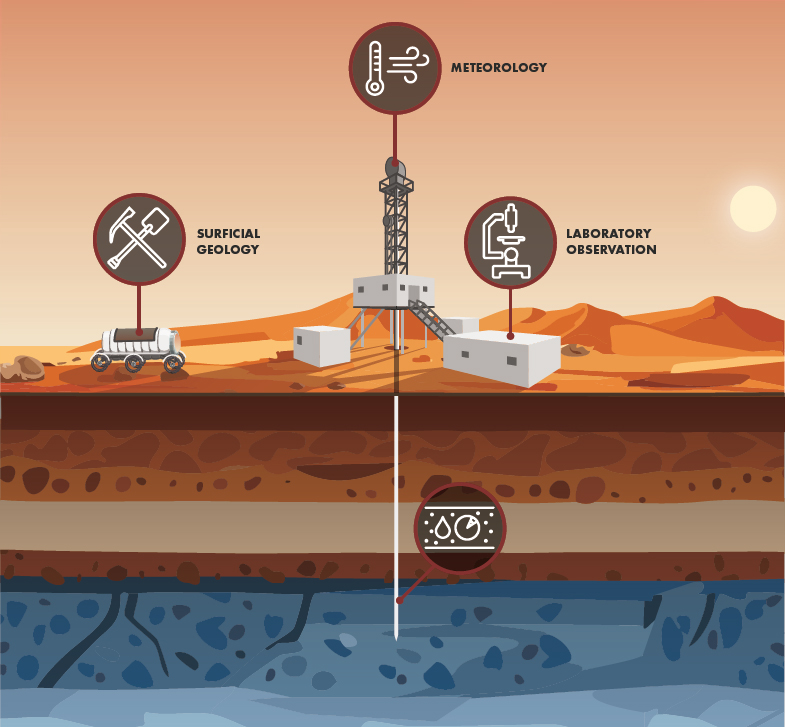
This campaign is designed using the 30-Cargo-300 architecture. This campaign prioritizes specific objectives and measurements during the 30-sol stay to deliver significant scientific breakthroughs while establishing the foundation for more in-depth investigations over the long term and returning samples for most rigorous Earth-based analysis. By taking advantage of the unique capabilities associated with a human-led mission, the campaign combines broad aerial coverage, vertical extent (subsurface and atmospheric), and temporal duration, effectively creating a four-dimensional view of Mars (Figure S-2).
This campaign supports rapid field geology and targeted scientific investigations in the first 30 sols, followed by focused data collection in the 300-sol segment to investigate various specific phenomena in detail. The first key measurements include
- A field geology campaign aided by handheld instruments to study mineralogy, composition, and subsurface structure to search for promising sites for astrobiology sampling and ISRU follow-up, and for selecting a drill site;
- Targeted laboratory-based measurements of volatiles and organic geochemistry of samples, in part to select those to return to Earth to deliver high-profile initial science results and inform next samples and actions for the search for life; and
- Meteorological measurements to give context to the site and determine suitability for a dust lofting study in the 300-sol segment.
The in situ measurements in the 300-sol segment would provide the opportunity to explore more of the EZ, but also crucially to focus on vertical measurements (subsurface access and atmospheric profiling) and measurements over an extended time on the surface. Continuous data acquisition allows for the observation of diurnal cycles, weather events, and seasonal variations. This campaign design takes best advantage of responsive decision making while measurements are made; early discoveries, or null results, will drive a decision-tree process for the next science steps (see Box 1-1, “Discovery-Driven Science”).
Seeking Life Beneath the Martian Icy Crust
The top priority for science on Mars is to determine if, in the exploration zone, evidence can be found for any of the following: habitability, indigenous extant or extinct life, and/or indigenous prebiotic chemistry in the
exploration zone (Science Objective 1). The Seeking Life Beneath the Martian Icy Crust Campaign achieves a suite of additional science objectives but focuses on habitability and life.
Accessing samples below the lower boundary of the martian cryosphere (Carrier et al. 2020) is the top priority for this campaign, along with a complementary focus on habitability, prebiotic chemistry, and ancient life. Below the cryosphere, Mars is expected to be habitable to life as we know it (e.g., Jones et al. 2011; Michalski et al. 2013a; Stamenkovic et al. 2020; Tarnas et al. 2021; Cockell et al. 2024) and may have been habitable over billions of years. The depth at which liquid water may exist is shallowest for near-equatorial low-altitude sites (Figure S-3). This campaign seeks a site with a Noachian-to-Hesperian transition zone. Ideally, such a site would include deposits of water ice above possible liquid water. Habitable zones for ancient life may be more accessible in near-equatorial regions owing to a higher frequency of impact events creating temporary habitable zones linked to permanently habitable deep subsurface environments (Schwenzer et al. 2012).
Providing context to habitability and life detection, this campaign prioritizes characterizing water and carbon dioxide reservoirs and cycles, mapping the geologic record (necessary to contextualize life detection, and invaluable for understanding later exploration), and characterizing the radiation environment. The longitudinal impact of the integrated martian environment upon the crew will be a constant theme including radiation, dust environment, and physiological, cognitive, and emotional health. Secondary science objectives include assessing microbial population dynamics and characterizing the environment for ISRU.
A key strength and central concept of this campaign is interrogating a cross section of martian history, with its record of habitability and the possibility of life detection, through deep drilling to liquid water likely at depths

of 2–5 km. The initial 30-sol mission would establish the geologic context and identify sites for drilling, and then the following 300-sol mission would focus on deep drilling, core collection, and initial analyses, with the bulk of the selected samples returned to Earth for access to multiple laboratories and curation for investigations using future technologies.
Investigating Mars at Three Sites
A 30-30-30 architecture satisfies some science objectives from each of the four disciplinary panels and broadens science return with a wider variety of landing sites and exploration zones. First and foremost, the Investigating Mars at Three Sites Campaign would land at three widely separated sites, which enables exploration of widely varying environments, maximizes the science return from dating of martian rocks by pinning absolute ages from physical samples to estimates based on crater counts at each site, and enhances the return from seismometers and meteorological towers, both of which could be deployed during relatively short stays and yet continue to collect data for extended periods after each landing (Figure S-4). Possible site types are
- Igneous and impact melt geology: A selection of igneous rocks and impact melts enables radiometric dating and helps establish martian cratering chronology, which heretofore has been calibrated by analogy to the lunar record. Other hard-rock geology science objectives would also be emphasized.
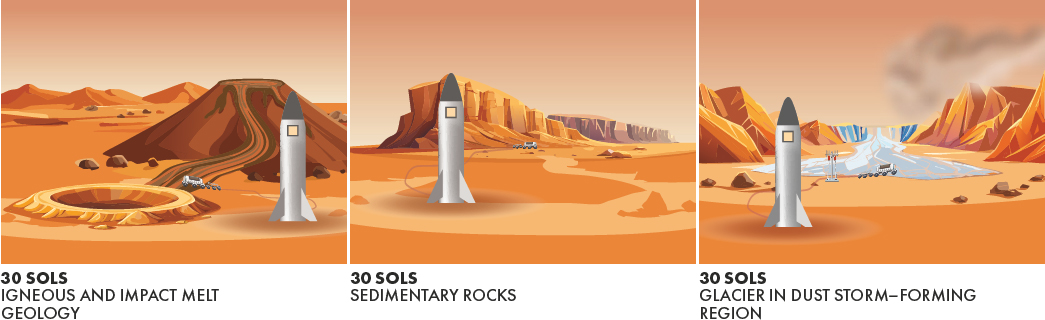
- Sedimentary rocks for evidence of ancient life and/or prebiotic processes: This site would ideally offer a good record of sedimentary rocks, similar to previous rover explorations of Gale and Jezero craters. The main goals will be to look for evidence of extinct life, along with indirect evidence for extant life (e.g., resolving the abundance and source of martian methane).
- Glaciers within a dust storm–forming region: The third landing would be at a low- to mid-latitude site that shows evidence for subsurface ice. The two top goals will be to (1) establish the viability of this site for a future long-term stay that will require ISRU and (2) look for any signs of life within the ice or within associated brines.
Science priorities for all three missions will include as many human factors objectives as possible, although long-term studies of human health, microbial populations, plant growth, and animal behavior and reproduction will be curtailed by the short duration of each 30-sol stay.
In this scenario, the key assets for each mission are different. Mission 1 requires no major equipment apart from crewed and robotic rovers. Mission 2 would require the capability of measuring rock and volatile samples in real time. Mission 3 would require a drill capable of reaching 2 m or more, and all three missions require a meteorological tower and seismometer.
This campaign strategy maximizes the number of different locales that can be investigated and thus addresses science objectives from all four of the disciplinary panels. This strategy establishes the chronological geologic markers by correlating crater counting at the sites with isotope geochronology of the samples from those sites. The kinds of investigations that require 300 sols, such as multigenerational animal studies, cannot be achieved in three 30-sol missions.
RECOMMENDATIONS
The recommendations are presented throughout the chapters that follow where their topic is explained, and they are listed here.
Planetary Protection
Planetary protection, in the context of this report, is the name given to policies intended to preserve the integrity of the search for and study of possible martian life (forward contamination) and to address risks to humans on Earth (backward contamination). Guidelines, stated by the international Committee on Space Research (COSPAR) Policy
and summarized in Section 2.3.4, would likely preclude many of the activities discussed in this report. Planetary protection is essential to consider for achieving Science Objective 1, part of which is the search for evidence of indigenous life. However, these guidelines prohibit the contamination of “Special Regions”—where the likelihood of finding extant martian life is highest—by both robotic systems and human activities (COSPAR 2024).The search for extant or extinct life is the highest priority scientific goal of human Mars exploration in this report, so this presents an inherent conundrum: How can the science goals of the suggested campaigns be satisfied without contradicting guidelines identified by COSPAR? This committee does not have the expertise or the authority to answer this question. Ways to meet the guidelines have been suggested (NASA 2005, 2024h, 2025c; NASEM 2021; Spry et al. 2024), and further guideline maturation, operational assessment, and technology development need to occur to enable human exploration while preserving the scientific integrity of the search for indigenous life. This conundrum will need to be resolved before human exploration of Mars becomes part of our future in space.
Recommendation: Human missions to Mars should be designed to meet scientific and exploration objectives. Many of these objectives are limited by current planetary protection guidelines, notably the search for extinct and extant life with human explorers. NASA should continue to collaborate on the evolution of planetary protection guidelines, with the goal of enabling human explorers to perform research in regions that could possibly support, or even harbor, life.
Surface Laboratory
Analytical capabilities on the martian surface are necessary to make meaningful progress toward the highest priority objectives. These capabilities include both measurements to be performed in the field and measurements on samples to be performed in a habitat, with laboratory instrumentation. Preliminary testing in on-site laboratories may maximize the quality and minimize the mass of samples returned. Furthermore, on-site laboratories create the ability to analyze ephemeral phases that may not survive transit to Earth and to minimize backward contamination (see Section 2.3.6).
Recommendation: NASA should include as part of its crewed surface infrastructure a Mars surface laboratory consisting of a variety of geologic, astrobiologic, and biomolecular analytical tools and analysis capabilities.
Sample Return
Returning samples from Mars to Earth laboratories is critical even for crewed missions. The analytical capacity of Earth laboratories is vastly greater than anything possible on Mars in the coming century. The enormous infrastructure supporting such facilities represents a required complexity on Earth that is currently unfathomable to miniaturize for in situ analyses. In addition to the complexity of the first measurements, divergent scientific interpretations will require additional measurements and interpretation by multiple research groups. Samples that might contain evidence of extinct or extant life are a unique case that could answer one of the greatest questions in human existence (“Are we alone?”) and so they will be the most contested. Verification of the results will similarly require multiple analyses by different groups. Indeed, returned samples will enable future analyses by instruments and techniques not yet in existence, as has recently so fruitfully occurred with curated Apollo samples (see Section 2.3.7). Although it is difficult to place specific mass requirements on the amount of samples to be returned, each human mission to Mars will likely have the ability to return tens of kilograms of samples from Mars. Tens of kilograms would likely satisfy the stated need for multiple independent analyses by different research groups, the need to have samples to share for education and public outreach (e.g., academia and museums), and the need to archive duplicate sealed samples for posterity (MEPAG E2E-iSAG 2011; Beaty et al. 2019).
Recommendation: Samples from every human mission to Mars should be returned to Earth. NASA should engage the science community to determine the number, type, mass, and environmental conditioning required for samples before the first human missions commence. Sample return guided by human interpretation of in situ measurements should be a priority for all human missions.
Human–Agent Teaming
An operational goal of any research endeavor is to maximize both the quality and quantity of science that can be successfully completed. Both metrics are vitally dependent on human factors in a human-tended mission, whereas in a robotic mission they are not. Human–agent teaming, the collaborative effort between one or more humans and artificial agents to achieve common goals, blends these two considerations. “Agent” is a broad descriptor encompassing software to robotics to humanoid robotics. Because agents have a human interface, and some ability to act and make decisions within the context of the team’s goals, they need to be considered elements of a team (O’Neill et al. 2022). Human–agent teaming is different from “autonomy,” where software and hardware operate independently of crew expertise or decision making. The process of teaming is determined by the characteristics of autonomous agent(s), team composition, task characteristics, human individual differences, training, and communication (O’Neill et al. 2022). The abilities of each team member, whether they are robotic or human, vary in how they gather information from the environment, evaluate feedback, learn new patterns, and develop meaningful verbal and nonverbal responses (Meimandi et al. 2023) (see Section 4.2.3).
By integrating best practices from aerospace engineering and machine learning, mission-critical measurements and design robustness can be ensured for future human exploration missions. In the context of human–agent teaming, a Machine Learning Technology Readiness Levels framework offers a principled approach to developing robust, reliable, and responsible systems (Lavin et al. 2022) to enable cross-functional teams to collaborate effectively on science objectives (see Appendix F, “Implications of Artificial Intelligence for Human Mars Exploration”).
Recommendation: NASA should initiate a recurring Mars Human–Agent Teaming Summit that captures emerging trends in the field. The goal of this summit should be to maximize the amount of time on Mars available for astronauts to perform scientific research, and to maximize the quality of that science. In planning these summits, NASA should cover, at a minimum, the following topics:
- Updating detailed task analyses necessary to complete science objectives on Mars;
- Identification of tasks best suited to human and automated agents;
- Updates on the development of reliable, trusted, and environmentally robust artificial intelligence, including machine learning capabilities, as components of human–agent teams on Mars;
- Communication between human and artificial agents; and
- Decision making.
HUMANITY’S NEXT GREAT EXPLORATION
By both objective and subjective measures, the Moon landing was a seminal moment in human history. Neil Armstrong’s words as he set foot on the lunar surface are one of the best-known quotes of the past century. The first human landing on Mars will begin the most significant chapter in human spaceflight since the Moon landing and will be an era of inspiration for generations to come. The United States will play a central role in bringing this era to fruition, and the challenge will be worthy of our greatest efforts.


