A Science Strategy for the Human Exploration of Mars (2026)
Chapter: 1 Introduction
1
Introduction
Humankind’s space exploration journey, marked by “one small step,” sparked the imagination of people of all ages around the globe. If we could do this, we can do anything. Imagine the excitement of the next unprecedented step, footprints on an extreme martian landscape, when decades of exploration, science, and innovation converge to reshape understanding of the cosmos, perhaps life itself, and humanity’s place within it (Figure 1-1).
1.1 SCOPE OF THE CONSENSUS STUDY
As directed by the statement of task (Appendix A), this report captures the high-priority science objectives in key relevant disciplines, including astrobiology, geosciences, atmospheric sciences, biological sciences, human factors, physical sciences, and space physics, to be addressed by human explorers across multiple science campaigns on the surface of Mars. These disciplines were represented in four panels: Astrobiology, Atmospheric Science and Space Physics, Biological and Physical Sciences and Human Factors, and Geosciences.
Paramount to any human space mission is the health and safety of its crew. The success of the Mars exploration plan will depend uniquely on the insights from these highly dedicated, trained individuals. This report is founded on the explicit and implicit assumption that a robust crew health and performance plan will be in place for early Mars missions, with enhanced medical capabilities that ameliorate the risks associated with distances from Earth that are orders of magnitude greater than current human spaceflight experience. The steering committee assumed that general principles for human-tended space science missions remain valid—that crew health and safety would take precedence over research. Consequently, the committee determined that crew health and medical operations were beyond its remit, while recognizing that the development and validation of new methods to monitor and maintain human physical and behavioral performance is necessary translational research that can and needs to be part of Mars science campaigns.
Highest priority science objectives were assessed among each of the disciplines to be addressed by humans on the surface of Mars. As defined by the statement of task, although science objectives for samples returned from Mars were evaluated, science objectives for the in-space phases of the crewed missions were explicitly excluded. The committee and supporting panels mapped each science objective to their respective reports, including relevant decadal studies and discipline roadmaps, as well as to the objectives identified in NASA’s Moon to Mars strategy (NASA 2024f), noting any relevant missing objectives. Criteria that impacted priority order are noted, including number of astronaut crew members and the duration of the surface missions. A separate discussion of the criteria used to assign prioritization for campaigns is included.
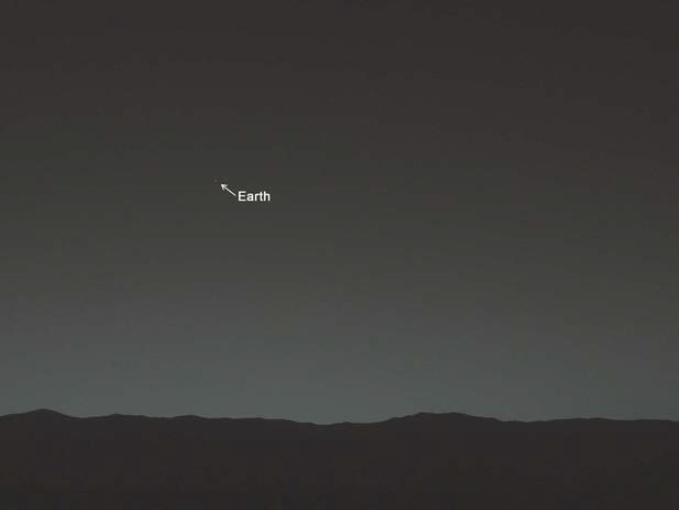
SOURCE: NASA/JPL-Caltech/Malin Space Science Systems/Texas A&M University, https://science.nasa.gov/resource/earth-from-mars.
The report includes types of samples and measurements needed to address science objectives, such as key measurements requiring preplaced assets before human arrival, key in situ measurements, and measurements on the martian surface before Earth return to achieve the identified science objectives. When measurements on the martian surface are required, justification is provided for measurements to be performed on Mars rather than in terrestrial laboratories. In addition, key measurements that must be made in terrestrial laboratories on returned martian samples are specified, with estimates of mass of samples returned, as well as justification and rationale for analyses required during the return trip from Mars to Earth.
Four science campaigns are identified and prioritized that will achieve a subset of the identified highest priority science objectives. Each campaign encompasses the first three landings of human-scale landers on Mars. Each science campaign is accompanied by a science roadmap that includes the highest priority science objectives addressed, as well as the secondary science objectives that are achievable, the measurements needed to address the objectives, and key assets and major equipment emplaced at each phase of the campaign.
The crew’s role in each mission phase is described. In addition, where applicable, the report provides variations, guidance, risk assessments, and decision rules that enable the achievement of the highest priority science objectives. In particular, the measurements needed for a given science objective may need to be reassessed during the mission itself (see Box 1-1, “Discovery-Driven Science”).
Commonalities and synergies with exploration goals, equipment, and capabilities for each campaign are provided, including a review of upcoming missions supporting Moon exploration, with planned missions to the Lunar Gateway (or Gateway), a planned orbiting station around the Moon or the International Space Station, and specific alignment with NASA’s Moon to Mars Strategy and Objectives Development report (NASA 2023c). While the committee was tasked with reviewing this context, this report endeavors throughout to address the best science possible for early human missions to Mars, regardless of timing, precursors, or changing architectures.
This report does not address landing site selection or details of mission architectures. The report does not address all missions required to completely address investigation of specific scientific sub-objectives; rather, it focuses on the science accomplished with the first three human-scale landings for the identified campaigns. In addition, the report does not address prioritization of precursor missions (see Section 2.3, “Assumptions and
BOX 1-1
Discovery-Driven Science
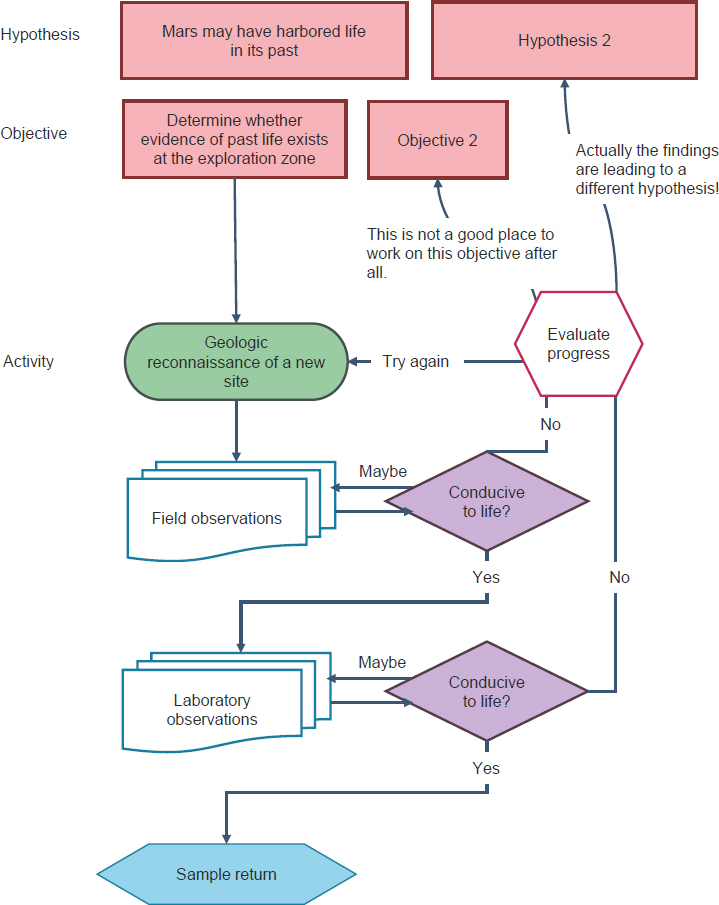
SOURCE: Based on data from J.B. Garvin, 2013, “Discovery-Driven Science,” ASK Magazine, NASA.
The first human missions to Mars will be technology enabled and science driven. While this report poses the most important science objectives, the specific sites selected for exploration and the technology used will alter how the objectives are advanced. Therefore, the concept of “discovery-driven” science can be used to frame the science activities (Garvin 2013).
Discovery-driven science describes investigations of high discovery potential for which there are multiple possible outcomes from each measurement, including some outcomes that cannot be known or considered prior to the mission. Rather than focus science objectives on quantifiable, incremental improvements in the state of knowledge associated with a small number of specific questions or issues, this committee has chosen to embrace more ambitious measurements of the unknown or, as it is sometimes called, “the previously unmeasurable.”
A decision tree can be built a priori to guide science as it happens on Mars: the tree selects the next measurements to be made based on the results of previous measurements. An example of a discovery-driven science approach is provided in Figure 1-1-1. Using the example of Science Objective 1 (see Table 2-1), Figure 1-1-1 shows how observations must be evaluated at every step and how the results direct the next phase of activity. The next activities could entail additional measurements, abandonment of a line of inquiry, or redirection to new hypotheses.
The Apollo missions to the Moon dramatically demonstrated how human activities can enable and accelerate discovery-driven science, thanks to the intrinsic adaptability of the human explorer. Highly trained astronauts quickly survey the geology of a site, adapt to new information, formulate new hypotheses, and identify the best samples to collect for further analysis with in situ instruments or return to Earth. This near-real-time feedback process enables astronauts to cover more ground as compared to robotic explorers and conduct hypothesis-driven adapted exploration. The first Mars campaigns will greatly benefit from taking advantage of this intrinsic capability of human exploration.
Caveats for Campaign Planning”). For NASA’s mission architecture planning, see the Moon to Mars Architecture Definition Document (NASA 2025b) and Moon to Mars Strategy and Objectives Development (NASA 2023c); the latter includes the benefits of sending humans to space in three categories: science, national posture, and inspiration.
1.2 HISTORY OF HUMAN-PERFORMED SCIENCE ON PLANETARY BODIES
The history of space exploration is a testament to the profound synergy between human spaceflight and scientific advancement. Beginning with Yuri Gagarin’s historic spaceflight in 1961, which marked the first human venture beyond Earth’s atmosphere and humankind’s first investigation of the effects of spaceflight on humans, humanity has continually leveraged its presence in space to drive scientific discovery.
The Apollo Moon missions were particularly significant, providing geological samples that revolutionized the understanding of the Moon’s formation and its connection to Earth. These missions provided the first comprehensive biomedical science investigations on astronauts (NASA 1975) and revealed major challenges of planetary exploration, especially associated with extravehicular activity and lunar dust (Gaier 2005) (Figure 1-2). Human Mars missions will face these challenges and more, substantially amplified. Five major hazard areas are radiation, isolation, distance, gravity, and environment (Afshinnekoo et al. 2020). The Apollo missions also highlighted the unique capabilities humans bring to space exploration, such as adaptability, real-time decision making, and the ability to conduct nuanced scientific experiments—capabilities that robotic missions, while invaluable, have not yet fully replicated.
As human spaceflight progressed, it established a new paradigm for scientific investigation. The ability to conduct on-site experiments and make immediate observations created a dynamic interplay between astronauts and their scientific objectives, as evidenced by the thousands of experiments conducted on the Space Shuttle and NASA’s missions to various space stations, as well as the extensive space exploration conducted by other global space programs.
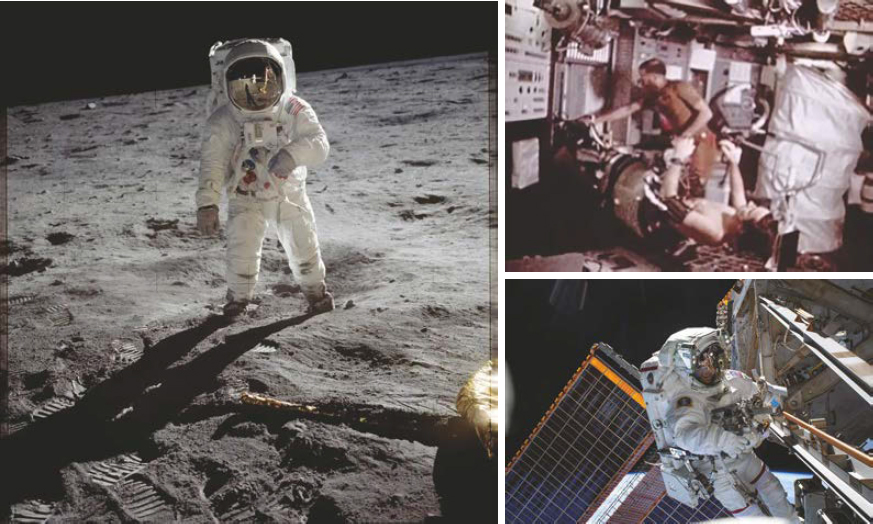
SOURCE: NASA (Left) https://www.nasa.gov/image-article/buzz-aldrin-moon; (Top right) https://www.nasa.gov/history/50-years-ago-skylab-4-astronauts-push-past-the-one-month-mark; (Bottom right) https://images.nasa.gov/details/iss068e045241.
This human-driven science approach laid the groundwork for more ambitious missions, particularly the exploration of Mars. The success of early missions demonstrated that humans could significantly enhance their scientific reach, not only by testing new technologies but also by unlocking the potential of planetary bodies through direct interaction and analysis.
Sending large masses to low Earth orbit (LEO) is a necessary precursor to deliver, support, sustain, and return astronauts to and from Mars; super heavy payload lift capability is being developed through programs such as NASA’s Space Launch System, SpaceX’s Starship, and Blue Origin’s New Glenn. The physics of rocket thrust produced by combustion sets limits on the efficiency of space launch. The advent of reusable flyback boosters denoted by the first successful landing of a Falcon 9 rocket’s first stage on December 21, 2015, marks an inflection point and continued acceleration of launch rates and mass to orbit for constellations such as Starlink satellites (McDowell 2020). Development of super heavy-lift launch vehicles paired with planned demonstrations of large-scale inflight refueling on platforms like Blue Origin’s Blue Moon Mark 2 lander and SpaceX Starship, shows strong progress toward the capabilities needed for sending humans to Mars (Figure 1-3).
In parallel to human endeavors, robotic missions have played a crucial role in expanding knowledge of the solar system. Humans work virtually on Mars every day and have done so for more than two decades. This is the heritage of the series of missions that began with the arrival of Pathfinder and its Sojourner rover on July 4, 1997, a return to the planet’s surface after a long hiatus since the Viking landers in the 1970s. This was followed, after a 6-year gap of surface operations, by the Mars Exploration Rovers, Spirit and Opportunity. With Spirit’s landing on January 3, 2004, and Opportunity’s landing later that month, the ongoing epoch of continuous remote exploration of Mars began, enabled by the subsequent arrival of Mars Science Laboratory’s Curiosity rover in 2012 and the Mars 2020 Perseverance rover and Ingenuity helicopter. Both Curiosity and Perseverance continue to operate and enable new insights and impactful discoveries about both ancient and modern Mars.
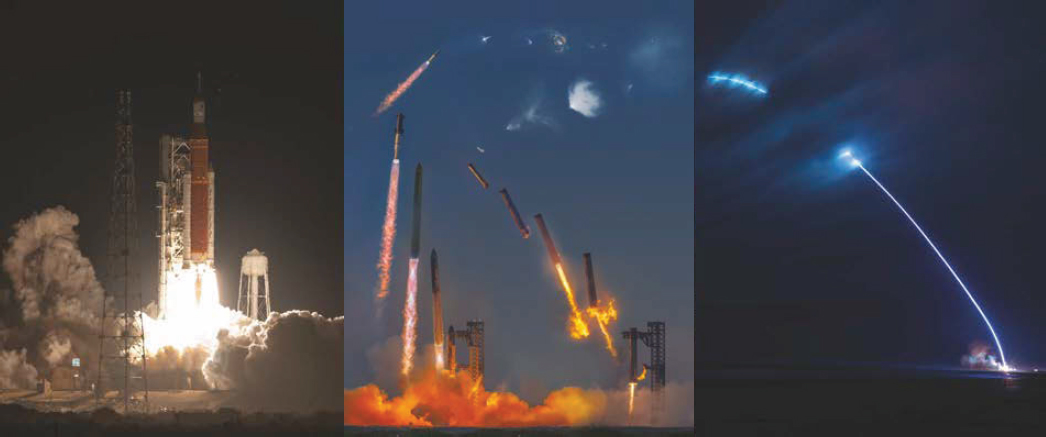
SOURCES: (Left) NASA/Bill Ingalls, https://images.nasa.gov/details/NHQ202211160203; (Center) Andrew McCarthy, https://x.com/AJamesMcCarthy/status/1846979563508978172; (Right) U.S. Space Force/U.S. Air Force Senior Airman Samuel Becker, https://www.spaceforce.mil/Multimedia/Photos/igphoto/2003629237/mediaid/8851939.
Mars orbiters have provided strong science return as well as essential context for surface operations. In the post-Viking era, these include the Soviet Phobos 2 (1988), Mars Global Surveyor (1996–2006), Mars Odyssey (2001–), the European Space Agency’s (ESA’s) Mars Express (2003–), Mars Reconnaissance Orbiter (MRO) (2005–), Mars Atmospheric and Volatile EvolutioN (MAVEN) (2013–), the Indian Space Research Organisation’s (ISRO’s) Mars Orbiter Mission (2013–2022), ESA/Roscosmos’s ExoMars Trace Gas Orbiter (2016–), UAE’s Emirates Mars Mission Hope Probe (2020–), and the China National Space Administration’s (CNSA’s) Tianwen-1 Orbiter and Zhurong rover (2020–). NASA’s orbital infrastructure at Mars is operating beyond originally proposed nominal mission periods, with some nearing end-of-life constraints such as available fuel (e.g., Mars Odyssey).
These missions have provided a wealth of data on Mars’s environmental conditions, surface processes, and potential biosignatures, forming a foundational knowledge base essential for planning future human missions. Robots have also served as pathfinders, identifying terrain, climate processes, and hazards that inform the logistics and safety measures necessary for human explorers.
The orbital mechanics of Earth and Mars around the Sun make it far more energetically favorable to go to or return from Mars around the time of certain orbital geometries that repeat approximately every 26 months. This consideration results in two broad families of human Mars mission opportunities (Figure 1-4): “opposition class” missions characterized by short stays on Mars in the approximately 10–90-sol range and round-trip mission times of order 500–800 days, and “conjunction class” missions characterized by extended surface stays of about 300–500 sols, and round-trip times of order 900–1,000 days. Actual durations will vary depending on the specific years of travel (i.e., on the relative orbital geometries of Earth and Mars around the Sun at the time of the mission), the types of propulsion systems used, the amount of propellants allowed, whether there is an opportunity for Venus gravity assist, for example (NASA Mars Architecture Steering Group 2009; Drake et al. 2012; NASA 2025b).
In either case, these mission durations vastly exceed the record for a single human spaceflight (currently 437 days in LEO). Exposure to deep space and the martian environment for more extended periods will present unique challenges to human health and adaptation.
In recent years, strategic planning for Mars exploration has increasingly drawn from the experiences of NASA’s Artemis program, which aims to reestablish a sustained human presence on the Moon in the mid-2030s timeframe. The Artemis missions are designed to address challenges such as dust management, low-gravity operations,
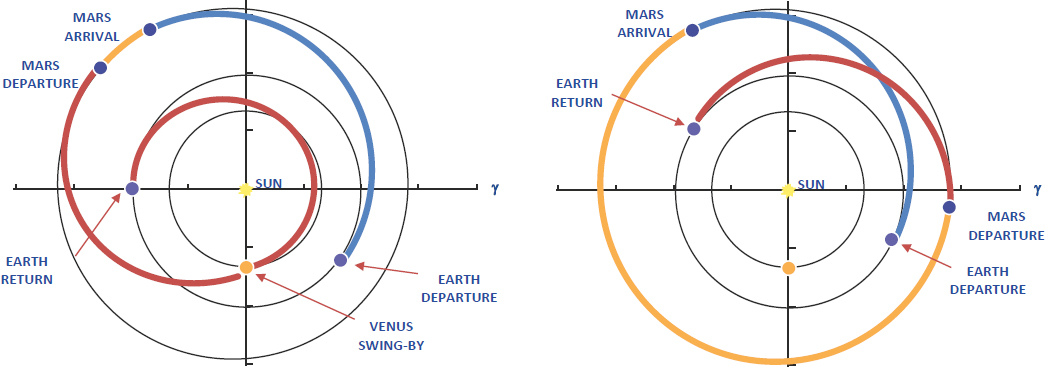
SOURCE: B.G. Drake, J.D. Baker, S.J. Hoffman, D. Landau, and S.A. Voels, 2012, “Alternative Strategies for Exploring Mars and the Moons of Mars,” NASA presentation at the Global Space Exploration Conference, Washington, DC, https://ntrs.nasa.gov/citations/20120009026.
and resource limitations and to be a testing ground for critical systems such as life support, radiation protection, and in situ resource utilization, all of which are vital for the longer and more demanding missions to Mars.
The interplay between human and robotic exploration is set to transform martian science. Robots will continue to handle extensive data collection and perform hazardous or repetitive tasks, effectively extending the operational capacity of human crews. Meanwhile, astronauts will provide the expertise needed to interpret data, conduct sophisticated experiments, and make strategic decisions based on real-time observations. This collaborative approach, often referred to as “human–agent teaming,” maximizes scientific productivity by combining the endurance and precision of robots with the adaptability and problem-solving abilities of humans.
The committee’s science strategy for Mars emphasizes an interdisciplinary approach, integrating insights from lunar missions and advanced robotic technologies. The objectives include understanding Mars’s habitability, unraveling its geological and climatic history, developing methods for in situ resource utilization, advancing life-support and habitat technologies, and understanding how life adapts and evolves in a gravitational acceleration field quite different from Earth. This strategy outlines a clear roadmap for successful Mars exploration. It underscores the essential role of human ingenuity, supported by robotic endurance, in unlocking the scientific mysteries of the red planet.
As stated in Humans in Space to Accomplish Science Objectives, NASA and community reports have “consistently called for well-designed partnerships between astronauts and robotic explorers” (NASA 2024b). Astronauts’ flexibility, dexterity, and creativity underpin their success as researchers, operators, and troubleshooters in ever-changing environments, providing responsive insight, judgment, and personal reactions to enhance both science and exploration (see Box 1-1, “Discovery-Driven Science”). As robotic capabilities and artificial intelligence continue to mature in the years ahead, it is anticipated that science will take full advantage of these tools.
1.3 MAP OF THE REPORT
The report is structured as follows:
- Chapter 4: Science input from expert disciplinary panels.
- Chapter 5: Integration of science with NASA’s Moon to Mars Architecture.
- Chapter 6: Synopsis of the report.
Supporting material:
- Appendix A: Statement of task.
- Appendixes B–E: Detailed panel analyses.
- Appendix F: Implications of advances in machine learning.
- Appendix G: If life is found.
- Appendix H: List of acronyms and abbreviations used in the report.
- Appendix I: Committee and staff biographical information.
- Appendix J: Detailed “science traceability matrices” for the panel-identified priority areas. The content for Appendix J is only available online.


