A Science Strategy for the Human Exploration of Mars (2026)
Chapter: 4 Disciplinary Science Priorities
4
Disciplinary Science Priorities
Results from the Panels on Astrobiology, Atmospheric Science and Space Physics, Biological and Physical Sciences and Human Factors, and Geosciences are distilled to show how these priorities shaped the campaign selections.
Although this chapter is organized by disciplinary areas, campaigns, of course, are inter- and multidisciplinary. The disciplinary perspectives herein provide deep insights that have been incorporated into the cross-disciplinary science for campaigns described in Chapter 2, where the steering committee has explicitly integrated the best science across disciplinary boundaries and identified cross-cutting opportunities that are served by such collaborations.
4.1 RANKED SCIENCE OBJECTIVES
All of the top science objectives are directly traceable to both NASA’s Moon to Mars (M2M) Objectives and to the individual discipline’s decadal surveys and community roadmaps (Table 4-1).
The objective to search for life is particularly strongly supported in the 2023–2032 decadal survey for planetary science and astrobiology, Origins, Worlds, and Life (NASEM 2023a), and NASA’s Mars Exploration Program goals, along with the additional objectives highlighted in this report of understanding the processes that control martian weather and its changing climate over the past 4 billion years, deciphering the evolution of Mars’s surface and interior and the processes that control them, and gathering the essential scientific knowledge necessary to permit humans to land on and explore Mars.
Origins, Worlds, and Life recommends a series of missions tied to the search for life, including a Mars Life Explorer mission to search for life on Mars and a Mars Sample Return mission to bring samples back for analysis on Earth. The Mars Life Explorer would drill into ice deposits to search for biosignatures. The report also recommends the international Mars Ice Mapper mission by arguing that the prime exploitable martian resource is ice, which would be of great use to future explorers as in situ resource utilization (ISRU).
Moreover, Origins, Worlds, and Life recommends that the most important resources are the astronaut explorers who propel exploration missions and research into planetary science, astrobiology, and planetary defense, and that providing opportunities for them to thrive is also a priority.
The high ranking of search for life and identification of habitability in this report is supported by the NASA Astrobiology Strategy (NASA 2015). This strategy recommends to better constrain the environmental conditions that can produce life, to understand linkages among geology, climate, and life, to sustain the human imperative to explore the unknown, and to address key questions, for example, “Are any other bodies in our solar system habitable?”
TABLE 4-1 Science Objectives in Common Among This Report, Moon to Mars Objectives, Relevant Decadal Surveys, and the Human Research Roadmap
| This Report’s Prioritized Objectives | Moon to Mars Objectives | Origins, Worlds, and Life | Thriving in Space | The Next Decade of Discovery in Solar and Space Physics | Human Research Roadmap |
|---|---|---|---|---|---|
|
LPS-4: Advance understanding of the origin of life in the solar system by identifying where and when potentially habitable environments exist(ed), what processes led to their formation, how planetary environments and habitable conditions have coevolved over time, and whether there is evidence of past or present life in the solar system beyond Earth. | Key Questions: Q9. What led to the emergence of life on Earth, and what does this tell us about the likelihood of life elsewhere? Q10. What other potentially habitable environments exist in the solar system, how did they form, and how do planetary and habitable environments coevolve? Q11. Is there evidence of past or present life in the solar system beyond Earth, and how do we detect it? |
None | Guiding questions: What can we learn from comparative studies of planetary systems? What internal and external characteristics have played a role in creating a space environment conducive to life? |
None |
|
LPS-3: Reveal inner solar system volatile origin and delivery processes by determining the age, origin, distribution, abundance, composition, transport, and sequestration of lunar and martian volatiles. | Q6. What establishes the properties and dynamics of solid body atmospheres and governs atmosphere–surface–interior exchange and loss to space, and why did planetary climates evolve to their current varied states? | None | None | None |
| This Report’s Prioritized Objectives | Moon to Mars Objectives | Origins, Worlds, and Life | Thriving in Space | The Next Decade of Discovery in Solar and Space Physics | Human Research Roadmap |
|---|---|---|---|---|---|
|
LPS-1: Uncover the record of solar system origin and early history, by determining how and when planetary bodies formed and differentiated, characterizing the impact chronology of the inner solar system as recorded on the Moon and Mars, and characterize how impact rates in the inner solar system have changed over time as recorded on the Moon and Mars. LPS-4: Advance understanding of the origin of life in the solar system by identifying where and when potentially habitable environments exist(ed), what processes led to their formation, how planetary environments and habitable conditions have coevolved over time, and whether there is evidence of past or present life in the solar system beyond Earth. |
Key Questions: Q10. What other potentially habitable environments exist in the solar system, how did they form, and how do planetary and habitable environments coevolve? Q11. Is there evidence of past or present life in the solar system beyond Earth, and how do we detect it? |
None | Guiding questions: What can we learn from comparative studies of planetary systems? What internal and external characteristics have played a role in creating a space environment conducive to life? |
None |
|
HBS-2: Evaluate and validate progressively Earth-independent crew health and performance systems and operations with mission durations representative of Mars-class missions. HBS-3: Characterize and evaluate how the interaction of exploration systems and the deep space environment affect human health, performance, and space human factors to inform future exploration-class missions. |
None | Key questions on Adapting to Space: How does the space environment influence biological mechanisms required for organisms to survive the transitions to and from space, and thrive while off Earth? How do genetic diversity and life history influence physiological adaptation to the space environment? How does the space environment alter interactions between organisms? |
None | Human Research Roadmap Gaps: BMed-101, BMed-102, BMed-108, EIHSO-801, Sleep-101, Sleep-102, Team-101, Team-102, Team-103, Team-106, B8, Bone-401, Cancer-602, CV-203, CV-301, DCS7, DL-401, Dust-101, EVA-102, ExMC 4.24, FN-302, Fracture 2, IM-501, Medical-101-301, Micro-301, SANS-403, SANS-501, SM-301 |
|
LPS-2: Advance understanding of the geologic processes that affect planetary bodies by determining the interior structures, characterizing the magmatic histories, characterizing ancient, modern, and evolution of atmospheres/exospheres, and investigating how active processes modify the surfaces of the Moon and Mars. AS-1: Characterize and monitor the contemporary environments of the lunar and martian surfaces and orbits, including investigations of micrometeorite flux, atmospheric weather, space weather, space weathering, and dust, to plan, support, and monitor safety of crewed operations in these locations. |
Q6. What establishes the properties and dynamics of solid body atmospheres and governs atmosphere–surface–interior exchange and loss to space, and why did planetary climates evolve to their current varied states? | None | None | None |
|
AS-3: Characterize accessible lunar and martian resources, gather scientific research data, and analyze potential reserves to satisfy science and technology objectives and enable in situ resource utilization (ISRU) on successive missions. | None | Key questions on Which Answers Will Enable Space Exploration: What principles enable identification, extraction, processing, and use of materials found in extraterrestrial environments to enable long-term, sustained human and robotic space exploration? | None | None |
| This Report’s Prioritized Objectives | Moon to Mars Objectives | Origins, Worlds, and Life | Thriving in Space | The Next Decade of Discovery in Solar and Space Physics | Human Research Roadmap |
|---|---|---|---|---|---|
|
HBS-1: Understand the effects of short- and long-duration exposure to the environments of the Moon, Mars, and deep space on biological systems and health, using humans, model organisms, systems of human physiology, and plants. | Key questions on Adapting to Space: How does the space environment influence biological mechanisms required for organisms to survive the transitions to and from space, and thrive while off Earth? How do genetic diversity and life history influence physiological adaptation to the space environment? How does the space environment alter interactions between organisms? Decadal survey recommendations 3-1 (Themes 1 and 2), 3-3, 4-2, 4-3. |
|||
|
HBS-1: Understand the effects of short- and long-duration exposure to the environments of the Moon, Mars, and deep space on biological systems and health, using humans, model organisms, systems of human physiology, and plants. HBS-2: Evaluate and validate progressively Earth-independent crew health and performance systems and operations with mission durations representative of Mars-class missions. HBS-3: Characterize and evaluate how the interaction of exploration systems and the deep space environment affect human health, performance, and space human factors to inform future exploration-class missions. |
None | Key questions on Adapting to Space: How does the space environment influence biological mechanisms required for organisms to survive the transitions to and from space, and thrive while off Earth? How do genetic diversity and life history influence physiological adaptation to the space environment? How does the space environment alter interactions between organisms? Recommendations 3-1 (Themes 1 and 2), 3-3, 4-2, 4-3, 6-1 (BLiSS). |
None | Gaps: Micro-101, Micro-102, Micro-103, FN-302 |
|
AS-1: Characterize and monitor the contemporary environments of the lunar and martian surfaces and orbits, including investigations of micrometeorite flux, atmospheric weather, space weather, space weathering, and dust, to plan, support, and monitor safety of crewed operations in these locations. | None | None | None | Dust-101, Dust-12 AEH 1-5 |
|
HBS-1: Understand the effects of short- and long-duration exposure to the environments of the Moon, Mars, and deep space on biological systems and health, using humans, model organisms, systems of human physiology, and plants. | None | Key questions on Adapting to Space: How does the space environment influence biological mechanisms required for organisms to survive the transitions to and from space and thrive while off Earth? How do genetic diversity and life history influence physiological adaptation to the space environment? How does the space environment alter interactions between organisms? Decadal BLiSS, pp. 58–60 Research Campaign: Bioregenerative Life Support Systems, 172–181. |
Guiding questions (Q): What can we learn from comparative studies of planetary systems? What internal and external characteristics have played a role in creating a space environment conducive to life? |
None |
| This Report’s Prioritized Objectives | Moon to Mars Objectives | Origins, Worlds, and Life | Thriving in Space | The Next Decade of Discovery in Solar and Space Physics | Human Research Roadmap |
|---|---|---|---|---|---|
|
HS-1: Improve understanding of space weather phenomena to enable enhanced observation and prediction of the dynamic environment from space to the surface at the Moon and Mars. | None | None | Guiding questions (Q): What can we learn from comparative studies of planetary systems? What internal and external characteristics have played a role in creating a space environment conducive to life? |
Acute-5 and -6 Cancer 11, Cancer-602, CV 101-301 |
NOTES: LPS, lunar and planetary science; HBS, AL, and HS, respectively, refer to the lunar and planetary science, human and biological science, applied science, and heliophysics science identification numbers in the “Lunar Goals, Objectives, and Characteristics and Needs” and “Mars Goals, Objectives, and Characteristics and Needs” in NASA’s Moon to Mars Architecture documentation; Q refers to the priority science questions in Origins, Worlds, and Life, BLiSS refers to Bioregenerative Life Support Systems, and MEPAG refers to the Mars Exploration Program Analysis Group. The following are document naming conventions used by the “Human Research Roadmap” (HRR) and are not acronyms: BMed, EIHSO, Sleep, Team, B, Bone, Cancer, CV, DCS, DL, Dust, EVA, ExMC, FN, Fracture, IM, Medical, Micro, SANS, SM, AEH, Acute.
SOURCES: NASA, 2023c, NASA’s Moon to Mars Strategy and Objectives Development; NASEM, 2023a, Origins, Worlds, and Life, National Academies Press; NASEM, 2023b, Thriving in Space: Ensuring the Future of Biological and Physical Sciences Research: A Decadal Survey for 2023–2032; National Academies Press; Human Research Program, 2025, “Human Research Roadmap,” NASA; National Academies Press; NASEM, 2025, The Next Decade of Discovery in Solar and Space Physics: Exploring and Safeguarding Humanity’s Home in Space.
Further support of the objective to search for life comes from NASA’s M2M Objectives, which recommend answering questions about the origin of life; the geology and chemistry of planetary bodies; understanding how the deep-space, lunar, and martian environments affect living things; developing resource utilization capabilities to support human Mars exploration; and developing technologies and capabilities to live and work on planetary surfaces.
The 2023–2032 decadal survey for biological and physical sciences research in space, Thriving in Space (NASEM 2023b), recommends addressing a set of key scientific questions that enable safe space exploration and are enabled by access to space. These key scientific questions are grouped into three themes: (1) Adapting to Space, which concerns how the fundamental physics of space environments impacts the ability of living systems to survive transition to and extended stays in space; (2) Living and Traveling in Space, which explores living systems and supportive environments over long durations in space, while deriving resources in space under the logistical and physical constraints of space; and (3) Probing Phenomena Hidden by Gravity or Terrestrial Limitations, which seeks scientific insights that can be found only in space.
4.2 SUMMARIES OF SCIENCE INPUT FROM THE PANELS
Each disciplinary panel identified key scientific objectives, listed below (see Appendixes B–E for panel statements and Appendix J for the panels’ science traceability matrices [STMs]). In addition, several areas overlap among panel priorities. Each panel’s priorities are discussed in the following sections.
- Panel on Astrobiology
- Determine if evidence can be found for extant or extinct life.
- Determine if niche habitats exist on Mars where life could have survived.
- Determine the potential for processes leading to prebiotic chemistry or the origin of life.
- Panel on Atmospheric Science and Space Physics
- Determine what controls the present-day water and CO2 cycles and the surface/subsurface volatiles.
- Determine how the climate, water, and CO2 cycles differed in the ancient past, as indicated by geologic evidence.
- Determine how the climate, water, CO2, and dust cycles varied in the recent past (up to tens of millions of years ago), as captured by the layered terrain (e.g., recent past).
- Determine how the atmosphere is being lost today and how it was lost in the past.
- Determine the present-day atmospheric isotopic and elemental composition and its sources and sinks.
- Panel on Biological and Physical Sciences and Human Factors
- Determine whether microbial population dynamics and species distribution in biological systems and habitable volumes are stable and promoting health and performance throughout the mission.
- Determine the impact of the integrated longitudinal martian environment (ILME) on physiological, cognitive, emotional, and physical aspects of crew members’ global allostatic load1 and crew cohesion and confirm effectiveness of countermeasures in maintaining allostasis.
- Determine the impact of an integrated Mars environment on plant physiology and development by measuring quantitative traits, biochemical markers, transcriptome, epigenome, and proteome, at selected time points and more than two generations where possible.
- Ensure the crew has sufficient resources, capabilities, knowledge, skills, and abilities to perform all required science and engineering tasks to criterion throughout mission duration.
- Panel on Geosciences
- Characterize past and present water and ice reservoirs within the exploration zone to understand geologic and climate evolution over Mars’s history.
- Characterize the rock record within the exploration zone to understand environmental changes over Mars’s history.
___________________
1 The term “allostatic load” is used to refer to all the stresses, both physiological and psychological, that could impair a crew member or reference biology (microbes, plants, or animals) on Mars (Sterling and Eyer 1988; McEwen 1998; Guidi et al. 2021).
-
- Constrain absolute ages of martian events and tie them to the impact record to calibrate crater counts.
- Characterize igneous systems within the exploration zone to determine planet formation, differentiation, and volcanic history.
- Overlapping objectives among disciplines
- Water and ice reservoirs.
- Characterization of habitability and niche habitats.
- Atmospheric dynamics and dust storm processes.
- Integrated human health and martian environment.
- Prebiotic chemistry and organic molecule detection.
- Radiation environment.
4.2.1 Astrobiology
Astrobiology, which is the study of life and its interaction with the planetary environment over evolutionary timescales, encompasses life detection and characterization, paleontology, habitability, and more. It overlaps strongly with geosciences and atmospheric science, but adds a connection to biology and evolution, prebiotic chemistry and thermodynamics, and the origin of life. Previous uncrewed Mars landers and rovers had astrobiology as a primary focus, and astrobiology is the number one science objective for the crewed missions discussed in this report, which is to determine if, in the exploration zone, evidence can be found for any of the following: habitability, indigenous extant or extinct life, and/or indigenous prebiotic chemistry. Furthermore, the objectives for astrobiology include the search for (1) life’s origin, (2) evolution, (3) distribution, and (4) future in the universe.2
Astrobiology is more than science alone because of its unique connection to society. Of particular interest is the societal and scientific impact of the search for life beyond Earth in terms of understanding our place in the universe and how those processes began, became organized, and evolved into the myriad lifeforms on Earth. The astrobiology community has been conducting workshops and other means of intellectual exchange for many years in order to gain ideas about communicating the detection of life to the general public. This ongoing effort will continue as we prepare for future potential detection.
In planning for life detection missions, it is important to rely on multiple lines of evidence and not view it as a binary answer (i.e., alive or not alive) (Green et al. 2021) but as a progressive scale where claims of life detection are reported in terms of the level of confidence and using metrics that are discussed and refined within the astrobiology community. This includes concepts like biosignature assemblages (Mustard et al. 2013), potential agnostic biosignatures (Johnson et al. 2018), the Ladder of Life Detection (Neveu et al. 2018), and suites of nested astrobiological approaches to deciphering the preservation of biosignatures and presence of life (Chan et al. 2019). Community efforts also emphasize the importance of communicating issues of life detection and the uncertainty of interpretations to different audiences (Green et al. 2021).
The Panel on Astrobiology’s STM includes numerous science objectives divided into four different categories. From these, the panel picked three as their highest priorities, all of which are related to the top science objective for these crewed missions.
- Determine if evidence can be found for extant or extinct life. This is the science driver that distinguishes Mars from the other planets in the solar system, because it is the planet most likely to have harbored Earth-like (liquid-water-requiring) life on or near its surface. Other bodies in the solar system, mostly outer planet moons, are also of interest to astrobiology, but any life found there will be cryptic and exceedingly challenging to reach under kilometers of ice; thus, Mars is still the best candidate for supporting findable life or its past traces. Additionally, Mars is also more accessible from Earth than these other bodies.
- Determine if niche habitats exist on Mars where life could have persisted. Many different niche habitats at a variety of spatial scales have been identified as possible abodes for extant life on Mars. The panel’s STM lists several of the key types: brines, caves, icy terrains, salt deposits, salt/ice interfaces, ice/rock interfaces,
___________________
2 As directed by Congress in S.442, National Aeronautics and Space Administration Transition Authorization Act of 2017: Sec. 507.
- and mud volcanoes. Caves represent potential niche habitats, including possibly for extant life, that would be key to explore, first via robotic scouts, then eventually by humans (see Box 4-1). The deep subsurface is also a tantalizing but challenging potential habitat where (non- or minimally saline) liquid water is expected to be stable at depths of a few kilometers near the equator, or deeper at mid- to high latitudes.
- Determine whether Mars had processes leading to prebiotic chemistry or the origin of life. At first glance, this seems straightforward: Life on Earth is based on the chemistry of organic carbon, and most astrobiologists (and biologists) agree that life elsewhere is likely to be similar, because carbon bonds in complex ways that no other element can duplicate. But when one examines this objective more closely, problems immediately arise, the biggest one being contamination from organic compounds delivered by meteorites. Carbonaceous chondrites are chock-full of complex organics thought to have been formed in interstellar space, the primitive solar nebula, or within the meteorites themselves during the time that they remained warm from radioactive decay. So, the search for prebiotic chemistry would need to focus on distinguishing actual evidence for such chemistry from these abiotically produced compounds. Similarly, even agreeing on what constitutes evidence for the origin of life is difficult, because biologists and astrobiologists do not agree on how this happened.
BOX 4-1
Caves on Mars
More than 1,000 pits, caves, and volcano-tectonic depressions have been identified and cataloged on Mars (Cushing et al. 2015, Cushing 2017; Wynne et al. 2022) (Figure 4-1-1). Caves and pits on Mars cluster predominantly in two volcanic provinces: Tharsis and Elysium. The majority of Mars’s pits and caves are partially collapsed lava tubes and pit craters and are located in Tharsis. The lava tubes and skylights found to date are predominantly located on the flanks of the giant volcanoes, at high elevation.
On Earth, caves are a subject of popular interest and appeal; however, many planetary scientists and engineers are unaware of the globally rich speleological scientific literature that has been produced over the past ~150 years (UIS 2025). On Mars, surface environmental conditions are so harsh for life that the martian subsurface has been suggested as a more plausible environment for a still extant martian microbiota (Boston et al. 1992). As windows into the planetary crust, caves represent potential unique
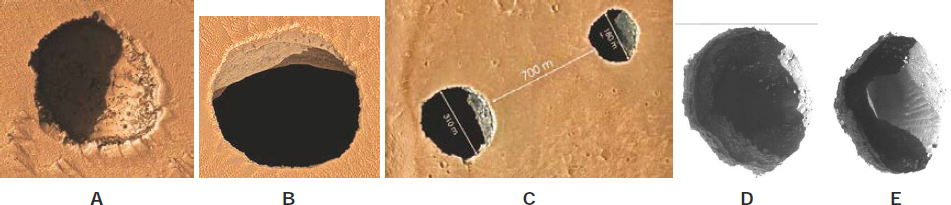
SOURCES: (A–C) P. Lee, G. Quinn, J. Rohrig, A. Himmelmann Schuster, S. Dalal, and S. Khan, 2024, “Caving on the Moon and Mars: First Analog Field Study of EVA Systems and Operations Requirements for Moon and Mars Cave and Pit Exploration at Skylight Cave Lava Tube, Oregon,” 53rd International Conference on Environmental Systems, July 21–25, Louisville, KY; (D and E) NASA/JPL-Caltech/University Arizona: https://science.nasa.gov/resource/boulders-inside-a-rimless-martian-pit-stretched and https://science.nasa.gov/resource/sand-ripples-inside-a-rimless-martian-pit-stretched.
havens of shelter in which life might be able to survive and thrive (Boston 2000) analogous to extreme cave environments on Earth (Boston et al. 2001). Caves provide shielding from (1) ionizing space radiation from the galaxy (galactic cosmic rays) and the Sun (solar particle events), (2) micrometeoritic bombardment, and (3) wide-amplitude diurnal temperature variations. These stressors reach biocidal levels for terrestrial-type life at the surface of Mars but are mitigated in the subsurface. From the perspective of the search for extant indigenous life, caves on Mars represent exceptionally favorable environments and opportunities (Léveillé and Datta 2010; Boston 2016; Carrier et al. 2020). Lastly, this same protective environment can also better preserve biosignatures of now extinct organisms (e.g., biotextures and biologically mediated secondary minerals that have been positively identified as biogenic in Earth caves).
Of particular significance for astrobiology, some volcanic caves on Mars likely have experienced conditions allowing liquid water to be available (Schörghofer 2021). Caves might in some locations (high or polar latitudes; high altitude on Mars) also harbor water and other volatile ices (Schörghofer 2021; Lee 2023). Volcanism on Mars might still be active, only dormant, and water is expected to be a volatile that is abundantly vented when volcanoes are active. The most recent volcanic eruptions on Mars might have occurred in Elysium about 53,000 years ago (Horvath et al. 2021) and 2 to 10 million years ago in Tharsis (Neukum et al. 2004; Pieterek et al. 2022).
Finding extant indigenous life may be viewed as critical, because only extant indigenous life will allow the required analyses in biochemistry (e.g., protein-forming amino acids) and genetics (e.g., DNA or RNA equivalents) to establish with certainty a clear separate origin from terrestrial life or a common ancestry. Because all life on Earth is phylogenetically related (Woese and Fox 1977; Hug et al. 2016), a key approach to demonstrate that life found on Mars is indigenous would be to show that it is phylogenetically or biochemically distinct from life on Earth. A complementary way would be to show that proteins in any extraterrestrial lifeform are not built from the same set of 20 to 22 left-handed amino acids that are used to make proteins in all forms of life on Earth. To conduct genetic or protein analysis on a lifeform found on Mars, one would have to find it alive (or dead recently enough to preserve genetic material or proteins). To find it alive on Mars, it likely has to be sought in the martian subsurface (Stamenković et al. 2020). Of the two ways to access the subsurface to reach environments that may harbor microbial habitats with extant life—deep drilling on the order of kilometers and caving in natural openings—caving will likely be within easier reach in the near future (Lee 2023).
Beyond consideration of their potential to shelter life, caves on Mars offer unique windows into the geology of the subsurface. Last, beyond their scientific importance, caves offer the intriguing prospect of serving as potential shelters and habitats for future human exploration and settlement (Boston 2000; von Ehrenfried 2019).
Few studies have been carried out to date that look into the practical aspects of cave exploration by humans on the Moon and Mars. The challenges of caving extravehicular activities include (1) darkness, (2) low temperatures, (3) confinement to exiguous spaces, (4) high-roughness surfaces deleterious to spacesuits and other built components, and (5) communications restrictions, but solutions do exist that open up prospects for future human cave exploration (Ball et al. 2023; Lee 2023, 2024a), perhaps in Mars campaigns following initial ones.
The fourth category of science objectives considered by the Panel on Astrobiology was “characterization of martian life if found.” The committee’s guidance for characterizing extant life if it is found is discussed in Appendix G.
In summary, astrobiology is an acknowledged key driver for Mars human missions and also underpins NASA’s entire program of Mars exploration. Finding evidence for life beyond Earth would be a discovery equivalent in magnitude to some of the greatest scientific discoveries of all time. Sara Seager at the Massachusetts Institute of Technology, who studies exoplanets, has described it as “the second Copernican Revolution.” Sending humans to Mars is one way of increasing the odds that this could happen within our lifetimes or those of our children or grandchildren.
4.2.2 Atmospheric Science and Space Physics
The Panel on Atmospheric Science and Space Physics covers atmospheric science, space physics, weather, climate, interactions between the space plasma and the upper atmosphere, and interactions between the atmosphere and the ground, including exchanges of dust, water, and carbon dioxide. Some of the panel’s top objectives overlap with the astrobiology and geosciences panels’ objectives.
The panel’s highest ranked objective is to determine what controls the onset and evolution of dust storms (see Appendixes D and J). Global dust storms can last for months, produce huge planetwide reduction in visibility, and can diminish solar radiation at the surface by more than two orders of magnitude (e.g., Guzewich et al. 2019). In these conditions the martian surface becomes dark during the day, visibility is reduced significantly, and solar power is reduced by orders of magnitude, making surface operations challenging (Figure 4-1).
Dramatic increases in atmospheric dust content owing to regional and global dust storms are the major cause of the present-day variability in Mars weather, climate, and atmospheric loss rates (e.g., Kahre et al. 2017; Guzewich et al. 2020; Vicente-Retortillo et al. 2025). Although robotic missions could contribute to the understanding of dust storms, human missions would enable comprehensive measurements in sites where dust lifting occurs. Sample collection and atmospheric measurements by humans would allow measurements in the subsurface, at the surface, and above the surface to address key science questions not addressed by robotic missions. Human presence uniquely enables rapid, adaptive decision making and complex troubleshooting during atmospheric sampling and instrument deployment, which cannot be replicated by robotic missions. Additionally, humans can deploy instruments in strategic locations and quickly respond to dynamic and unpredictable phenomena such as sudden dust storms, ensuring optimal sample collection and immediate on-site analysis. Above the surface, measurements could be conducted using instruments mounted on towers, drones, and balloons. Atmospheric soundings to high altitudes on Mars could be accomplished by balloons and drones (e.g., Noga et al. 2023).

SOURCE: NASA/JPL-Caltech, https://science.nasa.gov/resource/insights-final-selfie.
Conclusion: Understanding the martian climate and the long-term effects of space physics processes on the surface requires long-term monitoring stations to continue monitoring the weather after humans leave.
The panel’s next objective is to determine what controls the present-day water and carbon dioxide cycles and the distribution of volatiles in the subsurface and surface. After the dust cycle, the water and carbon dioxide cycles are the most important processes driving the present-day martian climate (e.g., Buhler and Piqueux 2021; de la Torre Juárez et al. 2024). Although atmospheric measurements made at any location would be useful, measurements near the polar layered deposits, where the bulk of the water and carbon dioxide sublimates seasonally, are of particular interest. Profiling of near-surface atmospheric water vapor and its exchange with the surface are key for understanding what controls the water cycle. Better knowledge of atmospheric aerosol sizes and compositions is needed to characterize the radiative effects of Mars clouds.
The panel’s next objective is to determine how the climate, water, and carbon dioxide cycles differed in the ancient past, as indicated by geologic evidence. This is critical for understanding how the Mars climate transitioned from its more Earth-like past to its current state (e.g., Wordsworth 2016; Palumbo and Head 2018). Humans on Mars would be better to assess, select, collect samples, and analyze rocks in situ as needed for these investigations than robots (e.g., Yingst et al. 2009; Antonenko et al. 2013; Glass and Briggs 2013; and subsequent studies).
Determining the ideal landing sites for achieving the panel’s top objectives would require precursor information to assess the presence of local dust lifting and ice-dust layering. The vision is that instrumentation assembled on Mars by humans would remain in operation long after the astronauts’ departure to continue monitoring weather phenomena on diurnal, seasonal, and interannual scales.
4.2.3 Biological and Physical Sciences and Human Factors
The Panel on Biological and Physical Sciences and Human Factors (BPS/HF) is not a single discipline, but several science disciplines represented by multiple offices distributed across two NASA directorates. Their objectives are intrinsic to the science agenda for crewed missions to Mars, both for understanding current missions and for driving insights to improve the health and performance of future missions. Because they are largely site agnostic, BPS/HF objectives are embedded in every science campaign to the greatest extent possible.
The methods to develop science objectives vary considerably across the panel. The Biological and Physical Sciences Division in NASA’s Science Mission Directorate utilizes the decadal survey process developed in concert with the National Academies. The most recent decadal survey, Thriving in Space, completed in 2023, reviews the current state of biological and physical sciences (NASEM 2023b). The Human Research Program in the Exploration Sciences Mission Directorate utilizes a very different approach: a formal continuous risk management process to ensure that evidence gleaned from flight operations and research can help NASA make risk-informed decisions that protect the astronauts and the mission. These risks consider the immediate, long-term, and lifetime health effects of exposure to the spaceflight environment (Antonsen et al. 2022).
NASA’s Human System Risk Board (HSRB; NASA 2025a) manages the risk reduction process. The initial set of human risks and the mitigation process was developed in the early 2000s by NASA. Both the risks and the process have been vetted extensively by the National Academies (IOM and NRC 2006; IOM 2008, 2014, 2015; NASEM 2016, 2017, 2018b). Using an evidence-based decision-making process, HSRB accepts a risk posture when countermeasures are deemed efficacious or no further risk reduction is considered appropriate at that time.
HSRB operates as part of the Health and Medical Technical Authority of the Office of the Chief Health and Medical Officer of NASA via the Johnson Space Center Chief Medical Officer. It currently tracks and manages the risk posture for the 29 human system risks and concerns (NASA 2025a).
In considering its statement of task, the committee assumed that these robust crew health and safety programs will be in place for any human mission. The core needs and capabilities of these programs will therefore include baseline requirements defined by the medical community and were considered to be outside the committee’s research campaign scope. Consequently, the Panel on BPS/HF was charged with identifying discovery science objectives associated with ecosystems of microbes, plants, animals, humans, and teams which may or may not translate to improved crew health and performance, and translational science objectives that would lead to new practices, procedures, and technologies that could improve crew health, safety, and performance (Box 4-2).
BOX 4-2
NASA’s Biomedical Research Program
NASA’s biomedical research program is decentralized, clustering in three main areas: (1) Crew Health and Safety (CHS), an operational program which provides the full continuum of healthcare needed to ensure astronaut health, and collects and analyzes astronaut occupational health data; (2) the Human Research Program, a research and development program that works to improve astronauts’ ability to collect data, solve problems, respond to emergencies, and remain healthy before, during, and after extended space travel; and (3) the Division of Biological and Physical Sciences research program, a discovery science program which utilizes the spaceflight environment to study biological phenomena in ways that cannot be done on Earth. This flexible structure operationalizes the translational science continuum commonly used in biomedical research (Figure 4-2-1).
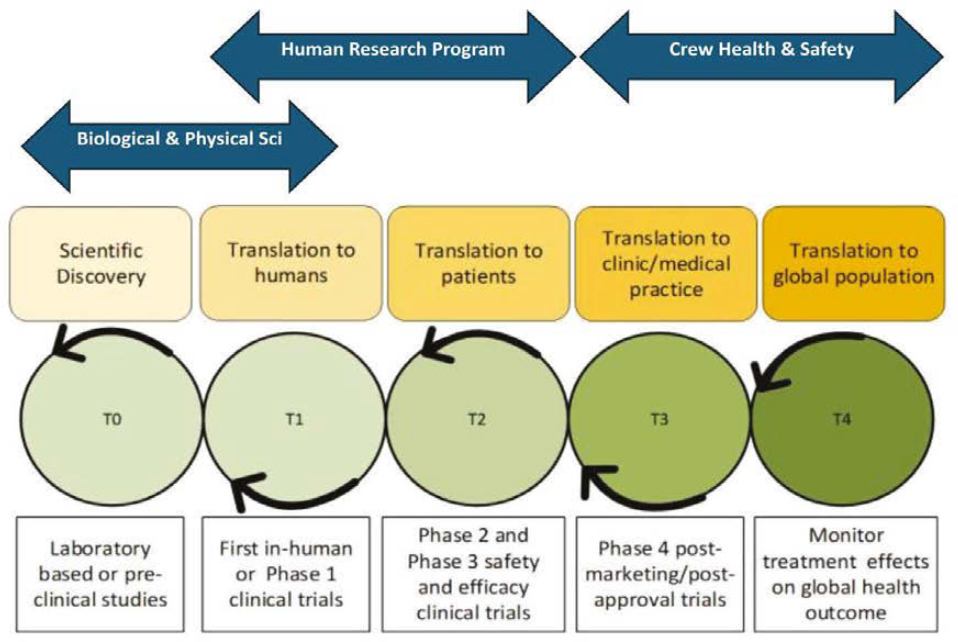
SOURCE: Chart from S. Dayal J. Heath, 2023, “What Is Translational Research?” Copyright 2023 Leica Biosystems Imaging Inc., https://www.leicabiosystems.com/pt-pt/educational-resources/articles/what-is-translational-research.
When synthesizing this information into martian campaigns, the steering committee reviewed past decadal surveys, important trends in science, and unique science opportunities associated with the martian environment that would affect the overall scope of campaign objectives. Here the committee highlights several evolving trends that inform the scope and conduct of BPS/HF research during early martian campaigns.
BPS/HF Research Priorities for Exploration
The martian environment poses risks to humans that are different from risks in low Earth orbit: a gravitational acceleration 38 percent of Earth’s; a highly energetic radiation environment; hostile environmental conditions, including temperature, wind, and fine dust that may be abrasive and chemically reactive; isolation and confinement; and a distance from Earth averaging 250 × 106 miles, nearly 600 times greater than the distance to the Moon. Indeed, social isolation for periods exceeding 2 years (surface operations plus transit time) may be among the greatest stress that humans will experience during a Mars mission (Le Roy et al. 2023).
The Panel on BPS/HF referred to these abiotic and biotic features collectively as the “integrated, longitudinal martian environment” (ILME), recognizing that these stresses are both interactive and cumulative. The resultant strain—an allostatic load—affects crew health and performance on Mars, and potentially long after return. For example, isolated teams can experience severe stress and lack of productivity and cohesion when they feel they are ill equipped, under-resourced, or insufficiently supported to carry out their assigned mission (Le Roy et al. 2023).
Accordingly, the Panel on BPS/HF adopted an occupational health framework for humans on Mars that would include both real-time monitoring and long-term health surveillance to develop a deep understanding of the cumulative stress that astronauts will experience on this remote world for an unprecedented amount of time. Such a program—the Longitudinal Study of Astronaut Health—was established by NASA in the 1990s and has been reviewed by the National Academies previously (IOM 2004). The panel’s science objectives expand this work further.
Overall, the panel suggested a balanced approach that reflects research priorities in crew health and performance, and space biology. Seven of the 11 Key Scientific Questions from the recent biological and physical sciences in space decadal survey, Thriving in Space (NASEM 2023b), are represented in the panel’s prioritized science objectives. Research themes of special consideration are described below:
- How does the space environment influence biological mechanisms required for organisms to survive the transitions to and from space, and thrive while off Earth?
- How do genetic diversity and life history influence physiological adaptation to the space environment?
- How does the space environment alter interactions between organisms?
- What are the important multigenerational effects of the space environment on growth, development, and reproduction?
- What principles guide the integration of biological and abiotic systems to create sustainable and functional extraterrestrial habitats?
- What principles enable identification, extraction, processing, and use of materials found in extraterrestrial environments to enable long-term, sustained human and robotic space exploration?
The Data Revolution in Life Sciences
Biology and medicine in the 21st century are dominated by “omics,” a broad term referring to the collective characterization of chemical and functional classes of biological molecules and effects to obtain a comprehensive understanding of the biological system under study (Figure 4-2). Omics encompasses technologies to characterize the structure, function, and dynamics of cells, genes, molecules, and organisms. Dozens of “omes” that describe location, structure, and/or function have been identified. For example, genomics includes all genes; transcriptomics, all of the gene products; proteomics, all of the protein; epigenomics, reversible chemical modification of DNA; metabolomics, small-molecule metabolites and metabolic intermediates in a biological sample. The total number of variables being considered (often 104–106) is orders of magnitude greater than traditional biological research. Consequently, omics analyses share common features: high-throughput analytical techniques, statistical methods

SOURCE: C.W. Jones, E.G. Overbey, J. Lacombe, et al., 2024, “Molecular and Physiological Changes in the SpaceX Inspiration4 Civilian Crew,” Nature 632:1155–1164, https://doi.org/10.1038/s41586-024-07648-x. CC BY 4.0.
to aggregate data and infer cause and effect, and tools to elucidate associations between disparate forms of data such as genomes and medical measurements. These approaches are well suited to describing characteristics of an ecosystem of humans, plants, and microbes that will coexist on Mars, described by the Panel on BPS/HF as the “Human Exploration System.”
The dynamic nature of many omes is associated with changes in health status. Current terrestrial research aims to characterize these temporal shifts to capture dynamic changes in health. However, molecules such as RNA are affected by ionizing radiation and have specific storage requirements such as lyophilization and cryopreservation that make sample return problematic (Kornienko et al. 2024). Consequently, the committee recognized that in situ analysis during campaigns would be necessary to reduce, but not eliminate, sample return requirements. Developing the intelligent, robust, compact, lightweight, and low-power analytical tools for omics research and medical monitoring on Mars will likely precipitate bidirectional technology transfer between the space biomedical and terrestrial biomedical communities.
Multigenerational Studies
A human presence on Mars enables several research objectives probing the same existential question: Can life continue on a planetary body other than Earth? Because growth, development, and reproduction sustain all life, it is not surprising that panels included multigenerational studies of microbial, plant, and animal life in their STM objectives.
The selection of species for these studies will be important. For example, the phenotypic, biochemical, cellular, and molecular responses of Arabidopsis thaliana, a small, adaptable plant with a short life cycle from the Brassicaceae (mustard) family, have been well characterized in the space environment (Olanrewaju et al. 2023). Successful seed-to-seed experiments have been flown on the International Space Station (ISS) (Link et al. 2014). It is expected that any candidate plant species for a martian mission will have been studied with a similar or greater level of fidelity to be part of a Mars mission.
For animal studies, the selection of species is even more critical. Cross-species ontologies combine data about genes, phenotypes, and diseases from different species to provide important insight about human disease mechanisms and aid disease diagnosis. For example, current terrestrial efforts such as the Monarch Initiative capture phenomic knowledge in all its forms, including human and model organisms’ phenotypic data, with the intent to elucidate the causes and mechanisms of human disease (Putman et al. 2024). Using such tools, information obtained from life-cycle experiments of model organisms could provide early insight relevant to human adaptation on future, permanently inhabited martian outposts. Potential model organisms for early martian campaigns include the nematode Caenorhabditis elegans, the first multicellular organism to have its whole genome sequenced, and Drosophila melanogaster, the common fruit fly. Both are extremely well characterized (e.g., Riddle et al. 1997; Wormbook 2018; Braendle and Paaby 2024; Genetics Society of America 2025), have genotype–phenotype associations analogous to human diseases, and have flown in space previously (Iyer et al. 2022; Scott et al. 2023). Practical cryopreservation techniques for long-term storage and later reactivation have been vetted for both species. With lifespans of approximately 15 days for C. elegans and 70 days for Drosophila, multigenerational and lifespan studies are best completed during longer missions, such as the 300-sol missions included in some campaigns.
The Ubiquitous Nature of Microbiomes
Microbes play essential roles in terrestrial systems as vital components of all macroorganisms and ecologies. Microbiomes underlie and strongly affect the health and performance of humans and other species, including plants, and are intrinsic symbionts of all Earth-derived organisms. Furthermore, symbiosis is an important part of proposed bioregenerative life support systems, which utilize microbial activity to clean and renew air, water, and waste in habitat. For example, bioreactors could be used to process urine, condensate, and gray water. Managing microbial communities to reduce organic carbon and convert and recover nitrogenous compounds offers an alternative to more traditional physiochemical solutions (Loader et al. 1998; Sevanthi et al. 2014). Previous research on the International Space Station (ISS) and Space Shuttle, submarines, Antarctic overwintering facilities, hospitals,
and other closed or limited built spaces show that such environments are particularly vulnerable to microbial instabilities, the propagation of pathogenic and other deleterious species, and biofouling. In a martian environment, microbes are hypothesized to adapt over time, impacting humans and their habitats.
Because of the critical role that microbiomes play in astronaut health and effects on the spacecraft environment, the study of Earth-derived accompanying microbial organisms is likely to be a high priority for investigation by the first crew on the surface of Mars. Early research is key to evaluating the immediate and future potential impact of the integrated longitudinal martian environment on microbiomes themselves, the humans that depend on the functioning of their microbial symbionts, and possible pathogens. Such research will also provide fundamental insight into microbial population dynamics in novel environments. Critically, studies throughout transit and landing can provide essential insight into the likely composition of potential forward contamination from habitable volumes to the martian surface environment so that planetary protection countermeasures may be most efficacious (Figure 4-3).
Bioregenerative Life Support Systems (BLiSS)
Human waste management is a challenge for human space exploration. Typically, technology focuses on compaction, sterilization, caching, and disposal of human waste, rather than recycling. For example, on the ISS, human waste is stabilized, dried, and packed into the emptied supply vehicle, which burns up in Earth’s atmosphere (Linne et al. 2014). This method is clearly not appropriate for Mars missions. Current plans for caching waste increase the risk for forward contamination of the martian surface and would not be sustainable.
Bioregenerative life support systems (BLiSS) are a family of advanced concepts identified as a research campaign in the most recent BPS decadal survey (see Figure 4-4). BLiSS could process wastes, refresh air and water, and supply precursors for food manufacturing or plant growth, enabling humans to thrive in planetary and deep space environments for extended periods of time (NASEM 2023b).
Plants and microbes together form the foundations of BLiSS. More advanced concepts can convert in situ resources, including regolith, into biologically available mineral nutrients and molecular feedstock for diverse applications ranging from building materials to pharmaceuticals.
Despite extensive research over several decades, no BLiSS has reached sufficient technological maturity to significantly increase the autonomy of a mission to the Moon or Mars. Thus, pragmatic efforts are needed for BLiSS development and validation on Mars (Verseux et al. 2022; NASEM 2023b).
4.2.4 Geosciences
Mars is a geologic wonderland (see Figure 4-5). The planet is significantly larger and more massive than the Moon, and has experienced, by comparison with Earth’s natural satellite, a much more diverse and complex geologic history. While Mars is smaller than Earth, the total land area of Mars is similar to that of all Earth’s continents put together. The present surface geologic features of this vast, rocky planet are the expression of the planet’s long evolution from its origin to the present, the resulting product of its early accretion and differentiation, and the subsequent action of both endogenous processes (internal to the planet, such as volcanism) and exogenous processes (external to the planet, such as impact cratering), as well as interactions between the surface and the planet’s atmosphere.
Among the major lessons learned to date, in large part from the planet’s surface geology, is that Mars experienced past epochs with very different surface environmental conditions. Liquid water, for instance, which is central to the origin, evolution, and sustenance of life as we know it on Earth, was more abundant and frequently occurring in Mars’s surface and near-surface environment in the past than today. It is now also clear that Mars experienced multiple episodes of glaciation in its past, across vast regions if not globally, and likely throughout its history, with ice from some of these glacial episodes still lingering in the near-surface environment today, including at low- to mid-latitudes. Volcanism has also been active throughout Mars’s history, with a multitude of eruptive events building up volcanoes, some among the largest in the solar system. Tectonism—the process of deformation and fracturing of the planet’s crust—has also played a significant role in shaping the planet’s surface, for instance by contributing to the creation of some of the planet’s monumental canyon systems.

NOTE: C001, C002, C003, and C004 are crew member designations.
SOURCE: B.T. Tierny, J.K. Kim, E.G. Overbey, et al., 2024, “Longitudinal Multi-Omics Analysis of Host Microbiome Architecture and Immune Responses During Short-Term Spaceflight,” Nature Microbiology 9:1661–1675, https://doi.org/10.1038/s41564-024-01635-8. CC BY 4.0.

SOURCE: R. Santomarino, N.J.H. Averesch, M. Bhuiyan, et al., 2023, “Toward Sustainable Space Exploration: A Roadmap for Harnessing the Power of 4608 Microorganisms,” Nature Communications 14:1391, https://doi.org/10.1038/s41467-023-37070-2. CC BY 4.0.
Recent Mars Geosciences Prioritized Objectives
Several key documents have been compiled by the Mars and broader planetary science community to help identify and guide science priorities in Mars exploration in the geosciences, specifically (a) the Mars Exploration Program Analysis Group (MEPAG) goals document; (b) the report of the MEPAG Tiger Team which, in Summer 2023, was tasked to rapidly identify preliminary science objectives for humans on Mars; and (c) the National Academies decadal surveys in planetary sciences from 2011 and 2023. Although some of these documents have historically been created to help prioritize investigations of Mars via robotic exploration, they all identify fundamental
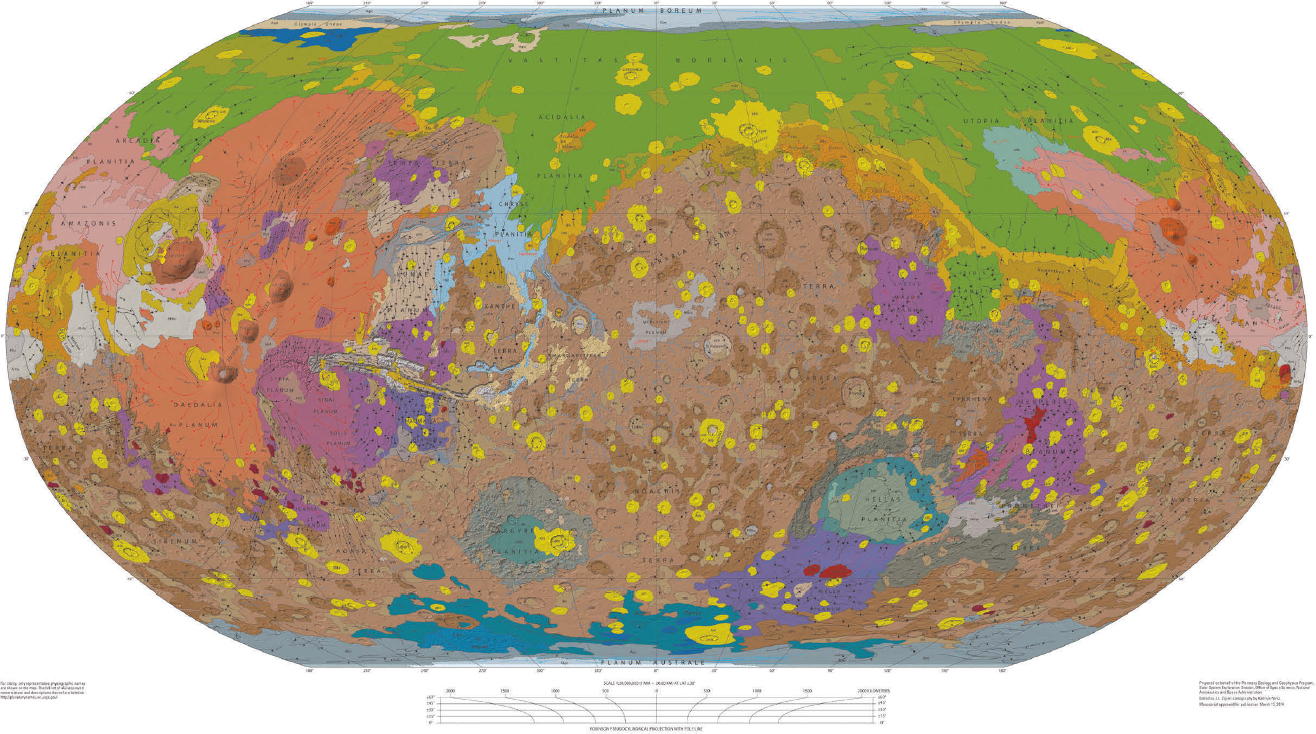
SOURCE: U.S. Geological Survey, 2014, “Geologic Map of Mars,” https://www.usgs.gov/media/images/geologic-map-mars.
geosciences questions (and questions beyond the geosciences) that would also need to be answered in the context of crewed missions to Mars (e.g., Beaty et al. 2019).
While these documents have provided, and continue to provide, important guidance in prioritizing Mars geosciences investigations, the scientific objectives proposed by the Panel on Geosciences providing input into the present study, as well as the resulting geosciences objectives among the highest priority science objectives identified in this study, are notable for their greater level of detail and specificity. These objectives are formulated so as to be actionable by human crews on Mars going about investigating the exploration zone accessible from their landing site.
Input from the Panel on Geosciences
The Panel on Geosciences examined the breadth of investigations relating to the origin and geologic history of Mars, from the planet’s formation to the present, that crewed missions to Mars could address from the first campaign onward (see Appendix E). These investigations would serve to reveal Mars’s original starting state upon accretion through its subsequent geologic and environmental evolution. They would also provide crucial context for other domains of investigation, in particular astrobiology and atmospheric sciences.
The panel identified a list of 10 prioritized objectives and constructed an accompanying STM. The following objectives top their list, with no prioritization between them:
- Characterize past and present water and ice reservoirs within the exploration zone to understand geologic and climate evolution over Mars’s history.
- Characterize the rock record within the exploration zone to understand environmental changes over Mars’s history.
- Constrain absolute ages of martian events and tie to the impact record to calibrate crater counts.
- Characterize igneous systems within the exploration zone to determine planet formation, differentiation, and volcanic history.
Mars’s geologic record of the nature, duration, and extent of water and ice reservoirs provides key information about the evolution of Mars’s climate and surface environmental conditions through time, with implications for the role of orbital forcing (analogous to Milankovitch cycles on Earth), the planet’s habitability, and the evolution of planetary volatiles in the solar system. Reconstruction of local, regional, and global stratigraphic relationships is essential for understanding the timing of Mars’s climatic and geologic events throughout the planet’s history. Dating Mars sample materials to determine the absolute ages of geologic events and their resulting features, including calibration of impact crater surface densities, is fundamental to reconstructing the chronology of Mars’s history, of its habitability, and of planetary evolution. Igneous materials preserve isotopic and chemical fingerprints of Mars’s origin and evolution through time, from early accretion and differentiation to degassing, atmosphere and hydrosphere development, and volcanic evolution.
The Panel on Geosciences identified requirements and assumptions to optimally meet its objectives. These include the establishment of “a basecamp with the buildup of supporting infrastructure,” the inclusion of “a professionally trained planetary field scientist(s) on the crew,” and “substantial planetary science training . . . for all crew members.”
The panel also recognized that the emphasis of geosciences investigation activities on Mars will vary with surface mission duration. For instance, considering the ratio of time spent conducting analyses in situ versus time spent collecting samples, a 300-sol mission would likely be characterized by a higher such ratio than a 30-sol mission.
The panel also emphasized the importance of building sufficient flexibility in campaign and mission planning to allow these to remain discovery responsive. The panel suggested that although having in situ analytical capabilities will enable discovery responsiveness, samples being returned to Earth need to be kept pristine and not analyzed in transit but instead examined via an array of state-of-the-art analytical capabilities once returned to Earth.
The panel identified mapping, in particular, of near-surface water ice at low- to mid-latitudes as a key robotic precursor activity crucial to informing landing site selection and allowing site characterization. Topographic information will be needed to plan campaigns; the higher the resolution, the more useful it would be. Some data can be
obtained from existing orbital assets, such as the High Resolution Imaging Science Experiment (HiRISE) camera on the Mars Reconnaissance Orbiter (MRO), pointing out the criticality of these assets. Precursor missions with LIDAR-equipped rovers may also be necessary.
Beyond the crewed expedition time on Mars, the panel identified the need to continue collecting data post expedition to monitor and characterize long-term change on Mars.
Importantly, the panel identified synergies across the geosciences that lead to viewing Mars as an integrated system. As an example, understanding past and present water and ice reservoirs will not only lead to understanding the geologic and climate evolution of Mars, but also guide the astrobiological characterization of habitable environments and the search for extant indigenous life on Mars.
Although geosciences investigations of Mars are fundamental to gaining an understanding of the geologic features, processes, and evolution of Mars’s surface and interior through time, they are also key from what they reveal about the evolution of environmental conditions on Mars. They provide context for other major areas of scientific enquiry, in particular astrobiology, atmospheric science and space physics, and biological and physical sciences and human factors. With regard to astrobiology, the geology of Mars, and in particular the occurrence of liquid water and ice, informs assessments of whether the planet had environmental conditions potentially conducive to the origin of life, the planet’s habitability through time, and where extant indigenous life might still find harbor on or within Mars today. In relation to atmospheric science and space physics, the geology of Mars holds a vast record of the planet’s atmospheric and climatic evolution, including features still actively produced by the interaction between the atmosphere and the surface, such as dunes. With regard to BPS and HF, the geology of Mars needs to also be understood for how it would affect humans—assessing the particle size distribution and chemical toxicity of martian dust, for instance.
Beyond Mars, understanding the geologic evolution of Mars also informs the evolution of the solar system as a whole, the nature of terrestrial planets as a class of objects, and the planet phenomenon in the broader universe. Mars’s rapid and possibly thwarted growth from planetesimals in proximity to fast-forming giant planets, its presumed greater initial endowment in volatiles relative to Earth, and its evolution under higher impactor fluxes in the vicinity of main-belt asteroids are all aspects of Mars’s relationship with the rest of the solar system that may be informed by deeper Mars geosciences investigations. In this context, Mars’s two moons, Phobos and Deimos, are intriguing objects to also explore, as their origin remains a mystery (Box 4-3).
Synopsis
Experience with geologic field exploration on Earth indicates that, although Mars is less diverse and complex than Earth, it is still remarkably diverse and complex and will require a long time to thoroughly explore. No single campaign of three missions, even with the inclusion of a 300-sol stay, will likely get to the bottom of all the major Mars geosciences questions that need to be answered. Furthermore, using existing assets to prepare for human fieldwork is especially important: Human field teams will need the best surface photography and topography available, and then they will also need drones or other surface assets to scout when walking on the surface.
Opportunities to iterate are central to conducting exploration and field geology. To do field geology is to investigate a planet at its surface and accessible subsurface in order to examine geologic materials and landforms up close in their minimally disturbed natural state, note spatial relationships, make in situ measurements, collect well-selected samples for further analysis, formulate and test hypotheses about the origin and evolution of geologic systems and past environmental conditions, and iterate until hypotheses in play are reduced, and ultimately fine-tuned and verified. The need for iteration cannot be overstated. Both opportunity and time for iteration must be allowed in any well-designed exploration and field geology campaign.
The Panel on Geosciences noted a strong preference for a campaign strategy that would establish an exploration infrastructure comprising, by analogy with the U.S. McMurdo Station in Antarctica, a fixed base and a mobility system with expanding reach over time (Lee 2024a, 2024b). Such a surface exploration infrastructure on Mars would enable, over time, increasingly long-range and in-depth exploration of the planet from that infrastructure, over multiple campaigns.
BOX 4-3
Phobos and Deimos
Mars has two moons, Phobos and Deimos, both “small bodies” discovered in 1877 by American astronomer Asaph Hall from the U.S. Naval Observatory in Washington, DC. Mars’s moons are irregular in shape and much smaller than the Moon of Earth: Phobos is 27 × 22 × 18 km; Deimos is 15 × 12 × 11 km. Their origin and potential connection to each other, if any, remain mysterious. Leading hypotheses hold that Phobos and Deimos might be either remnants of Mars’s own formation, captured asteroids or comet nuclei, or reassembled ejecta from Mars following large impacts earlier in the planet’s history. Depending on which origin scenario is correct, investigating Phobos and Deimos could mean exploring Mars itself or exploring objects that have little to do with Mars but would provide valuable insights into the early solar system.
The NASA Mars Exploration Program Analysis Group (MEPAG) Goals Document identifies, under its Goal III pertaining to geosciences, an Objective C that is to “determine the manifestations of Mars’s evolution as recorded by its moons.” Objective C has two sub-objectives: (C1) constrain the planetesimal density and type within the Mars neighborhood during Mars formation, as implied by the origin of the Mars moons, and (C2) determine the material and impactor flux within the Mars neighborhood, throughout Mars’s history, as recorded on the Mars moons. In addition to allowing these sub-objectives to be addressed, and regardless of their formation scenario, Phobos and Deimos’s proximity to Mars also means that their surface may have incorporated, over time, detectable amounts of materials ejected from Mars by impacts on Mars, and so sifting through Phobos or Deimos’s regolith could facilitate assessing Mars’s geologic diversity (Lee et al. 2005).
The Mars Moons eXploration (MMX) mission developed by Japan Aerospace Exploration Agency (JAXA), with NASA as a participating partner, is a Phobos sample return mission to be launched in 2026 and to return samples to Earth in 2031, so the origin of at least one of Mars’s moons could be elucidated soon. MMX might also allow a preliminary assessment of whether, and to what extent, Phobos’s regolith might contain materials from Mars.
Beyond this robotic reconnaissance, Phobos and Deimos have been proposed as potential targets for human exploration in the broader driving context of the human exploration of Mars (e.g., Singer 1984; O’Leary 1985; Lee et al. 2005). NASA has convened three International Conferences on the Exploration of Phobos and Deimos, in 2007, 2011, and 2016, addressing “the science, robotic reconnaissance, and human exploration of the two moons of Mars.” A recommendation from the first workshop was that Phobos, and possibly Deimos as well, should be explored by astronauts, perhaps opportunistically during an early shakedown mission to Mars orbit (Lee 2009).
One idea to further enhance the value of such an early human visit to Phobos is to conduct a series of precursor robotic sampling missions on Mars, cache the samples on Phobos, and have human crews who are visiting Mars orbit retrieve the samples (Stooke 2007, 2014). One possible advantage of this approach is that samples collected on Mars would effectively be quarantined on a space radiation–exposed airless body prior to their transfer to Earth, thus assisting in planetary protection goals. Alternatively, if the goal of some particular samples was to search for biological materials, such a destructive environment would present an engineering challenge to protect them.
A commonly proposed idea is to use the moons of Mars as orbital platforms from which astronauts in Mars orbit could teleoperate robotic assets on Mars without the time latency associated with the light travel time delay between Earth and Mars. This idea has only limited merit, because the main time bottleneck between robots on Mars and their operators on Earth is not so much the light travel time delay, but the time it takes to iterate on the science and the formulation of new commands.
4.2.5 Overlapping Science Objectives
A review of the scientific objectives identified by the Panels on Astrobiology, Atmospheric Science and Space Physics, Biological and Physical Sciences and Human Factors, and Geosciences revealed several important areas of overlap. These intersections highlight opportunities for interdisciplinary collaboration, enabling optimized mission planning and enhanced scientific returns. Key overlapping objectives include the following:
- Water and ice reservoirs
- This objective was prioritized by both the Panel on Astrobiology and the Panel on Geosciences, reflecting its crucial importance for assessing habitability, understanding Mars’s climate evolution, and enabling ISRU.
- Characterization of habitability and niche habitats
- Highlighted by the Panels on Astrobiology, Geosciences, and BPS/HF, this objective emphasizes the importance of investigating environments such as brines, ice deposits, subsurface habitats, and caves. These habitats hold potential for supporting life or sustaining biological systems, directly influencing landing site selection and exploration strategies.
- Atmospheric dynamics and dust storm processes
- This priority was explicitly identified by the Panel on Atmospheric Science and Space Physics and was recognized by the Panel on Geosciences owing to dust storms’ impact on surface geologic processes. A thorough understanding of dust storm dynamics is essential not only for crew safety but also for interpreting Mars’s geologic and climatic history.
- Integrated human health and martian environment
- The Panel on BPS/HF strongly emphasized assessing human physiological and psychological responses, microbial interactions, and habitat sustainability in martian conditions. This objective aligns with planetary protection considerations highlighted by the Panel on Astrobiology, as well as environmental characterization priorities within the Panel on Atmospheric Science and Space Physics.
- Prebiotic chemistry and organic molecule detection
- Central to the Panel on Astrobiology, this objective closely intersects with the analyses of Mars’s rock records by the Panel on Geosciences. Investigating Mars’s potential for prebiotic chemical processes aligns with geochemical assessments of ancient environmental conditions and their capability to preserve organic materials.
- Radiation environment
- Understanding the radiation environment on the surface is Mars is critical to assessing risk to astronauts and to planning infrastructure. The radiation environment of each sample taken is a crucial measurement to understand the sample (e.g., was it taken on the surface but protected by overhanging rock formations?).
These overlapping objectives underscore the value of integrated, multidisciplinary approaches. By combining expertise across panels, mission planners can enhance astronaut safety, maximize scientific outcomes, and deepen humanity’s understanding of Mars as a complex and dynamic planetary system.


