A Science Strategy for the Human Exploration of Mars (2026)
Chapter: 5 Putting Science in the Moon to Mars Architecture
5
Putting Science in the Moon to Mars Architecture
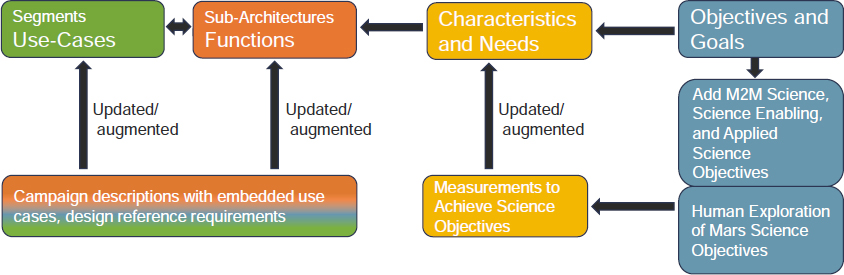
Science is a major focus of NASA’s Moon to Mars (M2M) exploration strategy. NASA utilizes a systems engineering approach to generate an integrated architecture that decomposes broad goals and objectives into functions and use cases that guide hardware and technology development. In response to the statement of task (Appendix A), this chapter demonstrates how science goals and objectives developed from the science traceability matrices (Appendix J) can be utilized to refine and further develop the M2M Architecture. Complete decomposition of all objectives was neither warranted by the statement of task nor possible within the scope of this study; rather, several case studies are provided to illustrate how the activities described in this report and in previous documents and reports (e.g., decadal surveys, workshops and working group reports, and M2M Architecture documents) will guide the completion of what is arguably the most important part of the M2M Architecture. Figure 5-1 summarizes the steering committee’s approach.
NASA’s science goals are expansive and visionary. They include understanding the formation of the solar system, the origins of life, the Sun, space weather, matter, time, and the impact of lunar, martian, and deep space environments on living organisms, including humans. At the time of this writing, science goals for human exploration of Mars had not yet been decomposed into more actionable elements. Readers are encouraged to familiarize themselves with the M2M Architecture Definition Document (NASA 2025b) for context.
The M2M exploration strategy emphasizes the continuity of technology and scientific integration across NASA’s lunar and martian exploration planning (Merancy 2024). Technology development and operational approaches proven on the Moon are essential in mitigating risks associated with Mars exploration. Each Mars science campaign will benefit from the strategic and technological foundation established by lunar missions, ensuring that Mars-bound technologies are robust, scalable, and directly supportive of mission success. Human presence on Mars will facilitate novel scientific discoveries from its surface.
Section 5.1 provides a brief overview of the architecture and the complementary principles underpinning this complex framework: “architecting from the right” and “executing from the left,” as shown in Figure 5-2. Architecting from the right involves decomposing long-term goals and objectives to establish the complete set of elements that will be required for success. Once goals are fully reduced to systems and elements, scientists, engineers, and technologists execute from the left in a regular development process, integrating within the architecture.
Section 5.2 considers the M2M sub-architecture framework—a group of tightly coupled elements, functions, and capabilities that perform together to accomplish architecture objectives—from a science perspective. Collectively, the sub-architectures span many elements of the M2M Architecture that are common to Mars missions.
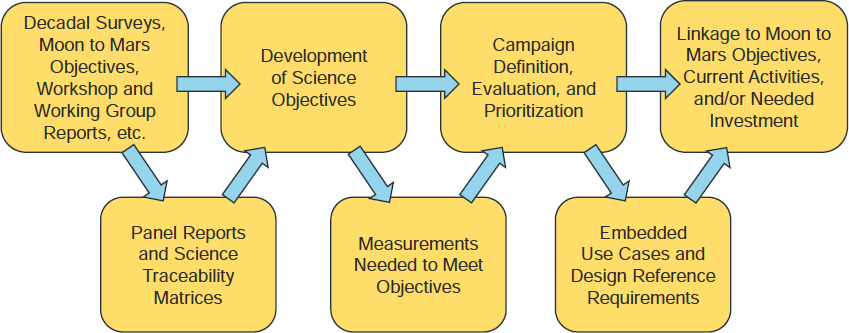
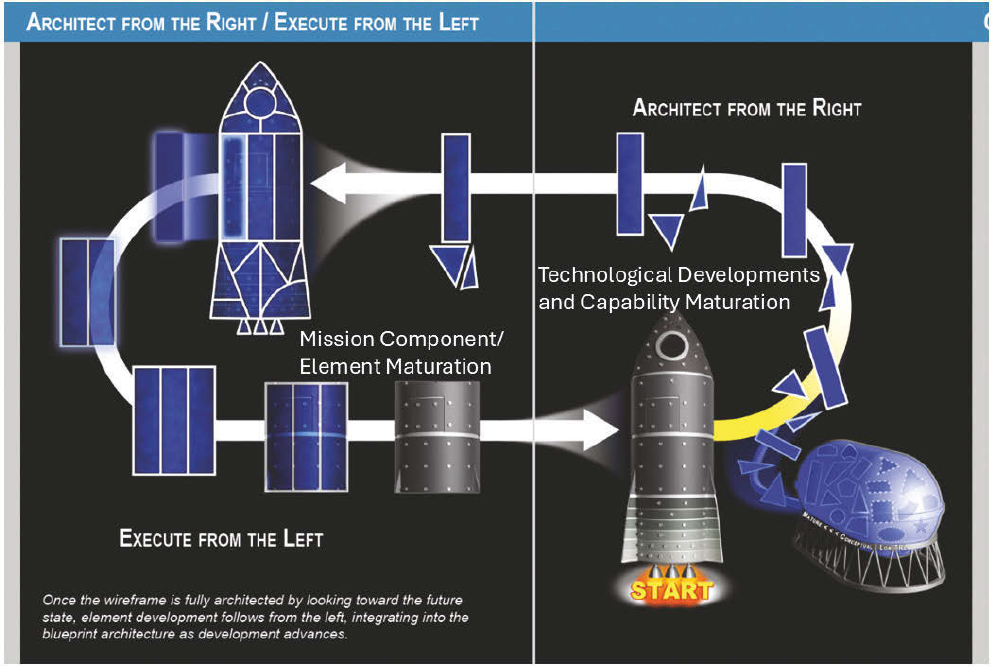
SOURCE: NASA, 2023, NASA’s Moon to Mars Strategy and Objectives Development, NP-2023-03-3115-HQ, https://www.nasa.gov/wp-content/uploads/2023/04/m2m_strategy_and_objectives_development.pdf.
Therefore, they are by their very nature science enabling. Specific applications based on Mars science objectives are provided to help guide further refinement of the sub-architectures but are not an all-encompassing list.
Section 5.3 provides example use cases derived from the campaign descriptions and science traceability matrices to architect from the right. These and additional cases can be used to begin developing design reference requirements for Mars and execute from the left by determining future investments in technology. Some use cases were selected to explicitly highlight cases where the capabilities, needs, and functions are already embedded in the current architecture and can be used to provide design reference requirements. Other examples were selected to highlight areas in which there are greater gaps in the capabilities, needs, and functions.
Section 5.4 highlights the importance of linking current Moon-focused and Mars-focused investments to leverage capability and reduce cost, and to show how Mars exploration needs may drive capabilities throughout the architecture. Although the ultimate goal is Mars, the campaigns, objectives, and measurements described in this report could, in many instances, be applied to architect lunar science. Conversely, the Artemis program is the ultimate example of executing from the left with regard to human exploration of Mars. Successful execution of the Artemis lunar science program is expected to substantially reduce the technology investments needed to successfully complete Mars science objectives.
5.1 OVERVIEW OF THE MOON TO MARS ARCHITECTURE
NASA is leading a human exploration campaign for the 21st century that commences with the Artemis program, the return to the Moon, and reaches fruition with the landing of the first astronauts on another planet and the sustained exploration and potential habitation of Mars. These first extended missions to the lunar surface will explore the south pole to better understand the origins, history, and resources of the Moon (Merancy 2024). A long-term lunar presence will also prepare humans for the subsequent exploration of Mars. Extended lunar surface operations help NASA develop a cadence for exploration operations on a planetary body.
The M2M exploration strategy is expected to evolve based on ongoing reviews as novel concepts emerge and new knowledge is acquired, accompanied by advancements in technology. Initially, NASA leadership established 10 goals and 63 objectives for the M2M exploration strategy (NASA 2025b). These overarching goals and objectives reflect a strategy for NASA and its partners to establish the foundation for a sustained human presence throughout the solar system, commencing with M2M campaigns. Per the statement of task, no specific timing of the first missions is assumed, only that there will be at least three robust missions.
5.1.1 Architecting from the Right
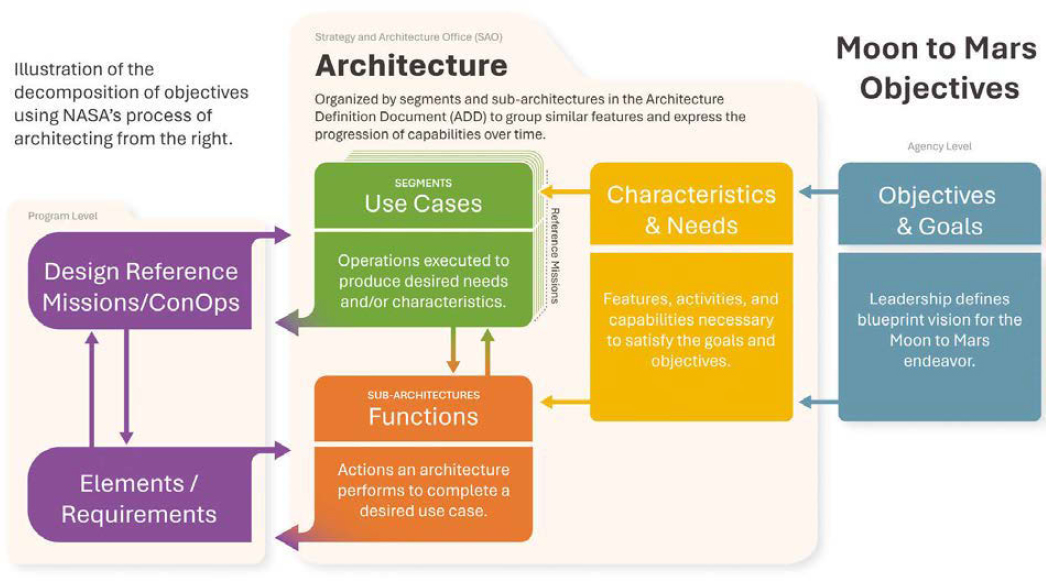
Architecting from the right is a systems engineering approach to decompose goals and objectives into actionable elements by progressing through a series of steps that both reduce abstraction and allow functional regrouping of elements with similar engineering requirements (Figure 5-3). Execution of such a systems engineering process is highly iterative and evolves over time.
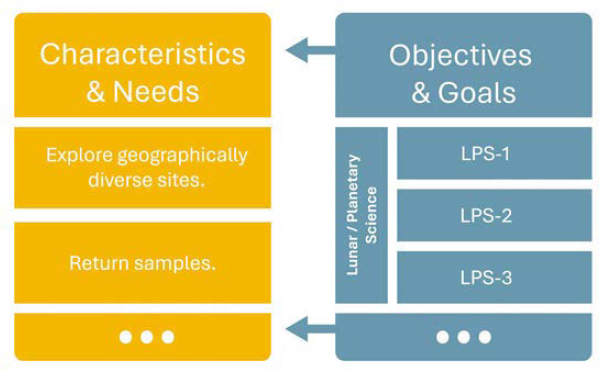
Architecting from the right begins with breaking down “objectives and goals” into “characteristics and needs.” Objectives are used to answer the question “why?” and focus development on desired outcomes, characteristics, and needs to translate outcomes into the features or products of the architecture necessary to produce those outcomes. Characteristics and needs articulate features, activities, and/or capabilities necessary to achieve goals and objectives. They do not define particular solutions to produce desired results. This step is crucial for converting generalized objectives into actionable elements.
As illustrated in the notional M2M Architecture decomposition and mapping example (Figure 5-4), characteristics and needs provide additional detail that may inform architecture decisions such as mass, power, or volume requirements, and/or campaign requirements such as site location or drilling depth. Measurement requirements and objectives in a science traceability matrix (STM) are roughly equivalent to characteristics and needs in the M2M Architecture (see Appendix J).
Use cases and functions begin to define actionable features of the exploration architecture. They are more operationally focused and are developed with stakeholders to ensure that desired scientific goals will be achieved.
SOURCE: NASA, 2025, Moon to Mars Architecture Definition Document, ESDMD-001 Rev-B.1, https://www.nasa.gov/wp-content/uploads/2024/12/esdmd-001-add-rev-b.pdf.
Use cases answer questions like “where?” and “when?”; functions answer questions like “what?” and “how many?” Instrument and data requirements elements are derived from use cases and functions because they provide the necessary fidelity to assemble sub-architectures and mission designs and to define synergies and commonalities with lunar and martian exploration that can leverage developed capabilities to control cost and schedule.
The steering committee’s prioritized objectives and the disciplinary panels’ STMs are the starting points for architecting science objectives from the right (see Appendix J). Translating these objectives into Mars-specific
SOURCE: NASA, 2025, Moon to Mars Architecture Definition Document, ESDMD-001 Rev-B.1, https://www.nasa.gov/wp-content/uploads/2024/12/esdmd-001-add-rev-b.pdf.
but architecture-agnostic characteristics is the crucial step toward developing design reference requirements for future technology and exploration capabilities. The campaigns described in Chapter 3 help define characteristics and needs and contextualize use cases.
The M2M Architecture will continue to evolve. By establishing a prioritized set of science objectives, the derived functions and capabilities can be used to populate elements in NASA’s M2M Science Objectives, and M2M Science-Enabling and Applied Science Objectives. Once completed, these Science, Science-Enabling, and Applied Science elements can be regrouped into science-specific sub-architectures. Fortunately, the extensive sub-architecture framework that has already been developed supports, to a degree, Mars science objectives and notional campaigns.
5.2 THE SUB-ARCHITECTURE FRAMEWORK APPLIED TO SCIENCE ON MARS
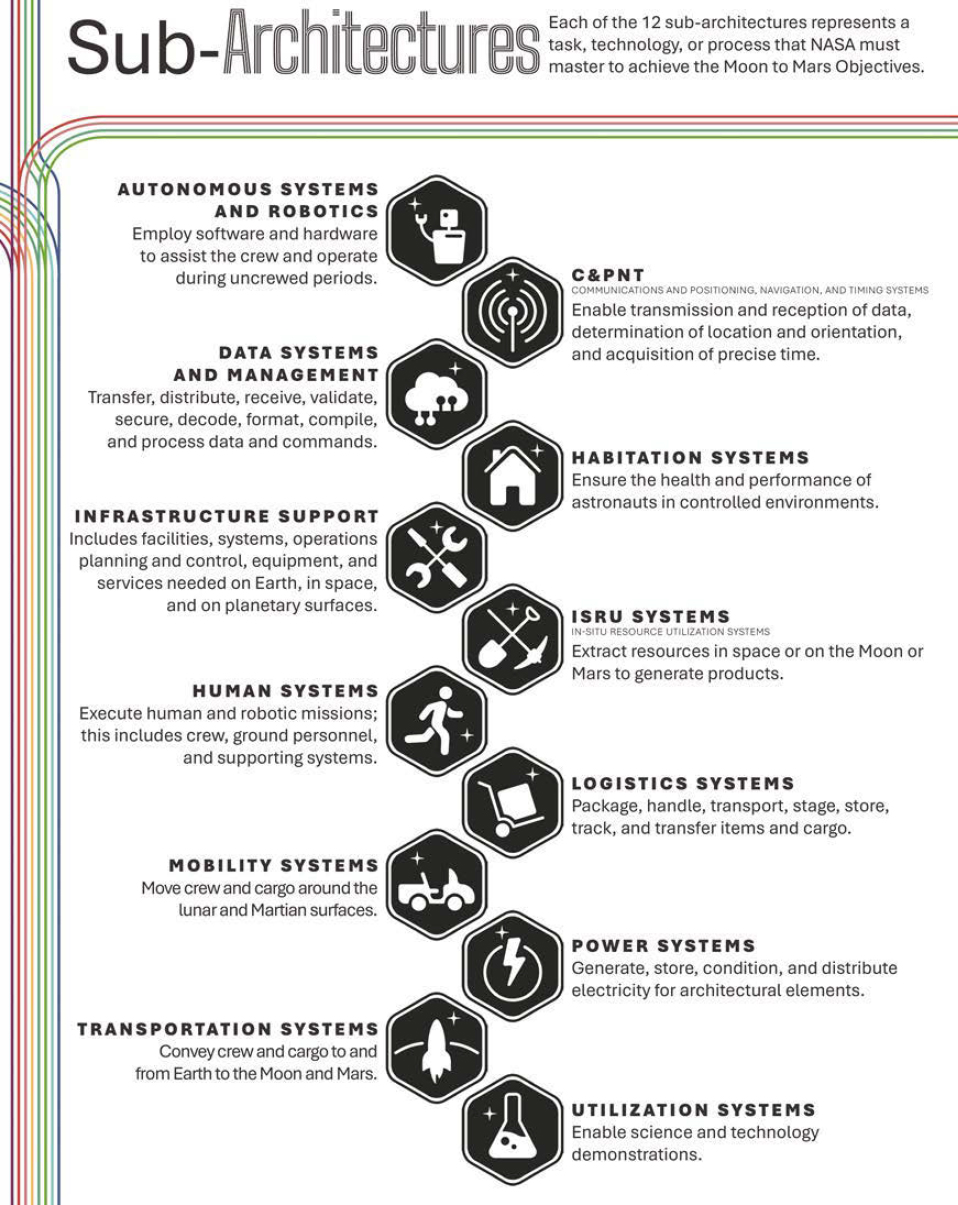
NASA’s M2M sub-architectures framework, illustrated in Figure 5-5, defines a set of common capabilities and needs relevant to planetary exploration. Sub-architectures are a tightly coupled group of systems, needs, and capabilities that function together to complete objectives, even though the objectives themselves may not be related. For example, all science objectives will require some amount of data storage and transmission as research campaigns are executed; the same statement is true for monitoring the function of environmental control and life support systems. Although these two use cases are not closely related, data and data management make up a sub-architecture because the systems are very similar.
The current set comprises autonomous and robotics systems; communications, navigation, positioning, and timing systems; data and management systems; habitation systems; infrastructure support systems; in situ resource utilization systems; human systems; logistics systems; mobility systems; power systems; transportation systems; and utilization systems such as science and technology demonstration systems. Each sub-architecture provides the task, technology, or process leading to specific architecture elements and hardware. These sub-architectures will continue to grow and evolve as mission and science objectives are decomposed and additional commonalities are recognized.
The steering committee recognizes that the definition of sub-architectures for Mars missions cannot be completed until all science objectives have been fully decomposed. However, in many cases the existing sub-architecture framework is applicable to the completion of the science objectives defined by the steering committee. Some of these synergies are identified below.
5.2.1 Autonomous Systems and Robotics
Objective Alignment: Autonomy and robotics are central to NASA’s exploration strategy, enabling systems to operate independently in communication-deprived environments. Robotic lunar missions, which prepare and equip landing sites, conduct reconnaissance, and perform preliminary resource extraction, provide crucial groundwork for Mars exploration, where communication latency and delays require high levels of autonomy.
Mars science requires autonomous or teleoperated assets for prearrival reconnaissance as well as post-departure exploration and science activities. A sparse but global network of autonomous assets, including a network of autonomous dust storm–monitoring stations, deployed drones and rovers, and power and data collection systems, will allow long-term monitoring of global and regional activity and allow exploration to continue. Human–robotic partnerships, such as rover and drone technology, could reduce human impact in Special Regions by supporting remotely operated science operations, where appropriate.
Mars Science Synergy with M2M: Autonomous and effective robotic operations are synonymous with NASA’s legacy of successful space missions. As summarized in early M2M Architecture white papers (NASA 2022a), automated landing and hazard avoidance, robotic assistance of crew exploration, sample collection and site surveillance, robotic manipulators for space suits, and autonomous crew health decision making are but a few required autonomous operations. Mars missions rely on autonomous robotic systems capable of executing complex tasks without direct human oversight. Advanced technologies refined through lunar trials will empower Mars rovers and robotic assets to navigate diverse terrains, adapt to environmental conditions, and undertake crucial tasks
SOURCE: NASA, 2024, Moon to Mars Architecture Executive Overview: 2024 Architecture Concept Review, https://www.nasa.gov/wp-content/uploads/2024/12/2024-architecture-executive-overview.pdf.
such as sampling, transportation, and habitat maintenance. Given the round-trip light time communication delays of 6–45 minutes, robotic systems have to make real-time decisions and adapt quickly, supporting human crews in tasks ranging from scientific analysis to emergency response. Leveraging lessons from lunar missions, Mars campaigns will benefit from highly reliable robotic systems that optimize efficiency, enhance safety, and extend mission reach. From robotic uncrewed operations at the lunar south pole to the software developed for the Gateway External Robotics Systems (NASA 2025b), efforts to close the autonomous and robotics technology gaps directly support Mars science objectives.
5.2.2 Communications, Position, Navigation, and Timing Systems
Objective Alignment: Robust communications and precise guidance, navigation, and control of spacecraft and surface assets are required for all Mars exploration, including precursor missions, human exploration, and robotic surface operations. In addition to hardware control, communications, position, navigation, and timing (C&PNT) provide crew communications, video collection, and data recording in support of crew safety, science objectives, and public outreach. Common standards for interoperability are needed for collaboration between the various stakeholders at Mars, supporting diverse needs such as data return or telepresence collaboration over interplanetary distances.
Mars Science Synergy with M2M: The C&PNT sub-architecture for lunar exploration, LunaNet, is in development. The network includes multiple ground stations on Earth and multiple orbital relay stations around the Moon, with a strategy that includes lunar visibility, the use of the Gateway, multiple international providers, surface assets on the Moon, and planned human landers. Multiple stakeholders drive a requirement for operations standards, for example, the LunaNet Interoperability Specification, and the International Communication Systems Interoperability Standard, among others. In addition, critical reference system components and radionavigation hardware, as well as user systems such as onboard navigation systems to manage data processing and effective navigation and a common time standard are being developed for lunar operations. A similar but different approach will be required for Mars.
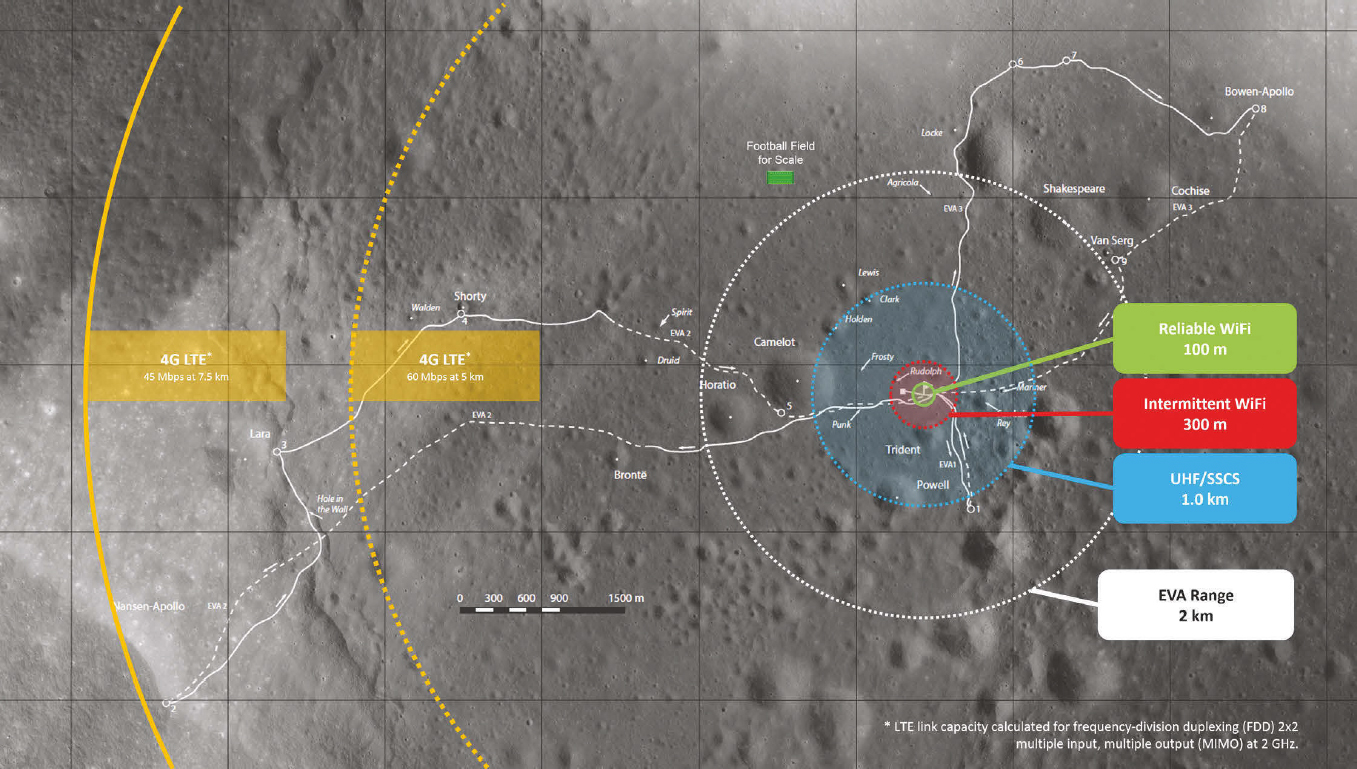
As lunar C&PNT services are made operational, a greater understanding of requirements for the Mars C&PNT architecture will mature. Key drivers are expected to include line-of-sight constraints, orbiting asset constraints, and an understanding of available Mars surface assets. Sample capability for Mars developed on the Moon includes using Wi-Fi for close-proximity high-rate video communications. Short-stay Mars missions are likely to have range-rate needs similar to those in Figure 5-6. Longer-stay missions are likely to include longer excursions and need surface or orbital relays. Through commercial partnerships, the NASA Space Technology Mission Directorate (STMD) and its partners demonstrated initial feasibility for 4G/LTE (long-term evolution) communications between landers and rovers on the Moon (i.e., the Lunar Surface Communications System, “Network in a Box” lunar mission) (Nokia Bell Labs 2025).
5.2.3 Data Systems and Management
Objective Alignment: The Mars exploration enterprise includes everything from the instruments on rovers, payloads, landers, relay satellites in orbit, machinery, and test equipment to the individual crew members on the martian surface. Of course, the system also includes all the data collection and distribution centers on Earth. The capability for data transfer, distribution, receipt, validation, formatting, compiling, and data processing is an integral part of every mission. For Mars science, data management systems requirements overlap with nearly every other sub-architecture, with closer coupling to the autonomous and robotics systems, C&PNT systems, infrastructure support systems, logistics systems, and the utilization systems sub-architectures.
Mars Science Synergy with M2M: Mars science will require standardization of measurements, technologies to process and analyze data, and the infrastructure needed to collect, transmit, store, organize, and manage data and maintain data integrity. NASA’s Lunar Data Systems and Management effort addresses this capability for Moon exploration. All work developed for lunar data systems is directly applicable to Mars. Advanced data analytics, processing, computational efficiency, and machine learning systems, including agentic artificial intelligence (AI) as well as systems for omics data collection and protection will require special consideration for Mars science.
NOTE: EVA, extravehicular activity; LTE, long-term evolution; SSCS, Space-to-Space Communications System; UHF, ultra high frequency.
SOURCE: NASA, 2023, “NASA’s Lunar Communications and Navigation Architecture,” White paper for 2023 Moon to Mars Architecture Concept Review, https://www.nasa.gov/wp-content/uploads/2024/01/lunar-communications-and-navigation-architecture.pdf.
5.2.4 Habitation Systems
Objective Alignment: Advanced life support and habitat systems are essential for sustaining human missions in extreme environments. NASA’s M2M Strategy prioritizes habitat innovations, including closed-loop environmental control and life support systems, radiation shielding, thermal control, and waste management and crew health and survival systems, which are critical for Mars missions given the planet’s intense radiation and temperature extremes. The steering committee prioritized in situ resource utilization (ISRU) processing with an early focus on water for habitation systems.
Mars Science Synergy with M2M: Mars missions—particularly those lasting 300 sols or longer—require robust, modular regenerative life support systems. Data from lunar habitats testing water recycling, air supply and purification, and thermal management offer crucial insights into the performance of closed-loop systems in low-gravity environments. Consistent with previous NASA strategies such as the Controlled Ecological Life Support System (CELSS) program, it is envisioned that bioenabled regenerative systems would evolve from meeting small fractions of the need to meeting most of the need, with the physicochemical systems becoming backups. By analogy to natural Earth-based systems, these are likely to be ecosystems of plants, microbes, and animals, and their development and maintenance will require the experts of all those fields plus ecologists experienced in microbiome-supported plant and animal systems. For Mars, where radiation exposure poses significant health risks to the astronauts, lunar experiments with regolith-based shielding, habitat construction and designs, and possible lava tube protection provide essential models. Proven technologies for insulation, redundancy, modularity, instrumentation, and environmental controls on the Moon will directly inform the design of martian habitats to support crew health and safety over extended periods.
5.2.5 Infrastructure Support
Objective Alignment: Infrastructure support systems for Mars science exploration vary significantly by selected campaign structure. Mission specifics, including surface duration, landing site selection, crew size, selected science measurements, and preplanned on-surface equipment and operations will significantly influence operations planning, facilities, and staging. However, whereas the Mars surface operational specifics will likely change by mission, mission support facilities on Earth, basic planning processes, and infrastructure support services will likely build on International Space Station (ISS) heritage and its continuous human presence in space since November 2000.
Each of the campaigns (Chapter 3) identifies preliminary architecture assumptions and key equipment and capabilities to support science performed during long and short surface stays. The most significant capabilities can be classified as infrastructure, for both the equipment itself and often the construction required for assembly and operation. Examples include drilling equipment capable of drilling up to multiple kilometers deep and dust and weather monitoring stations. Some of the more ambitious science objectives may require establishing substantial exploration infrastructure to enable science targets tens to hundreds of kilometers distant to be reached and investigated, including power stations, communication, and data storage infrastructure, landing sites, laboratory capability, and so on.
Mars Science Synergy with M2M: Lunar infrastructure support systems under development are directly applicable to needs for Mars exploration. Mars exploration infrastructure elements include augmented capabilities for crew safety, for example, extensibility via telepresence from Earth and AI-augmented support systems. Additional considerations include capabilities for surface and subsurface characterization for optimal site selection (stratigraphy, water/ice deposit location, dust storm initiation, Mars Global Circulation Model for forecasting, and remote sensing for weather forecasting) as well as infrastructure for long surface stays. Synergy with the C&PNT systems, logistics systems, mobility systems, power systems, and transportation systems will be required.
5.2.6 In Situ Resource Utilization Systems
Objective Alignment: Characterizing the martian environment for ISRU opportunities and applicability is one of the steering committee’s top science objectives. Beyond science, understanding ISRU for opportunities to support permanent habitation drives a synergy of purpose. ISRU is a cornerstone of sustainable exploration within NASA’s M2M framework. It enables the reduction of reliance on Earth-based resupply missions and enhances mission autonomy. Technologies for extracting and processing lunar resources, such as oxygen from regolith and water from ice deposits, are highly useful precursors for the more demanding ISRU requirements of Mars missions.
Mars Science Synergy with M2M: On Mars, ISRU capabilities will extend beyond basic survival needs to support fuel production and habitat expansion. This will enable long-duration exploration and preparation for potential future settlements. Lunar-tested technologies for regolith processing, oxygen generation, and water extraction directly inform ISRU systems designed for Mars’s unique resource composition. For example, extracting water ice from martian regolith would provide drinking water and oxygen and enable hydrogen production for fuel. Mars’s abundance of carbon dioxide further supports advanced ISRU processes such as fuel synthesis, broadening the application of lunar ISRU developments. Recently, ISRU technology demonstrated oxygen extraction from the carbon dioxide–rich atmosphere on Mars—specifically, the Mars Oxygen In-Situ Resource Utilization Experiment (MOXIE) operated on the Perseverance rover on Mars—to test a method that future astronauts could use to make rocket propellant or breathable air. Technology development of ISRU on the Moon and Mars is critical to build a lunar presence, create a robust space economy, and support initial human exploration of Mars campaigns.
5.2.7 Human Systems
Objective Alignment: The human systems sub-architecture consists of the systems to support crew and ground personnel, as well as all of the supporting systems required to execute missions. Although there are close linkages to C&PNT, transportation, autonomous systems and robotics, infrastructure, logistics, habitation, ISRU, and mobility systems sub-architectures, this category of scope captures those efforts that are explicitly not covered by those systems. Human systems solutions build on the competencies that are developed as exploration evolves beyond the limits of uncrewed exploration to include humans in the exploration loop. The specific focus of this sub-architecture is the safety and health of the crew. As noted in the M2M Architecture documents, “Vehicles, systems, training, and operations must be designed around the ‘human system’” as the most critical part of crewed missions in deep space (NASA 2025b).
Although the steering committee assumes that a robust crew health and safety program will be in place for any human mission, the various campaigns (see Chapter 3) point to a few key assumptions of crew performance and tasking that directly impact early architecture decisions. Most of these concerns have been identified in early M2M strategic planning:
- Crew sizes to support robust and safe surface operations;
- Technology to enable Earth independence, including health monitoring and medical support systems, and the means to address lower gravity, from deconditioning in transit to the effects of reduced gravity on wound healing (Farahani and DiPietro 2008);
- Technologies to counteract unique martian environments, like radiation protection and martian dust; and
- Solutions that address elements of isolation and long stays away from Earth.
Collectively, the “integrated, longitudinal martian environment” was reviewed, and prioritized science objectives are discussed in Chapter 4.
Mars Science Synergy with M2M: By highlighting the human systems decisions as a priority rather than as an afterthought, the M2M “architecting from the right” strategy acknowledges the need for human systems requirements to be prioritized in early decision making. The example of shifting vehicle architecture now being driven by crew considerations emphasizes NASA’s evolved planning perspective (NASA 2025b). Purposefully, lessons from the ISS are being used to inform lunar missions and eventually martian systems. NASA’s ground systems for each family of missions, from mission control to operations, are well exercised and practiced and ought to have limited challenges as NASA builds on decades of success.
Radiation protection and health monitoring are critical components of NASA’s M2M Strategy, as they pose significant risks owing to cosmic galactic and solar particle radiation. Severe radiation exposure for astronauts is a possible mission-terminating risk. In-space and lunar habitats serve as testing grounds for radiation shielding materials, dosimetry and wearable systems, and real-time health monitoring technologies, establishing the groundwork for Mars, where radiation exposure risks are heightened. Mars’s thin atmosphere (<1 percent of Earth) and absence of a magnetic field provide minimal protection against cosmic and solar radiation, necessitating advanced radiation protection and continuous health monitoring. Lunar trials with shielding materials like regolith barriers,
radiation-blocking structures, and underground lava tube protection will guide the development of martian habitats. Continuous monitoring technologies proven on the Moon will also be crucial on Mars, enabling real-time radiation exposure data-driven adaptive responses to unexpected events, thereby mitigating health risks to crew members. Health monitoring systems will reveal vital signs, radiation levels, and environmental exposures to support crew well-being and ensure timely interventions in response to extreme environmental challenges.
The challenges of Earth independence will be more difficult to address and will greatly benefit from the measurements, data, and analyses from the martian campaigns. As noted by early M2M presentations, the human systems challenge is different from those of Apollo and ISS, and will be different from the Lunar Gateway orbiter and lunar surface landings. But each level of exploration will build capability, including creatively addressing communication gaps and isolation challenges. Lunar data will inform architectures, including robotic capabilities, that enable crew readiness (NASA 2024c).
5.2.8 Logistics Systems
Objective Alignment: Logistics systems for Mars surface science include the equipment and supplies necessary to support the crew, maintain systems, and conduct science. Mission requirements shape specific campaign logistics. The campaign design, including surface-stay duration, mission sequencing, crew size, and so on, determines the requirements for what is needed and when. Logistics systems planning provides the infrastructure to track safe shipment, delivery, packaging, location, outfitting, spares, and resupply.
Mars science equipment and systems are categorized as logistics items. Although the utilization sub-architecture element covers science specific operations, the transport, packaging, delivery, and tracking of the equipment are all covered by the logistics sub-architecture element. (Logistics items are generally defined as the equipment, supplies, and hardware not required for vehicle operations.) Major equipment and construction needs are discussed in Chapters 3 and 4. Although frequently mentioned in this report, a key logistics challenge, sample return, merits specific attention. Featured prominently in the Mars campaigns, samples returned to Earth are crucial to current and future science. Curating samples for future analysis starts at the moment of collection. The location and geographic context, specimen pretreatment (e.g., stabilization and fixation), and storage conditions (for example, temperature, pressure, atmospheric composition, and so on) are all required to preserve detail at the molecular level. Mars science will require developing autonomous logistics systems with capabilities of data tracking and advanced robotics. In addition, preservation and transport of selected samples may require cryopreservation (<−80°C). Although sample curation practices may be standard, collection and preservation, over possibly multiple years, with available location and conditions will be required.
Mars Science Synergy with M2M: NASA has decades of experience with crewed exploration logistics on the ISS. Key areas include crew health and safety, on-orbit science, experience with special carriers, and logistics elements. The logistical planning includes handling, offloading, transfer; staging, storage, tracking, and integration strategies that involve multiple government, commercial, and international stakeholders. Lunar logistics and drivers have been considered at great length and captured in the M2M white papers (NASA 2023a). The Moon to Mars Architecture decisions appear to take into account the complexities of both lunar and martian logistics challenges, particularly crew consumables (e.g., food and clothing), life support (e.g., air, water, utilization, maintenance, and spares), and other supplies and materials needed to implement crewed Mars missions. As with Mars exploration, lunar logistics needs are linked to architecture decisions and mission details. There is clearly significant overlap. The initial Moon to Mars surface concept of operations includes strategies that maximize crew time available for science operations. As NASA has learned through multiple missions, to maximize time working on science, the crew needs to be highly organized, with careful thought put into when things are unstowed, allowing quick access to tools, to save time for more productive activities.
Logistics in support of Mars science will involve the additional complexity of preplaced assets and infrastructure elements, for example, drills, masts, or laboratories. A critical logistics system for all Mars science disciplines is one that effectively addresses successful sample return. Although sample selection, Mars storage, preservation, collection, transportation, and ultimately testing on Earth are driven by the science community, overall management will require significant logistics consideration and planning. Sample requirements include preserving the integrity of the samples by minimizing exposure to high temperatures, maintaining mechanical integrity, and avoiding potential contamination.
Although lunar exploration will also necessitate sample return, Mars has unique criteria not currently included in the M2M plan. Sample handling and containment methods tested on the Moon will also provide a framework for Mars, where planetary protection is essential to preserve scientific integrity and prevent cross-contamination between Earth and Mars environments.
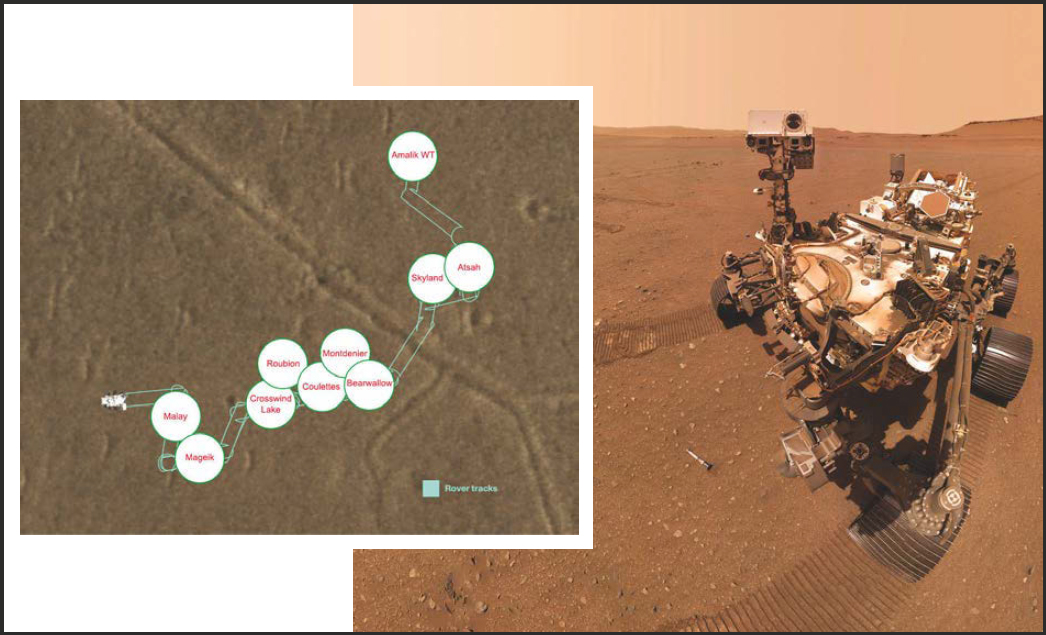
However, NASA’s strong heritage in Mars exploration and sample collection and tracking will likely also influence the Mars science sample return logistics efforts. The Mars Perseverance rover currently exploring the Jezero Crater (see Figure 5-7) provides insight into the complexities of a system to select, drill, sample, track, and store samples for future analysis on Earth. Also shown in Figure 5-7, the existing track of the rover and its approach to caching specimens helps to shape guidance for Mars logistics and tracking of individual specimens, locations, and environments in precursor missions, during crewed surface sample collection, and in post mission efforts.
5.2.9 Mobility Systems
Objective Alignment: NASA’s strategy emphasizes versatile mobility systems to enable extensive surface exploration. Crewed and robotic rovers are essential for both lunar and martian missions, facilitating the transport of crews, scientific equipment, and supplies across diverse terrains.
Mars Science Synergy with M2M: Mars missions require advanced mobility systems capable of navigating challenging terrain in extreme cold and arid conditions. Lunar mobility systems, subjected to rigorous testing in rugged areas and extreme temperatures, inform the design of future Mars rovers capable of traversing the vast martian landscape. Enhanced power systems and autonomous navigation capabilities will empower Mars rovers to traverse extensive distances and reach high-value scientific sites, significantly expanding the scope of Mars campaigns. Lunar
SOURCES: (Left) NASA/JPL-Caltech, https://science.nasa.gov/resource/perseverances-three-forks-sample-depot-map; (Right) NASA/JPL-Caltech/MSSS, https://science.nasa.gov/resource/perseverances-three-forks-sample-depot-selfie.
rover experiences with solar and nuclear power systems provide valuable insights into energy storage and management for Mars missions, where variable sunlight and dust accumulation pose challenges for photovoltaic systems.
5.2.10 Power Systems
Objective Alignment: Reliable and sustained power generation, storage, and distribution, with an ability to withstand the harsh martian environment, is mandatory for Mars exploration. Major components include power generation systems, energy storage devices (such as batteries), power conditioning and distribution systems, and potentially systems for managing waste heat. Like other systems on the Mars surface, the designs need to be as autonomous, self-monitoring, and robust as possible to allow for maximum crew time allocated to science.
Mars Science Synergy with M2M: NASA prioritized nuclear fission power for Mars surface operations for initial crewed missions to Mars in the 2024 M2M Architecture Concept Review (NASA 2024f). The selection of nuclear power technology over non-nuclear power technology supports a robust capability that ensures power over a wide range of harsh martian environments, including global dust storms and low light. The designs provide lower landed mass and volume and support not only martian power concerns but also those facing lunar missions. Key requirements include autonomous operation, limited repair capability, and an ability for prestaging. NASA estimates that megawatt-class power systems are the minimum power required for a 30-sol, two-person human Mars surface mission at 10 kW. The Lunar Surface Power Testbed will serve as an effective means to drive down risks for systems needed on Mars. For example, development of an incremental, evolvable, and scalable lunar power generation and distribution system to support continuous robotic and/or human operation at a range of power utilization and industrial power levels would help to characterize appropriate solutions for Mars.
5.2.11 Transportation Systems
Objective Alignment: As NASA noted in early architecture discussions, the multiple capabilities needed to move crew, cargo, and supplies, whether in space, associated with round-trip transit from Earth to Mars, or entry descent, landing, and ascent at Mars, are some of the first and perhaps most visible elements of a discussion on Mars exploration (NASA 2022b). The timely alignment of objectives to transportation architecture decisions is foundational to the architecting from the right strategy. Mars transportation system design trades include assessing landing sites, crew assumptions, landed mass requirements, ISRU, returning payload and specimen mass and volume, and human system risks. The campaign discussions in Chapter 3 include many of the relevant factors that can influence future architecture decisions.
Mars Science Synergy with M2M: Transportation systems elements under development for lunar exploration provide pathfinder capabilities that are directly applicable to transportation for Mars exploration. However, differences in distance and velocity between the Moon’s orbits of Earth and Mars’s and Earth’s orbits of the Sun drive complexities in vehicle capability requirements, particularly higher energy needs, longer system service life, and more stringent departure window constraints. New transportation elements for Mars exploration, including Mars transit habitats, Mars landers, Mars ascent vehicles, and large Mars cargo vehicles, are in early concept and feasibility studies, with many discussed in the annual M2M Architecture Strategy meetings (NASA 2025b).
5.2.12 Utilization Systems: Science and Technology Demonstration Systems
Objective Alignment: Advanced scientific instrumentation is crucial for achieving Mars exploration science objectives and enabling detailed in situ analysis and secure sample returns. Equipment, measurements, and alignment with science objectives are discussed in Chapters 3 and 4. Mars exploration requires sophisticated scientific instruments capable of conducting detailed analyses of geology, atmosphere, and potential biosignatures. Instruments developed for lunar applications, such as high-resolution spectrometers and regolith analysis tools, will be adapted for Mars, where precision is paramount for detecting subtle evidence of past habitability or life. The requirements for recovery of intact cores and chemically, biologically, and physically pristine samples will be different and require additional development. Potential very deep drilling to retrieve samples from below the cryosphere is a new and challenging need for Mars.
SOURCE: NASA, 2024, “Architecture-Driven Technology Gaps,” White paper for 2024 Moon to Mars Architecture Concept Review, https://www.nasa.gov/wp-content/uploads/2024/12/acr24-architecture-technology-gaps.pdf.
Mars Science Synergy with M2M: Lunar missions will validate novel spectrometry, imaging, and containment technologies under reduced gravity conditions, directly informing instrumentation designs for Mars.
5.2.13 Technology Gaps
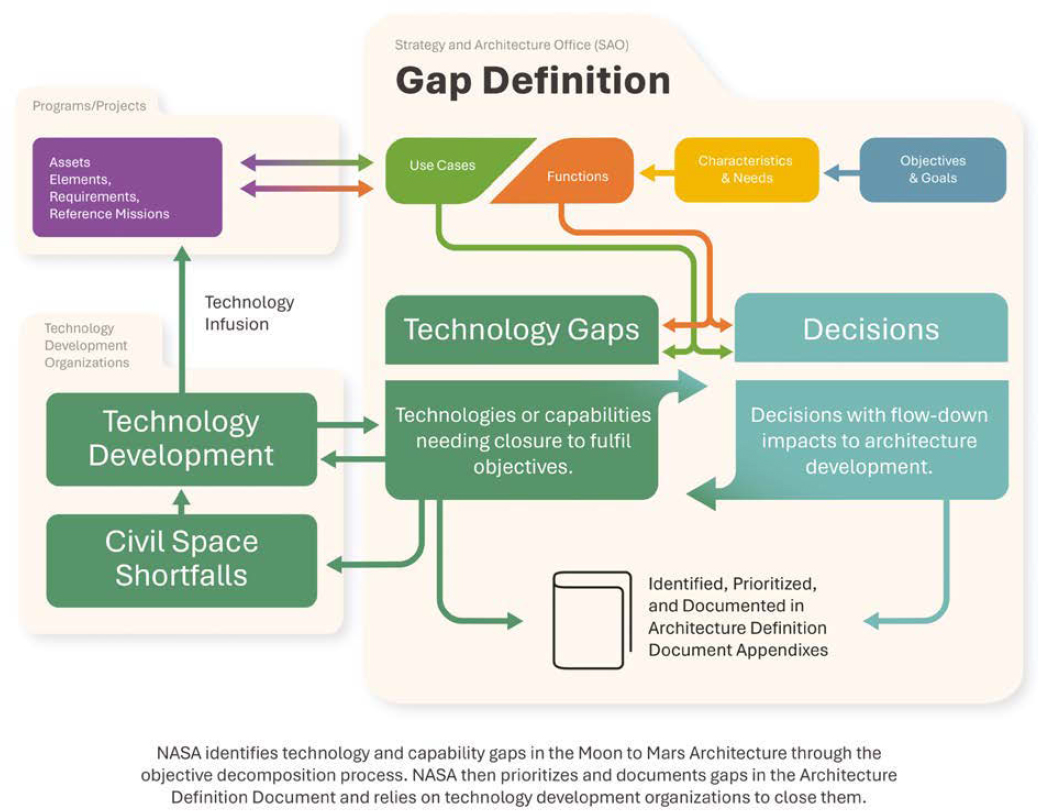
This section links the science objectives identified by the steering committee and the associated characteristics, needs, and use cases (e.g., key measurements) derived from the notional campaigns, with sub-architectures identified in the current iteration of the M2M Architecture (NASA 2025b). Incomplete representation and alignment of science objectives and the M2M Architecture are to be expected. Generally, this occurs for one or both of two reasons: (1) the architecture requires further work in that area, or (2) there is a technology gap (Figure 5-8). The M2M Architecture is well suited to address both types of needs.
Table 5-1 summarizes the current M2M sub-architectures, their applications to Mars science objectives, development areas for recurrent M2M investment, and examples of additional capabilities required for Mars campaigns. New and evolving requirements relevant to human Mars exploration are identified, but no attempt is
TABLE 5-1 Relationship of Moon to Mars (M2M) Existing Sub-Architectures to Mars Science Investment Needs
| Sub-Architecture | Applicability to Mars Science | Current M2M Investment Areas | Example Additional Capabilities Required for Mars Campaigns |
|---|---|---|---|
| Autonomous Systems and Robotics | Software and hardware to assist the crew and operate during uncrewed periods | Extreme access equipment, extreme environment technology, commercial rovers, hoppers |
|
| Communications and Positioning, Navigation, and Timing Systems | Transmission and reception of data, determination of location, and precise timing required for precursor missions, human exploration, and robotic surface operations | Near Space Network, Deep Space Network, Lunar Communications Relay and Navigation Systems, Lunar Surface Relay-Mobile |
|
| Data and Management Systems | Avionics and software capabilities that work together to manage, compute, store, translate, and ensure integrity and interoperability of data for use throughout the architecture | ISS and Gateway advanced systems: responsibilities of this sub-architecture include identifying and analyzing data handling (e.g., commands, files, telemetry, imagery, audio, and biomedical) |
|
| Habitation Systems | Ensure health and performance of astronauts in controlled environments | Surface habitats |
|
| Infrastructure Support | Facilities, systems, operations planning and control, equipment, and services | Planetary imagery and other phenomenology |
|
| Sub-Architecture | Applicability to Mars Science | Current M2M Investment Areas | Example Additional Capabilities Required for Mars Campaigns |
|---|---|---|---|
| In Situ Resource Utilization (ISRU) Systems | Extract resources. Collecting, processing, storing, and using materials found and/or manufactured on the surface in support of long-duration missions | Excavation and construction equipment; commercial-scale water, oxygen, metals, and commodity production; in situ derived feedstock for construction, manufacturing, and energy generation |
|
| Human Systems | Crew, ground personnel, and supporting systems required for successfully conducting human-in-the-loop science as well as ensuring crew health and successful return. | Exploration ground systems, spacesuits, Environmental Control and Life Support System (ECLSS) technology |
|
| Logistics Systems | Packaging, handing, transporting, tracking, and transferring items and cargo | Integrated surface logistics architecture |
|
| Mobility Systems | Moving crew and cargo on the martian surface, including the payloads and equipment necessary to capture scientific data, scouting and transit (identified by all panels) | Lunar Terrain Vehicle (1000 km), Endurance rover (>2000 km), pressurized rover |
|
| Power Systems | Generate, store, and distribute power for all elements | Vertical solar array technologies and fission surface power |
|
| Transportation Systems | Landers, launch systems required for cargo and crew | Space Launch System (SLS) and launch vehicle adapter, commercial launch systems, landers, and habitats |
|
| Utilization Systems: Science and Technology Demonstration Systems | Enabling capabilities in support of science objectives | Lunar sample return freezer system, plant growth and development payload, regolith analyzer, ground test equipment, and dust mitigation systems |
|
NOTE: AI, artificial intelligence; ISS, International Space Station; PNT, position, navigation, and timing.
SOURCE: Current M2M Investment Areas data from NASA, 2025, “NASA’s Moon to Mars Architecture Definition Document,” ESDMD-001 Rev-B.1, https://www.nasa.gov/wp-content/uploads/2024/12/esdmd-001-add-rev-b.pdf.
made to generate a comprehensive inventory. Some of these requirements, which are referred to as “design reference requirements,” may be fulfilled with technology developed for ISS or lunar exploration. Others will require additional capabilities, and some can be characterized as technology gaps. The steering committee has adopted the narrow definition of “technology gap” utilized by NASA: “If NASA can initiate a project or program to meet an architectural need using existing technology, then that area is not a technology gap. Architecture-driven technology gaps require entirely new technologies or significant performance advancement in existing technologies to establish a capability needed to achieve the Moon to Mars Objectives” (NASA 2024a, p. 1).
5.3 TRANSLATING SCIENCE OBJECTIVES INTO DESIGN REFERENCE REQUIREMENTS
As described in the introduction to this chapter, science requirements relevant to human exploration of Mars will be effectuated using the M2M Architecture Definition Framework. This section illustrates how the M2M Science, Science Enabling and Applied Science Objectives, and the Science Objectives for Humans to Mars identified by the steering committee can be used to populate science requirements in the M2M architecture.
The campaigns’ science objectives and science measurements incorporate use cases and performance and functional characteristics, which can be thought of as design reference requirements. The full architectural decomposition and tracing process starting with the science objectives will complete the investment mapping and gap identification needed to support Mars exploration. In turn, this analysis will support sub-architecture definition, technology investment mapping, and gap identification as the plans evolve to support Mars exploration. A preliminary assessment of the technology and investment mapping against existing sub-architectures is provided in Section 5.2.
5.3.1 Current State of Development
The science objectives of this report are aligned with the M2M goals and objectives and the campaigns defined in Chapter 3, which provides the characteristics and needs information along with use cases and functions needed to complete the linkage and decomposition. It is beyond the scope of this study to perform a comprehensive tracing of all the goals to objectives to characteristics and needs to use cases and functions. In particular, the tracing and linkage between the M2M Science, Science Enabling, and Applied Science Goals is work still to be done.
For reference, the NASA Moon to Mars Objectives document (NASA 2022b) includes Science Objectives grouped by NASA science discipline area as well as Science Enabling and Applied Science Goals as shown below in Tables 5-2 through 5-7.
TABLE 5-2 Moon to Mars Lunar/Planetary Science (LPS) Goal
| Lunar/Planetary Science (LPS) Goal: Address high priority planetary science questions that are best accomplished by on-site human explorers on and around the Moon and Mars, aided by surface and orbiting robotic systems. | |
|---|---|
| LPS-1 | Uncover the record of solar system origin and early history, by determining how and when planetary bodies formed and differentiated, characterizing the impact chronology of the inner solar system as recorded on the Moon and Mars, and characterize how impact rates in the inner solar system have changed over time as recorded on the Moon and Mars. |
| LPS-2 | Advance understanding of the geologic processes that affect planetary bodies by determining the interior structures, characterizing the magmatic histories, characterizing ancient, modern, and evolution of atmospheres/exospheres, and investigating how active processes modify the surfaces of the Moon and Mars. |
| LPS-3 | Reveal inner solar system volatile origin and delivery processes by determining the age, origin, distribution, abundance, composition, transport, and sequestration of lunar and Martian volatiles. |
| LPS-4 | Advance understanding of the origin of life in the solar system by identifying where and when potentially habitable environments exist(ed), what processes led to their formation, how planetary environments and habitable conditions have co-evolved over time, and whether there is evidence of past or present life in the solar system beyond Earth. |
SOURCE: NASA, 2023, NASA’s Moon to Mars Strategy and Objectives Development, https://www.nasa.gov/wp-content/uploads/2023/04/m2m_strategy_and_objectives_development.pdf.
TABLE 5-3 Moon to Mars Heliophysics Science (HS) Goal
| Heliophysics Science (HS) Goal: Address high priority heliophysics science and space weather questions that are best accomplished using a combination of human explorers and robotic systems at the Moon, at Mars, and in deep space. | |
|---|---|
| HS-1 | Improve understanding of space weather phenomena to enable enhanced observation and prediction of the dynamic environment from space to the surface at the Moon and Mars. |
| HS-2 | Determine the history of the Sun and solar system as recorded in the lunar and Martian regolith. |
| HS-3 | Investigate and characterize fundamental plasma processes, including dust-plasma interactions, using the cislunar, near-Mars, and surface environments as laboratories. |
| HS-4 | Improve understanding of magnetotail and pristine solar wind dynamics in the vicinity of the Moon and around Mars. |
SOURCE: NASA, 2023, NASA’s Moon to Mars Strategy and Objectives Development, https://www.nasa.gov/wp-content/uploads/2023/04/m2m_strategy_and_objectives_development.pdf.
TABLE 5-4 Moon to Mars Human and Biological Science (HBS) Goal
| Human and Biological Science (HBS) Goal: Advance understanding of how biology responds to the environments of the Moon, Mars, and deep space to advance fundamental knowledge, support safe, productive human space missions and reduce risks for future exploration. | |
|---|---|
| HBS-1 | Understand the effects of short- and long-duration exposure to the environments of the Moon, Mars, and deep space on biological systems and health, using humans, model organisms, systems of human physiology, and plants. |
| HBS-2 | Evaluate and validate progressively Earth-independent crew health and performance systems and operations with mission durations representative of Mars-class missions. |
| HBS-3 | Characterize and evaluate how the interaction of exploration systems and the deep space environment affect human health, performance, and space human factors to inform future exploration-class missions. |
SOURCE: NASA, 2023, NASA’s Moon to Mars Strategy and Objectives Development, https://www.nasa.gov/wp-content/uploads/2023/04/m2m_strategy_and_objectives_development.pdf.
TABLE 5-5 Moon to Mars Physics and Physical Science (PPS) Goal
| Physics and Physical Science (PPS) Goal: Address high priority physics and physical science questions that are best accomplished by using unique attributes of the lunar environment. | |
|---|---|
| PPS-1 | Conduct astrophysics and fundamental physics investigations of space and time from the radio quiet environment of the lunar far side. |
| PPS-2 | Advance understanding of physical systems and fundamental physics by utilizing the unique environments of the Moon, Mars, and deep space. |
SOURCE: NASA, 2023, NASA’s Moon to Mars Strategy and Objectives Development, https://www.nasa.gov/wp-content/uploads/2023/04/m2m_strategy_and_objectives_development.pdf.
TABLE 5-6 Moon to Mars Science-Enabling (SE) Goal
| Science-Enabling (SE) Goal: Develop integrated human and robotic methods and advanced techniques that enable high-priority scientific questions to be addressed around and on the Moon and Mars. | |
|---|---|
| SE-1 | Provide in-depth, mission-specific science training for astronauts to enable crew to perform high-priority or transformational science on the surface of the Moon, and Mars, and in deep space. |
| SE-2 | Enable Earth-based scientists to remotely support astronaut surface and deep space activities using advanced techniques and tools. |
| SE-3 | Develop the capability to retrieve core samples of frozen volatiles from permanently shadowed regions on the Moon and volatile-bearing sites on Mars and to deliver them in pristine states to modern curation facilities on Earth. |
| SE-4 | Return representative samples from multiple locations across the surface of the Moon and Mars, with sample mass commensurate with mission-specific science priorities. |
| SE-5 | Use robotic techniques to survey sites, conduct in situ measurements, and identify/stockpile samples in advance of and concurrent with astronaut arrival, to optimize astronaut time on the lunar and Martian surface and maximize science return. |
| SE-6 | Enable long-term, planet-wide research by delivering science instruments to multiple science-relevant orbits and surface locations at the Moon and Mars. |
| SE-7 | Preserve and protect representative features of special interest, including lunar permanently shadowed regions and the radio quiet far side as well as Martian recurring slope lineae, to enable future high-priority science investigations. |
SOURCE: NASA, 2023, NASA’s Moon to Mars Strategy and Objectives Development, https://www.nasa.gov/wp-content/uploads/2023/04/m2m_strategy_and_objectives_development.pdf.
TABLE 5-7 Moon to Mars Applied Science (AS) Goal
| Applied Science (AS) Goal: Conduct science on the Moon, in cislunar space, and around and on Mars using integrated human and robotic methods and advanced techniques, to inform design and development of exploration systems and enable safe operations. | |
|---|---|
| AS-1 | Characterize and monitor the contemporary environments of the lunar and Martian surfaces and orbits, including investigations of micrometeorite flux, atmospheric weather, space weather, space weathering, and dust, to plan, support, and monitor safety of crewed operations in these locations. |
| AS-2 | Coordinate on-going and future science measurements from orbital and surface platforms to optimize human-led science campaigns on the Moon and Mars. |
| AS-3 | Characterize accessible lunar and Martian resources, gather scientific research data, and analyze potential reserves to satisfy science and technology objectives and enable in situ resource utilization (ISRU) on successive missions. |
| AS-4 | Conduct applied scientific investigations essential for the development of bioregenerative-based, ecological life support systems. |
| AS-5 | Define crop plant species, including methods for their productive growth, capable of providing sustainable and nutritious food sources for lunar, Deep Space transit, and Mars habitation. |
| AS-6 | Advance understanding of how physical systems and fundamental physical phenomena are affected by partial gravity, microgravity, and general environment of the Moon, Mars, and deep space transit. |
SOURCE: NASA, 2023, NASA’s Moon to Mars Strategy and Objectives Development, https://www.nasa.gov/wp-content/uploads/2023/04/m2m_strategy_and_objectives_development.pdf.
TABLE 5-8 Linkage of the Science Objectives in This Report to the Current Moon to Mars Objectives
| Prioritized Science Objectives | Links to M2M Science Objective | Links to M2M Science Enabling (SE) or Applied Science (AS) Objective, or Operations (OP) Goal |
|---|---|---|
|
LPS-4 | All SE objectives AS-3 |
|
LPS-4 | All SE objectives AS-1 |
|
LPS-1, LPS-2, LPS-3 LPS-4, HS-2 |
All SE objectives AS-3 |
|
HBS-1 HBS-2 |
SE-1 SE-2 SE-4 |
|
LPS-2 HS-1 HS-3 |
SE-1, SE-2, SE-5, SE-6 |
|
HBS-1 LPS-2 LPS-3 |
SE-1,SE-2 SE-5, SE-6 AS-3, MI-4, OP-3, OP-11 |
|
HBS-1 HBS-2 |
SE-1, SE-2 AS-4 |
|
HBS-1 HBS-2 |
SE-1, SE-2, SE-4, AS-4 |
|
HBS-1 HBS-2 |
SE-1, SE-2, AS-4 |
|
HBS-1 HBS-2 |
SE-1, SE-2, AS-3, AS-4, AS-5, AS-6 |
|
HS-1 | SE-1, SE-2, SE-4, SE-5 AS-1, AS-2, AS-4 |
NOTE: HBS, human and biological science; HS, heliophysics science; LPS, lunar and planetary science; M2M, Moon to Mars. See also Tables 5-2 to 5-7.
SOURCE: Data from NASA, 2023, NASA’s Moon to Mars Strategy and Objectives Development, https://www.nasa.gov/wp-content/uploads/2023/04/m2m_strategy_and_objectives_development.pdf.
5.3.2 Relating Report Objectives to Moon to Mars Science Priorities
Table 5-8 shows the linkage of this report’s Mars-specific prioritized science objectives to the M2M Science Objectives as well as to the M2M Science Enabling and Applied Science Objectives. Additional detail and linkages can be found in the campaign descriptions, disciplinary descriptions, and STMs from each of the four panels of this committee (Appendixes B–E and J).
Note that the M2M Mars Infrastructure, Transportation, and Operations Objectives were also evaluated and found to be consistent with the campaign capabilities and needs. Whereas most could have been cited, the linkages below are only the ones with linkage to a specific science objective. From the prioritized objectives of this committee and the campaign definition, the committee did not identify linkages to the Moon to Mars PPS-2: “Advance understanding of physical systems and fundamental physics by utilizing the unique environments of the Moon, Mars, and deep space.” This is not a statement that such work is unimportant. As the architecture progresses and expeditions and/or missions are defined, science workshops need to be convened to identify opportunities for conducting such experiments.
5.3.3 Example Case Studies
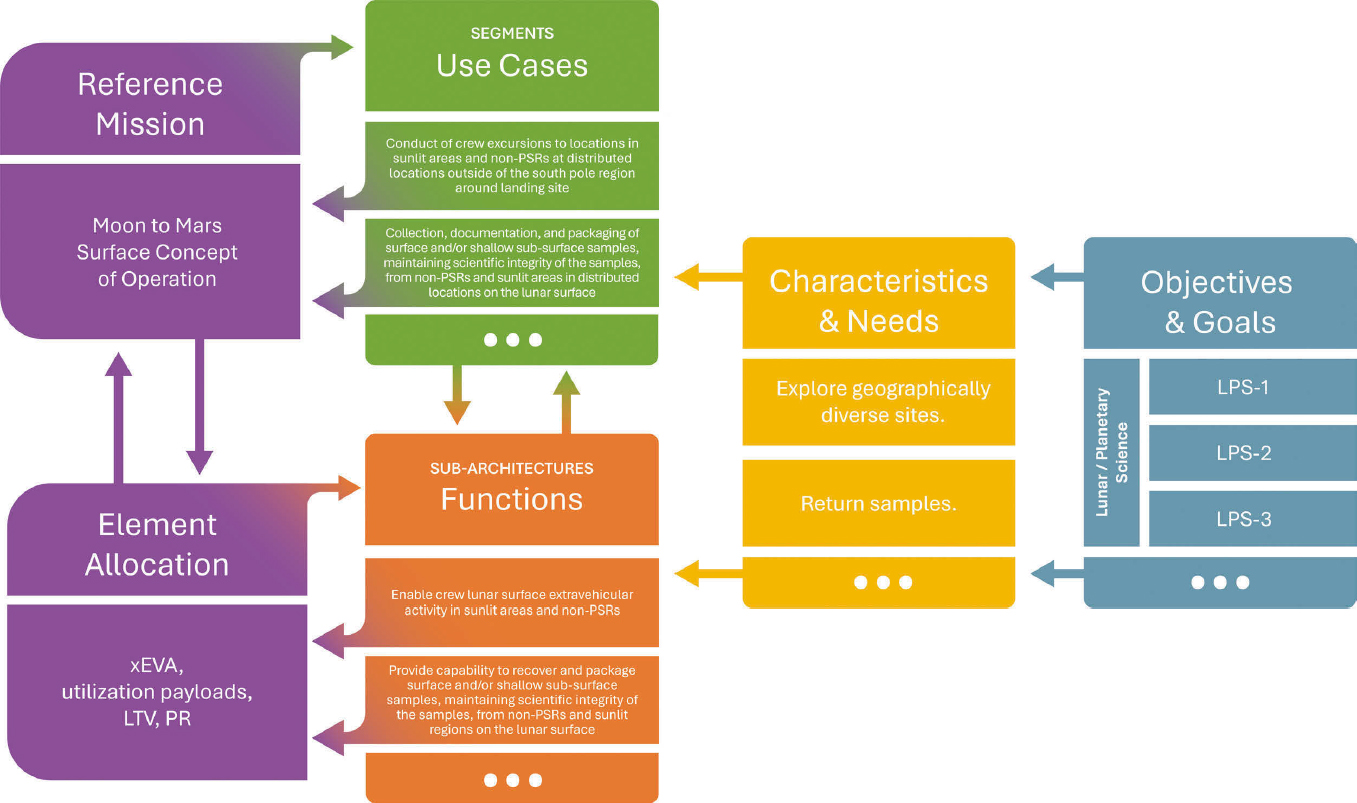
Science goals for Mars will be translated into the M2M Architecture in the near future, increasing the complexity and scope of the sub-architecture framework (see Figure 5-9).
Completing the decomposition and tracing of objectives to characteristics and needs to use cases and functions as shown in Figure 5-10 will provide detail but also identify those that are missing or incomplete.
The campaign descriptions are inherently a compendium of use cases and functional descriptions along with metrics that can be thought of as design reference requirements. Many of the functions needed to execute the campaigns are already described in the Architecture Definition Document (ADD) but are presently linked to non-science-related goals so completing the decomposition would serve to validate much of the current content. In other cases, the needed functions are missing or incomplete and completing the work will fill gaps and provide additional traceability. This section contains three examples spanning the space from completing an already substantially complete description to adding significantly new functions, capabilities, and needs in areas not currently well captured.
Case Study: Finding Extant or Extinct Life or Prebiotic Chemistry
Answering the question “Are we alone in the universe?” is a universally understood imperative. Understanding of the origin of life in the solar system has been an overarching theme of NASA’s robotic exploration for decades, heavily driven by the strategy “follow the water.” Mars is the first place beyond Earth where field scientists will
NOTE: EVA, extravehicular activity; LPS, lunar and planetary science; LTV, Lunar Terrain Vehicle; PR, pressurized rover; PSR, permanently shadowed regions.
SOURCE: NASA, 2025, Moon to Mars Architecture Definition Document, ESDMD-001 Rev-B.1, https://www.nasa.gov/wp-content/uploads/2024/12/esdmd-001-add-rev-b.pdf.
be able to be effectively deployed on a body with the potential for presently having or having had life at some point in its history.
Identifying where and when potentially habitable environments exist(ed), what processes led to their formation, how planetary environments and habitable conditions have coevolved over time, and whether there is evidence of past or present life or prebiotic chemistry on Mars is both a compelling goal and a driver of capabilities and planning to effect the search. Planning will need to allow for many carefully selected sites, both to increase the opportunity for positive results and to ensure that negative results are not simply the result of unfortunate site selection. Water-bearing sites have the potential for harboring life but are also valuable as resource extraction sites for ISRU and establishment of long-term sustainable habitats, so strategies and criteria will be needed to “clear” a site for exploitation.
The measurements needed to achieve the associated science objectives and the campaign descriptions in Chapter 3 provide useful information in completing the linkage of science, science enabling, and applied science objectives specified in the Moon to Mars Architecture and decomposition to characteristics, needs, use cases, and function. It was beyond the scope of this study to be comprehensive, but useful examples are shown in Table 5-9 for the associated “target” measurements, with more needing to be gleaned from the campaign descriptions and Table 3-2. In addition, there is the opportunity to derive design reference requirements useful for technology investment planning.
For example, there are currently function descriptions in the Mars ADD for “shallow” and “deep” sample collection but no quantification or other functional requirements on collecting and preserving the sample. From the current report, “shallow” means less than 30-m depth, collection from at least three separate sites, identification, the ability to collect from layered water-bearing sites, and handling and likely return of the extracted samples to preserve spatial, biological, and chemical integrity. Similarly, “deep” means the additional depth capability from greater than 30 m up to 5 km with the same other attributes. Such analysis can thus be used to define design reference requirements. It is anticipated that this additional information will serve not only to illuminate concepts of operations and trade studies but also to inform decisions needed for investments to close performance and/or functional gaps. It is recognized that the “stretch” case of deep drilling to kilometer depths is very challenging for early missions but was retained to drive trades and investments in advanced technological capabilities that might make it practicable. Such drilling is also not a one-size-fits-all approach and needs to be tailored to the specific science needs. For example, see the case study later in this chapter, “Drilling on Mars for In Situ Resource Utilization.”
Case Study: Spatially Resolved Transcriptomics
Compared to the astrobiology and geophysics objectives, biological and physical sciences and human factors objectives will need better definition and/or addition of new capabilities and needs and/or functions to adequately address Science Objectives 4, 6, 8, and 10. Nucleic acid sequencing is an excellent case in point.
The campaigns described in Chapter 3 will be the first time that an integrated ecosystem of humans, plants, animals, and microbes will coexist on a planetary body other than Earth. Because determining the extent to which genes are being expressed is foundational to the study of biological adaptation, sequencing of deoxyribonucleic acid (DNA), ribonucleic acid (RNA), and protein figures prominently in the science objectives.
First- and second-generation sequencing technologies have been employed for purposes such as characterizing variation in DNA sequence, sequencing genomes where there is no reference sequence available (aka, de novo sequencing), sequencing complex microbiomes, detecting epigenetic changes within the genome, quantitating the abundance of messenger RNA (mRNA) transcripts, and identifying the degree of translation of mRNA transcripts (Schadt et al. 2010). These technologies shared a common feature that relied on amplification—the growth of clusters of DNA, which were subsequently sequenced and synchronized. Consequently, they had a resolution averaged across many cells and were relatively cumbersome for field application. In contrast, third-generation technologies sequence DNA and RNA directly with single-cell resolution. They interrogate single molecules of DNA, enabling longer reads at lower cost. Third-generation sequencers have reached a high level of technology readiness for spaceflight (technology readiness level [TRL] >7) and have already been used to demonstrate the feasibility of off-Earth “swab
TABLE 5-9 Notional Decomposition of Search for Extant or Extinct Life or Prebiotic Chemistry by Architecting from the Right
 |
||||
|---|---|---|---|---|
| Functions | Use Cases | Science Objective Target Measurements | Study Science Objectives | Moon to Mars Objectives |
|
|
|
SO-1. Determine if, in the exploration zone, evidence can be found for any of the following: habitability, indigenous extant or extinct life, and/or indigenous prebiotic chemistry. SO-2. Characterize past and present water and CO2 cycles and reservoirs within the exploration zone to understand their evolution. SO-3. Characterize and map the geologic record and potential niche habitats within the exploration zone to reveal Mars’s evolution and to provide geologic context to other investigations, including the study of bolide impacts, volcanic and intrusive igneous activity, the sedimentary record, landforms, and volatiles, including liquids and ices. |
LPS-2. Advance understanding of the geologic processes that affect planetary bodies by determining the interior structures, characterizing the magmatic histories, characterizing ancient, modern, and evolution of atmospheres/exospheres, and investigating how active processes modify the surfaces of the Moon and Mars. LPS-3. Reveal inner solar system volatile origin and delivery processes by determining the age, origin, distribution, abundance, composition, transport, and sequestration of lunar and Martian volatiles. LPS-4. Advance understanding of the origin of life in the solar system by identifying where and when potentially habitable environments exist(ed), what processes led to their formation, how planetary environments and habitable conditions have co-evolved over time, and whether there is evidence of past or present life in the solar system beyond Earth. HS-2. Determine the history of the Sun and solar system as recorded in the lunar and Martian regolith. |
NOTES: Goals and objectives are derived from the M2M Architecture and this study; characteristics and needs from Table 3-2; use cases from STMs and Table 3-3; and functions from Table 3-3. HS, heliophysics science; LPS, lunar and planetary science. See also Tables 5-2 to 5-7.
SOURCES: Color key at top from NASA, 2024, “Architecture-Driven Technology Gaps,” White paper for 2024 Moon to Mars Architecture Concept Review; Moon to Mars Objectives data from NASA, 2023, NASA’s Moon to Mars Strategy and Objectives Development.
to sequencer” community microbial profiling on the ISS (Stahl-Rommel et al. 2021). These capabilities will certainly improve with time and therefore represent relatively low-risk technology investments for early Mars missions.
Single-cell sequencing resulted in an explosion of research focused on characterizing cell heterogeneity. However, this technology has an important limitation: it is best suited to the study of cells isolated intact from surrounding tissue. Although this approach is sufficient for many applications such as sampling of microbial populations and characterization of immune cells, the processes for isolating single cells from tissues and then lysing them to extract RNA can cause cell stress and/or cell death. More importantly, they disrupt cell context, such as tethering to scaffolding structures or adjacencies to neighboring cells. In contrast, spatially resolved transcriptomics, also known as spatial transcriptomics, is a fourth-generation technology based on in situ characterization of transcripts at the subcellular level to provide contextual information and describe tissue architecture. Because the location of any given cell relative to co-located cells and noncellular structures is useful to appreciate cellular phenotype, cell state, and cell and tissue function, spatial analysis contributes to understanding the molecular underpinning in health and disease (Williams et al. 2022).
The workflow for spatial molecular imaging is complex, often requiring the sectioning of stabilized tissues or organisms prior to microvisualization at the cellular level, microdissection, and analysis. The low state of technology readiness presents, in the steering committee’s view, too great a technology challenge to contemplate spatial omic analysis on the surface of Mars during early human missions. Nevertheless, spatial omics could be enabled by hybrid workflows such as cryofixation of plant, animal, microbial, or human samples on Mars that are subsequently returned to Earth for more detailed analysis. These storage and return requirements have not yet been fully decomposed in the M2M Architecture (NASA 2025b).
Thus, the decomposition of science requirements has to address two needs: (1) that omic analysis will be desirable on Mars, and (2) that more complex techniques such as spatial analysis will be better addressed with sample return to Earth, which both maximizes science engagement on Earth and closes a technology gap. Table 5-10 summarizes current understanding using the M2M framework.
Case Study: Dust
Dust poses a significant challenge for astronauts on both the lunar and martian surfaces (e.g., Cain 2010; Bueno et al. 2024). The martian crust includes sulfate minerals, clay minerals (phyllosilicates), chlorides/chlorates, and occasional carbonates (Carter et al. 2013), some of which can be significant human health hazards. Toxic components of martian dust include perchlorates, silica, nanophase iron oxides, and gypsum, and trace amounts of toxic metals such as chromium, beryllium, arsenic, and cadmium (Wang et al. 2025).
Via lunar missions, astronauts will gain experience conducting extended science campaigns in dusty environments, preparing them for human Mars exploration. Habitation, mobility, transportation, power systems, and ISRU systems will be validated in the lunar dusty environment before deployment to Mars. Science activities in the dusty and cold lunar environment will prepare astronauts for conducting science activities (e.g., instrument deployment or drilling) in the similarly hostile martian environment. Conducting these activities on dark lunar polar craters will further prepare astronauts to conduct them during the potentially months-long dark, global dust storm conditions on Mars.
Lunar dust is persistently adhesive and abrasive, owing to its combined physical and electrical properties (Cain 2010). The lower gravitational acceleration reduces gravitational sedimentation and increases deposition of fine particles at greater distances from their source. During the Apollo program’s extravehicular activities (EVAs), or spacewalks, dust abrasion of astronauts’ spacesuits posed hazards to the integrity of the pressure garment (most notably glove abrasion, clogging of mechanisms, and diminished heat rejection) (e.g., Gaier 2005) and contamination hazards during suit removal inside the lunar module (e.g., Cain 2010). In microgravity conditions, deposition of small particles (smaller than 2 μm) in the lung is greater than at 1 g and they are deposited more peripherally in the bronchial tree, beyond the reach of the mucociliary clearance system (Darquenne 2014). The wet history of Mars has enhanced chloride and sulfate minerals in the near surface (e.g., Hynek et al. 2019), some of which have no lunar counterpart.
TABLE 5-10 Notional Decomposition of Functional Genomic and Spatially Resolved Transcriptomic Analysis by Architecting from the Right
|
||||
|---|---|---|---|---|
| Functions | Use Cases | Science Objective Target Measurement | Study Science Objectives | Moon to Mars Objectives |
|
|
Track a full suite of molecular, medical, and behavioral crew health parameters with sufficient detail to maintain fitness for duty and to differentiate individual responses during cruise, landing, early exposure, and equilibration and exposure to Mars conditions ranging from 30 to 300 sols and show that steady state is reached. Monitor changes in crew and habitat microbiomes over the same periods and correlate to physiological and behavioral changes in humans. Track functional genomics and heritable epigenetics of one animal species ontologically mapped to humans over two or more generations to determine responses to cruise, landing, early exposure, and equilibration to Mars conditions. Monitor crew habitat and crew microbiomes to track changes during cruise, landing, early exposure, and equilibration to Mars conditions, and determine when the microbiomes have stabilized under Mars conditions. Measure plant and plant microbiome responses and evolution in cruise, landing, early exposure, and equilibration to Mars conditions and determine when microbiomes have stabilized under Mars conditions |
SO-4. Determine the longitudinal impact of the integrated martian environment on crew physiological, cognitive, and emotional health, including team dynamics, and confirm effectiveness of countermeasures. SO-7. Determine whether the integrated martian environment affects reproduction or the functional genome across multiple generations in at least one model plant species and one model animal species. SO-8. Determine throughout the mission whether or not microbial population dynamics and species distribution in biological systems and habitable volumes are stable and are not detrimental to astronaut health and performance. SO-10. Determine the longitudinal impact of the integrated martian environment on plant physiology and development across multiple generations where possible as part of an integrated ecosystem of plants, microbes, and animals. |
HBS-1. Understand the effects of short- and long-duration exposure to the environments of the Moon, Mars, and deep space on biological systems and health, using humans, model organisms, systems of human physiology, and plants. HBS-3. Characterize and evaluate how the interaction of exploration systems and the deep-space environment affect human health, performance, and space human factors to inform future exploration-class missions. |
NOTES: Goals and objectives are derived from the M2M architecture and this study; characteristics and needs from Table 3-2; use cases from STMs and Table 3-3; and functions from Table 3-3. HBS, human and biological science.
SOURCES: Color key at top from NASA, 2024, “Architecture-Driven Technology Gaps,” White paper for 2024 Moon to Mars Architecture Concept Review; Moon to Mars Objectives data from NASA, 2023, NASA’s Moon to Mars Strategy and Objectives Development.
Dust is also expected to be a significant hazard during Mars landings, ascents from the surface, and EVAs. The interaction of thruster plumes with the regolith on both the Moon and Mars stirs up large quantities of dust, which can impair visibility and damage flight hardware (e.g., Clegg-Watkins et al. 2016; Watkins et al. 2021; Bueno et al. 2024). On Mars, dust storms further complicate surface operations by depositing dust on solar panels and any hardware placed on the surface (e.g., Vicente-Retortillo et al. 2018; Lorenz et al. 2021). Furthermore, global dust storms can reduce surface solar radiation to less than 1 percent of the typical value for weeks, making surface exploration extremely challenging (e.g., Leovy et al. 1973; Wang and Richardson 2015; Kass et al. 2020). Extended lunar missions can help prepare astronauts to operate in the similarly dusty martian surface, although additional work will be needed to understand the translation of lunar results to martian application, given the differences in wind weathering and chemical composition on Mars.
Mitigating the effects of martian dust is captured qualitatively in the M2M Architecture Definition Document but does not capture the need to understand dust storm origin and evolution, details of needed internal and external sampling, dust characterization, or impacts on equipment or crew. As illustrated in Table 5-11, linkage to the science objective and elucidation of the additional detail and quantification in the characteristics and needs via the use case in the campaigns and measurement objectives will provide information needed to create these design reference requirements.
Case Study: Drilling on Mars for In Situ Resource Utilization
Accessing subsurface samples is a common technology need across campaigns. This access has been denoted “drilling,” although alternatives such as blasting could be used at shallow depths. A wide range of drilling technologies are in development for planetary environments (e.g., see Section 2.3.3, “Depth to Organics and Drilling on Mars”; Figure 2-8; and Section 2.4.2, “Deep Drilling Systems”). Effective use of the architecture definition process would identify the best technologies for Mars exploration and any gaps in technology development. The current depth limit of planetary drilling is 3 m, obtained during Apollo 17; the Lunar Instrumentation for Subsurface Thermal Exploration with Rapidity (LISTER) drill recently demonstrated automated drilling to ~1 m of its planned 3-m capability (Firefly Aerospace 2025). The Regolith and Ice Drill for Exploring New Terrain (TRIDENT) was carried to the moon during the PRIME-1 mission but could not drill into the lunar surface owing to the orientation of the Intuitive Machines-2 (IM-2) Athena lander (NASA 2025b). TRIDENT was also to be included on the Volatiles Investigating Polar Exploration Rover (VIPER) mission. Future drilling of lunar permanently shadowed regions (PSRs) and non-PSRs provides an opportunity to advance drilling precursor technology in preparation for Mars, where drilling is expected to contribute to the search for life, understanding the record of volatiles, characterizing the geologic record, and identifying resources for and performing ISRU activities (Table 5-12). The likely more stringent requirements for preserving biological, chemical, and physical integrity of Mars samples may drive additional technology development.
This short case study examines the specific decomposition of drilling needs for ISRU to specific measurements and objectives. Similar future decompositions could inform additional drilling use cases and functions. Although this use case is focused on ISRU, other use cases associated with deep drilling (e.g., geologic sampling or life detection) would likely intersect with this case, yielding a comprehensive set of elements and requirements to inform future technology development. To illustrate this further, consider mid-latitude ice sheets thought to be up to 100 m thick (Dundas et al. 2018): characterization of the Mars climate and history of dust storms as recorded by such an ice sheet would likely require systematic analysis of ice with depth, and access to the 100-m profile by drilling or via an exposed scarp. In contrast, operational use of volatiles for ISRU may not require access to 100-m-scale depth or require extensive sample context. To deploy a RedWater-like system may require other systems such as a borehole seal for subsurface pressurization and a mechanism for heating and circulating water. A hot-water drilling system was used to access subglacial Lake Whillans, Antarctica, with extensive ultraviolet decontamination to avoid introducing viable life to the lake environment. However, such a system is not suitable for acquiring geologic samples or drilling through bedrock. Deep drilling on Mars may require a combination of technologies to provide samples for diverse objectives and to maintain their integrity.
TABLE 5-11 Notional Decomposition of Environmental and Health Impacts of Martian Dust by Architecting from the Right
|
||||
|---|---|---|---|---|
| Functions | Use Cases | Science Objective Target Measurement | Study Science Objectives | Moon to Mars Objectives |
|
|
Erect meteorological towers and suites of sensors at three spatially separate sites to observe and characterize storm onset and seed global circulation models during a 30–300-sol excursion and for at least 1 year post return. Regularly sample habitat dust composition and concentration to at least 0.5-μm particle size; measure crew ocular and pulmonary exposure and function; measure pulmonary dust deposition and clearance in crew members. |
SO-5. Determine what controls the onset and evolution of major dust storms, which dominate present-day atmospheric variability. SO-7. Determine whether the integrated martian environment affects reproduction or the functional genome across multiple generations in at least one model plant species and one model animal species. SO-9. Characterize the effects of martian dust on human physiology and hardware lifetime. |
AS-1. Characterize and monitor the contemporary environments of the lunar and Martian surfaces and orbits, including investigations of micrometeorite flux, atmospheric weather, space weather, space weathering, and dust, to plan, support, and monitor safety of crewed operations in these locations. HS-3. Investigate and characterize fundamental plasma processes, including dust–plasma interactions, using the cislunar, near-Mars, and surface environments as laboratories. HBS-1. Understand the effects of short- and long-duration exposure to the environments of the Moon, Mars, and deep space on biological systems and health, using humans, model organisms, systems of human physiology, and plants. |
NOTES: Goals and objectives are derived from the M2M Architecture and this study; characteristics and needs from Table 3-2; use cases from STMs and Table 3-3; and functions from STMs and Table 3-3. AS; applied science; HBS, human and biological science; HS, heliophysics science.
SOURCES: Color key at top from NASA, 2024, “Architecture-Driven Technology Gaps,” White paper for 2024 Moon to Mars Architecture Concept Review; Moon to Mars Objectives data from NASA, 2023, NASA’s Moon to Mars Strategy and Objectives Development.
TABLE 5-12 Notional Decomposition of Drilling on Mars for ISRU by Architecting from the Right
|
||||
|---|---|---|---|---|
| Functions | Use Cases | Science Objective Target Measurement | Study Science Objectives | Moon to Mars Objectives |
| Provide capability to recover and package deep subsurface samples, including drill cores, maintaining scientific integrity of the samples. Alternative: Provide capability to recover required volatiles from the shallow or deep subsurface without preserving all scientific context. Maintain integrity of drill head with minimal contamination of sampling site. |
Collection, recovery, and packaging of deep subsurface samples, maintaining scientific integrity of the samples. Produce oxygen and propellant from locally derived resources. Extract water for habitation and experiment use. |
Identify, collect, and document deep subsurface samples from key destinations, while maintaining scientific integrity of the samples. Investigate suite of potential usable ISRU resources for future needs, including measuring chemical and mineral constituents prior to processing, and establish ISRU processes and equipment at a single site. |
SO-6. Characterize the martian environment for ISRU and determine the applications associated with the ISRU processing, ultimately for the full range of materials supporting permanent habitation but with an early focus on water and propellants. (Other relevant study objectives include SO-1, SO-2, and SO-3, related to the search for life, volatiles, and the geologic record.) |
AS-3. Characterize accessible lunar and Martian resources, gather scientific research data, and analyze potential reserves to satisfy science and technology objectives and enable ISRU on successive missions. Other relevant M2M objectives include LPS-3 and SE-5, related to volatiles and use of robotics to optimize human science activities. |
NOTES: Goals and objectives are derived from the M2M Architecture and this study; characteristics and needs from the M2M Architecture study and Table 3-1; and use cases and functions adapted from Table 3-2. AS, applied science; LPS, lunar and planetary science; M2M, Moon to Mars; SE, science enabling. See also Tables 5-2 to 5-7.
SOURCES: Color key at top from NASA, 2024, “Architecture-Driven Technology Gaps,” White paper for 2024 Moon to Mars Architecture Concept Review; Moon to Mars Objectives data from NASA, 2023, NASA’s Moon to Mars Strategy and Objectives Development.
5.4 CONTINUITY OF TECHNOLOGY AND SCIENCE: THE PROMISE OF MOON TO MARS
The architecture and technology roadmaps that will take NASA from low Earth orbit (LEO) to the Moon and then to Mars have received substantial attention in NASA’s M2M program. Applied science will be conducted by human and automated agent teaming. Infrastructure development for power, communications, navigation, and resource utilization on both the Moon and Mars will be undertaken to support human missions. Transportation, habitation, and operations systems will be constructed to facilitate long-term human presence.
Science can benefit from similar roadmaps, such as roadmaps for prioritized science objectives and mission-enabling capabilities. At the most fundamental level, both the Moon and Mars are rocky bodies in the inner solar system, shaped by similar histories of consolidation and bombardment, and share scientific inquiry of comparative planetology and solar system formation models. They are smaller than Earth—the Moon about one-fourth the diameter and Mars about half the diameter of Earth—and have proportionally smaller masses and gravitational acceleration (the Moon 1/6 g, and Mars 3/8 g). Both bodies lack a strong global magnetic field, and therefore their surfaces are subjected to greater bombardment by solar wind and radiation. They are distant from Earth (the Moon is approximately 384,000 km distant, and Mars on average is 225 million km distant), providing a degree of isolation for both the crew and their attendant ecosystems.
However, the Moon and Mars are quite distinct in terms of geologic composition, atmosphere, day–night cycles, temperature extremes, the size of their water substance reservoirs, and the potential for hosting extant or
extinct life. These differences strongly influence mission design, risk management, and the scientific instruments required to meet key objectives. (See Tables 5-2 through 5-7 for NASA’s top-level lunar and planetary science, heliophysics, human and biological science, and physics and physical science objectives.)
Depending on specific science objectives, investigations may prioritize comparative studies to understand universal processes or focus on differences to probe unique evolutionary pathways. For instance, some research is enriched by data collection across multiple environments, time points, and locations to provide a longitudinal or multifaceted view of a phenomenon. In gravitational biology, for instance, studying cell responses across the g continuum from microgravity to reduced gravity may require customized cell culture hardware or analytic processes. Similarly, tools for ISRU investigations on the Moon and Mars may differ to accommodate variations in surface temperature, pressure, atmospheric composition, and regolith properties.
Classic measures of technological maturity, such as TRL, will likely be utilized as architecture elements are defined and advance from proof of concept through laboratory testing to performance of integrated systems in increasingly relevant environments culminating in flight systems (i.e., “executing from the left”). For example, a regolith extraction tool might move from laboratory test (TRL 4) to martian analog field testing (TRL 6) to flight equipment (TRL 9). Research platforms, such as drop towers, parabolic aircraft, suborbital rockets, and LEO missions, offer both a practical and economical way to leverage Earth-based resources and mature scientific capabilities for performance and readiness for Mars campaigns.
Three dimensions of maturation are considered: scientific flight equipment, scientific ground capabilities, and disciplinary maturity.
5.4.1 Scientific Flight Equipment
This category encompasses human-class landers, instrumentation, facilities, or tools that may be developed and used across a variety of campaigns. Some tools may have analog testing on Earth before adaptation for the Moon or Mars environments, which also contributes to risk reduction and operational readiness. Some items may be generic, multiuser equipment, designed to support a range of scientific investigations—including microscopes, gloveboxes, computers, RNA and DNA sequencing instruments, freezers, and storage for volatiles, regolith, and rock samples. Specialized equipment is also foreseen for single investigations or categories of investigations, for example, fundoscopes for measuring astronaut intraocular pressure; dosimeters; artificial gravity and centrifuges for plant, animal, and human experiments; neutron spectrometers for measuring hydrogen abundance in the search for water; and drills for extracting rock cores and deep drilling up to 5-km depth.
5.4.2 Scientific Ground Capabilities
Similar to the flight equipment category, upcoming human missions in LEO and cislunar space will also lead to the development of robust scientific ground capabilities for sample preparation, curation, storage, and analysis. Just as the NASA Johnson Space Center Lunar Sample Laboratory Facility in Houston, Texas—which was opened in 1979 to care for Apollo’s geologic samples—continues to be leveraged, continuity of a variety of scientific ground capabilities is anticipated across the exploration future. The synergy between in situ collection and Earth-based analysis enables detailed post-mission studies, enhancing long-term scientific returns.
5.4.3 Disciplinary Maturity
In addition to equipment, instruments, facilities, and tools, a field is also matured in less tangible dimensions. Workforce development ensures continuous training and knowledge base maturation that underpins next-generation investigators and science. Maturation of technologies as well as policy frameworks and government and industry standards all provide norms and essential processes for data collection and interpretation. Cross-cutting campaigns benefit from continuity of funding, standardized and shared data, metadata curation, and sample curation. This includes frameworks for open data access and inter-mission science integration.
Looking across the top themes and objectives, essential equipment and capabilities for precursor missions in advance of human exploration missions have been assessed in STMs (see Appendix J). STMs were developed to identify essential equipment and capabilities needed to support precursor and human missions.
When the science objectives are fully decomposed, technology readiness and gaps can be ascertained. Given the distance from Earth and the harsh martian environment, technology investments will likely prioritize improving accuracy and precision; reduce size, weight, and power; and enhance autonomy and automation. Operating environments matter—hardware developed for the sharp regolith and near vacuum of the Moon may be a poor fit for the weathered surface and atmosphere of Mars. Predicting specific instruments or tools for Mars exploration is uncertain, but foundational technologies deserve intentional investments (i.e., deep drilling systems, compact sequencing platforms, high-performance computers, variable-gravity centrifuges to cover the spectrum of gravity, and high-resolution imaging technologies) (Nadeau et al. 2018) and AI and machine learning algorithms to search images for evidence of microorganisms (Riekeles et al. 2021).


