A Science Strategy for the Human Exploration of Mars (2026)
Chapter: 3 Campaigns
3
Campaigns
This chapter uses a consistent template of science objectives, notional architecture, measurements and samples, required assets, and strengths and weaknesses to describe the four prioritized crewed Mars campaign options:
- Mars Science Across an Expanded Exploration Zone (30-Cargo-300) in Section 3.3,
- Synergy of Mars Science Measurements (30-Cargo-300) in Section 3.4,
- Seeking Life Beneath the Martian Icy Crust (30-Cargo-300) in Section 3.5, and
- Investigating Mars at Three Sites (30-30-30) in Section 3.6.
These campaigns are general outlines with science priorities that NASA can use to make specific, implementable plans at the correct time; the later development of implementation-level detail is required because of the inevitable changes in the available technology, scientific knowledge, and other aspects of mission planning.
For each campaign considered in this study, this report
- Describes a science roadmap that includes the highest priority science objectives addressed, secondary science objectives that are also achievable, measurements needed to address the objectives, and key assets and major equipment emplaced at each phase of the campaign (before, during, between, or after crewed missions).
- Includes a discussion of the crew’s role in achieving the science objectives.
- Identifies preliminary criteria for appropriate landing sites that will enable science objectives to be met. Examples provided by NASA of landing site criteria that could be considered include (1) ice within a certain surface depth, (2) salt-bearing materials accessible to crew, and (3) caves with accessible entrance points for human explorers. While discussions of specific landing sites are beyond the scope of the present study, criteria to be met by optimal landing sites are identified.
- Identifies key equipment to address science objectives.
- Lists some of the strengths and weaknesses of the specific campaign design.
3.1 PRIORITIZING CAMPAIGNS
The campaigns are presented in the order of their priority, as determined by the steering committee. In constructing and evaluating campaigns, each committee member considered several objective and subjective criteria, including
- The criticality of public appeal, that is, the communication of this astonishing step by humans to another planet;
- The science objectives included in each campaign, high-level descriptions of the measurements needed for each, and how completely each might be achieved by a given campaign;
- The need for high-value return on the first mission of any campaign;
- The balance of themes within each campaign, and whether balance (attendance to a wide range of objectives, perhaps less in depth with any single objective) or focus (completion of a group of related objectives) was more desirable; and
- The risk of cancellation of a campaign after the first mission, and the balance of what has been completed versus what lay ahead in the rest of the campaign.
Different campaigns have the potential to answer any given science objectives more or less rigorously, because each campaign would attain different numbers and qualities of the measurements needed for addressing the objective. Although the level of rigor for each science objective will be defined and closely managed by the planning groups closer to campaign launch, as an example of how rigor might be assessed, the committee constructed Tables 3-1 and 3-2 as an example rubric to help assess the depth to which a campaign might answer a science objective.
In this example, the depth to which a campaign answers a science objective is described with three categories:
- Adequate measurement. The set of measurement characteristics that provide a significant advancement in the state of knowledge in the relevant area. For a high-priority objective, it is envisioned that other work would be deprioritized to achieve this level, but also, if this level is achieved and further advancement becomes unreasonably difficult, other lower- but still high-priority work would be executed.
- Target measurement. The set of measurements that advance the state of knowledge far enough that further steps in this area would require evaluation of the measurements collected in the context of the knowledge gained. It is envisioned that other work would be prioritized once this level has been achieved.
- Stretch measurement. A long-term goal that serves as a guiding star for advanced development and/or future action if breakthroughs in capability emerge.
The text for each objective within these three categories will need to be reconstructed freshly by future researchers for the needs of the time. For example, here an adequate measurement objective for Science Objective 1 (search for life) is defined, in part, as “(1) Obtain, examine, and preserve spatially correlated samples from at least 1 water-bearing site, from a depth ranging to at least 2 m with minimal surface contamination. Consider habitability, prebiotic chemistry, and indigenous extant or extinct life.” Future planning teams, knowing the technology and science advances that have occurred, might rewrite it as “(1) Obtain, examine, and preserve spatially correlated samples from at least 5 water-bearing sites, from surface to 20 m depth, with minimal surface contamination. Consider indigenous extant or extinct life.” Much more extensive edits are also possible, of course.
Table 3-1 includes the prioritized science objectives and key measurements of this report, and Table 3-2 shows one possible example of how this information can be formed into a rubric to measure how thoroughly (adequate, target, or stretch) a given science objective is being addressed by measurements and the number and type of samples. Future groups will need to redefine “adequate,” “target,” and “stretch” for their own contexts. Table 3-3 shows the performance of each campaign from this report against the notional rubric.
For Table 3-3, purple indicates that the campaign measurements entirely fulfill the category, blue indicates that fulfillment is possible, and cyan indicates that the campaign as planned does not fulfill the measurement rubric
TABLE 3-1 Prioritized Science Objectives and Key Measurements
| Science Objective in Priority Order | Key Measurements to Address This Science Objective |
|---|---|
|
Geochronology. Mineralogy and petrology of bulk rock and thin sections. Total carbon, inorganic carbon, organic carbon. Composition and abundance of volatiles in rocks. Isotopic endogenous versus exogenous. Compare adjacent environments of different ages. Biosignatures and/or examples such as biofabrics, potential metabolic by-products, potential biomolecule components, molecules and structures conferring function, metabolism, growth, and reproduction, and Darwinian evolution (Neveu et al. 2018). |
|
Near-surface (~1 m) ice: Neutron spectrometer measurements on ground. Deeper ice: Ground-penetrating radar. Ground truth: Drilling down-borehole in situ measurements and drill cuttings brought to surface. Mass spectrometry measurements for water. Subsurface ice stratigraphy from visible imaging down-borehole or analysis of cuttings bites from different depths after samples are brought to surface. Near surface: 3D vapor fluxes of absolute water abundance and CO2 as function of height. Monitoring of ice frost and fog. Atmospheric temperature (T) and 3D wind as function of height. Surface pressure (P), T, energy balance. Subsurface porosity, water content, T. Chemistry and mineralogy of regolith. Boundary layer: Dust mixing ratio and particle distribution, T. 3D wind vectors, vapor mixing ratios and isotopic composition, ice abundance and particle distribution as function of altitude. Turbulent eddy horizontal and vertical scales. Vertical energy and momentum transport. Orbital: Global surface P. Polar cap edge extent, volatile composition, temperature, 4D water vapor and CO2 abundance, water ice and CO2 aerosol abundance, dust, T, winds. Global Ar and CO in atmosphere as tracer for atmospheric condensibles. Depth and location of near-subsurface ice, globally. Quantity and composition of seasonal ice deposited in polar regions and rates of condensation, sublimation, precipitation. Multiwavelength retrievals of water ice aerosol, determination of aerosol particle size. |
|
Stereo visible imaging to provide geological context. Multi- or hyperspectral imaging visible through midinfrared to establish compositional variations at outcrop and smaller scales. Handheld compositional and mineralogical measurements at millimeter to centimeter scales, sample powdering preparation via drilling, abrasion, rock hammering for sample selection. Analyses of thin sections to confirm mineralogy, textures, and petrology and distinguish among subunit types. Subsurface measurements. Organic chemistry. Acquire data at all times of day. Hand-sample scale optical and multispectral imaging. High-resolution multispectral imaging of environment. Abundance of CHONPS in rock and liquid. Total carbon, total inorganic carbon, and total organic carbon in solids and liquids. Organic composition and abundance via chromatography, organic extractions, in situ organic mapping. Redox state. Environmental measurements. Spatial boundaries of habitable areas within upper 20 m. Spatial boundaries of habitable area. |
|
Longitudinal, frequent measurements and samples to assess physical and behavioral health status, including, but not limited to, cognitive function, individual and team behavior, fluid distribution and hydration status, ocular function, cardiovascular and pulmonary function, vestibular and sensorimotor function, cerebral flow and perfusion, musculoskeletal quality and function, microbiome stability and diversity, and symptoms of decompression sickness. |
| Science Objective in Priority Order | Key Measurements to Address This Science Objective |
|---|---|
|
Near surface: Vertical dust fluxes and lofted particle size distributions. Horizontal sand fluxes and mobile particle size distributions as a function of height. Surface wind stress from 3D winds at high frequency and 2D/3D winds at two heights. E-field strength. Regolith grain properties. P, atmospheric T at multiple heights. Solar and thermal radiative fluxes. Boundary layer: Dust mixing ratio, T, 3D winds as function of height. Turbulent eddy horizontal and vertical scales. Vertical energy and momentum transport. Profiles of particle size distribution of dust, water ice, and CO2 ice, and mixing ratio of water. Orbital: 4D dust, water, and ices, T, and wind vectors from surface to 100+ km with temporal coverage over all latitudes at multiple times of day. Surface albedo and spectral changes as function of time and location. Wide-field-of-view synoptic views of dust clouds as distinguished from water and CO2 clouds. High-resolution imaging of dust devil activity and other local dust lifting. Global surface P. |
|
Chemical and mineral constituents in regolith prior to and post processing. Fitness of organisms carrying out extraction process. Performance indicators of engineering system. Monitoring of microbiome diversity, health, fitness, other living components of BLiSS and ISRU. Changes in input and output levels. System productivity. |
|
Reproduction and development. Epigenome. Transcriptome. Proteome. Metabolome. |
|
Human microbiomes. Plant microbiomes. Microbiome of built environments. Composition of biofilm communities. Composition of communities in any bioreactors. |
|
Chemical composition and particle size distribution of dust. Pulmonary function tests, exhaled gas analysis, inflammatory biomarkers, ultrasound. Atmospheric monitoring in habitat and spacesuit. |
|
Germination and growth rates. Carbon dioxide uptake, respiration, transpiration, leaf number and area, heights, biomass production rates, shoot mass, root mass, yield and harvest index. Nutrient uptake rates, chlorophyl content, anthocyanin production, vitamin production, phytonutrients. Genomics, transcriptomics, metagenomics, proteomics, metabolomics. |
|
Health markers to catch early effects of radiation. Radiation flux as a function of depth. Environmental measurements of subsurface. |
NOTE: BliSS, bioregenerative life support system; CHONPS, carbon, hydrogen, oxygen, nitrogen, phosphorus, and sulfur; ISRU, in situ resource utilization.
TABLE 3-2 Prioritized Science Objectives with One Possible Example Rubric for Adequate, Target, and Stretch Implementation of Measurements in Campaigns
| Science Objective in Priority Order | Example Science Objective Adequate Measurement | Example Science Objective Target Measurement | Example Science Objective Stretch Measurement |
|---|---|---|---|
|
(1) Obtain, examine, and preserve spatially correlated samples from at least one water-bearing site, from a depth ranging to at least 5 m with minimal surface contamination. Consider habitability, prebiotic chemistry, and indigenous extant or extinct life. (2) Collect and/or document rock samples from one site showing possible morphological evidence for extinct life (e.g., stromatolites or microfossils). |
Add: Sampling as per (1) at left at least two additional separate water-bearing sites, with opportunities for sample examination iterations in-between. Add: Sampling as per (2) at left at least two additional sites for extinct life. |
Add: Obtain, examine, and preserve spatially correlated samples from at least one site reaching below the boundary margin of the martian cryosphere (several kilometers or greater depth). (2) Collect and/or document rock samples from dozens of different sites showing possible morphological evidence for extinct life (e.g., stromatolites or microfossils). Consider habitability, prebiotic chemistry, and indigenous extant or extinct life at each site. |
|
Obtain, and preserve spatial and chemical integrity in, 5-m core samples from at least one layered solid water bearing site. | Obtain, and preserve spatial and chemical integrity in, 5-m core samples from at least three separate layered solid water bearing sites. | Obtain, and preserve spatial and chemical integrity in, 5-m core samples from four or more separate layered solid water bearing sites. More extensive coring up to hundreds of meters would facilitate studies of climate, dust storm frequency, and other processes over longer timescales. |
|
Investigate and sample at least once, at least three unique geologic and hydrologic features distributed in time across Mars’s three principal geologic epochs. | Investigate and sample at least twice, with opportunities for analytical iteration in between, at least three unique geologic and hydrologic features distributed in time across Mars’s three principal geologic epochs. | Investigate and sample at least three times, with opportunities for analytical iterations in between, at least 10 unique geologic and hydrologic features distributed in time across Mars’s three principal geologic epochs. |
| Science Objective in Priority Order | Example Science Objective Adequate Measurement | Example Science Objective Target Measurement | Example Science Objective Stretch Measurement |
|---|---|---|---|
|
Track a full suite of molecular, medical, and behavioral crew health parameters with sufficient detail to maintain fitness for duty and to differentiate individual responses during cruise, landing, early exposure, and equilibration to Mars conditions. Monitor changes in microbiomes of crew and habitat over the same periods. | Track a full suite of molecular, medical, and behavioral crew health parameters with sufficient detail to maintain fitness for duty and to differentiate individual responses during cruise, landing, early exposure, and equilibration and exposure to Mars conditions ranging from 30 to 300 sols and show that steady state is reached. Monitor changes in crew and habitat microbiomes over the same periods and correlate to physiological and behavioral changes in humans. | Track a full suite of molecular, medical, and behavioral crew health parameters with sufficient detail to maintain fitness for duty and to differentiate individual responses to cruise, landing, and equilibration phases, and exposure to Mars conditions exceeding 300 sols and to show when steady state is reached. Monitor crew habitat and crew microbiome changes over the same periods and correlate to health status in real time. |
|
Erect a 10-m meteorological tower and suite of sensors at a single site to observe and characterize storm onset during a 30-sol excursion and for at least 1 year post return. | Erect meteorological towers and suites of sensors at three spatially separate sites to observe and characterize storm onset and seed global circulation models during a 30–300-sol excursion and for at least 1 year post return. | Add: 5 years of data post return to Earth. |
|
Investigate suite of potential usable ISRU resources for future needs, including measuring chemical and mineral constituents prior to processing, and establish ISRU processes and equipment at a single site to produce oxygen and propellant. | Add, for example: Produce oxygen and propellant in usable quantities. | Add, for example: Build storage to offset resupply needs for future excursions and characterize chemical and mineral constituents in the materials stored and disposed of post processing. |
|
Track functional genomics and epigenetic responses of one animal species ontologically mapped to humans to determine responses to cruise, landing, early exposure, and equilibration to Mars conditions for 30 sols. | Track functional genomics and heritable epigenetics of one animal species ontologically mapped to humans over two or more generations to determine responses to cruise, landing, early exposure, and equilibration to Mars conditions. | Track functional genomics and heritable epigenetics of two or more animal species ontologically mapped to humans over many generations to determine responses to cruise, landing, early exposure, and equilibration to Mars conditions for 300 sols as part of an ecosystem with plants and microbes. |
|
Monitor crew habitat and crew microbiomes to track changes during cruise, landing, early exposure, and equilibration to Mars conditions. | Monitor crew habitat and crew microbiomes to track changes during cruise, landing, early exposure, and equilibration to Mars conditions, and determine when microbiomes have stabilized under Mars conditions. | Monitor crew habitat and crew microbiomes to track changes during cruise, landing, early exposure, and equilibration to Mars conditions, determine when microbiomes have stabilized under Mars conditions, and correlate to changes in human health over the corresponding periods. |
|
Regularly sample habitat dust composition and concentration to at least 0.5-μm particle size; measure crew ocular and pulmonary exposure and function. | Regularly sample habitat dust composition and concentration to at least 0.5-μm particle size; measure crew ocular and pulmonary exposure and function; measure pulmonary dust deposition and clearance in crew members. | Continuously sample habitat dust composition and concentration to <0.5-μm particle size; measure crew ocular exposure and pulmonary function; monitor pulmonary dust deposition and clearance in crew members and relate occupational dust exposure to changes in crew health. |
|
Assess growth, development, and function at the molecular, cellular, organismal, and ecosystem levels in cruise, landing, early exposure, and equilibration to Mars conditions. | Assess growth, development, function, and evolution at the molecular, cellular, organismal, and ecosystem levels in cruise, landing, early exposure, and equilibration to Mars conditions and determine when model species have stabilized under Mars conditions. | Assess growth, development, function, and evolution at the molecular, cellular, organismal, and ecosystem levels in a multigenerational recycling ecosystem during cruise, landing, early exposure, and equilibration to Mars conditions. Determine when communities have stabilized under Mars conditions. Conduct related experiments to enable future bioregenerative ECLSS and recycling systems. |
|
Implement compact onboard dosimetry quantifying galactic cosmic radiation heavy ions and heavy ion particle events (high-energy nuclei component of galactic cosmic rays). Implement reliable warning and all-clear forecasts for solar events. Validate shielding strategies with in-space or martian surface measurements at vehicle-relevant thicknesses (~20–40 g/cm2 for Al) and depths (up to 80 g/cm2 shielding equivalent of regolith). | Add: Validate surface radiation models measurements at depths >100 g/cm2. Assess changes in solid and blood carcinogenic risks; cardiac, vascular, cerebrovascular, and neurocognitive diseases risks; and neurocognitive performance with surface stay times up to 30 sols. | Add: Validate advance solar weather forecasting with a minimum of 5-day outlook. Assess changes in risks of solid and blood carcinogenic risks; cardiac, vascular, cerebrovascular, and neurocognitive disease risks; and neurocognitive performance with surface stay times up to 300 sols. |
NOTE: ECLSS, Environmental Control and Life Support System; ISRU, in situ resource utilization.
TABLE 3-3 Performance of Each Campaign’s Measurements Against the Notional Rubric of Adequate, Target, or Stretch
| Science Objective | Campaign 1: Mars Science Across an Expanded Exploration Zone | Campaign 2: Synergy of Mars Science Measurements | Campaign 3: Seeking Life Beneath the Martian Icy Crust | Campaign 4: Investigating Mars at Three Sites |
|---|---|---|---|---|
|
Target | Target | Stretch | Target |
|
Stretch | Stretch | Target | Target |
|
Stretch | Stretch | Adequate | Target |
|
Stretch | Stretch | Stretch | Target |
|
Target | Target | Target | Target |
|
Stretch | Stretch | Target | Target |
|
Stretch | Stretch | Stretch | Target |
|
Stretch | Stretch | Stretch | Target |
|
Stretch | Stretch | Stretch | Target |
|
Stretch | Stretch | Stretch | Target |
| Science Objective | Campaign 1: Mars Science Across an Expanded Exploration Zone | Campaign 2: Synergy of Mars Science Measurements | Campaign 3: Seeking Life Beneath the Martian Icy Crust | Campaign 4: Investigating Mars at Three Sites |
|---|---|---|---|---|
|
Stretch | Stretch | Stretch | Target |
| Additional Science Objectives of Campaign 4: Investigating Mars at Three Sites | ||||
| Determine the present-day atmospheric isotopic and elemental composition and its sources and sinks. CH4 is of particular interest. | N/A | N/A | N/A | Stretch |
| Characterize Mars’s internal structure (through seismology). | N/A | N/A | N/A | Stretch |
NOTES: Colors indicate the degree to which a campaign fulfills a science objective. Light blue for adequate, medium blue for target, and purple for stretch.
in this category. In crafting campaigns, committee members were free to choose not only the 11 top prioritized science objectives but also any objectives presented by the panels. This freedom allowed individual campaigns to highlight additional crucial science within the context of that campaign. One campaign, Investigating Mars at Three Sites, selected 2 science objectives beyond the steering committee’s prioritized list of 11, and the 2 additional objectives are listed in Table 3-3 and Section 3.6.
In the rubric presented below, the “adequate” example is a measurement that would significantly expand the current state of knowledge but would still need confirmation from more measurements (perhaps with refined the objectives) in subsequent missions. The “target” examples are a set that would not only expand the current state of knowledge but also could be reasonably expected to reduce uncertainties from site variability and measurement to measurement uncertainties and redefining the investigation space for future campaigns. The “stretch” examples are a set that are likely achievable only if they are deemed an overriding priority and/or if a technological breakthrough enables investigations deemed not feasible with today’s technologies and an ecumenical investment strategy. In Table 3-3, the assessment against the measurement rubric is a statement that the committee believes that it could be possible to meet a given level. However, doing so will be affected by intervening events and the constraints imposed on a given mission once finally formulated for flight.
3.2 COMMON BIOLOGICAL AND PHYSICAL SCIENCES IN SPACE AND HUMAN FACTORS REQUIREMENTS FOR ALL CAMPAIGNS
Biological and physical sciences in space and human factors (BPS/HF) research objectives will be achieved through a combination of surveillance and experimental research that can and needs to be conducted anywhere on Mars. Therefore, they were included in all campaigns to the greatest extent practicable. Although astronaut health and well-being will be monitored and tended to as a top operational priority on any human mission to Mars, research in BPS/HF might be considered a “secondary objective” in some campaign scenarios depending on their specific scientific drivers. Secondary science objectives are those that can be conducted at any landing site and/or are decoupled from the primary science objectives of the campaign.
Table 3-4 summarizes the housing, sampling, analytical, and sample return requirements to execute a nominal BPS/HF research program. They include plant and animal habitats capable of sustaining model species for a duration of up to 300 days with the ability for crew access and remote monitoring, and designed biological
TABLE 3-4 Notional Requirements to Complete BPS/HF Research Objectives (Science Objectives 4, 7, 8, 9 [partial], 10, and 11 [partial])
| Requirement | Location | Use Cases |
|---|---|---|
| Husbandry | IVA | Habitats for housing and breeding model plant species Habitats for housing and breeding model animal species Biological ecosystems of plants, animals, and microbes Cold (e.g., −80°C) storage to hold model animals in stasis in transit and on the martian surface |
| Sampling | EVA | Regolith (grams) Material at dumps and caches |
| IVA | Model plants: root, shoot, flower, fruit, and seed Model animals: egg, embryo, larvae, pupae, and adult Habitats: microbiomes in various locations Crew: skin, hair, fine needle aspirates, saliva, sputum, urine, blood, and feces |
|
| EVA and IVA | Built environment: temperature, humidity, radiation, sound, atmospheric composition, and turbidity | |
| Analysis | IVA | Plants, animals, crew: genomics, transcriptomics, proteomics, metabolomics, and epigenomics Microbiomes: metagenomics, metatranscriptomics, and population dynamics Crew: health and performance, including, but not limited to, imaging, physiological, and behavioral performance at rest and under stress; health reporting Chemical composition and physical characterization of regolith Bioinformatics: analysis, data fusion, visualization, data transfer, and archiving |
| In situ, real time | Crew: environmental (e.g., temperature, humidity, radiation, sound, breathing gas composition, and turbidity), physiological, biobehavioral, and spatial (individuals and team) monitoring with wearable devices Crew: ecological determination of emotional, cognitive, operational, and status; team morale and cohesion |
|
| Sample return | Preservation and transport of selected samples from plants, animals, microbes, and crew. Cryopreservation may be necessary (<−80°C) | |
NOTE: EVA, extravehicular activity; IVA, intravehicular activity.
ecosystems (e.g., a BLiSS), that may be activated at any phase of a mission. Seeds hold advantage over clonal propagants because the former can be held in dry form and germinated at any time. Embryos from model animals such as Caenorhabditis elegans and Drosophila melanogaster may require different treatment, such as cryostabilization at ultralow temperatures (less than −80°C).
Although the majority of research activity will be intravehicular, limited extravehicular activity (EVA) will also be needed to execute this science portfolio, primarily for forward planetary protection monitoring (sampling from caches and dumps). EVA needs to be considered a special human factors research case which includes, in addition to health monitoring, a limited set of biobehavioral measurements from wearable devices that are minimally intrusive to crew. EVA in novel martian environments may also require more rigorous evaluation of human–agent team performance (NASEM 2022).
In the particular case of human research, NASA collects Spaceflight Standard Measures from astronauts on the International Space Station and research volunteers in analog environments. This suite of measurements is designed to capture changes in structure, function, and behavior at selected time points before, during, and
after missions. The current set of core panels includes sleep and activity, blood and urine biomarkers, vascular dimensions, serum and urine metabolites, cognitive function, gut and skin microbiome composition, personality traits, team cohesion, and sensorimotor function (Cranford 2021). New norms for some of these measures (e.g., neurovestibular performance) may be required to account for the reduced gravitational force on Mars. Additional physiological and behavioral measures beyond the Spaceflight Standard Measures may be needed; some of which may be obtained using shared crew health monitoring equipment such as ultrasound imaging.
The Spaceflight Standard Measures would need to address the effects of stress, which will be experienced at a variety of levels and for unprecedented durations. Representative examples (not a complete list) of biomarkers of acute stress focus on sympathoadrenal function: heart rate, blood pressure, heart rate variability, and blood biomarkers of the sympathetic nervous system (e.g., catecholamines). Chronic stress assessment focuses on the hypothalamic-pituitary-adrenal axis (e.g., cortisol from saliva, blood, and hair), metabolic biomarkers (e.g., glucose, HbA1c, and triglycerides), the ratio of inflammatory to anti-inflammatory cytokines, and thyroid function. The measurement of genetic and epigenetic changes relates structure, function, and phenotype. The success of countermeasures will also be important, which can, for example, be assessed using functional testing: strength, power, cardiorespiratory endurance, pulmonary function, visual acuity, and hearing.
Because Mars missions will likely extend time away from Earth beyond the current experience base of human spaceflight there will be a greater need to collect Spaceflight Standard Measures over the course of a mission to capture adaptation as it occurs. The utility of real-time analysis is twofold: first, it is obligatory for monitoring crew health; second, it provides crew and mission support personnel feedback to modify conditions that might have impacts on crew performance and therefore successful completion of any science objective. For example, evolving changes in team cohesion may be identified with emerging techniques such as proximity analysis (Salas et al. 2015).
For all organisms, omics analysis is a prominent BPS/HF requirement. Cellular diversity and cell-specific function are best appreciated at the protein level; therefore, analysis of nucleic acids, protein, and small molecules (e.g., metabolites, ions) is included. International standards for omics processing in space environments are currently being developed (Rutter et al. 2020). The analytical tools for extraction, library preparation, sequencing of nucleic acids, and analysis of small molecules in a space environment are expected to improve considerably prior to a human Mars mission (Ahmed et al. 2024). Again, real-time analysis is assumed (e.g., changes in the microbial population dynamics of ECLSS elements over time may require crew interaction to ensure nominal function). Bioinformatics requirements for mapping, counting, functional annotation, and more advanced techniques are considerable and may need to be distributed between Mars and Earth.
Last, a limited capability for return of frozen or otherwise stabilized samples is provided to allow for analysis of samples on Earth using more advanced techniques (e.g., a case study of spatial transcriptomics is described in Section 5.3.1).
3.3 MARS SCIENCE ACROSS AN EXPANDED EXPLORATION ZONE (30-CARGO-300)
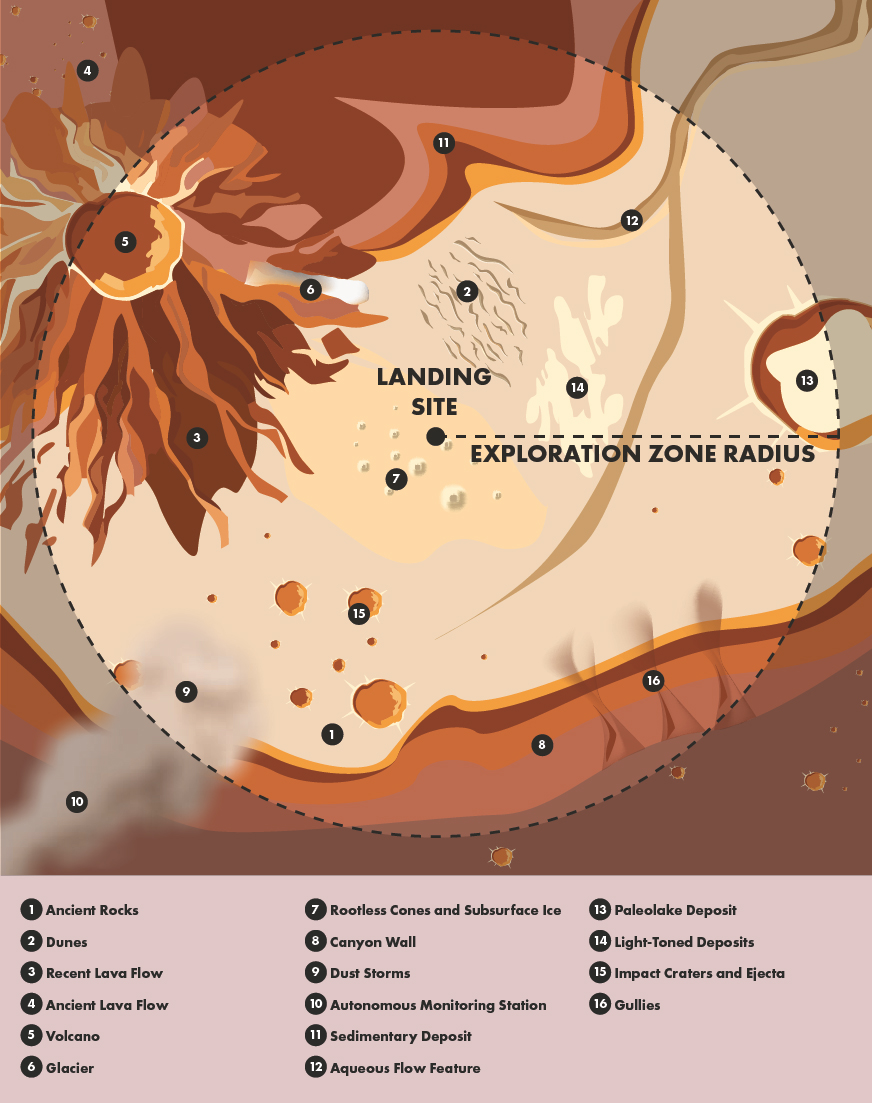
The Mars Science Across an Expanded Exploration Zone Campaign is enabled by selecting a single landing site (LS) and an exploration zone (EZ) of order 100 km in radius, depending on the region on Mars, with specific characteristics. This campaign targets a low- to mid-latitude LS/EZ presenting near-surface glacier water ice and a diverse suite of geological features, materials, and units (Figure 3-1).
The Expanded Exploration Zone Campaign would conduct a search for signs of prebiotic chemistry and extant or extinct life at or near the surface, characterize H2O and CO2 atmosphere–surface interactions, gain key insights into Mars’s geologic and environmental evolution through time, and characterize H2O and CO2 reservoirs for in situ resource utilization (ISRU). The LS/EZ would also be close enough to dust storm activity areas to allow deployment, via crew and/or dispatched robotics, of a network of autonomous dust storm monitoring stations.
Field measurements would require a wide suite of science instruments, specifically elemental and molecular compositional analyzers, ground-penetrating radar (GPR), and sonic anemometers, dust sensors, and water vapor sensors for eddy flux measurements. More detailed investigations, such as isotopic measurements, would be
conducted back at the laboratory in the habitat. Significant equipment required would include a drilling system capable of characterizing subsurface materials in place, and of retrieving core samples from depths of 2–10 m. A meteorological tower 10 m in height would also be needed for atmospheric measurements to characterize Mars’s atmospheric boundary layer at the surface, including diurnal temperature variations, wind speeds, and turbulent eddies (Petrosyan et al. 2011). Using a 10-m meteorology tower on Mars, similar in height to standard meteorology towers on Earth, is justified not only by the similarity in boundary layer processes, but also because meteorological measurements on Mars may then be directly compared to those made on Earth. Effective mobility systems—including both unpressurized and pressurized rovers—allowing multiple traverses to explore the EZ and transport field gear (e.g., GPR, drill) on spatial scales of a few to a few hundred kilometers and on timescales of 1 to tens of sols, would also be needed. All LS/EZ-agnostic prioritized science objectives in this report would also be addressed during the campaign.
3.3.1 Campaign’s Science Objectives
The selection of a landing site that meets the requirements of the science objectives (see Section 2.3.3) allows this campaign to address to some depth each one of the report’s 11 prioritized science objectives (Table 3-5). Science Objective 1—determine if, in the exploration zone, evidence can be found for any of the following: habitability, indigenous extant or extinct life, and/or indigenous prebiotic chemistry—remains the top priority and its measurement will begin first, and will be conducted based on real-time responsive decision making as early results come in.
Science Objectives 4, 7, 8, 9, 10, and 11 can be conducted at any landing site and will be addressed as possible in the first mission, and more intensely during the 300-sol mission 3. Primary science objectives are the most important to complete and are tied to the landing site choice. Secondary science objectives are those that can be conducted at any landing site and/or are decoupled from the primary science objectives of the campaign.
3.3.2 Notional Architecture
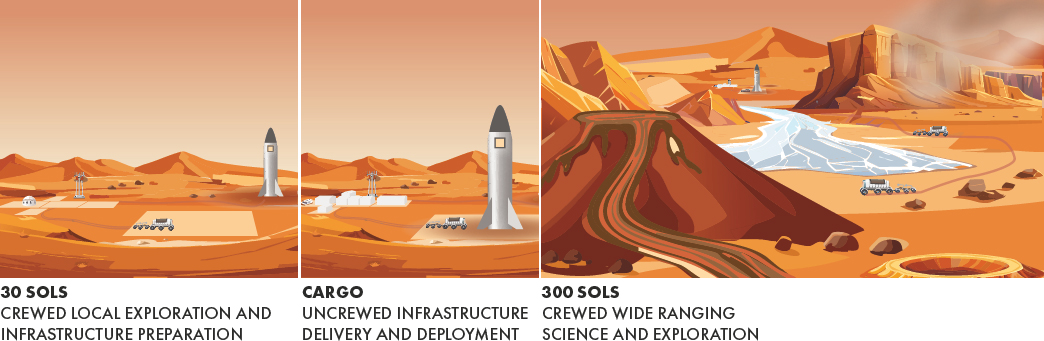
The key aspect of this campaign is its 30-Cargo-300 architecture (Figure 3-2); this architecture allows this campaign (and others with the same architecture) to address to some extent all the prioritized science objectives of the report, given the right LS and ability to reach a wide EZ. See Section 2.1 for campaign architecture definitions.
Landing Site Requirements
To develop a list of LS/EZ criteria, the type of geologic feature or setting was identified for each of the 11 science objectives so that the majority of that science objective’s scope could be met (see Section 2.3.3). For each of the lower-priority objectives on the list, account was taken of the LS/EZ criteria retained in higher-priority objectives, to take advantage of commonalities in LS/EZ criteria to the maximum extent possible.
Science Objective 1 calls for the search for evidence of habitability, the search for evidence of extant life, the search for evidence of extinct life, and the search for evidence of indigenous prebiotic chemistry. The LS criteria for “low- to mid-latitude near-surface water ice” is the key LS/EZ criterion across Science Objective 1, as it maximizes the science that can be achieved at the site.
Then, for Science Objective 2 (characterize past and present water and CO2 cycles and reservoirs within the exploration zone to understand their evolution), the LS/EZ criterion for Science Objective 1 could optimally apply as well, provided the qualifier “layered” was added. Science Objective 3 required significantly different LS/EZ criteria from those previously used and so were defined separately.
The LS/EZ would be chosen to allow access to low- to mid-latitude near-surface H2O glacier ice, and present diverse geology to include multiple pristine and altered/degraded impact, volcanic/igneous and sedimentary units, and H2O activity features (e.g., channels, gullies, recurrent slope lineae, light-toned deposits) spanning Noachian (>3.7 Ga) through Late Amazonian (<0.5 Ga) (Table 3-6).
In addition, the LS/EZ would be close enough to sites of active dust lifting, textured dust clouds, dust devils, and dust storm passage to deploy, with crew or via robots, a network of autonomous dust storm monitoring stations. Access to aeolian deposits and features, ancient and modern, would be a good addition.
TABLE 3-5 Science Objectives for the Mars Science Across an Expanded Exploration Zone (30-Cargo-300) Campaign
| Campaign Science Objectives | Justification for Primary or Secondary Classification | Required Measurements | Additional Desired Measurements |
|---|---|---|---|
| Primary Science Objectives | |||
|
This is the top scientific priority of the campaign because it is the top science priority for humans on Mars identified in this study. This priority serves as a key science driver for the entire campaign, including being the key driver for choice of landing site. | Chromatography and organic sample extractions, site-specific isotopic fractionation, mineral/elemental/organic micromapping and characterization and imaging of micro- and macroscopic features within rocks. Aqueous geochemistry measurements (salinity, Eh, pH, water activity). | Low-temperature H2O ice targeted for sampling, and provisions made to preserve the samples’ original pressure (P) and temperature (T) conditions during curation on Mars and return to Earth. |
|
This science objective is considered primary because of its inherent importance (top priority in geosciences) and its crucial relevance to other primary objectives of the campaign, in particular by providing local volatile evolution context to campaign priorities 1 and 3. This priority also serves as a secondary driver for landing site selection. | Near-surface ice (~1 m depth): Neutron spectrometer measurements on the ground. Deeper ice: Ground-penetrating radar. Ground truth: Drilling (down-borehole in situ measurements (near infrared [NIR] for water bands), and/or drill cuttings brought to surface (NIR measurements of water ice). Mass spectrometry measurements for water. Subsurface ice stratigraphy from visible imaging (down borehole) or through analysis of cuttings bites from different depths after samples are brought to the surface. Eddy covariance measurements to determine the H2O, CO2, and dust fluxes. | If possible, acquire complementary information from greater near-surface depths, for instance via drill sampling. |
|
This science objective is primary because of its inherent importance and its crucial relevance to other primary objectives of the campaign, in particular by providing geologic context to campaign priorities 1 and 2. This priority also serves as a secondary driver for landing site selection. | Stereo visible imaging to provide geological context, multi- or hyperspectral imaging (visible through midinfrared) to establish compositional variations at outcrop and smaller scales. | Continuous imaging by surface assets throughout the mission would provide important contextual and interpolation data. Drone imaging would also bridge gaps between orbital remote sensing and in situ surface data. |
| Campaign Science Objectives | Justification for Primary or Secondary Classification | Required Measurements | Additional Desired Measurements |
|---|---|---|---|
|
This is the top priority identified in atmospheric sciences. This priority also serves as a secondary driver for landing site selection. |
Near-surface and boundary layer dust measurements (e.g., heat and dust fluxes, mixing ratios, and surface wind stress), including
|
The establishment of a regional network of meteorology stations creates an opportunity for other network science. |
|
This is a top priority to inform and enable ISRU, which is critical in all recent NASA design reference missions to the surface of Mars. | Ice concentration versus depth (via drilling, ground penetrating radar, surface neutron spectrometry surveys). Reactor inputs and outputs. Biological data (swabs, from different locations of the system). Engineering systems performance (e.g., P, T, flow rates, power usage, and efficiencies). |
H2O extraction from sources on Mars other than ice would be important to investigate in parallel, including H2O extraction from atmospheric ice fog and from polyhydrated sulfates and other H2O-rich minerals. |
| Secondary Science Objectives | |||
|
This objective is important but considered secondary in this campaign because acquiring data for this objective does not drive the selection of the landing site or the other science priorities of the campaign. Rather, its data are acquired opportunistically, with graceful descopes, as the primary objectives are pursued. | Longitudinally, at multiple time points across the course of the mission: crew behavior and cohesion behavioral measures, and measures of basic health, physical stress, radiation exposure, and genetic testing. | See Section 3.2 for more details. |
| Campaign Science Objectives | Justification for Primary or Secondary Classification | Required Measurements | Additional Desired Measurements |
|---|---|---|---|
|
As above. | Habitats for model species. Ability to sample at selected time points over a complete life cycle. Typical workflows: Genomics: DNA extraction and quality control (ultraviolet spectophotometry), library preparation, sequencing, and data analysis. Transcriptomics: RNA extraction, fragmentation, cDNA generation, amplification, RNA enrichment, sequencing, analysis. Proteomics: protein extraction, enzymatic digestion, separation of peptides (HPLC), and analysis (tandem mass spectrometry; database searching, software-based protein quantification). | See Section 3.2 for more details. |
|
As above. | Shotgun metagenomics workflow: extraction, fragmentation, amplification, DNA sequencing, analysis (gene finding, phylogenetic binning, metabolic reconstruction). Many of these elements are automated; a considerable amount of processing power is required. | See Section 3.2 for more details. |
|
As above. | Largely covered by dust Science Objectives 4 and 5. Addition of pulmonary function tests, exhaled gas analysis, particle size analysis, markers of lung inflammation, and ultrasound examination may be beneficial. | See Section 3.2 for more details. |
|
As above. | Growth rates, organismal function and health measurements (e.g., CO2 uptake, nutrient uptake rates), water use, and reproduction. | See Section 3.2 for more details. |
|
As above. | Ionizing radiation, from high-energy events like galactic cosmic rays and lower energy such as solar energetic particles. | See Section 3.2 for details. |
NOTE: cDNA, copy deoxyribonucleic acid; DNA, deoxyribonucleic acid; HPLC, high-performance liquid chromatography; ISRU, in situ resource utilization; RNA, ribonucleic acid.
To search for indigenous extant life, the landing site would be chosen to give access to plausible habitable niche(s), in particular near-subsurface ice likely containing brines in the interface with the regolith (e.g., Fischer et al. 2014; Chevrier et al. 2020) and/or a cave. Settings in which extant life might be found on Mars were considered during the “Mars Extant Life: What’s Next?” conference held in Carlsbad, New Mexico, on November 5–8, 2018. Although the conference report does not provide a prioritization among potential habitable niches (Carrier et al. 2020), arguments have been made for caves as a top- or high-priority setting to explore (e.g., Gunn 2004; Léveillé and Datta 2010; Lee 2023).
TABLE 3-6 Landing Site Criteria for the Mars Science Across an Expanded Exploration Zone Campaign
| Campaign Science Objective | Prioritized Landing Site/Exploration Zone Criteria |
|---|---|
| Primary Science Objectives | |
|
Low- to mid-latitude near-surface H2O ice (warmer ice preferred for extant life and prebiotic chemistry). Light-toned deposits. Salt deposits. |
|
Near-surface layered H2O ice (low- to mid-latitude glacier ice). |
|
Diverse geology, including multiple pristine and altered/degraded impact, volcanic/igneous and sedimentary units, and H2O activity features (e.g., channels, gullies, recurrent slope lineae, light-toned deposits) spanning Noachian (>3.7 Ga) through Late Amazonian (<0.5 Ga). Aeolian deposits and features, ancient and modern, a plus. |
|
Close enough to sites of active dust lifting, textured dust clouds, dust devils, and dust storm tracks to deploy, with crew or via robots, autonomous dust storm monitoring stations. |
|
Near-surface H2O ice (glacier ice preferred because it is cleaner). |
| Secondary Science Objectives: All can be achieved agnostic of landing site. | |
NOTE: See Figure 3-1 for an example notional landing site and exploration zone that would fulfill the landing site criteria.
To search for biosignatures associated with indigenous extinct life, the landing site needs to give access to a well-preserved aqueous sedimentary record covering a long span of time, to include specifically the Noachian when liquid water was more prevalent in the martian near-surface environment than at present.
Crew Role
The Mars Science Across an Expanded Exploration Zone Campaign (30-Cargo-300) is characterized by the opportunity to address a wide range of science objectives across a science target-rich extended exploration zone over a substantial amount of surface time. The likely need to traverse long distances of order tens to hundreds of kilometers in pressurized rovers over multiple days to reach far-ranging targets, or to conduct closer-range excursions with multiple target stops, implies complex surface operations generally requiring vehicle crews of two or more to implement. While it is beyond the scope of the present study to identify specific surface exploration architectures, lessons from terrestrial analogs in which vast tracts of territory were explored and investigated via habitable land vehicles suggests that science operations across large-distance scales on Mars will likely require two or more pressurized rovers working in tandem to implement, that is, crews of at least four assuming a minimum of two per vehicle (Lee and Schutt 2021). Larger crews beyond four members, while desirable for more operational flexibility and redundancy, are not necessarily required for the strict implementation of science objectives in the Expanded Exploration Zone Campaign, assuming all the required science training is sufficiently represented among the crew of four. Compact crews may also be sufficient for the implementation of many science EVAs. While EVAs from either landing site habitats or pressurized rovers are generally assumed to mobilize at least two suited crew members at a time, single-astronaut EVAs may actually be safer and more efficient under some circumstances (Lee 2024b). On the other hand, other aspects of fieldwork may add more to the workload than is obvious at first: an important observation from terrestrial field experience is the frequent need for repeat visits to the same target sites to allow iterating on field observations and/or sampling (e.g., Lee 2024b). Some types of surface science activities, however, are inherently labor intensive, at least in their traditional implementation—for instance, drilling. Field drilling on Earth even to shallow depths of only a few meters often requires crew sizes of two, three, or more, depending on the challenge presented by the substrate and the performance of the drill. On Mars, the exact number of crew members required for shallow drilling would depend on similar factors, and also on the amount of automation built into the drilling system. Geophysical surveys, for example, GPR and seismic surveys, would typically require at least two crew members on EVA as well.
The estimated minimal crew size needed to implement all campaign science objectives in the Expanded Exploration Zone campaign might ultimately be four to six, in consideration also of simultaneous IVA science laboratory work needs and the need to organize crew shifts to more optimally implement the science. Such estimates, however, remain uncertain, as the required crew size will depend on overall crew composition and training, and other mission constraints and requirements. The minimal rough estimates suggested here assume highly trained and cross-trained crew members, all capable of carrying out crucial aspects of the campaign’s science investigations, with the means to reliably and efficiently access all science target sites and perform all science tasks.
3.3.3 Strengths and Weaknesses of the Campaign Design
Strengths
- A key feature of the Mars Science Across an Expanded Exploration Zone Campaign (and of all campaigns using the 30-Cargo-300 architecture) is its ability to support long-duration and long-range science operations, which imply the opportunity to iterate on science questions, reach diverse but possibly interrelated science targets within a single mission, conduct repeated visits to some targets, have multiple sampling opportunities, and establish regional networks of long-term monitoring instruments. The establishment of a substantial exploration infrastructure does not benefit only safety and logistics, but also in situ science capabilities, including in-habitat laboratory and instrument capabilities.
- This campaign, if implemented at a strategically well-selected LS/EZ, allows all the prioritized science objectives from this report to be addressed.
- Although defining architectures is outside of the study’s remit, this campaign does lend itself well to establishing a single scientific base on Mars, enabling exploration tools and resources to be sent ahead of time, co-located, and built out to further scientific progress.
Weaknesses
- Although there can be meaningful variety in LS environments when reviewing the entirety of a large EZ, this campaign is initially constrained to a specific area on Mars and therefore may offer a limited view of the planet compared to campaigns visiting three different sites. A strategic LS would have to be identified on Mars that would allow a wide diversity of science targets to be reached within the time and range constraints of the campaign.
- In the absence of a sufficiently diverse EZ, or the capacity to reach distant enough destinations, this campaign would not be able to meet all of its science objectives.
3.3.4 Measurements
This campaign would need to drill to a depth of 2–10 m, assuming a surface with high exposure age, to access fresh samples beyond the oxidized layer or reach an antioxidant-rich zone (such as one rich in manganese). This campaign would also need to have the ability to sample ice-rich materials to similar depths and preserve the integrity of volatile-rich samples through their return transfer to Earth.
The selection of a good site for a 30-Cargo-300 campaign scenario is of the utmost importance given the imperative and opportunity in this scenario to access, investigate, and sample a wide variety of areas of interest. In situ robotic reconnaissance would be crucial prior to crew arrival. The robotic asset deployed for this reconnaissance could remain available in support of exploration activities following crew arrival.
Crew and Equipment Transport: Effective mobility systems allowing multiple traverses to explore the EZ and transport field gear (e.g., drill, ground-penetrating radar) on spatial scales of a few kilometers to a few hundred kilometers and on timescales of 1 to 300 sols—that is, unpressurized and pressurized rovers—are required.
Shallow Drilling: Shallow drilling to a depth of 2–10 m is required to meet Science Objectives 1 and 2. Eventual deeper drilling to depths of up to 5 km to access deep subsurface aquifers remains an important but major equipment- and time-demanding task to more fully address Science Objective 1.
Weather Stations: A network of autonomous meteorology or weather stations for monitoring dust storms that would be deployed robotically or by crew is required for Science Objective 5.
Instruments: Field measurements would require a wide suite of science instruments, specifically imaging instruments from microscopic imagers to digital hand lenses and panoramic imagers; elemental, isotopic, and molecular compositional analyzers; eddy covariance instrument systems; and GPR.
Following crew departure, including on timescales of potentially a few years afterward, it could be highly advantageous and desirable to have autonomous or teleoperated robotic exploration assets left behind by crews in the EZ to continue exploration work, including iterating on science questions raised during the crewed missions.
3.3.5 Key Assets and Major Equipment
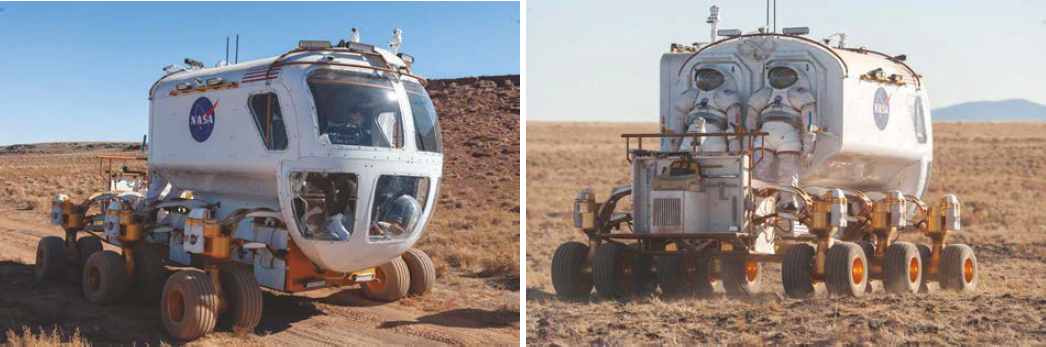
Before crew arrival, robotic rotorcraft, a surface rover, or other capable equipment is needed to confirm selection of a good LS/EZ. Key to this campaign’s success when crew are on the surface would be the inclusion of a surface mobility system capable of reliably accessing all science areas of interest within the EZ (Figure 3-3). In the present conceptual study, this could be 100 km to a few hundred kilometers in radius. This scenario requires the availability of one or more pressurized rovers, at least for the 300-sol mission segment, in order to allow crew(s)
SOURCE: Courtesy of NASA.
and equipment to rapidly reach, and return from, areas of interest within the EZ that would be located many tens of kilometers from the LS (Figure 3-4).
The second critical major equipment needed while the crew is on the surface is the drilling rig and support instrumentation and equipment. Dust monitoring stations would stay in place after the crew leaves, and so power, computing, communications, and other support would be needed.
3.4 SYNERGY OF MARS SCIENCE MEASUREMENTS (30-CARGO-300)
The Synergy of Mars Science Measurements Campaign is designed to advance Mars exploration by leveraging the commonality of the top scientific objective’s common measurement needs, correlated through a comprehensive

SOURCE: Courtesy of Pascal Lee.
analysis of the panel science traceability matrices (STMs). This campaign is distinct from the Mars Science Across an Expanded Exploration Zone Campaign in that this campaign is designed to accomplish common measurements that can be done at a range of possible landing sites. This approach offers a campaign that has looser site-specific needs, although the extent to which each objective can be completed will necessarily vary with the site-specific characteristics.
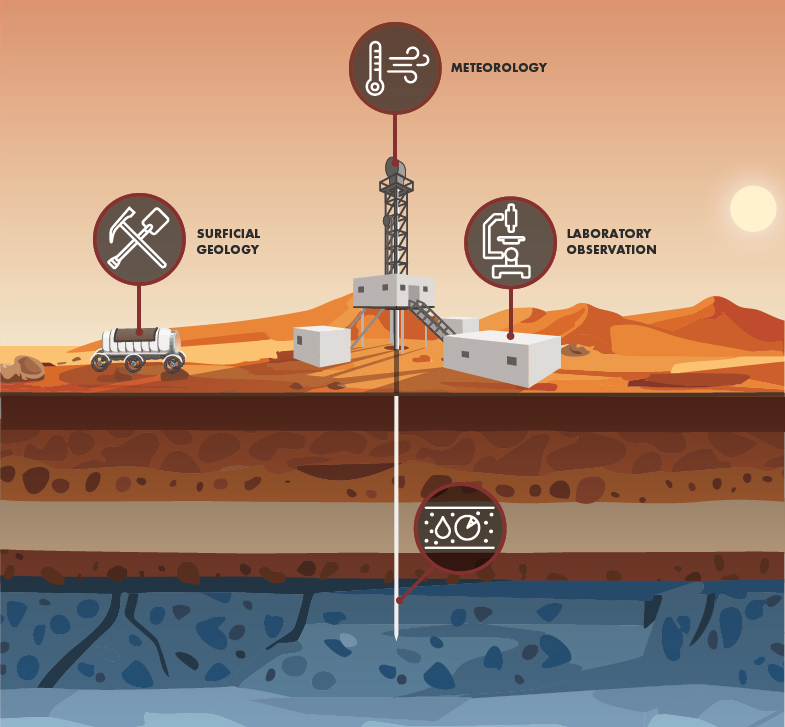
Spanning an initial 30-sol field campaign followed by an extended 300-sol period, the campaign integrates in situ analyses and sample return to achieve comprehensive scientific objectives. This campaign prioritizes specific goals and measurements during the 30-sol stay to deliver significant scientific breakthroughs while establishing the foundation for more in-depth investigations over the long term. By taking advantage of the unique capabilities associated with a human-led mission, the campaign combines aerial coverage, vertical extent (subsurface and atmospheric), and temporal duration, effectively creating a four-dimensional view of Mars (Figure 3-5).
A campaign constructed around common analytical measurements needed to serve a plurality of the top science objectives would be inclusive to a broad range of U.S. and global science communities. By tackling big goals that necessitate multidisciplinary approaches, the campaign encourages science measurement innovation, especially for instruments and technologies that can accomplish multiple cross-disciplinary needs.
3.4.1 Campaign’s Science Objectives
The Synergy of Mars Science Measurements campaign is designed to advance the understanding of Mars through common samples and measurements that significantly advance the top-rated objectives (Table 3-7).
Primary Science Objectives: Objectives 1, 2, 3, and 5 would be the primary focus of this campaign, with a plurality of the planned analytical needs being accomplished in situ or in laboratories on Mars and/or by sample return to Earth.
Secondary Science Objectives: By establishing the capability to address the top objectives, Science Objectives 6, 9, and 11 are readily addressable as well, rounding out an exciting scientific complement. The 30-Cargo-300 architecture also enables a robust framework for including common activities (see “Biological and Physical Sciences in Space and Human Factors,” Section 3.2).
TABLE 3-7 Science Objectives for the Synergy of Mars Science Measurements Campaign
| Campaign Science Objectives | Justification for Primary or Secondary Classification | Required Measurements | Additional Desired Measurements |
|---|---|---|---|
| Primary Science Objectives | |||
|
Address the highest priority science investigation. | Geologic mapping of the exploration zone (EZ). Mineralogy and petrology of surface units. Electric field strength and radiation. |
Laboratory-based analyses on Mars or via sample return: Mineralogy and petrology, total carbon, organic composition and abundance, volatile composition and abundance, isotopic analysis (stable and radiometric). |
|
Drives the campaign to subsurface access. | Geologic mapping of the EZ. Mineralogy and petrology of surface units. Subsurface structure. Local atmospheric conditions and variability. |
Abundance and distribution of volatile species in the subsurface. Abundance and composition of atmospheric constituents. Dust mixing ratio, particle distribution, and turbulence of the atmosphere. Sample-based volatile composition and abundance. Sample-based isotopic analysis (stable and radiometric). |
|
Provides overall geologic and spatial context to the campaign while enabling high-priority science advances. | Geologic mapping of the EZ. Mineralogy and petrology of surface units. Subsurface structure. |
Abundance and distribution of volatile species in the subsurface. Laboratory-based analyses on Mars or via sample return: mineralogy and petrology, total carbon, organic composition and abundance, volatile composition and abundance. Isotopic analysis (stable and radiometric). |
| Campaign Science Objectives | Justification for Primary or Secondary Classification | Required Measurements | Additional Desired Measurements |
|---|---|---|---|
|
Provides maximum feed forward to utilization. | Geologic mapping of the EZ. Mineralogy and petrology of surface units. Subsurface structure. |
Abundance and distribution of volatile species in the subsurface. Dust mixing ratio, particle distribution, and turbulence of the atmosphere. Laboratory-based analyses on Mars or via sample return: Mineralogy and petrology. Total carbon. Volatile composition and abundance. |
| Secondary Science Objectives | |||
|
The height of the drilling apparatus affords a synergistic opportunity to make significant progress on atmospheric conditions. | Geologic mapping of the EZ. Measure local atmospheric conditions and variability. |
Abundance and composition of atmospheric constituents. Dust mixing ratio, particle distribution, and turbulence of the atmosphere. Electric field strength and radiation. |
|
Geologic mapping of the EZ. Mineralogy and petrology of surface units. |
Dust mixing ratio, particle distribution, and turbulence of the atmosphere. | |
|
Many of these measurements overlap with the primary objectives, particularly providing context for biological signatures and habitability. | Geologic mapping of the EZ. Electric field strength and radiation. |
Laboratory-based analyses on Mars or via sample return: isotopic analysis (stable and radiometric). |
Initial Measurements: This campaign supports rapid field geology and targeted scientific investigations in the first 30 sols, followed by focused data collection in the 300-sol segment to investigate specific phenomena in detail. The first key measurements include
- A field geology campaign aided by handheld instruments providing mineralogy, composition, and subsurface structure to find promising sites for astrobiology sampling, ISRU follow-up, and to select a drill site.
- Targeted laboratory-based measurements of volatiles and organic geochemistry on samples, in part to select those to return to Earth to deliver high-profile initial science results and inform next samples and actions for the search for life.
- Meteorological measurements to give context to site and determine suitability for a dust lofting study in the 300-sol segment.
3.4.2 Notional Architecture
Why 30-Cargo-300?
This campaign is predicated on making crucial analytical measurements on the martian surface, as well as returning carefully selected, meticulously documented samples to Earth. The 30-Cargo-300 architecture was selected for its ability to balance rapid deployment with long-term scientific investigation. In the initial 30 sols, the crew would conduct an initial geologic field campaign and initial environmental assessments to inform subsequent scientific activities. They would collect samples from a potentially habitable site and examine them for signs of extinct or extant life, providing exciting early science return. Initial activities would also support site validation, ensuring the selected landing site meets all criteria and is safe for extended operations.
This foundation supports the extended 300-sol period, during which more complex operations, such as extended EZ exploration, deep drilling, atmospheric measurements, and laboratory-based data collection, can be established in multiple locations. This structure offers the ability to preplace significant infrastructure assets and enable initial reconnaissance to adapt elements of the extended phase based on real-time findings. Longer-duration stays enable more monitoring of volatile and aerosol exchange rates (including interior and exterior) and cycles with seasonal influence, with the ideal situation being a return of a full Mars year of sets of measurements. Longer stays also allow for iteration and to ensure the instrument installation is conducted properly.
Landing Site Criteria
This campaign is open to a wide range of potential landing sites and exploration zones, with the caveats that the specific location of the landing site drives the magnitude of the return associated with science objectives examining volatile access and dust lifting. The initial 30-sol phase conducts site reconnaissance, enabling elements of the extended phase to be selected or customized based on the characteristics of the site, ensuring that the mission remains flexible and responsive to emerging scientific priorities.
The benefits of this campaign are that it can return a broad swath of high-priority science and at least partially fulfill many of the top science objectives at nearly any landing site chosen for exploration. But with the judicious selection of an EZ, some objectives may be more fully satisfied (see Section 2.3.3). This selection would be driven by current data sets as well as additional global mapping efforts to refine landing site selection and identify geologic features of interest and to detect areas rich in water-related minerals, guiding targeted drilling operations.
Crew Role
Geologic mapping is enabled by extended durations on the surface for two or more crew members to conduct the fieldwork. For the extended 300-sol phase, four crew members would be needed to support the breadth of tasks and iterative exploration, as results come in and point to new areas of geography or lines of inquiry.
The ability to choose which samples to collect for further study, informed by field observations and analytical measurements on the martian surface, makes a huge difference to the potential for scientific discovery. The ability to explore more terrain with more crew members facilitates a comprehensive understanding of geologic setting and characterization of the geologic processes of the site that guide the decision trees for sampling and analysis for astrobiology and resource utilization goals.
The goals of field study are to understand planetary processes in the EZ to be able to guide decision trees for sample collection, analysis, siting assets, and prospecting for resources. These activities require observation in the field, the creation of a conceptual model, the formulation and testing of hypotheses, and repeated visits to the same locations. These tasks take advantage of human flexibility, experience, and judgment. Additionally, astronauts uniquely enable a wide spectrum of biological sciences and human factors research that enhances the safety and productivity of future crewed missions.
3.4.3 Strengths and Weaknesses of the Campaign Design
Strengths
- The use of every sample and measurement is optimized for science output because of the analysis of commonality across all panel STMs.
- This campaign, if implemented at a strategically well-selected LS/EZ, allows all prioritized science objectives of this study to be thoroughly addressed.
- By making foundational measurements of dust, radiation, and ISRU potential, the campaign measurements maximize usefulness for architecture decisions for sustained martian exploration.
Weaknesses
- The principal drawback to this campaign is that, by accommodating the common measurements, some of the specialty measurements for each objective may not be accomplished as envisioned, possibly leading to nonclosure of these objectives within the initial campaign.
- By prioritizing the most common analytical measurements, the geology, astrobiology, and atmospheres objectives are emphasized and many of the principal BPS/HF objectives become secondary or opportunistic.
3.4.4 Measurements
The range of specific analytical measurements mapped to science objectives is captured in Table 3-7. Common, crucial measurements include those made in situ across the EZ and those made in laboratories either on Mars or back on Earth. Table 3-8 maps measurements to science objectives for this campaign. The gold boxes denote measurements to be done in the 30- and 300-sol phases. The teal boxes denote additional measurements to be done in the 300-sol phase. There are no measurements that are only to be made in the 30-sol phase.
Measurements to Be Made In Situ on Mars
The following are measurements to be made in situ on Mars:
- Geologic relationships;
- Mineralogy and petrology;
- Subsurface structure;
- Subsurface volatiles;
- Atmospheric abundance and composition (water, CO2, Ar);
- Pressure, temperature, and wind;
- Dust mixing ratio, particle distribution, and turbulence; and
- Electric field and radiation.
The first 30-sol segment would focus on observations and measurements of martian surface and atmospheric conditions, identifying and returning samples with the highest likelihood of containing extant or extinct life, and characterizing the EZ (dust, radiation, and ISRU potential) to make informed choices for the 300-sol segment. A geologic field campaign, including observations, imaging, and sampling, would be crucial in identifying and characterizing surface features, for example, sedimentary layers, volcanic structures, and impact craters. Along with mapping, handheld instruments to capture geochemical information, subsurface structure, and other discriminators would be crucial to selecting a location for deep drilling. Monitoring atmospheric phenomena and dynamic weather events that influence surface and subsurface conditions would also be accomplished to better understand the site and its potential for in-depth atmospheric science goals.
TABLE 3-8 Measurements Mapped to Science Objectives for the Synergy of Mars Science Measurements Campaign
| Objective | In Situ | Laboratory (on Mars and/or Earth) | |||||||||||
|---|---|---|---|---|---|---|---|---|---|---|---|---|---|
| Geologic Relationships | Mineralogy and Petrology | Subsurface Structure | Subsurface Volatiles | Atmospheric Abundance and Composition (Water, CO2, Ar) | Pressure, Temperature, Wind | Dust Mixing Ratio, Particle Distribution, Turbulence | E-Field Strength and Radiation | Mineralogy and Petrology | Total Carbon | Organic Composition and Abundance | Volatile Composition and Abundance | Isotopic Measurements (Stable and Radiometric) | |
|
|||||||||||||
|
|||||||||||||
|
|||||||||||||
|
|||||||||||||
|
|||||||||||||
|
|||||||||||||
|
|||||||||||||
NOTE: Gold indicates measurements to be made in 30-sol and 300-sol phases; teal indicates additional measurements to be made in the 300-sol phase.
The in situ measurements in the 300-sol segment would provide the opportunity to explore more of the EZ, but also crucially to focus on the vertical and time dimensions. The vertical dimension is pivotal, encompassing both subsurface access and atmospheric profiling. Continuous data acquisition allows for the observation of diurnal cycles, weather events, and seasonal variations.
Subsurface drilling would provide unique measurements to determine if evidence can be found for extant or extinct life at the landing site and to identify and characterize past and present water and other volatile reservoirs (e.g., location, timing, and extent of ancient water reservoirs). The campaign would use a drill station to penetrate deep into the martian crust, reaching depths where organic materials and microbial fossils are more likely to be preserved (greater than 10 m, up to 1 km depth or more), extracting core samples from various depths to analyze the stratigraphy and search for evidence of past or present life, and investigating the layering and composition of subsurface materials to identify ancient water reservoirs and habitable zones. A tall drill station may serve dual duty by providing a large mast upon which height profiling sensors can be attached.
Atmospheric height profiling would provide measurements for determining what controls the onset and evolution of major dust storms, which dominate present-day climate and weather variability:
- Vertical dust fluxes and particle size distributions: Assessing how dust particles are transported and deposited across different atmospheric layers.
- Surface wind stress: Measuring wind speeds and directions at multiple heights to understand surface–atmosphere interactions.
- Electric field: Monitoring atmospheric electric fields to study dust storm dynamics and their effects on atmospheric circulation.
- Pressure and temperature profiles: Capturing rapid pressure changes and temperature variations at various altitudes to model weather patterns and vortex activities.
- Solar and thermal radiative fluxes: Measuring incoming and outgoing radiation to evaluate the energy balance and its impact on climate processes.
Measurements to Be Made in Laboratories on Mars and/or Earth
The following are measurements to be made in laboratories on Mars and/or Earth:
- Mineralogy and petrology,
- Total carbon,
- Organic composition and abundance,
- Volatile composition and abundance, and
- Isotopic measurements (stable and radiometric).
More detailed composition, abundance, isotopic analysis, and imaging of specific samples can be conducted in laboratory facilities inside or attached to the habitat. They enable a suite of analyses to determine the chemical and physical properties of martian materials in order to characterize possible biosignatures and to guide further crew exploration of the EZ. Some of the more important measurements for analysis on Mars include
- Organic molecule detection: Identifying complex organic compounds that may indicate past life.
- Isotopic analysis: Stable isotopic ratios to understand geologic and atmospheric processes.
- Redox state: Abundance of reducers and oxidizers in solids and liquids if present.
- Microscopic examination for microfossils: Searching for fossilized microbial life within drilled samples.
- Mineralogical and geochemical analyses: Assessing mineral compositions to identify potential biominerals.
- Water content analysis: Measuring the presence and distribution of water in surface and subsurface materials.
Many of the in-depth analyses needed to fully address the science objectives would require returning samples to Earth (see Section 2.3.7). Sample return enables more in-depth analysis and comparison of analyses between laboratories:
- Organic molecule detection: The nature and distribution of organic carbon (chirality, structural isomers, repeating subunits, potential for storing information, and nonequilibrium distribution patterns).
- Isotopic analysis: Radiometric isotopic ratios to accurately and precisely date lithologic units.
- Mineralogical and geochemical analyses: Small-scale geochemical gradients, trace elements abundances and ratios, volatile elements, and nitrogen speciation (e.g., nitrates), particularly given nitrogen’s critical role in biological processes and habitat sustainability.
Measurements to Be Made Using Preplaced Assets
No measurements are required to be accomplished by preplaced assets for this campaign, but, as discussed below, preplaced logistics and significant infrastructure elements (drill, mast, and laboratory) would expand exploration capabilities and ensure comprehensive data collection within the limited mission period.
3.4.5 Key Assets and Major Equipment
Key assets and major equipment required for this campaign include a deep drilling apparatus (1 km or greater), a tall tower structure (30 m), and laboratory equipment available in a stable, internal environment. Enabling assets for supporting these capabilities include mobility, communication, power, and sample return capability. In particular, mobility (via drones, rovers, or mobile habitats) enables more of the EZ to be examined in detail, to give context to the in-depth measurements and to provide diversity and trends across the geologic terrain. Power and data relay and communications are clearly important to allow the equipment to be used by the crew but could be expanded after the crew departs to continue investigations remotely, which would be particularly advantageous for preparing for the 300-sol mission (see also Section 2.4.1).
Before Crew Arrival
Before the initial 30-sol segment, it would be beneficial to preplace large assets, enabling the crew to more readily explore the EZ. Drones or rovers that are already deployed would enable crew to conduct preliminary reconnaissance, map the terrain, and identify optimal locations for detailed investigations. Maximizing coverage of the EZ would allow crew to readily decide where best to position the larger infrastructure for the 300-sol segment. Prior to the 300-sol segment, preplacement of major cargo elements would facilitate setup when crew members arrive. The deep drilling apparatus would be positioned at the designated landing site. The drill rig tower could double as a tall mast to support atmospheric sensors and communication equipment, and additionally to enable continuous environmental monitoring and data transmission. Laboratory equipment and sample collection and containment supplies could be preplaced and be ready to install in a controlled habitat module that provides a reliable environment for initial scientific analyses and equipment testing. Solar arrays, data relays, essential supplies, tools, and spare parts to support long-term mission sustainability could also be prepositioned.
Crewed Operations
Crew members would operate the deep drill to extract subsurface samples for biosignature and water detection; install and monitor instruments on the tall mast for continuous atmospheric data collection to study climate dynamics and dust storm activities; conduct on-site laboratory analysis, including time-sensitive analysis of collected samples using onboard laboratory equipment to identify organic molecules and geologic features; and prepare samples by securing and cataloging collected samples for potential return to Earth, ensuring their preservation and integrity. Although it is difficult to place specific mass requirements on the amount of samples to be
returned, each human mission to Mars will likely be able to return tens of kilograms of samples from Mars. Tens of kilograms would likely satisfy the need for multiple independent analyses by different research groups, the need to have samples to share for education and public outreach (e.g., academia and museums), and the need to archive duplicate sealed samples for posterity (MEPAG E2E-iSAG 2011; Beaty et al. 2019).
After Crew Departure
Autonomous systems to sustain power and data collection would ensure continuous environmental monitoring and data logging. If remote analytical facility control is desired, it could help scientists continue to analyze stored samples, providing ongoing scientific insights without the presence of the crew. Deployed drones and rovers could also operate autonomously to explore additional areas of interest and support future missions. On Earth, a coordinated analysis campaign for returned samples would be undertaken.
3.5 SEEKING LIFE BENEATH THE MARTIAN ICY CRUST (30-CARGO-300)
Accessing samples below the lower boundary of the martian cryosphere (Carrier et al. 2020) is the top priority for this campaign, along with a complementary focus on habitability, prebiotic chemistry, and ancient life (Figure 3-6). The campaign optimizes team, tools, and time for these objectives, expending resources on other science and technology demonstrations where operationally compatible with this focus.
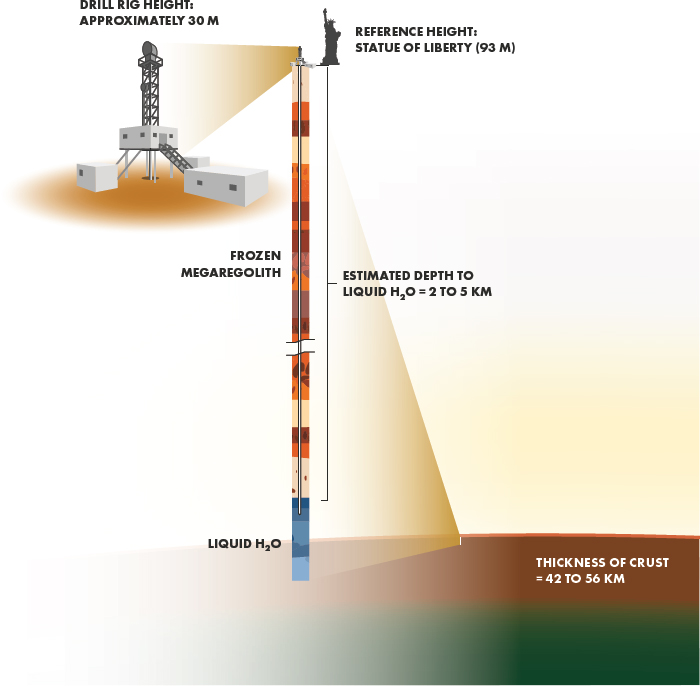
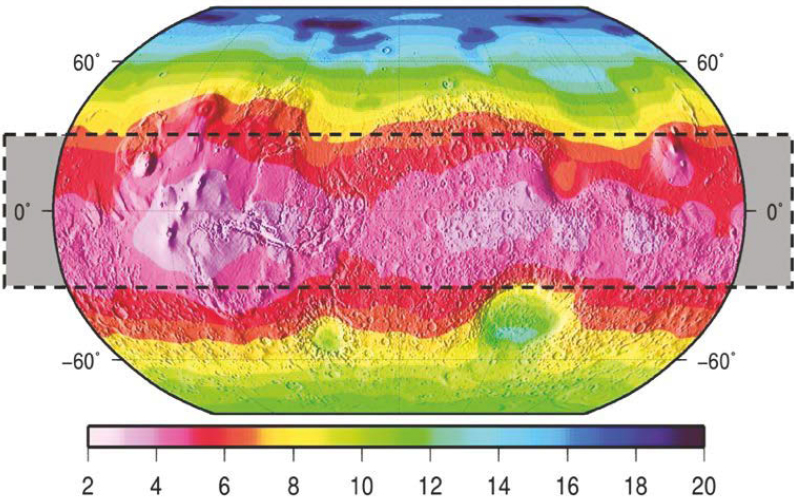
SOURCE: V. Stamenković, K. Lynch, P. Boston, et al., 2021, “Deep Trek: Science of Subsurface Habitability & Life on Mars,” Bulletin of the AAS 53(4), https://doi.org/10.3847/25c2cfeb.dc18f731. CC BY 4.0.
Below the cryosphere, Mars is expected to be habitable to life as we know it (e.g., Jones et al. 2011; Michalski et al. 2013a; Stamenković et al. 2020; Tarnas et al. 2021; Cockell et al. 2024) and may have been habitable over billions of years. Evidence of subsurface habitability is supported by inferred surface habitability of ancient Mars, including wildly different parts of the planet at Gale Crater (Grotzinger et al. 2014; Losa-Adams et al. 2021) and Jezero Crater (Kizovski et al. 2025). The depth to where liquid water may exist is closest for near-equatorial low-altitude sites (Clifford et al. 2010; Jones et al. 2011) (Figure 3-7). This campaign seeks a site with a Noachian-to-Hesperian transition zone. Ideally, such a site would include deposits of water ice above possible liquid water. Habitable zones for ancient life may be more accessible in near-equatorial regions owing to a higher frequency of impact events creating temporary habitable zones linked to permanently habitable deep subsurface environments (Schwenzer et al. 2012).
3.5.1 Campaign’s Science Objectives
The search for, and sampling of, indigenous extant life is one of the most complex surface activities on Mars because of the high requirements for in situ identification, sampling, containment, limited in situ analysis, and potential curation and storage for return to Earth.
Science Objective 1 is the primary focus of this campaign, with Science Objectives 2, 3, and 11 providing context for the astrobiology objectives. By establishing the capabilities to monitor crew health and address the primary objectives, Science Objectives 4, 6, 8, 9, and 11 become opportunistic and provide valuable data to support future mission planning (Table 3-9).
TABLE 3-9 Science Objectives for the Seeking Life Beneath the Martian Icy Crust Campaign
| Campaign Science Objectives | Justification for Primary or Secondary Classification | Required Measurements | Additional Desired Measurements |
|---|---|---|---|
| Primary Science Objectives | |||
|
The top priority of all martian science is life detection and habitability. | Inorganic analysis, organics. Volatiles, mineral/organics mapping. | If evidence for extant or extinct life is detected, see Appendix G. |
|
Necessary to target deep drilling. | Seismic, radar. or other imaging to identify the lower edge of the cryosphere, impediments to drilling, and most likely access to liquid water. | Characterize transport, salinity, temperature, and pressure in reservoirs; characterize near-surface water ice deposits, their stability, and coupling to atmospheric and other surface processes. |
|
Necessary to contextualize life detection. | Obtain samples up to 10-m depth (including low exposure age) across a wide range of ancient rocks (sedimentary, volcanic for context if available) with limited in situ characterization, focused on age dating, and evidence of ancient life and/or prebiotic chemistry. | Map spatial boundaries of potentially habitable areas within the upper 20 m to identify potential niche habitats across space or time. Increase sampling within these zones. |
|
Necessary to contextualize life detection. | Sample-specific dosimetry. | |
| Secondary Science Objectives | |||
|
Opportunistic science target supports future mission planning. | Leverage crew health and safety tools to support Human Research Program (HRP) investigations by investigators back on Earth. | Consider whether other existing instrument suites support relevant in situ analysis with minimal overhead versus sample return. |
|
Opportunistic science target supports future mission planning. | Leverage omics tools from astrobiology and crew health and safety for periodic microbiome assessments of living areas, ECLSS systems, and spacesuits. | Continue to monitor habitat after crew departure. |
| Campaign Science Objectives | Justification for Primary or Secondary Classification | Required Measurements | Additional Desired Measurements |
|---|---|---|---|
|
Opportunistic science target supports future mission planning. | Leverage dosimeters from astrobiology primary objectives, and crew health and safety monitors to characterize total dose and type of radiation. | If not already available, add radiation time course measurements and segment by energy level. Evaluate effectiveness of selected interventions. |
|
Opportunistic science target supports future mission planning. | Leverage crew health and safety tools to support HRP investigations by investigators back on Earth. Examine wear conditions and patterns on key hardware elements. Chemical composition and particle size distribution of martian dust. Return dust/regolith samples to Earth. | Pulmonary function tests, ultrasound, exhaled gas analysis, and inflammatory biomarkers. Atmospheric monitoring in habitat. Relevant real-time biomarker analysis. Consider controlled experiments on exposure of key materials and systems. |
|
Opportunistic science target supports future mission planning. | Assess ice deposits and reserves for future habitation based on near-surface cryosphere and deep drilling aquifers at 2–5 km or beyond. Return dust/regolith samples to Earth. | Characterize and map other resources (salts, minerals). |
NOTE: ECLSS, Environmental Control and Life Support System; IRSU, in situ resource utilization.
The opportunities to include supplemental science at minimal cost or time include primarily measurements that are required for other operational reasons (e.g., medical research enabled by data already collected for astronaut health and medical operations, operational risk reduction) and measurements that leverage tools already needed for the primary campaign (e.g., drilling and coring, radiation dosimetry needed for astrobiology sample curation also being used for habitat monitoring).
3.5.2 Notional Architecture
Mission design splits efforts into an “establishing” 30-sol mission and an “executing” 300-sol one: The first mission would establish geologic context and pick specific sites of interest, install a seismic network or other means to map out deeper structure to optimize deep drilling site selection, and conduct analysis on ancient rocks including at the near surface (2–10 m), low–exposure age samples, investigations of which could target signs of prebiotic chemistry and ancient life and, opportunistically, extant life (Table 3-3, Science Objective 1 both adequate and target scope). An intermediate cargo delivery mission would provide infrastructure in support of a long surface stay and deep drilling. In contrast, the 300-sol mission would set up deep drilling infrastructure and obtain samples from below the cryosphere, analyze samples, and expand drilling to additional sites as time allows.
The architecture of this campaign is driven by the assumption that deep drilling to 2–5 km requires more than 30 sols. A 30-sol mission would allow for initial science and more precise location of the desired deep drilling site(s). Shallow (initially 1–2 m, and up to 10 m) cores could be taken to characterize geotechnic properties and to enable preliminary science (e.g., ancient life preserved within previously habitable zones or extant life within transiently habitable refugia in the near surface). A following 300-sol mission would focus on the hard work of deep drilling, core collection, and initial analyses, with the bulk of the selected samples returned to Earth for access by multiple laboratories and curation for investigations using future technologies.
Based on current understanding of Mars, accessing below the cryosphere may require drilling to 2–5 km or more below the surface. While drilling 800 m through glacial ice to reach subglacial Lake Whillans took only a few days (Rack 2016) and required ~450 metric tons of gear, hard rock drilling is expected to take orders of magnitude longer. The Lake Whillans effort, however, was not optimized for minimum mass. If precursor development accelerates deep drilling capabilities, obtaining deep cores from multiple sites would enhance science return during a future extended-stay mission. Specific science needs will drive the specific drilling capabilities required. (For an example see the Section 5.3.3 case study, “Drilling on Mars for In Situ Resource Utilization.”)
Landing Site Criteria
Mars and Earth have significant overlap in the temperature and pressure regime known to support life on Earth (Jones et al. 2011). The most extensive overlap is in the deep subsurface (Carrier et al. 2020). Radiolytic decay alone could support cell densities of millions of cells per kilogram of rock (Tarnas et al. 2021). The best locations for extant life as it is now understood are in places with permanent liquid water that are sheltered from surface radiation and chemical reactions. Liquid water/ice water table depth is most shallow near the equator and could be up to 5 km or more (Clifford et al. 2010). The estimated thermal skin depth, based on InSight Lander measurements, is a few centimeters (Spohn et al. 2024); thus, surface-driven thermal fluctuations are limited to less than 1 m depth. Gases may permeate significantly deeper depending upon porosity. Below 10 m, radiation is dominated by naturally occurring radioactivity (Horne et al. 2022). Interactions of impact events can result in transient habitable environments (Schwenzer et al. 2012; Osinski et al. 2013), resulting in preserved ancient life above the current cryosphere/hydrosphere boundary. These transient zones for ancient life may be more accessible in near-equatorial regions, owing to a higher frequency of impact events creating temporary habitable zones linked to permanently habitable deep subsurface environments (Schwenzer et al. 2012).
Few low-latitude sites have been observed to have abundant near-surface ice, and modeling shows conditions for transient near-surface habitability are more likely at latitudes greater than 33°N (Mellon et al. 2024). However, prioritizing extant life means seeking persistent, deep water. The easiest access to below the cryosphere (Figure 3-7) would likely be provided by targeting a low-latitude and low-altitude site (Clifford et al. 2010; Jones et al. 2011). Such sites exist and have been identified in the literature (Gourronc et al. 2014; Horvath et al. 2021; Mitrofanov et al. 2022; Fastook and Head 2024; Gou et al. 2024).
Crew Role
For both the 30-sol and 300-sol missions, a bifurcated crew is anticipated, with one subteam focused on drill setup, operations, and maintenance, and a second subteam focused on in situ sample collection, curation, and analysis. During drilling, the science team might be able to conduct additional surface science while they await core samples. Where more hands are needed for a given operation, cross-training would apply. With NASA’s standard assumption of a buddy system, this drives a minimum of a four-person crew focused on this campaign, with the need for larger crew complements evaluated as drilling operations and automation are refined and prototyped.
3.5.3 Strengths and Weaknesses of the Campaign Design
Strengths
- Interrogates a cross section of martian history by deep drilling.
- Maximizes time on target for the top scientific objective and increases hyperlocal context and depth of understanding of samples.
- Minimizes secondary science hardware, training, and overhead by focusing first and foremost on one field of study.
- Simplifies messaging by focusing on fewer primary objectives.
Weaknesses
- Overhead of deep bore drilling to 2–5 km depth limits the number of sites, requiring correct site selection before drilling begins.
- Science returns and community engagement for biological and physical sciences and human factors and for atmospheric and space science are more limited than for other disciplines.
- The risk of mission failure is high when the mission is so heavily focused on a single objective.
3.5.4 Measurements and Samples
The measurements to be done with preplaced assets include
- Measuring the distribution and extent of near-equatorial subsurface ice and the lower limit of the cryosphere.
- Mapping of spatial boundaries of potentially habitable areas within the upper 20 m to identify potential niche habitats based on, for example, ice, water vapor transport, thermal inertia, salt content, or mineralogy.
The measurements to be done in situ include the following:
- Search for life, including both Earth-life agnostic and Earth-life targeted approaches, especially in deep core measurements to 5 km or more, and surface and shallow (1–2 m depth) samples:
- Determine organic composition and abundance, for example, untargeted and targeted analysis including diverse approaches, not limited to nucleic acids, sugars, cofactors, amino acids, and lipids. Characterize the abundance, nature, and spatial distribution of organic molecules, including information on chirality, structural isomers, and repeating subunits.
- Seek to identify near-surface regions on Mars that are or could have been habitable (e.g., brines, caves, ice, salt deposits, salt/ice interfaces, ice/rock interfaces, or mud volcanoes).
- Assess characteristics that influence habitability: the presence and abundance of water, ice, organics, and salts; protection from radiation; and hydrologic activity.
- Study attendant biology and human factors of the mission itself:
- Collect spaceflight standard measures to characterize crew physiological, cognitive, and emotional health, including team dynamics.
- Characterize the evolution of microbial population dynamics and species distribution in biological systems and habitable volumes.
- Mapping and mineralogy:
- Map surface and subsurface features, including spatial boundaries of potentially habitable areas, and subsurface geomorphology.
- Map mineralogy of bulk and microscale rock along the depth profile, especially searching for alteration minerals that inform sediment diagenesis, including cementation processes, dissolution, authigenesis, recrystallization, oxidation/reduction, fluid–mineral interactions, and hydrated minerals.
- Hand-sample/scale optical and multispectral imaging to reveal the structure of the macro- and microenvironment.
- Perform high-resolution multispectral imaging of the environment, which could elucidate local-scale geochemical processes.
- Chemical composition:
- Determine the abundance of inorganic elements in rock, ice, and liquid, including CHONPS and electron donors (H2, Fe2+, H2S, CH4, NH4+) and acceptors (CO2, Fe3+, SO4, ClO4−). Include redox state.
- Determine chemical composition with regard to oxidants (peroxide, perchlorate, chlorate, NO3, O2), and oxidation state of Fe and Mn.
- Determine the composition and abundance of reduced, greenhouse, and noble gases in rocks, ice, and the atmosphere (e.g., CH4 and H2). Include related isotopic fractionation.
- Determine salinity, redox potential, pH, water activity, and temperature of brines, solutions, and water.
- Environmental characterization via:
- Light flux;
- Temperature, pressure, and relative humidity; and
- Radiation dosimetry at relevant sites and sampling depths.
The measurements to be done via sample return include additional characterization on Earth (accelerator mass spectrometry, life detection testing [e.g., stable isotope priming]), noting that careful curation of cores is required to avoid loss of volatiles, breakdown owing to sunlight and/or atmospheric exposure, or other external influences.
This campaign may not be achievable to the level of the full stretch objective within the 300-sol second mission (e.g., if the cryosphere is deeper than expected, there are issues with drilling, or the available crew time is too low). A plan to achieve this campaign’s objectives will need to include mitigations with precursor activities and extended and/or follow-up missions.
3.5.5 Key Assets and Major Equipment
Before Crew Arrival
The most crucial precursor work is identifying promising subsurface sites for accessing the subsurface beneath the cryosphere. There is a technology gap for the equipment that can characterize the subsurface at the most accessible low-latitude cryosphere depths (5 km and perhaps up to 10 km at low latitudes; Figure 3-7). Evaluation of assets capable of mapping geomorphology deeper than Mars Advanced Radar for Subsurface and Ionosphere Sounding (low-frequency GPR) may include seismic methods, or transient electromagnetic sounding (Carrier et al. 2020; Nunes et al. 2022).
Finding: Targeting a drill site with maximal likelihood of accessing liquid water requires characterization of subsurface structures at relevant depths. There is a technology gap for such characterization at depths greater than a few kilometers.
Crewed Operations
The primary work is site characterization, drill setup, and deep subsurface sampling. This requires surface mobility for carrying heavy equipment and core samples to and from the drilling sites, shallow and deep drilling infrastructure, analytic tools, and sample storage capabilities. Deep drilling will require more capable tooling than ever used on an extraterrestrial body.
For the secondary objectives, no unique major equipment is required. The campaign leverages existing operational measurements as described above, including crew health and performance instrumentation, dosimeters, omics tools, and geologic sampling kits as outlined in Section 3.2.
After Crew Leaves
There are no additional key assets specified, but for all automated exploration-enabling systems left on the martian surface, or set up for recurring human presence, the attendant science opportunities need to be evaluated, for example,
- Life detection instrumentation on any water collection systems;
- Biology of the built environment monitoring over time;
- Environmental characterization, such as dosimetry, and temperature and pressure changes;
- Video and light flux of dust storms; and
- Any automated preparatory activities required for cargo infrastructure delivery and/or setup.
3.6 INVESTIGATING MARS AT THREE SITES (30-30-30)
A 30-30-30 architecture would pose less risk for the astronauts and would satisfy some science objectives from each of the four disciplinary panels. First and foremost, it would enable landings at three widely separated sites, which maximizes the science return from dating of martian rocks, helping to validate estimates of surface ages based on cratering counts (Figure 3-8). Admittedly, this enhanced science return requires the ability to bring
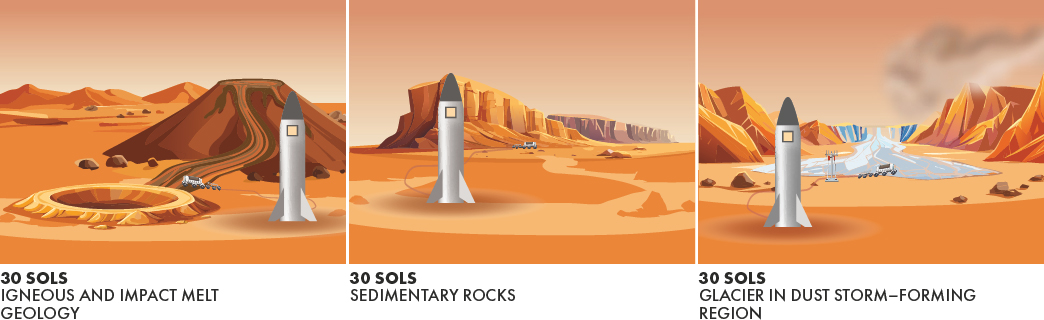
back useful samples from Missions 2 and 3, which are focused on different objectives. Wide separation would also enhance the return from seismometers and meteorological towers, both of which could be deployed during relatively short stays and yet continue to collect data for extended periods after each landing. Many of the astrobiological science objectives could be achieved as well, although not to the extent allowed by longer surface missions. Although the exact choice of sites remains negotiable, three possibilities are listed below:
- Igneous and impact melt geology. The first landing would be at a site that offers a good selection of igneous rocks and impact melts to perform radiometric dating. It would be located somewhere in the southern highlands, in a region that will provide a good set of measurements to help establish martian cratering chronology, which heretofore has been calibrated by analogy to the lunar record. Other hard-rock geology science objectives will also be emphasized, although sample collection time will be limited because of the relatively short stay.
- Sedimentary rocks for evidence of ancient life and/or prebiotic processes. The second landing would be at a site that offers a good record of sedimentary rocks, similar in many respects to previous rover explorations of the Gale and Jezero craters. The main objectives will be to look for evidence of extinct life, along with indirect evidence for extant life (e.g., resolving the abundance and source of martian methane). This site would also be located within the southern highlands, preferably at some location that also contains igneous rocks and/or impact melts that could be used to establish a second data point in the martian cratering chronology.
- Glaciers within a dust storm–forming region. The third landing would be at a low- to mid-latitude site that shows evidence for subsurface ice. The two key goals will be (1) to establish the viability of this site for a future long-term stay that will require ISRU and (2) to look for any signs of life within the ice or within associated brines. The landing site is located within a dust lofting region that can be studied with instruments deployed on weather stations and a meteorological mast. This site has similar characteristics to the Mars Science Across an Expanded Exploration Zone Campaign (Section 3.3), which involves a 30-Cargo-300 stay at a particular location.
3.6.1 Campaign Science Objectives
The science objectives of this campaign could be described as being broad but not deep. They are broad because the campaign involves three 30-sol missions to widely separated parts of the martian surface that will provide information on a variety of different scientific questions of interest to all four of the subpanels. They are not as deep, however, as the questions addressed by some of the other representative campaigns that involve one
30-sol mission, a follow-up uncrewed supply mission, and a third 300-sol crewed mission, all utilizing the same landing site. The main science objectives are different for each of the missions and are listed separately below. The objectives for the Panel on BPS/HF are common to all missions and are discussed afterward.
The science objectives for this campaign are shown in Table 3-10, divided by mission number. Mission 1 targets igneous and impact melt geology. Mission 2 targets sedimentary rocks for evidence of ancient life and/or prebiotic processes. Mission 3 targets glaciers within a dust storm–forming region. Note that in some cases for this campaign, the overall prioritized science objectives shown in Table 3-1 are divided into parts to be addressed
TABLE 3-10 Science Objectives for the Investigating Mars at Three Sites Campaign
| Mission | Campaign Science Objectives | Justification for Primary or Secondary Classification | Required Measurements | Additional Desired Measurements |
|---|---|---|---|---|
| Primary Science Objectives | ||||
| 1 |
|
The main goal of this mission is to calibrate the martian cratering record and determine if it is consistent with the lunar record. | Age dating of collected igneous rocks and impact melts (to be performed back on Earth). | None |
|
The igneous rocks collected for age dating can also be analyzed for information regarding core formation and degassing history. | Mineralogy and isotopic ratios of trace elements (also done back on Earth). | None | |
| 2 |
|
The search for life is the topmost science priority for Mars exploration. | Collect rock samples for later study on Earth. Search for preserved organic material and/or sedimentary structures indicative of life. | None |
|
Sedimentary rocks provide a record of past environmental changes. | Mineralogy and morphology of sedimentary deposits. | None | |
| 3 |
|
This site has the best chance of harboring near-surface extant life. | Organics. Search for biopolymers such as DNA and RNA. Other, nonterrestrial biopolymers, if found, might be even more informative, because they would be indisputably indigenous. |
None |
|
This is the topmost science objective of the Panel on Atmospheric Science and Space Physics. | Dust samples for analysis on Earth. Sand flux measurements. Atmospheric temperature, pressure, wind speed and direction, and relative humidity at various heights. Eddy covariance measurements at various heights, up to 10 m above the surface. |
Energy balance measurements (e.g., solar radiation, thermal radiation, and heat flux). | |
| Mission | Campaign Science Objectives | Justification for Primary or Secondary Classification | Required Measurements | Additional Desired Measurements |
|---|---|---|---|---|
| Secondary Science Objectives | ||||
| 1 |
|
Basic geologic mapping of the landing site. | Visual and photographic mapping. | None |
| 2 | Additional science objective: Determine the present-day atmospheric isotopic and elemental composition and its sources and sinks. CH4 is of particular interest. | Not the primary goal of this mission but interesting in its own right. | Gas chromatography/mass spectrometry analysis of atmosphere, best done by bringing atmospheric samples back to Earth. | Eddy covariance measurements. |
| 3 |
|
Interesting but not as mission critical as the search for extant life. | Drill to 5 m depth. Look for layering in the subsurface ice that might reflect recent climate history. | None |
|
Interesting from a practical standpoint but not crucial for mission success. | Measure abundance of water ice and other volatiles near the landing site. | None | |
| All | Additional science objective: Characterize Mars’s internal structure (through seismology). | Easy to do but not crucial for mission success. | Seismic measurements extending for at least one martian year following the mission. | None |
|
This will be done for the purposes of crew safety. Critical for safety reasons but not to the main scientific objectives of the mission. | Monitoring of microbial populations within the spacecraft. | None | |
|
Same as above. | Observations of crew members. | None | |
|
Radiation monitoring necessary to ensure crew health. | Monitoring of charged particle radiation. | None | |
NOTE: DNA, deoxyribonucleic acid; ISRU, in situ resource utilization; RNA, ribonucleic acid.
during different missions. Additional science objectives that are specific to this campaign but that are not among the 11 prioritized science objectives shown in Table 3-1 are also noted.
Mission 1: Igneous and Impact Melt Geology
- Constrain the geochronology of the martian cratering record by dating igneous rocks and impact melts at a variety of different sites.
Because it visits different spots, this campaign is ideally suited for establishing the chronology of the martian cratering record, something that has heretofore been accomplished previously only by analogy with the lunar cratering record. The lunar analogy, while credible, might fail if the numbers of planetesimals at Earth’s and Mars’s orbital distances decreased at different rates. Bringing back samples of igneous rocks and impact melts from close to the landing site on the very first mission will allow researchers to test the lunar analogy at one location on Mars’s surface. The landing site for this first mission will be optimized for this purpose. If the landing sites for the next two missions contain igneous rocks, it may be possible to further constrain the cratering timescale by obtaining samples of different ages.
- Characterize igneous systems within the exploration zone to determine planet formation, differentiation, and volcanic history.
The same igneous rocks that allow accurate dating will provide a host of other useful information regarding the planet’s early history. Mars is a small planet that stopped growing well before its larger counterparts in the inner solar system. Parts of its surface have also been preserved for much longer than on Earth, so it can provide fresh insight into processes like core formation that occur early in a planet’s history.
Mission 2: Sedimentary Rocks for Evidence of Ancient Life and/or Prebiotic Processes
- Determine if evidence can be found for extant or extinct life at the landing site.
This mission will visit a region hosting ancient sedimentary rocks, similar to the Gale Crater and Jezero Crater being explored by the Curiosity and Perseverance rovers. These rocks can be analyzed using a variety of different techniques (e.g., optical imaging, chemical and isotopic analysis) to look for evidence of extinct life. The focus here is on extinct life, not extant life, because these rocks have been exposed to a cold, dry, high-radiation environment for millions of years and hence are not likely to host viable organisms, even if life did arise on Mars at one time.
- Characterize the rock record within the exploration zone to understand environmental changes over Mars’s history.
Sedimentary rocks also contain a record of surface processes and climate change and hence can be used to learn about Mars’s environmental history over millions to billions of years. Where possible, this stratigraphy can be correlated with crater counts using the information gleaned from Mission 1. Sedimentary rocks may contain time-sensitive phases that offer insights into the climate history of Mars, including the timing of the transition from a wetter to a drier environment.
- Determine the present-day atmospheric isotopic and elemental composition and its sources and sinks.
This has been a goal of several past lander and rover missions, beginning with Viking in 1976 and including the Curiosity rover, which has been active on Mars since 2012. One of the goals of both missions is to measure the abundance and isotopic ratios of noble gases, which can provide information on atmospheric formation and
escape. Nevertheless, some isotopic ratios, for example, 20Ne/22Ne, remain poorly constrained. Meanwhile, measurements of CH4 (methane) in the Gale Crater made by the Mars Science Laboratory on Curiosity suggest that methane is present at low abundances and shows both seasonal and diurnal cycles (Webster et al. 2021). Methane is a possible biosignature gas, so figuring out where it is coming from is a high priority.
Mission 3: Glaciers Within a Dust Storm–Forming Region
- Determine if evidence can be found for extant or extinct life at the landing site.
The focus here will be on looking for extant life that might be present in subsurface ice or in brines associated with that ice. Finding extant life would, of course, be tremendously exciting and would almost certainly drive most subsequent human Mars missions. Life discovery, however, is only one of several science objectives for this mission.
- Determine what controls the onset and evolution of major dust storms, which dominate present-day climate and weather variability.
Dust storms occur frequently on Mars because of the arid environment, and some of them become global in extent, threatening the health and lives of astronauts anywhere on the planet. In this mission, the astronauts will study the conditions necessary for triggering dust storms by analyzing the nature of the dust itself, by measuring saltation, by deploying weather stations, and by erecting a meteorological tower to measure the dust flux and other atmospheric parameters. This tower would presumably be left in place and would hopefully return wind, dust, and turbulence measurements for at least a full martian year.
- Characterize past and present water and ice reservoirs within the exploration zone to understand geologic and climate evolution over Mars’s history.
Just as sedimentary rocks can provide a record of environmental changes over very long (billion-year) timescales, subsurface ice deposits provide a record of change over somewhat shorter timescales. In particular, ground ice probably migrates back and forth between high and low latitudes as a consequence of large, chaotic obliquity variations that are predicted to occur on timescales of tens of millions of years. These obliquity fluctuations are probably best recorded in the layered terrain near Mars’s poles, but they could conceivably be observed in subsurface ice at lower latitudes.
- Characterize the martian environment for ISRU.
These same subsurface ice deposits may eventually be useful for ISRU. ISRU is widely acknowledged to be important for long-duration stays on the martian surface. Water, or water ice, is perhaps the most useful local resource, both for its direct application to human survival and plant growth and for the potential to generate fuels for getting back off the planet. The crew will not have time to fully map out the ground ice near the landing site in this short mission, but they will at least be able to check if it is truly there. Optionally, a robotic precursor mission could be sent to the desired location ahead of time to make sure that the ground ice is there.
Objectives Common to All Three Landing Sites
- Characterize Mars’s internal structure through seismology: At each landing site, the astronauts will deposit a seismometer to monitor marsquakes triggered by seismic activity or impacts. The fact that the three landing sites are well separated in space would allow improved seismic monitoring as compared to the single station emplaced by NASA’s InSight mission.
- Constrain martian atmospheric circulation models by measuring atmospheric pressure, temperature, relative humidity, and wind speed and direction by emplacing a ground-level meteorology station at each landing site.
- Determine throughout the mission whether or not microbial population dynamics and species distribution in biological systems and habitable volumes are stable and are not detrimental to astronaut health and performance.
Most of the monitoring of microbial populations will occur during the two long cruise phases of these missions; however, these activities will continue while the astronauts are on the planet’s surface.
- Determine the longitudinal impact of the integrated martian environment on crew physiological, cognitive, and emotional health, including team dynamics.
As noted, the crew members will spend most of their time in space, not on the planet’s surface. So, any study of the effects of the integrated martian environment on crew health and behavior would focus on early adaptation to the martian environment.
- Characterize the primary and secondary radiation at key locations in the crew habitat and astrobiological sampling sites to contextualize sample collection and improve models of future mission risk.
3.6.2 Notional Architecture
The 30-30-30 campaign is different in nature from the 30-Cargo-300 campaigns in that it does not involve long-duration stays on Mars’s surface. In that sense, it is less risky but also less ambitious than the other campaigns outlined in this document. To think of it another way, it is more like the 1969–1972 Apollo missions to the Moon, except that the in-flight travel times are much longer. The stay times on Mars’s surface are also an order of magnitude longer than on the Apollo missions but comparable to planned Artemis missions to the Moon.
Landing Site Requirements
These are described above in Section 3.6.1, “Campaign Science Objectives.”
Crew Role
Given the high density of science folded into just 30 sols per landing, a crew large enough to support multiple science operations simultaneously would be optimal. With NASA’s standard assumption of a buddy system, this drives a minimum of a six-person crew focused on this campaign, with the need for larger crew complements evaluated as operations and automation are refined and prototyped.
3.6.3 Strengths and Weaknesses of the Campaign Design
Strengths
- This strategy maximizes the number of different locales that can be investigated in a three-mission campaign. It thus addresses science objectives from all four of the disciplinary subpanels.
- The cadence of this campaign would create a high level of excitement and possible unexpected findings that propel the future engagement of the interested community and the resources needed for the next segments.
- This campaign will arguably do the best job at establishing the chronology of cratering on Mars. The first landing site is picked specifically for this purpose, and the second and third landing sites may provide additional data points if they are located in regions that have different crater counts than the first mission and if they contain datable rocks.
- Placing seismometers at three widely separated locations on Mars’s surface will maximize the return from seismology, assuming these stations can remain operative after the astronauts have left.
- Likewise, leaving meteorology stations at all three landing sites will allow measurements of atmospheric properties that may be useful in constraining Mars atmospheric circulation models.
Weaknesses
- Some objectives will be addressed, but it may be difficult to do so in an optimal manner. For example, drilling into subsurface ice in Mission 3 will have to be done quickly, limiting both the depth of drilling and the number of different sites that can be studied. Most sample analyses will likely need to be done on Earth because of the limited time available on Mars’s surface.
- The astronauts will have limited ability to react to discoveries made within the first few sols after landing. It is possible to find life on Mars’s surface but not know it until samples are brought back to Earth.
- Given the limited amount of time at each landing site, some science objectives, such as acquiring samples of igneous materials for geochronology, as would be done during Mission 1, might be difficult to achieve during Missions 2 and 3 that focus on other primary objectives. It takes time to identify and acquire adequate samples and characterize their context.
The limited amount of time spent on the surface in each mission will mean that some of the longer-term, BPS/HF objectives will not be able to be achieved. For example, the goal of “studying the longitudinal impact of the integrated martian environment on plant and animal physiology and development across multiple generations where possible as part of an integrated ecosystem of plants, microbes and animals” cannot be accomplished with this architecture. As another example, “A typical, healthy and well-maintained outbred Drosophila population will have a median lifespan of approximately 70 days and maximum of approximately 90 days at 25°C” (Piper and Partridge 2018), which exceeds the proposed surface stay time.
3.6.4 Measurements and Samples
The measurements to be made are quite different for each of the three missions, and so are broken down in that way.
Mission 1
The key measurements for Mission 1 involve sampling of igneous rocks and impact melts for later radiometric dating and elemental and isotopic analysis to study planetary formation and differentiation. Low-precision (K-Ar, Ar-Ar) dating can likely be done in situ with samples larger than 30 mg for the K-Ar system and larger than 2 mg for the Ar-Ar system. High-precision dating using 87Rb/87Sr ratios will require several kilograms of rocks. The mass spectrometers required to perform these analyses are typically bulky and require carefully maintained climate and dust controls, so these measurements likely will require bringing rock samples back to Earth. In situ analyses of rocks to determine their promise as returned samples may include, at a minimum, abrasion, imaging, and compositional analysis. Planetary formation and differentiation can be studied by measuring other properties of igneous rocks, including their chemistry, petrology, mineralogy, and isotopic composition of many elements, but Nd, W, and Xe, in particular. Several kilograms of rocks need to be returned to Earth to accomplish this task.
Mission 2
The measurements enabled by Mission 2 span a wider variety of techniques. Sedimentary strata can be studied by eye to look for textures such as stromatolites. Multiscale, stereo, and multispectral imaging may also prove to be useful tools. A combination of a Mars compass and a portable 3D camera with mapping capabilities and a zoom, coupled to a data recorder (for continuous recording), would meet this requirement.
Several kilograms of rocks from interesting-looking formations would be returned for detailed chemical and isotopic analyses in laboratories back on Earth, just as in Mission 1. But analysis of air samples—for example, to look for methane—would ideally be done first on Mars to avoid the possibility of contamination or leakage during the trip back to Earth. This would require a sophisticated gas chromatograph/mass spectrometer (GCMS) like the one that is part of the Sample Analysis at Mars instrument package on Curiosity.
As with Mission 1, the astronauts will also look for igneous rock samples to bring back to Earth for radiometric dating to help calibrate the cratering record. This can be facilitated by having more astronauts (at least four) so that they can share these duties. The same initial characterization of samples will need to be performed to ensure that the samples are datable.
Mission 3
This mission has perhaps the most diverse set of measurement requirements of the three missions studied here. A prime objective is to drill as deeply as possible, but at least 2 m, to sample subsurface ice. This will ideally be done at multiple locations near the LS. Measurements would include looking for organic material within the ice or within associated brines. Ideally, some of these measurements would be conducted at the LS to avoid contamination (or melting) during the long return trip to Earth.
A completely different set of measurements will be required to study dust lofting near the LS. Sampling the regolith and making measurements (e.g., of particle size, shape, and composition) is one step. These measurements can be safely done at laboratories back on Earth. A related set of measurements will be conducted with saltation sensors, meteorology stations, and instruments set up on an approximately 10-m-high meteorological tower for eddy covariance measurements to study turbulence, fluxes, and their relationship to dust lofting. This tower and weather stations would remain in place following the mission, and the instruments would be designed to return data for a full martian year.
Any igneous rocks that can be identified will be brought back to Earth for dating to further calibrate the cratering record.
3.6.5 Key Assets and Major Equipment
Mission 1
Pre-mission mapping will be used to identify the optimal landing site for this mission. This requirement applies to all three missions. No major equipment is needed for this task. Uncrewed rover exploration of possible landing sites could allow for low-resolution K-Ar or Ar-Ar dating, thereby testing whether one or more of them is suitable for a more capable human mission.
Mission 2
A sensitive GCMS instrument will be included to enable analysis of the composition of air samples in real time during the mission.
Mission 3
The key pieces of equipment for this mission are a drill capable of penetrating rock and/or ice to a depth of 2 m or more and a deployable meteorological tower that extends to a height of ~10 m. This tower would be equipped with instruments designed to provide general meteorological data in addition to measurements targeted at understanding the initiation of dust storms.


