A Science Strategy for the Human Exploration of Mars (2026)
Chapter: 2 Defining the Science for Campaigns
2
Defining the Science for Campaigns
Designing and prioritizing science campaigns requires the development of a broad set of tools and concepts before progress on the campaigns themselves can begin. This chapter defines a Mars campaign and describes the architectures considered by the committee before explaining how the candidate science objectives were developed and themselves prioritized. Crafting campaigns from these science objectives required several assumptions and caveats, including crew size, exploration zone definition and size, and planetary protection. A final section lists enabling technologies for human exploration of Mars.
2.1 WHAT COMPRISES A CAMPAIGN TO MARS?
A campaign in the context of this study is a set of missions encompassing the first three landings of human-scale landers on Mars (Figure 2-1). Long-term Mars exploration could be implemented as a succession of several campaigns. Not every landed mission within a campaign would necessarily carry humans to the surface of Mars; a cargo mission delivering substantial infrastructural elements for humans would qualify as the landing of a human-scale lander. The campaigns in this report are each guided by a different concept, and the three missions in each case carry the humans or cargo and complete the concept.
Multiple Mars landings maximize the return on investment associated with the significant cost of hardware development and operations support needed to enable humans to safely journey from Earth to Mars, land on Mars, be productive explorers on Mars, ascend from Mars, journey back to Earth, and analyze their scientific return. Planning a campaign of several missions is more cost-effective than planning single missions individually. The lessons learned and progress of technology inherent in the first missions to Mars mean that any longer series of human-scale landings would be difficult to define and plan in detail, especially if later missions are to be allowed to evolve in design and scope.
While the technology available to a campaign will change with time, and potential precursor missions, such as sample return, will shape the ways future explorers will pursue their science, this study aims to be agnostic to the timing of the first human missions to Mars. Instead, the campaigns focus on the community’s top science themes, independent of timing and execution.
NASA has conducted several design reference mission studies for the human exploration of Mars. Two reference mission scenarios were provided by NASA for this study, and they define the building blocks used to assemble the report’s campaigns: the “long-stay” 300-sol mission scenario and the “short-stay” 30-sol mission scenario (Hoffman and Kaplan 1997; Portree 2001; Hoffman et al. 2022; Needham and Rucker 2024) (Figure 2-2).

SOURCE: NASA/JPL-Caltech/USGS, https://science.nasa.gov/resource/global-color-views-of-mars.

These long-stay and short-stay scenarios are determined by orbital dynamics and can be considered as being fixed constraints. They are combined into campaigns in two ways:
- The 30-30-30 campaign scenario comprises three 30-sol crewed surface missions deployed consecutively at up to three different locations on Mars.
- The 30-Cargo-300 campaign scenario comprises three landed missions to the same location on Mars: one 30-sol crewed surface mission, followed by one uncrewed cargo surface mission to robotically deliver and deploy infrastructure to enable a much longer stay, followed by one 300-sol crewed surface mission. The purpose of each of the missions is determined by the campaign’s science priorities (see additional detailed discussion of campaigns in Chapter 3).
2.1.1 Advantages and Disadvantages of the Two Campaign Architectures
The two architectures have both short-term and long-term advantages and shortcomings, particularly in how science fits into the architectures, and what their budget and schedule needs would be.
The cadence of the 30-30-30 campaign scenario is similar to a chaptered book: each site visited reveals a different act in Mars’s story. The 30-30-30 campaign scenario allows up to three different landing sites to be explored, which means that the planet’s diversity could be broadly sampled. Owing to the relatively short stays, the exploration zone associated with each landing site will be limited in extent. The 30-30-30 campaign scenario may leave behind a global network of instruments suitable for long-term monitoring of global and regional activity and phenomena on Mars, but this scenario is not immediately conducive to long-term studies of human health, microbial populations, plant growth, and animal behavior and/or reproduction. However, one or more missions could have a more substantive biological and physical sciences and human factors component. The 30-30-30 campaign architecture requires fewer extreme technological advances than the 30-Cargo-300 campaign because of the special needs of a 300-sol human stay on Mars. Additionally, unforeseen events may force NASA into a 30-30-30 scenario, making its planning and consideration a key activity.
In contrast, the 30-Cargo-300 campaign scenario targets a single landing site, entailing only two crewed missions, with a human scale but uncrewed cargo landed mission dedicated to infrastructure deployment in between the 30- and 300-sol crewed missions. Owing to the establishment of this infrastructure, the third mission in the campaign is a long-stay, 300-sol mission, enabling the scientific investigation of a large exploration zone. This architecture allows science targets tens to hundreds of kilometers distant to be investigated, including via multiple visits to allow iterations, multiple sampling opportunities, and the establishment of long-baseline instrument networks. By the end of the 30-Cargo-300 campaign, an initial human science and exploration infrastructure has been established on Mars, which may serve as the basis for follow-up campaigns that could further expand the infrastructure and the exploration zone.
The 30-Cargo-300 architecture therefore delivers greater depth of scientific study at one site, because the 300-sol period allows the crew to be discovery responsive, with enough time for task and measurement iterations (see Box 1-1, “Discovery-Driven Science”). The 30-Cargo-300 strategy forces the consideration of establishing a fixed base. Establishing a base is a proven strategy in scientific field exploration, for example, in the Antarctic and Arctic (e.g., Lee et al. 2022; Lee 2024a, 2024b). Establishing a fixed base has long-term benefits for repeat visits and providing a source of inspiration to Earth, but it has the disadvantage of focusing upon a single exploration zone.
2.1.2 Overview of the Four Prioritized Notional Campaigns
The campaigns presented here for consideration (Figure 2-3) are described in detail in Chapter 3. In priority order, they are as follows:
- Mars Science Across an Expanded Exploration Zone (30-Cargo-300) in Section 3.3,
- Synergy of Mars Science Measurements (30-Cargo-300) in Section 3.4,
- Seeking Life Beneath the Martian Icy Crust (30-Cargo-300) in Section 3.5, and
- Investigating Mars at Three Sites (30-30-30) in Section 3.6.

For each campaign, the committee was tasked with describing a science “roadmap” that includes the highest priority science objective(s) addressed, secondary science objectives that are also achievable, measurements needed to address the objectives, and key assets and major equipment emplaced at each phase of the campaign (before, during, between, or after crew missions; see Appendix A for the statement of task). Because of the roadmap’s similarity to standard NASA science traceability matrices (STMs) (Weiss et al. 2005), the report refers to them as STMs (see Appendix J).
To identify the science objectives for each campaign, the committee agreed upon a common understanding that a science objective is a science aim that is as large as possible but still answerable by a series of measurements and their interpretation. Each campaign includes a selection of science objectives, as well as a selection of measurements for those science objectives, as shown schematically in Figure 2-4.

2.2 SCIENCE OBJECTIVES AND THEMES
The committee created science objectives, relying on input from the four disciplinary panels and its own broad viewpoint. The committee’s final objective list does not necessarily map one-to-one with the panel STMs but rather is intended to capture the highest priority science across themes and disciplines, broken into achievable objectives.
The committee received input from the four disciplinary panels in the form of presentations on their science objectives, comprehensive science traceability matrices—including potential robotic precursor observables and samples—and additional pages of written commentary (see Appendixes B–E and J). Incorporating input from the panels, the community, invited speakers, and published sources (see References section), and through months of conversations and exercises, the committee created a combined, prioritized list of science objectives, shown in Table 2-1.
Every campaign consists of science objectives selected from this ranked list and the key measurements needed to address the objectives. Some campaigns also contain additional crucial science objectives from the longer lists provided by the four panels. Primary science objectives for each campaign are those that are the most important to complete and are tied to the landing site choice. Secondary science objectives are those that can be conducted at any landing site and/or are decoupled from the primary science objectives of the campaign.
As the committee considered the scientific objectives advanced by each panel, several common themes emerged as major thrusts of the highest-impact research. The committee identified themes common across disciplines—Life: Past and Present; Life: Habitability; Climate: Weather, Processes, and History; Human Experience and Habitation; and Enabling Future Missions (Table 2-1). Furthermore, the committee identified derivative areas of study that affect research on Mars. These are expanded below.
2.2.1 Life: Past and Present
The detection of life on Mars is a persistent top priority for explorers of many disciplines, and it is the top science objective in this report. The work that goes into understanding the context and meaning of a possible life detection requires, however, a network of information gleaned from multiple objectives and, thus, the broader theme discussed here emerged. Furthermore, detection of life on Mars, whether extant or extinct, necessarily relies on multiple lines of evidence and cannot be viewed as a simple binary yes-no answer (Green et al. 2021), but as a progressive scale where claims of life detection are reported in terms of the level of confidence and using metrics that are discussed and refined within the astrobiology community. This includes concepts like biosignature assemblages (Mustard et al. 2013), the Ladder of Life Detection (Neveu et al. 2018), and nested astrobiological approaches to deciphering the preservation of biosignatures and the presence of life (Chan et al. 2019).
The committee endorses a “decision tree” approach, where the next set of measurements is dynamically defined based on the results from previous measurements (see Box 1-1). The search for life cannot return a definitive “no,” but only a spectrum from “no evidence yet” to higher levels of evidence, and—as humans have wished for centuries—the possible answer of yes, there is life on Mars.
If evidence of life were discovered, any information gained on the surface about the nature of the purported martian life would be most helpful in dealing with the returned samples, and the astronauts would need a detailed search plan prepared in advance. Community efforts to communicate issues of life detection could emphasize the uncertainty of interpretations to different audiences (Green et al. 2021).
2.2.2 Life: Habitability
Part of astrobiology is exploring new conditions under which life can exist and thrive. Mars offers the closest and most accessible means of exploring whether life can exist in a substantially different way than it does on Earth. Habitability is defined as environments or conditions where life could persist. Habitability can also be viewed as a matter of degree, to differentiate between conditions where life merely persists versus where life thrives or is most likely to be found in abundance. The report An Astrobiology Strategy for the Search for Life in the Universe (NASEM 2019) also defined the concept of “dynamic habitability,” which refers to the changing degree of habitability of a planet over time. This is particularly important for Mars because its climate has changed dramatically in the past 4 billion years from its warmer and wetter past to the cold and dry present.
TABLE 2-1 Scientific Themes and Prioritized Science Objectives
| Disciplinary Topics | A: Life: Past and Present | B: Life: Habitability | C: Climate: Weather, Processes, and History | D: Human Experience and Habitation | E: Enabling Future Missions | |
|---|---|---|---|---|---|---|
| Astrobiology | X | X | X | ||
| Geosciences and atmospheric science | X | X | X | X | |
| Geosciences and astrobiology | X | X | X | X | X |
| Human factors | X | X | |||
| Atmospheric science | X | X | |||
| Biological and physical science | X | X | |||
| Biological science | X | X | |||
| Biological science | X | X | X | ||
| Biological and physical science and human factors | X | X |
| Disciplinary Topics | A: Life: Past and Present | B: Life: Habitability | C: Climate: Weather, Processes, and History | D: Human Experience and Habitation | E: Enabling Future Missions | |
|---|---|---|---|---|---|---|
| Biological science | X | X | |||
| Astrobiology, atmospheric science, biological and physical science, and human factors | X | X | X | X | X |
The geologic record on Mars contains evidence of martian environments and their evolution. The framework for correlating specific events or transitions that are widely separated across time and space (e.g., impacts, volcanism, and sedimentary resurfacing) is created by establishing local and regional stratigraphic relationships, constrained by estimated timelines derived from crater densities and/or radiometrically dated samples. By incorporating observations of morphological, textural, spectral, and chemical properties at well-selected sites, an emerging stratigraphic context can be used to develop working hypotheses about the global environmental evolution of the entire planet through time.
2.2.3 Climate: Weather, Processes, and History
Measurements of the present-day atmospheric state and processes, in concert with measurements of solar radiation, are needed to understand the present climate of Mars. Profiling near-surface atmospheric water vapor and its exchange with the upper regolith is important for determining the sources and sinks of atmospheric water and their role in the transport of water across the planet. Similar measurements are also needed for CO2 and other volatiles such as CH4.
Atmospheric effects that still need to be better understood include physical weathering and material transport, planetary temperature variations, chemical weathering, mineral formation, and their impact on habitability. Interactions of the atmosphere with sand, dust, exposed bedrock, and the shallow subsurface form archives of past climate and geologic processes that can be studied (e.g., polar layered deposits, ice cores, and layered rock strata) to understand the past climate of Mars (Figure 2-5). Both the atmosphere and the rock record hold information on the past and present radiation environment of Mars.
2.2.4 Human Experience and Habitation
The “human exploration system” on the martian surface will consist of living components (plants, microbes, and animals, including humans), the inhabited environment (lander, habitat, rover, extravehicular activity suit, and launch vehicle), and systems operated by the crew (e.g., in situ resource utilization payloads). It is undeniable that the function of this human exploration system will determine overall mission success. Consequently, an overarching goal is to improve its performance to increase science return.
As stated in Section 1.1, maintaining the health and safety of the crew is an inviolate expectation for any human space mission. Meeting this requirement when the continuity of medical care is broken by time and

SOURCES: (Left) Copyright William K. Hartmann, 1983; (Right) NASA/JPL-Caltech/University of Arizona, https://static.uahirise.org/images/2017/details/cut/PSP_009840_2745-2.jpg.
distance poses special challenges for Mars. The enhancements in medical capabilities that will be required during Mars transit and surface operations pose a formidable challenge for health professionals that is beyond this committee’s remit.
From a human factors perspective, the development and validation of new methods to monitor and maintain human physical and behavioral performance is necessary translational research that can and needs to be part of Mars science campaigns. Hardware reliability overall needs be a mission priority, including considerations of redundancy, repairability, and early warning, with particular focus on systems critical for health and human safety.
The complexity, dynamism, and uniqueness of the human exploration system is characterized collectively as the integrated longitudinal martian environment. It includes environmental stressors such as dust, radiation, diurnal cycles, and psychosocial factors such as isolation, task difficulty, and team cohesion, whose potential impact is individual, interactive, longitudinal, and cumulative. The resultant strain disturbs allostasis and will affect crew health and performance on Mars and potentially long after return.1 Therefore, developing effective primary and secondary strategies to optimize the human exploration system in response to those demands is a cross-cutting theme and a long-term goal for planetary exploration. For more information on implementation during early missions, see Section 3.2, “Common Biological and Physical Sciences in Space and Human Factors Requirements for All Campaigns.”
2.2.5 Enabling Future Missions
All new knowledge of martian environmental conditions, including the existence of water and carbon dioxide, temperatures, winds, dust, and many others under the themes of Life: Past and Present, Life: Habitability, and
___________________
1Allostasis is an extension of the concept of homeostasis. It represents the process of adaptation to physical, psychosocial, and environmental challenges or stresses (Logan and Barksdale 2008).
Climate: Weather, Processes, and History, will allow future missions to be done more safely and efficiently. Similarly, investigations under Human Experience and Habitation, including measurements of stressors, understanding best practices associated with Mars surface operations, identifying and characterizing in situ resources, and more, will enable future missions.
Of all the results of sending humans to Mars, the greatest source of inspiration and wonder will be the faces of humans standing on the red planet. Optimizing safety and ensuring that humans will return to Mars again is therefore of the greatest importance.
2.2.6 Cross-Cutting Topics
A crucial task of the steering committee was to consider cross-cutting or extradisciplinary topics that might not be naturally emphasized and prioritized by the disciplinary panels. The committee identified five such crosscutting topics:
- Radiation effects on humans and on martian materials (Science Objective 11).
- In situ resource utilization (ISRU) potential on Mars (Science Objective 6). Specific actions envisioned to address ISRU are summarized in Chapter 3 as part of the scenario development. Sub-objectives for biological and physical sciences, geosciences, and other science domains are summarized in Chapter 4.
- Human–agent teaming.
- The social science and humanity of space exploration (partially captured in Science Objective 4).
- Dust (Science Objective 9). This topic is considered as a special case in Chapter 5.
Where possible, these topics were incorporated into the prioritized science objectives and themes in Table 2-1. Topics not discussed elsewhere are described in more detail below.
Ionizing Radiation
Space radiation is characterized by omnipresent galactic cosmic radiation and sporadic solar particle events, both having substantial biological impacts owing to their high energies (tens of MeV to GeV). Consequently, deleterious health effects to astronauts induced by space radiation are among the most important long-term health risks for human missions to Mars.
Crew exposure to radiation during transit and on Mars’s surface is complex and situational, being influenced by heliosphere (including phase of the solar cycle), atmosphere, and topography. Mars has no intrinsic magnetic field and only a thin, diurnally and seasonally varying atmosphere that can block a large fraction of solar particle events but is insufficient to stop relatively higher-energy galactic cosmic rays. The effects of atmospheric shielding and the solar cycle are asynchronous, operating on different timescales (2–3 years versus 11 years).
Galactic cosmic radiation ions with high atomic number and energy, despite their low abundance, can be extremely damaging because the energy deposited is proportional to the square of the particle’s charge (Guo et al. 2021). When these energetic particles interact with the martian atmosphere, regolith, habitats, or biological tissues, they generate large numbers of secondary particles, including neutrons and gamma rays. Secondary neutrons are of considerable concern because they penetrate many forms of matter easily and are indirectly ionizing when absorbed. Neutrons are therefore weighted heavily when converting absorbed doses to biologically equivalent and effective doses (e.g., Higley et al. 2012).
The health risks from radiation exposure are both deterministic and stochastic. A whole-body radiation dose above a threshold of approximately 0.7 Gy may trigger acute radiation syndrome, the severity of which increases with higher doses. Chronic exposure increases the probability of late-term effects such as the development of cancer and cataracts, damage to the central nervous system or cardiovascular system, and epigenetic effects. These risks vary directly with dose and are cumulative over time (e.g., Chancellor et al. 2014; Guo et al. 2021).
To manage risks from acute, chronic, and nuclear technology radiation exposure, NASA adopts the “as low as reasonably achievable” principle (Francisco 2023). Short-term radiation exposure to solar particle events is limited to an effective dose of 250 mSv per event to minimize acute effects. Total career effective radiation dose is not to exceed 600 mSv, regardless of age and sex. These limits are based on an increased likelihood of cancer-related radiation exposure–induced death above an estimated population baseline level, which is currently set at 3 percent greater than the mean—comparable to lifestyle effects such as physical inactivity and smoking (NASEM 2021; OCHMO 2022).
Direct quantification of the radiation environment in deep space and on the martian surface has helped reduce uncertainty about the absorbed radiation dose that humans will receive on Mars. Galactic cosmic rays would produce an average dose-equivalent rate of 1.84 mSv/day in deep space and 0.64 mSv/day at the surface of Mars (Zeitlin et al. 2013; Hassler et al. 2014). Solar energetic particle events, however, are highly variable, and could inflict a dose-equivalent of 1.2–19.5 mSv/event in deep space and of 0.025 mSv/event on Mars (Hassler et al. 2014).
The Radiation Assessment Detector (RAD) on the Mars Science Laboratory mission has continuously measured the most energetic part of the deep-space radiation field within the spacecraft during the cruise and surface phases of the mission since Curiosity’s landing in August 2012 and confirms for this time period the more general numbers given above. RAD data indicate dose equivalent on the order of 1–2 mSv/day in deep space and 0.3–0.9 mSv/day on the surface of Mars (Guo et al. 2021). These data have been essential to inform models to predict radiation risks for future Mars missions; however, total radiation dosages will need to be characterized over an entire solar cycle to be more comprehensive and predictive.
Recent efforts to improve radiation risk assessment for human missions use a multimodal ensemble framework (Simonsen and Slaba 2020) to integrate research data from interrelated sources with the aim to characterize crew exposure during all phases of a mission and estimate biological effects (both cancer and noncancer) of particles at the whole-body and tissue levels.
As illustrated in Figure 2-6, cumulative dose estimates for a 30-day surface campaign and total mission duration of 870–1250 days range from about 685 mSv to >1,700 mSv, depending on the trajectory (Simonsen 2024).

SOURCE: Redrawn from L. Simonsen, 2024, “The Martian Radiation Environment and Human Health Risks,” Presentation to the committee, August 6, National Academies of Sciences, Engineering, and Medicine.
These exposure levels fall well outside the existing base of human spaceflight and exceed the current career limit of 600 mSv. As previously stated in Space Radiation and Astronaut Health, “Unless technological advancements and engineering controls provide improved radiation shielding or other protections to astronauts, for a mission to Mars to proceed, NASA would need to seek waivers to the radiation health standard both for the mission and for each astronaut” (NASEM 2021).
Current knowledge gaps include characterization of neutron spectrum dosimetry ranges, risk characterization between average cumulative doses on the International Space Station (ISS) (~300 mSv) and potential Mars exposures (>1200 mSv), estimation of relative biological effect (e.g., cancer, cardiovascular, cognitive) for exotic parts of the radiation spectrum, understanding interactions of particles with their immediate and nearby surroundings (regolith, spacecraft, and tissues), determination of the effectiveness of shielding strategies, and improving forecasting of infrequent solar particle events (Simonsen 2024). Consequently, the Panel on Biological and Physical Sciences and Human Factors prioritized validating advanced passive and active dosimeters to measure dose rate and composition of the radiation field, understanding stochastic and deterministic radiation effects in plants, animals, and humans, and validating risk biomarkers such as DNA damage, oxidative stress, and inflammation.
Human–Agent Teaming
An operational goal of any expedition is to maximize both the quality and quantity of science that can be successfully completed. These metrics vitally depend on human factors in a human-tended mission, whereas in a robotic mission they do not.
Human operations on a planetary body as remote as Mars will require a different cadence than operations in low Earth orbit (LEO) or on the Moon. At distances from Earth of ~400 km for the ISS in LEO and ~400,000 km for the Moon, both are relatively close; thus, humans can be assisted by mission controllers and investigators. Uploads and downloads are frequent; verbal communication approximates normal conversation but is impaired by the one-way time delay of 1.28 seconds to the Moon. In contrast, Mars averages 225,000,000 km from Earth—three orders of magnitude greater than the distance from the Moon. One-way communication delays can be as great as 22 minutes, hampering regular communication. Thus, a higher degree of crew self-sufficiency will be required than is typical of current space operations, relying heavily on collaboration and coordination among human crew and constructed assistants.
Human–agent teaming refers to the collaborative effort between one or more humans and artificial agents2 to achieve common goals (O’Neill et al. 2022). It is distinct from “autonomy,” where software and hardware operate independently of crew expertise or decision making. The abilities of each agent, whether they are robotic or human, vary in how they gather information from the environment, evaluate feedback, learn new patterns, and develop meaningful verbal and nonverbal responses (Meimandi et al. 2023).
While future martian explorer-scientists will likely carry large compendiums of human knowledge, if this information is not in an easily accessible form, its utility will be limited. Human–agent teaming utilizes concepts from diverse fields such as psychology, human factors engineering, cognitive sciences, neuroscience, computer science, and robotics to enable crew autonomy far from Earth. Functional capabilities that offload routine science and mission management tasks such as science sample processing and data analysis from humans can enable crew members to reallocate time and expertise, improving situational awareness for more complex and independent tasks such as field geology, hypothesis evolution when novel findings require follow-up, and search-and-rescue operations.
Rapid advances in artificial intelligence (AI) and machine learning hold promise for a larger role of artificial agents in human–agent teaming. However, human operators working alongside AI frequently encounter partners who excel in certain areas but lack fundamental skills in others (Dellermann et al. 2019). AI requires extensive machine learning based on large, well-established, carefully curated, and ecologically relevant training sets. Better definition of the surface activities on Mars will be needed so that AI agents can be appropriately trained
___________________
2“Agent” is a broad descriptor encompassing software to robotics to humanoid robotics. Because agents have a human interface, and some ability to take action and make decisions within the context of the team’s goals, they need to be considered elements of a team (O’Neill et al. 2022).
(Stuster et al. 2019); however, for many aspects of Mars human–agent teaming operations, such information may not be available until surface operations commence. Thus, some regression in AI is likely to occur in an unfamiliar martian environment, requiring validation, and perhaps retraining, of the AI agent (Lavin et al. 2022). Research incorporating scientific Mars data and synthetic data can lead to the development of a digital twin for Mars.
By integrating best practices from aerospace engineering and machine learning, mission-critical measurements and design robustness can be ensured for future human exploration missions. In the context of human–agent teaming, a Machine Learning Technology Readiness Levels framework offers a principled approach to developing robust, reliable, and responsible systems (Lavin et al. 2022) to enable cross-functional teams to collaborate effectively on science objectives. Tailoring and aligning secure and trusted AI tools and machine learning workflows for human exploration missions can serve as a common language to enable cross-functional teams to collaborate effectively on science objectives—an essential capability for future human missions to Mars. It will be incumbent on NASA and associated stakeholders to ensure that modern machine learning capabilities can be translated into highly reliable and environmentally robust (i.e., gravity, radiation, temperature, and dust insensitive) adjuncts suitable for human–agent teaming on Mars and then validate teaming in situ (see Appendix F: Implications of Artificial Intelligence for Human Mars Exploration).
Recommendation: NASA should initiate a recurring Mars Human–Agent Teaming Summit that captures emerging trends in the field. The goal of this summit should be to maximize the amount of time on Mars available for astronauts to perform scientific research, and to maximize the quality of that science. In planning these summits, NASA should cover, at a minimum, the following topics:
- Updating detailed task analyses necessary to complete science objectives on Mars;
- Identification of tasks best suited to human and automated agents;
- Updates on the development of reliable, trusted, and environmentally robust artificial intelligence, including machine learning capabilities, as components of human–agent teams on Mars;
- Communication between human and artificial agents; and
- Decision making.
Social Science Considerations for Human Exploration of Mars
By objective and subjective measures, the Apollo 11 Moon landing on July 20, 1969, was a seminal moment in human history. More than 600 million people, approximately 20 percent of the world’s population, watched the event live. Neil Armstrong’s words as he set foot on the lunar surface are one of the best-known quotes of the past century—“That’s one small step for man, one giant leap for mankind.” The first human landing on Mars will likely be just as inspirational, if not greater, than the Moon landing. Assuming readily available social media, broad engagement worldwide in a Mars landing is likely to exceed that of the Moon landing.
The immediate and long-term effects of the Apollo lunar landings on crews and society have been considered through the lens of social science, a broad and multidimensional field that examines behavior, human interaction, and social structures. It includes psychology, which studies individual and group behavior, and disciplines such as sociology, which investigates social structures and group dynamics, and anthropology, which explores human cultures and societies. Social scientists employ a wide range of quantitative and qualitative research methodologies to gather and analyze data. They collect anthologies and conduct surveys, interviews, experiments, and observational studies to gain insights into social phenomena.
Although social sciences in space environments are not widely represented in NASA’s current science portfolio, notable examples exist. The Astronaut Journals study (Stuster 2010), conducted in the 2005–2010 timeframe, summarized entries from 10 astronauts each aboard the ISS for between 150 and 200 days (exact mission durations were not provided to maintain confidentiality). Content and tone of the astronauts’ extemporaneous thoughts were summarized from more than 4,000 journal entries. This type of research requires extensive planning, including the validation of collection instruments, planning to maintain data security, and the characterization and quantification of behavioral responses. Most crucially, it demands the trust of highly visible astronaut crew to share their stories as they see fit.
The impact of this type of research is twofold: First, it provides granular insight into the psychosocial and biomedical performance of the crew, which is valuable to mission designers and planners. This consideration is captured in Science Objective 4. Second, it offers the public a window into life on Mars similar to the way ISS astronauts share their lives on social media today. The need to capture, summarize, and understand the impact of Mars landings on human behavior and social dynamics in an increasingly connected world is recognized in the “inspiration” pillar underpinning NASA’s Moon to Mars Architecture (NASA 2025b). The intrinsic value of social science as one of the three branches of science (along with physical and life science) is that it brings rigor to the study of enigmatic topics such as inspiration (e.g., Thrash et al. 2014).
Finding: The committee notes that social science is not included as a scientific domain in NASA’s Moon to Mars strategy. However, some mission-critical aspects of social science are captured in crew health and performance objectives.
Conclusion: The first human landings on Mars will cause some of the largest individual, societal, and ethnographic impacts on humanity in modern history. These impacts will be a rich area for scientific research, and NASA’s Moon to Mars Strategy and Objectives could be expanded to better include this research area both for the astronauts on Mars and for the inspirational impacts on humanity more broadly.
2.3 ASSUMPTIONS AND CAVEATS FOR CAMPAIGN PLANNING
In the time between completion of this study and the first human Mars campaign, a wide range of technical advances are possible. To create the campaigns presented in this report, the committee adopts certain bounding assumptions while simultaneously attempting to present the boldest and clearest vision possible. This section presents the assumptions and caveats used in all campaigns. Additional assumptions and caveats specific to a particular campaign scenario are detailed within that scenario’s section.
2.3.1 Crew Size and Utilization
Estimating the crew size needed to implement science investigations depends upon a detailed knowledge of the tasks and time needed to achieve the science, which is a complex issue relying in part upon technologies that have yet to be developed (Stuster et al. 2019). In Chapter 3, each campaign outlines the role of the crew and how that role impacts possible crew size estimates. The number of crew members was not a factor in the committee’s prioritization of science objectives; rather the science objectives drive the estimates of crew size for each campaign. Generally, crewed missions will have lower utilization fractions (the portion of the sol available for science work activity) than robotic missions because humans sleep, eat, and perform other mission-relevant tasks that are not science objectives (NASA 2021a, 2021b; Stromgren et al. 2022). However, there are sophisticated science tasks that only humans can complete, or that humans can complete far more effectively than robots.
Estimating the hours needed for humans to complete the science outlined in these proposed campaigns is not yet possible for missions that will occur many years in the future. The campaigns do distinguish between what can be done in 30 days versus 300 days on the surface, but parsing time into individual labor hours is beyond the scope of this report. Currently, astronauts are estimated to spend about 20 percent of each sol performing science tasks (HEOMD 2022). This value is consistent with utilization fractions of 5–20 percent empirically recorded on previous space missions (Mattfeld et al. 2015) and on polar expeditions (Hoffman 2012; Lee 2015).
The fraction of time available for science may change, but far more uncertainty surrounds how many hours doing the science itself would take. The demands of science tasks depend upon the instruments being used (which are beyond the scope of this report); the integration of automation, artificial intelligence, and robotic assistance; the amount of training that has occurred; the nature of the landscape; and many more variables. Appendix J contains detailed distinctions for science that must be done on the surface versus what can be done back on Earth using returned samples. As tasks and equipment grow in complexity and scope, so too will the demand on crew time for maintenance and repair (Stuster et al. 2019).
Between this report and the launch of the missions, significant time has to be spent on determining exactly how the science will be achieved, calculating the necessary time allocation, and reconciling these calculations with the mission plan. This iterative process will necessarily result in changing the exact science measurements performed. Table 3-1 provides examples of measurements that could achieve science objectives acceptably, better, or best to guide these decisions.
2.3.2 Landing Sites and Exploration Zones for Science Objectives
NASA’s First Landing Sites/Exploration Zones (LS/EZ) Workshop for Human Missions to the Surface of Mars, held in Houston, Texas, in October 2015, provided constraints in latitude and elevation where humans could land on Mars (Figure 2-7). Latitudes greater than 50°N or 50°S were excluded, as well as terrain at elevations greater than 2 km. This meant that Mars’s polar regions and their polar layered deposits, for instance, were off limits. An exploration zone was defined as a 100-km-radius area surrounding a landing site, accessible via some mobility solution.
Such mission constraints reflected specific assumptions about logistical, engineering, and operational capabilities that the current study was instructed to ignore. The current study was also instructed to not propose or consider any specific landing site or exploration zone on Mars.
Instead, LSs and EZs are characterized only by the set of scientific criteria that need to be met to optimally address science priorities, depending on the campaign scenario considered. The committee used its own experience, that of the panels, and published results to inform its recommendations, and all campaigns proposed here are believed to have suitable landing sites on Mars available in which to carry them out. The Moon to Mars community is already planning workshops for determining landing sites, and these workshops will provide information for architectural and technological investment decisions.
Science Objective 1: Determine if, in the exploration zone, evidence can be found for any of the following: habitability, indigenous extant or extinct life, and/or indigenous prebiotic chemistry.
Science Objective 1 addresses broadly the search for signs of indigenous life on Mars, via four possible lines of evidence: (1) habitability, past or present; (2) extant life; (3) extinct life; and (4) prebiotic chemistry, past or present.
All four lines of evidence may be pursued simultaneously only at an LS/EZ allowing access to present water and ideally also to a record, as extensive and diverse as possible, of past aqueous activity, including cycles thereof. Organics as remnants of life would be better preserved in ice; however, extant life would be better found in a habitable environment, e.g., with liquid water. Liquid water can lead to hydrolysis of organics, and sampling ice reduces the risks of uncontrolled forward or backward contamination of a water reservoir (see Section 2.3.4 for additional discussion of planetary protection). Liquid water on or near the surface of Mars today is expected to be found mainly in the form of brines, including perchlorate-rich brines (Martinez et al. 2013; Fischer et al. 2014; Renno et al. 2021), which could limit but not preclude the possibility of extant life (Trüper and Galinski 1986; Murray et al. 2012). Deep subsurface aqueous environments may be a desirable setting to search for extant life and are expected to be encountered at depths of 2–5 km at low- to mid-latitudes (Clifford 1993; Wright et al. 2024).
Water ice might serve as a transient habitat for life and/or could capture a record of extant or ancient life deposited on ice as dust, snow, or ejecta from distant impacts. Beyond water ice, additional locally accessible habitable niches (e.g., caves, gullies, light-toned deposits, mud volcanoes, recurrent slope linear, salt deposits) could be sampled for evidence of extant life.
Ancient sedimentary rocks could also be sampled for evidence of ancient life (MEPAG E2E-iSAG 2011; Beaty et al. 2019). A record of indigenous prebiotic chemistry might also be found in ancient (Noachian) rocks having experienced only limited alteration or in settings showing hydrothermal redox gradients implying different degrees of heating. Signatures of recent prebiotic chemistry might also be found. However, while important to characterize, organics associated with recent indigenous prebiotic chemistry would have to be distinguished from meteoritic organics.
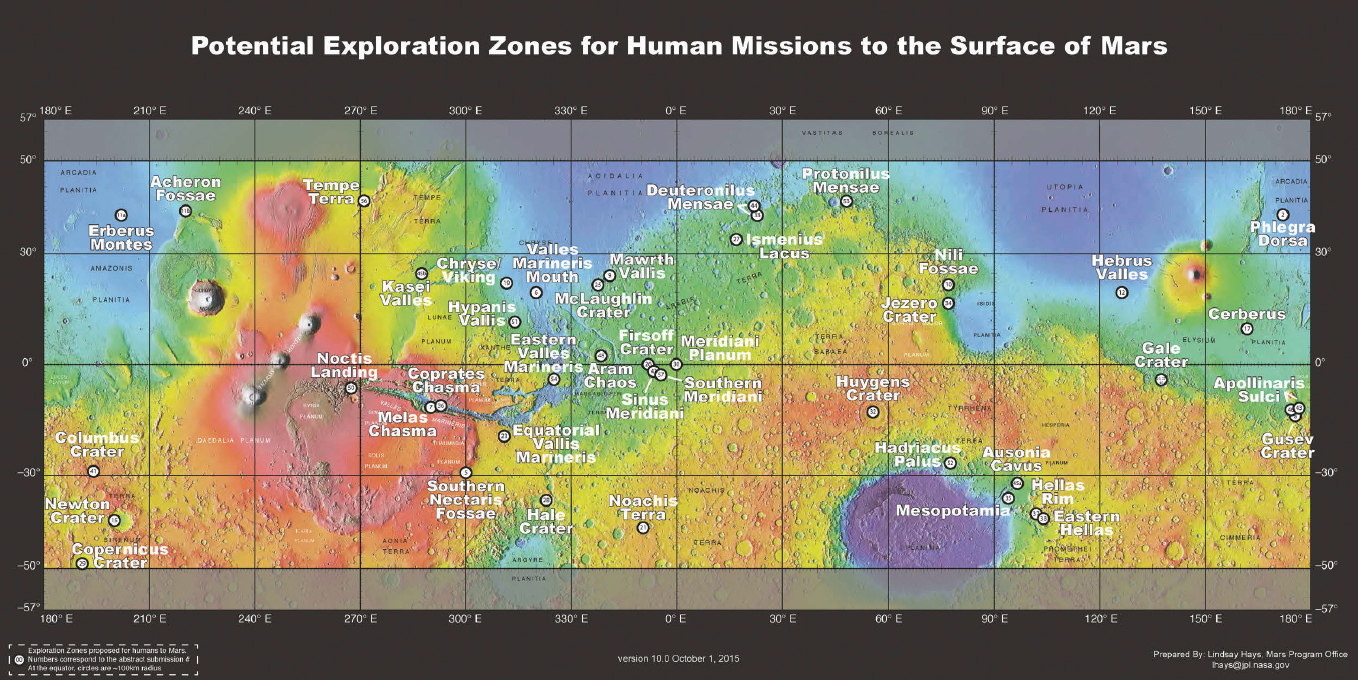
SOURCE: L. Hays, 2015, “Potential Humans to Mars Landing and Exploration Zones,” The Planetary Society, Bruce Murray Space Imagery Library, https://www.planetary.org/space-images/potential-humans-to-mars.
Science Objective 2: Characterize past and present water and CO2 cycles and reservoirs within the exploration zone to understand their evolution.
Present atmosphere–surface exchanges of these volatiles occur continuously while being modulated daily, seasonally, annually, and on obliquity variation and geological timescales everywhere on Mars, so the characterization of ongoing volatile cycling may be considered, to first order, landing site agnostic. Past exchanges, however, are best recorded in the geologic record. Among options for the latter, Mars’s present repositories of water and/or CO2 ices may be considered the highest priority, as they would allow bridging the gap between ongoing volatile cycles and those of the past, albeit the geologically recent past.
Although polar layered deposits are expected to present the best preserved and most comprehensive records of recent to ongoing water and CO2 cycling on Mars, they are not considered optimal for addressing Science Objective 1. Instead, a suitable alternative for addressing Science Objective 2 would be a layered glacier water ice deposit located at lower latitude.
Science Objective 3: Characterize and map the geologic record and potential niche habitats within the exploration zone to reveal Mars’s evolution and to provide geologic context to other investigations, including the study of bolide impacts, volcanic and intrusive igneous activity, the sedimentary record, landforms, and volatiles, including liquids and ices.
Science Objective 3 entails revealing Mars’s impact, volcanic and/or igneous, sedimentary, and environmental evolution by investigating the geologic record and potential niche habitats in the EZ. A niche habitat is an organism’s functional role within an environment reflecting both habitability and available resources. For example, two microbes in a habitable environment may each be able to grow and reproduce but may specialize in their resource utilization, metabolism, spatial distribution (e.g., in microenvironments), or temporal dynamics driven by available resources, competition, and interactions. Meeting this objective means that the selected LS/EZ has to present diverse geology, allowing examination and near-surface sampling of a suite of geologic materials and their geochemically altered or degraded products, to include multiple impact, volcanic and igneous, and sedimentary units spanning ideally a maximum swath of Mars’s history. An LS/EZ presenting contrasting environments exhibiting different degrees of degradation is important to allow relatively pristine and degraded materials from different times to be sampled and compared, and to help reconstruct environmental evolution. Comparisons between ancient (>3.5 billion years and recent lavas may for instance indicate changes in Mars’s radiation environment, which in turn may reveal when Mars’s magnetic field decayed.
Characterizing potential niche habitats and Mars’s environmental evolution requires access to, and sampling of, a geologic record ideally reflecting multiple past and/or present water activity within the EZ as well. To complement the characterization of Mars’s environmental evolution, aeolian deposits (dust bowls and sand dunes) which may incorporate materials having originated within or beyond the EZ would be important to access and sample also, although less dusty settings are better for rock exposure and multispectral mapping. Understanding Mars’s geologic and environmental evolution is also key to providing context for other campaign science objectives.
Science Objective 4: Determine the longitudinal impact of the integrated martian environment on crew physiological, cognitive, and emotional health, including team dynamics, and confirm effectiveness of countermeasures.
Science Objective 4 would be carried out for any mission regardless of location.
Science Objective 5: Determine what controls the onset and evolution of major dust storms, which dominate present-day atmospheric variability.
Science Objective 5 does not require selecting an LS in an area where major dust storms originate, but the EZ would be required to give access to an area known to frequently experience the passage of dust storms (e.g., Wang
and Richardson 2015). Ideally this would include areas with dust storm tracks and time-variable albedo features, where the evolution of storms can be monitored directly. The LS/EZ would allow the deployment of dust activity monitoring stations at remote locations experiencing active dust lifting within reach from the LS/EZ, within or beyond the EZ. Proximity to active dunes and ripples would be advantageous to more completely characterize the aeolian transport, deposition, and erosion environment.
Science Objective 6: Characterize the martian environment for in situ resource utilization (ISRU) and determine the applications associated with the ISRU processing, ultimately for the full range of materials supporting permanent habitation but with an early focus on water and propellants.
Science Objective 6 addresses ISRU with an initial focus on water and propellants. Propellant pairs considered are liquid hydrogen (H2) and liquid oxygen (O2), or liquid methane (CH4) and liquid oxygen (O2). On Mars, H2 would be produced from water (H2O); O2 from either H2O or CO2; and CH4 from both H2O and CO2. CO2 is an atmospheric resource available everywhere on Mars. Water ice is available in near-surface materials ubiquitously at high latitudes, commonly at mid-latitudes, and locally at low latitudes. Low-latitude occurrences of water ice on Mars are of particular interest owing to the warmer operational temperatures prevailing at lower latitudes year round. In order for low- to mid-latitude ice to be thermodynamically stable, it would have to be buried under a surface burden on the order of meters that provides both thermal and diffusive insulation. Such ice could be found at elevations below +2 km (Lee 2023; Watters et al. 2024). Although rarer, low-latitude occurrences of glacier ice would be particularly attractive for ISRU owing to the meteoric origin of ice and its implied cleanliness relative to ground ice in other settings on Mars where ice is typically mixed with other regolith components.
The remaining Science Objectives 7 through 11 are site agnostic. See Table 2-1 for a list of all the science objectives.
2.3.3 Depth to Organics and Drilling on Mars
Radiation Penetration Depth
Space radiation is dominated by galactic cosmic rays and solar energetic particles. Galactic cosmic rays are composed of higher-energy hydrogen nuclei (e.g., protons; 87 percent) and helium nuclei (12 percent), and heavier ions (1 percent) (Simpson 1983). Solar energetic particles are dominated by lower-energy protons, electrons, and helium nuclei. Solar particles fluctuate with the 11-year solar cycle and can increase dramatically over short periods owing to coronal mass ejections. During times of maximum solar activity, the galactic cosmic ray flux in the inner solar system is reduced. During solar minimum, the galactic cosmic ray flux is maximal.
Mars lacks a thick atmosphere (<1 percent of Earth’s atmosphere with an average surface pressure of 610 Pa) and has only a limited magnetosphere, which together result in higher dose rates of ionizing radiation from galactic cosmic rays and solar energetic particles than on the surface of Earth. However, solar energetic particles are largely stopped by the martian atmosphere, while galactic cosmic rays will reach the surface. As discussed in Section 2.2.6, the measured average surface dose rate has been estimated to be 210 ± 40 μGy/d (77 ± 15 mGy/y; a dose-equivalent rate of ~0.64 mSv/d) at Gale Crater during solar maximum (Hassler et al. 2014), which is lower than the 481 ± 80 mGy/d (176 ± 29 Gy/y; dose-equivalent rate of ~1.84 mSv/d) measured in deep space (Zeitlin et al. 2013) owing to shielding of about half the sky by the planet itself. The significant altitude elevation variations on Mars would modulate surface doses owing to a factor-of-10 difference in atmospheric thickness.
When energetic particles impact regolith, they generate secondary particles including neutrons and gamma rays. For this reason, the peak dose on Mars occurs around 30 cm below the surface (Zhang et al. 2022). Radiation simulation of interactions with regolith can generally be cut off below 10 m owing to lack of penetration (Zhang et al. 2022). Relativistic muons are generated through cosmic ray interactions within the upper atmosphere, and these high-energy particles can penetrate tens of meters or even kilometer depths (Woodley et al. 2024). The flux at the surface of Earth is around 102 m−2s−1, compared to four orders of magnitude lower at 1 km depth in water (Tanaka 2020).
However, while muons do penetrate deeply, the dose they deliver is lower than other forms of ionizing radiation except at depths below 10–15 m, where other forms of radiation do not penetrate. Because the dose at 10 m is quite low, the muon dose is ignored in some studies (Charpentier et al. 2024). Indeed, muon doses can be ignored beneath 10 m for the purposes of organic survival when background radiation (e.g., radioactive isotopes in bedrock, potassium-40 in salts) is taken into consideration (see also Section 2.2.6).
Sampling Depth to Preserved Organics
Amino acids are the building blocks of proteins. Amino acids are a common target for astrobiological investigation owing to their widespread abiotic production in space and planetary systems, their persistence over millions to billions of years, their use in all known life as the basis for metabolic machinery, and their potential use by life beyond Earth in a similar capacity. For example, the Murchison meteorite is rich in amino acids despite its age of 4.6 billion years, including some of the same amino acids used by life (see, e.g., Cronin et al. 1981; Koga and Naraoka 2017). It also contains many diverse amino acids not found in life. The astrobiology community has proposed measuring amino acid abundance, chirality (handedness), and complexity as ways to distinguish organic material derived from life as opposed to abiotic processes. Therefore, measuring amino acids is useful both to characterize the abiotic background and to seek evidence of life.
Radiation, however, damages organic molecules such as amino acids and obscures their origin and history. Recent work with meteoritic amino acids using gamma irradiation as an analog of space radiation demonstrated limited amino acid survival near the surface. Degradation was enhanced by the presence of silica and even more by the presence of 1 percent perchlorates (Pavlov et al. 2022). After 80 Ma in a silica matrix, none of the amino acid isovaline would still exist at the surface, and only 40–60 percent of the original concentration at 2 m depth. After an exposure time of 500 Ma, only one part in 103 to 105 would remain at 2 m depth under the studied conditions. Thus, even the planned Rosalind Franklin Rover (ExoMars) may be unable to sample deep enough to recover undamaged amino acids unless under ideal conditions (low exposure age, specific preservation conditions).
Pavlov et al. (2022) estimate that an original ~100 ppb of amino acids (a number based on martian meteorite analysis) would have been reduced to 0.1 ppb in 70 Ma of exposure at Mars Sample Return sample depths, below the detection limits of the best liquid chromatography mass spectrometry methods on Earth. Therefore, sampling needs to be done at significantly greater depths than 2 m to reduce degradation by the orders of magnitude needed for meaningful analysis; to abrogate the impact of space radiation on radiolysis of organics entirely, depths greater than 10 m may be needed.
The presence of diverse amino acids in Murchison and other meteorites might be taken to imply that at least some amino acids can survive space radiation for billions of years. However, there are several important caveats: most meteorites are derived from a few recent collisions in the asteroid belt (Broz et al. 2024), and organic-rich CM/CI meteorites typically have exposure ages of 7 Ma or less (Takenouchi et al. 2014). Samples collected from the surfaces of asteroids can have low exposure ages (e.g., 0–10 Ma) owing to impact gardening of asteroid surfaces (Matsuoka et al. 2023) and selection of young sites such as craters (Welten et al. 2024).
Although the prior text focuses on amino acids, a few words about nucleic acids are warranted. The first-order decay kinetics of DNA are affected by temperature (which affects the rates of hydrolysis) and other in situ characteristics such as pH (Allentoft et al. 2012). While DNA has been recovered from ice dated to ~8 million years old in Beacon Valley on Earth (Bidle et al. 2007), modeling of the soil and ice-rich permafrost suggests seasonal maximum temperatures would permit partial melt of liquid veins in ice and permit microbial activity. This may explain why the oldest DNA sequenced on Earth is widely considered to be 2 million years old, obtained from marine sediments in Greenland (Kjaer et al. 2022), whose clay component is likely to have aided preservation by inhibiting enzymatic degradation for mineral-bound DNA.
While there is no expectation of recovery of DNA beyond many millions of years on Earth, Mars’s significantly colder temperatures could extend DNA’s potential survival; natural radioactivity may ultimately be the limitation on DNA survival. Studies of the synergistic effects of desiccation and freezing on microbial survival to irradiation (Horne et al. 2022) suggest that at greater than 10 m depth on Mars, the extremophile Deinococcus radiodurans could survive an equivalent of more than 100 million years. Life in the near subsurface of Mars could therefore
persist between transiently habitable periods (e.g., resulting from obliquity cycling as described below) if shielded from surface irradiation.
To access zones with liquid water that have likely been habitable over billions of years and may remain so today, access below the Mars cryosphere would be required. This depth is estimated to be 2–5 km even where it is the shallowest, near the equator. If inhabited, accessing such environments could permit direct study of extant life, permitting a wide range of characterization methods, including targeting not only organic material but also active processes such as metabolism, growth, reproduction, movement, and other functional properties of life.
Conclusion: To reach organic material that is not substantially modified by space radiation requires access to sample depths beyond 2 m and likely up to 10 m. While this may suffice for detecting abiotically produced organics or ancient life, to maximize the chances of detecting extant life on Mars, access to the deep subsurface below the cryosphere to where liquid water may exist, at least 2–5 km depth, may be required.
Near-Surface Potential for Extant Life
The most habitable location for extant life on Mars is beneath the cryosphere (see Section 3.5), where habitable conditions are expected to persist over billions of years, but recent studies suggest there may also be near-surface niches for life. Radiatively habitable zones for photosynthesizing organisms could exist within tens of centimeters of the surface in mid-latitude ice (Khuller et al. 2024). Today, however, conditions for adequate water activity (>0.6) and permissive temperature for metabolic activity (greater than −40°C) are not simultaneously met at or near the surface of Mars (Rivera-Valentin et al. 2020; Mellon et al. 2024).
Modeling of obliquity changes over the most recent 2.5 million years suggests that during periods of high (>33°) obliquity, the water activity at the ice table and temperatures greater than −40°C can be achieved, resulting in seasonal transiently habitable conditions in the shallow (centimeters to meters) subsurface (e.g., around 510 ka, with such periods lasting for 10,000 years or more) (Mellon et al. 2024). If adequately protected from irradiation, microbes metabolizing or replicating during such habitable periods could remain viable in the present day (Allentoft et al. 2012; Horne et al. 2022).
Technologies are being developed (Figure 2-8) to access depths below 2 m, including below 10 m, where space radiation is no longer a factor, using traditional drill bits and pneumatic and hot water systems. Advanced drilling technologies for kilometer-scale deep drilling also include plasma and millimeter wave drilling. Current deep drilling systems require humans for operation. Drilling to depth is not synonymous with obtaining an unaltered sample from depth; different technologies have different implications for sample heating, for example. The specific requirements for sample collection need to be taken into account to match capabilities with science needs. (For an example, see the case study in Section 5.3.3, “Drilling on Mars for In Situ Resource Utilization.”)
Organic preservation is not simply a matter of depth because of the dynamic nature of the surface: material at depth may have been at the surface in the past, potentially increasing the total integrated dose of radiation, or material at the surface may have been recently exposed, reducing the total integrated dose. Thus, local processes, current and historic, need to be taken into consideration when determining sample depth requirements.
2.3.4 Planetary Protection
Planetary protection involves protecting solar system bodies from contamination by Earth life (forward contamination) and protecting the Earth–Moon system from contamination by any extraterrestrial life or bioactive molecules (backward contamination) (NASA 2024e). Since the Viking missions that delivered life-detection experiments to the martian surface, microbial analysis and sterilization have been used to quantify and reduce the density of spores on and in spacecraft. These techniques were designed to increase the likelihood that the life-detection experiments could identify martian life rather than Earth life carried by the spacecraft.
Planetary protection guidelines are promulgated by an international body formed in 1958, the Committee on Space Research (COSPAR). The legal basis for planetary protection derives from the 1967 Outer Space Treaty, which calls for avoidance of “harmful contamination” and “harmful interference” (UN General Assembly 1967).

SOURCES: (panel A left) NASA/JPL-Caltech/MSSS; (panel A right) NASA/JPL-Caltech/Arizona State University; (panel B left) ESA/Mlabspace; (panel B right) NASA/JPL-Caltech; (panel C left) Firefly Aerospace; (panel C right) B. Mellerowicz, K. Zacny, J. Palmowski, et al., 2022, “RedWater: Water Mining System for Mars,” New Space 10(2):166–186. The publisher for this copyrighted material is Mary Ann Liebert, Inc.; (panel D left) Courtesy of Honeybee Robotics, a Blue Origin Company; (panel D right) Reed Scherer/National Science Foundation/U.S. Antarctic Program; (panel E left) Zaptec; (panel E right) Courtesy of Quaise Energy.
The United States is a signatory to the treaty. Specific operating principles and requirements are regulated by national space agencies, including NASA (Figure 2-9).
Within NASA, the Office of Planetary Protection oversees planetary protection from within the Office of Safety and Mission Assurance. Current rules are governed by NASA Procedural Requirements 8715.24, Planetary Protection Provisions for Robotic Extraterrestrial Missions, and NASA Interim Directive 8715.129, Biological Planetary Protection for Human Missions to Mars; this Interim Directive expired on September 30, 2025 (Benardini 2025).
The COSPAR guidelines (March 20, 2024) state that “planetary protection goals should not be relaxed to accommodate a human mission to Mars” but recognize that specific implementation guidelines will be different (COSPAR 2024; Spry et al. 2024).3 However, one of the accompanying guidelines states: “Neither robotic systems nor human activities should contaminate Special Regions on Mars, as defined by this Committee on Space Research (COSPAR) policy” (NASEM 2018a, p. 29). “Special Regions” are defined as locations on Mars that might possibly harbor indigenous martian life or terrestrial life brought there by astronauts or otherwise. At present, there are only candidate Special Regions. With current human exploration system capabilities, this guideline would essentially preclude responding to the top scientific objective identified by this committee, which is to search for life. However, ways to meet these guidelines have been suggested, for example (NASA 2005, 2025c) and further technology development and operational assessment could help to quantify and reduce forward contamination risks while preserving the
___________________
3This report was written before the COSPAR’s 2026 guidelines became available. The latest policy can be found on the COSPAR Panel on Planetary Protection’s webpage.

SOURCE: NASA/JPL-Caltech, https://photojournal.jpl.nasa.gov/catalog/PIA23718.
scientific integrity of studies in Special Regions. The risks of contamination will never be zero, and, as a result, it is important to develop explicit plans to address this contingency. As highlighted in Section 5.2.1, human–robotic partnerships for remotely operated science could reduce human impact in Special Regions, where needed.
Special Regions on Mars are also relevant to the possibility of backward contamination, that is, bringing martian organisms back to Earth. Minimizing the chance of backward contamination is a key goal of planetary protection policy. No policy could entirely eliminate the possibility of backward contamination, but visiting Special Regions with astronauts would clearly increase it. However, not visiting Special Regions would also minimize or eliminate the chance of finding extant martian life. This committee does not presume to have the authority to resolve this debate: the committee instead points out that it needs to be well studied before any crewed Mars missions are launched, or even completely planned. One factor reducing the chance of backward contamination, as compared to the Apollo missions to the Moon, is the much longer return time: 6 months, as opposed to 3 days. This gives the crew more time to better understand the potential for backward contamination through collaboration with Earth-based researchers and crew-performed onboard analysis. Backward contamination remains a more serious concern for Mars than it was for the Moon, as by almost any measure Mars is more likely to be inhabited.
Planetary protection guidelines have a dual purpose. They protect both the integrity of scientific measurements and human health. While many life-detection methods are sensitive to potential Earth contamination, others are unlikely to be affected; for example, DNA sequencing can identify known Earth contaminants by comparison with controls and databases of known organisms and likely contaminants. Metagenomic studies of low-biomass environments need to address contaminants owing to a wide range of contaminant sources including personnel and reagents used in sample processing. Current best practices integrate positive and negative controls at multiple stages to identify potential contaminants, alongside screening of sequencing data for contamination (Fierer et al. 2025).
Planetary protection guidelines are dynamic, not static, and are modified as knowledge grows. As the community continues to learn about mechanisms of organism death, dispersal, and reproductive potential or lack thereof, as well as transport phenomena in the martian atmosphere and subsurface, there needs to be continuing community dialogue. Improved knowledge about interactions of environmental challenges including vacuum, solar
heating, and ultraviolet light on microbial lethality (Schuerger 2024) can be incorporated into probabilistic risk analysis used to estimate the bioburden of spacecraft, for example, as did Europa Clipper (McCoy et al. 2021).
Knowledge gaps have been identified for planetary protection in support of human Mars missions (Spry et al. 2024). Both robotic and human lunar exploration can serve as a crucial testbed for verification of approaches that are under consideration for Mars (Lee et al. 2020), even while surface conditions, and thus microbial survival and transport, are different on the Moon versus Mars. Experiments that directly evaluate the effectiveness of various mitigation strategies can help bound the risks of human exploration to science and health.
Although today’s planetary protection guidelines are inconsistent with human exploration, the world-class science to be conducted by human explorers of Mars is an impetus for continued investment in the tools and knowledge that address contamination risks and inform these guidelines. By integrating this work early in the mission development process, human Mars exploration campaigns can achieve the required levels of scientific integrity and backward contamination risks.
Conclusion: Current planetary protection guidelines would not enable humans to achieve the top science objective for Mars exploration, namely, the search for life. That is largely because operations in areas termed “Special Regions” that are most likely to harbor indigenous life, or that could conceivably be contaminated by life brought to Mars from Earth, require limits on bioburden that may be infeasible for human systems (e.g., surface bioburden level of less than 30 spores) (COSPAR 2024).
Conclusion: The possibility of backward contamination from Mars to Earth is difficult or impossible to eliminate entirely, but risks can be significantly reduced by temporary isolation of the astronauts and their samples when they return to Earth.
Recommendation: Human missions to Mars should be designed to meet scientific and exploration objectives. Many of these objectives are limited by current planetary protection guidelines, notably the search for extinct and extant life with human explorers. NASA should continue to collaborate on the evolution of planetary protection guidelines, with the goal of enabling human explorers to perform research in regions that could possibly support, or even harbor, life.
2.3.5 In Situ Analytical Capabilities on Crewed Missions
Analytical capabilities on the martian surface are necessary to make meaningful progress toward the highest objectives identified by all panels. These capabilities include both measurements to be performed in the field and sample analyses to be conducted within a habitat-based laboratory. On-site laboratories maximize the scientific quality of returned samples and create the ability to analyze ephemeral phases that may not survive transit to Earth. Furthermore, they minimize backward contamination risk.
Science-focused surface exploration in complex geological environments is enhanced by mobility systems capable of handling challenging terrain, and astronaut-compatible techniques that allow rapid measurements in the field, including imaging, traditional field geology tools, and handheld portable instruments providing immediate analytical feedback.
Many measurements today require the scale and accuracy of laboratory measurements. For example, mineralogical analysis on the scale of a thin section, time-sensitive volatile compound analysis, and those requiring sample preparation and consumption or destruction of the sample (e.g., powdering for X-ray diffraction or digesting for inductively coupled plasma mass spectrometry or liquid chromatography) typically demand laboratory-grade instrumentation. Advances in instrumentation may provide future tools capable of performing increasingly sophisticated in situ analyses.
Another important analytical need is longitudinal tracking of biological, physiological, and behavioral health measurements. Such spaceflight standard measures would be impractical to return to Earth for processing and may require real-time analysis to support crew health and performance objectives. Furthermore, if sample analysis reveals actionable results, immediate on-site analytical capabilities will be required.
Omics—referring to a group of sciences that study entire sets of biological molecules to understand their roles in an organism’s structure, function, and dynamics (examples are genomics, proteomics, transcriptomics, and metabolomics)—approaches have widespread biological applications such as diagnosis of genetic diseases, molecular stratification of disease risk, identification of environmental pathogens, elucidating the molecular basis of organismal response and adaptation to spaceflight (microbes, plants, and animals), and population metagenomics.
Typical workflows for nucleic acids require extraction, quality control steps, library preparation, sequencing, and data analysis (Figure 2-10). Other omics often require extraction, enzymatic digestion, separation and analysis (typically using mass spectrometry), and subsequent bioinformatic data analysis. The capabilities to utilize these methods in real time in spaceflight environments (i.e., “point-of-care” applications) are evolving rapidly, particularly because of small (palm-size), low-power devices (for example, nanopore sequencing, which eliminates the requirement for polymerase chain reaction amplification). The feasibility of onboard real-time genetic analysis has been demonstrated on the ISS (Castro-Wallace et al. 2017), as have robust workflows for real-time microbial profiling (Stahl-Rommel et al. 2021). Successful nanopore sequencing has also been demonstrated under martian gravity conditions (Carr et al. 2020).
Such capabilities need not replicate the complete range of terrestrial facilities but can be focused to provide analyses needed for time-sensitive measurements and those needed to decide on next steps in a decision tree. Maturation of these tools offers an opportunity for cross-field development of Mars analytical capabilities. Advancements in computational capabilities to support these tools will also enhance the ability to conduct sophisticated bioinformatic and other computational analyses on the surface.
Conclusion: An appropriate laboratory on the martian surface is important for in situ, noninvasive, real-time analysis of geologic, astrobiological, biological, and medical samples.
Recommendation: NASA should include as part of its crewed surface infrastructure a Mars surface laboratory consisting of a variety of geologic, astrobiological, and biomolecular analytical tools and analysis capabilities.

SOURCE: NASA, https://images.nasa.gov/details/iss069e086055.
2.3.6 Mars Sample Return from Crewed Missions
Return of martian samples and biological specimens collected from crew, model organisms, and the built environment is important for the advancement of human knowledge. Samples that might contain evidence of extinct or extant life are a unique case that could answer one of the greatest questions facing humanity—“Are we alone?”—and thus will be among the most valuable.
Skilled humans on Mars will be able to understand the landscape and its rocky materials better than any remotely operated robot (e.g., Yingst et al. 2009; Antonenko et al. 2013) and will be able to conduct real-time analysis and prioritize sample collection much faster than any robotic system (Glass 2013; Cohen et al. 2015). Thus, human explorers are essential for the best possible sample selection and contextual understanding at the martian surface.
Similarly, experts on Earth are needed for the most comprehensive sample analysis. Although longer-stay missions will have more time for analysis on the martian surface, the needs for Earth-based specialist expertise, better Earth instrumentation, and multiple laboratories necessitate the return of samples. For example, biological techniques such as single-cell spatial analysis (DNA, mRNA, or protein), which provide positional context of cells in an organism, require sample preparation and processing (e.g., fixation, sectioning, imaging, microdissection, and in situ hybridization and sequencing) that are time and labor intensive.
Measurements utilizing phase-specific stable and radiogenic isotopes, trace elements, nanometer-scale composition and texture, and precise organics characterization cannot be done remotely or entirely on Mars because they require sample preparations and analytical precisions only possible in specialized laboratories (NRC 2011; NASEM 2023a). The infrastructure supporting such facilities represents a required complexity on Earth that is currently impractical for early Mars missions.
Beyond the initial complex measurements, divergent scientific interpretations will require measurements in multiple laboratories and interpretation by multiple research groups. Replication of results similarly requires multiple analyses in different laboratories. The extensive analyses performed on EET 84001 (Righter 2024) and planned measurements for the Mars Sample Return mission (Beaty et al. 2019; Whetsel et al. 2025) are examples of the scientific need for materials to be analyzed by multiple techniques and multiple groups, simultaneously solving questions and creating new avenues of inquiry.
Curating samples for future analysis—a standard practice—begins at the moment of collection. Documenting context is crucial, as is any required specific pretreatment (e.g., stabilization and fixation) and storage conditions (e.g., temperature, pressure, and atmospheric composition) to preserve detail at the molecular level. Last, sample return will allow for future analyses by instruments and techniques not yet in existence, as has recently been demonstrated with curated Apollo samples.
Conclusion: Sample masses of the order of tens of kilograms are desired for a wide range of dissimilar analysis by independent groups, but the exact amount depends on the science objectives and evolving analytical techniques. This estimate also includes the need for duplicate samples for long-term archiving and to be shared for education and public outreach purposes.
Recommendation: Samples from every human mission to Mars should be returned to Earth. NASA should engage the science community to determine the number, type, mass, and environmental conditioning required for samples before the first human missions commence. Sample return guided by human interpretation of in situ measurements should be a priority for all human missions.
2.4 ENABLING TECHNOLOGIES
Technologies required to enable human science exploration fall into two categories: technologies needed for long human surface stays, and technologies to better enable the science discovery, as referenced in panel STMs to enhance science return in any of the architectures or campaigns. Discussion of certain enabling technologies is
embedded in the campaign discussions and discussions of synergy with NASA’s Moon to Mars (M2M) activity (see Chapters 3 and 5) are briefly mentioned in this section because of their criticality:
- In situ resource utilization (ISRU). Many of the design reference mission architectures rely on ISRU for propellant production (methane and oxygen) for surface stays and the return mission. In addition, access to water for long surface stays is critical. Patterns of obliquity cycling on Mars modify the stability of ice, and at present, surface ice within 45° of latitude of the equator is unstable (Mellon and Sizemore 2022). Even in unstable regions, capping deposits may help to stabilize buried ice, and mid-latitude regions on Mars have extensive ice deposits up to ~100 m thick (e.g., Dundas et al. 2018) or more. Therefore, even near the equator, relict ice deposits may be accessible by drilling (e.g., Watters et al. 2024). A focus on ISRU is included in NASA’s M2M effort.
- Mobility systems. Mobility systems, some pressurized and others unpressurized, are identified in each campaign scenario. Requirements are notionally specified as the number of crew members to transport, the amount of field equipment to deploy, or the range and frequency of deployments, rather than any vehicle specifications. This includes the inhabited environment (lander, habitat, rover, extravehicular activity suit, and launch vehicle) and systems operated by the crew (e.g., ISRU).
- Robust sample return technologies. Return of samples to Earth for specialized analysis and characterization is identified across every discipline, with requirements ranging by volume, mass, handling specifics, thermal control (including long-term cryogenic storage requirements), and multiple preservation methods.
- Robust surface communications. Human surface efforts require high-bandwidth, high-reliability surface-to-surface communications to support human-to-human communications, data relay, and robotics operations.
In addition, recent investments in a series of key cross-cutting enabling technologies are promising for future support of Mars science. Summarized alphabetically below, each technology area discusses Mars science-focused technology needs, and existing emerging capabilities in space applications and within Earth analogs.
2.4.1 Communications, Observation, and Power Infrastructure
A robust planetary infrastructure for communications, observation, and power is vital. The existing Mars orbiting infrastructure backbone consists of observation by the Mars Reconnaissance Orbiter (MRO), communications by the Mars Atmosphere and Volatile EvolutioN (MAVEN) mission, and Mars Odyssey, all in extended mission phases. High-resolution imagery, low-latency communications, accurate positioning systems, sufficient computing capabilities, and adequate power are crucial for human operations. Multiple technology gaps in these areas are captured in the M2M Technology Gaps Definition and Prioritization assessment (NASA 2025b).
Every science discipline and mission phase requires capable, redundant, and safe communications, observation, and power infrastructures with a range of bespoke capabilities tied to specific science discipline research. For example, observation and power infrastructure for communications and data relay for dust monitoring stations and other long-term data collection between missions and after the crew leaves are needed. Although untended, long-term, remote sensing scientific data collection from space is the foundation of space observatories and some Earth environmental monitoring programs. Demonstrated technologies include hardening components such as sensors, data loggers, power sources, and electronics boards to withstand Mars surface conditions, building on knowledge gained in years of Mars robotic missions. The biggest challenges may lie with deep-space communications. Near-real-time data sharing of large files and images is ideal and is particularly useful for communicating key data such as crew medical or health information. For reference, the ISS transmits data to ground stations at a rate of 600 Mbps. The Hubble Space Telescope transmits recorded data at 1 Mbps. Continued improvements in laser communications prove promising. Early demonstration missions, like NASA’s Deep Space Optical Communications technology on the Psyche mission and other laser communication pathfinder programs such as the Laser Communications Relay Demonstration, NASA’s first two-way optical communications relay system, and the TeraByte Infrared Delivery (TBIRD), have demonstrated transmission rates of 267 Mbps at 33 million miles
(53,108,352 km) (comparable to Mars’s closest approach to Earth) (NASA 2024e), 1.2 Gbps from geostationary orbit (NASA 2023b), and 200 Gbps from geostationary orbit (Wang 2025), respectively. In addition, recent developments in autonomous adaptive data acquisition point to enabling technologies associated with using artificial intelligence and machine learning to assist in data collection and interpretation for untended data sites (Holman et al. 2023). All science disciplines have flagged portable power systems to enable mobile scientific data collection on Mars. Over the years, NASA’s Space Technology Mission Directorate has funded a variety of early technology readiness level (TRL) investigations of enabling technologies in support of planetary exploration in pursuit of portable power, including regenerative fuel cells capable of storing and generating electricity using fuel and oxidizer, solar cell technologies, lithium-ion batteries, and modular power systems. High-power energy generation on lunar and martian surfaces has been prioritized as a critical enabling technology by NASA and the space exploration community. In addition, commercial space power systems, driven by a boom in small satellites and commercial satellites (up to 12,000 SpaceX Starlink satellites and 3,236 Amazon Kuiper satellites have been approved), have driven interest in developing key capabilities. Of interest to portable power subsystems for Mars science applications is the work in improved power storage, improving thermal performance (lithium batteries generally operate from −20°C to 60°C; Mars temperatures range from −143°C to 20°C), limiting explosion risk, and power management and distribution, among other performance attributes. Solutions include solid-state batteries, alternatives to lithium, supercapacitors, and alternate energy devices (NASA 2024i).
2.4.2 Deep Drilling Systems
The search for life on Mars requires drilling below the zone of significant radiation damage, as discussed in Section 2.3.3 and illustrated in Figure 2-8, which encompasses technologies for accessing surface to kilometer-scale depths. Future missions such as the Rosalind Franklin rover will carry drills able to access up to 2 m in depth, a dramatic advance compared to the Curiosity and Perseverance rovers, but less than the up to ~3-m depth achieved during the Apollo missions. Another approach to accessing intermediate (5–10 m)-depth samples is to target ejecta or to sample within fresh impact craters (Daubar et al. 2022). The largest known fresh impact craters to date reach depths below 10 m and generate ejecta from depths down to 7 m (e.g., up to 58 m diameter, and 1:8 to 1:10 ratio of depth to diameter) (Daubar et al. 2022). A rare recent impact event resulted in a 150-m-diameter crater of ~21 m depth (Posiolova et al. 2022). On Earth, a wide range of shallow (less than 30 m) and deep (greater than 30 m) drilling technologies exist but may require substantial mass transported to Mars (see the Seeking Life Beneath the Martian Icy Crust Campaign). The development of drilling rigs for pristine deep samples, however, may be needed before any definitive answers about life on Mars can be reached. Linked to the specific drilling technology is the need for supporting infrastructure such as a drilling tower, which may be meters to tens of meters in height.
New technologies to access shallow to deep regions are in development, each with their relative advantages and disadvantages, as summarized, for example, by Bar-Cohen and Zacny (2021). One strategy to access greater depth without drilling is a Rodriguez-type well, which utilizes an initial borehole into ice, circulating hot water to create a melt pool that can extend much deeper than the initial drill depth. On Mars such a strategy requires drilling through overburden, followed by sealing of the borehole to permit adequate pressure to allow liquid water (Mank et al. 2021; Mellerowicz et al. 2022). The case study “Drilling on Mars for In Situ Resource Utilization” (Section 5.3.3) describes how an ISRU application may have quite different drilling requirements than, for example, studies that might require layer-resolved sampling.
Two new deep drills of note are The University of Wisconsin-Madison’s Blue Ice drill, and China’s Shenditake. An updated version of the Blue Ice drill (BID), BID-Deep, can produce 241-mm cores to 200 m depth and be operated by two people (Kuhl et al. 2017). The Shenditake drill is designed to drill to a depth of 10 km or more (Zhu 2024). These and other advanced drills may form the predecessor designs for one that will go to Mars. Major challenges to deployment of deep drilling on Mars include power, mass, and technology-dependent aspects such as drilling fluid, which may not be appropriate for Mars due to lack of availability and/or contamination potential. Major investments are likely required to realize deep drilling for Mars.
On Earth, plasma drills are expected to provide routine drilling to 10 km depth to enable use of geothermal energy (Kocis et al. 2017). Plasma drilling has been proposed as a solution for low-mass planetary drilling
(Hoftun et al. 2017) including Mars ice (Tang et al. 2022). Plasma drilling uses electric arcs to generate plasma that disintegrates the target material without contact and without, in some cases, moving parts. Thus, with suitable heat and transfer of gas and particulates, it can be performed near continuously with reduced equipment wear compared to mechanical (rotary and/or percussive) drilling. Unlike hot water drilling for ice or lubricated drilling, there is no solvent being introduced and thus it can be very clean. The main downside of plasma drilling is the energy requirement: commercial plasma drilling, under development by several companies, utilizes kilowatts to megawatts of energy. Nevertheless, plasma drilling may be possible even with solar power on Mars (Tang et al. 2022), and, more likely, with alternative power sources such as fission.
2.4.3 Advances in Human–Agent Teaming
Humans will likely work in teams on Mars comprised of combinations of people and technology. Advanced data analytics, processing, computational efficiency, and machine learning systems, including agentic AI (machine learning systems that analyze, learn, decide, and act to achieve objectives) are crucial enablers. AI agents can manage the execution of complex tasks, providing a virtual team of support personnel to augment human capabilities during exploration missions. Potential applications of agentic AI include autonomous navigation, real-time data analysis, predictive maintenance, resource utilization and tracking, climate and weather prediction, enhanced communication, health monitoring, robotic assistance, scientific discovery, and mission planning. Current challenges and threats to human–agent teaming include perceptual limitations (accurate and precise object recognition in “noisy” [e.g., dusty] environments), brittleness (ability to respond only in situations covered by training), learning lags, hidden biases resulting from limited or biased training data, and the lack of causal inference (NASEM 2022).
Teleoperation and telerobotics are complementary to human–agent teaming and will be especially effective when operations are from and on the surface of Mars and latency is low. Low-latency telerobotic field assistants can significantly augment astronaut capabilities. Telerobotic hardware that can be operated effectively includes rovers to collect and cache samples, place robotic drills, and assemble structures. The challenges of latency owing to signal delay in telerobotics can be improved by proximity and a prepositioned wireless network infrastructure (Cundar et al. 2023).
2.4.4 Human Surface Stays
Long surface stays (beyond 30 sols) require technology developments beyond those needed for 30 sols to address crew health risks (Antonsen et al. 2021; Antonsen et al. 2022). The accelerated two-person crew baseline of the 30-sol HEOMD-415 Design Reference Mission (HEOMD 2022) identifies multiple constraints. Although out of this study’s scope, potential key enablers for long surface stays include (see additional information in Antonsen et al. 2022)
- Durability and repair of habitations and laboratory facilities, enabling them to resist longer radiation exposure and more dust damage, for example;
- Health kits with increased capability to address specific surface concerns;
- Medical capabilities that replace evacuation to definitive care;
- Communications or means to circumvent communication lags to assist in robust diagnosis and treatment of health conditions; and
- Musculoskeletal aids to prevent injury in extravehicular activities.
Although habitation concepts for long surface stays have been in the study phase for decades, robust habitat design remains a challenge. Promising early technologies continue in development by Habitats Optimized for Missions of Exploration (HOME), a consortium of universities focused on developing technologies for deep-space habitats funded by NASA’s Space Technology Research Institute for Deep Space Habitat Design (Robinson 2019). Example emergent technologies include autonomous systems, decision optimization, failure-tolerant design,
human–automation teaming, dense sensor populations, data science, machine learning, robotic maintenance, robust Environmental Control and Life Support Systems, onboard manufacturing, and human health and performance, including emergency interventions (HOME 2023).
2.5 CAMPAIGN ARCHITECTURE ALTERNATIVES
The remit for this study required that campaigns be defined and compared, and also defined that campaigns consist nominally of three landed missions. While fulfilling this remit, the committee also discussed whether different architectures, especially those recently implemented in NASA’s Moon to Mars strategy (Merancy 2024), would support science priorities and improve recommended campaigns.
The committee brainstormed multiple campaign ground rules, including science achieved, minimizing backward contamination, minimizing in situ analyses and maximizing sample return, accelerating missions using existing technology while focusing on affordability, considering a core technology (e.g., large drilling capability) as the basis for a mission, focusing on a particular geographic feature (e.g., lava tubes), considering one-way missions, and using Moon to Mars architectures (e.g., a station in Mars orbit, or maximizing robotics, teleoperations and drones in partnership with humans).
Among other options, the committee considered the potential of a human-tended orbiting station. Although out of scope of this study, a human-tended station would provide a place for astronauts to live and work, support surface sorties, and serve as a research laboratory and as a safe haven. The station would leverage proximity to the martian surface by using low-latency telerobotic planetwide scouting and analyses.
Supporting a permanent human-tended station, however, requires significant investment spanning decades, sustained support, and maintenance; these requirements may conflict with the objectives and funding commitment to early landed missions. The committee developed illustrative use cases to support discussions regarding potential benefits:
- Use Case 1: Enabling Site Selection and Access. Many science objectives are intrinsically linked to site selection. A tended orbiting platform provides detailed orbital surveillance and analysis of candidate landing sites and exploration zones in close temporal proximity to actual landings. The number of sites that can be studied increases because the time at any one site is no longer fixed. Moreover, equipment transported to the surface can be customized for each site.
- Use Case 2: Adaptation–Readaptation. Surface stay time is potentially variable in an orbital laboratory architecture and need not be restricted to a single landing. The human-tended orbiting Mars laboratory offers a site for short-term crew readaptation and health monitoring to capture rapid phases of readaptation from martian to microgravity. Considering the martian environment from an occupational health perspective (e.g., chronic dust exposure), this added capability can be crucially important for informing the design and development of long-term martian outposts.
- Use Case 3: Tended Science from Orbit. A human-tended orbiting Mars laboratory supports a unique subset of science objectives. For example, the crucial timing of contemporaneous atmospheric data collection informed by dust devils or textured dust clouds seen from orbit in multiple locations would contribute to understanding the onset and evolution of major dust storms. The near-real-time evaluation using a combination of visual observations from space, low-latency communication with preplaced assets, meteorology, and communication with ground personnel would provide both unique insights and inform the required instrumentation and data gathering of future missions.