Improving Transit Customer Perception of Personal Security (2025)
Chapter: Appendix B: Survey Instrument

APPENDIX B
Survey Instrument

Long Description.
The data given in the screenshot reads the following:
APPENDIX B: SURVEY INSTRUMENT
TCRP SB-39 Improving Transit Customer Perception of Personal Security
Q1 Researchers from the Texas A and M Transportation Institute (T T I) are conducting a research project, sponsored by the Federal Transit Administration (F T A) and managed by the Transportation Research Board, Transit Cooperative Research Program.
The research team needs your help to document the practices employed by your agency to address the customer’s perception of personal security. Please complete this survey to let us know about these practices or indicate the name of the staff member who is the most knowledgeable about this topic. If there are any questions you can’t answer, feel free to leave them blank.
This survey should take about 10 to 15 minutes to complete.
The information you provide will be synthesized with information collected from other respondents. While respondent names are confidential, answers and responses to questions may be quoted in the published report.
Your participation is greatly appreciated. If you have questions, concerns, or complaints regarding this study, you may contact Joan Hudson at j-hudson@tti.tamu.edu. With your consent, you may be contacted by T T I to help clarify your answers or gather additional information.
We value your perspective as a transit employee in shaping the approach to transit passengers’ perception of security.
If you are willing to participate in this study, please click the “I Agree” button, and you will be taken to the survey.
If you do not want to participate in this study, please select “I Disagree” or close this window.
I agree.
I disagree. Right arrow
End of Survey. If Q1 equals I disagree.
Long Description.
The data given in the screenshot reads the following:
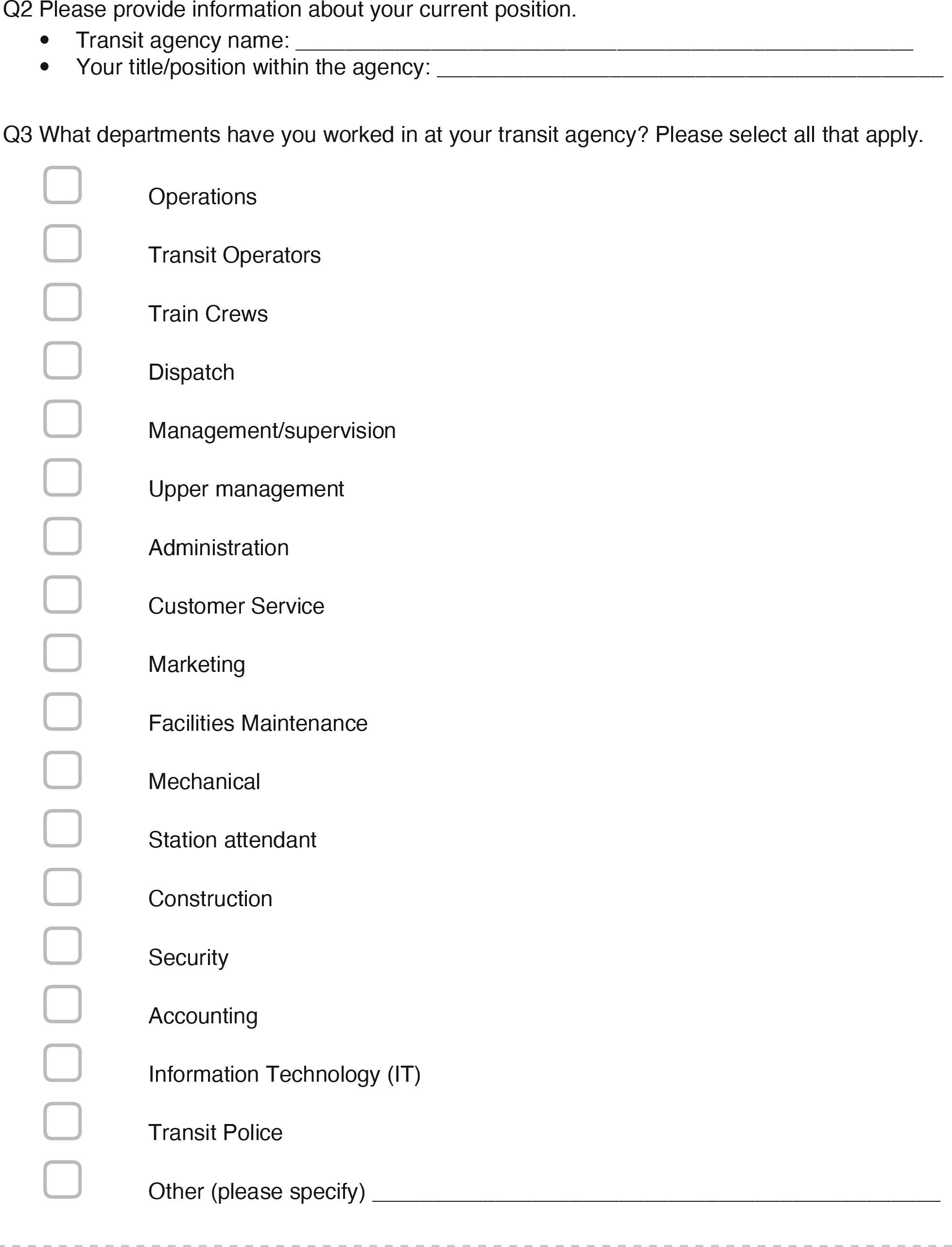
Q2 Please provide information about your current position.
Transit agency name:
Your title or position within the agency:
Q3 What departments have you worked in at your transit agency? Please select all that apply.
Operations, Transit Operators, Train Crews, Dispatch, Management or supervision, Upper management, Administration, Customer Service, Marketing, Facilities Maintenance, Mechanical, Station attendant, Construction, Security, Accounting, Information Technology (IT), Transit Police, Other (please specify)
Long Description.
The data given in the screenshot reads the following:
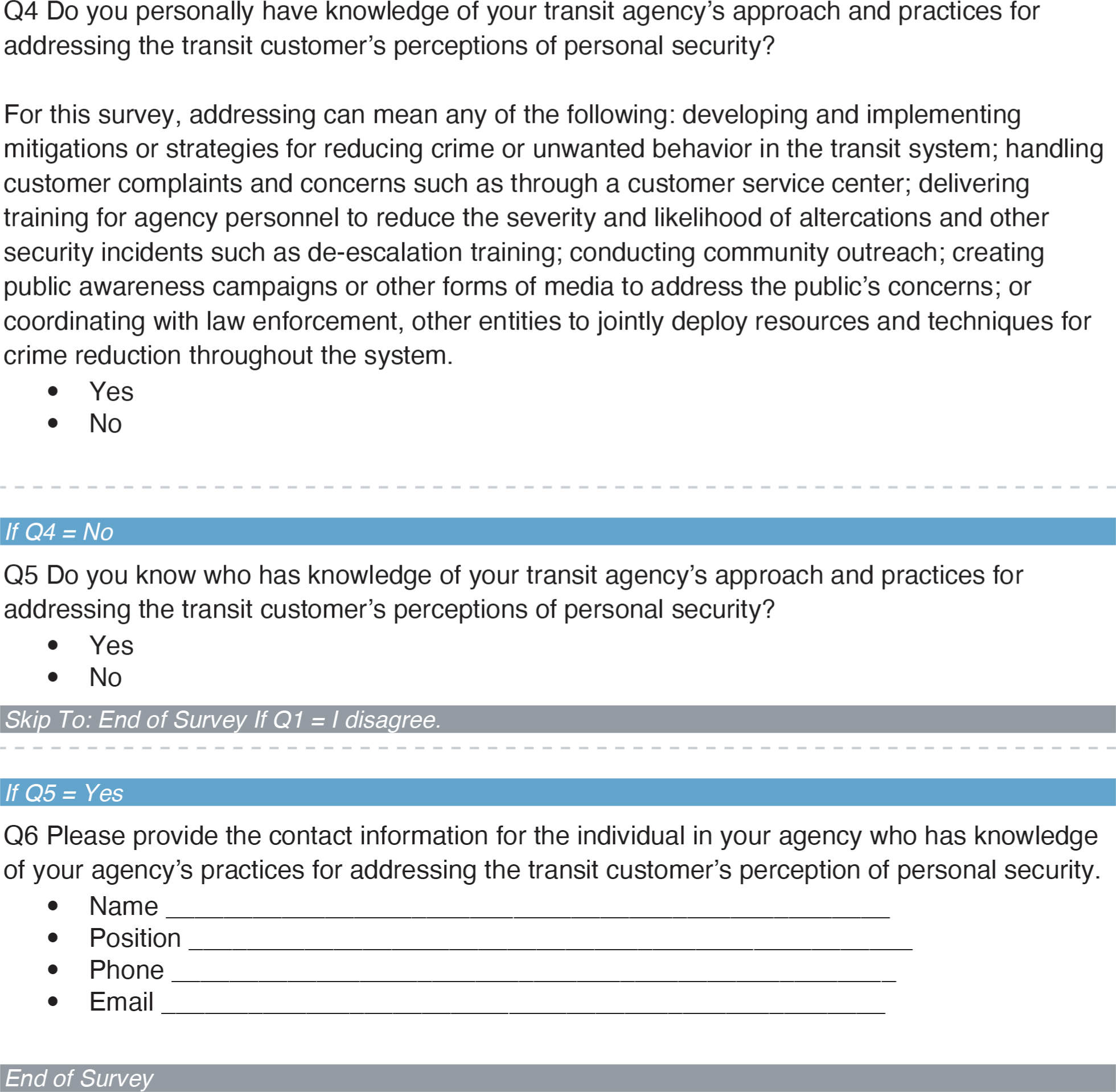
Q4 Do you personally have knowledge of your transit agency’s approach and practices for addressing the transit customer’s perceptions of personal security?
For this survey, addressing can mean any of the following: developing and implementing mitigations or strategies for reducing crime or unwanted behavior in the transit system; handling customer complaints and concerns such as through a customer service center; delivering training for agency personnel to reduce the severity and likelihood of altercations and other security incidents such as de-escalation training; conducting community outreach; creating public awareness campaigns or other forms of media to address the public’s concerns; or coordinating with law enforcement, other entities to jointly deploy resources and techniques for crime reduction throughout the system.
Yes No
If Q4 equals No
Q5 Do you know who has knowledge of your transit agency’s approach and practices for addressing the transit customer’s perceptions of personal security?
Yes No
Skip To: End of Survey If Q1 equals I disagree
If Q5 equals Yes
Q6 Please provide the contact information for the individual in your agency who has knowledge of your agency’s practices for addressing the transit customer’s perception of personal security.
Name
Position
Phone
End of Survey
Long Description.
The data given in the screenshot reads the following:
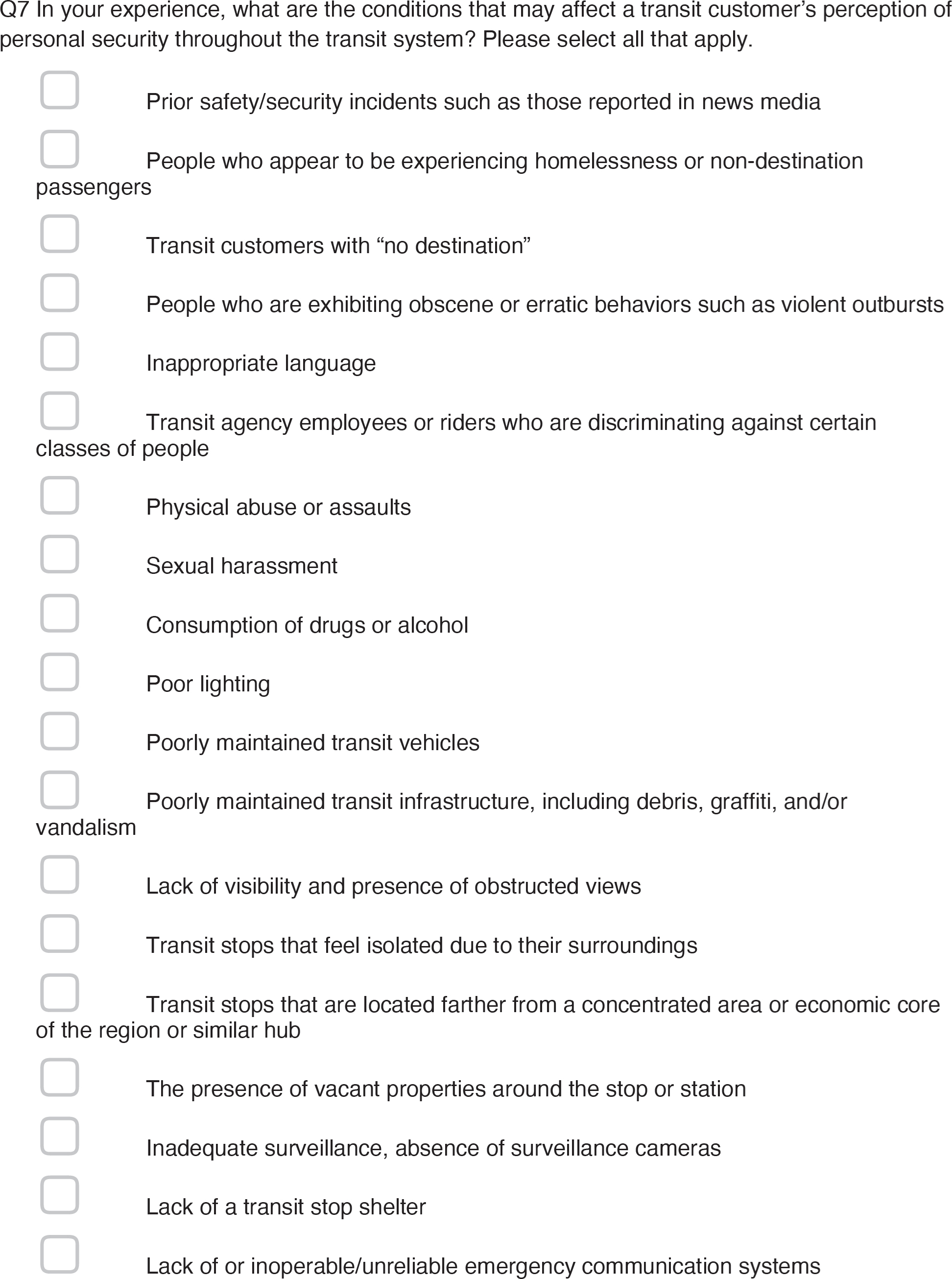
Q7 In your experience, what are the conditions that may affect a transit customer’s perception of personal security throughout the transit system? Please select all that apply.
Prior safety or security incidents, such as those reported in the news media
People who appear to be experiencing homelessness or non-destination passengers
Transit customers with “no destination”
People who are exhibiting obscene or erratic behaviors, such as violent outbursts
Inappropriate language
Transit agency employees or riders who are discriminating against certain classes of people
Physical abuse or assaults
Sexual harassment
Consumption of drugs or alcohol
Poor lighting
Poorly maintained transit vehicles
Poorly maintained transit infrastructure, including debris, graffiti, and or vandalism
Lack of visibility and presence of obstructed views
Transit stops that feel isolated due to their surroundings
Transit stops that are located farther from a concentrated area or economic core of the region, or a similar hub
The presence of vacant properties around the stop or station
Inadequate surveillance, absence of surveillance cameras
Lack of a transit stop shelter
Lack of or inoperable or unreliable emergency communication systems
Long Description.
The data given in the screenshot reads the following:
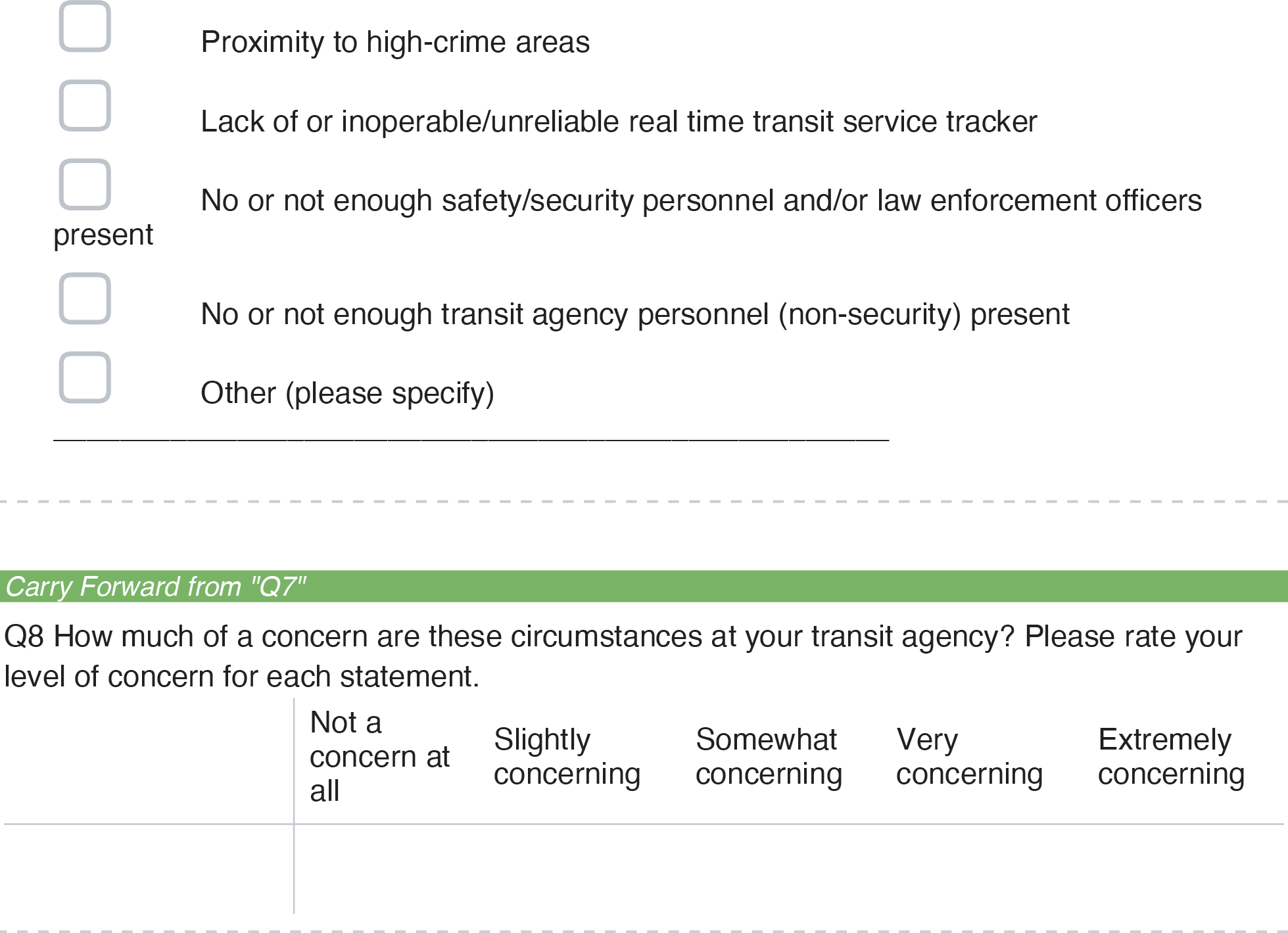
(Options from Q7 continued)
Proximity to high-crime areas
Lack of, inoperable, or unreliable real-time transit service tracker
No or not enough safety or security personnel and or law enforcement officers present
No or not enough transit agency personnel (non-security) present
Other (please specify)
Carry Forward from "Q7"
Q8 How much of a concern are these circumstances at your transit agency? Please rate your level of concern for each statement.
Not a concern at all
Slightly concerning
Somewhat concerning
Very concerning
Extremely concerning

Long Description.
The data given in the screenshot reads the following:
Q9 What methods are used in your agency to gather passenger feedback on their perceptions of personal security? Please select all that apply.
In-person interviews or surveys
Surveys provided as paper copies on board the transit vehicles
Customer service lines
Anonymous phone or text submittals of concerns
Online polls or surveys
Venting to transit workers
Internal or interdepartmental focus groups
Passenger advisory boards
Social media engagement
See Something, Say Something reports
Customer service or relationship management system
Agreements with local police departments
Other (please specify)
Our transit agency hasn’t asked for passenger feedback

Long Description.
The data given in the screenshot reads the following:
Q10 What strategies has your transit agency adopted to improve passengers’ perception of security? Please select all that apply.
Addressed concerns surrounding the physical built environment, such as improved lighting, access control, like fencing, and maintenance
Clear panels around transit structures to reduce hiding places
Security Personnel Presence, including police officers, security guards, transit or public safety ambassadors, etc.
Surveillance technology such as CCTV and monitors
Notification mechanisms for customers, such as emergency call buttons, security apps, or texting lines
Public outreach campaigns
See Something, Say Something campaigns
Adoption of Transit Agency Policies
Coordination or partnership building with law enforcement, social services, nonprofits, or other stakeholders
Other (please specify)
Our transit agency hasn’t adopted any strategies
Carry Forward from "Q10"
Q11 Have you seen changes (positive or negative) based on your feedback collection methods after implementing strategies to address the transit customer's perception of personal security?
Yes, we saw positive changes
Yes, we saw negative changes
There were no changes
I don’t know or Not applicable
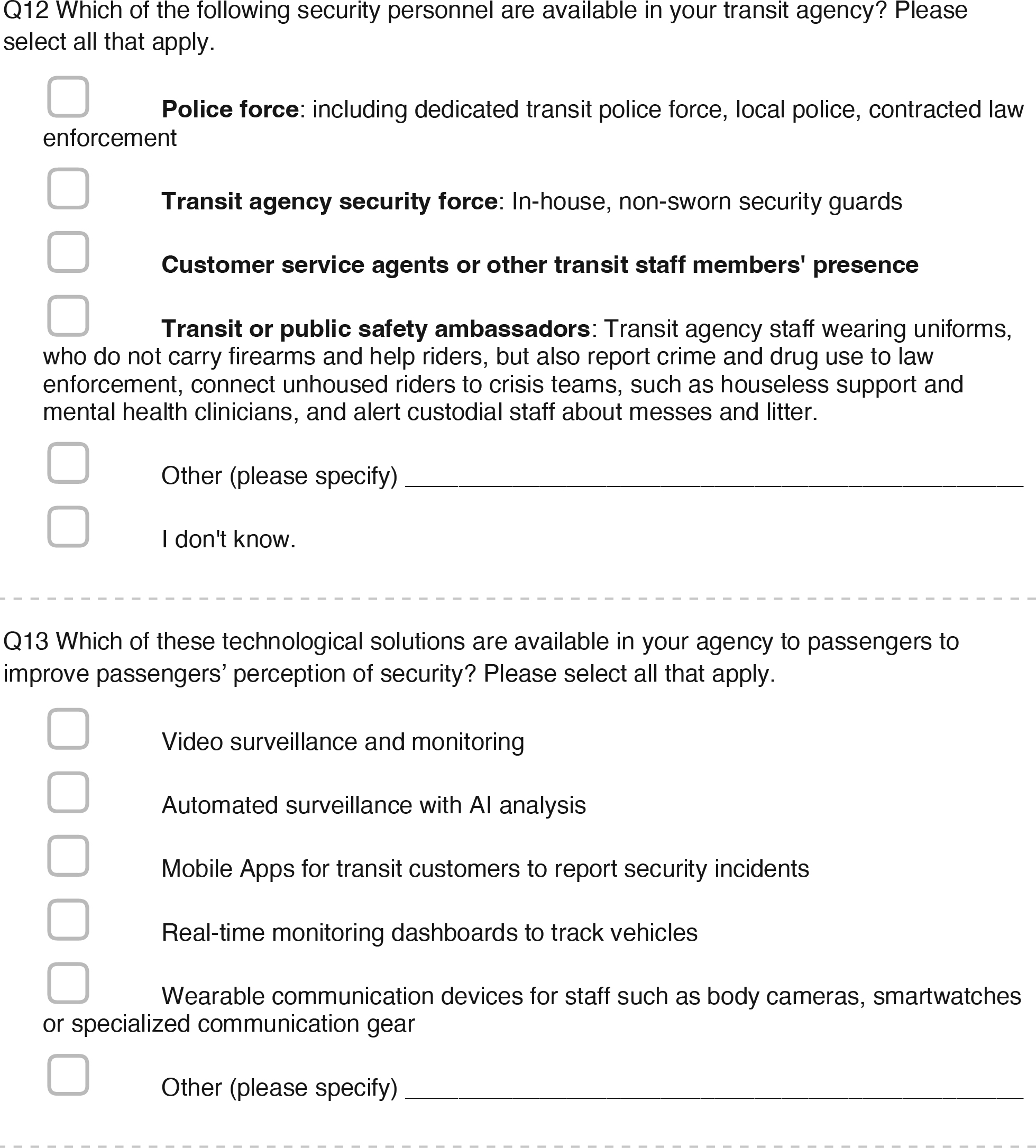
Long Description.
The data given in the screenshot reads the following:
Q12 Which of the following security personnel are available in your transit agency? Please select all that apply.
Police force: including dedicated transit police force, local police, and contracted law enforcement
Transit agency security force: In-house, non-sworn security guards
Customer service agents or other transit staff members' presence
Transit or public safety ambassadors: Transit agency staff wearing uniforms, who do not carry firearms and help riders, but also report crime and drug use to law enforcement, connect unhoused riders to crisis teams, such as houseless support and mental health clinicians, and alert custodial staff about messes and litter.
Other (please specify)
I don't know.
Q13 Which of these technological solutions are available in your agency to passengers to improve passengers’ perception of security? Please select all that apply.
Video surveillance and monitoring
Automated surveillance with AI analysis
Mobile Apps for transit customers to report security incidents
Real-time monitoring dashboards to track vehicles
Wearable communication devices for staff, such as body cameras, smartwatches, or specialized communication gear
Other (please specify)

Long Description.
The data given in the screenshot reads the following:
Q14 Which public information and outreach programs are available in your agency to passengers to improve the transit customers' perception of security? Please select all that apply.
Online safety or security resources
Public outreach campaigns – such as posters about encouraging the reporting of security concerns, passenger code of conduct, etc.
Public outreach campaigns to discourage inappropriate behavior
Other (please specify)
Q15 What policies are available in your agency for improving transit customers’ perception of security? Please select all that apply.
Courtesy stops between designated bus stops on demand at night
Rider suspension policies: suspending assailants from riding transit vehicles
Code of conduct policies
Fare enforcement policies
Other (please specify)

Long Description.
The data given in the screenshot reads the following:
Q16 Are there specific locations where you have noticed security concerns? Please select all that apply.
Onboard buses
Onboard trains
Transit stations
Bus stops
Parking lots
Elevators
Escalators or stairways
Transfer locations
Hallways
Property near transit stops
Other (please specify)
I have not noticed any security concerns
Q17 Does your agency make any special effort to address security concerns for specific communities of people based on age, ancestry, color, disability, ethnicity, gender, gender identity or expression, genetic information, HIV or AIDS status, military status, national origin, pregnancy, race, religion, sex, sexual orientation, veteran status, or any other class of people?
Yes
No
I don't know
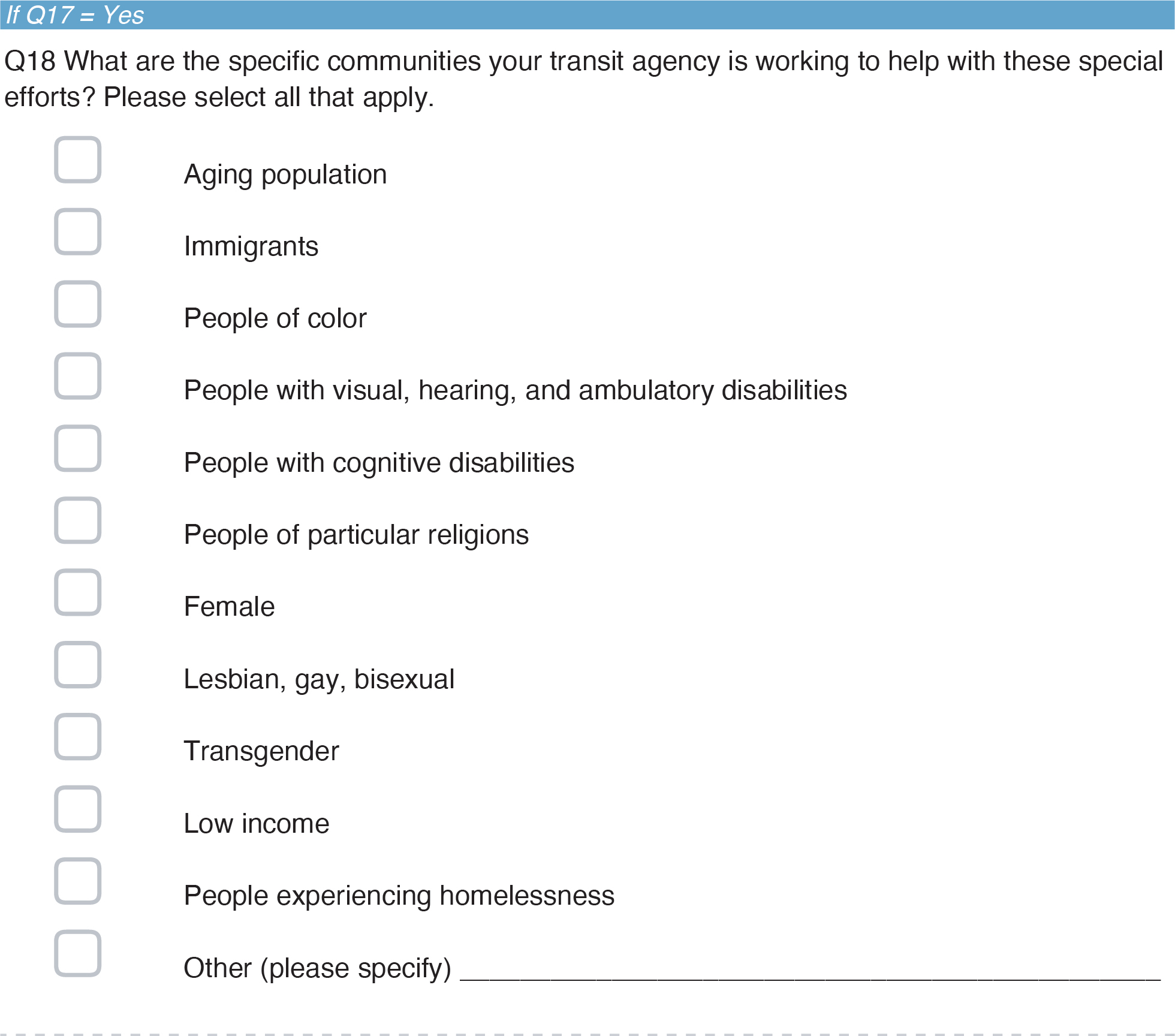
Long Description.
The data given in the screenshot reads the following:
If Q17 equals Yes
Q18 What are the specific communities your transit agency is working to help with these special efforts Please select all that apply.
Aging population
Immigrants
People of color
People with visual, hearing, and ambulatory disabilities
People with cognitive disabilities
People of particular religions
Female
Lesbian, gay, bisexual
Transgender
Low income
People experiencing homelessness
Other (please specify)

Long Description.
The data given in the screenshot reads the following:
Q19 Does your transit agency partner with the following agencies to address and prevent security concerns to improve the perception of security (e.g., addressing homelessness, mental health, and drug use)? Please select all that apply.
Local police or sheriff's department
Municipal or county social service agencies
Local government agencies
Mental health service centers
Services for people experiencing homelessness, including homeless advocacy groups
Nonprofit agencies on violence prevention
Homeless advocacy groups
Victim Service centers
Other (please specify)
No - we do not have any partnerships in this area.
If Q19 equals No - we do not have any partnerships in this area.
Q20 Please describe the partnership(s) with other agencies to address and prevent security concerns to improve perception.
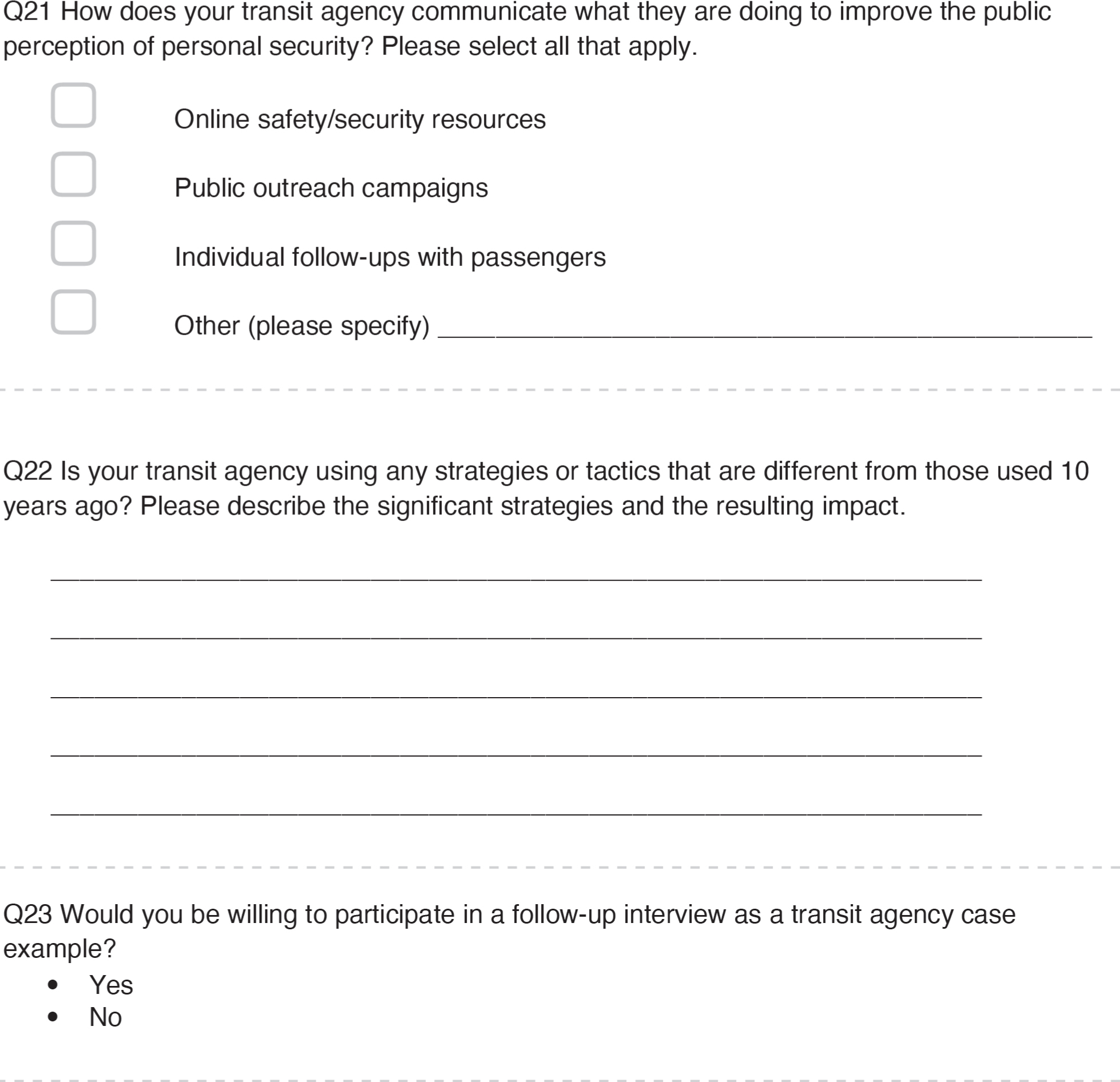
Long Description.
The data given in the screenshot reads the following:
Q21 How does your transit agency communicate what they are doing to improve the public perception of personal security? Please select all that apply.
Online safety or security resources
Public outreach campaigns
Individual follow-ups with passengers
Other (please specify)
Q22 Is your transit agency using any strategies or tactics that are different from those used 10 years ago? Please describe the significant strategies and the resulting impact.
Q23 Would you be willing to participate in a follow-up interview as a transit agency case example?
Yes
No

Long Description.
The data given in the screenshot reads the following:
If Q23 equals Yes.
Q24 Please provide your contact information. Please remember that the information you provide is confidential, and your name will not be used in any reports stemming from this project. We are asking for this information only for a follow-up interview or case study.
Name:
E-mail address:
Phone number:
Q25 Thank you for your participation and valuable input. Please click next to submit your responses.
End of Survey


