Improving Transit Customer Perception of Personal Security (2025)
Chapter: 4 Case Examples

CHAPTER 4
Case Examples
After assessing the results of the survey, the project team selected five transit agencies as case examples. These five agencies are diverse in terms of geography, socioeconomics, size, and types of vehicles in transit revenue service (see Table 10).
Of the five agencies selected, one operates in a smaller urban area (Mountain Line), one operates in a midsize region (Greenlink), one is in a large urban area (Sun Metro), and two operate in very large urban areas (BART and SEPTA). This chapter includes the feedback and findings from each agency.
Case Example Interview: BART
Introduction
The BART system is a vital public transportation rail network serving the San Francisco Bay Area. Established in 1972, BART connects major cities and suburbs across five counties:
- San Francisco
- Alameda
- Contra Costa
- San Mateo
- Santa Clara
The system includes 131 miles of track and 50 stations (see Figure 9). Before the pandemic, BART served 405,000 trips on an average weekday. Ridership levels dropped significantly

Source: NTD.
1Also operates in New Jersey, Delaware, and Maryland
2Also operates in New Mexico
3Indicates size of agency
Long Description.
The column headers of the table are Transit Agency, Urbanized Area (UZA), UZA Population, Vehicles Operated in Maximum Service (note 3), and Modes of Service. The data given in the table row-wise are as follows: Row 1: BART; San Francisco; Oakland, CA; 3,281,212; 534; Heavy rail, hybrid rail, monorail, or automated guideway. Row 2: Greenlink; Greenville, SC; 387,271; 23; Demand response, motor bus. Row 3: Mountain Line: Missoula, MT; 82,157; 25; Demand response, motor bus. Row 4: SEPTA; Philadelphia, PA (note 1); 5,696,125; 1,962; Heavy rail, demand response, light rail, motor bus, streetcar, commuter rail. Row 5: Sun Metro; El Paso, TX (note 2); 803,086; 183; Demand response, motor bus.
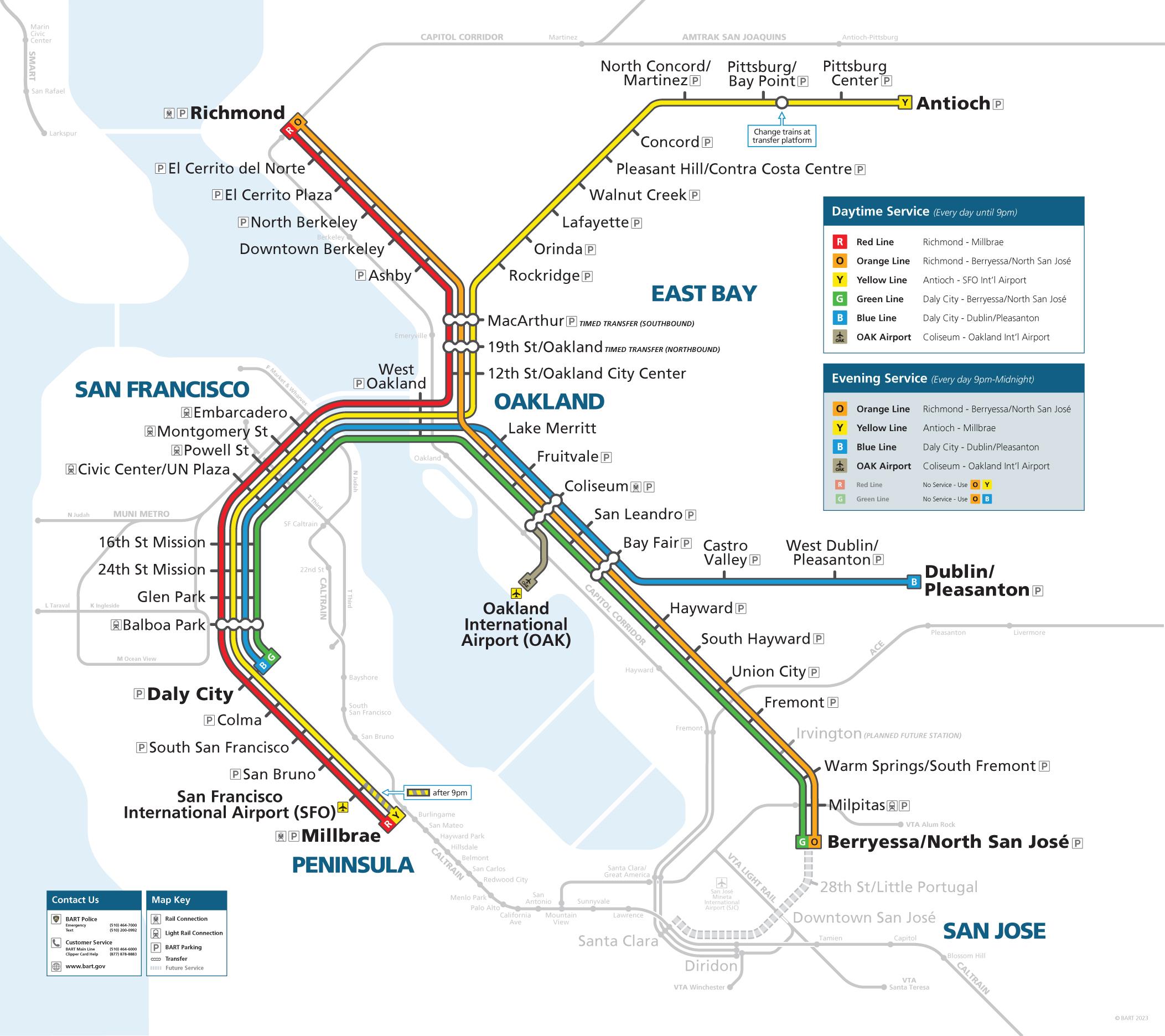
Source: BART.
Long Description.
The legend of the map shows two textboxes titled Daytime service (Every day until 9 PM) and Evening service (Every day from 9 PM to Midnight). The daytime services include red line, orange line, yellow line, green line, blue line, and OAK Airport. The evening service includes the orange line, yellow line, blue line, and OAK Airport. The red line and green line are of no service or use. The map shows the major cities of San Francisco, Oakland, Peninsula, San Jose, and East Bay. The end stops are Daly City, Millbrae, Richmond, Antioch, Dublin or Pleasanton, Oakland International Airport (OAK), and Berryessa or North San Jose. Each line connects the following places: Red line: Richmond to Millbrae. Orange line: Richmond to Berryessa or North San Jose. Yellow line: Antioch to Millbrae. Green line: Daly City to Berryessa or North San Jose. Blue line: Daly City to Dublin or Pleasanton.
during the pandemic but have since been steadily increasing, according to agency ridership reports (BART, n.d.-a). The project team interviewed BART staff working to improve customer experience. The summary of interview results focuses on BARTʼs general practices to improve customersʼ perception of security.
Conditions Affecting Perceptions of Security
Interviewees highlighted several key issues that affect ridersʼ perception of safety, such as the lack of phone charging stations, cleanliness of trains and stations, the visible presence of police officers, and drug-related hazards. Direct engagement with riders through conversations, surveys, and outreach through their Not One More Girl safety initiative has revealed that these concerns are particularly pronounced among younger passengers. Young people are concerned their cell phones may run out of battery and they wonʼt be able to call others. Riders consistently expressed that dirty trains and stations made them feel unsafe. The perception was that a lack of cleanliness indicated a lack of care for the system. Requests for more garbage cans were frequent, as clean environments contribute to a sense of safety. Additionally, the presence of discarded needles was a major safety concern. Riders found needles hidden in seat cushions and other places, which contributed to a feeling of insecurity. Interviewees mentioned that although the prevalence of needles has decreased recently, the issue significantly impacted their perception of safety.
A notable divide existed in rider preferences regarding police presence. While many surveyed riders expressed a desire for more police officers, others felt uncomfortable or anxious seeing multiple officers or police cars at stations. This perception can create a sense that something is wrong, even if the officers are present to prevent incidents. This latter group often includes youth and people of color, who sometimes associate multiple officers in one area with an immediate threat or incident. Commuters who work in white-collar jobs often express a desire for more police officers; in contrast, other riders may prefer nonpolice personnel in brightly colored uniforms to ensure safety and provide a welcoming presence on trains and platforms. The feedback suggests a need for a balance between visible security and a nonthreatening presence. Interviewees also pointed out that the demeanor of officers impacts perceptions; riders feel more comfortable when officers smile and greet them rather than appearing to search for trouble.
Rider opinions on the presence of homeless individuals on trains are also divided. Some passengers feel uncomfortable and want them removed, citing issues like odor and belongings. Others express empathy, noting that homeless individuals often just need a place to sleep and shouldnʼt be disturbed unless necessary. This feedback underscores the delicate balance BART must maintain in addressing homelessness compassionately while ensuring passenger comfort.
Interviewees also mentioned several critical concerns impacting rider perceptions and BARTʼs overall reputation, including physical abuse and assaults, sexual harassment, and media influence. Ongoing concerns about physical abuse and assaults on BART contribute significantly to perceptions of insecurity, necessitating enhanced safety measures. Reports of sexual harassment further affect rider comfort and safety, especially for women and other groups that have unique safety concerns. Media coverage heavily shapes public perception of BART, often portraying it as unsafe based on isolated incidents. Many people who havenʼt used BART recently still believe it is unsafe due to these reports.
Systems for Monitoring Perceptions
To gather and analyze customer perceptions, BART employs several methods (see Table 11). They conduct ongoing passenger and employee surveys with QR codes on trains, allowing for real-time feedback. A comprehensive customer satisfaction survey is conducted every other
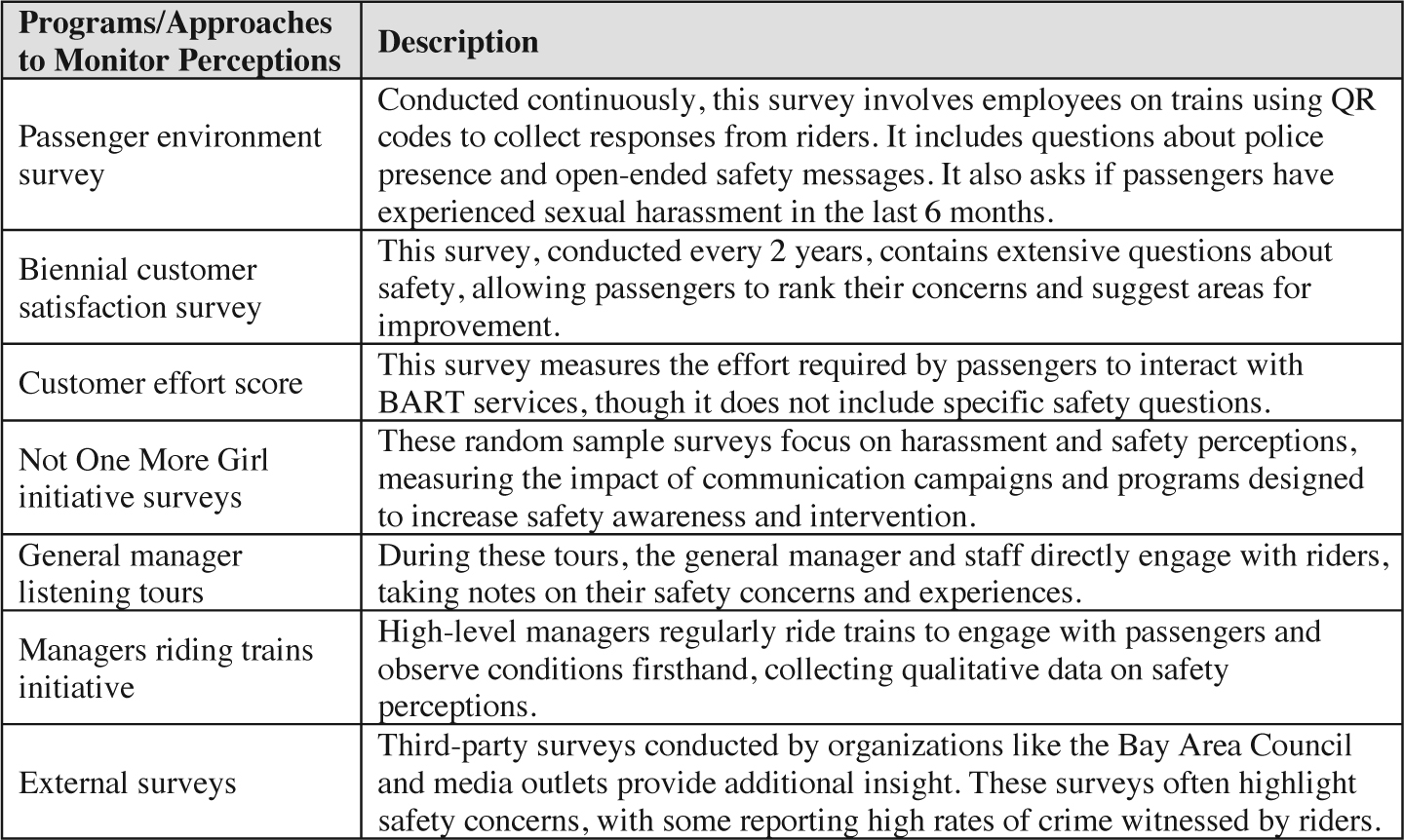
Long Description.
The column headers of the table are Programs or Approaches to Monitor Perceptions and Description. The data given in the table row-wise are as follows: Row 1: Passenger environment survey: Conducted continuously, this survey involves employees on trains using QR codes to collect responses from riders. It includes questions about police presence and open-ended safety messages. It also asks if passengers have experienced sexual harassment in the last 6 months. Row 2: Biennial customer satisfaction survey: This survey, conducted every 2 years, contains extensive questions about safety, allowing passengers to rank their concerns and suggest areas for improvement. Row 3: Customer effort score: This survey measures the effort required by passengers to interact with BART services, though it does not include specific safety questions. Row 4: Not One More Girl initiative surveys: These random sample surveys focus on harassment and safety perceptions, measuring the impact of communication campaigns and programs designed to increase safety awareness and intervention. Row 5: General manager listening tours: During these tours, the general manager and staff directly engage with riders, taking notes on their safety concerns and experiences. Row 6: Managers riding trains initiative: High-level managers regularly ride trains to engage with passengers and observe conditions firsthand, collecting qualitative data on safety perceptions. Row 7: External surveys: Third-party surveys conducted by organizations like the Bay Area Council and media outlets provide additional insight. These surveys often highlight safety concerns, with some reporting high rates of crime witnessed by riders.
year, which includes detailed questions about safety. Listening tours, where the general manager speaks directly with riders at various stations, provide additional qualitative data. Third-party surveys from organizations like the Bay Area Council and local media also contribute to understanding public sentiment.
BART staff, in collaboration with the Alliance for Girls, are working to finalize an evaluation framework for its safety programs. This framework will include indicators such as increased trust, belonging, comfort, and confidence in riding BART and decreased negative perceptions and fear. The framework can be used to guide future projects and station developments, ensuring they are aligned with these indicators.
Notification Mechanisms
BART offers multiple ways for customers to report safety concerns and request assistance. These include the BART Watch app, text messaging services, intercoms on trains, and call boxes on platforms. The usage of intercom buttons and call boxes is closely monitored to ensure passengers are aware of these safety tools.
The BART Watch app, powered by Elerts, allows riders to report incidents in real time. This data is meticulously tracked and analyzed, with Elerts providing robust support and insights into trends and patterns. All data from the Elerts app, dispatch, and surveys is stored in comprehensive databases. Regular reviews of this data help identify trends, assess response effectiveness, and determine necessary training for staff, especially concerning responses to incidents of sexual harassment and trauma.
Strategies to Address Customer Perceptions
BART has implemented several strategies to improve the built environment and overall safety perception. These include shorter trains, crisis intervention specialists, and transit ambassadors.
Surveys indicate that the primary concern for rider safety is on the trains, where the sense of being trapped can heighten anxiety. BART does not operate buses, so efforts are concentrated on improving safety in the train system. Running shorter trains has increased the number of
passengers per car, which has been associated with a decrease in criminal activity due to increased visibility and presence of other riders.
Structural changes at stations have also been significant. For example, replacing brick walls with glass panels in stairwells has eliminated hidden corners, improving visibility and reducing areas where illicit activities might occur. Surveys have shown that such changes significantly improve ridersʼ feelings of safety. Modernizing restroom designs to eliminate main doors and create open stalls has reduced the incidence of crimes and unsanitary conditions in restrooms.
Security Configurations
BART maintains its own transit police force and does not rely heavily on local police departments, except in certain suburban areas where local police might respond more quickly. The interviewees mentioned that introducing restroom and elevator attendants has significantly improved cleanliness and safety in these areas. BART also deploys crisis intervention specialists and transit ambassadors to address crises and provide a welcoming presence, contributing to a safer environment for passengers (see Figure 10 posters installed in trains and stations describing the agencyʼs crisis intervention specialists and transit ambassadors).
A directive for police officers to patrol on foot rather than staying in their cars has increased the visibility of safety personnel. This change, along with reframing survey questions to include all safety staff (not just police officers), has led to a significant increase in the reported presence of safety personnel.
Technological Solutions
BART has deployed a robust surveillance system with extensive camera coverage (more than 4,000 working cameras). Nearly live access on trains will be available once Wi-Fi is fully implemented. Live surveillance feeds inside stations help to quickly address incidents and identify repeat offenders.
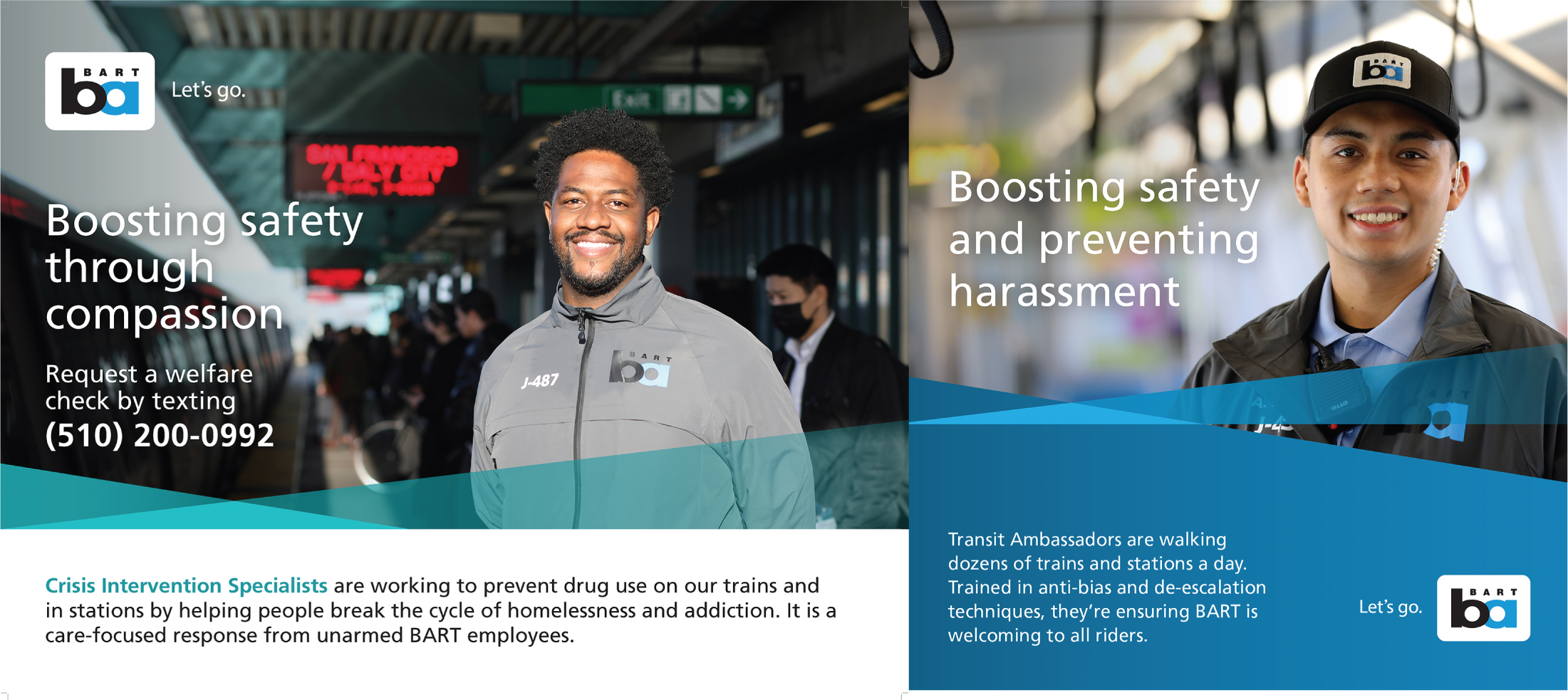
Source: BART.
Long Description.
Left poster: A smiling Crisis Intervention Specialist stands on a busy train platform. The text reads “Boosting safety through compassion” and provides a welfare check request number (510) 200-0992. The description at the bottom reads, 'Crisis Intervention Specialists are working to prevent drug use on our trains and in stations by helping people break the cycle of homelessness and addiction. It is a care-focused response from unarmed BART employees.' Right poster: A Transit Ambassador smiles while standing inside a train. The text reads “Boosting safety and preventing harassment.” The description at the bottom reads, Transit Ambassadors are walking dozens of trains and stations a day. Trained in anti-bias and de-escalation techniques, they're ensuring BART is welcoming to all riders.
A safety intercom is available so people can push a button and communicate directly with the agency (Figure 11).
Policies
BART has updated its policies to address issues such as fare evasion and sexual harassment. Fare evasion is a significant concern because it correlates with perceptions of lawlessness. While fare evasion for youth has been decriminalized by California state law, civil fines remain and enforcement for adults remains strict, with officers following protocols to handle combative individuals appropriately.
BART has specific guidelines for how officers should interact with passengers, particularly when addressing fare evasion and engaging with homeless individuals. For example, officers cannot ask for proof of payment outright; it must be part of a broader conversation. If a passenger is found without a valid fare, the officer will typically guide them to purchase one rather than resorting to punitive measures.
BART added sexual harassment to its code of conduct, enabling police to act against offenders even though it is not a penal code violation. This policy change allows BART to escort offenders off trains and address harassment complaints more effectively. BART has also implemented prohibition orders to ban repeat offenders for serious offenses such as violence, drug use, and urination. This policy has been effective in reducing reoffending rates.
Community Feedback, Communications, and Engagement
Based on feedback, especially from youth, BART is working on redefining safety and communicating it effectively through posters and other materials. The goal is to create a more inclusive and understanding environment that addresses modern concerns. For example, BART is moving away from the See Something, Say Something slogan, which is considered outdated and associated with profiling. The new approach aims to use language that is more approachable, relatable, and holistic, reflecting a broader definition of safety that prioritizes well-being and inclusivity.
BART uses posters, digital signs, and outreach campaigns to inform the public about safety initiatives and set clear expectations for rider interactions with security. Transparent communication helps demystify procedures and encourages riders to engage with security measures confidently.

Source: BART.
Long Description.
A woman presses a button on a safety intercom panel inside the vehicle. The intercom is mounted on a white wall near a symbol indicating priority seating for individuals with disabilities.
BART has various programs and partnerships to engage with diverse communities, including advisory groups representing people with disabilities, focus groups, and outreach events in collaboration with organizations like Chinese for Affirmative Action and the Ed Roberts Campus in Berkeley. These efforts ensure that feedback is gathered from a wide range of populations.
Another example of community engagement programs is the Not One More Girl initiative. The initiative includes a comprehensive evaluation framework with indicators such as increased trust, belonging, comfort, and confidence in riding BART. Phase I of the Not One More Girl initiative launched in April 2021 as a partnership between BART, the Alliance for Girls, Betti Ono, Black Girls Brilliance, and The Unity Councilʼs Latinx Mentorship and Achievement Program. After phase I implementation, survey results indicated that 36% of riders felt safer riding BART.
Riders, especially young people, often group BART with other bus agencies when talking about feeling unsafe. They donʼt realize BART is separate from the bus agencies.
Partnerships
BART collaborates with numerous external agencies to enhance safety and security. BART has a full-time senior manager for social service partnerships who specializes in coordinating with county services. This role is crucial in fostering collaboration with homeless outreach teams and other service providers. BART pays counties to support their homeless outreach efforts, recognizing that a collective approach is necessary to effectively address these complex issues. BARTʼs managers, including the senior manager for social service partnerships, engage with frontline staff to understand the effectiveness of partnerships. For example, station agents report frequent and positive interactions with the Contra Costa homeless outreach team, indicating strong, supportive relationships. BART has also partnered with the Asian Womenʼs Shelter to develop a program addressing domestic violence on transit. This initiative includes a dedicated website with resources and information, highlighting the often overlooked issue of domestic violence in transit settings. These partnerships ensure comprehensive support for populations who have unique safety concerns and reinforce safety throughout the transit system.
BART has good coordination with other agencies such as MUNI. When a crime happens on BART and surveillance cameras show the suspected perpetrator arrived via bus or MUNI train, those agencies share their videos with BART.
Changing Strategies Over Time
The interviewees mentioned that over the past 12 years, BARTʼs safety strategies have evolved significantly. The focus has shifted from simple, direct messaging like see something, say something to more comprehensive and compassionate approaches. For example, early posters focused on bomb detection, whereas current campaigns promote a culture of care and bystander intervention, emphasizing how to help someone in distress with the assistance of crisis staff rather than armed officers. BART also engages deeply with the community through initiatives like Be the Change, which involved extensive community engagement and led to creating progressive policing strategies, including introducing ambassadors and crisis intervention specialists and additional training for safety staff.
BART has implemented mandatory de-escalation training for all employees, not just frontline staff. This training includes techniques for providing good customer service even in combative situations and recognizing signs of escalating behavior. BART has created an active shooter training video specific to its facilities to prepare staff for potential emergencies. BART actively collects and analyzes data to better understand and address issues related to harassment on its trains and stations.
Case Example Interview: GTA
Introduction
The Greenville Transit Authority (GTA) operates as the regional transportation authority in Greenville County, SC. This agency provides public transportation through its 12 fixed bus routes (see Figure 12) and demand response services (paratransit) for eligible individuals. Greenlink, the branding for GTAʼs transit services, handles approximately 662,940 unlinked passenger trips annually (FTA 2022).
Conditions Affecting Perceptions of Security
Based on the interview with GTA, several conditions affect passengersʼ perception of security. The bus stops along routes were identified as places where the agency has the least control, making passengers feel less secure when arriving or departing due to the lack of sufficient supervision and control of incidents. The agencyʼs transit center was cited as the place with the highest number of law enforcement calls due to the convergence of 10 out of 12 bus routes and a higher passenger density.
Built environment factors were identified as affecting security perceptions. Lack of lighting, sidewalks, and infrastructure issues, in addition to passing traffic and speeding, can cause feelings of insecurity. On top of environmental factors, the presence of homeless individuals camping in and around bus shelters can make passengers uncomfortable. Nondestination passengers, particularly during the zero-fare period (COVID-19 pandemic) caused issues by occupying limited seats.
Passenger behavior was noted as another factor that can reduce the perception of security. Having intoxicated individuals boarding buses and at the transit center led to complaints from other passengers.
In some circumstances, driver behavior could also influence customersʼ perception of security. Examples provided included erratic or aggressive driving and driver handling of trip hazards and railroad crossings. Finally, the interviewee mentioned that assault and harassment incidents are occasionally reported to the agency, mainly occurring at the transit center. Although these circumstances are not extremely frequent, they significantly impact passenger security perceptions when they occur.
According to the interviewee, the locations with a high potential for perception of insecurity by passengers are bus stops and destinations with high ridership, including big-box stores, the mall, hospitals, and low-income neighborhoods.
Systems for Monitoring Perceptions
The GTA frequently monitors passengersʼ feedback regarding security concerns through their external security team, the outcomes and results of the Mystery Rider program, and the biweekly operations team meeting discussions regarding security issues. The interviewee illustrated the agencyʼs monitoring approach by highlighting how recreational activities around the transit center could lead to increased drug use and alcohol consumption. They explained how the agency proactively informed law enforcement to address this issue.
Notification Mechanisms
Based on the interview, multiple notification mechanisms are available at GTA. Onboard incidents are usually reported by the bus operators. If an incident occurs on the bus and is reported to

Source: Greenlink.
Long Description.
The map legend lists the following: Greenlink Transit Center – star symbol. 501 S Pleasantburg – Purple. 502 White Horse – Red. 503 Poinsett – Dark Blue. 504 Anderson – Orange. 505 Rutherford – Sage Green. 506 Woodside – Grey. 507 Augusta – Light Blue. 508 Wade Hampton – Pink. 509 E North – Dark brown. 510 Laurens – Violet. 601 Simpsonville Connector – Light Green. 602 Woodruff Connector – Blue. The map shows all 12 routes represented in different colors that extend to specific parts of Greenville County. The right side of the map shows the following text: Route 602: Woodruff Connector Deviation. Monday to Friday 2 a.m. to 5:30 p.m. only. Route 601: Simpsonville Connector. Route 602 shows the blue line while route 601 shows the sage green line.
the operator, the operator calls the dispatch team. An incident report is then filed in a Microsoft Access database. If the incident requires law enforcement, the dispatcher and supervisor instruct whether the bus should stop on the route for law enforcement to board or continue to the transit center where law enforcement will be waiting.
Customer feedback is an important element of the notification mechanism. Customers can directly report incidents to the bus operator or call dispatch via the standard information line. An online complaint form is also available on the GTA website; however, it is mainly used for reporting driver behavior rather than for emergencies.
Video surveillance is another mechanism the agency uses to identify security-related circumstances.
Each of these mechanisms aims to collect, address, and handle incidents, improving passengersʼ perception of security as well as their actual security and safety.
Strategies to Address Customer Perceptions
The interviewee referenced several mitigation strategies implemented by the agency to improve passengersʼ perception of security.
Bus stops were previously identified as areas that affect security perception. To ensure the bus stops comply with the Americans with Disabilities Act, more than 300 stops will be upgraded over the next 5 years, providing a level landing pad away from the curb. Amenities like lighting, bus shelters, and benches will be added to increase safety and comfort for waiting passengers. These improvements were funded by a $5.6 million Rebuilding American Infrastructure with Sustainability and Equity grant (now called the Better Utilizing Investments to Leverage Development Grant Program), with ongoing engineering, construction, and inspection processes.
To design a safe place for youth in crisis, GTA partners with a local Safe Place organization to ensure that GTAʼs policies and procedures meet Safe Place standards, including annual audits to maintain the Safe Place certification. Moreover, GTA provides human trafficking training to frontline team members to increase awareness and reporting of such incidents.
The agency has contracted with an external security team to provide on-site security from 10:00 a.m. to 8:00 p.m. inside the transit center. The initial goal of the external security plan was to address staff retention concerns and their feeling unsafe; however, this plan also benefits customer safety.
As another permanent change, the transit agency built a new facility and relocated some of the GTA team. This change opened up office space in the transit center; the agency is currently in discussions to lease the vacated space to the police department. Parking police cars around the transit center is anticipated to positively influence passengersʼ perception of security. Relocating bus stops is another strategy GTA uses. The agency evaluates bus stop locations and works with property owners to relocate stops if necessary. This change involves obtaining permission from property owners because GTA does not file for eminent domain. The issue of homelessness around the transit center was addressed by a homeless outreach team with office space in the downtown business district, which is also where the transit center is.
Security Configurations
As mentioned in the Strategies to Address Customer Perceptions section, GTA has contracted with an external security team to provide on-site security at the transit center from 10 a.m. to 8 p.m. (peak passenger time). This security contract was first planned to address the transit staffʼs
security concerns; however, the presence of the guard team also improves the passengersʼ sense of security.
In addition, the agency plans to lease its vacant office spaces around the transit center to the police department. The presence of police cars parked at transit facilities can reduce criminal activities, enhancing the overall security of the environment.
Technological Solutions
Each bus is equipped with internal and external cameras; the internal cameras have audio capabilities. The transit center also has audio and video security cameras. The surveillance system is not monitored live, but the footage can be provided to law enforcement for incidents on the bus or at the transit center. A new facility under construction will have a staffed dispatch room with multiple TV monitors. The agency has around 450 bus stops with no cameras. The plan is for the agency to pilot solar-powered real-time arrival screens at high-demand bus stops. An app is currently available to find real-time arrival information. Figure 13 shows a video screenshot where GTA shares information for first-time users.
Policies
The agency has policies in place, such as requiring passengers to exit the vehicle after one complete trip and calling law enforcement when necessary to mitigate some of the issues related to nondestination passengers. However, GTA is less able to control challenges related to environmental factors and behavior at bus stops because other authorities are responsible for this.
GTA implemented Greenlinkʼs customer code of conduct and passenger responsibility policy to enhance actual and perceived security. GTA worked with the cityʼs legal team to identify state statutes and local ordinances that could apply to the code of conduct. This policy allows GTA to call law enforcement when passengers violate codes in this law.
Community Feedback, Communications, and Engagement
GTA has performed multiple public outreach programs to improve passengersʼ perception of security. As mentioned in the Strategies to Address Customer Perceptions section, GTA has promoted their human trafficking awareness initiative through social media campaigns. A grant from the FTA Human Trafficking Awareness and Public Safety Initiative supports GTAʼs human

Source: Greenlink.
Long Description.
A person in a red hoodie is seated in the driver’s position. A fare reader screen is visible in the foreground. Ahead, another Greenlink bus is parked in a covered bus depot area with traffic cones nearby.
trafficking program. GTA has used this grant to conduct an 18-month public education and awareness campaign.
An important component of GTAʼs outreach activities is the Mystery Rider program. This program is an initiative to identify the areas that need improvement using anonymous passengersʼ feedback. The agency gave volunteer passengers subsidized ride passes for 12 rides to ride the buses and give their feedback regarding the safety and security of each route. The volunteer riders who completed the 12 rides received transit passes valued at $75 as compensation.
GTA also brainstormed a campaign to tell the public and riders about the challenges bus operators must deal with based on real experiences. However, the agency decided not to publicize the outcomes for fear they might affect future operatorsʼ willingness to apply for transit jobs.
To address homelessness in the central business district, multiple partners funded a homeless outreach team with office space in downtown. GTA can ask outreach team personnel to help handle homelessness circumstances affecting passengersʼ security perception.
The agencyʼs main platform for communicating with the public is Twitter (now X), which is used for posting updates. The City also uses other social media (Facebook and Instagram) when GTA needs broader outreach. Text alerts are a direct way of communicating with transit passengers for real-time updates. The agency newsletter has around 1,200 subscribers receiving news and notices about significant upcoming changes and updates.
Partnerships
GTA collaborates with a local Safe Place organization called Pendleton Place. This agency is an emergency foster home for young people to board. In addition, the agency partners with a residential program providing training on human trafficking, specifically on prevention and educating the public. When asked about the agencyʼs partners for addressing security concerns, the police department was identified as GTAʼs go-to for security perception calls. In addition, GTA is working with United Housing Connections, a nonprofit organization that provides an outreach team in the downtown Greenville area that builds relationships with individuals and transit passengers to help determine their needs and find them resources.
Changing Strategies Over Time
Over the past 10 years, the transit agency has significantly improved its ability to contact passengers directly. The electronic fare system gives the agency the email addresses of registered passengers and therefore the ability to directly contact these passengers to notify them about programs such as the Mystery Riders program or other security-related updates.
Additional Items of Interest
Greenlink has used information from Morpace International, Inc. and Cambridge Systematics, Inc. (1999) to develop a survey and track satisfaction levels. The agency hired a student intern to help develop a survey as part of their thesis. The student analyzed factors that an average rider using Greenlink bus services experienced, ranked the factors based on impact, and then developed solutions to address factors based on the ranking system. Some of the questions in the survey pertained to cleanliness, shelter/bus maintenance, lighting, and interactions with the operator—answers to which might point to feelings about personal security.
Another strategy that has been successful is the agencyʼs bus shelter art contest. Mural contests have been in place for over 2 years, where high school students submit designs and the winning

Source: Greenlink.
Long Description.
The art displays a colorful nature scene with trees, birds, butterflies, and bicycles on a green background. The shelter has a blue roof trim, a black frame, and a metal bench inside. The setting includes flowering trees and a parking lot in the background.
art is digitized and put up inside 15 bus shelters throughout the City of Greenville with a vinyl wrap (Figure 14). The first 2 years were funded partly by the Arts in Public Places Commission. Interviewees reported less vandalism at these bus shelters.
Case Example Interview: Mountain Line
Introduction
Operated by the Missoula Urban Transportation District, Mountain Line is a public transit system that serves the residents of Missoula, MT, and the surrounding area (see Figure 15). As of 2022, the system recorded a ridership of 1.2 million, not including paratransit. The agency employs a robust security method to enhance passengersʼ perception of security and reinforce the agencyʼs commitment to providing a secure transit experience for the community.
Conditions Affecting Perceptions of Security
Several factors were highlighted by the interviewee as affecting perceptions of security. Unhoused individuals on the bus, while small in numbers, were mentioned as one of the main circumstances affecting perceptions of both riders and nonriders in locations served. The impacts of homelessness in Missoula have two main origins. The first is that population growth, combined with a lack of affordable housing and increased cost of living, has increased the number of unhoused individuals, which affects the perception of security. The presence of houseless individuals particularly at transfer centers and near housing shelters can be a perception issue. Secondly, this community experiences significant, extreme weather conditions (hot summers and cold winters) that affect houseless individuals, who may seek shelter from inclement weather for a short time while still having eventual destinations. The presence of individuals intoxicated or using drugs can be another circumstance that affects the customersʼ perception of security.
Systems for Monitoring Perceptions
The agency tracks the passengersʼ feedback regarding their perception of security through different measures. The interviewee mentioned that a dedicated customer service representative answers phone calls throughout the day. The agency also has software to track incidents to be handled internally and/or by law enforcement. Additionally, public relations staff engage the community by attending public venues, interacting with people directly, and distributing surveys to collect passengersʼ feedback.

Source: Mountain Line.
Long Description.
The legend of the map is titled 'Weekday route frequencies (approximation).' The legend lists four BOLT lines, two UDASH lines, and four icons. The frequency on weekdays is every 15 minutes, 30 minutes, and 60 minutes. The frequency on Saturday and Sunday is every 60 minutes and above 60 minutes. Each line is numbered based on the route.
The agency addresses the customer feedback through direct response and collaboration with law enforcement.
Notification Mechanisms
Mountain Line uses multiple communication channels, including the agency website and social media sites, to update the public and customers regarding any changes in service or new information.
Strategies to Address Customer Perceptions
To address the perception of houselessness issues, the agency has employed some strategies related to physical and built environmental factors. These include creating an inviting and safe environment at the transfer center by eliminating hidden spots and adding new activities and businesses, such as restaurants, to improve the sense of security in an inviting environment.
To address the issues related to extreme weather conditions, the agency has implemented other strategies, such as limiting the number of round trips for nondestination riders to one route loop per hour. The agency is also partnering with local organizations to support homeless individuals and nondestination riders to access better life conditions and jobs.
The public intoxication and drug use challenges are managed through assertive supervision and technology, including putting a Naloxone vending machine on site. The transit agency makes efforts to make sure supervisors are available at the transfer center to manage any rider concerns. In terms of technology, the camera system allows real-time monitoring. Overall, to address the houseless and nondestination riders, the agency benefited from combining environmental redesign, strategic policies, and most importantly, community support.
Security Configurations
The agency works with public law enforcement under a written agreement and mutual aid arrangements to address security needs in the downtown area and around the transfer center. Moreover, this agency contributes to security in the area by keeping a supervisor on site and maintaining visual observations from multiple locations at any given time.
Technological Solutions
All fixed-route buses, paratransit vehicles, supervisor vehicles, support vehicles, and maintenance vehicles are equipped with surveillance cameras. Cameras are also installed at the transfer center.
Policies
When asked about policies that the agency implemented to improve the perception of security, the interviewee highlighted CPTED (crime prevention through environmental design). Using CPTED principles, the agency focuses on how built environment attributes can improve customersʼ perception of security. Examples include designing a well-lit area around the transit station (particularly in winter) and eliminating places of refuge by trimming bushes to no more than 2 feet off the ground and trees to approximately 10 feet off the ground. This latter example was implemented by the agency to increase the actual and perceived security of bus stop environments as well.
To avoid group gatherings that can create an unsafe and insecure environment for passengers, the agency reconfigured the benches to face away from each other around the transfer center.
The agency also improved the signage notifying the public about active cameras, some with audio recording capabilities.
The interviewee explained about a recent bus stop project aimed at improving safety, security, and accessibility that has been recently completed. This project included the installation of new shelters with open designs. These changes enhance visibility, reduce unwanted behaviors, and contribute to an overall safer environment.
Community Feedback, Communications, and Engagement
Social media sites were mentioned as the main communication tool for regular interaction with the public. Other tools such as communication boards and television screens providing real-time updates on bus schedules and other important information were also identified as public communication methods. To be more visible all the time, the agency uses paper postings. The public relations team communicates regularly with local media to distribute agency updates and newsworthy stories and to address media inquiries. The agency provides QR codes on buses and a highlighted link on the website so customers can scan and send their recommendations and safety concerns anonymously.
Partnerships
The agency collaborates with the local Access and Functional Needs Committee to improve transit accessibility for people with disabilities. In addition, the local crisis intervention team has become involved.
The agency also collaborates with a local emergency planning committee to streamline processes during natural or man-made disasters and, to combat human trafficking, it works with Truckers Against Trafficking and the county human trafficking group.
Changing Strategies Over Time
One strategy implemented in recent years was the use of partition barriers by driversʼ seats to prevent the spread of COVID-19. These partition screens have been maintained postpandemic to separate passengers and operators and increase the sense of security for both.
Public engagement and de-escalation training is implemented for all bus operators. This focuses on reading people and their body language to understand them and ensure passengersʼ safety. In addition, new training focuses on positive interactions with passengers to reduce incidents and conflicts between operators and customers. The implementation of new technologies provides multiple ways to report and record incidents in real time or after the fact.
Case Example Interview: SEPTA
Introduction
The Southeastern Pennsylvania Transportation Authority (SEPTA) is one of the largest transit systems in the country. The 2,200-square-mile service area covers five counties in the Greater Philadelphia area and connects to transit systems in Delaware and New Jersey. With regional rail, buses, trolleys, subways, and a high-speed line, SEPTA offers a multitude of transportation modes that connect people to their destinations. Safety and security are front and center on the website, in messages from the general manager, and in publications.
SEPTA has had its own transit police force since 1981. It currently employs about 250 sworn officers and covers three patrol districts. In 2021, SEPTA started its SCOPE program (see Figure 16),
Source: SEPTA.
Long Description.
The tagline reads, 'Safety, Cleaning, Ownership, Partnership, Engagement.'
which won the 2022 Innovation Award, to address issues surrounding safety, cleanliness, crime, and outreach. The agency and its Transit Police Department also received the APTAʼs Gold Award for Rail Security in 2024. According to a press release the agency issued at the time, “SEPTA police have made significant strides recently in reducing crime on the system, hiring and retaining officers, using innovative patrol methods, and utilizing technology to help prevent crime and apprehend suspects” (SEPTA 2024a).
Committed to providing a safe and clean service, SEPTA reenacted an enforcement policy in July 2024 regarding quality-of-life violations to “discourage incidents, focus on repeat offenders, and enhance the customer experience.” According to its website, it issues code violation notices for low-level crimes such as alcohol consumption, public urination, smoking, and littering, with fines ranging from $25 to $150 per offense. Chronic offenders (receiving four violations and/or not paying their fines) are banned from using the transit service (SEPTA 2024b).
A press release published July 3, 2024, stated that SEPTA experienced a 37% decrease in serious crimes on the system during the first 6 months of 2024 as compared to the same period in 2023, showing that what it is doing is having an effect (SEPTA 2024c).
Conditions Affecting Perceptions of Security
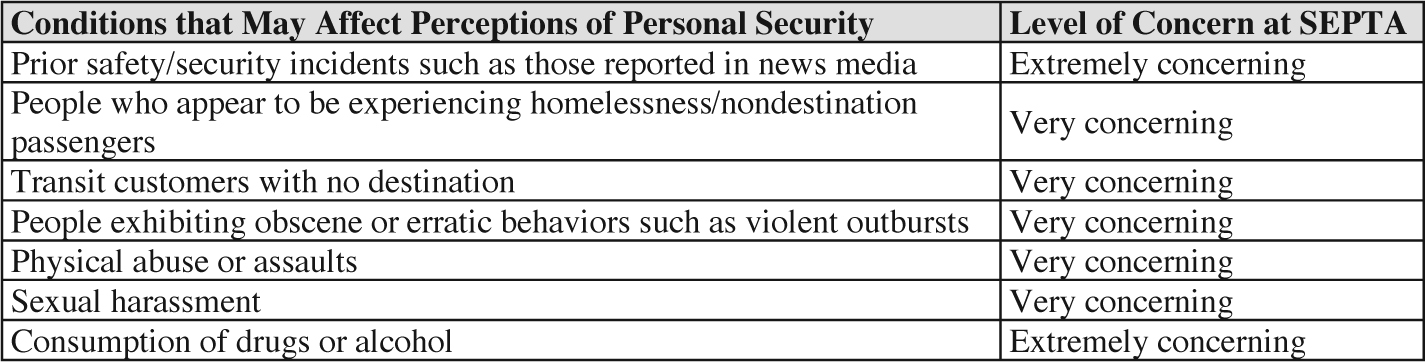
The case example interview with SEPTA began with clarifying the answers provided in the survey regarding the extent to which conditions or factors affecting customer perception of security are of concern to the agency. When the project team clarified that the follow-up question is about whether the condition is a major problem at the agency, SEPTA staff modified some of their answers to the survey. In other words, when the survey was completed several of the conditions listed were selected and rated as extremely concerning; however, when interviewed staff changed these answers to lower-level concerns. A couple of examples are poor lighting and poorly maintained transit vehicles, which were both rated as extremely concerning in the survey. With lighting and vehicle maintenance being a top priority at the agency, SEPTA has a system in place to address these concerns and, as such, lowered their extremely concerning rating to somewhat concerning and not a concern at all, respectively. In fact, almost all the conditions that may affect a customerʼs perception of personal security received a lower level of concern when discussed in the interview due to the agencyʼs efforts to address that issue. Table 12 lists the conditions or circumstances that received very or extremely concerning ratings.
When looking at the complaints received by SEPTA, complaints about people experiencing homelessness typically rank among the top five complaint categories each month. As such, SEPTA has been doing more to reduce homelessness on the system and has seen positive results. The
Long Description.
The column headers of the table are Conditions that May Affect Perceptions of Personal Security, and Level of Concern at SEPTA. The data given in the table row-wise are as follows: Row 1: Prior safety or security incidents, such as those reported in news media: Extremely concerning. Row 2: People who appear to be experiencing homelessness or nondestination passengers: Very concerning. Row 3: Transit customers with no destination: Very concerning. Row 4: People exhibiting obscene or erratic behaviors such as violent outbursts: Very concerning. Row 5: Physical abuse or assaults: Very concerning. Row 6: Sexual harassment: Very concerning. Row 7: Consumption of drugs or alcohol: Extremely concerning.
agency has reduced the number of people on transit experiencing homelessness by 44% since starting the SCOPE program.
Staff made it clear that any incident that rises to the level of being reported in the media is extremely concerning, and although obscene language would likely affect someoneʼs perception of security, it is not prevalent on the system. There are physical abuses and assaults that occur on the system and those incidents are very concerning to them. Also, the consumption of drugs or alcohol is extremely concerning to SEPTA staff.
Poor lighting was listed lower, as somewhat concerning, because of the efforts SEPTA has already made to address unlit areas. Likewise, transit vehicles and infrastructure have been maintained to good levels and as such there is not a big problem with vehicle maintenance. Cameras and surveillance monitoring exist across the system. Other technology in use includes the real-time transit service tracker.
Systems for Monitoring Perception
The main ways the agency gets information from customers are through the customer service system (Veritas) and the Transit Watch app. Surveys are also conducted monthly (and sometimes weekly) to understand how people feel about safety and security.
Notification Mechanisms
SEPTA staff stressed the feedback received and actions taken to address concerns. With the weekly and monthly surveys, they hear their customers, make changes, and hear them again. The reporting structure in place gives the agency the data to make daily decisions on where to send outreach teams.
Strategies to Address Customer Perceptions
The SEPTA infrastructure improvements and maintenance are handled by the Bridges and Buildings Department. The agency has worked to increase lighting in poorly lit areas and bolster older infrastructure, such as replacing gates that are not up to par, improving elevators and escalators, and creating easy access for customers. In addition, vehicles have been upgraded to meet customersʼ needs to ensure safety and security. Staff indicated the agency has a robust program in place to address infrastructure. One infrastructure change being piloted is installing higher fare gates at one SEPTA station. The agency is seeing an improvement in revenue and a decrease in fare evasion. If this trend continues, SEPTA plans to expand the pilot to 3–6 other transit stations and eventually throughout the system.
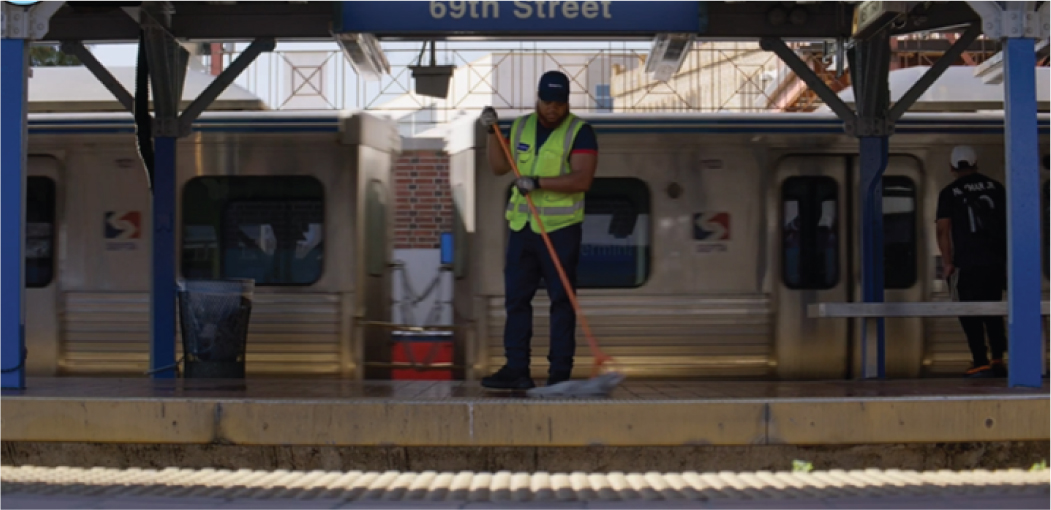
The main locations with security concerns are static infrastructure, such as stations, platforms (Figure 17), and major hubs, essentially where populations who have unique safety concerns seek
Source: SEPTA.
Long Description.
A silver SEPTA train is parked in the background, and another person is seen walking at the far end of the platform.
respite. SEPTA is not seeing security concerns as much on buses. Also, people who are experiencing homelessness are sometimes on elevators and in stairways. The concern is not systemic, but there is a concern. The SCOPE program is having success mitigating the presence of unsheltered people on the system. One area of the system has three stations within half a block of a large illegal drug market. To address security at these stations, SEPTA has static outreach teams with bolstered security and security guards present at least 16 hours a day, 6 days a week.
Operator assaults are increasing lately at SEPTA, as at many other agencies. To help address this concern, the agency recently added information about penalties for assaulting a SEPTA employee. If, however, someone reports an assault and there is a conviction, that person can get a reward of up to $1,000. Operators are instructed to avoid getting involved in a verbal confrontation with a customer, but sometimes confrontations do occur. To protect the operator, there are plexiglass barriers and an emergency alarm button, which is silent, allowing the control center to turn on the mic and hear what is going on. An additional button, “Help, Call Police” allows others on the bus to help in an emergency. The agency recently began an automatic announcement that plays when the bus operator opens the door and states the fare for entering the bus, for example, “The fare is $2.50.” This announcement removes some of the interaction between the passenger and the operator and is intended to mitigate operator assaults.
All the strategies that have been implemented have resulted in positive changes, according to the interviewee. When asked which strategies have been more impactful than others, SEPTA interviewees specified:
- Through the SCOPE program, the effort to clean the system has seen great improvements in terms of customer feedback. SEPTA hired 200–300 additional cleaners to address the cleanliness and are getting ahead of it. The agency uses media outlets and social media to show the results of the clean system.
- 70 additional police officers have been hired. Part 1 crime has decreased by almost 50%.
- Outreach teams have been instrumental in removing certain populations from system properties. The interviewees said the teams ask people to leave the system. This is one reason SEPTA is seeing a 45% decline in homelessness on transit properties: “simply by the power of ask.”
- Engaging members of populations who have unique safety concerns before calling SEPTA Transit Police. Some data was shared during the interview:
- During the first quarter of this year, SEPTA recorded 35,000 removals.
- During the second quarter, there were 36,000 removals. However, 31,000 of these were by the outreach team (without the assistance of SEPTA Transit Police).
- Being data-driven has enabled the agency to reassign resources. On a daily basis, SCOPE leaders instruct the outreach team to target areas of concern.
Security Configurations
The SEPTA Transit Police has sworn and nonsworn officers handling its security. It does not have traditional ambassadors who guide customers for day-to-day operations. Instead, it has outreach workers to engage members of the community with unique safety concerns (see Figure 18 for the outreach process). During events and new initiatives, SEPTA employees volunteer as “guides” to serve in an outreach capacity. Interviewees reported that the SCOPE program now falls under SEPTA Transit Police, a change that occurred in July 2024. Previously, the program was directly under SEPTAʼs Chief Operating Officer. The program continues to evolve.
Technological Solutions
In terms of cameras and surveillance monitoring, SEPTA has a virtual patrol center operated 7 days a week monitored by retired police officers. With over 30,000 cameras in place and more being planned, the agency is seeing results. It has the ability to listen to audio in most vehicles in real time. At stations, SEPTA can look, listen, and speak. The virtual patrol can look at live video, activate the microphone, and speak to people to discourage activity or respond to someone in need. In addition, interviewees reported that SEPTA had a contract with Zero Eyes, an AI company that detects guns, but software issues between the agencies could not be resolved so it ended the contract.
Passengers can report concerns via the Transit Watch app and customer service line. Also, there are emergency call buttons on all train vehicles, stations, and platforms. Human trafficking initiatives are in place to inform and educate on what to do and what not to do.
Another technology SEPTA uses as part of the SCOPE program is GPS-enabled smartphones, which each outreach worker carries. The agency can monitor where members of the team are in real time and where they have been using a dashboard. It is a control mechanism to ensure the team are where they need to be and provides a built-in safety feature.

Source: SEPTA.
Long Description.
A circular arrow flow surrounds the SEPTA and SCOPE logos at the center. The four steps are as follows: Step 1 (orange): Rapport building: Greetings. Step 2 (blue): Assessment of an individual’s needs. Step 3 (orange): Offering treatment and services. Step 4 (blue): Providing services or asking individuals to leave. The design uses alternating blue and orange arrows to illustrate the continuous outreach cycle.
Policies
SEPTAʼs recently updated Code of Conduct relates to the perception of security in that it tells the public what is required of them.
The agency has been permitting courtesy stops for decades, which allows the operator to stop to let someone off the bus not at a bus stop as long as it is safe.
Community Feedback, Communications, and Engagement
SEPTA has an extensive outreach program with social media campaigns, posters encouraging people to report security concerns, printed passenger codes of conduct displayed throughout the system, and a SCOPE resource page. Social media campaigns keep people informed about what they can do to reach out for help.
There are also campaigns focused on sexual assault; the interviewees said the focus of these campaigns is not just on women. The agency encourages people to reach out for help. However, SEPTA representatives stressed that they do not hold one category of people above others; all are treated the same.
Partnerships
The agency has many partnerships through SCOPE and other SEPTA departments. It is a robust network of social service providers, nonprofits, government and private entities, law enforcement agencies, and universities and colleges. One example is the partnership with Hub of Hope, run by nonprofit Project HOME (Figure 19; https://wwww.septa.org/safety/scope/scope-partnerships/). Offering a safe place where people experiencing homelessness can receive social and health care services, have coffee, take a shower, do laundry, and connect with resource coordinators, Hub of Hope operates year-round in SEPTAʼs downtown station in Philadelphia.
Another notable program SEPTA is running to address the presence of people experiencing homelessness on the system is its partnership with universities in the region. First-year medical students from Drexel University volunteered to complete their 6-month practicum working as “health navigators” providing minor wound care and first aid and guiding vulnerable individuals to places of respite such as housing, medical facilities, and mental health treatment facilities. The partnership idea began due to conversations between leaders at SEPTA and Drexel, who had a good relationship. These leaders set staff in motion to develop the program.
The partnership model has grown over the past 3 years to include other universities like Cabrini, Temple, and La Salle and other degree programs in health and social work. It began as a street medicine concept where medical schools deployed interns to treat people on the streets and learn the challenges of supporting populations who have unique safety concerns. At no cost to SEPTA, this outreach program is helping to provide the holistic approach to addressing homelessness
Source: SEPTA.
Long Description.
The tagline reads, 'Housing opportunities medical education.'
with compassion and achieve the goal of improving the perception of security by shifting this vulnerable population from the transit properties to places where they can receive assistance.
Changing Strategies Over Time
The SCOPE program demonstrates how strategies have changed over time. The increase in the number of people experiencing homelessness and the opioid epidemic and other illegal drug concerns have been an “emerging threat to the transit system.” Transit agencies are having to get involved in addressing these societal concerns.
Additional Items of Interest
Interviewees indicated that the SCOPE program has received praise from the FTA. There is a need for more funding to offset coverage gaps and when investigators spoke to interviewees, FTA representatives were looking into options to support SEPTA partners like outside organizations in an effort to engage and assist the homeless community.
Case Example Interview: Sun Metro
Introduction
Sun Metro is El Pasoʼs Mass Transit Department, funded to serve the urbanized area of El Paso, TX, and the Sun Metro municipal boundary (see Figure 20). It offers public transportation through fixed bus routes and demand response services. In fiscal year 2023, Sun Metro recorded a total of 6,086,454 unlinked passenger trips (TTI 2023). Sun Metro operates 166 fixed-route vehicles and serves more than 15 million passengers a year.
Conditions Affecting Perceptions of Security
The interviewee highlighted some of the factors affecting Sun Metro customersʼ perception of security. Dark bus stops were mentioned as a built-environment factor; homelessness was given as another issue. Homeless individuals who take buses with no destination can reduce regular passengersʼ sense of security.
The downtown transit center has the highest passenger throughput and associated safety concerns due to theft and scams. However, security personnel help maintain order. Most security issues arise on buses, where passengers may start arguments or physical altercations, though these incidents are relatively infrequent.
Systems for Monitoring Perception
To collect passenger feedback, Sun Metro has a comprehensive system that uses multiple channels, including the agencyʼs website with a dedicated section for comments and concerns, a customer service hotline for direct communication, and QR codes for passengers to submit surveys or complaints. Customersʼ feedback can range from reporting dirty bus stops to security concerns to driver behavior. All customer complaints and feedback are recorded and stored in a database. The collected data is used to make changes and improvements to the transit systemʼs security measures.
Notification Mechanisms
There are two main notification mechanisms at Sun Metro. The first is real-time notifications to passengers via message boards in terminals and at Sun Metroʼs Brio rapid transit stations.

Source: Sun Metro (https://sunmetro.net/assets/documents/sysmap.pdf).
Long Description.
The map displays multiple color-coded transit routes across the metropolitan area of El Paso. Each colored line represents a specific bus route, connecting neighborhoods, commercial areas, and landmarks. The routes converge at a central hub, and several transfer points with transit centers marked using icons. The legend of the map at the bottom left portion provides important information such as Route numbers with corresponding colored lines, Icons representing transit centers or key landmarks, and Text blocks outlining fare details, policies, or rider instructions. The map also includes inset text boxes with transit guidelines and a small overview map in the bottom right corner for a broader regional context.
All Sun Metro buses are equipped with notice signs; the agency can send messages to buses and customers can read them while on board.
CCTV cameras are installed at all Brio rapid transit stations, at transfer centers, and on buses to monitor and address security concerns. When an incident occurs, bus drivers notify dispatch personnel, who then communicate with metro security units and transit supervisors. If necessary, the police department is also alerted. Buses are equipped with covert panic alarms that notify dispatch of emergencies without needing the driverʼs intervention.
Strategies to Address Customer Perceptions
To address the issue of dark stops, Sun Metro has installed solar lights and panels on many of its bus shelters to improve the visibility and safety of the bus stops in the evenings.
Security Configurations
The interviewees reported that security incidents are rare, and security personnel do a great job of increasing the security perception of transit passengers. The presence of security guards (both stationary and mobile) enhances passenger safety; the mobile security units patrol high-traffic areas and bus stops to ensure passengersʼ safety and security. Sun Metro facilities are strategically located near police department buildings, particularly in downtown areas, to facilitate frequent patrolling and ensure visible police presence. Police officers are responsive and assist whenever needed, without a fixed schedule for their patrols. These guards also rove to other locations and instruct drivers to call dispatch and transit supervisors when they encounter issues they cannot handle. Drivers are instructed to pull over to safe locations and open the bus doors in case of an incident, allowing passengers to exit if they feel unsafe.
The agency recently finished a TSA security assessment, which includes various security exercises to ensure preparedness. Following the baseline assessment, the agency plans to conduct targeted assessments focusing on areas that need improvement, such as response to active shooters and other high-risk scenarios.
Technological Solutions
All transfer centers, Brio stations, and buses are equipped with CCTV systems. These cameras can record footage and are capable of live monitoring, which is crucial for responding to incidents. Currently, about 10 buses have the capability for live monitoring. The agency is planning and seeking funding to extend this system to approximately 70 buses in the fleet.
Policies
The agency has a tiered suspension system: 1–7 days, 30–60 days, or up to 1 year, based on the severity of the violation. Data and pictures of suspended riders are posted in the driversʼ lounge so drivers and security guards can recognize them and not allow them to board. No formal monitoring system exists postsuspension; drivers report any repeated issues, leading to potential video review and further suspension.
Under the current fare policy all passengers are expected to pay fares, but enforcement for not paying the fare is moderate unless nonpayment is habitual. Because the agency operates in an economically disadvantaged area, avoiding conflict over fare enforcement is the priority, especially since fares constitute a small part of the agencyʼs operating revenue. The agency believes that moving to a fare-free structure could reduce conflicts between bus drivers and passengers, thereby enhancing the perception of security.
Transit operators and supervisors receive de-escalation training from a specialized police unit. The training emphasizes remaining calm, avoiding actions that could escalate situations, and maintaining a clear separation between personal and professional issues. The training also covers broader life skills, aiming to ensure that staff can manage stress both at work and at home.
Community Feedback, Communications, and Engagement
The agency is preparing to launch the Faces on Sun Metro initiative, a social media-based campaign. This program highlights the benefits of using public transportation and aims to promote passengersʼ safety and security. This program conducts interviews with people to learn how they feel about riding Sun Metro.
The agency also runs the See Something, Say Something and Know2Protect campaigns to encourage passengers to report suspicious activities. The Know2Protect campaign provides resources so bystanders know the threats and can take action about child sexual exploitation and abuse. This campaign is disseminated through social media and placards on buses.
Partnerships
The agency partners with the police and fire departments to improve their understanding of agency vehicles, for example, personnel have been trained to shut down the overhead catenary wires on streetcars to avoid electrocutions when responding to emergencies. Sun Metro also participates in emergency responses. For instance, if there is an apartment fire in the middle of the night, the agency dispatches buses so people can have a place to shelter temporarily. The agency has also provided vehicles for sheltering migrants during extreme weather events. These partnerships and services strengthen Sun Metroʼs connection with the community.
The agency collaborates with other local transit providers and social service groups who help with operating paratransit services and reaching populations with unique safety concerns.
Changing Strategies Over Time
Leadership changes have led to strategy changes. New leadership has embraced the TSAʼs assistance and recommendations, viewing them as valuable resources for improving security. Strategies have evolved to better align with current security needs and threats. The agency uses TSA expertise to enhance safety measures.
Additional Items of Interest
One of the main challenges is the communityʼs preference for cars over public transit. This preference is influenced by the transit systemʼs current limitations, such as infrequent buses. To attract more riders, the agency recognizes the need to increase vehicle frequency and reduce travel times, making public transit a more viable option for the community.
Summary of Case Example Findings
The five case example transit agencies represent a diverse range of geographic areas, socioeconomic conditions, and transit modes. Each agency faced security concerns and developed strategies to address these concerns and enhance their passengersʼ safety perception.
A common security concern across all agencies was managing the impact of homelessness on their transit systems. Unhoused individuals often seek shelter in transit facilities, which can
affect other passengersʼ perception of safety. Agencies like BART, SEPTA, and Sun Metro noted the significant role this plays, and each has implemented strategies to handle this issue compassionately while ensuring the comfort of all passengers.
Improving the physical environment of transit facilities also emerged as a shared priority. Agencies focused on improving lighting, redesigning bus stops and stations, and removing physical barriers that might encourage unsafe activities. For instance, BART redesigned its stations to increase visibility, while Greenlink and Mountain Line upgraded their bus stops by adding better lighting, seating, and shelters.
All agencies use surveillance technology, such as CCTV cameras, to monitor transit facilities and improve real-time security. Some, like SEPTA, go further by integrating audio monitoring and live surveillance feeds in stations and vehicles. BART and Sun Metro also use apps that allow passengers to report incidents and receive real-time assistance.
Balancing security and passenger comfort was another recurring theme. While many riders appreciate the presence of security personnel, an overwhelming enforcement presence can make some passengers feel uneasy. This was particularly noted by BART and SEPTA, which use a combination of police officers and nonthreatening staff, such as transit ambassadors and outreach workers, to ensure both security and a welcoming environment.
Engaging with the community to gather feedback on safety concerns is vital. Agencies rely on regular surveys, public outreach, and specialized programs like BARTʼs listening tours and Greenlinkʼs mystery riders. This input helps the agencies refine their safety strategies and adapt to passengersʼ evolving concerns.
Collaboration with external organizations is another key to addressing safety concerns, particularly for populations who have unique safety concerns. SEPTAʼs partnership with local universities to provide healthcare outreach for those experiencing homelessness is a standout initiative, while Greenlink works with Safe Place to support youth in crisis and Mountain Line partners with local shelters to offer assistance to those in need.
Despite these strategies, several common challenges remain. Managing fare evasion without escalating conflicts is a shared challenge. While fare evasion is seen as undermining system integrity, agencies are cautious about strict enforcement to avoid negative confrontations with passengers, particularly in economically disadvantaged areas.
The gap between public perception and reality also presents a challenge, as media coverage can amplify isolated incidents, creating a disproportionate sense of insecurity. Agencies need to actively manage these perceptions through transparent communication and public engagement. Resource limitations also pose a challenge, with many agencies struggling to secure enough funding or personnel to implement comprehensive security measures like advanced surveillance systems and real-time monitoring. Finally, the safety of transit operators remains a concern, with increasing reports of assaults. Agencies are responding by installing protective barriers and providing de-escalation training, although these incidents continue to affect both staff and passenger perceptions of safety.


