Improving Transit Customer Perception of Personal Security (2025)
Chapter: 1 Introduction

CHAPTER 1
Introduction
Background
It is the responsibility of transit agencies to ensure the security and safety of their transit systems. How someone perceives their own security and safety could directly impact their travel decisions. In fact, fear and anxiety about personal security are important detractors for using public transit. As noted by Loukaitou-Sideris and Fink (2009), “people avoid specific transit routes or bus stops, use them only during daytime, or do not use transit at all if they believe that they may be harassed or victimized when on the bus or train or at the station or stop.” The link between personal security and ridership was further highlighted in a recent article about the Chicago Transit Authority (CTA). With decreased ridership after the pandemic, the crime rate increased at CTA. The authors noted that the conundrum is that “The more people who ride public transit, the safer it tends to be. But if riders donʼt feel safe, they wonʼt return” (Mitchell et al. 2024).
Lubitow et al. (2020) explored passengersʼ experiences when using public transit in Portland, OR, and found that women face even greater challenges (e.g., harassment, discrimination, violence) in their daily public transit routine than other users.
The increased rate of crime incidents in public transit environments raises the fear and sense of crime for potential and current passengers, calling for a crucial change in design, planning, policy, and education in public transit environments. While much important work on public transit security focuses on the actual crime incidents experienced by transit passengers, little work has been done that addresses how fear and sense of crime relate to the adoption and use of public transit by passengers and which policies and strategies can reduce the feelings of insecurity when using public transit services. These concerns may be compounded when fewer people are riding transit.
The increasing number of people experiencing homelessness on or near transit facilities also may decrease feelings of security for transit customers. Several transit agencies across the United States have started to implement strategies and programs to address the increasing number of unhoused people in transit facilities. For example, the Southeastern Pennsylvania Transportation Authority (SEPTA) created the Safety, Cleaning, Ownership, Partnership, and Engagement (SCOPE) program in response to the increasing number of individuals experiencing homelessness, substance abuse, and mental health issues. It is SEPTAʼs systemwide coordinated effort to connect individuals who have unique safety concerns with social services and provide a safe, clean transit system for riders and employees. As part of the SCOPE program, SEPTA increased police officers, deployed outreach specialists, provided 24-hour security at key locations, promoted the Transit Watch app, and added cameras in stations. The agency also increased funding for maintenance custodians to help address debris and created a specific working group to address new challenges (SEPTA 2022). Transit agencies in Los Angeles and New York are also working to
address homelessness and issues surrounding mental health. These agencies all hope to make the system safer, improve the perception of security, and attract more riders.
A 2016 survey of transit agency staff found that concerns about unhoused individuals was the challenge mentioned most by respondents representing 115 agencies. Part of the problem, according to survey participants, includes “the lack of funding, lack of government support, and unclear or undeveloped policies on how to address homelessness” (Loukaitou-Sideris et al. 2021a).
More security concerns seem to occur in rail-based systems, according to data from the National Transit Database (NTD), and less on bus. Paratransit travel services, where the only occupants of the vehicle are the operator and 1–2 people, are not seeing the security concerns of the other modes.
Objective
This synthesis documents the conditions that likely affect a customerʼs perception of security and the current practices transit systems use to improve that perception. The report highlights strategies being used to increase customer perception of security on transit, whether the strategies are successful, how these strategies are communicated to the public, and the associated change in customersʼ perceptions. The focus of this study is on rail and bus transit, not paratransit.
Technical Approach to Project
The synthesis was conducted through three main tasks: (1) a literature review and an industry scan, (2) a survey of transit agency staff, and (3) case example interviews.
Literature Review and Industry Scan
A review of the literature was conducted, focusing on academic and professional research on the perception of security in the United States. An online search of the Transportation Research Information Database (TRID), standard peer-reviewed and non-peer-reviewed literature databases, and other sources recommended by panel members was conducted. Beyond academic reports, the team scanned articles from trade magazines and attended webinars where agencies highlighted their activities and experiences. The information gained from these sources and from transit agency websites served as a scan of the industry. The results of the literature review and industry scan are summarized and incorporated in this report and are discussed in Chapter 2. Appendix A includes a table of industry scan findings.
Agency Survey
The second phase of the project was a survey of transit agency staff who work in customer service, customer experience, and marketing. A total of 35 transit agency representatives completed the survey (see Figure 1). Appendix B contains the survey instrument. The results and findings are discussed in Chapter 3.
Case Example Interviews
Chapter 4 contains five case examples from a diverse group of transit agencies to better understand conditions that impact a customerʼs perception of security, mitigation strategies to address those conditions, and how those have changed in the last decade. These agencies were
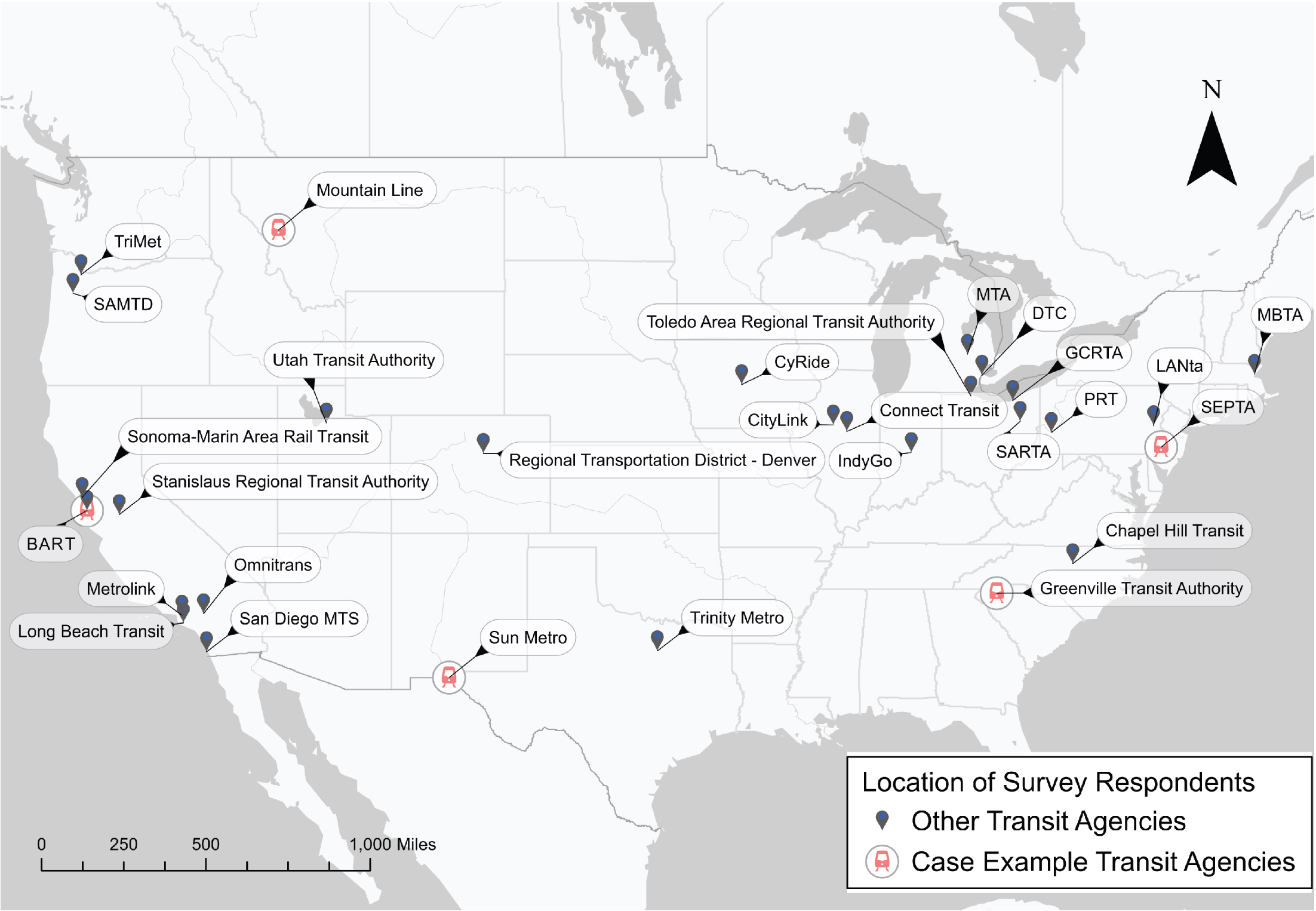
Long Description.
The legend of the map is titled Location of survey respondents and lists two agencies: Other transit agencies and Case example transit agencies. The data given in the map are as follows: Other transit agencies: TriMet, SAMTD, Utah Transit Authority, Sonoma-Marin Area Rail Transit, Stanislaus Regional Transit Authority, Metrolink, Omnitrans, Long Beach Transit, San Diego MTS, Regional Transportation District - Denver, Trinity Metro, Toledo Area Regional Transit Authority, CyRide, CityLink, IndyGo, Connect Transit, MTA, DTC, GCRTA, PRT, SARTA, LANta, MBTA, and Chapel Hill Transit. Case example transit agencies: Mountain Line, Bay Area Rapid Transit, Sun Metro, SEPTA, and Greenville Transit Authority.
selected based on their answers to the survey questions and feedback from the project panel. As shown in Figure 1, these agencies include:
- BART in San Francisco/Oakland, CA
- Greenville Transit Authorityʼs Greenlink in Greenville, SC
- Mountain Line in Missoula, MT
- SEPTA in Philadelphia, PA
- Sun Metro in El Paso, TX
Appendix C provides the case example interview guide.
Conclusions and Future Research
The final chapter summarizes the overall project findings and highlights future research needs.


