Stainless Steel Strands for Prestressed Concrete Bridge Elements (2025)
Chapter: 1 Introduction

CHAPTER 1
Introduction
1.1 Background
Corrosion of carbon steel reinforcement and prestressing strands deteriorates concrete structures, posing a significant challenge for bridge owners. To address this issue, several alternative corrosion-resistant materials are available, such as fiber reinforced polymers (FRPs), epoxy-coated reinforcement, galvanized bars, high-chromium alloys, and different grades of stainless steel. High-strength stainless steel (HSSS) prestressing strands are relatively new to the construction industry. Some states have already implemented these strands as prestressing reinforcement in piles in their new bridges. Note that these strands may be referred to as simply stainless steel (SS) strands. SS strands, as opposed to other alternative materials, have the advantage of requiring no special equipment or additional procedures other than those required for handling and stressing carbon steel (CS) strands in the casting yard, with the possible exception that SS strands may not need draping; however, tests have demonstrated that harping SS strands can be feasible. Standard chucks can be used to anchor SS strands when pretensioned, and typical detensioning methods, such as flame detensioning, can be used. Therefore, the fabrication time for elements prestressed with SS strands is similar to that for conventional CS strands.
The main concerns regarding the use of SS strands for prestressing concrete members are low ductility due to their limited strain at ultimate strength, the high initial cost of the material, notch sensitivity, and the current limited number of manufacturers of SS prestressing strands in the United States. Additionally, the AASHTO Load and Resistance Factor Design (LRFD) design specifications do not address the unique design issues that must be considered when designing flexural or axial bridge members constructed with SS prestressing strands.
Compared to conventional carbon steel, SS strand exhibits quite different stress-strain behavior (see Figure 1). The main concerns are (1) the lack of a clear yield point, (2) the short plastic deformation beyond elastic range (the lack of an extended plateau in the post-yield part of the stress-strain relationship), and (3) the relatively lower strength (grade) as compared to carbon steel and carbon fiber reinforced polymer (CFRP). The limited elongation available for SS strand has a significant effect on the design approach for prestressed concrete members using the material. The short plastic portion of the stress-strain relationship makes design with SS strand more similar to design using CFRP than carbon steel, with rupture of strands being the dominant failure mode for flexural members.
1.2 Research Objective
Stainless steel prestressing strands are a relatively new option for concrete bridge elements. Consequently, design and construction guidelines for both pretensioned and posttensioned applications are not yet available. Therefore, the main objective of this research project was to
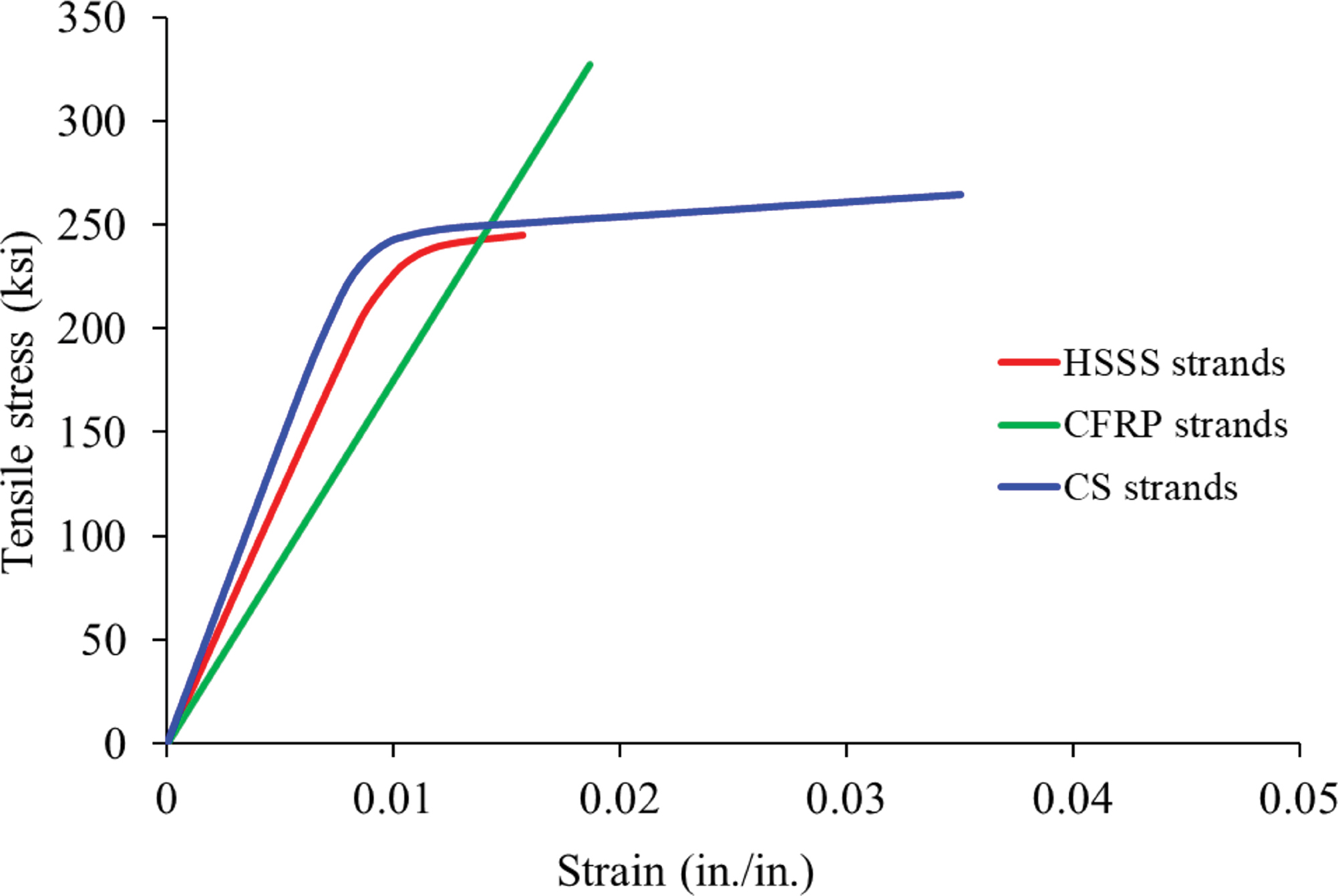
Long Description.
Three curves compare tensile stress in k s i on the vertical axis and strain in inches per inch on the horizontal axis. The horizontal axis ranges from 0 to 0.035, and the vertical axis ranges from 0 to 350. The carbon steel strand curve starts at 0 and rises steeply until about 0.01 strain and 250 k s i stress, then increases gradually. The high-strength stainless steel strand curve starts at 0 and follows a similar path but with a slightly lower slope and a flat portion after 0.012 strain. The carbon fiber reinforced polymer strand curve is a straight line with a higher slope, starting at 0 and rising continuously beyond 300 k s i stress at about 0.015 strain.
develop language for proposed design and construction guide specifications in the AASHTO LRFD format for pretensioned and posttensioned concrete bridge elements prestressed with SS prestressing strands. To demonstrate application of the requirements, design guidelines and design examples were also developed.
The proposed requirements for the “Guidelines for Design and Construction of Prestressed Concrete Elements with Stainless Steel Strands” provide design provisions that extend the use of AASHTOʼs LRFD Bridge Design Specifications, 10th ed. (AASHTO, 2024) (LRFD BDS) and LRFD Bridge Construction Specifications, 4th ed. (AASHTO, 2017) (LRFD BCS) for concrete bridge elements prestressed with SS prestressing strands. In general, provisions in the requirements replace or supplement provisions in the LRFD BDS or LRFD BCS. The proposed requirements are presented as standalone documents rather than proposed revisions to the LRFD BDS and LRFD BCS because the addition of these provisions to the current design and construction specifications is expected to require significant reorganization, which may also possibly involve incorporating revisions for CFRP prestressing systems.
In support of the effort to accomplish the main project objective to develop design and construction requirements and guidelines, the research team performed the following activities:
- Conducted an experimental program to investigate topics related to the use of SS prestressing strands, including material properties, harping, creep rupture, relaxation loss, friction losses, bond characteristics, and transfer and development lengths; and
- Conducted an analytical program to investigate topics related to the use of SS prestressing strands for some of the topics in the experimental program, as well as topics related to performance of element designs and calibration of resistance factors.
1.3 Research Plan and Methodology
The following tasks were performed to achieve the project objectives:
- Conducted an experimental program with pretensioned and posttensioned full-scale specimens to inform and validate proposed design procedures;
- Reviewed relevant practice, data, specifications, and research findings from both domestic and foreign sources on the prestressing of concrete elements using SS strands;
- Identified key parameters influencing the design of prestressed elements using SS strands and formulated a comprehensive work plan for developing effective design methodologies;
- Performed finite element simulations, sectional analyses, and reliability analyses to better understand the behavior of SS strands at both the material and member levels;
- Executed an experimental program that included material testing, small-scale beam testing, and full-scale prestressed concrete bridge element evaluations;
- Developed proposed requirements and commentary for designing concrete elements prestressed with SS strands;
- Developed design guidelines including five design examples to demonstrate the application of the proposed design methods and requirements; and
- Prepared a comprehensive report documenting the entire research process.
1.4 Organization of the Report
This chapter presents the background, objectives, methodology, and scope of the project. Chapter 2 provides a summary of relevant previous experimental and analytical investigations. Chapter 3 presents the results of the experimental and analytical investigations conducted in this project. Chapter 4 highlights the key findings from the research and discusses the applications of the proposed requirements. Chapter 5 presents a summary of the research and recommendations for future research studies. Language for “Proposed LRFD Guide Specifications for Design and Construction of Concrete Bridge Elements Prestressed with Stainless Steel Prestressing Strands” and “Guidelines for Design and Construction of Prestressed Concrete Elements with Stainless Steel Strands,” which includes five design examples illustrating the use of the proposed design methods and specifications, is not included herein but has been supplied to the AASHTO Committee on Bridges and Structures for their consideration.
Appendices A through D are available as separate documents on the National Academies Press website (nap.nationalacademies.org) by searching for NCHRP Research Report 1161: Stainless Steel Strands for Prestressed Concrete Bridge Elements. They provide further details on the different aspects of the research as follows:
- Appendix A: Literature Review of Previous Work
- Appendix B: Experimental Testing Program, Test Results, and Discussions
- Appendix C: Analytical Validations and Numerical Simulations
- Appendix D: Reliability Calibration of SS-Prestressed Beam Design


