Stainless Steel Strands for Prestressed Concrete Bridge Elements (2025)
Chapter: 2 Literature Review and Current Design Practices

CHAPTER 2
Literature Review and Current Design Practices
2.1 Available Corrosion-Resistant Prestressing Strands
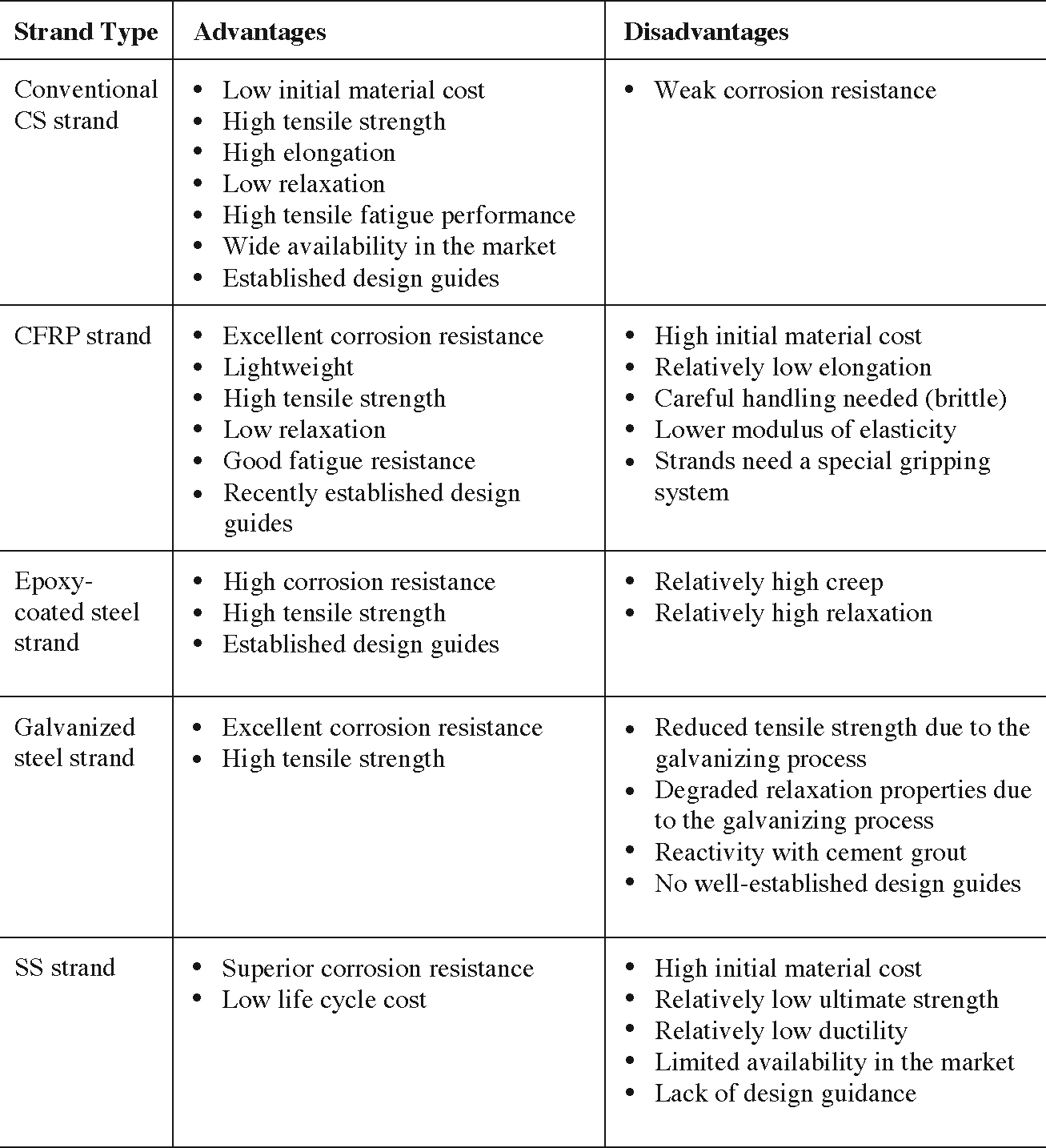
Due to their enhanced corrosion resistance, different types of corrosion-resistant prestressing strands have recently gained greater attention. Common corrosion-resistant alternatives available on the market include, but are not limited to, various forms of FRPs, epoxy-coated steel, galvanized steel, high-chromium alloys, and multiple grades of stainless steel. Table 1 presents the advantages and disadvantages of these strands.
Among all the available corrosion-resistant steels, stainless steel shows the most superior corrosion resistance. By using stainless steel, it is possible for structures to achieve a service life of at least 100 years (Clemeña et al., 2003). Consequently, the life cycle cost of reinforced concrete (RC) structures with stainless steel may be lower than that of conventional mild steel. Several types of stainless steel [i.e., UNS S32205 (2205), S32304 (2304), or S31600 (316)] are available, and different types have different mechanical and corrosion-resistant characteristics; thus, attention should be paid to type when stainless steel is being used. However, as for SS prestressing strands, limited types and manufacturers are available. Meanwhile, based on the available knowledge in this domain (Moser et al., 2011; Moser et al., 2014; Schuetz, 2013), duplex 2205 SS strands are recognized as the most recommended SS prestressing strand. Consequently, the ASTM A1114 standard for low-relaxation, seven-wire, Grade 240 SS strands has been published (ASTM International, 2020a), which requires that the base metal shall be duplex alloy 2205.
2.2 Current Applications of SS Strands for Prestressing
Stainless steel strands have been used in field applications by six different agencies. Table 2 shows a list of projects (provided by Sumiden Wire Products Corporation) that use SS prestressing strands as prestressing reinforcement for selected members such as piles, beams, and decks. Different applications of stainless steel have been documented, and these cases cite the use of different types of SS strands, including both austenitic and duplex. In most cases, SS strands were used to minimize the effects of corrosion in decks and piles.
2.3 Relevant Guidelines, Specifications, and Standards
2.3.1 Specifications Related to SS Strands
With the introduction of SS strands as an advanced prestressing material for concrete structures to address the corrosion problem, research to investigate the issues of their use related to the design of prestressed concrete structures has increased. In the absence of dedicated design codes, the use of SS strands remains constrained. To the best of the research teamʼs knowledge, formal
Long Description.
The table presents the advantages and disadvantages of five prestressing strand types in three columns labeled strand type, advantages, and disadvantages. For conventional carbon steel strand, the advantages include low initial material cost, high tensile strength, high elongation, low relaxation, high tensile fatigue performance, wide availability in the market, and established design guides, while the disadvantage is weak corrosion resistance. For carbon fiber reinforced polymer strand, the advantages include excellent corrosion resistance, lightweight, high tensile strength, low relaxation, good fatigue resistance, and recently established design guides, while the disadvantages include high initial material cost, relatively low elongation, careful handling needed, lower modulus of elasticity, and strands needing a special gripping system. For epoxy-coated steel strand, the advantages include high corrosion resistance, high tensile strength, and established design guides, while the disadvantages include relatively high creep and relatively high relaxation. For galvanized steel strand, the advantages include excellent corrosion resistance and high tensile strength, while the disadvantages include reduced tensile strength and degraded relaxation properties, both due to the galvanizing process; reactivity with cement grout, and a lack of well-established design guides. For stainless steel strand, the advantages include superior corrosion resistance and low life cycle cost, while the disadvantages include high initial material cost, relatively low ultimate strength, relatively low ductility, limited availability in the market, and lack of design guidance.
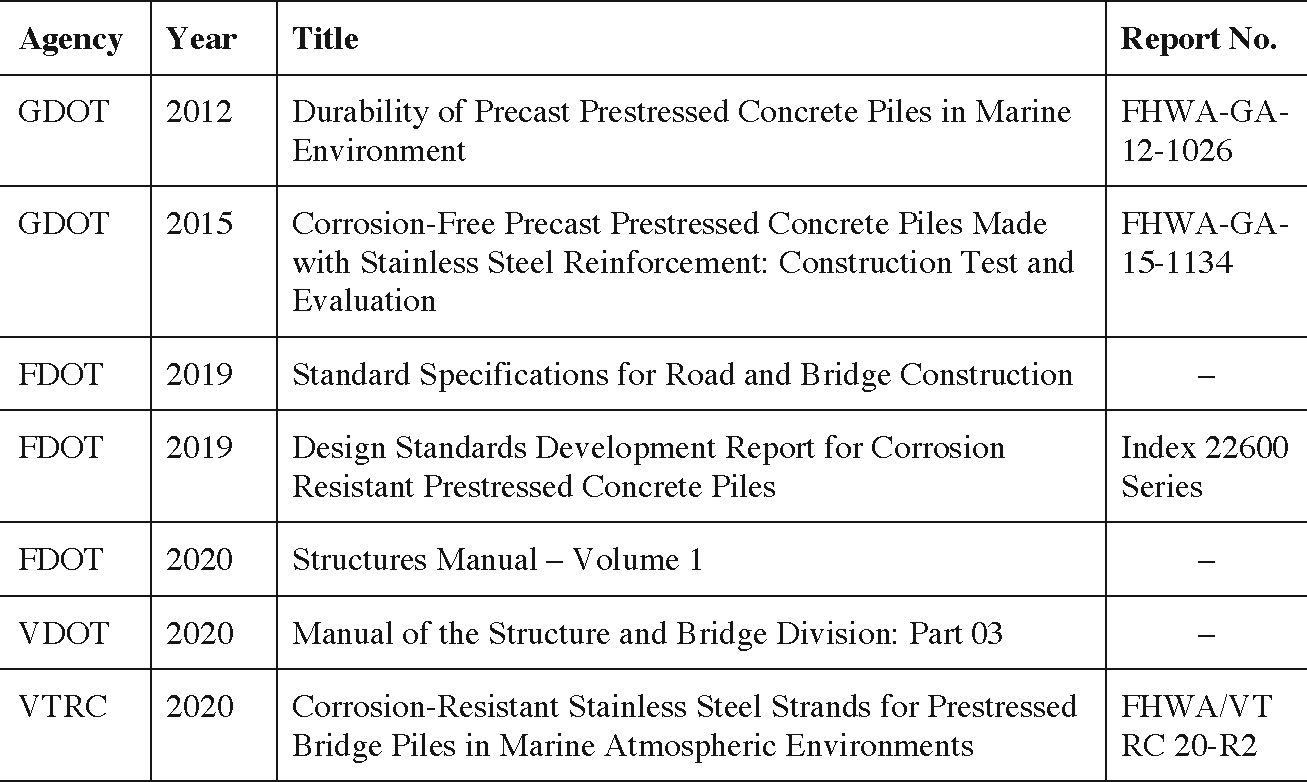
design specifications for concrete structures prestressed with SS strands exist only in the United States and are limited to standards and reports issued by select state departments of transportation (DOTs), including Georgia DOT (GDOT), Florida DOT (FDOT), Virginia DOT (VDOT), and the Virginia Transportation Research Council (VTRC). These specifications cover this issue either fully, as a dedicated document, or partially, by specific sections in a document. A list of available documents is given in Table 3, and a brief description of each is summarized afterward.
2.3.1.1 GDOT (2012): Durability of Precast Prestressed Concrete Piles in Marine Environment
The research conducted by the Georgia Institute of Technology presented findings regarding the durability of precast prestressed piles in marine environments. The report is divided into two parts, with the overall objective of determining approaches to reduce the corrosion of reinforcement in precast piles. The first part of the report investigates the development and evaluation of concrete mixture design for service life extension for piles in marine environments. The second part focuses on comparing pile performance with SS strands to conventional steel strands in such environments. Through their findings, the authors recommended that, for environments with chloride (Cl-) attack on structures, stainless steel alloy types 2205 and 2304 should be used because of their corrosion resistance and high strength. In addition, they indicated that during the production of stainless steel wire and strand, the induction heating process with the strands
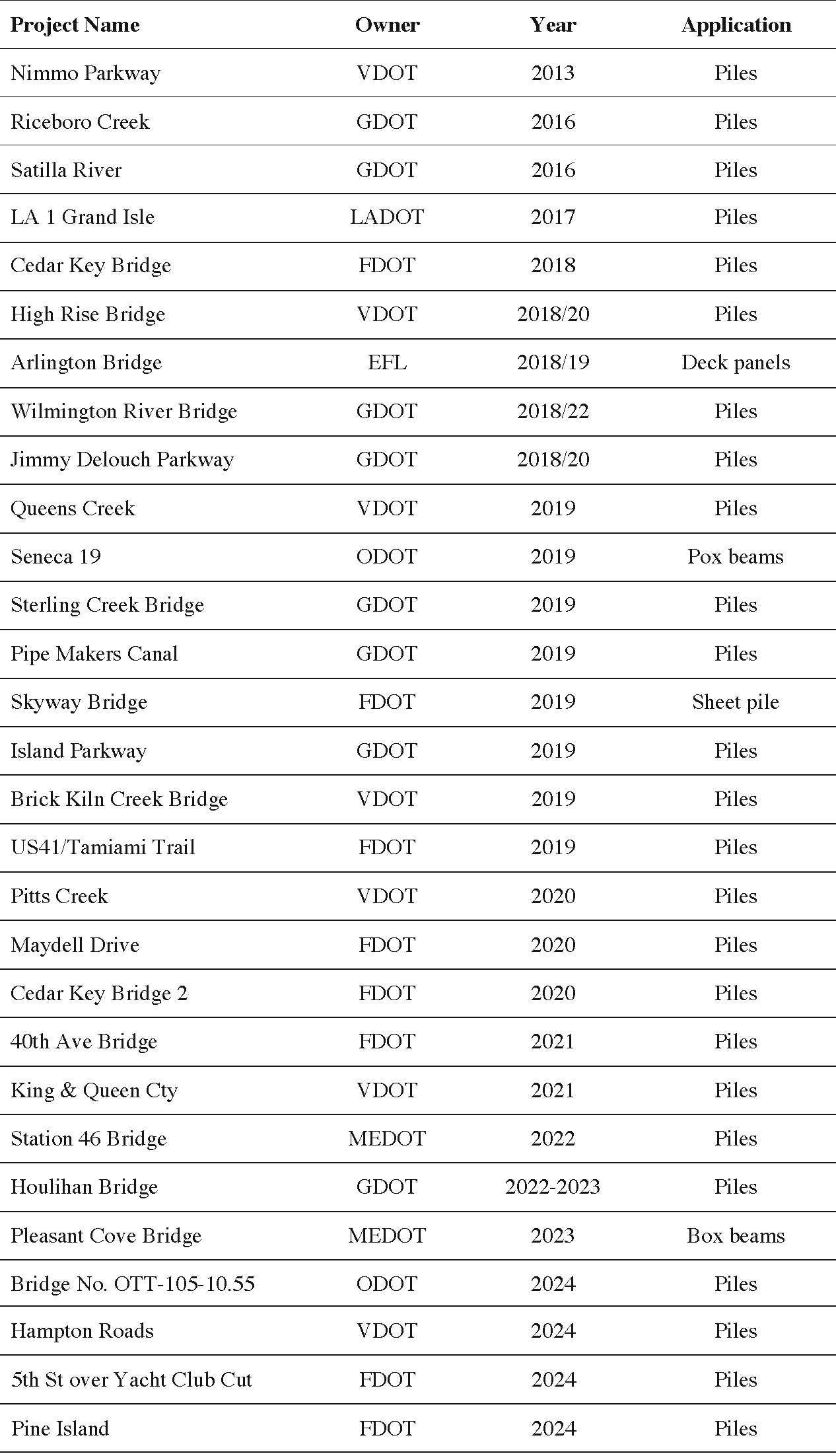
NOTE: VDOT = Virginia Department of Transportation; GDOT = Georgia Department of Transportation; LADOT = Los Angeles Department of Transportation; FDOT = Florida Department of Transportation; EFL = Eastern Federal Lands; ODOT = Ohio Department of Transportation; MEDOT = Maine Department of Transportation.
Long Description.
The table includes the following columns: Project Name, Owner, Year, and Application. The row details are as follows. Row 1. Project Name: Nimmo Parkway, Owner: Virginia DOT, Year: 2013, Application: piles. Row 2. Project Name: Riceboro Creek, Owner: Georgia DOT, Year: 2016, Application: piles. Row 3. Project Name: Satilla River, Owner: Georgia DOT, Year: 2016, Application: piles. Row 4. Project Name: LA 1 Grand Isle, Owner: Los Angeles DOT, Year: 2017, Application: piles. Row 5. Project Name: Cedar Key Bridge, Owner: Florida DOT, Year: 2018, Application: piles. Project Name: High Rise Bridge, Owner: Virginia DOT, Year: 2018 to 2020, Application: piles. Row 6. Project Name: Arlington Bridge, Owner: Eastern Federal Lands, Year: 2018 and 2019, Application: deck panels. Row 7. Project Name: Wilmington River Bridge, Owner: Georgia DOT, Year: 2018 and 2022, Application: piles. Row 8. Project Name: Jimmy Delouch Parkway, Owner: Georgia DOT, Year: 2018 and 20, Application: piles. Row 9. Project Name: Queens Creek, Owner: Virginia DOT, Year: 2019, Application: Box Beams. Row 10. Project Name: Seneca 19, Owner: Ohio DOT, Year: 2019, Application: piles. Row 11. Project Name: Sterling Creek Bridge, Owner: Georgia DOT, Year: 2019, Application: piles. Row 12. Project Name: Pipe Makers Canal, Owner: Georgia DOT, Year: 2019, Application: piles. Row 13. Project Name: Skyway Bridge, Owner: Florida DOT, Year: 2019, Application: Sheet Pile. Row 14. Project Name: Island Parkway, Owner: Georgia DOT, Year: 2019, Application: piles. Row 15. Project Name: Brick Kiln Creek Bridge, Owner: Virginia DOT, Year: 2019, Application: piles. Row 16. Project Name: U S 41 or Tamiami Trail, Owner: FDOT, Year: 2020, Application: piles. Row 17. Project Name: Pitts Creek, Owner: Virginia DOT, Year: 2020, Application: piles. Row 18. Project Name: Maydell Drive, Owner: Florida DOT, Year: 2020, Application: piles. Row 19. Project Name: Cedar Key Bridge 2, Owner: Florida DOT, Year: 2020, Application: piles. Row 20. Project Name: 40th Avenue Bridge, Owner: Florida DOT, Year: 2021, Application: piles. Row 21. Project Name: King and Queen City, Owner: Virginia DOT, Year: 2021, Application: piles. Row 22. Project Name: Station 46 Bridge, Owner: Maine DOT, Year: 2022, Application: box beams. Row 23. Project Name: Houlihan Bridge, Owner: GDOT, Year: 2022 to 2023, Application: piles. Row 24. Project Name: Pleasant Cove Bridge, Owner: Maine DOT, Year: 2023, Application: box beams. Row 25. Project Name: Bridge Number OTT 105 10.55, Owner: Ohio DOT, Year: 2024, Application: piles. Row 26. Project Name: Hampton Roads, Owner: Virginia DOT, Year: 2024, Application: piles. Row 27. Project Name: Fifth Street Over Yacht Club Cut, Owner: Florida DOT, Year: 2024, Application: piles. Row 28. Project Name: Pine Island, Owner: Florida DOT, Year: 2024, Application: piles.
Long Description.
The table presents publications on stainless steel strand piles, with four columns labeled agency, year, title, and report number. The first row lists Georgia DOT in 2012 with the title Durability of Precast Prestressed Concrete Piles in Marine Environment and report number FHWA dash G A dash 12 dash 1026. The second row lists Georgia DOT in 2015 with the title Corrosion-Free Precast Prestressed Concrete Piles Made with Stainless Steel Reinforcement Construction, Test and Evaluation and report number FHWA dash G A dash 15 dash 1134. The third row lists Florida DOT in 2019 with the title Standard Specifications for Road and Bridge Construction and no report number. The fourth row lists Florida DOT in 2019 with the title Design Standards Development Report for Corrosion Resistant Prestressed Concrete Piles and report number Index 22600 Series. The fifth row lists Florida DOT in 2020 with the title Structures Manual Volume 1 and no report number. The sixth row lists Virginia DOT in 2020 with the title Manual of the Structure and Bridge Division, Part 0 3 and no report number. The final row lists Virginia Transportation Research Council in 2020 with the title Corrosion-Resistant Stainless Steel Strands for Prestressed Bridge Piles in Marine Atmospheric Environments and report number FHWA slash Virginia Transportation Research Council 20 dash R 2.
under tension plays an important role in its strength and relaxation levels for both 2205 and 2304 stainless steel. Based on the results, it was recommended to use 2205 stainless steel for more aggressive exposure conditions; however, the cost of 2205 is higher than other types. Moreover, when using the stainless steel system for prestressed elements, the authors recommended that the same material be used for all reinforcing elements, especially in critical regions of corrosive exposure. That is, if stainless steel is selected for use in reinforced or prestressed concrete elements, all reinforcement within the structureʼs critical regions—such as prestressing strands, ties, and stirrups—should be made of stainless steel, as these components will be subjected to the same corrosive environment. Finally, the team acknowledged the lack of standards for prestressed concrete with SS strands and the need to develop resistance factors and allowable stress levels caused by the decrease in ductility and toughness of stainless steel compared to conventional CS strands.
2.3.1.2 GDOT (2015), Corrosion-Free Precast Prestressed Concrete Piles Made with Stainless Steel Reinforcement: Construction Test and Evaluation
This research report serves as the basis for the recommendations in the Design Standard Development Report (DSDR) of FDOT. The investigation provided results of 16 in. square, 70-ft-long piles using 2205 SS strands and 304 SS spiral wire reinforcement tested in shear and flexure. The piles were compared with geometrically identical concrete piles using conventional strands and spirals. Through the experimental investigation, it was verified that the flexural capacity of the prestressed concrete piles can be conservatively predicted by using the AASHTO LRFD Bridge Design Specifications, 6th ed. (AASHTO, 2012) (LRFD BDS 6th) and provisions from the American Concrete Instituteʼs (ACIʼs) 2011 Building Code Requirements for Structural Concrete and Commentary 318-11 (ACI Committee 318, 2011) (ACI 318-11). Regarding shear capacity, a significant discrepancy was observed between the predicted values and the experimental results. Moreover, the ductility of 2205 SS strands is significantly less than that of the carbon strands, as reported. These findings affirm the need to investigate the stainless steel prestressed system further. The report confirms that for transfer length and development length, the provisions of LRFD BDS 6th and ACI 318-11 can be used to conservatively estimate the quantities. In addition, the results of the experimental tests to assess prestress losses were close to predictions by the LRFD BDS 6th refined method and virtually the same when applying the lump-sum method. Based on the research findings in this report and the conclusions drawn, it was recommended that the same
design and construction procedures for AISI 1080 steel can be used for duplex 2205 SS prestressing strands with 304 stainless steel transverse reinforcement. In addition, it was recommended to use a stress level at jacking of 0.60 fpu to account for the low strength and ductility of the SS strands.
2.3.1.3 FDOT (2019), Standard Specifications for Road and Bridge Construction, Section 933
This state specification section includes requirements SS strands for prestressed concrete members. The specification contains the requirements for conformity of the chemical properties of stainless steel according to ASTM standards and the minimum yield strength listed for specific diameters according to the minimum breaking strength of the strand, as well as the minimum total elongation. All remaining subparts of the specification contain guides for other prestressing materials, namely CFRP and CS strands. Stainless steel strands used for prestressing concrete members shall meet the chemical requirements of ASTM A276 (ASTM International, 2017) for UNS S31803 or S32205 (Type 2205) and shall comply with the mechanical and dimensional requirements of ASTM A416 (ASTM International, 2018a), with the exception that the minimum ultimate tensile strength must be 240 ksi.
2.3.1.4 FDOT (2019), Design Standard Development Report for Corrosion Resistant Prestressed Concrete Piles
This standard report provides background to pile standard development as well as design approaches. In addition, the new pile standard proposed in this report expects to utilize both CFRP and SS strands and spirals by standardizing their usage and providing an equivalent substitution for contractors. Estimated costs for using either CFRP or stainless steel or combined materials is presented to aid in the decision-making process, looking at premium prices for CFRP, stainless steel, and SS strand. Furthermore, the report refers to the findings from the Georgia Institute of Technology presented in the FHWA-GT15-1134 report to introduce the number of strands and tendons, prestressing level, and the ratio of strands/tendons by the span depending on the pile size and strand size recommended for piles.
2.3.1.5 FDOT (2020), Structures Manual – Volume 1 – Section 3.5.1
The Structures Manual provides engineering standards, criteria, and guidelines for developing and designing bridges and retaining walls. Prestressed concrete pile size and material requirements of carbon steel, CFRP, and stainless steel are addressed in volume 1, section 3.5.1. The manual states that the use of FRP or SS strands and reinforcing bars is preferred in splash zones and may be used at other locations upon approval by the District Structures Maintenance Engineer. A minimum pile size of 18 in. square for vehicular bridges, 14 in. square for pedestrian bridges, and 54 in. diameter for cylinder pile may be allowed for use on land or in water in environments that are extremely aggressive due to chlorides if approved by the District Structures Maintenance Engineer.
2.3.1.6 VDOT (2020), Manual of the Structure and Bridge Division: Part 03-BPP-2
This document is a standard detail sheet for square prestressed concrete piles with SS strands. The SS strands must meet the requirements of ASTM A1114. Requirements are also given for wire spirals. The pile sizes vary between 12 and 24 in. with 0.52 in. and 0.62 in. diameter strands.
2.3.1.7 VTRC (2020), Corrosion-Resistant Stainless Steel Strands for Prestressed Bridge Piles in Marine Atmospheric Environments
This report demonstrates that 2205 SS strands can be used as a replacement for conventional CS strands, meeting the requirements of ASTM A416. A corrosion evaluation was performed
on stranded cold-worked AISI 1080 carbon steel, cold-worked 201 modified austenitic stainless steel, and heavily cold-worked stranded 2205 duplex stainless steel. Additionally, the fabrication and installation of several prestressed piles reinforced with 2205 stainless steel—now incorporated into Virginia bridge structures—were observed. The results suggest that 2205 SS strands offer significantly enhanced corrosion resistance compared to conventional steel strands in prestressed concrete applications. To support future life cycle cost analyses, key mechanical properties and estimated baseline costs were also established for conventional steel, 2205 stainless steel, and CFRP strands.
2.3.1.8 FDOT (2020), Stainless Steel Strands and Lightweight Concrete for Pretensioned Concrete Girders
This project provides a comprehensive investigation into the feasibility of using SS strands as an alternative to traditional CS strands in prestressed concrete flexural members (girders). This report showed that the prestress loss evaluations indicated that SS strands experience greater relative prestress losses than CS strands due to their lower initial stress. Flexural testing highlighted the differences in post-cracking behavior, with SS strands providing higher flexural strength but limited by low ductility. However, the girders exhibited large reserve deflection and strength, providing substantial warning before failure. Composite girders prestressed with SS strands achieved ultimate capacities comparable to those with CS strands, and the recommended failure mode is rupture of strands. The report demonstrates that SS strands have the potential to serve as a reliable alternative to CS strands in prestressed concrete flexural members. It is noted that two failure modes, crushing of concrete and rupture of strands, be considered when designing such members. Designing girders to fail by rupture of strands is more economical, while slab girders are better suited to fail by crushing of concrete to ensure adequate deformability. Numerical equations and iterative approaches were proposed for computing nominal flexural resistance in sections prestressed with SS strands. Additionally, the report recommends using a strength resistance factor of 0.75 and limiting the maximum allowable stress in SS strands at jacking and transfer to 75% and 70% of their guaranteed ultimate strength, respectively.
2.3.2 ASTM Standards for Stainless Steel and Other Materials
This section discusses ASTM standards for material specifications and testing procedures of stainless steel for applications in concrete structures, which were considered in this research project. The number of ASTM standards directly related to SS strands is limited; therefore, standards for stainless steel bars, carbon steel, and FRP considered and evaluated in the study are also listed.
2.3.2.1 ASTM A1114/A1114M, Standard Specification for Low-Relaxation, Seven-Wire, Grade 240 [1655], Stainless Steel Strand for Prestressed Concrete
This standard specification was released in 2020 (ASTM International, 2020b) and covers only one grade of low-relaxation, seven-wire SS strands for prestressed concrete use. This strand has a minimum tensile strength of 240 ksi; hence, the designation is Grade 240. The base metal shall be duplex 2205 (UNS S32205) stainless steel. Two nominal diameters of strands are included in the specification: 0.52 in. and 0.62 in. The minimum breaking strength of the strand is 40,100 lb. for a 0.52 in. strand and 55,400 lb. for a 0.62 in. strand. Yield strength shall be determined at 1% extension under load, with a minimum value equal to 90% of the strandʼs ultimate tensile strength. The total elongation under load must be at least 1.4%. Relaxation losses shall not exceed 2.5% when the strand is initially loaded to 70% of its specified minimum breaking strength, or
3.5% when loaded to 80%, after 1,000 hours of testing. Furthermore, mechanical property testing shall be performed in accordance with ASTM A1061/A1061M.
2.3.2.2 ASTM A580/A580M, Standard Specification for Stainless Steel Wire
This standard specification (ASTM International, 2018b) covers stainless steel wire, including round, square, octagon, hexagon, and wire in coils only for the more commonly used types of stainless steels for general corrosion resistance and high-temperature service. An extensive list of alloys is included with their chemical composition requirements. As was the case with the previous standard, mechanical properties, except for the Brinell hardness, are provided for different types of stainless steel and finish on the material.
2.3.2.3 ASTM A416/A416M, Standard Specification for Low-Relaxation, Seven-Wire Steel Strand for Prestressed Concrete
This standard specification covers the two grades of low-relaxation, seven-wire conventional steel strands for prestressed concrete use. Two grades are included with minimum tensile strengths of 250 and 270 ksi; hence, the designation is Grade 250 and Grade 270. According to the diameter of the strand, the breaking strength, yield strength requirements, and diameter relation between the center and outer wires are presented. In addition to the requirements mentioned, tests for mechanical properties shall be conducted according to ASTM A1061/A1061M. Moreover, limits are set for elongation and relaxation properties for a testing protocol. The standard also includes requirements for bond strength of 0.6 in. diameter Grade 270 strand used in prestressed ground anchors. However, these are not applicable to strands used in prestressed concrete applications.
2.3.2.4 ASTM A1081/A1081M, Standard Test Method for Evaluating Bond of Seven-Wire Steel Prestressing Strand
This standard test method (ASTM International, 2015b) describes procedures for determining the bond of a seven-wire steel prestressing strand. This test method determines bond strength as the tensile force required to pull a seven-wire prestressing strand through cured mortar within a cylindrical steel casing. The reported bond strength corresponds to the tensile force applied at the loaded end of the strand that produces a 0.1 in. displacement at the strandʼs free end.
2.3.2.5 ASTM D7337, Standard Test Method for Tensile Creep Rupture of Fiber Reinforced Polymer Matrix Composite Bars
This standard test method (ASTM International, 2012) specifies the procedures for conducting tensile creep rupture tests on FRP matrix composite bars commonly used as tensile reinforcement in reinforced, prestressed, or posttensioned concrete. The resulting data support the design of FRP reinforcements subjected to sustained loads. Additionally, the method includes guidance for calculating the million-hour creep-rupture capacity of FRP bars.
2.3.2.6 ASTM E139, Standard Test Methods for Conducting Creep, Creep-Rupture, and Stress-Rupture Tests of Metallic Materials
This standard test method (ASTM International, 2011) evaluates the deformation behavior of materials subjected to constant tensile stress and temperature until fracture occurs, known as a rupture test. Rupture tests provide insight into the ultimate load-bearing capacity of a material over time. In contrast, creep tests measure the materialʼs ability to sustain a load with limited deformation under the same conditions. Each test offers distinct but complementary information about the long-term mechanical performance of materials under sustained loading.
2.4 Previous Experimental and Analytical Investigations
2.4.1 Material Properties of SS Strands
Stainless steel strands exhibit distinct stress-strain behavior compared to conventional CS strands, primarily in terms of elongation at rupture, or ultimate tensile strain. While CS strands have a minimum guaranteed elongation of 0.035, this value is approximately 2.5 times higher than that of SS strands. As a result, SS strands offer significantly lower post-yield strain capacity. This reduced elongation has important implications for design, as it shifts the governing failure mode in prestressed concrete members toward strand rupture when SS strands are used.
The compatibility in the coefficient of thermal expansion (CTE) of stainless steel and concrete, combined with the knowledge that stainless steels are isotropic, suggests that thermal variations should not lead to strength or serviceability issues in prestressed concrete bridge elements reinforced with stainless steel. As such, further thermal or thermomechanical characterization of stainless steel is not considered an urgent research need nor a design concern since the CTE for stainless steel is within 30% of that of concrete (Morton, 2018).
2.4.2 Durability of Prestressed Concrete Using SS Strands
Durability of prestressed concrete piles was studied by Moser et al. (2012). Electrochemical cyclic potentiodynamic polarization (CPP) testing was employed to assess the corrosion resistance of various stainless steel grades and AISI 1080 prestressing steel in simulated concrete environments, including both alkaline and carbonated conditions contaminated with chloride ions. The findings indicated that AISI 1080 steel was prone to corrosion initiation even in the least aggressive chloride solution (alkaline medium containing 0.25 M Cl-). The study concluded that stainless steels 2205 and 2304 demonstrated excellent corrosion resistance, particularly in low pH environments with chloride concentrations comparable to seawater (0.5 M Cl-). In contrast, at a chloride concentration of 1 M, significant pitting corrosion was observed on the surfaces of 304 and 316 stainless steels, which were found to offer the lowest level of corrosion resistance under these conditions. In duplex types 2101 and 2304, only sparse pitting was observed at this concentration, and no pitting was observed on the surface of 2205 stainless steel. Another study was performed by GDOT (Paul et al., 2015) to assess the long-term performance of prestressed concrete piles. Eight prestressed concrete specimens, each 20 in. in length, were exposed to a marine environment for a duration of 20 months. The specimens included both conventional steel strands and duplex stainless steel 2205 strands. Following the exposure period, they were positioned within the tidal zone of the Savannah River. The SS strand specimens were prestressed to the same level as the piles with conventional strands. The average and low annual temperatures were 77.4°F and 56.1°F, respectively. The chloride ion concentration was 4,552 mg/L, with a pH concentration of 6.78. Results showed that the presence of localized corrosion was observed in AISI 1080 steel strands at chloride concentrations lower than the chloride threshold level of 0.05, and the growth of tabular corrosion products from the steel surface was observed. On the other hand, the observations for the 2205 SS strands revealed that the strand surfaces remained in excellent condition, with no signs of corrosion initiation or chemical interaction at the impingement locations.
2.4.3 Initial Stress Level and Prestress Losses
The stress level before transfer for conventional stress-relieved strands and plain high-strength bars shall not exceed 70% of their ultimate tensile strength (UTS); the corresponding limit for low-relaxation strands is 75% of the UTS (AASHTO, 2020). The specified limit on the stress level
after losses, fpe, at the service limit state is 80% of the yield strength of the reinforcement, determined through the 0.2% yield offset method (AASHTO, 2020). By accounting for these limits, the total expected prestressing losses, which occur due to elastic shortening, relaxation, creep, shrinkage, anchorage seating, and temperature effects, is determined.
Relaxation losses are considered a property of the reinforcing material and receive significant interest in prestressing applications. Shirahama et al. (1999) performed a study on 2205 stainless steel, and test results showed that stress relaxation of the duplex prestressing stainless steel was almost the same as for conventional carbon prestressing steel. The research by Alonso et al. (2010) addressed the stress-relaxation behavior and stress corrosion risks of cold-drawn AISI 301 stainless steel wires at room temperature. The authors also concluded that the relaxation behavior of this grade of stainless steel is similar to that of conventional prestressing steel strands. Moreover, Schuetz (2013) investigated the stress-relaxation behavior of duplex SS strands and wires (2304 and 2205) under different levels of pretensioning at room temperature. The testing was performed in accordance with ASTM E328 (ASTM International, 2013). Relaxation at 1,000 hours with an initial stress of 70% of the UTS did not exceed 2% and 3% of the initial stress for 2304 and 2205 strands, respectively. Based on these observations, the authors suggested that the strands could be considered “low-relaxation strands.” Paul et al. (2017) used stress relaxation results from Schuetz (2013) as a part of their calculations of total prestress losses in prestressed concrete piles. Rambo-Roddenberry and Al-Kaimakchi (2020) applied AASHTO LRFD provisions to estimate relaxation losses for SS strands and measured other losses using vibrating wire strain gages. By comparing AASHTO predictions to measured total losses, the authors concluded that AASHTO equations are conservative for use with SS prestressing strands.
2.4.4 Transfer and Development Length
The bond performance of duplex 2205 SS strands was obtained by Paul et al. (2017) by measuring the transfer and development lengths for prestressed piles. The results were compared to piles reinforced with conventional carbon steel prestressing strands. The authors concluded that the transfer length of SS strands was similar to that of conventional CS strands. They also found that the development length of the SS strands was 81% and 55% of the value calculated using AASHTO LRFD BDS 2013 and ACIʼs 2014 Building Code Requirements for Structural Concrete and Commentary (ACI Committee 318, 2014) (ACI 318-14), respectively.
A study by Rambo-Roddenberry and Al-Kaimakchi (2020) investigated the transfer length of 0.6 in. diameter SS and CS strands in full-scale AASHTO Type II girders. The transfer length was determined from the concrete strains, which were measured using strain gauges. The maximum measured transfer length for CS strands was 25.5 in., while the maximum measured transfer length for SS strands was 21.5 in. The longer measured transfer length in CS strands was due to the 26.7% larger initial prestress in the strands. Experimental results revealed that the current AASHTO and ACI equations conservatively estimate the transfer length of SS strands. The low measured transfer length for 0.6 in. diameter SS strands indicates that the strand has good bond with the surrounding concrete. Evaluation of the test results indicate that the AASHTO equation conservatively predicts the transfer length of 0.6 in. diameter SS strands. Results revealed that the transfer length of SS strands increases with an increase in the initial prestressing force.
2.4.5 Prestressed Concrete Piles
Tests on piles fabricated using duplex 2205 SS prestressing strands and austenitic 304 stainless steel for shear and confinement reinforcement have been conducted by Paul et al. (2015). Five full-scale 16 in. square piles were tested to determine their shear and flexural capacities. Three piles were built using duplex 2205 SS strands and austenitic 304 stainless steel transverse reinforcement.
Two control piles were built using conventional carbon steel for prestressing strands and transverse wire reinforcement. Results showed that all piles exhibited a higher ultimate moment capacity than predicted using conventional analysis based on AASHTO LRFD BDS 2013 and ACI 318-11. Piles prestressed using duplex 2205 SS strands showed lower ultimate curvatures than those predicted using ACI 318-11 but higher ultimate curvatures than predicted using AASHTO LRFD BDS 2013. This lower ductility is a consequence of the smaller plastic deformation of duplex 2205 SS strands compared to conventional CS strands. The ultimate tensile strains of duplex 2205 SS and conventional CS strands determined by direct tension tests were 1.60% and 5.89%, respectively.
2.4.6 Flexural Behavior of Pretensioned Beams
Rambo-Roddenberry and Al-Kaimakchi (2020) conducted a study of a total of 13 pretensioned AASHTO Type II girders for an FDOT research project. Of the 13 girders, 10 were prestressed with SS strands, and three were prestressed with conventional CS strands. The girders were tested to failure in flexure. Girders prestressed with SS strands exhibited distinct post-cracking behavior with deflections continuing to increase up to failure without a plateau, unlike girders with CS strands. This difference in behavior results from differences in the mechanical properties of the strands. Girders with SS strands demonstrated higher flexural strength than those with CS strands when they both had the same initial prestressing force. Girders with SS strands exhibited approximately 11.7% (when tested without a slab) and 23.7% (when tested with slab) increase in ultimate capacity compared to the girders with CS strands.
All composite girders failed due to strand rupture, as the SS strands reached their ultimate tensile strain before the concrete in compression reached its ultimate strain. Despite the low ductility of the SS strands, the girders exhibited significant reserve strength, large deflections, and widespread flexural cracking, providing ample warning before failure. Ultimate deflections ranged from L/125 to L/84, decreasing with higher reinforcement ratios. Experimental results confirmed that girders prestressed with SS strands could achieve ultimate capacities and deformability that were comparable to girders with conventional CS strands, with strand rupture occurring as the typical failure mode for I-girders with SS strands.
Two failure modes are possible for concrete members prestressed with SS strands: crushing of concrete and rupture of strands. Based on an analytical study, the researchers for the FDOT study concluded that crushing of concrete failure mode is unlikely for deep members (i.e., I-girders) due to limited available space for SS strands in the section. Yet, based on experimental observations of providing warning before failure, it was concluded that rupture of strands can be an acceptable failure mode when deep members are prestressed with SS strands. It was also found that prestressed slab girders with SS strands are more likely to fail by crushing of concrete. Numerical equations and iterative approaches were proposed for computing nominal flexural resistance in sections prestressed with SS strands. Additionally, it was recommended to use a strength resistance factor of 0.75 and a maximum allowable stress in SS strands at jacking and transfer of 75% and 70% of the minimum specified ultimate strength, respectively.
An FDOT research project is currently underway to investigate the use of SS strands in Florida Slab Beams (FSBs). The project consists of casting and testing in flexure four 34-ft-long FSBs. Each specimen has a depth of 12 in. and a width of 48 in. The reinforcement ratio (number of strands) is the only design parameter being evaluated. When tested in flexure, all four FSBs failed by concrete crushing in the compression zone. This indicates that the stress in the SS strands was less than their measured ultimate stress. AASHTO LRFD has an equation to predict the strand stress for ultimate strength conditions; however, that equation was developed for CS strands. As part of the FDOT project, Hazard (2024) evaluated that equation and determined that it can
be used for SS strands. Based on a parametric study, it was concluded that the current AASHTO equation is conservative for predicting stress in SS strands and therefore conservative for predicting the nominal flexural resistance.
2.4.7 Factors Affecting the Design of SS Strand Pretensioned Elements
- Mechanical properties of SS strands
- Anchorage
- Harping and draping
- Limiting stresses for strands at jacking, transfer
- Creep rupture
- Time-dependent prestress losses
- Relaxation losses
- Strength reduction factor
- Flexural, axial, and shear design
- Mode of failure and ductility
- Posttensioned construction
- Limitations on SS strands applicability
- Design examples


