Summary1
The U.S. West Coast is entering a transformative period in its relationship with the ocean. The region’s unique oceanographic and economic characteristics—deep offshore waters, the productive California Current Ecosystem (CCE), major global ports, and culturally and economically significant fisheries—are now intersecting with a regional imperative to expand renewable energy generation. Offshore renewable energy (ORE), including floating offshore wind (FOW) and marine hydrokinetic (wave and tidal) technologies, is emerging as a viable clean energy option. These ORE projects will intersect existing ecological, economic, social, and maritime systems of the West Coast. Steps can be taken to ensure the benefits of ORE development will outweigh burdens on coastal communities.
Recognizing these complexities, Congress, through the James M. Inhofe National Defense Authorization Act for Fiscal Year 2023 (P.L. 117-263), directed the National Academies of Sciences, Engineering, and Medicine to assess the potential impacts of offshore renewable energy development on maritime traffic and fisheries—including commercial, recreational, and Tribal fisheries—along the U.S. West Coast.
The committee’s charge was to:
- Document historic and current uses of offshore areas, including commercial, Tribal, and recreational fishing, Tribal usual and accustomed fishing, and shipping.
- Analyze current and expected Coast Guard operations relevant to commercial fishing activities.
- Evaluate anticipated interactions—positive and negative—between ORE infrastructure and maritime uses.
- Review the ORE decision-making process and recommend improvements to account for affected communities and activities.
To meet this charge, the committee members reviewed scientific and policy literature; convened information-gathering sessions with federal and state agencies, Tribal representatives, fishing and maritime stakeholders, and subject-matter experts; and drew from their own experience to conduct a deliberative analysis.
The study area encompasses state and federal waters off California, Oregon, and Washington, extending from the U.S.–Mexico to the U.S.–Canada borders and offshore 200-nautical miles (NM) to the outer limit of the exclusive economic zone (EEZ) (Figure S-1).
___________________
1 This summary does not include references. Citations for the information presented herein are provided in the main text.
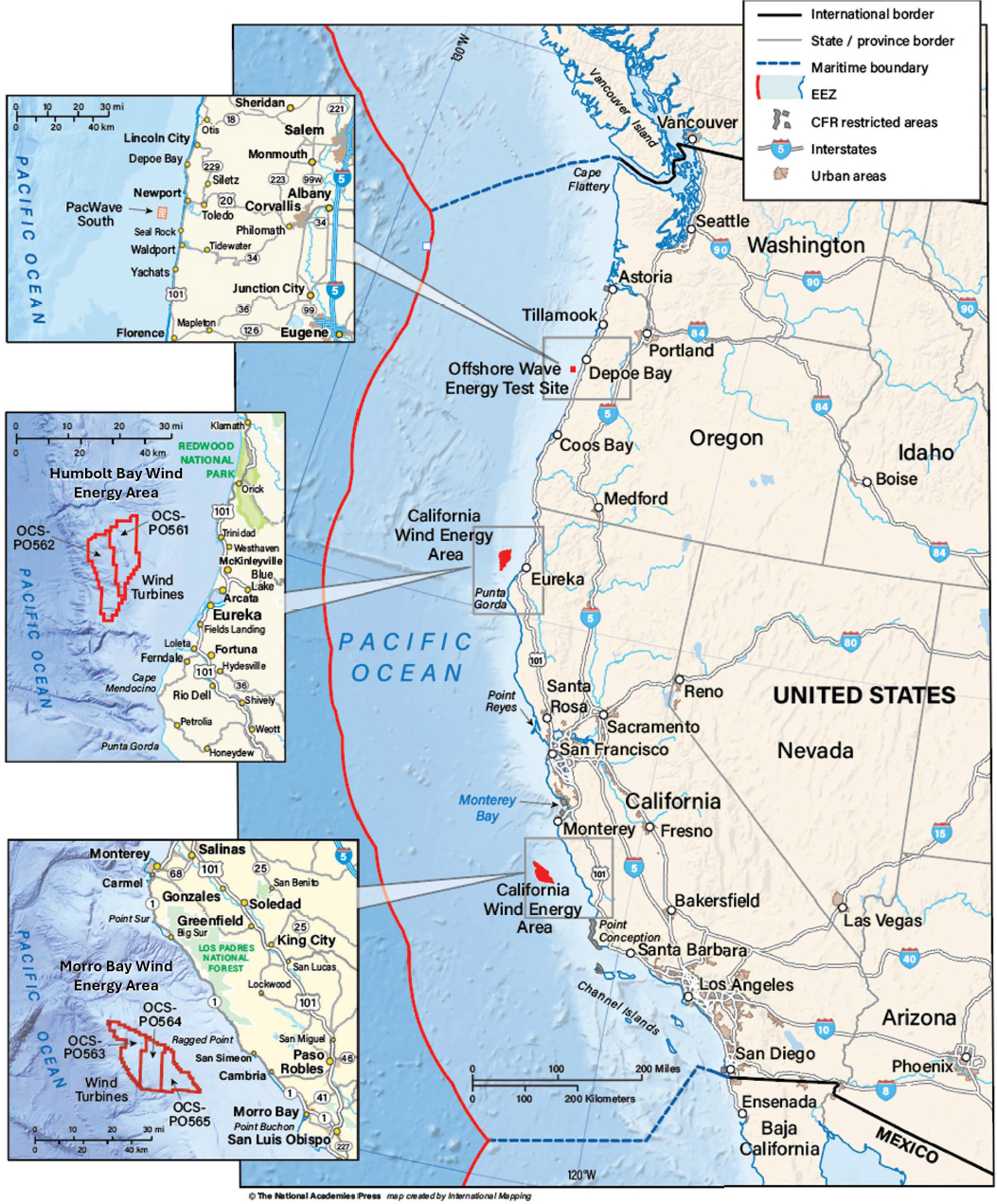
NOTE: OCS = Outer Continental Shelf; OSC – P0561, OSC-P0562, OSC-P0563, OSC-P0564, and OSC-P0565 are individual lease areas.
SOURCE: Created for the committee by International Mapping.
THE SETTING: MARITIME ACTIVITY AND ECOSYSTEM CONTEXT
Maritime Activity on the West Coast
The U.S. West Coast has 7,863 miles of shoreline, supporting a diverse array of maritime activities including commercial shipping, commercial, recreational, and Tribal fisheries, recreation, aquaculture, defense operations, and energy production. Fourteen deep-draft ports form the backbone of the region’s commercial shipping system, from San Diego to Tacoma. In 2023, maritime transportation accounted for over 40 percent of the total value of U.S. global trade, with West Coast ports handling more than one-third of that and supporting nearly 12 million user-related jobs.
Analysis of the Coast Guard’s Pacific Coast Port Access Route Study (PAC-PARS) revealed rising vessel traffic over the 2017–2021 period, measuring activity through total tracked vessel movements. To analyze vessel movement, PAC-PARS used automatic identification system (AIS) and vessel monitoring system (VMS) data, which capture the vast majority of commercial ships involved in international and domestic trade. However, commercial fishing vessels, and many recreational vessels, are not required to carry AIS or VMS, notably if they are less than 65 ft in length. PAC-PARS found commercial cargo and tanker traffic mostly occurs within 25–40 NM offshore, and the numbers of these vessels rose slightly over the period. Recreational vessels and small fishing craft stay closer to shore and the study saw a large increase in recreational vessels.
Through an inclusive engagement process which included federal and state agencies, stakeholders, Tribes, and fishing communities, the Coast Guard considered current and future uses of the West Coast waterways. The Coast Guard’s PAC-PARS recommendations—currently pending implementation—include establishing coastwise and nearshore fairways to codify existing traffic patterns and thus increase navigational safety.
The California Current Ecosystem and Fisheries
The CCE extends roughly 1,860 mi from Southern California to Washington, forming one of the most productive marine ecosystems in the world. Seasonal upwelling of nutrient-rich water supports a diverse community, from plankton and forage fish (sardine, anchovy, squid) to higher predators (tuna, salmon, seabirds, and marine mammals). Winds that drive seasonal upwelling also make the region favorable for offshore wind energy development. Figure S-2 shows annual windspeeds and direction along the coast, with higher windspeeds in orange and red.
Commercial, Tribal, and recreational fishing are central to coastal economies and cultures. Throughout the West Coast region from 2011–2020 Dungeness crab accounted for about 30 percent of total commercial fishery value, followed by Pacific oyster,2 Pacific whiting, and market squid. National Oceanic and Atmospheric Administration’s (NOAA’s) National Marine Fisheries Service (NMFS) reported more than $700 million in commercial ex-vessel revenue and 290,000 jobs across the three coastal states in 2022. Recreational fisheries across the region in 2022 accounted for 7,500 jobs and over $800 million in trip expenditure.
Tribal fisheries—rooted in usufructuary rights3 and, in some cases, guaranteed by treaties and reaffirmed by the courts—are foundational for both cultural and subsistence uses. Fishing rights encompass both access and habitat integrity, requiring careful consideration in the siting and operation of ORE infrastructure. The Stevens Treaties of the 1850s reserved Tribes’ rights to fish in their usual and accustomed areas in the Pacific Northwest. Later in the 1970s the Boldt Decision (United States v. Washington) reaffirmed these rights allowing Tribes the right to half the allowable catch and establishing co-management between Tribes and the states. Federal regulations list the locations for usual and accustomed fishing for the four Tribes that exercise their treaty rights in 50 CFR 660.4. Other federally and state recognized Tribes also engage in fishing throughout the West Coast.
Area-use data for commercial and recreational fishing activity to identify historic and current fishing grounds come from AIS and VMS vessel tracking data, commercial and charter fishing logbooks, and efforts by local fishermen to map fishing grounds. Some challenges arise in identifying fishing grounds because many vessels are not
___________________
2 Pacific oysters are harvested through aquaculture in bays and estuaries.
3 Usufructuary rights are defined as rights to use and benefit from a property without owning it.
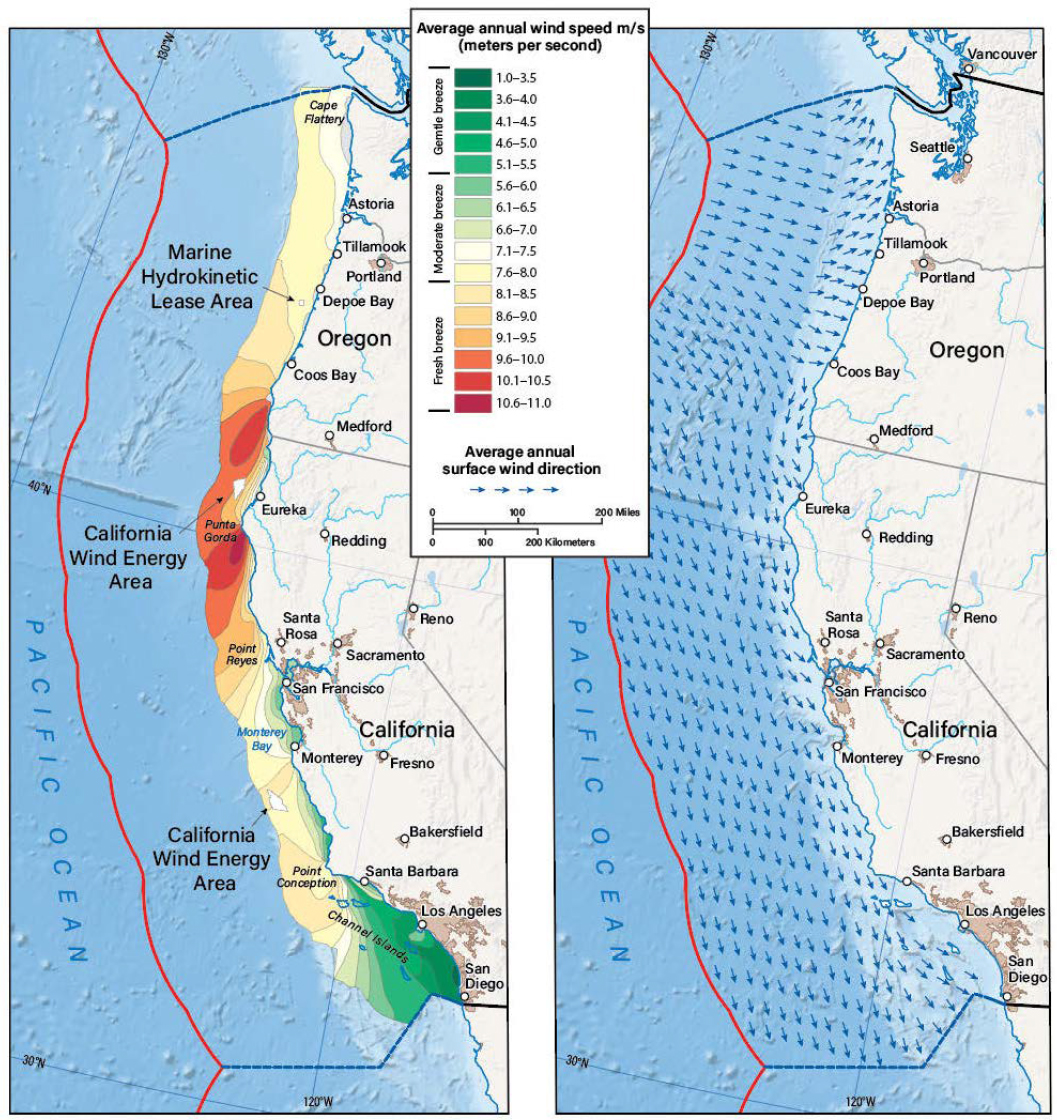
SOURCE: Created for the committee by Map by International Mapping. Based on data from Draxl et al., 2015.
required to carry AIS or VMS4 and fishing vessel information derived from logbooks often lack spatially discrete data upon which conclusions can be reached about where specific fishing activities are occurring.
Coast Guard Operations and Maritime Safety
The Coast Guard has extensive responsibilities for search and rescue (SAR), maritime safety and security, aids to navigation (ATON), law enforcement, and environmental protection across the EEZ offshore California, Oregon, and Washington. This study was asked to focus on Coast Guard operations relevant to commercial fishing activities near ORE sites, specifically related to SAR and safety at sea. Two Rescue Coordination Centers (RCCs)—RCC Alameda and RCC Seattle—oversee regional operations, supported by Sectors, Cutters, small boat stations, and air stations (Figure S-3).
For commercial fishing vessels, Coast Guard involvement remains critical. Vessel losses and fatalities have declined since the 1980s, and SAR activity continues to peak seasonally during spring and summer, but often some of the worst cases occur in winter and fall when poor weather conditions affect search conditions.
The Coast Guard’s operations also affect commercial fishing through its fisheries enforcement, and waterways management missions. In partnership with NOAA, the Coast Guard regulates fisheries and fishing vessel safety in part through boardings across the three West Coast states. Its waterways management mission additionally includes maintaining over 2,700 fixed and floating ATON along the continental West Coast.
OFFSHORE RENEWABLE ENERGY TECHNOLOGIES
Floating Offshore Wind
FOW is the most applicable and relevant ORE technology for the Pacific coast due to the region’s narrow continental shelf and deep offshore waters. FOW turbines on the West Coast are expected to exceed 15 megawatt (MW) capacity, with rotor diameters up to 250 m and mounted on floating platforms (spar, semi-submersible, or tension-leg designs) moored to the seafloor. FOW arrays are expected to include inter-array cables that connect platforms with dynamic (suspended) and static (lying on the seafloor) sections, substation transformers, and submarine cables to transfer energy to shore. FOW projects on the West Coast are in the planning phase and, at the time of writing, exact project configurations have not been proposed.
In 2022, the Bureau of Ocean and Energy Management awarded five lease areas off California—two near Humboldt Bay (North Coast) and three near Morro Bay (Central Coast)—covering 583 sq mi. These sites, located 20–50 NM offshore, are expected to host hundreds of turbines spaced roughly 1 mile apart with an expected generation capacity of 4.6 to 8.1 GW. At the end of 2024 a draft programmatic environmental impact statement was published, and lessees are conducting site assessments, but subsequent federal policy changes have halted further federal actions.
Wave and Tidal Energy
Wave and tidal technologies remain in earlier stages of commercial development. The PacWave South test site off Newport, Oregon, represents the first grid-connected wave energy facility in U.S. federal waters. It consists of four berths capable of hosting up to 20 wave energy converters with a combined capacity of 20 MW. The nearby PacWave North site supports non-grid-connected prototype testing.
Tidal energy converters harness tidal currents through various device archetypes such as axial-flow and cross-flow turbines or oscillating hydrofoils. The predictability of tidal currents makes tidal current energy conversion attractive. Technology readiness levels for wave and tidal systems generally range from 5 to 8, below the 8–9 range typical for mature wind systems.
___________________
4 Automatic identification systems (AIS) are continuous communication systems between ships and shore while vessel monitoring systems (VMS) are scheduled broadcasts from vessels to satellites that are then transmitted to shore.
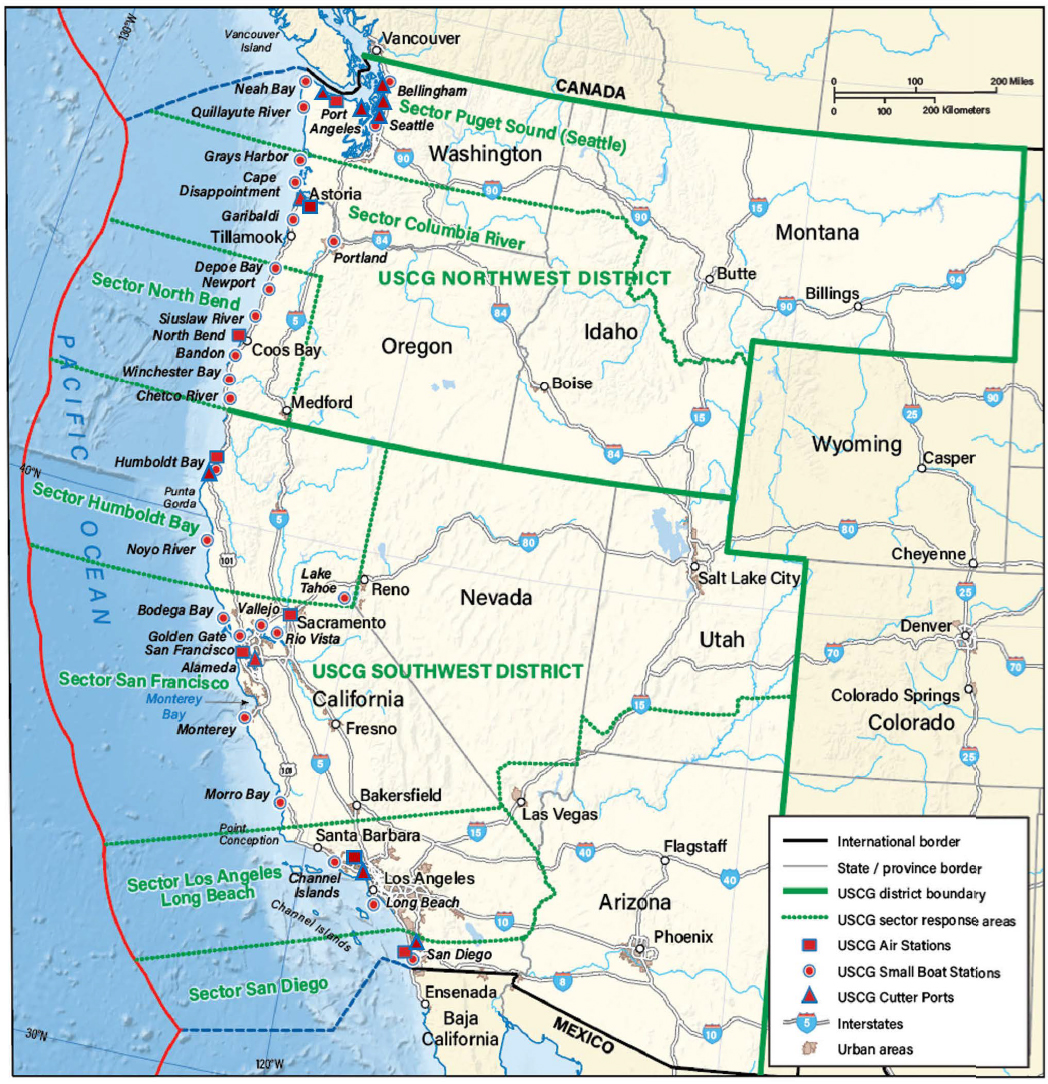
NOTE: USCG = U.S. Coast Guard
SOURCE: Created for the committee by International Mapping.
PLANNING AND REGULATORY FRAMEWORK
Federal Governance
Offshore renewable energy in federal waters (beyond 3 NM baseline) is governed by the Outer Continental Shelf Lands Act as amended by the Energy Policy Act of 2005. The process is overseen by the Bureau of Ocean Energy Management (BOEM) and Bureau of Safety and Environmental Enforcement (BSEE). BOEM manages planning, leasing, and site assessment, while BSEE oversees construction, operation, and decommissioning (Figure S-4).
The six-step federal process includes
- Planning and analysis,
- Leasing,
- Site assessment,
- Construction,
- Operation, and
- Decommissioning.
BOEM, in consultation with other federal agencies (e.g. NOAA, Coast Guard, Environmental Protection Agency), initiates planning through requests for interest, call areas, and designation of wind energy areas (WEAs). Developers compete in auctions to obtain leases, followed by submission of site assessment plans (SAPs) and construction and operations plans (COPs). Federal review under the National Environmental Policy Act (NEPA) and consultation under the Endangered Species Act, National Historic Preservation Act (NHPA), and Coastal Zone Management Act (CZMA) help to ensure environmental and cultural compliance. This review is conducted as an environmental and technical review once the COP is received (Figure S-4).
Through information gathering meetings, the committee heard that BOEM’s engagement with Tribal, fishery participants, and local communities on the West Coast during these stages has often been limited and one-directional, characterized by information provision rather than dialogue. Enhancing this engagement, including early consultation with Tribal governments and evaluating co-management or co-development practices, can lead to informed decision making that maximizes benefits from clean energy development while minimizing impacts to communities.
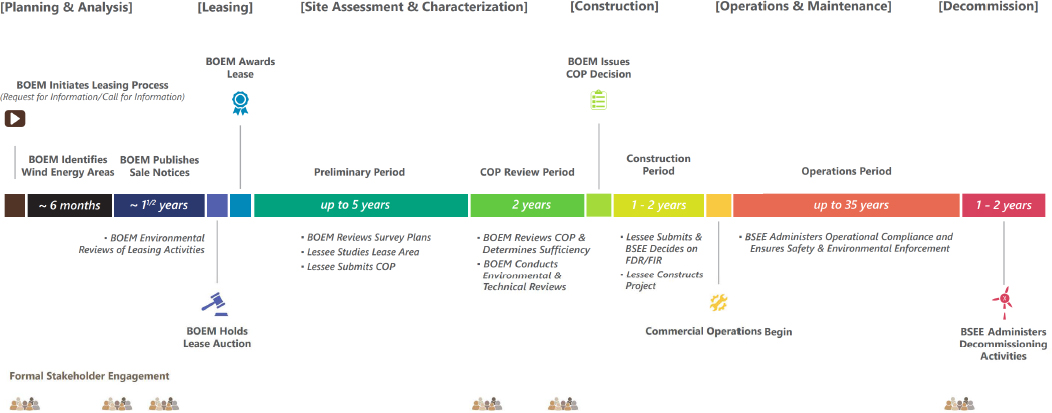
NOTE: BOEM = Bureau of Ocean Energy Management; BSEE = Bureau of Safety and Environmental Enforcement; COP = construction and operations plan; FDR/FIR = Facility Design Reports/Fabrication and Installation Reports.
SOURCE: BOEM, n.d.
State-Level Frameworks
California has developed a state roadmap for offshore wind through Assembly Bill 525 (2021) and the 2024 Offshore Wind Energy Strategic Plan. California set targets of 2 to 5 GW by 2030 and 25 GW by 2045 and calls for coordinated permitting, meaningful Tribal consultation, and mitigation of impacts to fisheries and local communities. Senate Bill 605 (2023) further mandates evaluation of wave and tidal energy feasibility and spatial suitability mapping.
Oregon’s House Bill 4080 (2024) directs creation of an Offshore Wind Roadmap emphasizing effective stakeholder engagement, environmental protection, and Tribal inclusion. Oregon’s decarbonization goals—100 percent clean electricity by 2040—anchor these efforts.
Washington’s Clean Energy Transformation Act targets carbon-free electricity by 2045. The Washington State Energy Strategy for 2021 includes adding 4 GW of offshore wind between 2040 and 2050. Although no leasing has begun, Washington’s approach integrates offshore wind into regional energy and transmission planning.
Marine Spatial Planning and Data Needs
Marine spatial planning (MSP) is central to integrating multiple ocean uses. High-quality spatial data—for commercial, Tribal, and recreational fisheries, fish habitats, shipping, and other maritime activities—are foundational to siting decisions that minimize impacts on the environment, other ocean users, and local communities. However, data gaps persist especially for commercial, Tribal, and recreational fisheries. Using transparent spatial suitability models, developed collaboratively with states, Tribes, coastal communities, fishermen, and stakeholders, would improve siting and reduce future conflicts.
INTERACTIONS, EFFECTS, AND BENEFITS
Ecosystem Effects
Environmental considerations for FOW include wake effects, effects on upwelling, seabed disturbance, underwater noise, electromagnetic fields (EMFs), and interactions with marine life. While FOW reduces the need for pile driving relative to fixed-bottom systems and may limit the other environmental effects during installation, actions such as anchoring ORE devices with mooring cables, potential bottom sweeping from mooring cables, and transmission cables running to shore have the potential to disturb sensitive bottom habitat and may create new environmental effects. Underwater noise and EMFs may influence species behavior. For example, laboratory studies suggest shore crabs linger near EMF sources, while some larval fish exhibit altered swimming behavior. However, these effects are highly localized.
Modeling studies of FOW arrays (up to 8 GW capacity) indicate potential localized impacts on upwelling, nutrient flux, and primary productivity around the two lease areas off California. Modeled results also showed effects diminishing in magnitude from physical processes to biological outcomes. Continued research and monitoring are warranted to understand effects from greater FOW capacity.
Entanglement risk for large marine mammals is low for primary interaction with mooring cables but uncertain for both secondary entanglement involving fishing gear lost or snared at an ORE site and tertiary entanglement when already entangled and caught on mooring lines and inter-array cables. Ongoing monitoring and adaptive management will be needed to ensure that large marine mammals are not disturbed or harmed.
Fisheries and Tribal Impacts
FOW infrastructure may create de facto exclusion zones for certain fishing methods because of the risk of gear becoming entangled. Mobile and bottom-contact gears (e.g., trawls, longlines) are least compatible with floating platforms and dynamic inter-array cables, while surface and hook-and-line fisheries may be less affected.
ORE may also disrupt long-standing Tribal fishing activities and treaty-protected habitats. Tribes’ usufructuary rights include both access to fisheries and protection of habitat from degradation. Meaningful government-
to-government consultation and co-management approaches are required. Beyond direct fishing impacts, ORE development could displace port-dependent industries, reduce harbor capacity, and create congestion during installation (e.g., turbine towing) and maintenance operations.
FOW infrastructure may provide the benefit by acting as a floating fish aggregation device. Structures in the FOW arrays (e.g., anchor systems and underwater portion of turbines) can attract various fish species. The extent of these effects will differ than those observed at fixed bottom offshore wind projects on the U.S. East Coast and in Europe.
Fisheries Management and Research
ORE installations may impede NOAA’s long-term fishery-independent surveys by restricting vessel access or altering fish distributions. Such disruptions would compromise stock assessments and ecosystem models. New methodologies—autonomous platforms, modified survey designs, and adaptive sampling—can mitigate survey disruption and maintain data continuity. ORE development projects also provide the opportunity to monitor the marine environment through research studies on understanding their potential impact and as a platform for sensors and new technologies.
Shipping and Navigation
Floating wind arrays will occupy ocean space that may affect vessel transits. While large commercial ships are expected to avoid arrays, smaller vessels (fishing boats, tugs) may choose to navigate through or around them. The Coast Guard recommends arrays be configured in straight rows with 1 NM spacing to maintain safe navigation and SAR operations. Consideration of transit corridors might be appropriate to allow safe navigation if multiple projects are developed adjacent to each other.
Wind turbines can create radar clutter, potentially affecting vessel and aircraft navigation. One mitigation method includes radar signal processing upgrades. Additionally, BOEM and the Coast Guard have developed standards for developers including the use of AIS identification of platforms, and differentiated lighting and marking of specific platforms. Continued coordination between BOEM and the Coast Guard on the West Coast will incorporate navigational safety early in siting decisions and throughout project construction.
Coast Guard Operations
ORE development will influence many aspects of Coast Guard operations particularly around SAR operations. FOW arrays complicate search planning by creating drift obstructions unaccounted for in the Coast Guard’s Search and Rescue Optimal Planning System model. High-frequency radar shadows behind turbines could further reduce drift model accuracy. Turbulence, lighting, and tower structures pose hazards to low-altitude helicopter operations. Coordination on turbine shutdown procedures and compatible lighting can mitigate the impacts. Increased offshore workforce may generate more medevac cases and require coordination between industry and Coast Guard response assets.
Social Dimensions and Engagement
Public perception, social acceptance, and procedural fairness are central to the sustainability of ORE development. Research on East Coast projects indicates that meaningful participation—defined by two-way dialogue, transparency, and tangible influence on outcomes—is strongly correlated with local support.
The committee observed that BOEM’s engagement to date has been largely procedural and inconsistent across regions. The Government Accountability Office (GAO) found that BOEM “had not consistently demonstrated efforts to consider or address Tribal concerns.” Many Tribes lack the resources or personnel to engage fully in technical consultations. Engagement with Tribal governments is an essential part of the ORE development pro-
cess and there may be multiple appropriate engagement methods because of the sovereignty of each federally recognized Tribe or Nation.
Community benefit agreements, workforce training investments, and fishery compensation programs represent emerging tools to balance benefits and burdens. Developing these mechanisms in a way that is transparent and co-designed with affected groups can build trust and legitimacy.
Economic and Infrastructure Considerations
Port infrastructure on the West Coast is a limiting factor for ORE deployment. California found that only the Ports of Humboldt, Los Angeles, and Long Beach have the potential to support full assembly and staging of floating turbines. California’s AB 525 port readiness study estimates that $11.7 billion in investment will be needed for port upgrades.
These port developments can bring substantial economic opportunities, including local manufacturing, operations and maintenance jobs, and supply-chain growth. There is a risk of displacing existing maritime and fishing activities with port upgrades; balanced planning, informed by cumulative impact assessments, is essential to align economic benefits with community resilience.
COMMITTEE RECOMMENDATIONS
The committee’s recommendations are created to capture best practices, organized by topic area, and are intended to improve research, engagement, safety, and governance.
Recommendation 7-1: National Oceanic and Atmospheric Administration’s National Marine Fisheries Service should identify research and data needs to better understand the potential effects (e.g., on upwelling, nutrient levels, productivity, species distributions) of offshore renewable energy development on the broader California Current Large Marine Ecosystem and West Coast fisheries and commence to fill identified gaps as resources allow.
Recommendation 7-2: Congress should designate funding or resources to support consultation and collaboration by Tribes and other engagement by Tribes who do not have resources to meaningfully engage in the Bureau of Ocean Energy Management process.
Recommendation 7-3: Lead federal agency(ies) for offshore renewable energy projects (e.g., Bureau of Ocean Energy Management, Federal Energy Regulatory Commission, U.S. Army Corps of Engineers) should meaningfully engage and establish a dialogue with states, Tribes, fishing and coastal communities, other ocean users, and interested persons to exchange and integrate local knowledge while gaining a mutual understanding of the needs and concerns of all users.
Recommendation 7-4: Lead federal agency(ies) (e.g., Bureau of Ocean Energy Management, Federal Energy Regulatory Commission, U.S. Army Corps of Engineers), in collaboration with National Oceanic and Atmospheric Administration and state agencies, should require offshore renewable energy projects to develop and implement scientifically robust long-term environmental monitoring plans for leased sites that ensure comparability across sites and results in publicly accessible data. Monitoring plans should include elements that are designed at a regional level and use standardized, comparable methods across sites.
Recommendation 7-5: National Oceanic and Atmospheric Administration’s National Marine Fisheries Service, in conjunction with lead federal agency(ies) for offshore renewable energy projects (e.g., Bureau of Ocean Energy Management, Federal Energy Regulatory Commission, U.S. Army Corps of Engineers), should develop a Federal Survey Mitigation Implementation Strategy for the Pacific U.S.
Region. The Mitigation Strategy would minimize disruptions to long-running datasets that are used for stock assessments and other fishery management decisions.
Recommendation 7-6: Bureau of Ocean Energy Management, the lead federal agency for offshore wind development, in consultation and collaboration with other applicable federal agencies, states and Tribes, should conduct a marine geospatial assessment, including a spatial suitability model, for the West Coast. This assessment would be used to evaluate the competing uses, and assess the risks, mitigations, costs, and benefits of the different uses.
Recommendation 7-7: The Coast Guard should expedite enactment of the Pacific Area Port Access Route Study fairways for the U.S. West Coast.
Recommendation 7-8: Bureau of Ocean Energy Management, the lead federal agency for offshore wind development, should engage the Coast Guard and other applicable federal agencies, commercial, Tribal and recreational fisherman, and maritime stakeholders to study whether transit corridors through or between offshore wind lease sites are needed to allow for safe passage for fishing, vessel traffic, and Coast Guard operations.
Recommendation 7-9: The Coast Guard, Bureau of Ocean Energy Management, and Bureau of Safety and Environmental Enforcement should continue adding, refining, and standardizing measures for offshore renewable energy projects in order to mitigate the risk to Coast Guard operations, including surface, subsurface, air, cyber, and command-and-control operations.
Recommendation 7-10: Bureau of Ocean Energy Management, the lead federal agency for offshore wind development, should require offshore renewable energy area lessees to provide services for 24/7 vessel and aircraft search and rescue response capabilities to support their personnel and assets. Additionally, the Coast Guard should establish planning and coordination procedures with operators to facilitate search and rescue response.
CONCLUSION
Offshore renewable energy development on the U.S. West Coast is both promising and complex. Commercial-scale ORE deployment can proceed responsibly if underpinned by scientific understanding, robust interagency coordination, and early engagement with Tribes, fishing communities, and other maritime users.
West Coast ORE development can contribute meaningfully to decarbonization and energy resilience while preserving maritime safety, ecosystem health, and community cultural integrity. Achieving this balance requires proactive investment in research, planning, and governance mechanisms that honor the ocean’s multiple values and users.
Through the conclusions and recommendations articulated herein, the committee envisions a pathway toward sustainable, science-based, and socially just ORE development—one that provides the benefits of clean energy and reflects the diverse interests, histories, and futures of the West Coast and its people.
This page intentionally left blank.


