Offshore Renewable Energy Development on the West Coast: Understanding Effects on Shipping, Fisheries, and Maritime Activities (2026)
Chapter: 6 Offshore Renewable Energy Planning Process
6
Offshore Renewable Energy Planning Process
The planning process for ORE project development is overseen at both the federal and state levels. The process encompasses analysis of potential ORE development areas from site selection and assessment through operation with opportunities for public engagement. An important aspect of ORE planning includes broad marine spatial planning (MSP) which encompasses different and sometimes competing uses of the ocean, often overlapping with the identified areas for ORE project development. This chapter first addresses the offshore wind planning process at the federal level and then outlines processes in California, Oregon, and Washington. Next is a discussion of state-level MSP planning efforts. Finally, the chapter concludes with consideration of interactions between local communities, users of the marine environment, stakeholder groups, and the agencies responsible for planning ORE projects.
FEDERAL OFFSHORE RENEWABLE ENERGY REGULATIONS
Regulation of offshore wind energy development in federal waters is primarily overseen by two bureaus within the U.S. Department of the Interior (DOI)—BOEM and BSEE. Unlike federal land management agencies such as the Fish and Wildlife Service, the National Park Service, the Bureau of Land Management, and the Forest Service, BOEM and BSEE were not established by an act of Congress or granted a broad planning mandate by Congress. Rather, BOEM and BSEE, on behalf of DOI, implement laws governing energy and mineral development on the OCS without regard to a wider mission to manage the ocean commons or regional management plans. They are among a number of federal agencies that manage different aspects of ocean waters including NOAA (fisheries and protected species), the Coast Guard (navigational safety), USACE (navigational safety, obstruction to navigation, and integrity of structures), and the Department of Defense (DOD), which, for example, manages areas of the ocean used in its own operations.
Federal lands and waters begin 3 NM offshore most states and territories, including California, Oregon, and Washington, except for Monterey Bay where a straight baseline is drawn across the bay beginning federal waters farther than 3 NM from shore. The waters shoreward of 3 NM are state waters and, under the Submerged Lands Act,1 states have the right to manage, lease, develop and use the lands and natural resources (living and nonliving) within these waters. However, even in state waters, the federal government retains rights, including national
___________________
1 Submerged Lands Act, 43 U.S.C. §§ 1301–1315.
defense, international affairs, navigation regulation, and commerce regulation (e.g., over water pollution). It is important to note that jurisdiction and control of water power was not transferred to the states. The Submerged Lands Act “does not include water power, or the use of water for the production of power.”2
For offshore wind energy development in those state waters not included within overlapping federal jurisdictions such as DOD areas or national marine sanctuaries, the adjacent state would be the lead agency. For example, Rhode Island was the lead for the United States’ first offshore wind power project, the Block Island Offshore Wind Power Project (BIOWP). Projects in state waters are still required to obtain federal permits,3 consider federal interests (e.g., endangered species and marine mammal protection acts), and evaluate environmental effects, with USACE generally the lead federal agency. Although the federal government retained all rights to waterpower in state waters, it effectively relinquished rights related to wind power under the Submerged Lands Act, so that any rents, royalties, or other payments would flow to the applicable state.
To manage energy resources on offshore federal lands and waters, Congress adopted the Outer Continental Shelf Lands Act of 1953 (OCSLA),4 with the primary regulatory focus of oil and gas development and to a lesser extent minerals mining, such as sand for beach replenishment. In 2005 Congress adopted the Energy Policy Act of 2005,5 which modified the OCSLA and authorized DOI to also lease ocean areas for “alternative energy,” including offshore wind, tidal, wave, and current energy.6 However, regulations governing those alternative energy uses were not adopted until 2009.
Although the United States is not a party to the UN Convention on the Law of the Sea (UNCLOS), it has stated that it considers much of UNCLOS to reflect customary international law and to be binding on the United States. In 1983 President Ronald Reagan issued Proclamation 5030, establishing an EEZ from 12 NM out to 200 NM from the U.S. coast7 and claiming the sovereign rights and jurisdiction over the EEZ that UNCLOS accords, which include energy. Under UNCLOS, each country also has a continental shelf maritime zone which by agreement extends at least 200 NM from the coast, although a country can seek a determination that it has a longer (extended) continental shelf if its continental shelf extends further than 200 NM geomorphologically (see Figure 1-1). Ports and coastal adjacent waters such as rivers, bays, and wetlands are considered inland waters.
Offshore Renewable Energy Processes
BOEM’s regulation of alternative uses of the OCS is divided into six phases: (1) planning and analysis; (2) leasing; (3) site assessment; (4) construction; (5) operations and (6) decommissioning, with BOEM overseeing the first three and BSEE the latter three (Figure 6-1).
Offshore wind energy project construction and operation may have effects on vessel navigation and fishing. OCSLA requires that any activity carried out under a lease, easement, or right-of-way be carried out in a manner that provides for “prevention of interference with reasonable uses (as determined by the Secretary) of the EEZ, the high seas, and the territorial seas.”8 Given the early stage of development of offshore wind energy projects off the West Coast, thoughtful planning, siting, and evaluation can avoid, mitigate, or lessen the burdens those effects place on navigation and fishing. Other potential impacts (ecological and environmental) will be identifiable only after floating offshore wind projects are constructed and put into operation. Well-developed monitoring plans are necessary to adaptively manage or mitigate such impacts. Next, we focus on BOEM’s processes and the first three stages of development. What follows is a description of what might be typical, but the process may vary given the nascent state of the industry. Additionally, BOEM’s process continues to evolve based on lessons learned from previous offshore wind projects; these are discussed in the Existing BOEM Activities section later in this chapter.
___________________
2 Submerged Lands Act, 43 U.S.C. § 1301(e).
3 For example, Rivers and Harbors Act of 1899 Section 10 permit, 33 U.S.C. § 403; 33 CFR Part 322.
4 Outer Continental Shelf Lands Act of 1953, 43 U.S.C. §§ 1331 et seq.
5 H.R.6, 109th Congress.
6 43 U.S.C. § 1337.
7 The first 12 NM comprise the sovereign maritime zone, known as the territorial sea.
8 43 USC § 1337(p)(4)(I).

NOTE: BOEM = Bureau of Ocean Energy Management; BSEE = Bureau of Safety and Environmental Enforcement; COP = construction and operations plan; FDR/FIR = Facility Design Reports/Fabrication and Installation Reports.
SOURCE: BOEM, n.d.-a.
Planning and Analysis Phase
The planning and analysis phase is usually initiated by BOEM through a state-focused task force meeting or series of meetings focused on planning for leasing of ocean space off that state. BOEM will then issue a request for developer interest (RFI) and designate a large potential developable area off the coast (the “RFI area”). An interested developer will inform BOEM of its interest and indicate where within the RFI area it may be interested. Based on developer interest, spatial analysis,9 and public comment, BOEM will typically reduce the RFI area, then publish a draft Call Area. The draft Call Area may be modified further based on additional input leading to the final Call Area. At that point, BOEM announces a call for information and nominations, which invites both public comment and developer nominations of areas of interest within the Call Area. After consideration of that input, BOEM announces a draft WEA. Based on further engagement and comments, BOEM publishes a final WEA, which concludes the planning and analysis phase.
Leasing Phase
The Energy Policy Act (2005), which provides BOEM with authority over offshore wind energy development, amended OCSLA, which, as noted earlier, is primarily focused on oil and gas development on the OCS. There are, however, differences between markets for oil and gas and those for electricity. For example, while oil can be sold into many markets and its wholesale price is linked to global prices, grid-connected offshore wind generated electricity is sold into state and regional markets, and its development tends to follow state electricity policies. With the present framework, potential offshore developers compete to pay the largest upfront payment rather than competing to deliver electricity at the lowest price while optimizing for a combination of other project attributes (such as community benefits, economic development, time to project operation, engagement plan).
Once a WEA (which BOEM typically divides into two or more potential lease areas) is designated, the leasing phase commences with BOEM’s publication of a Proposed Sale Notice inviting further comment. BOEM also commences an environmental assessment under the NEPA to evaluate the effects of site characterization activities (e.g., geophysical and geotechnical activities before construction), though this is not for full development or turbine
___________________
9 Spatial analysis can include use of a spatial suitability model such as NOAA’s NCCOS model. See Chapter 7 for further discussion of using the NCCOS model during site selection.
installation. After considering the environmental assessment, BOEM will either issue a Finding of No Significant Impact, which would be typical for these kinds of more limited activities (as opposed to the intended future act of placing a wind turbine and associated infrastructure in the ocean), or if the impacts may be significant, it undertakes a full EIS. For leases offshore California and Oregon, BOEM issued a Finding of No Significant Impact for the investigation activities allowed under the leases proposed off those states. Under OCSLA, BOEM is also required to provide the public with notice and an opportunity for comment on the proposed lease.10
After assessing the impacts of site characterization activities, BOEM would next issue a final sale notice. BOEM then holds an auction among qualified (developer) bidders, with bidding occurring separately and concurrently on each lease area within a WEA. For each lease area, BOEM announces a provisional winner—that entity tendering the highest bid. Winning bids have varied greatly depending on timing of the auction, location, state and federal government support, and market conditions, from less than $1 million to more than $1 billion. Two lease areas off Texas failed to receive any bids in an auction held in 2023 (Sheppard Mullin Richeter & Hampton LLP, 2023). The four New York Bight lease areas raised a cumulative $4.4 billion, while the only West Coast leases awarded—the five off California—raised $757 million (DOI, 2022a, b). With the exception of any monies that have been earmarked for bidding credits (as described in the Final Sale Notice), that bid money flows to the Federal Treasury, along with rents paid to lease the ocean space, and operating fees that would be generated if a project became operational.
Under section 388 of Energy Policy Act of 2005, Congress provided that if the nearest offshore wind turbine was within 3 NM of the federal–state line (or effectively 6 NM from the West Coast states), 27 percent of the revenues from upfront payments, rents, and royalties that would otherwise flow to the federal government would flow to the adjacent coastal state; however, if more than one state was within 15 mi of the geographic center of the wind project, the 27 percent would be shared equitably.11 The apparent congressional intent is to share offshore wind revenues with the coastal states, but this has not occurred because no offshore wind power projects have been sited in federal waters within 6 mi of a coastal state.
There is even broader sharing of oil and gas revenues with adjacent coastal states in the Gulf. The Gulf of Mexico Energy Security Act provides revenues to the Gulf-producing states and the Land and Water Conservation Fund to advance coastal restoration. More recently, perhaps given the absence of state revenue sharing, BOEM has allowed offshore wind developers to receive bidding credits to the extent a winning developer provides community benefits in accordance with the terms of the final sale notice and lease. After formalities, the lease is executed by BOEM and the winning developer.
Site Assessment Phase
The developer who holds a lease is required to submit a site assessment plan (SAP), and upon BOEM approval, undertakes site assessment activities. These activities include environmental, cultural, and visual assessments, as well as geotechnical and geophysical surveys to inform the siting of wind turbines, cables, and offshore wind power substations or offshore converter stations. Community engagement is an important component of SAP activities, including engagement with Tribal governments, states, fishing interests, local coastal residents and governments, and others who may have an interest or rights that may be affected by development. At the conclusion of assessment activities, the developer submits a construction and operations plan (COP) to BOEM, and if sufficient, BOEM undertakes environmental review under NEPA and technical review. The COP is required to be submitted within 5 years of lease issuance, though an extension may be granted.
As part of the NEPA process, BOEM, as the lead federal agency, consults with other federal agencies including Coast Guard, USACE, DOD, Federal Aviation Administration (FAA), NOAA, National Park Service, Fish and Wildlife Service, and the Environmental Protection Agency on navigation, defense, endangered species, marine mammals, essential fish habitat, migratory birds, visual effects on historic structures and national seashores, and air quality. Other statutes also have their own consultation requirements such as the Endangered Species Act.
___________________
10 43 USC § 1337 (p)(4)(K).
11 Id. at pinpoint to first cite to 43 U.S.C. § 4337.
BOEM also consults with state and Tribal historic preservation officers on cultural effects as mandated by NHPA.12 BOEM is required to consult with Tribal governments more generally given their sovereignty, the government-to-government relationship between federally recognized Tribes and the federal government, and treaty rights. Pursuant to the Submerged Lands Act, states have the right to manage the first 3 NMs off their coast. Also, BOEM is required to consult with states, given that they must decide whether to certify (or to condition certification on certain requirements) the project as being consistent with a state’s federally approved coastal zone management plan under the Coastal Zone Management Act (CZMA).13 BOEM is also required to share a draft environmental analysis, typically a draft EIS, with the public for written and oral comment.
To conclude the NEPA process, BOEM first publishes the final EIS and response to comments, and then after a minimum of 30 days issues a record of decision. Although far-reaching in many respects, NEPA, which was adopted by Congress in 1969, provides limited engagement with the public compared to what members of the public may be used to with local development decisions. Before commencement of an EIS, the lead agency, in this case BOEM, will seek comment on the scope of the EIS. It will be returned to the public after completing the draft EIS, and request written and oral comments. While BOEM typically make a short public presentation to kick off an opportunity to submit written comment on the draft EIS, the interaction is effectively one-way, with the public making comments, rather than a two-way dialogue with questions and answers. Only when the final EIS is issued does BOEM respond in writing. This falls somewhere between informing the public and consulting with it as compared to involving, collaborating, or empowering the public (IAP2 USA, n.d.; Arnstein, 1969).
BOEM’s NEPA reviews have been undertaken project by project; however, before approving the first COP (Vineyard Wind 1), BOEM decided to prepare a supplemental EIS that was effectively a cumulative impacts analysis that considered the effect of developing 22 GW of offshore wind power off the Northeast and Mid-Atlantic coasts.
After issuing a NEPA record of decision for a project, BOEM will then decide whether to approve that project’s COP. For COP approval, BOEM looks to the considerations set out in subsection 8(p)(4) of OCSLA, and its regulations at 30 CFR 585.102(a). Of most relevance to this report, BOEM must ensure that a project will provide for safety, protection of the environment, conservation of OCS natural resources, protection of correlative rights, and prevention of interference with reasonable uses of the territorial sea, EEZ, or high seas. BOEM must also provide “consideration” of leases, easements or rights-of-way on the OCS and of other uses of the ocean or seabed, “including use for a fishery, a sea lane, a potential site of a deepwater port, or navigation” and a fair return to the United States.14
After COP approval, oversight of a project shifts to BSEE, which oversees project construction, including foundation, turbine, inter-array and export cable, and transformer installation. Once the project is commissioned, BSEE oversees operation and at some point, typically at least 20 years after operation has commenced, will oversee decommissioning. The leases issued off California have an initial term of 38 years.
Existing BOEM Activities
BOEM has designated numerous WEAs off the East Coast from South Carolina to Maine and has approved 12 COPs. One commercial project is fully operational, South Fork Wind which supplies energy to Long Island, while several projects are under construction including Coastal Virginia Offshore Wind, Vineyard Wind I (Massachusetts), Revolution Wind (Rhode Island and Connecticut), and Sunrise Wind and Empire Wind (New York). Although BOEM nominally has an Atlantic Region, it is situated in BOEM’s main office in Sterling, Virginia, and renewable energy development is managed by BOEM’s Office of Renewable Energy Management. This lack of actual boots on the ground for renewable energy development contrasts with BOEM’s long-held strategy for offshore oil and gas.
___________________
12 54 U.S.C. §§ 300101 et seq.
13 33 U.S.C. §§ 1451 et seq.
14 43 USC § 1337 (p)(4)(J).
BOEM activity has only recently commenced on the West Coast, given different technology requirements described in Chapter 5. To date, floating foundations have been deployed in a few locations off Europe with the projects at a demonstration scale (one to a handful of turbines in an array) rather than at large commercial scale. California planning began in 2016 after Trident Winds tendered an unsolicited request for a commercial lease. In late 2022, BOEM announced the winners of five lease areas, two of which are in the North Coast (Humboldt) WEA and three of which are in the Central Coast (Morro Bay) WEA. BOEM published a final sale notice related to lease areas off Coos Bay and Brookings, Oregon, in August 2024 but postponed those WEA auctions a month later due to insufficient bidder interest and a request from the Oregon governor to postpone the sale. Tribal governments and the commercial and recreational fishing sectors also opposed the Coos Bay lease areas. Despite at least two unsolicited lease requests submitted for federal waters offshore Washington, federal planning off Washington State has yet to commence in earnest, though state maritime planning activities that could guide future developments have been undertaken.
Lessons Learned from Previous Offshore Wind Activities
While no commercial-scale ORE projects have been implemented off the West Coast, lessons can be learned from offshore wind development along the East Coast, particularly in the areas of project design, MSP, environmental review, engagement, commercial fishing, and bidding credits. The next sections will discuss the lessons learned and resulting changes made by BOEM during the California leasing process.
Project Design
BOEM’s 2018 draft “design envelope” guidance allowed a developer to propose a “reasonable range of project [component] designs”—for example, in turbine capacity, numbers, height, foundation types, cable size, voltage and routing (BOEM, 2018). With the design envelope, the environmental analysis evaluates the greatest potential impact of each component. This flexibility was needed in a fast-changing turbine market with long periods between project design and financial closure. BOEM published a “Representative Project Design Envelope for Floating Offshore Wind Energy: A Focus on the California 2023 Federal Leases” as part of the draft programmatic EIS in November of 2024 (Cooperman et al., 2024).
Marine Spatial Planning
Efforts to advance MSP in the mid-Atlantic and Northeast brought together states and Tribal governments in the region and federal agencies that have interests in the ocean to agree on regional ocean plans (National Ocean Council, 2016; BOEM, 2016). MSP development also helped to build relationships between individuals representing different states, Tribes, and federal agencies, which can facilitate future coordination on complex offshore siting and development. These efforts also led to regional data portals, which provide BOEM, developers, states, local governments, and civil society with access to data to better understand siting considerations (MARCO, n.d.; Northeast Ocean Data, n.d.). Similar regional data portals are under development for Oregon and California (West Coast Ocean Data Portal and BOEM, n.d.; California Offshore Wind Energy Gateway, n.d.). As an example, the state of Oregon, with several partners, developed the OROWindMap, a publicly available online mapping service (West Coast Ocean Data Portal and BOEM, n.d.). This database provides information on biological data (such as bird, fish, etc. species location and surveys), human related data (fishing locations, existing offshore energy locations, etc.), and physical data (bathymetry, etc.) as required in the Data Gathering and Engagement Plan for Offshore Wind Energy in Oregon (West Coast Ocean Data Portal and BOEM, n.d.).
Environmental Review
Strong environmental review can help identify potential impacts and related mitigation measures and can serve to build trust. It also is less likely to be subject to a successful legal challenge due to environmental concerns.
Engagement
BOEM’s engagement processes on the East Coast evolved over time from being mostly static affairs to more interactive approaches (Bennett, 2025). These approaches could include informal information sessions, town halls, and open houses. More on the issue of social engagement is presented at the end of this chapter in the Community Engagement section.
Commercial Fishing
BOEM gained a greater appreciation for the issues involved in the relationship between offshore wind power development and commercial fishing. In January 2025, BOEM issued “Guidelines for Providing Information for Mitigation of Impacts to Commercial and For-Hire Recreational Fisheries. BOEM describes the guidance this way:
This comprehensive final guidance, informed by extensive public input, establishes clear processes for the offshore wind industry to address potential disruptions to fisheries. It ensures consistency and promotes fair treatment of fishermen, regardless of their home or landing port. The guidance emphasizes early engagement and transparency with fishing communities, encouraging lessees to document interactions. Recommendations in the guidance address design considerations, safety protocols, and financial compensation processes. Compensation measures extend through construction, early operations, and decommissioning, ensuring comprehensive coverage for affected fisheries. (BOEM, n.d.-c)
Additional guidance related to floating offshore wind will be developed in the future; additional discussion of engagement with commercial fishing is presented at the end of the chapter in the Community Engagement section.
Draft Wind Energy Areas
Before designating the Oregon WEA, BOEM identified two draft WEAs (BOEM, 2023). This step enhanced the role of the state and the public in WEA selection by providing further review between the announcement of the Oregon Call Areas and the designation of the Oregon WEAs. This included engagement opportunities on more specific potential locations for siting offshore wind turbines. As part of this process, BOEM scheduled an intergovernmental task force meeting and public meetings and took public comments for 60 days.
Bidding Credits
In early 2023 BOEM published general rules on the use of “bidding credits” in auction processes.15 The notice for a sale will describe how bidding credits are handled for a given lease sale. In short, a developer gets credit against its bid to use the funds for public benefits, recognizing that offshore wind power development is not without community burdens and that burdens and benefits are not distributed evenly. The regulations are set out at 30 CFR § 585.216. The California leases allowed the successful bidder to claim up to 30 percent in bid credits (BOEM, n.d.-b):
- A 20 percent bidding credit to support FOW industry workforce training programs or develop a domestic supply chain for the FOW industry
- A 5 percent bidding credit to establish a lease area use community benefit agreement (CBA) with one or more communities, stakeholder groups, or Tribal entities who are expected to be impacted either by the actual location of the lease area, or because they use resources harvested from the location of the lease area
- A 5 percent bidding credit to establish a general CBA with one or more communities, Tribes, or stakeholder groups that are expected to be affected from lease development that are not otherwise addressed by the lease area use CBA. This could include potential impacts on the marine, coastal, and/or human environment (such as impacts on visual or cultural resources).
___________________
15 30 CFR Part 585.
Siting, Licensing, and Permitting Wave and Tidal Projects
Water power was not included in the natural resources transferred to states under the Submerged Lands Act, and BOEM has no jurisdiction in state waters. If a wave or tidal project is sited within 3 NM of the coast, and will be grid-connected, FERC would be the lead agency under the Federal Power Act.16 If the wave or tidal project is not grid-connected, a FERC license would not be required, resulting in the USACE being the lead federal agency under Section 10 of the Rivers and Harbors Act of 1899,17 addressing obstructions in the navigable waters and Section 404 of the Clean Water Act,18 addressing the discharge of dredge and fill materials. When a wave and tidal project is to be located in federal waters, a developer would also be required to obtain a lease from BOEM.
STATE-LEVEL PLANNING
California
Electricity demand within California is expected to increase by around 76 percent by 2045, relative to 2022 demand (CCST, 2025). This is due in large part to increased electrification (e.g. increased number of data centers, increase in electric vehicle usage, and other large loads), and population growth. In parallel with this increase in demand, California has ambitious targets for emissions reductions, and hence a growing need for renewable energy. In 2022 the California Energy Commission issued targets for offshore wind of 2 to 5 GW by 2030, and 25 GW by 2045 (CEC, 2022).
The California Renewables Portfolio Standard required electrical utilities to source 33 percent of energy from renewable sources by 2020, with this figure increasing to 60 percent by 2030. The state also has committed to sourcing all electricity from renewable sources by 2045 (CEC, n.d.). Wind and utility solar already provide substantial components of California’s electricity, supplying 6.5 percent and 19.2 percent in 2023, respectively (CCST, 2025).
Decommissioning of the Diablo Canyon nuclear facility by 2030 will reduce the availability of emission-free electricity and also provide transmission grid connection opportunities on the Californian Central Coast. Diablo Canyon currently supplies around 6 percent of California’s electricity generation (CCST, 2025). Note that further extensions to the operational period for Diablo Canyon may be authorized.
Applications within California State Waters
The California State Lands Commission is the lead decision agency for offshore energy applications within state waters. The assessment process for new applications is outlined in Figure 6-2. Though this process is designed for offshore wind applications, a similar process would apply to most marine hydrokinetic energy projects. For marine energy projects that are integrated into federally-managed coastal structures such as breakwaters and jetties, USACE will lead assessment of potential impacts on navigational safety. Details of the process and decisions for the proposed CADEMO project, which was put on hold in August 2024, show the substantial complexity of each stage in the process (CSLC, n.d.).
Offshore Energy Permitting (AB 525)
Assembly Bill 525 is legislation passed by California in 2021 calling for the California Energy Commission to develop a permitting roadmap for offshore wind. The Offshore Wind Energy Strategic Plan (CEC, 2024a) was published in June 2024 in three volumes and addresses
- Identification of suitable sea space for offshore wind development
- Identification of impacts on coastal resources, fisheries, Native American and Indigenous peoples, under-served communities and national defense, along with strategies to address those impacts
___________________
16 16 U.S.C. §§ 791a et seq.
17 33 U.S.C. § 403.
18 33 U.S.C. § 1344.
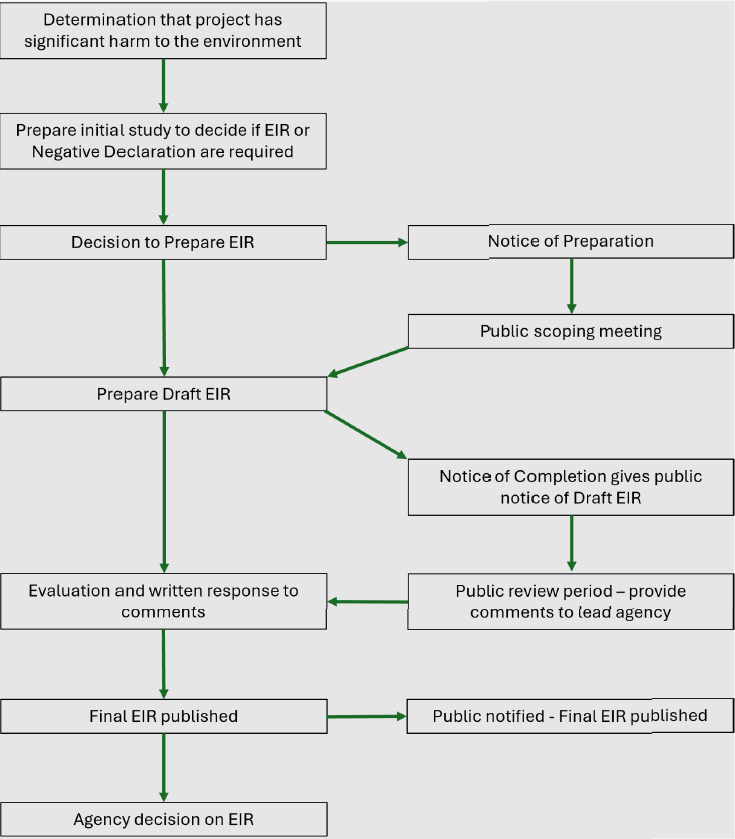
SOURCE: Modified from California Environmental Quality Act Process Flow Chart, 14 CA ADC Div. 6 Ch. 3 Appendix A.
- Economic and workforce development
- Infrastructure, including port space and transmission lines
- Permitting process
The final report was built from a phased project plan, the feasible maximum capacity of California offshore wind resources, assessing the economic benefits and workforce development needs, and determining the options for the permitting roadmap to emphasize a coordinated, comprehensive, and efficient process.
The roadmap notes that offshore wind development in California will occur primarily in federal waters under BOEM authority and that the state may coordinate with the BOEM process through the roadmap. California AB 525 requires that, as part of the roadmap development and communication, opportunities for meaningful input are provided to agencies, Tribes, and stakeholders. With regards to fisheries, a series of virtual and in-place meetings were held to solicit input regarding potential impacts on commercial and recreational fishing as well as identification of suitable sea space for offshore wind development. Consultations with Tribes were carried out throughout the process via letters to all California tribes to solicit consultation, phone calls and emails to tribes with ancestral boundaries near proposed WEAs, and twice-monthly meetings with an inter-Tribal working group.
Measures suggested to address Tribal impacts according to the roadmap include:
- Conducting ongoing, meaningful consultations and collaboration
- Encouraging developers to contract with tribes for ongoing cultural and environmental monitoring
- Encouraging, with BOEM, developers to agree to CBA with tribes
- Exploring opportunities to include Tribes in “adaptive management of offshore wind”
For fisheries, the study recommends:
- Using the latest fishing data from all sources to conduct data analysis of fishing effort and value metrics to inform decision making
- Continuing the California Offshore Wind Fisheries Working Group to develop a statewide strategy to address impacts and prioritize fisheries
- Working with Tribes, agencies, and other stakeholders to integrate efforts related to impact mitigation
The study looked at various models for the permitting approach, and the recommended roadmap stresses the need for a coordinated, comprehensive, and efficient process that is based on a model previously used in California called a renewable energy action team (REAT). Because permitting a large-scale project such as an offshore wind array will involve interactions with numerous public and private organizations, and potentially take years to accomplish, a coordinated approach (in this case via a REAT) would provide similar benefits for development of ORE on the West Coast.
With a REAT, dedicated staff from various agencies are brought together to integrate the required permitting activities and to serve as the primary contact point for Tribes and other interested persons. It is important that the REAT has clear decision-making authority within the agencies, and its members will ideally have been part of other REATs so that they can implement lessons learned from other efforts. With respect to offshore wind, BOEM and California have worked through an Intergovernmental Renewable Energy Task Force since 2016.
California Senate Bill 605
Two technical reports developed to support California Senate Bill 605 (2023) provide details of the potential benefits, impacts, and siting considerations for wave and tidal energy in waters off California. Technoeconomic factors of current wave and tidal energy converter designs resulted in the analysis being constrained to water depths of 200 m or less (CEC, 2024b). The Phase 1 report “Wave and Tidal Energy: Evaluation of Feasibility, Costs, and Benefits” evaluated feasibility of marine hydrokinetic energy development in California and identified classes of costs and benefits associated with those activities.
The California Senate Bill 605 Phase 2 report “Sea Space Analysis for Wave and Tidal Energy” applied MSP techniques to identify areas that were supportive of, and those less suitable for, marine energy development off the Californian coast. This report also outlines monitoring and evaluation considerations for future developments (CEC, 2025).
Oregon
HB 3630 directed the Oregon Department of Energy (ODOE) to develop a comprehensive state energy strategy addressing areas such as reliability, affordability, and greenhouse gas emission targets (ODOE, 2025). Among those targets are an 80 percent reduction in economy-wide emissions by 2050 and a 100 percent reduction for major electricity providers by 2040.
The strategy development process (ODOE, 2024) includes identification of decarbonization pathways through input from Tribes, state advisory and working groups, state agency representatives and interagency groups, and public comment to develop scenarios that will allow the state to meet these targets. The technical study was then built around a “Reference Scenario” prioritizing efficiency and electrification. This reference scenario was used
as a baseline to compare alternative scenarios with different mixes of technologies and fuels. Once defined, the scenarios are evaluated via a modeling approach to calculate the state’s energy needs and identify the lowest cost means of generating electricity within the clean energy targets. The final document detailing the strategy was due in November 2025.
In March 2023, the ODOE published the Transformational Integrated Greenhouse Gas Emissions Reduction study to evaluate actions needed to achieve the Oregon target of 45 percent reduction in greenhouse gas emissions (compared to 1990 levels) by 2035 (ODOE, 2023). The study evaluated two options for meeting the targets: electrification (focused solely on electrification of power demand) and hybrid (combining electrification with alternative fuels). Using a modeling tool that incorporates energy, emissions, and finances, the study determined net benefits and health benefits of these two scenarios. The calculations showed a cumulative net benefit of roughly $47 billion for either scenario by 2050. The cumulative health benefits from meeting the decarbonization targets were calculated as about $75 billion for either scenario by 2050 (ODOE, 2023).
Oregon publishes a biennial energy report with the latest version issued in 2024. Based on this report, in 2022 Oregon imported 32 percent of its electricity, with the remaining 64 percent generated in state via solar, hydro, wind, geothermal, natural gas, biomass, and petroleum (ODOE, 2024). Lawrence Livermore National Lab (LLNL) data from 2022 shows that 96 percent of Oregon’s in-state electricity came from three sources: natural gas (49 percent), hydro (37 percent), and wind (10 percent) (LLNL, 2025).
HB 408019 requires the Oregon Department of Land Conservation and Development to develop an Offshore Wind Roadmap that defines standards to consider in the processes related to offshore wind energy development and approval. The standards defined in the Offshore Wind Roadmap must support
- Effective stakeholder engagement;
- Local and regional coastal communities;
- The creation of economic opportunities and sustainment of existing local and regional economies;
- The creation of an offshore wind energy workforce that is local, trained, housed, and equitable;
- Protection of Tribal cultural and archaeological resources, culturally significant viewsheds and other interests of Indian Tribes;
- Protection of the environment and marine species; and
- Achievement of state energy and climate policy objectives, including energy resource diversity, reliability, and resilience of state and regional energy systems.
As of the time of this writing, the Oregon Offshore Wind Roadmap is still under development.
Washington
Washington has enacted the Clean Energy Transformation Act20 pursuant to defining clean energy targets for the state. Washington is committed to a carbon-free electricity supply by 2045. The Climate Commitment Act21 requires the state’s largest greenhouse gas emitters to purchase allowances for these emissions on a quarterly basis. These allowances are freely tradeable and are an effort to incentivize the reduction of emissions.
The 2021 Washington State Energy Strategy (WSES) seeks to balance three goals: competitive energy prices, increasing competitiveness, and reducing greenhouse gas emissions (WSDC, 2020). As part of developing their strategy, Washington created an advisory committee consisting of legislators, officials, civic organizations, businesses, and public interest advocates. The state also sought broader input through public engagement efforts. A macroeconomic model, PI+, developed and maintained by Regional Economic Models, Inc., was used to examine how decarbonization targets could be reached under various scenarios such as rapid electrification and behavioral changes compared to a “business-as-usual” scenario.
___________________
19 HB 4080, 82nd Oregon Legislative Assembly, 2024.
20 SB 5116, State of Washington 66th Legislature, 2019.
21 SB 526, State of Washington 67th Legislature, 2021.
Part of this strategy adds 4 GW of offshore wind to the state’s electricity portfolio between 2040 and 2050 (Gridworks, 2024). While it was recognized as early as 2023 that offshore wind is not currently cost-competitive with onshore wind or solar, this option is still being explored, particularly since onshore wind and solar resources are primarily out-of-state and require expansion of transmission capacity (Gridworks, 2024).
The development of in-state resources is important for economic development but must be balanced with commitments to upholding Tribal sovereignty and protecting the interests of communities where this development occurs. Estimates have indicated that the power generation opportunities from strong winter wind fields offshore can supply all of Washington’s winter power needs. Offshore wind also has the relative advantage of shorter transmission pathways to consumers. Washington does not have any explicit policy regarding offshore wind development or interactions with the federal government or private developers (Gridworks, 2024).
Per the WSES, 16 percent of greenhouse gas emissions in 2018 were from electricity generation (WSDC, 2020). The state targets to reduce emissions from all sources by 45 percent by 2030. Because the base year for comparison is 1990, and emissions have risen since then, this 2030 goal represents a 53 percent reduction from 2018 levels. WSES did not calculate net benefits of decarbonization, but notes that these will be calculated and published as part of a future report.
From 2022 data developed by LLNL, 86 percent of Washington’s in-state electricity came from three sources: hydropower (49 percent), nuclear (19 percent), and natural gas (19 percent). Five percent came from wind (LLNL, 2025). The WSES assumes that there is no room for growth in hydropower and that wind and solar will be needed to meet the additional future energy demands. Note that much of this supply will be imported: in one scenario 36 percent of 2050 electricity production would come from Montana and Wyoming–based wind. The state’s assumptions are that until 2040, solar and wind production in state and federal offshore waters will be minimal. By 2050, the state’s models include 6 GW of new transmission from Montana and 5 GW from Idaho.
Depending on the modeling assumptions used, the state estimates that the 2050 electricity mix will still heavily depend on hydropower, but less than current levels (WSDC, 2020). There will be a shift to solar and wind (both onshore and offshore) some of which will be in-state, with a portion imported from neighboring states. Overall gas-fired production will be somewhat reduced, and nuclear power will be phased out as the sole in-state power plant is shut down by 2040.
The WSES highlights that a key part of meeting decarbonization targets is developing greater interconnection among “the 11 Western states” highlighting that a regional approach is needed as opposed to a state-by-state approach.
STATE MARINE SPATIAL PLANNING AND MARINE COASTAL ZONE MANAGEMENT
The CZMA was adopted in 1972 with the goal of encouraging state planning for management of the coastal zone. It differs from other federal environmental laws in that state participation is voluntary (although currently all coastal states participate in the program other than Alaska, which withdrew in 2011) and states may craft their state plan as they wish in terms of structure, approach, and what to include. States are encouraged to participate through federal financial support and the consistency requirements set out in CZMA. CZMA also encourages the creation of special area management plans. The Rhode Island special area management plan for offshore wind power development, which led to the BIOWP, is an example. Importantly, CZMA does not authorize federally recognized coastal Tribes to be treated in a manner similar to states. As a result, Tribes whose lands border the ocean may not create Tribal coastal zone management plans to ensure floating offshore wind power projects are developed in accordance with enforceable Tribal coastal zone policies.22
Under the CZMA, a state’s coastal zone is defined by outer limits of the Submerged Lands Act, which for California, Oregon, and Washington is usually 3 NM, the adjacent shorelands, and inland as far as necessary to control the shorelands, which may be Highway 1 or another major roadway. The coastal zone excludes lands held
___________________
22 Unlike states, coastal Tribal governments were also not authorized by the Submerged Lands Act to manage the natural resources within 3 NM of the coast.
in trust by the federal government, including Tribal lands, lands within a national park, wildlife refuges, national forests, public land management systems, and military lands.
A state management plan identifies its boundaries and the enforceable policies (laws and regulations) behind it, and must define permissible and prioritized uses, designate areas of concern, include an energy planning process, allow reasonable uses that have regional benefits, and provide for public participation. Importantly, the trigger is not for an action to take place within the boundaries of a defined state coastal zone, but rather whether the action affects “any land or water use or natural resources of the coastal zone of that state.”23
California, through its Coastal Commission, Oregon, through its Department of Land Conservation and Development, and Washington, through its Department of Ecology, maintain coastal zone management programs. In addition, Oregon developed a Marine Renewable Energy Geographic Location Description to provide boundaries (following the 500 ft depth contour) where marine renewable energy projects automatically be subject to the federal consistency review of licenses for offshore wind or wave power generation facility development and underwater cables that service power generation (ODLCD CMP, n.d.).
Federal consistency requirements for potential ORE deployment come into play primarily in two ways. First, the issuance of a federal lease is considered a federal agency action.24 Thus, when BOEM issues an offshore wind power or a marine renewable energy lease in federal waters, BOEM is required to certify no later than 90 days before holding a lease sale that its lease action is consistent with affected state management plans to the “maximum extent practicable.” A state then has 60 days to either concur, conditionally concur, or object. Second, when BOEM issues a license or permit such as approving a COP, the applicant (developer) is required to make a certification that its activity is consistent with legally binding, and hence enforceable, portions of a state’s plan with regard to any “reasonably foreseeable”25 effects on land, water, and natural resources. A state may object, concur, or place conditions on its concurrence; but if the state fails to act within 6 months, concurrence is presumed. If the state objects, the state license or permit cannot be issued unless the secretary of commerce overrides the objection.
Oregon was called on to make a CZMA consistency determination for marine renewables (a 307(c)(3) license applicant) and offshore wind leasing (a 307(c)(1) BOEM). In early 2020, Oregon conditionally concurred in Oregon State University’s CZMA certification related to its application for a FERC license to operate the 20 MW PacWave hydrokinetic test facility. In July 2024 Oregon issued a conditional concurrence regarding a potential lease and associated easements for offshore wind power off southern Oregon (Coos Bay and Brookings). At that time, however, BOEM chose not to move forward with leasing. California issued CZMA consistency determinations for offshore wind power leasing in WEAs off Morro Bay and Humboldt in 2022. In each case, BOEM made a request for consistency determination, and California conditionally concurred.
DATA NEEDS FOR OFFSHORE RENEWABLE ENERGY SITE SELECTION
In selecting sites for ORE, several key factors must be balanced. The first is the availability of the energy resources (wind, wave, tide) based on historical weather patterns and the physics of wind and wave energy. This aspect is relatively well understood via resource characterization studies conducted by national laboratories within the Department of Energy and others.
The second key factor is the ability to extract ORE at a competitive price, which is governed by technoeconomic properties of the turbine or energy converter, and the ability to get the devices to the necessary locations. This requires an understanding of the port infrastructure necessary for construction and operation. Once the energy has been generated it must be transported to where it is needed, requiring an understanding of the capacity and limitations of the existing grid network. As most of the available energy is located a long distance away from major population centers, this requires substantial modeling and investment.
It is also necessary to understand what human and ecological systems could be affected by ORE development. This requires both information about existing spatial and temporal use patterns, and information about potential
___________________
23 16 U.S.C. § 1457 (c)(3).
24 307(c)(1), 16 U.S.C. § 1457.
25 15 CFR §930.11.
conflicts and interactions. Data may be quantitative (such as sampling, monitoring, reporting, survey responses) or qualitative (including interviews, focus groups, traditional narratives and oral histories). Thoughtful integration of these diverse sources of data and attempts to bridge traditional (Indigenous), local (fishermen), and science-based knowledge, while challenging, will be facilitated by thoughtfully designing collaborative processes to foster co-production of knowledge (Huntington et al., 2011; Alexander, et al., 2019; Berkes, et al., 2007).
Identification of conflicts (or potential for colocation opportunities) with other marine uses is the final component of site assessment but can be the most complex. This is due both to limited baseline information about some existing uses and the lack of previous projects from which physical and biological impact information can be sourced. Each of these data needs is addressed in the following subsections.
Resource Characterization
For wind energy, the turbine technology is well developed, and different developers compete for the right to develop in WEAs with known wind speeds and water depths. For hydrokinetic energy, the location of the ideal resource requires more detailed site- and device-specific analysis, due to the range of technologies and complex wave and current interactions with bathymetric contours and offshore geography. Each device will have an optimal set of operating conditions (e.g., water depth, wave height) and developers will seek to locate their devices in locations that most closely match their ability to generate power at different wave heights and periods or current velocities. Seasonality in wave heights and directionality of the waves will have different impacts on different devices, depending on their ability to self-align to the incoming energy and perform across the range of wave heights and periods.
Wind Energy Resource
The Pacific Northwest National Laboratory and NREL estimate that development of offshore wind on the U.S. West Coast may contribute up to 33 GW by 2050 (Douville et al., 2025). The West Coast Offshore Wind Transmission Study identified an area 10–50 mi off the coast of Northern California and southern Oregon as the most promising for offshore wind development. This area covers approximately 9,265 sq mi and has consistent winds in the 9.5–10 m/s range (approximately 22 mi per hour) at hub height, which is ideal for large wind turbines (Douville et al., 2025). Although winds are typically stronger with greater distance from the shore, this study restricted their analysis to identifying areas with depths of no more than 1,300 m, as mooring and cable infrastructure deployment become more complex and costly with depth.
Wave Energy Resource
NREL conducts resource characterization via sampling and modeling activities, and the energetic resource for wave and tidal energy is relatively well understood. The Marine Energy Atlas provides interactive maps of these resources for the entire country. The Phase 2 of the California Senate Bill 605 report provides more detailed information for the Californian coast, restricted to areas with a water depth of 200 m or less (CEC, 2025). This depth was selected because it is approximately twice the depth of existing wave power test facilities in Oregon and Hawaii, to allow for advances in mooring technology and reductions in the levelized cost of energy. This report included overall analysis of wave and tidal energy resources and spatial layers representing other marine uses, such as marine protected areas, defense operational and historical use areas, shipwrecks, navigational pathways, and areas of importance for commercial fishing, recreational angling, and aquaculture. This analysis also considered conflicts and colocation opportunities but did not weight layer importance or interactions in considering suitability of sites. It was also technology agnostic, meaning that it identified areas of highest available energy that were unconstrained by other marine uses. Due to limitations in the available data for energy closest to shore (in water depths of less than 50 m), which may be the best locations for wave energy, there may be additional areas worthy of further investigation that were not identified in the report. The report also outlines environmental monitoring and evaluation processes that should be incorporated into any permit for deployment of wave and tidal energy off the West Coast.
Port Infrastructure
In developing ORE, the location of key ports for construction and maintenance operations is critical. The size and scale of floating platforms and turbine components limit their construction and assembly to large port locations, as they are too large and heavy to be transported or assembled without access to deep water. Approximately $11.7 billion in investment is necessary to facilitate port development for offshore wind in California alone (Lim and Trowbridge, 2023). Further discussion of port development related to ORE development can be found in Chapter 7.
Transmission Infrastructure
Delivering the energy to locations where it is needed most is a critical factor. Inter-array cables, transmission cables and, depending on the size of the project, one to three offshore substations will be necessary to bring offshore energy to land. From there it must be transmitted to where the energy resources are required. The demand for energy is based on patterns of development and population centers. For grid-connected devices or arrays, the ability to locate or develop a suitable connection point is critical. At the time of writing, this is relevant to offshore wind, but less so for wave energy, where devices are typically on the scale of hundreds of kilowatts. For distributed applications with relatively small generation capacities, it is necessary to locate as close as possible to the demand, to reduce transmission costs and losses. Transmission grid studies have been undertaken for California, identifying necessary upgrades and limitations of the electricity network.
Existing Marine Uses
To date, most planning has relied upon desktop planning exercises that identify potential use conflicts from existing spatial information. This process works well where the alternative marine use has well defined spatial extents and there is a clear conflict that requires total exclusion of renewable energy. For example, it would not be appropriate or practical to locate turbines or energy converters in shipping lanes or fairways identified in the PAC-PARS (see Chapter 2), nor would it be appropriate to add new cable transmission routes through marine protected areas. Desktop planning exercises are less appropriate where the spatial extent of the alternative use is not (or cannot be) clearly delineated, or where the potential interaction between that use and renewable energy infrastructure is unknown or uncertain. For example, the impacts of mooring, noise, inter-array cables, and transmission cables on migratory marine mammals will require monitoring and adaptive management.
There is limited publicly available information with regard to the location and importance of recreational fishing activity. This information is obtainable only via dedicated surveys, which are conducted infrequently and do not include detailed information about where people fish. Limited information is available about commercial fishing in fisheries with a small number of participants (where the release of this information would result in confidentiality issues), or those where vessels are not required to use vessel tracking technologies. Cell phone mobility data may provide one means of more effectively tracking fishing activity in these sectors, but it would face substantial confidentiality and privacy obstacles and concerns.
By their nature, smaller commercial uses (e.g., locally important commercial and recreational fisheries) and nonmarket uses (recreation, cultural uses) will be more likely to have spatial data deficiencies, meaning that they may not be adequately considered in spatial planning exercises. This can lead to large impacts on small communities and industry sectors that may already be socially and economically vulnerable. The Community Engagement section provides additional information on this topic.
Impacts of Offshore Renewable Energy
Human Use Impacts
While freedom of navigation will remain within wind projects, there will likely be de facto limitations on some activities including commercial vessel navigation and the use of certain kinds of fishing gear given the size of vessels and gear, the presence of dynamic inter-array cables, and the distances between wind turbines. With
careful siting these conflicts can be avoided or minimized, but they may have locally relevant impacts on commercial and recreational fishing, and port users. There may also be acute and chronic impacts associated with construction and operation of both offshore installations, and their shoreside connection and service points. More details on human use impacts is included in the Community Engagement section below.
Ecological impacts
The 2025 GAO report identified a range of potential ecological impacts of ORE
- Collision, entrainment, impingement, and entrapment
- Underwater noise
- Electromagnetic fields
- Changes in habitats
- Entanglement (primary and secondary)
- Changes in oceanographic systems and processes
- Displacement
- Water quality.
Floating wind and marine energy are relatively new technologies and have not been tested at scale in the conditions and environments found off the U.S. West Coast. Pilot stage projects are designed to provide information both about real-world energy production and the environmental impacts of deploying these technologies. The Phase 2 report for California Senate Bill 605 provides an overview of monitoring and evaluation of best practices for wave and tidal energy, and many of the suggested studies are also relevant for offshore wind.
In addition to uncertainty about the potential impacts of ORE, there may be limitations in the baseline data about the use of marine areas by potentially sensitive and/or protected species. For example, migratory patterns of seabirds, marine mammals and commercially and recreationally important fish stocks are not fully understood.
The CADEMO project, as proposed, would have allowed for monitoring of environmental impacts of a small array of four floating wind platforms and turbines off the coast of Central California. That project was put on hold in August of 2024.
PacWave South in Oregon provides a grid-connected test facility for wave energy devices on the West Coast, which is pre-permitted for most devices and reduces the complexity of deployments. This provides an opportunity for many types of devices to reduce the costs of field testing, which is a critical component of advancing through the higher TRLs and ultimately to achieve commercial deployment, and lower levelized cost of energy.
COMMUNITY ENGAGEMENT
Renewable energy is often framed as an optimal and sustainable option to provide variation in methods of electricity generation, although its development and operation are not without social dynamics. Social scientists have long analyzed large-scale renewable energy development under the framework of “social acceptance” (Wüstenhagen et al., 2007), which considers market, socio-political, and community acceptance (Figure 6-3).
Research on community acceptance of offshore wind power, discussed below, relies on a longer-term understanding of the prerequisites to community acceptance. Participation processes that rely on one-way communication may not allow for meaningful participation, resulting in the public not feeling heard, or even feeling disrespected (Innes and Booher, 2004). A critical issue is often who controls information and whether those that do are trusted (Innes and Booher, 2004). More broadly, considering increasing social distrust (Kasperson et al., 1992) of science and institutions, more collaborative approaches than have typically been employed in federal energy permitting processes may be beneficial (Kasperson and Ram, 2011). Collaborative approaches seek to move beyond the one-way flow of information, envisioning face-to-face dialogue with interested parties communicating with and influencing one another, and building consensus (Innes and Booher, 2004; Ansel and Gash, 2008; Innes, 1996). Also, integrating traditional and local knowledge, citizen science, and joint fact-finding along with both formal

SOURCE: Wolsink, 2012.
and informal participation opportunities can facilitate meaningful participation (Smythe and McCann, 2018). The benefits of collaborative approaches are many: networks are built, as is intellectual, social and political capital; learning takes place; individuals can come to recognize that other opinions are legitimate; and trust is fostered (Innes and Booher, 2004; Ansell and Gash, 2008). In the end, better processes may be a prerequisite to community acceptance.
Turning to offshore wind power, fixed-bottom offshore wind power development recently has had difficulty in U.S. markets given supply chain and inflation woes in the face of previously negotiated fixed-price power purchase contracts leading to project cancellations. The industry also has seen a reversal in political support at the federal level, from the Biden administration’s goal of 30 GW by 2030, to the second Trump administration requiring a review of the government’s leasing and permitting practices on their first day in office. President Trump temporarily withdrew all areas of the OCS from future offshore wind leasing, and issued stop work orders or sought to have previously issued COPs and permits that are being contested in court by third-parties remanded to BOEM for review and potential modification or denial. However, state support for offshore wind power remains strong in several coastal states, including California, Maryland, Massachusetts, New York, Rhode Island, and Virginia.
Community acceptance has garnered significant scholarly attention, though most research has considered either land-based or fixed-bottom offshore wind power development. Regarding U.S. offshore wind power, much of the published social science research has focused on hypothetical offshore wind power projects or projects that had not yet been constructed at the time of the study, with the exceptions being research related to the BIOWP. The BIOWP has several atypical attributes, though, so research findings may not be generalizable. Specifically, the BIOWP is a demonstration-scale project composed of five wind turbines rather than commercial scale; it is located in state waters, so BOEM was not involved; it benefited from a state MSP effort in support of project development; it is located approximately 16 NM from the mainland coast of Rhode Island; but it is located within 3 NM of an island that supports a large summer tourism economy and a small year-round population (whereas commercial-scale projects can be expected to be located approximately 10 NM or further from shore); and the project as a whole includes a separate cable that connects the island to the land-based grid, which replaced diesel generators on the island.
More generally, there have been efforts to understand the social gap—that is, the gap between levels of general support for a given renewable energy technology and the percentage of proposed projects that are successfully developed—and the individual gap between levels of general support and levels of local project support, which are often lower (Bell et al., 2005). Scholars suggest that opposition to local projects is better seen as place-protective action rather than “not in my backyard” attitudes (Devine-Wright 2005, 2009), where for many coastal residents their support or opposition may be affected by whether they consider the local project to be in or out of place in the ocean and coastal environment (Russell et al., 2020). Closely related to the issue of sense of place is the visual effect of offshore wind turbines on coastal residents and tourists, with wind projects being viewed negatively and as a source of anger by some, and positively and as a source of pride by others (Russell and Firestone, 2022; Rus
sell et al., 2020; Parsons et al., 2020; Krueger et al., 2011). Concerns surrounding offshore wind power impacts on tourism, recreational uses, fishing communities, fishery economies, and wildlife abound (Smythe et al., 2021; Smythe et al., 2020; Parsons et al., 2020), which may also reflect underlying values and beliefs (Bidwell, 2017).
The scholarly evaluation of offshore wind power project attitudes has recently drawn on what is referred to as energy justice (Jenkins et al., 2016). Energy justice simply considers whether the process leading to project development has been fair, whether persons with an interest have been engaged in that process, and whether the outcome (the balance of benefits and burdens) is fair to affected users.
From the elucidation of the BOEM process above, it is apparent that BOEM provides many opportunities for public comment, but from surveys, interviews, and focus groups of coastal interests, it appears that the public is either disconnected from those opportunities or considers the substance of those opportunities to be wanting. Indeed, the literature suggests the public perceives BOEM as primarily being engaged in “box-checking,” where money is “power” and locals are marginalized (Smythe et al., 2025, 6, Table 2).
A lack of publicly available scientific data, along with mis- and dis-information, has also challenged members of the public who are trying to distinguish facts from fiction, confounding perceptions of justice (Korein et al., 2025). Offshore wind power mis- and dis-information has been found to be “pervasive,” particularly with regard to the effect of offshore wind power development on marine mammals, which multiple government agencies have stated is not significant from a scientific perspective (DOE, 2023). Slevin et al. (2025) focuses on offshore wind power obstruction, and details complex networks that include commercial fishing interests that spread offshore wind misinformation. However, in the broader context, Howley et al. (2025) examined perceptions of ten sources of misinformation, finding that social media and elected officials were seen as the most prevalent sources of misinformation, with offshore wind developers and the commercial fishing industry grouped among moderate sources and Tribes as the least prevalent source. This is consistent with earlier findings of a deficit of trust in, and openness and transparency of, government decision makers and project developers (Dwyer and Bidwell, 2019; Smythe et al., 2025). Among the recommendations to mitigate misinformation are trust and relationship building and acknowledging gaps in knowledge and information and uncertainties (Howley et al., 2025).
Regarding the operational (since 2019) BIOWP, although it garnered substantial support among Block Island residents, the process that led to the project’s development was described as a “done deal” and “not above board” (Firestone et al., 2020). Given these findings, perhaps not surprisingly, local support for U.S. offshore wind and perceptions of process fairness have been found to be correlated (Firestone et al., 2020).
Commercial and recreational fishermen may face distinct obstacles to engagement. Their interests are diffuse, and they come to any table or discussion with divergent interests. Some target mobile species and others sessile,26 and within those broad categories, different species require the use of different gear and may be impacted in distinct ways (Haggett et al., 2020). The GAO (2025), in its recent study, was able to discern neither how BOEM ensured that commercial fishing interests were included in its planning processes nor how it informed those commercial fishing interests how their input would be incorporated.
With commercial fishermen, face-to-face and personal interactions may be required for engagement to be meaningful (GAO, 2025). Fishery liaisons are typically employed by developers. These liaisons, along with organizations like the Responsible Offshore Development Alliance, can help to enhance capacity and to mitigate distrust and concerns over power imbalances (GAO, 2025).
BOEM is legally required to consult Tribal governments, and specifically Tribal historic preservation officers under the NHPA and under the principle of sovereign government to sovereign government relationships between the United States and federally recognized Tribes. As part of its study, the GAO (2025) interviewed 22 Tribal governments and Tribal organizations and found that BOEM had not engaged meaningfully with Tribal governments. Although there had been some consultation, the GAO (2025) concluded that when it received Tribal concerns, BOEM did “not consistently demonstrate efforts to consider or address these concerns.” The GAO (2025) noted that BOEM had recently adopted a Tribal Engagement Strategy but given its recent adoption, the GAO was uncertain how BOEM would implement that strategy in practice. In an unpublished master’s analytical paper, Garcia (2021) details interviews with representatives from five East Coast Tribal governments and one Tribal government
___________________
26 Sessile refers to immobile species that are attached to a surface, e.g., oysters
organization, along with representatives of BOEM, two states, three developers and other government agencies such as the National Park Service, NOAA, and the Environmental Protection Agency. These other government agencies had significantly more experience with Tribal consultation and engagement than BOEM, and the paper found that rather than engaging in government-to-government consultation with Tribal governments, BOEM was shifting its legal responsibility to developers. One interesting recommendation from the paper was that BOEM broadly trains staff and leadership to enhance understanding of the Tribal constitutional structure, history, and cross-cultural communication (Garcia, 2021). In a recent master’s thesis, Suarez (2025) co-designed a research project with the Yurok Tribe concerning Tribal sovereignty in the ocean and the development of offshore wind power. A centerpiece of the research was the interview of 13 individuals, at least nine of whom identified as Indigenous. The interviewees underscored the importance of federal, state and Tribal sovereigns coming to a common understanding of Tribal sovereignty offshore. BOEM’s failure to engage meaningfully with Tribal governments also has been exacerbated by Tribal capacity deficiencies (GAO, 2025). As noted by BOEM to GAO, and as emphasized in this chapter, under OCSLA all offshore wind power revenues from developers (auction bonus bid payments, rents and royalties) are deposited in the Federal Treasury, leaving BOEM without funds. Additionally, BOEM does not have authority under the OCSLA to provide support to Tribal governments that could build and enhance technical and human capacity, which could allow them to more meaningfully engage with BOEM and developers. Given that, the GAO (2025) concluded that congressional action is required for BOEM to provide adequate support.
A conundrum presented by offshore wind power is that there may be local impacts while the benefits in terms of clean air and climate mitigation and revenues are much more diffuse. BOEM has sought to address this issue within the constraints of OCSLA by providing bidding credits as part of lease auctions. State legislative bodies have opportunities to mandate local benefits through legislation that authorizes their state to consider contracts to purchase offshore wind energy. Likewise, state utility regulators can condition the acceptance of any contract on the provision of local benefits. States like Massachusetts have also conditioned CZMA concurrence on financial support to address impacts on the commercial fishing sector.
Offshore wind power development may generate benefits in the form of shoreside economic development (manufacturing and port re-development) and related tax revenue, jobs (including those directly related to site investigation, construction, and operation), and infrastructure improvements (grid, internet, and roads). Although these benefits may be substantial, they also may not be distributed in the same areas or among the industries experiencing burdens. For example, in California, wind projects are proposed to be developed off Central Coast communities while economic development related to wind turbine staging and deployment (and likely any related manufacturing) and associated jobs to facilitate the Central Coast development are expected to be in Southern California near the port of Long Beach.
This imbalance between local burdens and local benefits may in part be addressed through what are broadly referred to as community benefit mechanisms. Community benefit mechanisms include job creation, economic development, and monetary payments to support community goals such as local tax relief, community programs, or community infrastructure. Offshore wind power development presents some particular challenges given that the primary portion of the development is in federal waters outside of local control and zoning, typically creating boundaries as to who is a community of interest. Offshore wind can also be comprised of projects under separate control, such as the expansion of the Port of Los Angeles/Long Beach to accommodate offshore wind power development on the central California coast (Bingham et al., 2025; Kreider et al., n.d.; Tyler et al., 2022). Offshore wind power community benefit mechanisms may take the form of host community agreements (for those communities hosting project infrastructure such as cable landing), good neighbor agreements (e.g., to respond to visual impacts), project labor agreements, and CBAs to advance community goals and programs (e.g., coastal resiliency). From interviews in the Northeast, Smythe and colleagues (2025) found that offshore wind community benefit mechanisms can be a form of recognition, if they are fairly negotiated and the benefits are properly allocated, otherwise they can be perceived as bribes or handouts, and insufficient.
In the offshore wind context, there also have been “agreements” focused on compensating commercial fishermen for potential loss of revenue and livelihood that may result from offshore wind power development. BOEM has supported this through its recent issuance of fishery mitigation guidance as detailed below (2022). Also, there has been one Tribal benefit agreement with a developer to date. Importantly, Tribal benefit agreements must be
considered through the lens of Tribal sovereignty, treaty rights such as fishing rights, and potential desires for co-management of natural and cultural resources of concern to Tribal nations. Similarly, the CADEMO project signed a community benefits agreement with the federally recognized Santa Ynez band of Chumash Indians in 2023 (DOE, n.d.) before the project was put on hold in 2024.
Further, while demonstration projects like BIOWP have garnered support, it remains to be seen how large-scale commercial development will be viewed. On the one hand, coastal residents have indicated that if their local project was the first of many similar projects, they would tend to be more supportive of the local project. This was true even of the notorious Cape Wind Project that was proposed to be developed off Cape Cod, Massachusetts, but ultimately failed after more than a decade of controversy (Firestone and Kempton, 2007). On the other hand, while residents of Block Island and coastal Rhode Island evinced support for commercial-scale development near BIOWP, levels of support dropped if a project was being built to provide energy to neighboring Massachusetts, and even more so to neighboring New York state (Bidwell et al., 2022). These findings highlight the potential for regional issues to underly perceptions of distributional unfairness.
The adjacent ocean areas off the West Coast states of California, Oregon, and Washington do not overlap like the waters off the Northeast and mid-Atlantic states, and the West Coast states have for the most part long coastlines running north to south. Still, at the margins, a wind power project could be developed off the coast of one state to support energy sales under contract to another (e.g., development off Brookings, Oregon, which is located near the Oregon–California border) or could be viewed as providing energy to more removed urban residents and businesses rather than to coastal residents and economies. Concerns over visual impacts, tourism and property values are concerns regarding local burdens while benefits from offshore wind power development are more diffuse.
Burdens may be particularly pronounced on commercial fishers as well as on workers in the commercial fishing supply chain (fish processors and distributors, though some also process and distribute fish caught by other nations). In a study of commercial fishing and offshore wind power development in the United Kingdom focusing on coexistence, many respondents reported that they had been displaced, that spatial competition had increased, that they had to travel greater distances to fish, and that had been negatively affected financially (Szostek et al., 2025). The GAO (2025) had underscored concerns over loss of access. In the United Kingdom, although some fishers received compensation, they expressed “frustration in the amount of money received or inequity of payments between individuals or fleet sectors,” shedding further light on the distributional complexities (GAO, 2025). As the GAO (2025) noted, more profoundly, fishing communities may experience cultural changes if fishing becomes less viable as an occupation; these cultural changes include impacts on families who have multigenerational links to fishing. And as commercial fishers can originate in different ports to fish in overlapping areas at sea, there also can be impacts to what are referred to as “communities at sea” (St. Martin and Olson, 2017).
Potential or realized impacts to income or to gear due to interactions with wind turbine cable arrays or mooring lines suggest a role for fishery compensation schemes, which are presently not mandated in law. Considering the lack of legally mandated compensation, and facing fishing industry concerns regarding losses, BOEM (2022) issued fishery compensation mitigation guidelines. An East Coast consortium of 11 states is likewise trying to address these concerns through the establishment of a regional fishery compensatory fund; in November 2024 they selected a team to assist them in developing a standardized claims process (SIOW, n.d.). To date, when compensation has been provided, it has occurred on a project-by-project basis and has been driven as much by developers as by governments, which may explain some of the equity concerns detailed in research studies. Issues of fishery compensation are also ripe for consideration in the Tribal context, and those issues are even more pronounced given that Tribal fishing is governed by treaty rights. In contrast, there is no general commercial right to fish in the ocean. California Senate Bill 28627 requires the development of a statewide strategy “for ensuring that offshore wind energy projects avoid and minimize impacts to ocean fisheries to the maximum extent possible, avoid, minimize, and mitigate impacts to fishing and fisheries in a manner that prioritizes fishery productivity, viability, and long-term resilience, and fairly and reasonably compensate persons engaged in the commercial and recreational fishing industries and Tribal fisheries for economic impacts to ocean fisheries resulting from offshore wind energy
___________________
27 SB 286, Offshore Wind Energy Projects, 2023.
projects.” The California Offshore Wind Energy Fisheries Working Group, at the time of this writing, continues its work on developing the statewide strategy.
In contrast, studies of wave and tidal energy have been sparse. In a recent study of attitudes toward wave energy in the states of Washington, Oregon, and California and the Canadian province of British Columbia, researchers found that a majority had positive attitudes, but a full quarter did not have enough knowledge of the technology to express an opinion (Stelmach et al., 2023). In an early mail survey, Stefanovich (2009) found that while almost a quarter of coastal respondents required more information before they could answer a question about their attitude toward wave development off Oregon, 59 percent had positive attitudes compared to just 6 percent with negative attitudes.
Finally, a recently published review article by Boudet and colleagues (2025) that focuses on extensive public literature on renewable energy projects, with emphasis on offshore wind power, examines project siting. They distinguish effective siting practices—those that include “inclusive, expansive and immersive communication” and participatory assessments of project effects”—are flexible and transparent, and where local perspectives are given voice and treated as important inputs that help to shape siting—from ineffective practices—those that are box-checking, operate on a “decide-announce-defend” model, and where local perspectives are discounted relative to expert ones or simply not incorporated (Boudet et al., 2025, Box 2). They conclude that projects will need to focus on building trust, responding to public concerns rather than dismissing those concerns, and being realistic about the time required to address potential community effects.
REFERENCES
Alexander, Steven M., Jennifer F. Provencher, Dominique A. Henri, Jessica J. Taylor, Jed Immanuel Lloren, Lushani Nanayakkara, Jay T. Johnson, and Steven J. Cooke. 2019. “Bridging Indigenous and science-based knowledge in coastal and marine research, monitoring, and management in Canada.” Environmental Evidence 8 (1):36. doi: 10.1186/s13750-019-0181-3.
Ansell, Chris, and Allison Gash. 2008. “Collaborative governance in theory and practice” Journal of Public Administration Research and Theory, 18(4): 541-571. doi: 10.1093/jopart/mum032.
Arnstein, Sherry R. 1969. “A ladder of citizen participation.” Journal of the American Institute of Planners 35 (4):216-224. doi: 10.1080/01944366908977225.
Bell, Derek, Tim Gray, and Claire Haggett. 2005. “The ‘social gap’ in wind farm siting decisions: Explanations and policy responses.” Environmental Politics 14 (4):460-477. doi: 10.1080/09644010500175833.
Bennett, James. 2025. “Outer Continental Shelf (OCS) Energy.” [Presentation to a NASEM Committee.]
Berkes, Fikret, Mina Kislalioglu Berkes, and Helen Fast. 2007. “Collaborative integrated management in Canada’s north: The role of local and traditional knowledge and community-based monitoring.” Coastal Management 35 (1):143-162. doi: 10.1080/08920750600970487.
Bidwell, David. 2017. “Ocean beliefs and support for an offshore wind energy project.” Ocean & Coastal Management 146:99-108. doi: 10.1016/j.ocecoaman.2017.06.012.
Bidwell, David, Jeremy Firestone, and Michael D. Ferguson. 2022. “Love thy neighbor (or not): Regionalism and support for the use of offshore wind energy by others.” Energy Research & Social Science 90:102599. doi: 10.1016/j.erss.2022.102599.
Bingham, Julia A., Miller, Emily, Ruscetta, Lorren, Taufiq, Hossain A., Stelmach, Greg, Firestone, Jeremy, Johnson, Teresa R., Hazboun, Shawn, and Boudet, Hilary, 2025. Understanding the roles, limits, and best practices for community benefit agreements in U.S. offshore wind development. Ocean and Coastal Management. 268: 107769 doi.org/10.1016/j.ocecoaman.2025.107769
BOEM (Bureau of Ocean Energy Management). 2016. Mid-Atlantic regional ocean action plan. https://www.boem.gov/oil-gas-energy/mid-atlantic-regional-ocean-action-plan.
BOEM. 2018. Draft guidance regarding the use of a project design envelope in a construction and operations plan. https://www.boem.gov/about-boem/draft-design-envelope-guidance.
BOEM. 2022. Guidelines for mitigating impacts to commercial and recreational fisheries on the Outer Continental Shelf pursuant to 30 CFR Part 585. https://www.boem.gov/renewable-energy/draft-fisheries-mitigation-guidance.
BOEM. 2023. “BOEM identifies draft wind energy areas offshore Oregon for public review and comment.” [Press Release]. https://www.boem.gov/newsroom/press-releases/boem-identifies-draft-wind-energy-areas-offshore-oregon-public-review-and (accessed January 6, 2026).
BOEM. 2024. “BOEM Finalizes Tribal Engagement Strategy and Consultation Guidance.” https://www.boem.gov/newsroom/press-releases/boem-finalizes-tribal-engagement-strategy-and-consultation-guidance (accessed December 14, 2025).
BOEM. 2025. Guidelines for providing information for mitigating impacts to commercial and for-hire recreational fisheries on the outer continental shelf pursuant to 20 CFR Part 585. https://www.boem.gov/sites/default/files/documents/renewable-energy/Fisheries-Mitigation-Guidance_0.pdf
BOEM. n.d.-a “Leasing Process MOD Rule_CA.” https://www.boem.gov/sites/default/files/documents/California%20Offshore%20Wind%20-%20Leasing%20Process%20MOD%20RULE_CA%20EN%20508C.pdf (accessed December 14, 2025)
BOEM. n.d.-b. “Bidding Credits for Investments in Impacted Communities.” [Fact Sheet]. https://www.boem.gov/sites/default/files/documents/renewable-energy/state-activities/BOEM-Pacific-CBA-Factsheet.pdf (accessed December 14, 2025).
BOEM. n.d.-c. “Reducing or avoiding impacts of offshore wind energy on fisheries.” https://www.boem.gov/renewable-energy/reducing-or-avoiding-impacts-offshore-wind-energy-fisheries (accessed December 14, 2025).
Boudet, Hilary, Shawn Hazboun, Claire Haggett, and Susana Batel. 2025. Going slow to go fast: Public response and engagement in renewable energy projects. Nature Reviews Clean Technology. doi: 10.1038/s44359-025-00116-3.
California Offshore Wind Energy Gateway. n.d. “About Data Basin.” https://caoffshorewind.databasin.org/about (accessed December 14, 2025).
CCST (California Council on Science and Technology). 2025. Key challenges for California’s energy future. https://ccst.us/reports/key-challenges-for-californias-energy-future.
CEC (California Energy Commission). 2022. “CEC adopts historic California offshore wind goals, enough to power upwards of 25 million homes.” https://www.energy.ca.gov/news/2022-08/cec-adopts-historic-california-offshore-wind-goals-enough-power-upwards-25 (accessed December 14, 2025).
CEC. 2024a. AB525 offshore wind energy strategic plan. https://www.energy.ca.gov/publications/2023/ab-525-offshore-wind-strategic-plan.
CEC. 2024b. Wave and tidal energy, evaluation of feasibility, costs, and benefits: Senate Bill 605 Report. https://www.energy.ca.gov/publications/2024/wave-and-tidal-energy-evaluation-feasibility-costs-and-benefits-senate-bill-605.
CEC. 2025. SB 605 final consultant report on sea space analysis. https://tethys.pnnl.gov/sites/default/files/publications/Report-on-Sea-Space-Analysis.pdf.
CEC. n.d. “Developing Renewable Energy.” https://www.energy.ca.gov/about/core-responsibility-fact-sheets/developing-renewable-energy (accessed December 14, 2025).
Cooperman, Aubryn, Michael Biglu, Matt Hall, Daniel Mulas Hernando, and Stein Housner. 2024. Representative project design envelope for floating offshore wind energy: A focus on the California 2023 federal leases. National Renewable Energy Laboratory.
CSLC (California State Lands Commission). n.d. “Application for offshore wind energy development in state waters.” https://www.slc.ca.gov/renewable-energy/offshore-wind-applications (accessed December 14, 2025).
Devine-Wright, Patrick. 2005. “Beyond NIMBYism: Towards an integrated framework for understanding public perceptions of wind energy.” Wind Energy 8 (2):125-139. doi: 10.1002/we.124.
Devine-Wright, Patrick. 2009. “Rethinking NIMBYism: The role of place attachment and place identity in explaining place-protective action.” Journal of Community & Applied Social Psychology 19 (6):426-441. doi: 10.1002/casp.1004.
DOE (United States Department of Energy). 2023. “Addressing Misinformation on Offshore Wind Farms and Recent Whale Mortalities.” https://www.energy.gov/articles/addressing-misinformation-offshore-wind-farms-and-recent-whale-mortalities (accessed January 6, 2026).
DOE. n.d. “Local Benefit Mechanisms.” https://www.energy.gov/eere/wind/windexchange/local-benefit-mechanisms (accessed January 6, 2026).
DOI (U.S. Department of the Interior). 2022a. “Biden-Harris Administration Announces Winners of California Offshore Wind Energy Auction.” https://www.doi.gov/pressreleases/biden-harris-administration-announces-winners-california-offshore-wind-energy-auction (accessed January 6, 2026).
DOI. 2022b. “Biden-Harris Administration Sets Offshore Energy Records with $4.37 Billion in Winning Bids for Wind Sale.” https://www.doi.gov/pressreleases/biden-harris-administration-sets-offshore-energy-records-437-billion-winning-bids-wind (accessed January 6, 2026).
Douville, Travis, K. Arkema, E. Boos, M. Daly, K. Oikonomou, C. Qin, A. Rahman, E. Schweitzer, S. Siddiqui, Sophie Bredenkamp, Rebecca Fuchs, Connery Geschwend, Jennie Jorgenson, Trieu Mai, Claire Nguyen, Billy Roberts, Amy Rose, Pranav Sharma, Hongfrei Sun, and Gabriel Zuckerman. 2025. West Coast offshore wind transmission study. Golden, CO: National Renewable Energy Laboratory.
Dwyer, Joseph, and David Bidwell. 2019. “Chains of trust: Energy justice, public engagement, and the first offshore wind farm in the United States.” Energy Research & Social Science 47:166-176. doi: 10.1016/j.erss.2018.08.019.
Firestone, Jeremy, and Willett Kempton. 2007. “Public opinion about large offshore wind power: Underlying factors.” Energy Policy 35 (3):1584-1598. doi: 10.1016/j.enpol.2006.04.010.
Firestone, Jeremy, Christine Hirt, David Bidwell, Meryl Gardner, and Joseph Dwyer. 2020. “Faring well in offshore wind power siting? Trust, engagement and process fairness in the United States.” Energy Research & Social Science 62:101393. doi: 10.1016/j.erss.2019.101393.
GAO (Government Accountability Office). 2025. Offshore wind energy: Actions needed to address gaps in Interior’s oversight of development. https://www.gao.gov/products/gao-25-106998.
Garcia, Hannah-Marie P. 2021. Advancing offshore wind development and tribal sovereignty through engagement. Unpublished. Submitted to the faculty of the University of Delaware.
Gridworks. 2024. A proposed offshore wind engagement framework for Washington State. https://gridworks.org/wp-content/uploads/2024/06/Gridworks-WA-OSW-Engagement-Report.pdf.
Haggett, Claire, Talya ten Brink, Aaron Russell, Michael Roach, Jeremy Firestone, Tracey Dalton, and Bonnie J. McCay. 2020. “Offshore wind projects and fisheries: Conflict and engagement in the United Kingdom and the United States.” Oceanography 33 (4):38-47. doi: 10.5670/oceanog.2020.404.
Howley, Shannon, Tiffany Smythe, Emily Diamond, and David Bidwell. 2025. “Perceived misinformation in offshore wind: Insights from participants in Northeastern U.S. offshore wind planning and permitting processes.” Energy Research & Social Science 130:104403. doi: 10.1016/j.erss.2025.104403.
Huntington, Henry P., Shari Fox Gearheard, Andrew Richard Mahoney, and Anne K. Salomon. 2011. “Integrating Traditional and Scientific Knowledge through Collaborative Natural Science Field Research: Identifying Elements for Success.” Arctic 64:437-445. doi:10.14430/arctic4143.
IAP2 USA (International Association for Public Participation USA). n.d. IAP2 Brochure. N.p:IAP2USA. https://cdn.wildapricot.com/36983/resources/Documents/iap2usabrochure.pdf.
Innes, Judith E. 1996. “Planning through consensus building: A new view of the comprehensive planning ideal.” Journal of the American Planning Association 62(4): 460-472, doi: 10.1080/01944369608975712.
Innes, Judith E, and David E. Booher, 2004. “Reframing public participation: Strategies for the 21st century.” Planning Theory & Practice 5(4): 419-436.
Jenkins, Kirsten, Darren McCauley, Raphel Heffron, Hannes Stephan, and Robert Rehner. 2016. “Energy justice: A conceptual review.” Energy Research & Social Science 11: 174-182. doi.org/10.1016/j.erss.2015.10.004.
Jenkins, Jamie, Maria Malho, and Kari Hyytiäinen. 2022. “Regionally extended shared socioeconomic pathways for the offshore wind industry in Finland.” Energy, Ecology and Environment 7 (6):533-545. doi: 10.1007/s40974-022-00252-7.
Kasperson, Roger E., and Bonnie Ram. 2013. “Public Acceptance of New Energy Technologies” Daedalus 142(1): 90-96. doi: 10.1162/DAED_a_00187.
Kasperson, Roger E., Dominic Golding, and Seth Tuler. 1992. “Social distrust as a factor in siting hazardous facilities and communicating risks.” Journal of Social Issues 48:161-187. doi: 10.1111/j.1540-4560.1992.tb01950.x.
Korein, E., S. Swett, T. Smythe, J. Firestone, D. Bidwell, and K. Leonard. 2025. “Uncertainty confounds justice: The offshore wind “devil they don’t know” in the Northeast United States.” Journal of Environmental Policy & Planning. doi: 10.1080/1523908X.2025.2583200.
Kreider, Matilda, Max Jabrixio, Tristan Thomas, Lucas Eshuis, Chloe Constant, and Suzanne MacDonald. n.d. “Benefits and Burdens: Exploring the Role of Community Benefits in Wind Energy Development.” [Presentation.] https://docs.nrel.gov/docs/fy24osti/88603.pdf (accessed January 6, 2026).
Krueger, Andrew D., George R. Parsons, and Jeremy Firestone. 2011. “Valuing the visual disamenity of offshore wind power projects at varying distances from the shore: An application on the Delaware shoreline.” Land Economics 87 (2):268-283. doi: 10.3368/le.87.2.268.
Lim, Jennifer, and Matt Trowbridge. 2023. AB 525 offshore wind energy strategic plan. Moffatt & Nichol.
LLNL (Lawrence Livermore National Lab). 2025. “Energy flow charts.” https://flowcharts.llnl.gov/commodities/energy (accessed December 14, 2025).
MARCO (Mid-Atlantic Ocean Data Portal). n.d. “How to use the portal.” https://portal.midatlanticocean.org/how-use-portal (accessed December 14, 2025).
National Ocean Council. 2016. Northeast ocean plan. Chapter 4.
Northeast Ocean Data. n.d. “Agency actions.” https://www.northeastoceandata.org/agency-actions/ (accessed December 14, 2025).
ODOE (Oregon Department of Energy). 2023. Transformational integrated greenhouse gas emissions reduction project report. https://static1.squarespace.com/static/59c554e0f09ca40655ea6eb0/t/64275c449499a72eb55aa206/1680301133140/2023-TIGHGER-Project-Report.pdf.
ODOE. 2024. 2024 Biennial energy report. https://www.oregon.gov/energy/Data-and-Reports/Documents/2024-Biennial-Energy-Report.pdf.
ODOE. 2024. “Oregon energy strategy pathways to Oregon’s energy future.” [Flyer]. https://www.oregon.gov/energy/Data-and-Reports/Documents/OES-Project-Overview-Flyer-12-2024.pdf (accessed December 14, 2025).
ODOE. 2025. Oregon energy strategy draft for public comment. https://www.oregon.gov/energy/Data-and-Reports/Documents/DRAFT-Oregon-Energy-Strategy.pdf.
Oregon Department of Land Conservation and Development, Coastal Management Program. n.d. Geographic Location Description: Analysis of Reasonably Foreseeable Effects of Federal Actions Related to Marine Renewable Energy Projects on Resources and Uses Occurring within the Federal Waters of the Oregon Ocean Stewardship Area. Salem: State of Oregon. https://www.oregon.gov/lcd/OCMP/Documents/OCMP_MarineRenewable_GLD_final.pdf.
Parsons, George, Jeremy Firestone, Lingxiao Yan, and Jenna Toussaint. 2020. “The effect of offshore wind power projects on recreational beach use on the East Coast of the United States: Evidence from contingent-behavior data.” Energy Policy 144:111659. doi: 10.1016/j.enpol.2020.111659.
Russell, Aaron, and Jeremy Firestone. 2022. “More than a feeling: Analyzing community cognitive and affective perceptions of the Block Island Offshore Wind Project.” Renewable Energy 193:214-224. doi: 10.1016/j.renene.2022.05.032.
Russell, Aaron, Jeremy Firestone, David Bidwell, and Meryl Gardner. 2020. “Place meaning and consistency with offshore wind: An island and coastal tale.” Renewable and Sustainable Energy Reviews 132:110044. doi: 10.1016/j.renene.2022.05.032.
Sheppard Mullin Richeter & Hampton LLP. 2023. “Gulf of Mexico Offshore Auction Falls Short of Expectations.” https://www.jdsupra.com/legalnews/gulf-of-mexico-offshore-auction-falls-8323746 (accessed January 6, 2026).
SIOW (Special Initiative on Offshore Wind). n.d. “Fisheries Mitigation Project.” https://offshorewindpower.org/fisheries-mitigation-project (accessed December 14, 2025).
Slevin, Isaac, William Kattrup, Charlotte Marcil, and J. Timmons Roberts. 2025. “Beyond dark money: Information subsidies and complex networks of opposition to offshore wind on the U.S. East Coast.” Energy Research & Social Science 119:103829. doi: 10.1016/j.erss.2024.103829.
Smith, Sarah Lindley, Jennifer McCann, Julia A. Bingham, Sereno Diederichsen, Fredrik Gröndahl, Josselin Guyot, Céline Rebours, Jean-Baptiste E. Thomas, Carlos V.C. Weiss, and John P. Walsh. 2025. “Advancing multi-use in offshore wind energy planning: Perceived opportunities and barriers in southern New England, U.S.” Marine Policy 181:106851. doi: 10.1016/j.marpol.2025.106851.
Smythe, Tiffany C., and Jennifer McCann. 2018. “Lessons learned in marine governance: Case studies of marine spatial planning practice in the U.S.” Marine Policy. 94:227-237. doi: 10.1016/j.marpol.2018.04.019.
Smythe, Tiffany, David Bidwell, Amelia Moore, Hollie Smith, and Jennifer McCann. 2020. “Beyond the beach: Tradeoffs in tourism and recreation at the first offshore wind farm in the United States.” Energy Research & Social Science 70:101726. doi: 10.1016/j.erss.2020.101726.
Smythe, Tiffany, David Bidwell, and Grant Tyler. 2021. “Optimistic with reservations: The impacts of the United States’ first offshore wind farm on the recreational fishing experience.” Marine Policy 127 (104440). doi: 10.1016/j.marpol.2021.104440.
Smythe, Tiffany, Emma Korein, Sara Swett, David Bidwell, Jeremy Firestone, and Kelsey Leonard. 2025. “Watered down justice: Experiences of the offshore wind transition in Northeast coastal communities in the United States.” Energy Research & Social Science 120:103919. doi: 10.1016/j.erss.2024.103919.
Stelmach, Greg, Shawn Hazboun, Diane Brandt, and Hilary Boudet. 2023. “Public perceptions of wave energy development on the West Coast of North America: Risks, benefits, and coastal attachment.” Ocean & Coastal Management 241:106666. doi: 10.1016/j.ocecoaman.2023.106666.
Stefanovich, M. 2009. “Wave energy and public opinion in the state of Oregon, U.S.A.” OCEANS 2009, 26-29 October. 2009.
St. Martin, Kevin, and Julia Olson. 2017. “Chapter 7 - Creating Space for Community in Marine Conservation and Management: Mapping “Communities-at-Sea”.” In Conservation for the Anthropocene Ocean Interdisciplinary Science in Support of Nature and People, 123-141.
Suarez, Alyssa. 2025. “Exploring coastal spaces of tribal sovereignty and self-determination in ancestral waters proposed for offshore wind development.” Cal Poly Humboldt theses and projects. 2291. https://digitalcommons.humboldt.edu/etd/2291.
Szostek, C.L., S.C.L. Watson, N. Trifonova, N.J. Beaumont, and B.E. Scott. 2025. “Spatial conflict in offshore wind farms: Challenges and solutions for the commercial fishing industry.” Energy Policy 200:114555. doi: 10.1016/j.enpol.2025.114555.
Tyler, Grant, David Bidwell, Tiffany Smythe, and Simona Trandafir. 2022. “Preferences for community benefits for offshore wind development projects: A case study of the Outer Banks of North Carolina, U.S.” Journal of Environmental Policy & Planning 24 (1):39-55. doi: 10.1080/1523908X.2021.1940896.
WSDC (Washington State Department of Commerce). 2020. Washington 2021 State Energy Strategy. https://deptofcommerce.app.box.com/s/t4qd4zhozhb5kmp0rz5yb4c5h248e67e.
West Coast Ocean Data Portal, and BOEM (Bureau of Ocean Energy Management). n.d. OROWindMap. https://offshorewind.westcoastoceans.org/visualize.
Wolsink, Maarten. 2012. “The research agenda on social acceptance of distributed generation in smart grids: Renewable as common pool resources.” Renewable and Sustainable Energy Reviews 16(1), 822-835.
Wüstenhagen, Rolf, Maarten Wolsink, and Mary Jean Bürer. 2007. “Social acceptance of renewable energy innovation: An introduction to the concept.” Energy Policy 35 (5):2683-2691. doi: 10.1016/j.enpol.2006.12.001.


