1
Introduction
To date few ORE projects have been developed on the U.S. West Coast, due to the narrow continental shelf, deep waters, heavy seismic activity, severe winter storms, and the lack of ports and shoreside infrastructure outside major metropolitan areas. With recent advances in FOW and hydrokinetic technologies and a growing demand for clean energy sources, ORE development has emerged as a feasible and viable option for the West Coast. These new energy possibilities bring new challenges and raise questions of how these changes may affect the diverse and complex ecosystems, existing maritime activity, and coastal communities. Clean energy, including ORE, is a public good and has the potential for wide benefits such as improved local economy and quality of life. However, ORE must be developed in a way that reduces or avoids stresses on coastal communities, the marine environment, and ocean resource use.
Similar to ORE development on the East Coast, other uses of the offshore region come into consideration when contemplating where to site offshore renewable installations. Key maritime uses include maritime traffic (e.g., shipping lanes), recreational boating, commercial, Tribal, and recreational fishing, and the usual and accustomed fishing areas of West Coast Tribes. These sectors have raised significant concerns, including access to fishing grounds, shifts in vessel traffic patterns, disruption and displacement in ports supporting ORE development, interference between wind turbines and radars used for navigation and SAR, and other safety concerns. The construction and operation of ORE facilities also raise concerns about the potential to affect marine ecosystems through changes in hydrodynamics, shifts in feeding patterns, and changes in marine mammal and other migration routes that may be impacted by or impact shipping and fishing.
Complicating this picture are the anticipated shifts in maritime traffic and fishing due to an increased demand for shipping and potential changes in the ranges and distribution of marine species because of changing ocean conditions.
ORIGIN AND PURPOSE OF THE STUDY
In the James M. Inhofe National Defense Authorization Act for Fiscal Year 2023 (P. L. 117-263), Congress included a request for a National Academies of Sciences, Engineering, and Medicine (National Academies) study assessing the impacts on shipping and commercial, Tribal, and recreational fisheries from the development of ORE on the West Coast (Sec 11319).
The study description was developed through consultation with representatives from the U.S. Coast Guard, Bureau of Indian Affairs, Bureau of Ocean and Energy Management (BOEM), and National Oceanic and Atmospheric Administration’s National Marine Fisheries Service (NOAA NMFS).
STUDY APPROACH
Following the congressional request to assess the impacts of ORE development on the West Coast, the National Academies established an ad hoc committee of experts. With the help of the National Academies resource center, the committee conducted a literature review analyzing existing research on relevant fisheries present in the study area, effects of ORE on various communities and the environment, and ORE technologies in both the United States and abroad. During open public sessions, the committee heard from various experts in areas such as academia, industry, fisheries, federal and state government, and several Tribes and Nations. Using information from the literature review, information gathering sessions with regional and technical specialists, listening sessions with community members and resource users, and the committee’s own expertise, the committee deliberated and produced conclusions and recommendations.
To effectively respond to the statement of task, the committee divided their work into three levels of assessment: (1) recognition of relevant stakeholders and communities that could be affected directly or indirectly by ORE development and operation; (2) review of existing and developing ORE technologies and analysis of existing ORE development processes at both the state and federal level; and (3) identification of potential burdens and benefits associated with ORE development. A complete statement of task can be found in Box 1-1.
Covered waters in the statement of task refers to federal and state waters off the coasts of California, Oregon, and Washington from the U.S.–Mexico border to the U.S.–Canada border and offshore to 200 NM (Figure 1-1). Within this area there are existing offshore wind lease areas off Morro Bay and Humbolt Bay, California, and an offshore hydrokinetic test site off Newport, Oregon. Other ocean use areas include marine sanctuaries, marine reserves, marine protected areas, restricted areas, danger zones, shipping lanes, common fishing grounds, and Tribal usual and accustomed fishing areas.
STUDY CONTEXT
To understand the potential impacts and factors affecting ORE development, this study explores the topics of maritime activity, ecosystem and fisheries dynamics, Coast Guard operations, and the ORE planning process.
Maritime Activities
Maritime activity and uses on the U.S. West Coast include shipping, commercial and recreational fishing, Tribal fishing, recreational activities, military activities, space launch and recovery, aquaculture, ORE, offshore oil and gas, and offshore subsurface cables. Some areas, such as National Marine Sanctuaries, are set aside for conservation purposes. Many maritime activities compete for the same ocean space, while others can happen adjacent or within the same space. Careful planning must be undertaken when considering new activities that may disrupt or displace existing ocean uses and impact the ecosystem, such as with ORE development.
Waterborne vessels are the principal mode of transportation for international trade of goods (DOT, 2025). In 2024, commercial shipping moved 41.5 percent of the U.S. global trade’s value, or $2.1 trillion worth of goods, with ports along the West Coast accounting for more than one-third of all imports to the United States, over 1 million tons of cargo per day (PMA, 2024). The reach of West Coast ports extends far beyond the docks and the vessels they accommodate, in 2024 ports supported an estimated 161,000 direct jobs, 375,000 induced and indirect jobs, and an additional 11.9 million jobs related to port activity and commerce (PMA, 2024). The basis of this vast trade network starts with the ports and relies on the commercial ships that carry cargo and people in and out of the ports.
BOX 1-1
Statement of Task
The objective of this study is to understand potential impacts of offshore renewable energy development on maritime traffic and fisheries (commercial, recreational, and Tribal) on the West Coast in federal and state waters. The study will consist of a literature review and information gathering through public meetings to document the historic and current uses of areas that could be considered for renewable energy development and assess how they may be affected by the installation and operation of wind turbines and/or hydrokinetic energy structures. Specifically, the committee will:
- Document historic and current uses of offshore areas based on available, published information to include—
- Historic and current Tribal, commercial, and recreational fishing grounds, as well as areas where fish stocks are anticipated to shift in the future;
- Tribal usual and accustomed fishing areas in all covered waters;
- Historic, current, and potential future shipping lanes, based on projected growth in shipping traffic in all covered waters.
- Analyze—
- Current and expected Coast Guard operations relevant to commercial fishing activities, including search and rescue, radar, navigation, communications, and safety within and near renewable energy sites;
- Anticipated, substantial interactions with, and adverse impacts on, maritime activities with the placement of renewable energy infrastructure and the associated construction, maintenance, and operation; and
- Anticipated, substantial benefits and methods to mitigate adverse impacts through design, siting, maintenance and operational plans for renewable energy infrastructure, and including adjustments in management of fishing, shipping, and other maritime activities.
- Review the current decision-making process for offshore wind in covered waters, and outline recommendations for governmental consideration of all impacted coastal communities, particularly Tribal governments and fisheries communities, in the decision-making process for offshore wind in covered waters, including recommendations for—
- Ensuring the appropriate governmental considerations of potential benefits of offshore wind in covered waters; and
- Risk reduction and mitigation of adverse impacts for safety at sea and search and rescue Coast Guard operations relevant to commercial fishing activities.
Ecosystems
West Coast ecosystems support fisheries that benefit commercial, Tribal, and recreational fisherman and dependent fishing communities. The foundational ecosystem is the California Current Ecosystem (CCE), a roughly 3,000-km stretch of ocean ranging from southern California through Washington State (PFMC, 2022). The living marine resources of the CCE include a wide variety of plants and animals, resident and migratory, in the water column (pelagic) and near (demersal) or on the seafloor (benthic). The CCE is known for its high productivity due to predictable seasonal upwelling patterns that bring cold, nutrient-rich water to the surface of the ocean, supporting the populations of plankton and forage fish (e.g., sardines, anchovies, and squid) found along the coast (PFMC, 2022). This abundance in forage in turn sustains larger populations of commercial fish species, marine mammals, and seabirds. Invertebrates include squid, octopus, bivalves, and crustaceans (shrimp, crabs, lobsters). Vertebrates include small pelagic fish (e.g., anchovy and sardine), groundfish (e.g., Pacific hake and sablefish), highly migratory fish (e.g., albacore and Pacific bluefin tuna) and anadromous fish (e.g., salmon). Annually, NOAA publishes a California Current Integrated Ecosystem Assessment report that includes information on current ocean
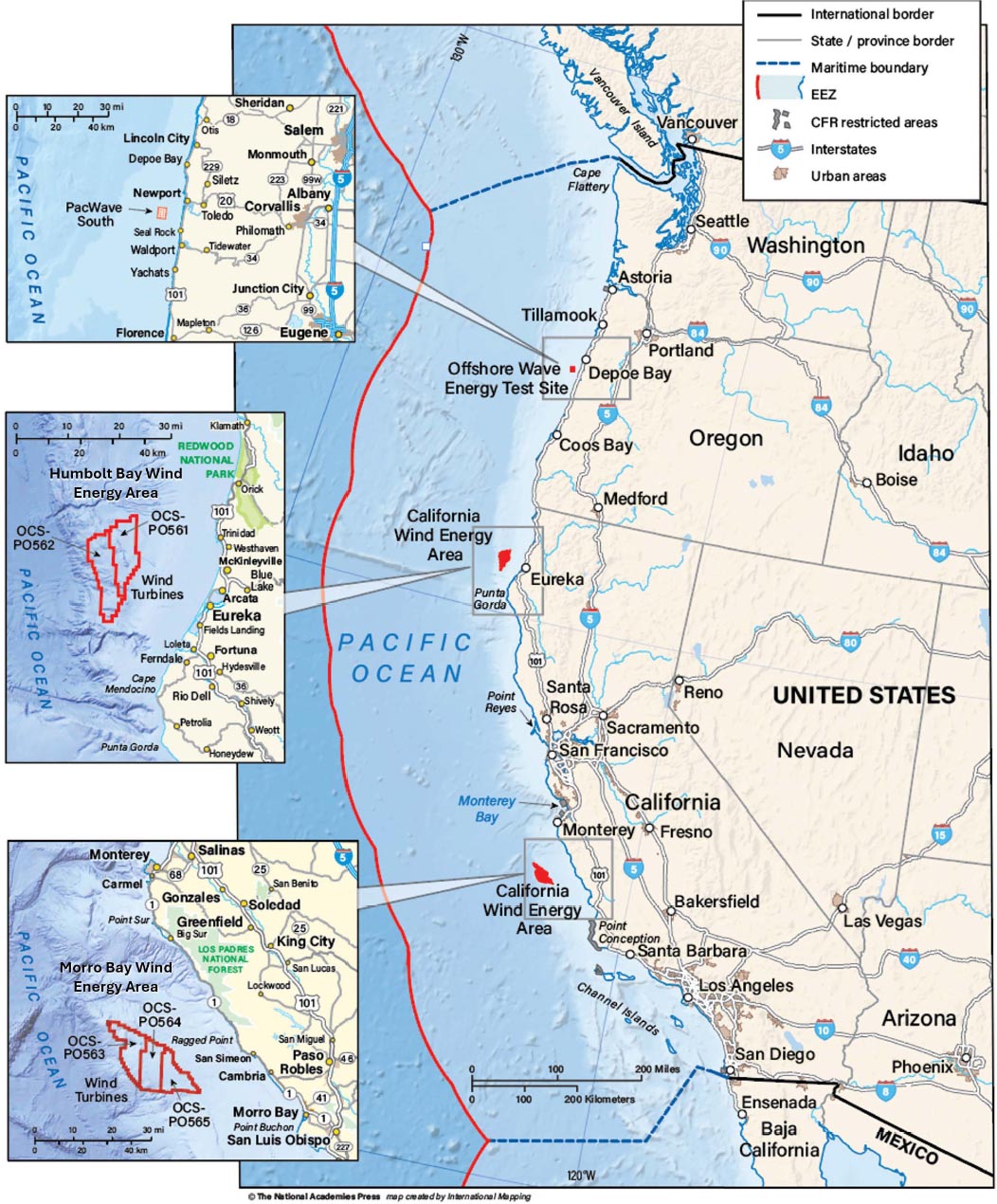
NOTE: OCS = Outer Continental Shelf; OSC – P0561, OSC-P0562, OSC-P0563, OSC-P0564, and OSC-P0565 are individual lease areas.
SOURCE: Created for the committee by International Mapping.
conditions, habitats, populations and abundances of fish stocks and data on fish landings. The report is presented to the Pacific Fishery Management Council (PFMC) in March each year to help inform management decisions in the upcoming fishing year.
Plants, birds, and marine mammals are also a key part of the CCE. Plants of commercial importance include kelps and other algae attached to the bottom, often in relatively shallow water. Both migratory and resident varieties of birds and mammal species are important to the ecosystem and may be affected by ORE development. Migratory species include birds (sooty shearwater, common murre, Black-footed albatross) and whales (blue, gray, humpback, minke whales, and West Coast Bigg’s Transient killer whales). Resident birds include many shorebirds and seabirds, particularly those associated with upwelling, including cormorants, pelicans, and boobies. Resident marine mammals include sea lions, seals, dolphins and the Southern Resident killer whale (NOAA Fisheries, n.d.).
A significant fraction of plankton production at times sinks and decays at depth, causing low oxygen in deeper and bottom waters (Zheng et al., 2020). Upwelled waters can be low in oxygen, though primarily on the inner shelf (Ren et al., 2025). Mixing due to wind and stratification due to solar heating also affect the vertical movement of water, nutrient fluxes, and production of organic matter by plankton and fish. ORE projects may affect both upwelling and mixing, particularly locally, with subsequent effects on plankton, fish, and fisheries.
Commercial, Tribal, and Recreational Fishing
West Coast ecosystems support various communities including fishing industries, commercial and recreational maritime users, and a number of Tribes and Tribal Nations. Commercial fishing along the West Coast began in the 1800s and has since grown into an industry employing thousands of people. Fisheries’ relative importance has changed over time. Figure 1-2 shows fishing activity since the 1970s, which has been impacted by major climate events and closures. Although target species have shifted over time, fishing remains a substantial industry on the West Coast. In its most recent annual economics report, NMFS reported over $700 million in commercial fishing ex-vessel revenue and 290,000 jobs throughout California, Oregon, and Washington in 2022 (NMFS, 2024). Ex-vessel revenue represents dollars paid to fishermen and does not capture the downstream economic benefits. Table 1-1 compares the relative value of commercial fisheries along the U.S. West Coast for 2011-2020. Dungeness crab (benthic) was the most valuable fishery. Pacific whiting (groundfish) was third. Whiting is broadly distributed along the U.S. West Coast and migrates, reproducing in the south and feeding and growing in the north (Hollowed, 1992). Market squid (pelagic) was fourth and pink shrimp (benthic) sixth. Albacore tuna (highly migratory), ranked seventh, migrate shoreward in spring to fall to feed on small pelagic fish, including anchovy and sardine. Chinook salmon ranked eighth and are of particular importance to Tribes situated on the West Coast and inland, given salmon migration up and down river systems. Chinook salmon are also the primary food of Southern Resident killer whales, a population federally listed as endangered.
In the United States, there are 574 federally recognized Tribes, hundreds of which can be found along the California, Oregon, and Washington coasts (Schwartz, 2024). In addition, there are several Tribes that are non-federally recognized but have been recognized by individual states. Fishing practices have sustained many of the coastal and some inland Tribes and continue to be important economically and culturally.
Coast Guard Operations
The Coast Guard conducts extensive operations along the West Coast that directly affect commercial fishing vessels, recreational boaters, and commercial maritime traffic through SAR services, navigation safety programs, fisheries law enforcement, marine environmental protection, and more. As stated in Box 1-1 the committee’s task focuses on Coast Guard operations related to commercial fishing activity. Beyond basic navigation safety operations, the Coast Guard’s SAR program represents perhaps the most critical service for commercial fishermen, with rescue coordination centers in Alameda, California, and Seattle, Washington, managing emergency responses for areas offshore California, Oregon, and Washington. Despite dramatic improvements since the 1980s, when nearly 250 commercial fishing vessels were lost annually nationwide, the Coast Guard still responds to significant numbers of fishing vessel emergencies. In 2023 the Coast Guard conducted 258 assistance cases for commercial fishing vessels, saving 17 lives while documenting 4 fatalities and 9 total vessel losses off California, Oregon,
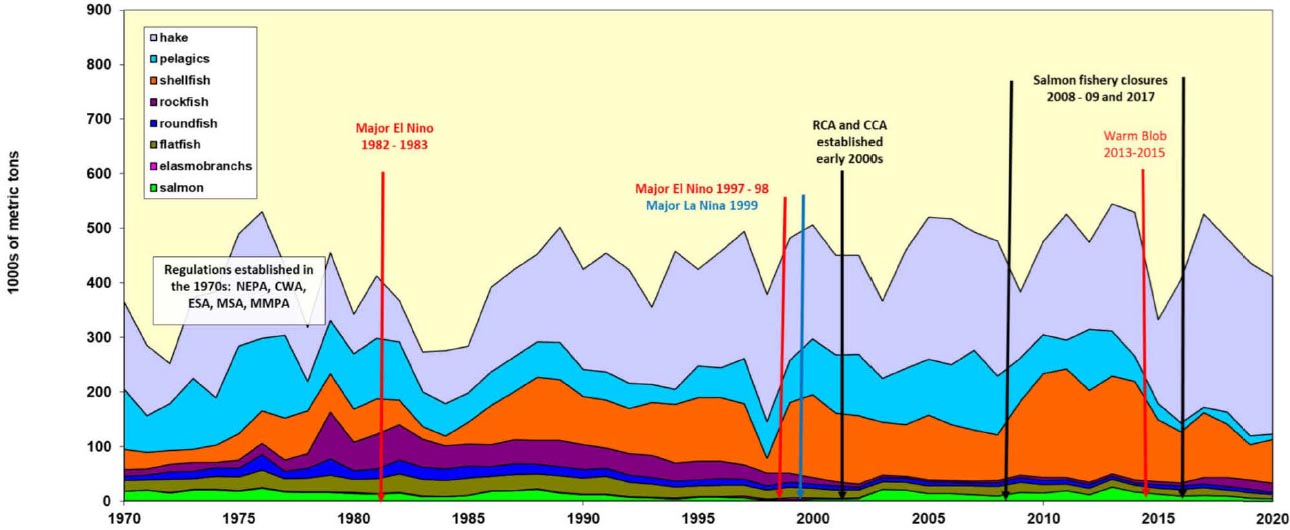
NOTE: CCA = Cowcod Conservation Area; CWA = Clean Water Act; ESA = Endangered Species Act; MMPA = Marine Mammal Protection Act; MSA = Magnuson-Stevens Act; NEPA = National Environmental Policy Act; RCA = Rockfish Conservation Area.
SOURCE: PFMC, 2022.
aThis figure was updated after release of the report to accurately reflect the time period of interest, from 1970 to 2020.
TABLE 1-1 Relative Commercial Fishing Value by Species
| Rank | Common Name | Gross Revenue of Landings (%) |
|---|---|---|
| 1 | Dungeness crab | 30.9 |
| 2 | Pacific oyster a | 8.2 |
| 3 | Pacific (whiting) hake | 8.2 |
| 4 | California market squid | 7.9 |
| 5 | Geoduck | 6.0 |
| 6 | Ocean pink shrimp | 5.9 |
| 7 | Pacific albacore tuna | 5.4 |
| 8 | Chinook salmon | 5.1 |
| 9 | Sablefish | 4.2 |
| 10 | California spiny lobster | 2.2 |
a Pacific oysters are all cultured within bays and estuaries.
SOURCE: Modified from Feist et al., 2025.
and Washington (USCG, 2024). The agency maintains a 2-hour response goal for emergencies in areas reasonably supported by cutters, small boat stations, and air stations, though this standard cannot always be met in remote ocean areas, where many commercial fishing operations occur.
The Coast Guard’s regulatory and enforcement activities also shape the daily operations of West Coast commercial fishermen through fisheries law enforcement, vessel safety examinations, waterways management, and environmental protection measures. Working in partnership with the NMFS, Coast Guard units patrol over 130,000 sq mi of the exclusive economic zone (EEZ) off California alone, conducting approximately 1,500 commercial and recreational fishery boardings in 2023 across the three West Coast states. The agency also maintains critical navigation infrastructure including nearly 2,800 aids to navigation along the waters off continental West Coast, manages port access routes and traffic separation schemes that affect vessel transit patterns, and enforces marine environmental protection measures designed to conserve the fish stocks and habitats upon which commercial fishermen depend.
Offshore Renewable Energy Planning
The development and management of ORE infrastructure is influenced by both federal and state regulations. Federal agencies included in the ORE development process are summarized in Table 1-2. Table 1-3 summarizes relevant state and federal law related to ORE.
Executive orders are another important aspect of ORE policy that can both indirectly and directly impact the process of development and subsequent management of these resources. An example of an executive order that indirectly impacts the development process for ORE is Bill Clinton’s May 24, 1996, Executive Order 13007, “Indian Sacred Sites,” which directs managers of federal lands to accommodate access to and limit adverse effects on areas deemed sacred to federally recognized Tribes. Similarly, executive memorandums and proclamations are presidential directives that can have a comparable impact to executive orders. For example, the Presidential Memorandum on January 20, 2025, “Temporary Withdrawal of All Areas on the Outer Continental Shelf from Offshore Wind Leasing and Review of the Federal Government’s Leasing and Permitting Practices for Wind Projects,” which temporarily withdraws all areas on the Outer Continental Shelf (OCS) from new or renewed offshore wind leasing.
Executive Order 13175, “Consultation and Coordination with Indian Tribal Governments,” requires federal agencies to take Tribal perspectives into account when developing and managing these kinds of projects by defining the need for a consultation process. Due to the sovereign nature of each federally recognized Tribe or Nation, there is no single method of engagement that is appropriate. Engagement with Tribal governments is an essential part of the ORE development process. Some agencies have worked to develop a framework for their consultation
TABLE 1-2 Federal Agencies Involved in Offshore Renewable Energy Development
| Federal Agency | Summary of Responsibilities |
|---|---|
| Bureau of Safety and Environmental Enforcement | Enforcement of offshore environmental and safety regulations including site inspections, environmental and safety responses, permit enforcement. |
| Bureau of Ocean Energy Management | Development of offshore wind energy projects including identifying suitable development areas, administering leases, conducting environmental studies under National Environmental Policy Act, and permitting. Leasing for hydrokinetic projects in federal waters. |
| Department of Energy | Supports research and development of offshore renewable energy (ORE) technology, fosters growth of supply chains and manufacturing of ORE parts, and plans for project grid integration |
| Federal Energy Regulatory Commission | Regulation of grid interconnection, transmission, and wholesale electricity markets and the development of hydropower and hydrokinetics. |
| National Oceanic and Atmospheric Administration | Research and policy development related to the atmosphere and the oceans, including weather monitoring and forecasts, coastal restoration, fisheries management, protection of some species of marine mammals, coastal zone management, and marine sanctuary management. |
| U.S. Coast Guard | Navigation safety, management and enforcement of maritime operations, including law enforcement, prevention and response (including search and rescue), marine transportation, security, and defense. |
| U.S. Army Corps of Engineers | Regulation of structures and building projects in navigable waterways including on the Outer Continental Shelf, regulation of dredge and fill material discharge, and oversight of ORE export cables onshore |
SOURCE: Pribyl, 2025.
TABLE 1-3 Laws Granting Regulatory Authority for Offshore Renewable Energy Development
| Act | State or Federal Power | Summary |
|---|---|---|
| Coastal Zone Management Act (1972) | State | Provides for state planning and regulation of coastal resources and can aid in the protection of coastal habitats. Grants states the authority to consider whether to certify federal actions and whether federal permittees affecting the coastal zone are consistent with enforceable state policies. |
| Submerged Lands Act (1953) | State | Defines the jurisdictional coastal lands of 3 NMa out from shore for the West Coast states. |
| Outer Continental Shelf Lands Act (OCSLA) (1953) | Federal | Regulates the placement, operation and decommissioning of offshore oil and gas and offshore wind infrastructure on the sea floor and mining from 3 NM from shore to the outer extent of the continental shelf, which is generally 200 NM. |
| Energy Policy Act (2005) | Federal | Amends the OCSLA to grant Department of the Interior authority to regulate alternative energy which includes offshore wind. Defines the framework associated with offshore development as it relates to the regulations, permitting, and other legalities. |
| National Environmental Policy Act (1969) | Federal | Develops the foundation for federal agencies to assess and report on the environmental impacts of actions funded, carried out, or authorized by federal agencies. |
| National Historic Preservation Act (1966) | Federal | Defines requirement of federal agencies to consult with Tribal Nations when a project can affect properties with cultural significance to Tribes. |
NOTE: This is not a complete list of appliable laws, but those relevant to discussion in this report.
a A straight baseline is drawn across Monterey Bay from Monterey to Santa Cruz to include the whole bay in state waters, extending the state water further than 3 NM from shore.
SOURCE: Pribyl, 2025
process, and other independent organizations have developed guidance documents that can provide a structure for engagement. However, these do not replace the need for involved agencies to develop individual relationships with affected Tribes and Nations to best determine suitable methods of engagement
REPORT ORGANIZATION
Drawing on information from several in-person and virtual information-gathering sessions and a review of current literature, the committee addressed the statement of task. The report is broken into seven chapters. Chapters 2 through 4 provide information on past and current uses of the maritime space including shipping, fisheries and Coast Guard operations. Chapter 2 presents an overview of maritime activity on the West Coast, and historic, current and future shipping activity. In Chapter 3, we examine historic and future commercial, recreational, and Tribal fisheries as well as information on anticipated shifts in fish stocks. Chapter 4 covers an analysis of Coast Guard operations on the West Coast, focusing on those relevant to commercial fishing as outlined in the committee’s Statement of Task.
Then, in Chapters 5 and 6 the report introduces ORE technology and the current planning process for development. Chapter 5 presents the state of ORE, FOW, wave, and tidal energy, and development sites on the West Coast. In Chapter 6 we discuss the ORE development planning process at both the federal and state planning levels and discuss community engagement.
The report concludes with a chapter on the interactions between ORE and other ocean use. In Chapter 7 we discuss interactions between ORE development and topics covered in Chapters 2 through 6, discussing potential benefits and burdens of these interactions. Conclusions are included throughout Chapters 2 through 7. In addition to highlighting both potential benefits and burdens from ORE development on the West Coast we provide recommendations at the end of Chapter 7.
REFERENCES
DOT (United States Department of Transportation Bureau of Transportation Statistics). 2025. Port performance freight statistics: 2025 annual report. Washington, DC.
Feist, Blake E., Robert Griffin, Jameal F. Samhouri, Leena Riekkola, Andrew O. Shelton, Y. Allen Chen, Kayleigh Somers, Kelly Andrews, Owen R. Liu, and Jennifer Ise. 2025. “Mapping the value of commercial fishing and potential costs of offshore wind energy on the U.S: West Coast: Towards an assessment of resource use tradeoffs.” PLOS ONE 20 (3):e0315319. doi: 10.1371/journal.pone.0315319.
Hollowed, Anne Babcock. 1992. Spatial and Temporal Distributions of Pacific Hake, Merluccius productus, Larvae and Estimates of Survival During Early Life Stages. CalCOFI Rep. Vol. 33. https://calcofi.com/publications/calcofireports/v33/Vol_33_Hollowed.pdf.
NMFS (National Marine Fisheries Service). 2024. Fisheries Economics of the United States, 2022. U.S. Dept. of Commerce, NOAA Tech. Memo NMFS-F/SPO-248B.
NOAA Fisheries. n.d. “California Current Regional Ecosystem.” https://www.fisheries.noaa.gov/west-coast/ecosystems/california-current-regional-ecosystem (accessed December 14, 2025).
PFMC (Pacific Fishery Management Council). 2022. Pacific Coast Fishery Ecosystem Plan For the U.S. Portion of the California Current Large Marine Ecosystem. https://www.pcouncil.org/documents/2022/04/pacific-coast-fishery-ecosystem-plan-march-2022.pdf.
PMA (Pacific Maritime Association). 2024. Pacific Maritime Association 2024 Annual Report. https://pma.uberflip.com/i/1533421-2024-pma-annual-report/0?
Pribyl, Sean. 2025. “Legal framework - Offshore renewable energy development process.” [Presentation to a NASEM Committee.]
Ren, A.S., D.L. Rubnik, and D.P. Nicholson. 2025. “Seasonal dissolved oxygen gas exchange in the California Current Upwelling System.” Progress in Oceanography 236:103473. doi: 10.1016/j.pocean.2025.103473.
Schwartz, Mainon A. 2024. “The 574 Federally Recognized Indian Tribes in the United States.” Congressional Research Service Report R47414. https://www.congress.gov/crs-product/R47414.
USCG (United States Coast Guard). 2024. U.S. Coast Guard 2023 report to the Pacific Fishery Management Council. https://www.pcouncil.org/documents/2024/03/h-2-a-supplemental-uscg-report-1-u-s-coast-guard-2023-report.pdf.
Zheng, Guangming, and Paul M. DiGiacomo. 2020. “Linkages Between Phytoplankton and Bottom Oxygen in the Chesapeake Bay.” Journal of Geophysical Research: Oceans 125 (2):e2019JC015650. doi:10.1029/2019JC015650.


