Coordination of Highway Safety Improvement Program and Highway Safety Office Activities (2026)
Chapter: 4 Case Examples

CHAPTER 4
Case Examples
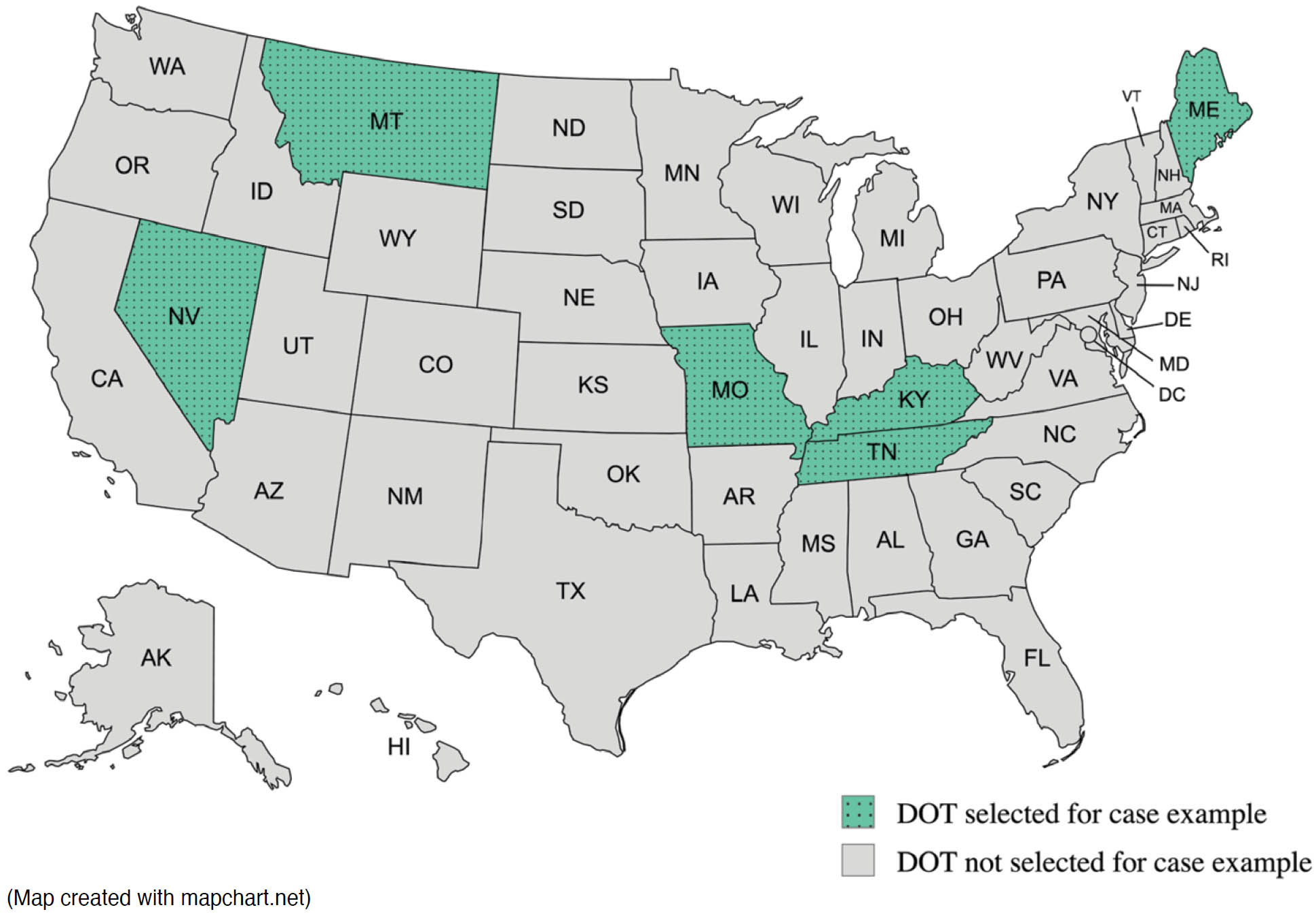
This chapter presents case examples for HSIP and HSO coordination by six DOTs (Figure 36): Kentucky (KYTC), Maine (MaineDOT), Missouri (MoDOT), Montana (MDT), Nevada (Nevada DOT), Tennessee (TDOT). In consultation with the topic panel, the following criteria were factors in choosing the DOTs for the case examples:
- Diversity with respect to organizational structure and geography and whether the HSIP and HSO are within the same agency; and
- Willingness to participate in a case example, as indicated in the survey.
Table 17 lists the DOTs selected for the case examples along with the basis for selection as a case example and the agency that houses their HSO (based on survey response).
The case examples were developed from phone interviews with personnel from the six DOTs. The case example write-ups were reviewed for accuracy and approved by the interviewees for each case example. HSO staff also participated in the DOT interviews for Kentucky, Maine, Missouri, Montana, and Nevada. Typical case example interview questions are provided in Appendix C. Some of the topics for HSIP and HSO coordination during the interviews included the following:
- Organizational structure;
- Coordination activities;
- Use of performance metrics, data, tools, and dashboards;
- Future direction; and
- Challenges.
The case examples are described in the following sections of this chapter.
KYTC
Structure and Overview
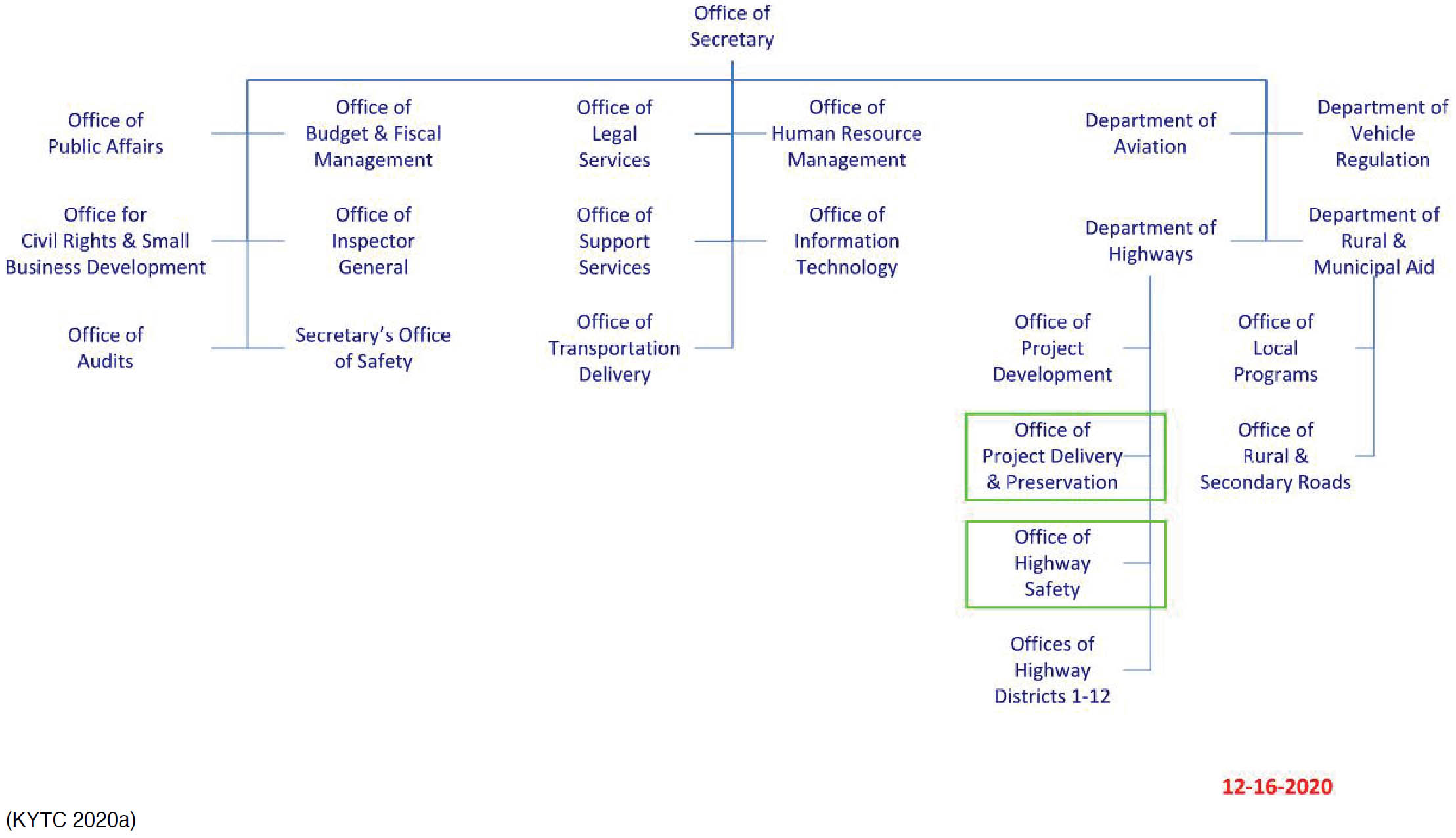
In Kentucky, the HSIP and HSO are both within the Transportation Cabinet. The HSIP is administered by the Traffic Safety Branch which is part of the Division of Traffic Operations within the Office of Project Delivery and Preservation. The Traffic Safety Branch is managed by the Traffic Safety Branch Manager with support from four other staff members. Their primary responsibility is to administer the HSIP. This group divides the state of Kentucky between them so that each staff member is responsible for an assigned portion of the state. The HSO is its own office within the Transportation Cabinet—the Office of Highway Safety. The HSO is divided into two divisions—the Division of Incident Management and the Division of Highway Safety Programs. An organizational chart is shown in Figure 37. The HSIP is located within the Office of Project Delivery & Preservation, and both offices report to the Department of Highways.
Long Description.
A map of the United States with state abbreviations. Nevada, Montana, Missouri, Kentucky, Tennessee, and Maine are marked as selected for DOT case example. All other states are marked as not selected for case example. A legend lists DOT selected for case example and DOT not selected for case example. The map is created with mapchart dot net.

Long Description.
The table has 3 columns and 7 rows. The column headers in Row 1 are DOT; Basis for Selection as Case Example; Agency that Houses HSO (asterisk note cue). Row 2: Kentucky; Southeastern region of United States. HSO under DOT as its own branch. Highest level of coordination is for SHSP; Kentucky Transportation Cabinet. Row 3: Maine; Northeastern region of United States. HSO under another agency. Coordination on wide range of activities; State Department of Public Safety. Row 4: Missouri; Midwestern region of United States. HSO under DOT, in same Division as HSIP. Highest level of coordination is for SHSP; MoDOT. Row 5: Montana; Northwestern region of United States. HSO under DOT, in different Division than HSIP. Highest level of coordination is for SHSP, identification of safety focus areas, and identification of safety strategies; MDT. Row 6: Nevada; Western region of United States. HSO under another agency. Highest level of coordination is for allocation of funding, SHSP, and engagement with local agencies; Department of Public Safety, Office of Traffic Safety. Row 7: Tennessee; Southeastern region of United States. HSO under another agency. Coordination on wide range of activities; Department of Safety and Homeland Security. Note for asterisk: As provided in the survey response for Question 1.
Long Description.
An organizational chart lists the Kentucky Transportation Cabinet executive offices and departments. At the top is Office of Secretary. Under it are Office of Public Affairs and Office of Budget and Fiscal Management, Office of Legal Services and Office of Human Resource Management, Department of Aviation and Department of Vehicle Regulation. Next, it includes Office for Civil Rights and Small Business Development and Office of Inspector General, Office of Support Services and Office of Information Technology, Department of Highways and Department of Rural and Municipal Aid. Under Department of Highways are Office of Project Development, Office of Project Delivery and Preservation, Office of Highway Safety, and Offices of Highway Districts 1 to 12. Under Department of Rural and Municipal Aid are Office of Local Programs and Office of Rural and Secondary Roads. The other offices under Office of Secretary are Office of Audits, Secretary’s Office of Safety, and Office of Transportation Delivery. The date December 16, 2020 appears at the bottom along with KYTC 2020 a.
The HSO is largely responsible for all behavioral-related safety projects, although HSO staff have also started getting more involved with infrastructure projects by helping with media and public messaging. This is especially true for projects involving innovative designs through a SAFERoad Solutions webpage (KYTC 2020e). Kentuckyʼs HSO is responsible for managing the stateʼs NHTSA grants for speeding, distracted driving, and impaired driving. Kentucky does not currently receive any penalty funds from NHTSA. The HSIP is largely responsible for all infrastructure-related safety projects.
The SHSP is managed by the HSO, with collaboration from the HSIP team.
Coordination Practices
The HSOʼs Division of Highway Safety Program works with the HSIP team now more than ever, although both teams recognize there is still room to grow. Most coordination occurs only when specific projects or needs are identified. Routine touching base and discussions occur when it is time to update safety performance targets for HSIP and HSO reporting. Most recently, the two teams have been collaborating heavily on VRU safety. The state is experiencing a sharp increase in crashes involving these VRUs, so the HSIP and HSO are working together to try and reverse the trend. This includes joint participation in VRU-focused Road Safety Assessments.
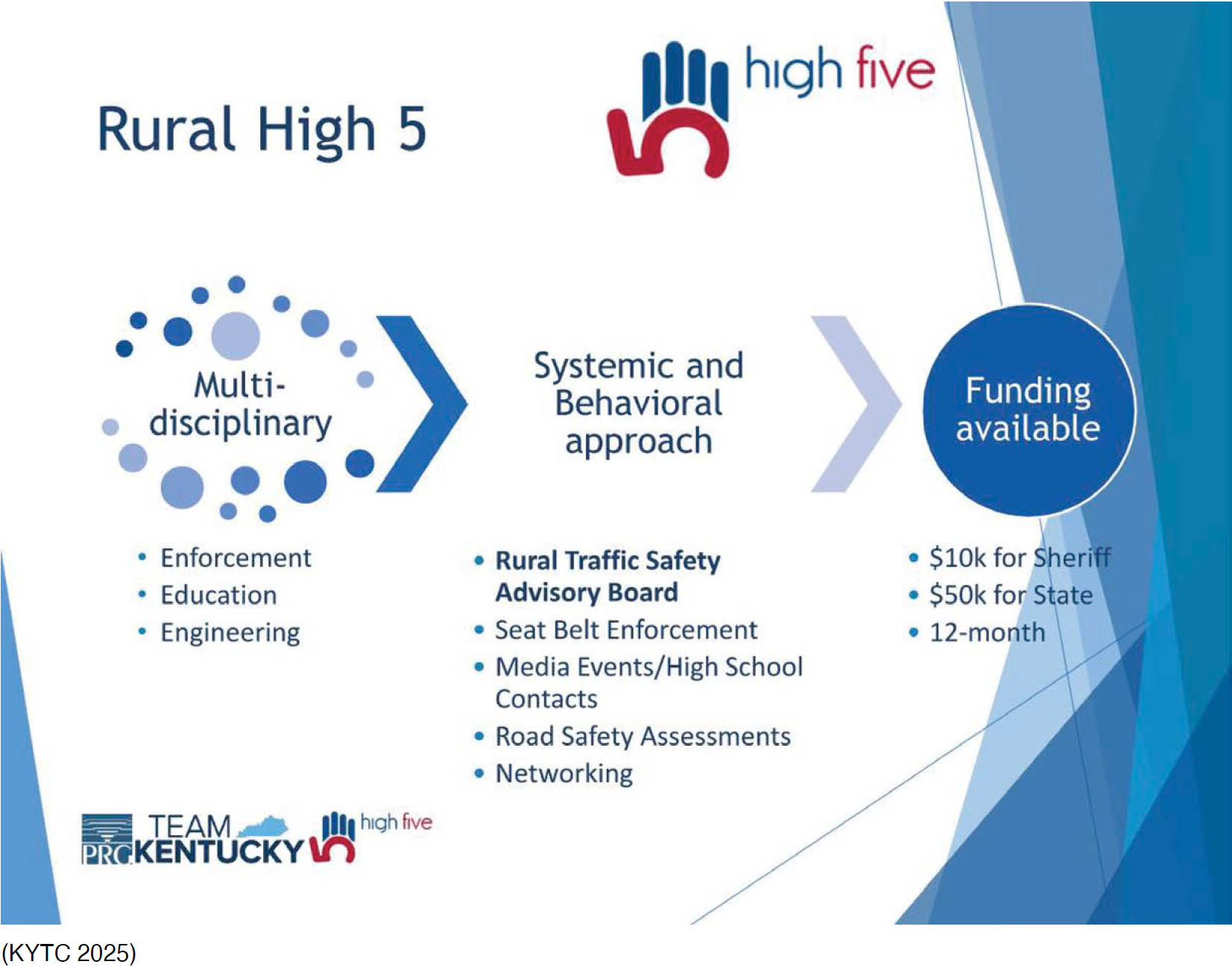
Another recent collaboration example includes Kentuckyʼs High Five Rural Traffic Safety Project, a program focused on improving seatbelt usage in rural areas (KYTC 2020b). The program has been repeated multiple times, and each time crash data is reviewed to identify five priority counties. Work includes community outreach, educational programs for kids, and surveys. Engineering is also involved through performing Road Safety Assessments on high-crash corridors in the counties. The assessments are used to identify low-cost improvements such as signing, pavement marking, and vegetation clearing. An overview of the program is shown in Figure 38.
Long Description.
The slide title reads Rural High 5. A high five logo appears at the top. The slide lists Multi disciplinary with Enforcement, Education, and Engineering. It lists Systemic and Behavioral approach which include Rural Traffic Safety Advisory Board comprising Seat Belt Enforcement, Media Events and High School Contacts, Road Safety Assessments, and Networking. Systematic and behavioral approach leads to Funding available. It lists 10 thousand dollars for Sheriff, 50 thousand dollars for State, and 12 month. The logos of PRC, Team Kentucky, and high five and the text KYTC 2025 are at the bottom.
Kentuckyʼs HSIP coordinates the annual HSIP report updates, and the stateʼs HSO coordinates the HSP. Other than the shared safety performance targets, little to no coordination occurs between the two offices for these annual report updates. Both agreed there is a potential to improve this in the future, especially about the PP&E meetings required by NHTSA. The HSO typically hosts these meetings across the state and had not thought of inviting HSIP representatives. At these meetings the HSO typically receives many infrastructure-related questions and must follow up with responses after the meeting. If HSIP representatives were invited to these PP&E meetings, answers could be provided in real time. HSIP is supportive of this idea.
Challenges and Opportunities
KYTC staff recognize that there is so much work and so many moving parts in the world of traffic safety, and it can be hard to remember to reach out to partners. KYTC staff are interested to hear how other states organize their collaboration efforts. Kentucky is also interested in safety program success stories because they are always open to trying new ideas. A key example of this is the High Five program, which started in Iowa and was then brought to Kentucky.
MaineDOT
Structure and Overview
In Maine, the HSIP is under the Office of Safety and Mobility at the Maine Department of Transportation (MaineDOT), and the HSIP Manager reports to the Chief Engineer. The Office of Safety and Mobility includes a highway safety engineering section, mobility engineering section, travel
analysis specialist, crash records section, and an ADA Coordinator (MaineDOT 2023). The Office of Safety and Mobility coordinates HSIP activities with other groups at MaineDOT, such as Regional Operations, Local Roads, Active Transportation Planner, Traffic Engineering, and Regional Planners. The HSO is within the Department of Public Safety, with the HSO Director reporting to the Commissioner of the Maine Department of Public Safety. HSO staff includes nine Highway Safety Program Coordinators, a Contract Grant Specialist, a FARS Analyst, and a Grant Manager/FARS Supervisor.
The HSIP primarily focuses on infrastructure and engineering countermeasures, while the HSO focuses on behavioral safety (e.g., distracted driving, impaired driving, aggressive driving, speeding, and child passenger safety), training for law enforcement and defensive driving, and traffic records systems (crash/citation). The HSIP and HSO collaborate on the SHSP through the Maine Transportation Safety Coalition (MTSC). HSIP funds are allocated based on SHSP emphasis area data and benefit-cost criteria (MaineDOT 2023), and HSIP projects are generally selected by the HSIP without HSO input. MaineDOT is updating its HSIP manual. Figure 39 shows the coordination process for MaineDOTʼs Safety/Mobility Committee from the draft HSIP manual. NHTSA penalty funds are primarily used by the HSIP for eligible activities.
Coordination Practices
Maineʼs HSIP and HSO collaborate heavily on SHSP development, crash data, media activities, and safety initiatives of mutual interest. The commissioners of MaineDOT and the Maine Department of Public Safety meet weekly. MaineDOT, through the MTSC, leads the SHSP development with significant participation from the HSO and other safety partners (e.g., law enforcement, EMS, Maine Turnpike Authority, MPOs, FHWA) (MaineDOT 2022). MTSC meetings are conducted quarterly. Some SHSP focus areas are led by MaineDOT, while others are led by Maineʼs HSO. The HSIP and HSO generally prepare their HSIP annual report and triennial HSP independently; however, the HSIP does contribute some data analysis to the triennial HSP, and the triennial HSP and annual grant application contribute to the strategies included in the SHSP.
Maineʼs HSIP and HSO also coordinate efforts on areas that overlap, such as pedestrian safety and speed management. The HSO funds law enforcement activities and does behavioral education on pedestrian safety, while MaineDOT funds pedestrian safety improvements and partners with the Bicycle Coalition of Maine and 21 communities on the Heads Up! Pedestrian Safety Initiative (Bicycle Coalition of Maine 2025). The HSO works with law enforcement on speed enforcement and necessary speed measuring devices, while MaineDOT provides some funding for municipal speed data collection.
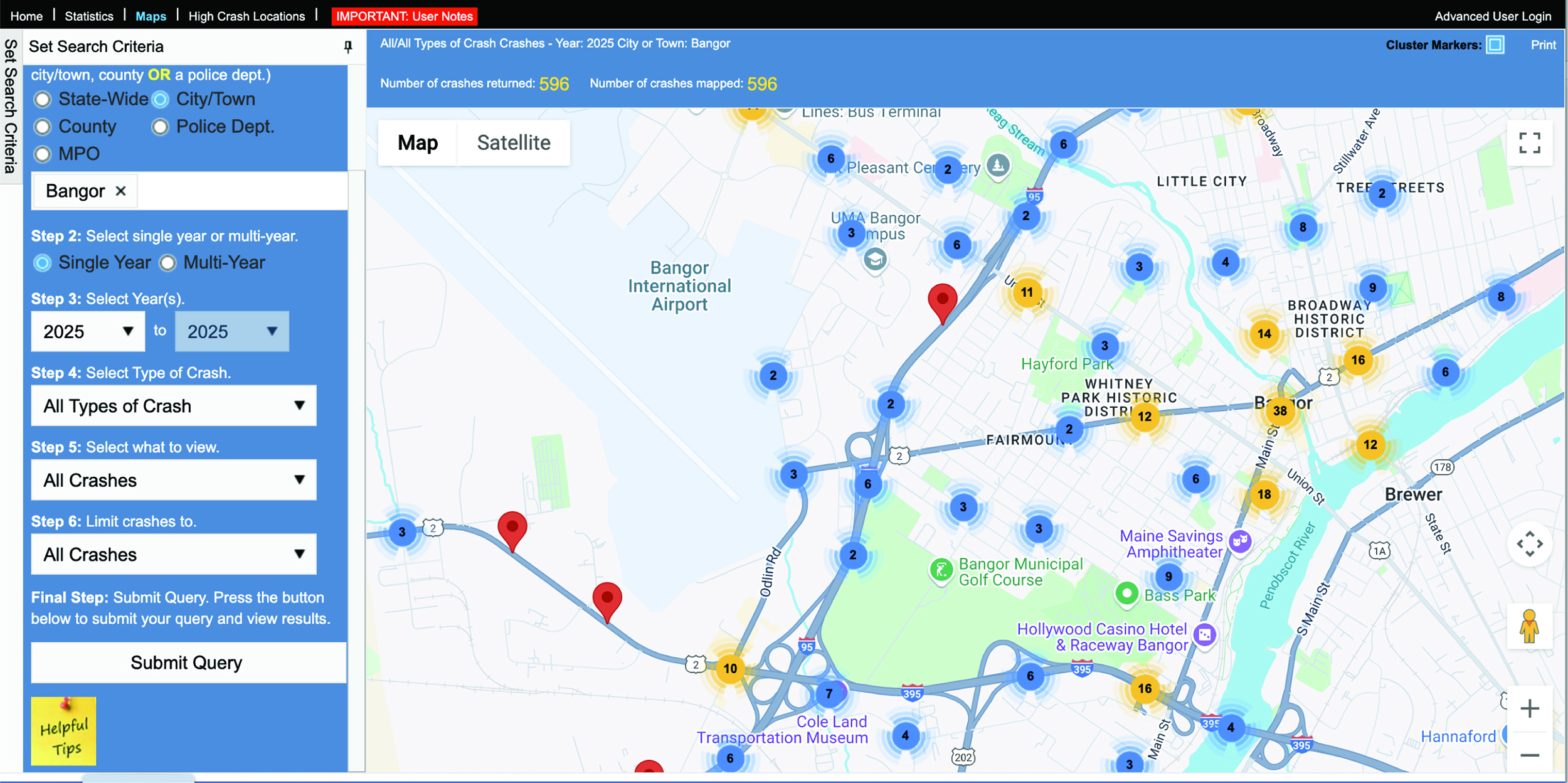
Maineʼs HSIP and HSO also have a high level of collaboration on crash data. The HSO houses FARS data and a crash data warehouse. While the Maine State Police own Maineʼs crash data, MaineDOT has a copy of the crash data, and MaineDOTʼs Crash Records Unit reviews crash reports and conducts safety analyses. MaineDOT provides crash data and analysis for the SHSP. In addition, MaineDOT hosts a publicly available crash query dashboard funded by the Traffic Records Committee (which is chaired by the Director of the HSO). The dashboard allows for queries for crash statistics, mapping, and high-crash locations (MaineDOT 2025b). An example map showing crashes for Bangor, ME, is shown in Figure 40.
Maineʼs HSIP and HSO also collaborate to align performance measures, with the HSIP taking the lead on setting targets for the three performance measures required to be the same (i.e., number of fatalities, number of serious injuries, and fatality rate) (MaineDOT 2023). The HSO shares performance targets from its triennial HSP with the HSIP.
For other programs, MaineDOT sets aside HSIP funds for HRRR (MaineDOT 2023). Rail crossings are under MaineDOTʼs Bureau of Planning, which also manages Safe Routes to School.

(MaineDOT HSIP Manual, unpublished draft)
Long Description.
The diagram centers on Safety Mobility Committee inside a circle with arrows forming a loop around it. Around the loop are circles labeled Safety Engineering, Crash Records, ADA Coordinator, Active Bike or Ped, Transportation Analysis, Regional Planners, FHWA, Project Development, ITS, Region Staff, and Traffic Engineering. On the left, a list titled Safety Delivery Partners includes Local Roads Center, M and O Crews, Highway Program, Multimodal Program, and Municipalities. On the right, a list titled Safety Influencers includes Data Driven Analysis by Governor, Maine DOT Leadership, Legislators, Media, Citizens, MPOs and RPOs, and State and Federal Agencies. Safety influencers lead to Safety or Mobility Committee which leads to Safety Delivery Partners.
(MaineDOT 2025a, Map data © 2025 Google)
Long Description.
The map displays crash data for 2025 in Bangor, Maine. The top states number of crashes returned 596 and number of crashes mapped 596. The map contains blue and yellow cluster markers with numbers and several red location markers. The left panel lists search options with Bangor selected, single year 2025 to 2025, and All Types of Crash and All Crashes selected. A submit query button appears at the bottom.
Maineʼs HSIP and HSO coordinated heavily to develop Maineʼs VRUSA, and MaineDOT developed an Active Transportation Plan in 2023. While the HSO leads PP&E efforts required by NHTSA, Maineʼs HSIP and HSO sometimes collaborate on other public engagement efforts. The HSIP and HSO coordinate to help keep their safety messaging consistent.
Challenges and Opportunities
MaineDOT finds that its HSIP and HSO coordinate well on safety plans, performance measures, and other activities and does not encounter any challenges to HSIP and HSO coordination. While Maineʼs HSIP and HSO offices are in different locations, Maine sees benefits in the use of virtual meeting tools to help foster collaboration and allow more stakeholders to participate. Maine is interested in learning about how other states integrate the Safe System Approach into strategic planning. Maine will work on updating its SHSP in 2026 after the HSIP completes data analysis.
MoDOT
Structure and Overview
Missouriʼs HSIP and HSO are both in the Highway Safety and Traffic Division at MoDOT. The HSIP manager is MoDOTʼs State Traffic Safety Engineer, while the HSO is led by the Assistant State Highway Safety and Traffic Engineer. Both individuals report to the State Highway Safety and Traffic Engineer, who reports to the MoDOT Directorʼs Executive Team. MoDOTʼs HSIP is highly decentralized, with districts selecting projects based on network screening and Central Office personnel providing statewide promotion, direction, and reporting for HSIP, including assisting the districts in problem identification, data analysis, and countermeasure selection. District traffic staff provide data analysis, problem identification, and recommended solutions for potential HSIP projects, and District planning staff assist in programming and budgeting funds for HSIP projects. HSIP funds are allocated among districts based on fatalities and serious injuries. The HSO is highly centralized with program managers overseeing various programs such as impaired driving. The HSO was previously (more than 20 years ago) under the Department of Public Safety.
The HSIP primarily focuses on infrastructure, while the HSOʼs primary focus is on behavioral safety. SHSP development is led by the HSO and Assistant State Highway and Safety Traffic Engineer in collaboration with the HSIP and other safety partners. NHTSA open container funds are split between the HSO (25%) and HSIP (75%), while repeat offender funds mostly go to the HSIP.
Coordination Practices
The HSIP and HSO function independently but share resources and collaborate on SHSP development, an annual traffic safety conference, data analysis, and focus areas of common interest. The focus areas with the most common overlap are speed management, pedestrian safety, and work zone safety. The HSO and HSIP coordinate heavily on SHSP development, especially on identifying emphasis areas. The HSO is not involved with preparing the HSIP report, and the HSIP does not work on the HSP. Within the past 10 years, MoDOT combined separate infrastructure-focused and behavioral-focused conferences into one conference and believes that the combined conference helps to encourage collaboration between the HSIP and HSO and rally safety partners on both infrastructure and behavioral aspects of safety. In addition, HSIP and HSO staff interact daily, and MoDOT finds that having the groups in the same division encourages collaboration.
Missouriʼs HSIP and HSO collaborate heavily on data analysis. Data analysts within the Highway Safety and Traffic Division provide support for both groups. The HSIP and HSO share five performance measures: number of fatalities, number of serious injuries, fatality rate, serious injury rate, and nonmotorized fatalities and serious injuries (MoDOT 2023c). The Missouri Coalition
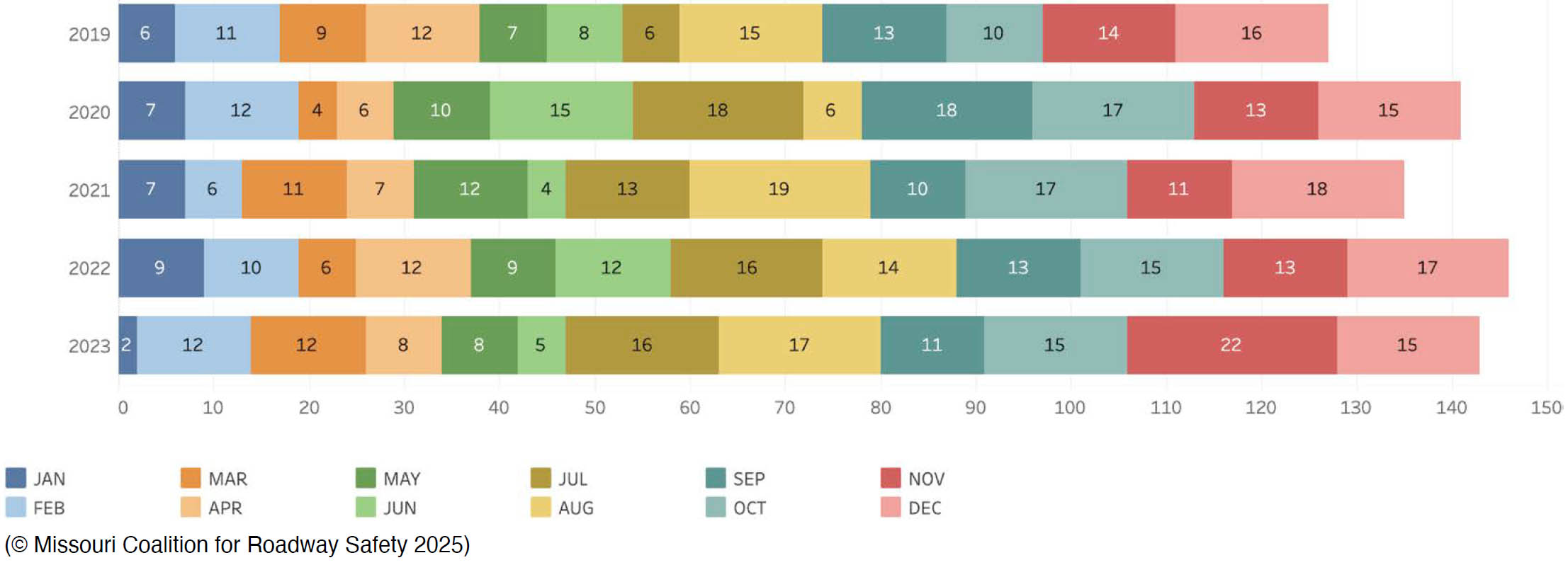
for Roadway Safety maintains various types of publicly available dashboards for traffic crashes and highway safety (Missouri Coalition for Roadway Safety 2025). Figure 41 shows the number of nonmotorized fatalities by year and month. MoDOT has used probe data for approximately 10 years, and both the HSO and HSIP use telematics data to a limited extent. In addition, MoDOT sponsored the development of a platform for data warehousing, analytics, and visualization that supports crash analytics and other use cases (Adu-Gyamfi et al. 2024).
Regarding other programs, MoDOT does not have a Safe Routes to School program and has not triggered HRRR. Rail is under MoDOTʼs Multimodal Division with its own funding sources. MoDOTʼs Rail Section participates in SHSP updates. VRUSAs are led by HSIP in coordination with the HSO. The HSO leads PP&E efforts, while the HSIP supports public involvement processes on infrastructure projects.
Challenges and Opportunities
MoDOT sees navigating administrative regulations, employee turnover, tight project timelines, and the need for finding time to talk to different groups as challenges to its efforts for HSIP and HSO coordination. MoDOT has experienced high staff turnover in the past 5 to 10 years. This turnover has reduced the amount of institutional knowledge related to traffic safety and has increased the need for a more deliberate, intentional evaluation of safety needs. MoDOT has developed tools such as Safety Assessment for Every Roadway (MoDOT 2023a) to facilitate this process. In addition, DOT projects administered through the STIP are typically on tight timelines with public commitments and fiscal constraints. This can limit the amount of time district staff have to evaluate safety needs, especially when funding is limited. MoDOT continues to navigate these challenges and has increased the number of projects that include safety improvements from approximately 28% to approximately 76% in the past 3 years. MoDOT is also interested in learning about any formal safety partnerships formed by other states.
MDT
Structure and Overview
Montanaʼs HSIP and HSO are both housed in MDT, but in different divisions. The HSIP is under the Highways and Engineering Division, while the HSO is in the Rail, Transit, and
Long Description.
The horizontal stacked bar chart lists nonmotorized fatalities in Missouri by month for years 2019 to 2023. Each bar is divided by months January, February, March, April, May, June, July, August, September, October, November, and December. In 2019 the values are 6, 11, 9, 12, 7, 8, 6, 15, 13, 10, 14, and 16. In 2020 the values are 7, 12, 4, 6, 10, 15, 18, 6, 18, 17, 13, and 15. In 2021 the values are 7, 6, 11, 7, 12, 4, 13, 19, 10, 17, 11, and 18. In 2022 the values are 9, 10, 6, 12, 9, 12, 16, 14, 13, 15, 13, and 17. In 2023 the values are 2, 12, 12, 8, 8, 5, 16, 17, 11, 15, 22, and 15. The copyright symbol and Missouri Coalition for Roadway Safety 2025 are at the bottom of the chart.
Planning Division. MDTʼs HSIP has a centralized structure with staff dedicated to developing the annual HSIP list based on a data-driven approach and a minimum benefit-cost threshold (MDT 2023a). MDTʼs HSIP reports to the Traffic and Safety Engineer/Bureau Chief which falls under the Administrator of the Engineering Division, while the head of the HSO is the Supervisor of the State Highway Section and reports to the Administrator of the Rail, Transit, and Planning Division.
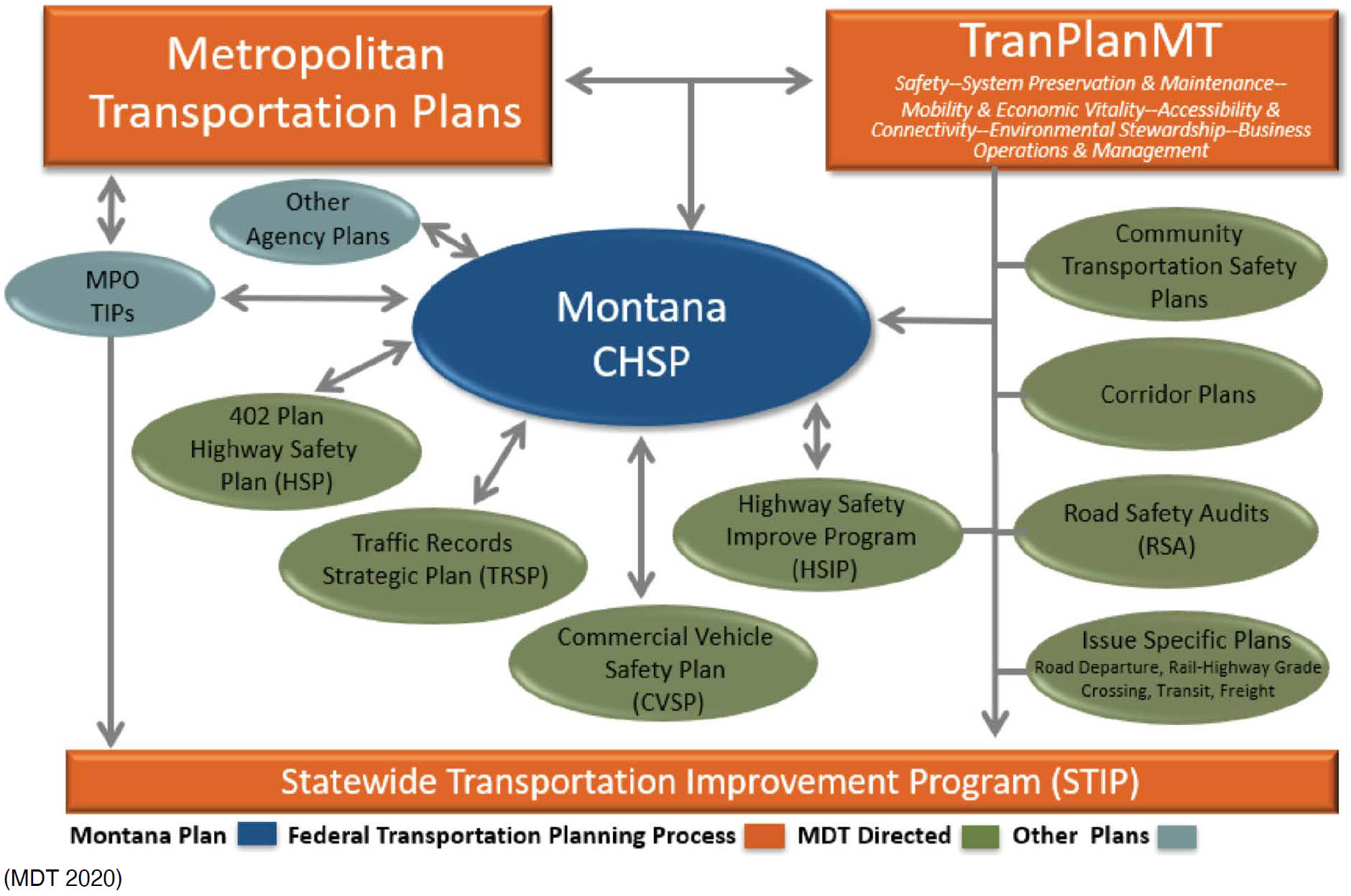
The HSIP primarily focuses on infrastructure, while the HSOʼs primary focus is on behavioral safety. The two groups share information as needed. Development of Montanaʼs CHSP is led by other personnel in the Rail, Transit, and Planning Division, with participation from the HSIP, HSO, and other safety partners. Figure 42 shows the relationship between MDTʼs CHSP and other plans. MDT receives Section 164 NHTSA penalty funds, most of which go to the HSIP. HSIP funds are managed by MDTʼs Headquarters/Central Office (MDT 2023a). In recent years, MDT has begun shifting some HSIP funding to the HSO for use in outreach campaigns. The HSO and HSIP have an annual discussion about sharing HSIP funds.
Coordination Practices
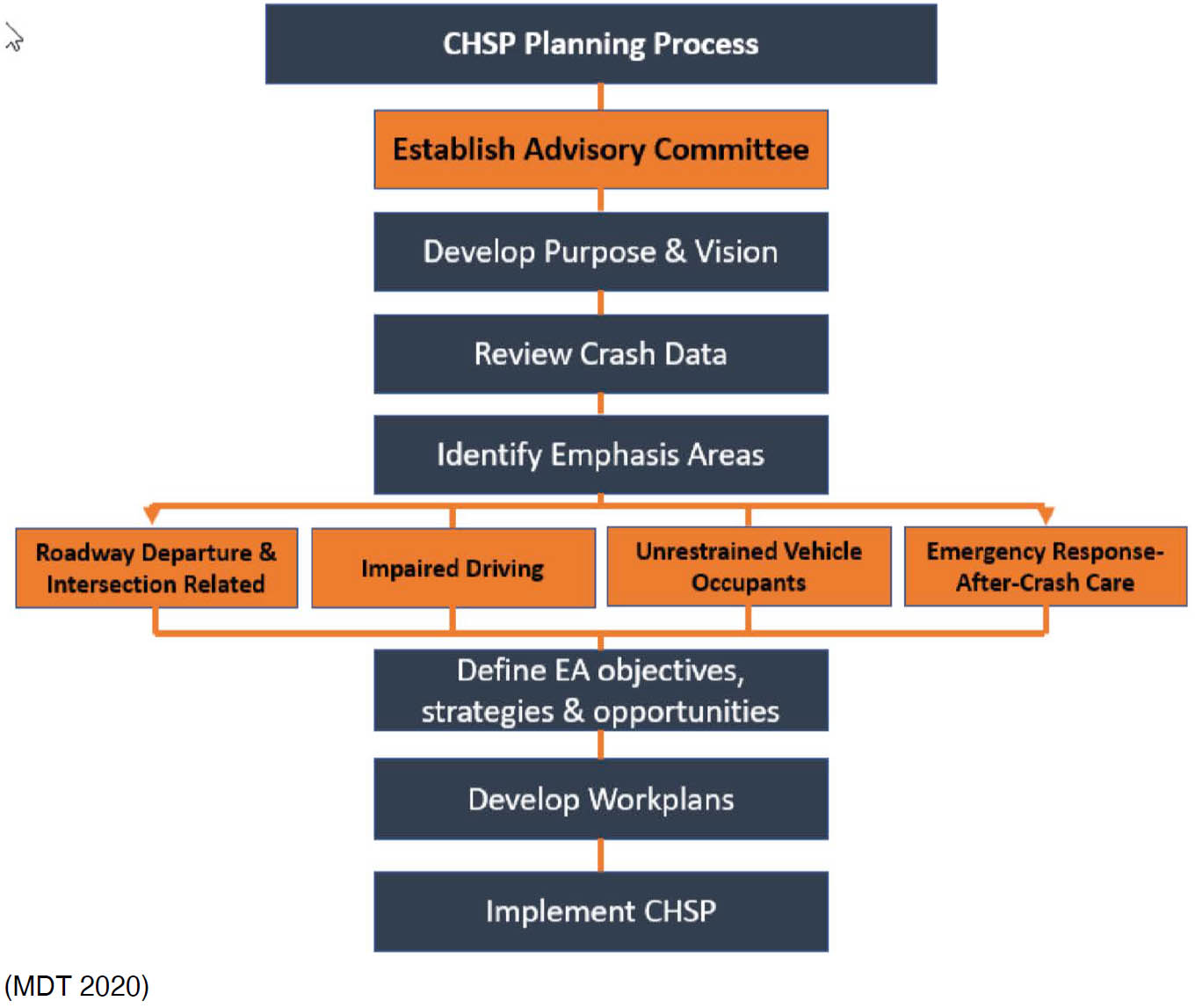
MDTs HSIP and HSO collaborate most often on crash data and CHSP development. An annual meeting is held for the CHSP. The meeting functions as a conference and includes representatives from the HSIP, HSO, and other safety partners. Figure 43 shows the CHSP planning process for MDT. MDT is updating its CHSP in 2025. HSIP staff are also involved in some of the HSOʼs media campaigns. The HSO is not involved with preparing the HSIP report, and the HSIP does not work on the HSP.
MDTʼs HSIP and HSO coordinate on data requests. The HSO has access to and analyzes FARS data, and the HSOʼs FARS data analyst works closely with HSIP staff. The HSIP has access
Long Description.
The diagram centers on Montana CHSP which is a Montana Plan. Montana CHSP includes Federal Transportation Planning Processes, such as Metropolitan Transportation Plans and Tran Plan MT at the top. Montana CHSP has mutual connections with Other Plans such as MPO TIPs and Other Agency Plans and to MDT Directed Plans such as 402 Plan Highway Safety Plan, HSP, and Traffic Records Strategic Plan, TRSP, Commercial Vehicle Safety Plan, CVSP, and Highway Safety Improve Program, HSIP. Tran Plan MT includes MDT Directed Plans such as Community Transportation Safety Plans, Corridor Plans, Road Safety Audits, RSA, and Issue Specific Plans, such as Road Departure, Rail Highway Grade Crossing, and Transit, Freight. These connect to Montana CHSP. Metropolitan Transportation Plans and Tran Plan MT lead to Statewide Transportation Improvement Program, STIP, a Federal Transportation Planning Process. A legend lists Montana Plan, Federal Transportation Planning Process, MDT Directed, and Other Plans. The text MDT 2020 is at the bottom of the diagram.
NOTE: EA = Emphasis Area.
Long Description.
The vertical flow chart presents the CHSP planning process. The steps are Establish Advisory Committee, Develop Purpose and Vision, Review Crash Data, and Identify Emphasis Areas. Under Identify Emphasis Areas are four focus areas. These are Roadway Departure and Intersection Related, Impaired Driving, Unrestrained Vehicle Occupants, and Emergency Response After Crash Care. The next steps are Define E A objectives, strategies and opportunities, Develop Workplans, and Implement CHSP. The text MDT 2020 is at the bottom of the chart.
to a crash database. The HSO and HSIP use some common performance measures and some independent performance measures. The two groups coordinate closely on the five performance measures (number of fatalities, number of serious injuries, fatality rate, serious injury rate, and nonmotorized fatalities and serious injuries) required by FAST (MDT 2020 and 2023a). The HSIP and HSO maintain some internal dashboards. MDT also makes some crash datasets publicly available (MDT n.d.b.) and provides a website with project status updates (MDT n.d.a.). MDT is in the early stages of exploring the use of crowdsourced data.
Regarding other programs, the Bicycle Pedestrian Coordinator in the Rail, Transit, and Planning Division oversees Safe Routes to School. HRRR is under the Highways and Engineering Division, while the VRUSA is coordinated by the personnel who handle the CHSP. MDT uses some HSIP funds for improvements at railroad grade crossings. MDTʼs HSIP and HSO handle public involvement separately. The HSO conducts PP&E efforts in accordance with NHTSA requirements, while the HSIP supports public involvement processes (e.g., public meetings) on infrastructure projects. MDTʼs HSO primarily focuses its PP&E efforts on tribal communities and teens.
Challenges and Opportunities
MDT experiences challenges in HSIP and HSO coordination such as coordinating the release of crash data to the public, differences in funding sources and administrative rules, and employee turnover. The HSIP oversees MDTʼs crash database and coordinates with Legal for releasing crash data. The HSO oversees the FARS data and works with the HSIP team to use non-fatal crash data. MDTʼs HSIP and HSO each have different funding sources with their own rules (HSIP and NHTSA funding), and both HSIP and HSO have seen many retirements and much turnover.
In addition, MDT is going through an agency reorganization. However, MDT finds that the relationship between its HSIP and HSO is strong and does not anticipate that the reorganization will affect coordination between the HSIP and HSO. MDT is interested in learning about the
HSO organizational structures of other states and believes that developing tools to help new employees get up to speed would be beneficial to its coordination practices.
Nevada DOT
Structure and Overview
In Nevada, the HSIP is within the DOT and the HSO is within the Department of Public Safety. The HSIP is under the Traffic Safety Engineering group of the Planning Branch and is managed by the Chief Safety Engineer with support from two assistant chiefs—the Assistant Chief of Data and Analytics, who manages two teams of data analysts, and the Assistant Chief of Engineering, who manages two teams of engineers. In total, 18 staff members support the HSIP and other department safety efforts. The HSO is its own branch of the Department of Public Safety. In addition to the HSIP, the HSO also coordinates with the Bicycle and Pedestrian group of the DOTʼs Planning Branch.
The HSO is largely responsible for all behavioral-related safety projects, and the HSIP is largely responsible for all infrastructure-related safety projects. Both groups know their expertise and work to complement each otherʼs strengths. They continuously collaborate on everything from communication and outreach to policy planning and grant awards. Nevada receives NHTSA penalty funds, and the HSO and HSIP collaborate on how to use the funds.
The SHSP is managed by the HSIP, but both plan development and implementation are a joint effort of the HSIP and HSO.
Coordination Practices
Nevadaʼs HSIP and HSO meet at least monthly to coordinate and collaborate on ongoing work. This includes integration into each otherʼs projects, data sharing, and supporting task forces and working groups. The HSIP also helps the HSO with consultant selection for media messaging and reviewing/providing feedback on messaging to be used. The HSO helps the HSIP with community outreach for projects.
Both the HSIP and HSO have extensive public engagement practices built into how the state approaches projects and their work. Typically, the two offices coordinate public engagement efforts. The HSO does not host formal PP&E meetings because they fulfill the NHTSA requirements organically through other project-related activities.
Nevadaʼs HSIP coordinates the annual HSIP report, and the stateʼs HSO is not involved. Nevadaʼs HSO coordinates the HSP report and includes the HSIP team. The HSIP teamʼs role involves evaluating proposed projects and collaborating on performance targets.
Challenges and Opportunities
One of the biggest challenges between the HSIP and HSO in Nevada is understanding the differences between each officeʼs federal requirements, and sometimes even differences in terminology between NHTSA and FHWA. In general, better documentation around program responsibilities, federal requirements, goals, and collaboration is needed so that, as personnel changes occur, coordination between the offices is not lost. The following specific opportunities for improvement were identified by Nevada:
- Improved documentation that defines how the two programs work together.
- Better understanding of NHTSA requirements at the DOT and HSIP requirements at the HSO, specifically federal program and funding requirements.
- Expanded data analysis and data visualization capabilities at the HSO. Currently, the HSO largely relies on DOT staff for this work.
- Clear communication discussing the similarities and differences between the FARS data and crash and citation data processed by the HSO, and crash data location and visualization efforts performed by the DOT.
TDOT
Structure and Overview
Tennesseeʼs HSIP is under the Traffic Design Division at TDOT, while the HSO is housed in the Department of Safety and Homeland Security. TDOTʼs HSIP manager reports to the TDOT Chief Engineer and Traffic Design Division Director, and the HSO Director reports to the Director of the Department of Safety and Homeland Security. TDOTʼs HSIP is highly centralized, but the Traffic Design Division works with other divisions and regions on the HSIP. Tennesseeʼs HSO was previously under TDOT but was moved to the Department of Safety and Homeland Security, where crash data is housed, in 2017.
The HSIP primarily focuses on infrastructure and engineering countermeasures, while the HSOʼs primary focus is on behavioral safety and data collection. The two groups share information (e.g., crash data) as needed and collaborate on the SHSP along with other safety partners. HSIP funds are allocated based on emphasis areas in Tennesseeʼs SHSP (TDOT 2023). Tennesseeʼs HSO receives an allotment of HSIP funds (approximately 30%) and NHTSA funds as determined by a commissionersʼ agreement. NHTSA funds are used by the HSIP for eligible activities (e.g., systemic safety improvements and VRU programs) and by the HSO for enforcement, education, and programs.
Coordination Practices
Tennesseeʼs HSIP and HSO collaborate most often on crash data and SHSP development. The two agencies collaborate on various aspects of the SHSP, such as identification of emphasis areas and strategies, along with other safety partners (e.g., law enforcement, MPOs, and bicycle and pedestrian advocacy groups). An example of SHSP strategies for improving incident response time and reducing clearance time is shown in Figure 44. Tennesseeʼs SHSP Steering Committee meets quarterly (TDOT and Tennessee Department of Safety and Homeland Security 2020). The HSO and HSIP share updates on action items at these quarterly meetings. The HSO is not involved with the preparation of the HSIP report, and the HSIP does not work on the HSP. The HSO and HSIP conduct separate conferences but sometimes collaborate on speakers for those conferences.
Tennesseeʼs HSO maintains crash data and shares it with the HSIP. Tennessee switched to electronic crash reporting in 2015. Crash reports are uploaded daily, and the HSO hosts various public-facing dashboards. An example dashboard for large truck crashes is shown in Figure 45. TDOT is developing project-related dashboards. The HSIP and HSO coordinate on setting targets for number of fatalities, fatality rate per VMT, and number of serious injuries (TDOT 2023).
Regarding other programs, TDOT has a Safe Routes to School program, but it is not under the HSIP. TDOTʼs rail crossing program is under the HSIP, and HSIP funds are set aside for HRRR (approximately 15%) and VRU Safety Programs (TDOT 2023). VRUs are also an emphasis area in Tennesseeʼs SHSP (TDOT and Tennessee Department of Safety and Homeland Security 2020). The HSO and HSIP collaborate on PP&E efforts and outreach campaigns as needed. For example, the HSO and HSIP both participated in an outreach campaign that involved riding in buses and identifying distracted drivers.

Long Description.
The table titled Improve incident response and reduce the clearance time for crashes lists actions 3.1 through 3.4. Action 3.1 is Improve communications procedures between 911 centers and first responders with plan HSIP and agency or champion TDOSHS. The performance measure is decrease in response time to incident. The Es involved are EMS with a medical cross icon and Enforcement with a badge icon. Action 3.2 is Establish TIM Committees in each county or region with plan HSIP and agency or champion TDOT. The performance measure is number of TIM committees established. The E involved is Engineering with a hard hat icon. Action 3.3 is Maintain and utilize the incident management test track for training of first responders with plan HSIP and agency or champion TDOT. The performance measure is number of trainings conducted and maintenance of test track. The E involved is Education with a graduation cap icon. Action 3.4 is Expand installation of Enhanced Reference Markers ERM and expand coverage of TDOT’s HELP program on controlled access highways with plan HSIP and agency TDOT. The performance measure is percent of access-controlled highway with ERMs. The E involved is Engineering with a hard hat icon. The text TDOT and Tennessee Department of Safety and Homeland Security 2020 is at the bottom of the table.

Long Description.
The dashboard titled January 1, 2025 to June 7, 2025 Crash Count presents large truck crash data. A bar chart at the top lists crash counts by time of day labeled 12 A, 3 A, 6 A, 9 A, 12 P, 3 P, 6 P, 9 P, and Unk. The highest bars appear at 9 A, 12 P, and 3 P. A heat map table below lists days Sunday through Saturday and the same time periods. The values range from 13 to 218. The highest value is 218 on Friday at 12 P. A color scale from 0 to 218 appears at the bottom. A horizontal bar chart on the right lists total crashes by day of week, with Tuesday with the highest total. The text Tennessee Department of Safety and Homeland Security 2025 is at the bottom of the dashboard.
Challenges and Opportunities
Challenges experienced by Tennessee in HSIP and HSO coordination include getting buy-in from stakeholders and aligning different goals. Tennesseeʼs HSIP and HSO have a strong relationship but find that being in different agencies can create challenges. Tennessee finds that aligning HSIP and HSO goals can be challenging since the HSO is focused on enforcement and outreach campaigns and the HSIP is focused on infrastructure. TDOT underwent a reorganization in which the Safety Office moved to the Traffic Design Division. Tennessee is interested in learning about the HSIP and HSO organizational structures of other states.
Summary of Case Examples by DOT
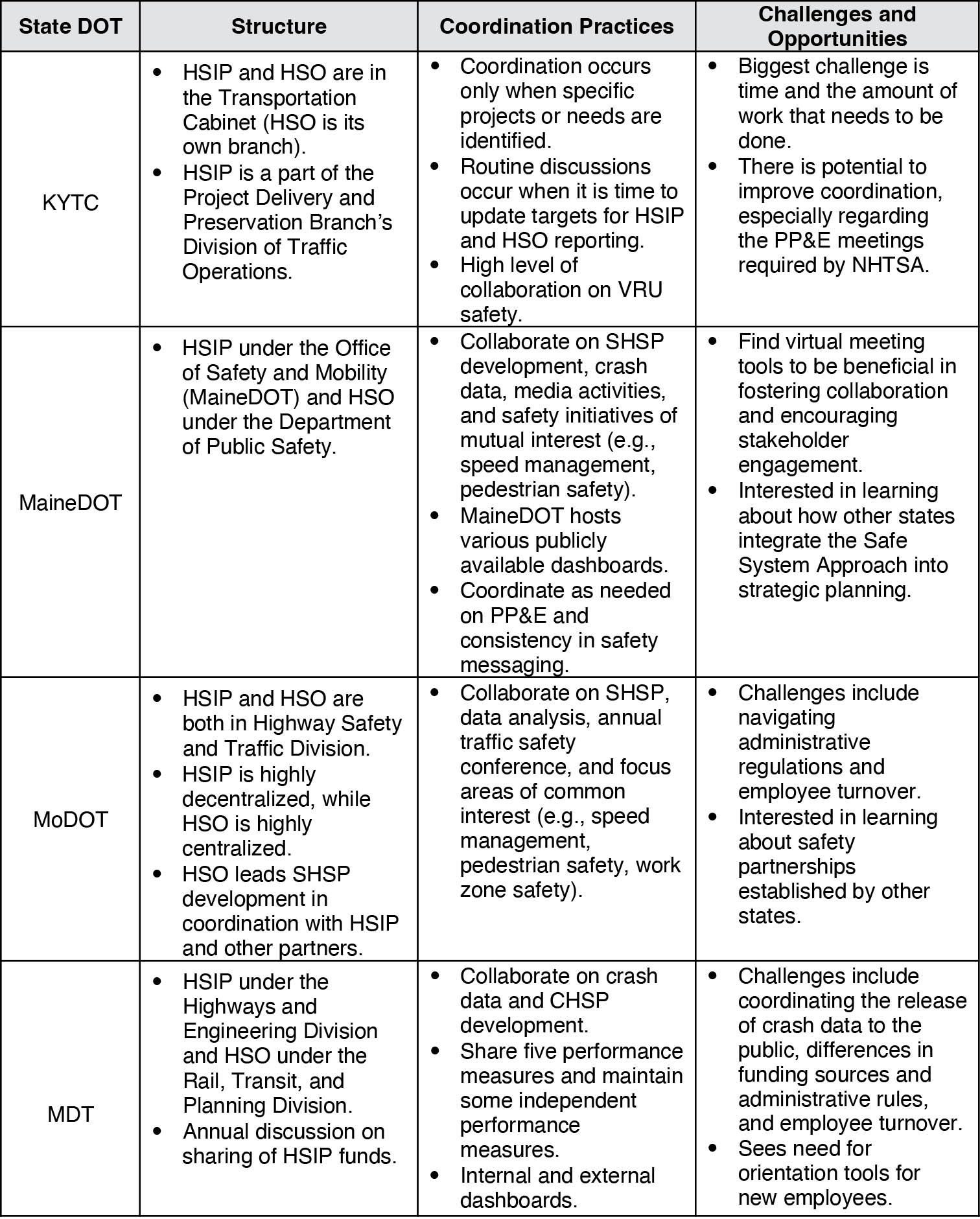
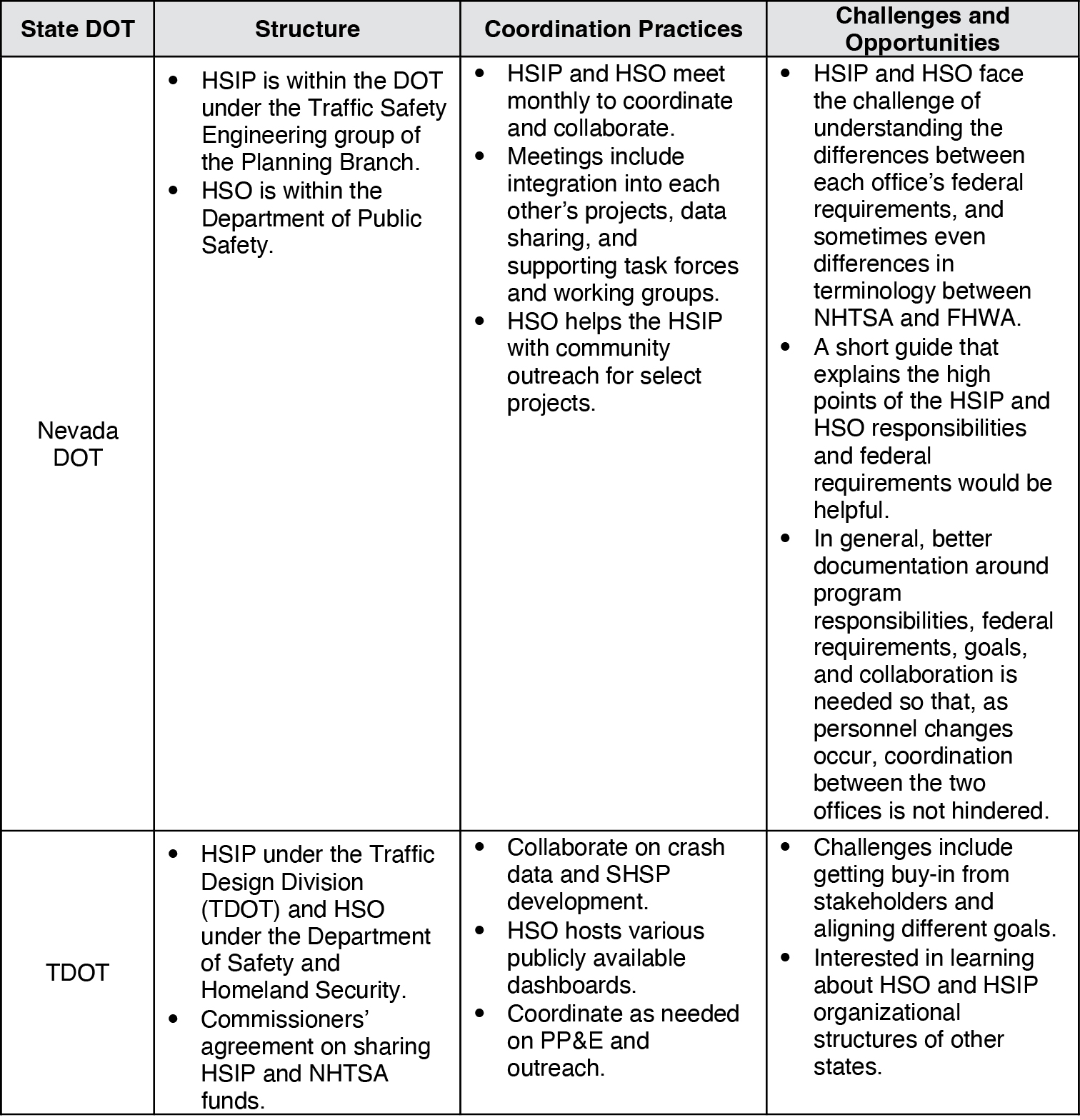
A summary of case examples by DOT is shown in Table 18.
(continued on next page)
Long Description.
The table has 4 columns and 7 rows. The column headers in Row 1 are State DOT; Structure; Coordination Practices; Challenges and Opportunities. Row 2: Kentucky; HSIP and HSO are in the Transportation Cabinet, where HSO is its own branch. HSIP is a part of the Project Delivery and Preservation Branch’s Division of Traffic Operations.; Coordination occurs only when specific projects or needs are identified. Routine discussions occur when it is time to update targets for HSIP and HSO reporting. High level of collaboration on VRU safety.; Biggest challenge is time and the amount of work that needs to be done. There is potential to improve coordination, especially with regard to the PPE meetings required by NHTSA. Row 3: Maine; HSIP under the Office of Safety and Mobility, Maine DOT, and HSO under the Department of Public Safety.; Collaborate on SHSP development, crash data, media activities, and on safety initiatives of mutual interest, for example, speed management and pedestrian safety. Maine DOT hosts various publicly available dashboards. Coordinate as needed on PPE and consistency in safety messaging; Find virtual meeting tools to be beneficial in fostering collaboration and encouraging stakeholder engagement. Interested in learning about how other states integrate the Safe System Approach into strategic planning. Row 4: Missouri; HSIP and HSO are both in Highway Safety and Traffic Division. HSIP is highly decentralized, while HSO is highly centralized. HSO leads SHSP development in coordination with HSIP and other partners; Collaborate on SHSP, data analysis, annual traffic safety conference, and focus areas of common interest, for example, speed management, pedestrian safety, and work zone safety; Challenges include navigating administrative regulations and employee turnover. Interested in learning about safety partnerships established by other states. Row 5: Montana; HSIP under the Highways and Engineering Division and HSO under the Rail, Transit, and Planning Division. Annual discussion on sharing of HSIP funds; Collaborate on crash data and CHSP development. Share five performance measures and maintain some independent performance measures. Internal and external dashboards; Challenges include coordinating the release of crash data to the public, differences in funding sources and administrative rules, and employee turnover. Sees need for orientation tools for new employees.;
Long Description.
The table has 4 columns and 7 rows. The column headers in Row 1 are State DOT; Structure; Coordination Practices; Challenges and Opportunities. Row 6: Nevada; HSIP is within the DOT under the Traffic Safety Engineering group of the Planning Branch. HSO is within the Department of Public Safety; HSIP and HSO meet monthly to coordinate and collaborate. Meetings include integration into each other’s projects, data sharing, and supporting task forces and working groups. HSO helps the HSIP with community outreach for select projects.; HSIP and HSO face the challenge of understanding the differences between each office’s federal requirements, and sometimes even differences in terminology between NHTSA and FHWA. A short guide that explains the high points of the HSIP and HSO responsibilities and federal requirements would be helpful. In general, better documentation around program responsibilities, federal requirements, goals, and collaboration is needed so that, as personnel changes occur, coordination between the two offices is not lost. Row 7: Tennessee; HSIP under the Traffic Design Division, TDOT, and HSO under the Department of Safety and Homeland Security. Commissioners’ agreement on sharing of HSIP and NHTSA funds; Collaborate on crash data and SHSP development. HSO hosts various publicly available dashboards. Coordinate as needed on PPE and outreach; Challenges include getting buy-in from stakeholders and aligning different goals. Interested in learning about HSO and HSIP organizational structures of other states.
Summary of Case Examples by Topic
The six states described in this chapter have diverse experiences with respect to HSIP and HSO coordination. Some of the key findings from the DOT interviews, based on the experiences of these six states, can be summarized in the following sections.
Key Case Example Findings for HSIP and HSO Coordination Practices
- HSIPs and HSOs collaborate most often on SHSP development, data, and safety emphasis areas of mutual interest (e.g., pedestrian safety, speed management, and work zone safety).
- The HSIPs and HSOs are both highly involved with SHSP development along with other safety partners (e.g., law enforcement, EMS, MPOs, FHWA, and bicycle and pedestrian advocacy groups).
- Generally, the HSIPs and HSOs prepare their HSIP reports and triennial HSPs independently.
- The HSIPs and HSOs have a high level of collaboration on data reporting and analysis. Both groups have access to crash data in different forms and share resources and/or results from data analyses.
- The HSIPs and HSOs coordinate heavily on the five required performance measures (i.e., number of fatalities, number of serious injuries, fatality rate, serious injury rate, nonmotorized fatalities and serious injuries) and other safety performance measures.
- The HSIPs and HSOs maintain various types of internal and public-facing dashboards. Public-facing dashboards include such functions as viewing crash statistics and making queries (e.g., mapping crashes and lists of high-crash locations).
- There is some limited use or exploration of telematics and crowdsourced data.
- There are various approaches to other programs (e.g., Safe Routes to School and rail crossings). For example, rail crossings are sometimes funded through HSIP or other sources. Safe Routes to School is typically in other DOT divisions or sections.
- PP&E efforts are typically led by the HSOs, but the HSIPs and HSOs often collaborate on various public outreach and engagement efforts.
Key Case Example Findings for HSIP and HSO Structure
- These states have various organizational structures for their HSIPs and HSOs, with HSOs being under the DOT (in the same or different division than HSIP) or other state agencies (e.g., Department of Public Safety, Department of Public Safety and Homeland Security).
- HSIPs are under different divisions within the DOTs, including Traffic Operations, Office of Safety and Mobility, Highway Safety, Engineering, Highways and Engineering, and Planning.
- The HSOs focus primarily on behavioral safety, while the HSIPs focus on infrastructure improvements for safety.
- HSIP funds and NHTSA penalty funds are used in different ways, and, in some cases, are shared between the HSIP and HSO by mutual agreement.
- Example uses of NHTSA penalty funds include HSIP-eligible activities, enforcement, education, and other programs.
Key Case Example Findings for Challenges and Opportunities
- Example challenges to HSIP and HSO coordination for these states include differences in funding sources and administrative rules, employee turnover, getting buy-in from stakeholders, aligning different goals, and working with crash data.
- Examples of ways these states are interested in learning more about practices of other states include HSIP and HSO organizational structure, coordination, and integration of the Safe System Approach into strategic planning.
- Perceived research needs include developing tools to help new employees get up to speed and a short guide that explains the high points of the HSIP and HSO responsibilities and federal requirements.


