Designing for Target Speed, Volume 1: Operating Speed and Road Elements (2026)
Chapter: 1 Background
CHAPTER 1. BACKGROUND
The concept of speed in its various forms is intertwined with the roadway design process. Design speed is related to particular geometric features of a roadway, though the speed at which drivers operate their vehicles on that roadway can differ from that design speed. In many cases, a segment is defined by its posted speed limit, because that is a tangible number that is usually readily identifiable. However, setting posted speed limit needs consideration of multiple factors, as described in NCHRP Project 17-76 (Fitzpatrick et al. 2021b, Fitzpatrick et al. 2021c). Cities and counties commonly have a de facto or prima facie speed limit that covers the entire jurisdiction except where signs are posted to display a different limit on a specific segment; as a result, streets with widely different characteristics could have the same posted speed limit, even if those characteristics prompt the driver to choose different operating speeds (whether higher or lower than the posted speed limit).
This condition leads to an important concept within this research project, described as the contextual expectations of a roadway, which may be commonly or colloquially referred to as the “look and feel” of a roadway. In this research, the contextual expectations of a roadway included not just what the driver expects, but also what is expected of the driver; contextual expectations extend beyond the roadway’s functional purpose of carrying traffic within the vehicle travel lanes, encompassing the overall visual and sensory experience presented to drivers, and communicating an appropriate speed to the driver. The driver then provides a contextual reaction, which is how the driver actually responds to the roadway given the contextual expectations.
An example of this condition is provided when contrasting the road in Figure 1 with the road in Figure 2. Both of these roadways are posted at 30 mph, but their design is different, as are the contextual expectations presented to the driver. One has narrow lanes, crosswalks, and storefronts or apartments with small setbacks (see Figure 1); the other has no center line or edge line markings, a wide paved width, and adjacent residential land use with minimal access (see Figure 2).
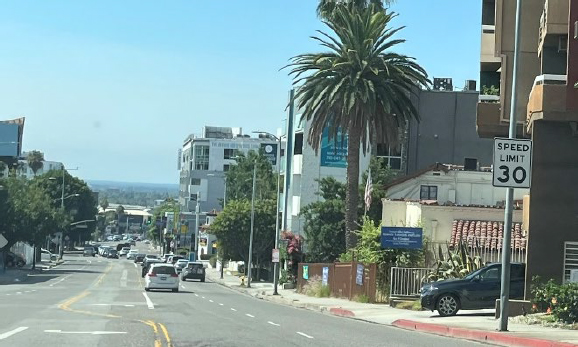
Source: Kay Fitzpatrick, TTI

Source: Marcus Brewer, TTI
Figure 3 to Figure 6 are additional examples of sites with the same posted speed limit (35 mph), but with basic design differences. For example, one site has shoulders (Figure 3) while the others have curbs along with several typical urban elements such as bus stops and signals (Figure 4). Figure 5 has sidewalks that are next to the curb while the road in Figure 6 has buffer-separated sidewalks.

Source: Kay Fitzpatrick, TTI
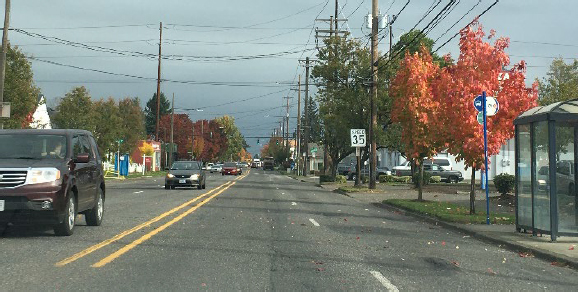
Source: Kay Fitzpatrick, TTI
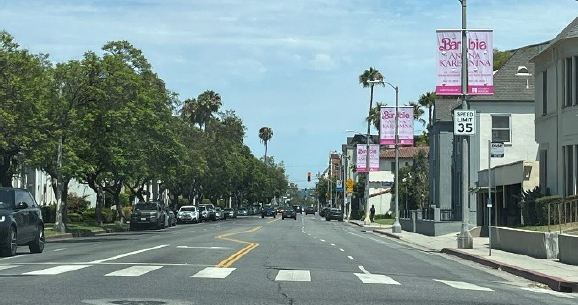
Source: Kay Fitzpatrick, TTI

Source: Kay Fitzpatrick, TTI
Variations in speed have led transportation practitioners to consider new ways to look at speed, and one that is increasingly common is the concept of target speed. While a single formal definition of target speed does not exist, common use implies that it represents the operating speed that the designer intends for drivers to use. The central issue to achieving target speeds involves the configuration and operation of roadways so that target speeds, compatible with context and all roadway users, are chosen by—and not forced upon—vehicle operators. However, much of the roadway context, especially the urban one, has already been established, so a large part of the effort of achieving target speeds involves retrofitting the existing environment. For practitioners to use this concept of target speed in redesigning existing roads, or even designing new roads, it is necessary to have a clear understanding of what combinations of roadway, roadside, and non-roadway factors influence operating speed, so that the desired target speed is achievable. That understanding can then lead to including consideration of those factors in the roadway design process, so that practitioners can regularly incorporate it into the planning, design, and operations of their roadways.
Research, then, is needed to obtain and analyze the necessary data to identify those influencing factors, quantify the relevant relationships between operating speed and those factors, and produce the findings for consideration. This knowledge is to be used to develop guidance so that practitioners can make informed decisions about design elements that will lead to target speeds that can be reasonably expected on a given roadway segment.
OBJECTIVE AND SCOPE
National Cooperative Highway Research Program (NCHRP) Project 15-76 was tasked with the following objectives: (a) to determine the effects of roadway, roadside, and non-roadway elements on operating speeds on roadways with a target speed between 30 and 40 mph and (b) to develop recommendations on how the findings can be incorporated into the roadway design process.
The scope of the project was an examination of the factors that have an effect on the speeds drivers choose on roadways in the defined speed limit range, based on operating speeds and characteristics of the segments that were studied. In essence, the research sought to quantify effects of factors that contribute to the contextual expectations of a roadway and motivate drivers to choose a particular operating speed as they travel along a given roadway segment. Thus, Project 15-76 took the approach of focusing on multiple factors for a road segment to identify the overall impacts on representative drivers who travel the segment, rather than using a study approach where the investigation is on the actions of one or more individual drivers. The wide range of variables considered and ultimately chosen for analysis reflect the various factors both on and near the roadway that may influence drivers’ choice of speed. The project also focused on data for a longer time period (i.e., operating speeds over a calendar year), which better represent the full population of drivers within the segment, rather than a specific slice of time that would be associated with individual drivers.
Two publications were generated as part of NCHRP Project 15-76:
- Practitioner’s Guide for Implementing Target Speed in the Design Process (Brewer et al. 2026).
- Investigating the Relationships Between Operating Speed and Road Elements for Target Speed, Web-Only NCHRP Report (this document).
PURPOSE AND ORGANIZATION OF FINAL REPORT
This report documents the research efforts and findings from NCHRP Project 15-76 in the following chapters and appendices:
- Chapter 1. Background: This chapter introduces the objective of the research along with the chapters and appendices contained in this web-only final report.
- Chapter 2. Research Approach: This chapter provides details on how the project was conducted.
- Chapter 3. Findings: The findings are summarized in this chapter for each major effort within NCHRP Project 15-76.
- Chapter 4. Conclusions, Recommendations, and Suggested Research: This chapter provides the conclusions generated from the research along with a list of suggested research needs.
- Appendix A. Review of Literature on Speed Concepts and the Design Process: This appendix presents the findings reported in the research literature on the concept of target speed and related speed measures, as well as factors that can influence speed.
- Appendix B. Review of Current Practices: This appendix presents findings from the review of current practices, policies, and guidelines that include target speed and related concepts.
- Appendix C. Proposed Data Framework for Investigating the Relationship of Speed with Road Elements: This appendix presents details on the data framework developed in Phase I to be used for structuring information gathered for review and analysis in Phase II. It also presents the findings from the research team’s Phase I activities in identifying potential sources of data for speed and segment characteristics to build the database in Phase II for analysis.
- Appendix D. Development of Analytical Approach: This appendix describes researchers’ activities within Phase I on developing and exploring multiple modeling and analysis strategies to identify the most appropriate modeling approach as well as the variables most suitable for investigation in Phase II analyses.
- Appendix E. Suitability of INRIX XD™ Speed Data: This appendix summarizes the research team’s activities in confirming the suitability of INRIX XD speed data for use in the Phase II analyses.
- Appendix F. Relationships Between Operating Speed and Road Elements on Roads with 25 to 40 mph Speed Limits: This appendix presents the data collection process used by the research team to develop the speed and road characteristics database for use in the analyses in Phase II, along with the results from those analyses.
- Appendix G. Supplemental Investigation of Average Lane Width, Center Line Markings, and Edge Line Markings: This appendix presents the results from supplemental analyses conducted by the research team to gain more insights into relationships between operating speed and characteristics of the study segments.
- Appendix H. Suggested Modifications to Standard References: This appendix describes where the findings from this project may be incorporated into common reference documents such as the 2018 American Association of State Highway and Transportation Officials (AASHTO) Green Book (formally titled A Policy on Geometric Design of Highways and Streets) (AASHTO 2018), the Federal Highway Administration’s (FHWA) Manual on Uniform Traffic Control Devices (MUTCD) (FHWA 2023), the 6th Edition of the Highway Capacity Manual (HCM) (TRB 2016), and other relevant references.


