Firepower in the Lab: Automation in the Fight Against Infectious Diseases and Bioterrorism (2001)
Chapter: Biological Warfare Scenarios
19
Biological Warfare Scenarios
William Patrick III
INTRODUCTION
This paper will discuss two vulnerability tests, neither of which could be talked about in an open forum until 1999, when the information became public. One of these was a large-scale aerosol test that demonstrated the vulnerability of a seaport, San Francisco. This test took place in 1950. The second test, conducted in 1965, was a simulated attack on an enclosed environment, the subway system of New York City.
LINE SOURCE DISSEMINATION
Today, we tend to talk about biological warfare agents in great detail and ignore the impact of the munitions system, the delivery system, and the meteorological conditions at the target. In addition, a number of important parameters exist that a would-be terrorist must address in order to be successful. Although a discussion of “weaponization 101,” as illustrated in Figure 19.1, is beyond the scope of this paper, it is important to discuss the line source dissemination (see Figure 19.2). Line source could be accomplished by a high-performance aircraft, or it could be an individual walking along a line with a 2-gallon spray tank disseminating a liquid perpendicular to the wind, with the energy of the wind taking the aerosol downwind. This is by far the most effective way to deliver a biological warfare agent. Fortunately, line source is very susceptible to meteorological conditions, such as changing winds.
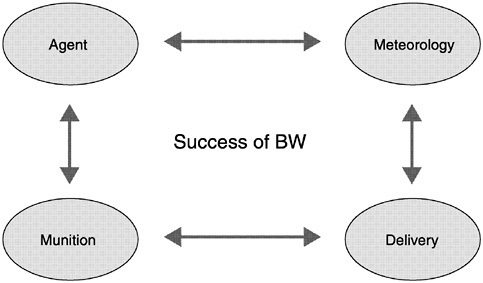
FIGURE 19.1 Four components which must be addressed in an offensive biological warfare program.
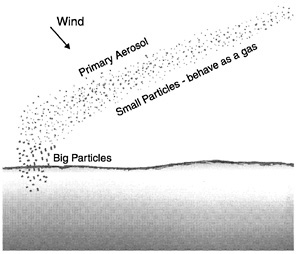
FIGURE 19.2 Line source dissemination.
Delivery vehicle sprays a line perpendicular to the wind
Target from one to many kilometers downwind
Wind transports infectious aerosol across target
Most efficient means of delivering a BW agent, provided meteorological conditions are favorable
Regarding the nature of the aerosol, it is important to note that there is a period of time immediately following dissemination (whether from an aircraft or any other disseminating device) when the aerosol comes into equilibrium with atmospheric conditions. During this period, referred to as the time of equilibration, the big particles fall out of the aerosol, land on the terrain, and form strong adhesive bonds with the surface (see Figure 19.3).
It is extremely difficult to get these particles to reaerosolize, which is called a secondary aerosol. However, it is the primary aerosol, which is composed of particles within the magic size range of 1 to 5 microns and which behaves as a gas, that remains airborne and causes infections. Once the primary aerosol is formed, these small particles remain airborne. This is one of the major differences between a chemical attack and a biological warfare attack; large quantities of decon are not needed to treat the area over which aerosol passes. Small particles do not fall out. Infections occur because we act as vacuum pumps, pulling in the small particles.
When a helicopter lands in an area that has been potentially contaminated by the fallout of organisms from a primary aerosol (which is very, very low), there will be little or no contamination on the helicopter or the personnel in that area, reflecting the fact that primary aerosols are composed of small particles that remain airborne. Problems arise when the ground is deliberately sprayed directly with either powder or liquid containing microorganisms. As a general rule, the concentration of organisms on the ground must exceed 1 × 10⁷ cells per meter square. This was
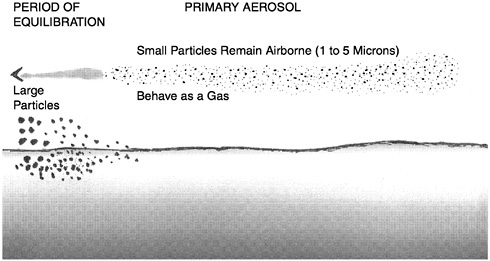
FIGURE 19.3 Physics of primary aerosol.
established in early Detrick studies (in the 1950s) and later by a bio-physicist at Dugway Proving Ground (35 to 40 years later). Concentrations of 1 × 10³, 104, and 105 organisms per square meter do not easily produce secondary aerosols unless high levels of energy are applied. These adhesive bonds are so strong that a high concentration of organism must be reached in order to overcome the bonds between organism and terrain.
The nature of the primary aerosol can be demonstrated effectively by tests conducted in the Pacific and the Arctic. The harmless simulant Bacillus globigii (BG) was disseminated in a series of tests demonstrating the vulnerability of naval vessels to small-particle primary aerosols. The aerosol is pulled into the ship by the air system and remains in a high concentration for about 1.5 to 2 hours. Then it departs the ship, leaving very little residue. The primary aerosol, which behaves as a gas, deposits little or no BG spore on the floors and walls of the ship, although the concentration of spores is high in the air. After the aerosol passed through the ship, the floors and doors were swabbed and cultures prepared; however, little contamination was found. In fact, the level of contamination was so low that a small quantity of seawater effectively removed it.
In conducting these simulant tests, the aerosols were sampled with the all-glass impinger (see Figure 19.4). Hundreds of these samplers were used during an open-air test. The impinger contains a fluid—the impinger fluid. Air is pulled in at a specified rate of 10 liters per minute (roughly the breathing rate of a man at rest), due to a calibrated orifice on the outtake. If the material collected in the sampler is determined and the length of time the impinger has operated is known, a relatively accurate fix can be made on the number of spores that would be inhaled by an individual.
SAN FRANCISCO
Using hundreds of these impinger samplers, a vulnerability test was conducted in 1950 on the city of San Francisco using the simulant BG. The purpose of the test was simply to determine if a seaport is vulnerable to biological warfare attack by line source dissemination.
A small naval vessel sprayed a line 2 miles long 2 miles off shore just at sundown using liquid BG (see Figure 19.5). In the first test a strong inversion was present with a gentle wind of about 10 mph. The down-town area of San Francisco was heavily contaminated with samplers, indicating more than 10,000 spores per liter. This concentration would have caused more than 60 percent infections among the population. When an aerosol is released, even under the best of conditions it is difficult to predict where it will go. Thus, the Berkeley area was also contaminated, although at a much lower level. We concluded that this test was highly successful.
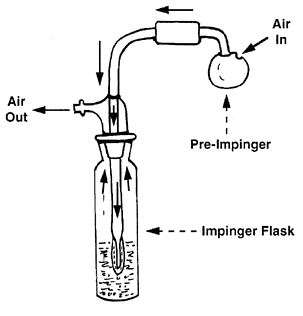
FIGURE 19.4 All glass impinger with pre-impinger.
The next test was conducted in an unstable air mass. Again, BG slurry was disseminated as a line 2 miles long. The same amount of BG was used. A high concentration of spores was found only about two blocks into the city. An unstable air mass failed to achieve the projected casualties, demonstrating that meteorological conditions on an open target are
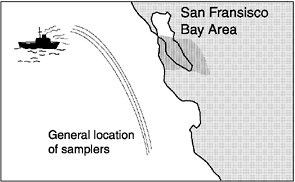
FIGURE 19.5 Simulated attacks.
San Francisco, 1950
Bacillus subtilis and Serratia marcescens
Meteorological conditions determlined success of “attacks”
Optimum conditions would have produced many casualties
Poor conditions would have produced few, if any, casualties
as important to the success of an attack as the agent, the munition, and the disseminating system.
A vegetative organism, Serratia marcescens, was also tested for its ability to contaminate San Francisco. The line of dissemination and general test conditions were similar to those for BG. The dissemination was made under good meteorological conditions, including moderate inversion and a 12 mph wind. The impingers indicated that only about 25 cells were recovered per liter in the first blocks of the city, suggesting that the attack was a failure. Upon subsequent testing we learned that, even though this test had been conducted at sundown, sufficient ultraviolet light was present to kill a vegetative cell. These tests were conducted by a wellsupported program that included microbiologists, aerobiologists, meteorologists, and munitions development engineers. The results should be expected to be good if this type of support is available and meteorological conditions are favorable.
DISSEMINATION ISSUES
One of the principles of biological warfare that we learned from our former offensive program is that, although liquid agents are relatively easy to make, they are very difficult to disseminate into a small-particle aerosol. A single-fluid nozzle with gaseous energy is one of the simplest ways to disseminate a biological warfare agent; however, it is not very efficient. Most of the particles are large and fall out of the aerosol quickly. For a single-fluid nozzle to achieve a 5 percent level of efficiency, it would require a minimum of 300 psi. At this level of pressure the container would have to be made of metal, not glass or plastic. The would-be terrorist must not only produce the agent but also requires a model shop in order to construct the agent container and combine it with an appropriate nozzle.
We have discussed big particles that fall out of the aerosol quite quickly. For biological warfare to be successful, a primary aerosol that is composed of 1- to 5-micron particles must be generated. The classic Ft. Detrick experiment compares man to the monkey and guinea pig. The volunteers for this study came from the Seventh Day Adventist Church. It must be emphasized that, at the time this study was conducted, the Soviet Union and Red China were our enemies, and although young people from the Seventh Day Adventist Church wanted to serve their country, they did not want to carry rifles. Therefore, they instead volunteered to be exposed to a series of organisms. The first aerosol tests were conducted with Coxiella burnetti, the causative agent of Q fever. Two years later Franciscella tularensis was used, and still later Staphylococcal enterotoxin B was tested. These diseases are self-limiting and can be effectively treated
with antibiotics. The volunteers recovered and have been followed medically over the years, with no adverse responses noted.
These were very important studies because when the volunteers were exposed, rhesus monkeys and guinea pigs were also exposed. Thus, a relationship was developed between the human and animal models that could then be applied to other diseases for which people could not have been exposed to testing for ethical reasons.
The first column of Table 19.1 shows aerosol particle size. The second column demonstrates the number of cells of tularemia required to kill the guinea pig at the 50 percent level, a respiratory LD50. The third column illustrates the number of tularemia cells needed to kill the monkey. The last column shows the number of cells of tularemia required to infect but not kill man (an ID50). An aerosol composed of 1-micron particles of tularemia requires only 2.5 cells to kill the guinea pig, 14 for the monkey, and between 10 and 52 cells to infect man. If the tularemia culture is less than 48 hours, the infecting dose for man is between one and 10 cells. This is the limit of assay precision. However, delivering a culture within 48 hours of its production is not operationally feasible.
When the aerosol is composed of 6.5-micron particles, a larger number of cells are now required to infect by the respiratory route. When the aerosol is composed of 18- to 22-micron particles, the number of tularemia cells becomes extremely large. Man was not exposed to these large particles because of other more important studies such as vaccine efficiency. This experiment clearly demonstrates that the biological warfare agent must be disseminated into a small-particle aerosol.
RELIGIOUS CULTS AND BIOTERRORISM
I would like to address the problem of religious cults and bioterrorism, specifically, the Aum Shrinrikyo cult in Japan. Two investigative
TABLE 19.1 Classic Experiment: Man-Monkey-Guinea Pig: Influences of Particle Size on Tularemia Infectivity
Aerosol Particle Diameter (Microns) | Guinea Pig RLD50 | Monkey RLD50 | Man RID50 |
1 | 2.5 | 14 | 10 – 52 |
6.5 | 4,700 | 178 | 14 – 162 |
11.5 | 23,000 | 672 | No Data |
18 | 125,000 | 3,447 | No Data |
22 | 230,000 | > 8,500 | No Data |
reporters for the New York Times, Miller and Broad, learned from various sources that this well-funded cult had allegedly disseminated liquid anthrax cultures on perhaps as many as nine occasions. All of these attacks failed to produce a single infection, and at the time the attacks were not even detected. Why did the Aum Shrinrikyo fail when the organization had modern laboratories, trained personnel, and sufficient funds? I believe the Aum failed because it did not meet the four essential components presented in Figure 19.1 for a successful biological warfare attack. First, it may not have selected a virulent strain of anthrax. Selection of the virulent strain is the most important in agent weaponization. For example, during the U.S. offensive program, many strains of anthrax were studied before selecting the most appropriate one for weaponization. Next, the munitions and delivery systems may not have been appropriate. Finally, it ignored meteorological conditions. One attack supposedly occurred from an eight-story building, at midday, in downtown Tokyo.
It is important to remember that liquid cultures are difficult to disseminate into small particles, and the disseminating device or munitions requires high levels of energy for success. Table 19.2 illustrates how agent viability interacts with particle size. Dry Serratia marcescens or SM is a very small vegetative cell. If the aerosol contains particulates in the 0.8-micron range, there are only 1.8 cells on average in these particles and the viability is 0.001 percent. As particle size increases, the viability of cells in the aerosol particle increases. Thus, big aerosol particulates contain viable cells, yet small particles are most effective in causing a respiratory infection. Therefore, our would-be terrorist has some basic problems that require solutions. (We cannot discuss in an open forum how this and similar problems are solved.) I suspect that biological warfare may have been attempted in this country and failed, and failure is not usually advertised.
TABLE 19-2 Dry Serratia Marcescans (SM): Relationship of Particle Size, Viable Cells per Particle, and Viable Cells per 1,000 Particles
Aerosol Particle Size | SM per Aerosol Particulate | Viable SM Cells per Aerosol Particulate | Viable SM Cells Frequency per 1,000 Aerosol Particulate |
0.8 | 1.8 | 0.001 | 0.5 |
1.3 | 4.2 | 0.01 | 2.6 |
3.0 | 18.0 | 0.2 | 15.6 |
6.5 | 73.0 | 2.5 | 38.0 |
11.5 | 195.0 | 7.7 | 14.0 |
16.0 | 350.0 | 11.0 | 60.0 |
NEW YORK CITY SUBWAY SYSTEM
The next scenario involves an enclosed environment where meteorological conditions are no longer a factor. One of the most important vulnerability studies conducted during our offensive program involved the New York City subway system. A simulant powder containing BG was prepared that possessed very good secondary aerosol properties. Lightbulbs were filled with BG and were dropped from the back of trains onto the subway tracks. Impinger samplers had been distributed throughout the subway system to include both trains and stations.
The passage of the trains over the powder created secondary aerosols that were carried throughout the entire subway system. The BG penetrated all test trains and remained in high concentration for 1 to 1.5 hours. Thereafter, with the dilution factor at work, the concentration dropped markedly, and after 2 hours the impinger samplers were not yielding spores. The risk of infection if a biological warfare agent had been used would have been highest for personnel using the subway near the site of powder drop and within the first hour following dissemination.
Studies have shown that in 1965 the average time people spent on the trains during rush hour (morning and afternoon) was about 8 minutes. Thus, impinger data that determined the number of organisms per liter of air and the number of minutes that people were on a train indicated that about 80 to 90 percent of the train population would have become infected. (If treatment is not started early in the disease process when the first subtle symptoms appear, anthrax is fatal.)
CONCLUSION
At this time, domestic terrorists do not have the capability to develop a biological warfare weapon that would result in serious casualties. However, there is concern that a state-supported group with trained personnel and adequate laboratories and funds could develop an agent powder with the appropriate biological and physical properties and that a few hundred grams of this powder, which could enter the United States via those with diplomatic immunity, if used in an enclosed environment, would produce thousands of casualties. The questions then become: How does the United States determine the perpetrator? and What is the response?