Einstein's Unfinished Symphony: Listening to the Sounds of Space-Time (2000)
Chapter: The Maestro Enters
The Maestro Enters
 he tale has been told and retold so many times that it has taken on the strains of a fable. In some autobiographical notes Einstein remembered being haunted as a lad by a strange musing: If a man could keep pace with a beam of light, what would he see? Would he observe a wave of electromagnetic energy frozen in place like some glacial swell? “It does not seem that something like that can exist,” he recalled thinking at the youthful age of 16. Here was the seed for Einstein's casting out the absolute space and absolute time of Isaac Newton. Relativity would arrive, not from concerns over the flaws in Newton's mechanics, but rather from contemplating the forces of electricity and magnetism as well as the mysteries of light.
For most of history it was generally assumed that light was something that was transmitted instantaneously. In a way it was everywhere “there.” With this premise the light from a far-off star arrived at our eyes on Earth as soon as it was emitted. By the seventeenth century,
however, certain thinkers began to wonder whether light had a finite speed after all—like sound—only far, far faster. Galileo may have been the first to test this hypothesis directly using two assistants. The first man stood on a hill and uncovered a lantern, signaling his companion positioned on another hill less than a mile away. The second man, as soon as he saw the initial beacon, would flash a return light of his own. Performing this task on hills spaced farther and farther apart, Galileo hoped to spot a successively longer delay between the dual flashes, which would reveal the speed of light. Of course, no delay was detected, given the crudeness of Galileo's experiment. Human reaction time is far too slow. The vast span of our solar system provided a far better test.
In the 1670s—Newton's day—the Danish mathematician and astronomer Ole Römer closely studied the movements of Jupiter's four largest moons, particularly the innermost one, Io. Specifically, he carefully monitored the moment when Io periodically moves behind Jupiter and gets eclipsed. In doing this, he noticed that the interval between successive eclipses (an event that occurred about every 42 hours) was not constant but regularly changed, depending on the position of Earth in relation to Jupiter. When Earth was moving away from Jupiter in its orbital motion around the Sun, the expected moment for Io to eclipse arrived later and later. This is because the light bringing that information to your eyes has to travel a bit more distance with each eclipse. By the time Earth reached its farthest point from Jupiter, Römer's measured delay mounted up to 22 minutes (a better figure is 16.5 minutes). Others had noticed such changes before, but Rö mer shrewdly deduced that the delay was just the time needed for Io's light to traverse the extra width of Earth's orbit. Dividing Earth's orbital width (186 million miles) by the delay time, Römer's crude measurements pegged a light speed of around 140,000 miles per second. That's quite fast, but Römer had shown it was certainly not instantaneous. The modern value is 186,282 miles per second.
By the nineteenth century physicists made great strides in understanding the nature of light. It was the era when scientists verified that light behaved like a wave. And, according to the physics of the 1800s, that required the light wave to be propagating through some kind of
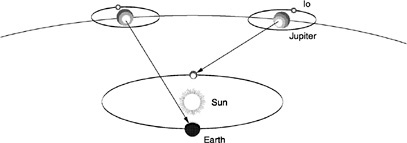
When Earth is farthest from Jupiter, the eclipse of Io is sighted later than expected because the light must travel the extra width of Earth's orbit. In the seventeenth century, Ole Römer used this effect to make the first good estimate of the speed of light.
medium. No reputable physicist would have dared to imagine that two objects could transmit light between one another lacking a substance to carry the wave. Sound waves move through air, and ocean waves travel through water; if there is a wave, something must be waving. For the heavens the transmitting agent came to be known as the “luminiferous ether,” a reworking of the heavenly ether once postulated by the ancient Greeks. It filled the whole universe. As conceived, the ether was a rather odd material: it had to be rigid enough to transmit light waves at terrifically high speed yet still allow the Earth, planets, and stars to move through it without resistance. Such a paradox provided theoretical physicists with a cottage industry for more than a century. Scientific journals were filled with attempts to explain how the ether could be both stiff and insubstantial. Permeating all of space, the ether also served as a motionless reference system. In a way the ether resembled a vast body of water. As a wave passes through the open sea, the water moves only up and down. The wave is transmitting energy but not moving the water forward. The same was thought to be true for the ether. Here at last was Newton's absolute rest frame in physical form.
At the same time, explorations were taking place into the nature of electricity and magnetism. A link between these two phenomena first came in 1820 when the Danish physicist Hans Christian Ørsted discovered that an electric current in a wire deflects a compass needle; in other words, a conducting wire acts as a magnet. Stop the current and
the magnetism vanishes. The Englishman Michael Faraday completed the connection when he noticed the opposite effect: a moving magnet creates an electrical current. Born into poverty, with no formal mathematical training, Faraday was a self-taught scientist. His mathematical deficiencies may have been to his advantage. Highly visual, he imagined his magnetic objects being surrounded by fields of force, invisible lines influencing the movements of objects within their midst. Such fields are wonderfully displayed in the way iron filings align themselves when you sprinkle them around a magnet. Likewise, Faraday thought that electric fields somehow manipulated charged particles with ghostly hands.
The distinguished Scotsman James Clerk Maxwell was just one in the legion of people, both scientists and nonprofessionals alike, who were captivated by Faraday's experiments. A handsome man with a delicate constitution, Maxwell became a professor of natural philosophy at the age of 24. Ten years later, with his august Treatise on Electricity and Magnetism, a triumph of nineteenth-century physics, he composed the mathematical “words” to explain Faraday's fields of force. His derivations, a set of four partial differential equations so elegantly succinct that they show up on physics students ' T-shirts, demonstrate how electricity and magnetism, two forces that on the surface seem so disparate, are merely two sides of the same coin, each unable to exist in isolation. Maxwell united them into the single force of electromagnetism.
More than that, Maxwell's equations also revealed that an oscillating electric current—charges moving rapidly back and forth—would generate waves of electromagnetic energy coursing through space. He even worked out the speed these waves would travel, which was related to the ratio of certain electrical and magnetic properties. The result turned out to be exactly equal to the speed of light. Was this just a coincidence, as some thought? Maxwell boldly said no. He concluded that light itself was a propagating wave of electric and magnetic energy, an undulation that moved outward in all directions from its source.
Visible light waves, each measuring about 1/50,000 of an inch from peak to peak, were just a small selection of the wide range of waves possible. There could also be waves of electromagnetic energy both
shorter and longer than visible light. The German physicist Heinrich Hertz proved this very fact in 1888. In a laboratory humming with spark generators and oscillators, Hertz created the first radio waves. Each wave had a length of 30 inches and sped across his lab at the speed of light. It was the first experimental verification of Maxwell 's prediction that electromagnetic waves existed.
Maxwell died of abdominal cancer in 1879 at the age of 48, nine years before Hertz conducted his experiments. In the year before his death Maxwell also wondered about the problem that plagued physicists through most of that century: the motion of the Earth through the ether. Given the assumption that Earth was moving through a stationary ether, Maxwell thought of an optical experiment to detect an “ether wind ” as Earth sailed at some 67,000 miles per hour in its annual voyage around the Sun. Like the air rushing past the passengers in a speeding convertible with its top down, the ether would be blowing past the Earth. Sparked by Maxwell's challenge, a young U.S. naval officer, Albert A. Michelson, built a special instrument to spot the ethereal breeze in 1881 while assigned to Berlin for postgraduate work in physics. The instrument was his own design, an intricate assembly of mirrors and prisms that allowed pencil-thin beams of light to bounce back and forth in order to peg light's speed. It came to be known as the Michelson interferometer. Michelson found no hint of a draft, though. Berlin traffic outside his laboratory rattled the detector at times, hurting its sensitivity. He tried again in 1887 as a civilian professor at the Case School of Applied Science in Cleveland, Ohio. There he had teamed up with Edward Morley, a chemist at neighboring Western Reserve University. Using a vastly improved interferometer, the two researchers sent one beam of light “into the wind” in the direction of Earth's orbital motion and directed another beam at right angles to this path. Michelson once explained to his young daughter Dorothy how the test worked: “Two beams of light race against each other, like two swimmers, one struggling upstream and back, while the other, covering the same distance, just crosses and returns.” The light beam fighting the ethereal “current” was expected to move a bit slower.
Michelson and Morley's elaborate equipment, set up in a basement laboratory, was mounted on a massive sandstone slab that floated
on a pool of mercury to cut down on vibrations. But even with such precautions the two scientists detected no difference whatsoever in the measured velocity of their two beams of light, no matter which way the beams were pointed. The technique was so sensitive that it should have been able to measure a wind speed as small as 1 or 2 miles a second. With the Earth moving more than 10 times faster, Michelson had figured they would easily spot it. He was dismayed to discover that he was wrong. In 1907 Michelson became the first American to win a Nobel Prize in the sciences. He was honored for the development of his exquisitely sensitive optical instruments, many of them inspired by his futile search for the ether.
Others looked for the ether and failed as well. (Even Einstein, as a college student, wanted to build his own apparatus to measure the Earth's movement against the ether, but a skeptical teacher nixed the plan.) The null results forced physicists to come up with elaborate schemes to explain the lack of a detectable “wind.” First the Irish physicist George FitzGerald and later Hendrik Lorentz, a Dutch physicist, suggested that an object traveling through the ether would contract—get physically compressed—in the direction of the motion. The dimensions of an object would somehow change as they moved about. That could explain why Michelson didn't notice a change; it was neatly canceled by this effect. Eventually, the great French mathematician Henri Poincar é railed against these complicated efforts to explain why physicists were not detecting Earth's absolute motion through the ether. In 1904 he presciently spoke of the need for a “principle of relativity. ” Soon such a theory would be provided.
Historians continue to debate whether the Michelson-Morley experiment influenced Einstein in any way. He makes only a brief and indirect reference to the test in his famous 1905 paper on relativity, even though his new theory neatly explained Michelson's continuing failure to discern the ether. What Einstein did stress was his perplexity over certain properties of electricity and magnetism. He was bothered by a seeming paradox. Consider either a bar magnet moving through a fixed coil or a coil moving over a stationary bar magnet. Each case is distinct. Maxwell's equations must handle each situation differently, depending on whether the coil is stationary and the magnet is moving
or the magnet is stationary and the coil is moving. But each case leads to the exact same result: a current. Why should that be, asked Einstein? The descriptions of what is happening are different for the two different points of view, yet the observed outcome—the flow of an electric current in the coil—is the same. The experiment cannot reveal which object—the coil or magnet—is really moving in absolute space. Here was a crack in the notion of a fixed, eternal reference frame.
Both Newton's mechanics and Maxwell's equations of electromagnetism were the two monumental theories of their era. Each yielded extremely accurate predictions. What disturbed Einstein was that these two great works of physics didn't seem to share the same rules on defining a space and time. Einstein's masterstroke was finding a way to make the two theories compatible with the simplest assumptions possible. Perhaps surprising was that his solution required no grand leaps of physics. Einstein's historic 1905 paper is exquisite in its simplicity. All of his hypotheses are based on the physics available in the nineteenth century. His one inventive assumption was a new conception of space and time. With that one change, all fell into place.
The prevailing image of Einstein has long been that of the venerable elder, the Chaplinesque figure with baggy sweater and fright-wig coiffure. But the youthful Einstein, at the height of his scientific prowess during the development of relativity, was a man whose limpid brown eyes, wavy hair, sensuous mouth, and virtuosity on the violin aroused considerable attention, especially among women. One acquaintance compared Einstein's demeanor to that of a young Beethoven, full of life and laughter. Yet like the great romantic composer, the twentieth-century 's most celebrated scientist had his dark side as well. He was also a loner (despite two marriages), a sharp-tongued cynic at times, and a self-centered man who could serve humanity yet express little empathy for the problems of those close to him. Einstein was born in 1879, the year of Maxwell's death, into a nonreligious Jewish family, one well assimilated into the culture of southern Germany for more than two centuries. His father ran, with mixed success, an electrical engineering company, the high-tech business of its time. Early on Einstein expressed an intense desire to learn things in his own way. He apparently didn't talk until the age of 3,
stubbornly waiting until he could speak in complete sentences. Growing up with his younger sister Maja, little Albert loved doing puzzles, building structures, playing with magnets, and most especially solving geometry problems, the very key to his later work. He detested the German school system, with its emphasis on rote learning. And he didn't suffer fools gladly: he eventually dropped out of gymnasium (high school) due to conflicts with a teacher, among other reasons. Fortunately, he was able to enroll in a Swiss university, the Polytechnic in Zürich (the Federal Institute of Technology), although he was hardly a favored student among his professors. One called him a “lazy dog.” As a result, he found no academic post upon graduation, surviving instead on the occasional teaching or tutoring assignment. Only in 1902 did he get a bona fide job, at the Swiss patent office in Bern. But all the while he was religiously devouring the books of the physics masters. He preferred self-learning. He had that spark—that devotion —since childhood.
Physics was at a critical juncture at the turn of the twentieth century. X rays, atoms, radioactivity, and electrons were just being discovered. It took a rebel—a cocky kid with mediocre college grades and no academic prospects but an unshakable faith in his own abilities—to blaze a trail through this new territory. Fearless at challenging the greats of his day, even as a student, Einstein was sure that the prevailing theory linking Newtonian mechanics with electromagnetism—electrodynamics —did not “correspond to reality . . . that it will be possible to present it in a simpler way.” His work as a patent examiner turned out to be a blessing. He would fondly remember his government office as “that secular cloister where I hatched my most beautiful ideas.” Unencumbered by academic duties or pressures, Einstein was able to explore those ideas freely. By 1905, at the age of 26, like a dormant plant that suddenly flowers, he burst forth with a series of papers published in the distinguished German journal Annalen der Physik. Any one could have garnered a Nobel Prize. Inspired by the new quantum mechanics, he first proposed that light consists of discrete particles, what came to be known as photons (the Nobel winner). Second, he explained the jittery dance of microscopic particles—Brownian motion—as the buffets of surrounding atoms. It helped persuade the sci-
entific community that atoms truly exist. Lastly, he submitted a paper blandly entitled “On the Electrodynamics of Moving Bodies” in which he revealed his special theory of relativity (actually rejected as a doctoral thesis topic for being too speculative).
Many of Einstein's mathematical arguments were similar to those already used by Lorentz and Poincaré, but there was a vital difference. Unlike his predecessors, Einstein was redefining the nature of time itself. He remarked many years later that the subject “had been his life for over seven years. ” Special relativity proposed that all the laws of physics (for both mechanics and electromagnetic processes) are the same for two frames of reference: one at rest and one moving at a constant velocity. Einstein was saying that a ball thrown up into the air on a train moving at a steady 100 miles per hour on a straight track behaves just the same as a ball thrown upward from a motionless playground. For that to be true, though, means that the speed of light must also be the same in each environment, both on the train and on the ground. If the laws remain the same, each must measure the same speed of light. “[We will] introduce another postulate . . . ,” wrote Einstein in his historic 1905 paper, “that light is always propagated in empty space with a definite velocity c, which is independent of the state of motion of the emitting body. ”
Let's make the comparison fairly drastic, since the effects of relativity are not really noticeable unless the comparative speeds are extremely high. Consider a spaceship steadily moving away from Earth at 185,000 miles per second, just under the velocity of light. Common sense might lead you to believe that the astronauts would be going nearly as fast as any light beam passing by, much as Einstein imagined as a youth. But that's not the case at all. The astronauts on that spaceship will still measure the velocity of that passing light beam at 186,282 miles per second, just as we do back here on Earth. This situation seems bizarre, but not really. The speed of light remains constant, but other measurements get adjusted. The seeming paradoxes that arise are taken care of by acknowledging that time is not absolute. Time is, well, relative. The very term “velocity” (miles per hour or feet per second) involves keeping time, but the astronauts and Earthlings do not
share the same time standard. That was Einstein's genius. He recognized that Newton's universal clock was a sham.
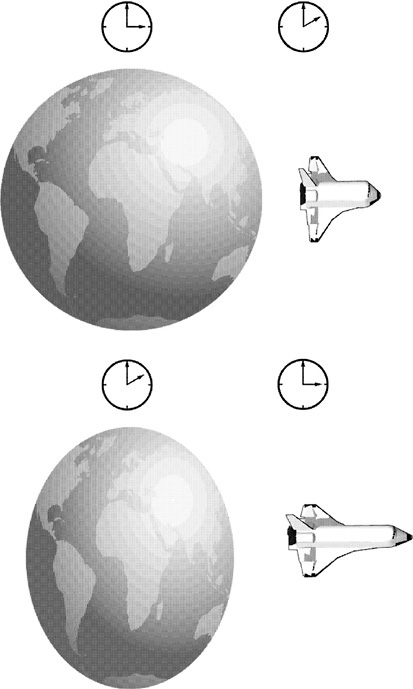
Since nothing can travel faster than the speed of light, two observers set apart in different frames of reference cannot really agree on what time it is. The finite speed of light prevents the two from synchronizing their watches. Einstein discovered that observers separated by distance and movement will not agree on when events in the universe are taking place. Consequently, by just looking, the Earthlings and astronauts will not agree on each other's measurements as well. Mass, length, and time are all adjustable, depending on one's individual frame of reference. Look from Earth at a clock on that swiftly receding spaceship. You will see time progressing more slowly than here on Earth. You will also see the spaceship foreshortened in the direction of its motion. Those on the spaceship, who perceive no changes in themselves or in their clock's progression, look back at their receding home planet and see the same contraction and slowing of time in the Earthlings! Each of us measures a difference in the other to the same degree. Space shrinks and time slows down when two observers are uniformly speeding either toward or away from one another. Lorentz and FitzGerald spoke of an actual contraction in absolute space. Einstein, on the other hand, showed that the changes are a perception of measurement. Space and time will be different in each reference frame. The only thing that the Earthlings and astronauts will agree on is the speed of light in a vacuum.* It is the one universal constant.
With absolute time destroyed, there was also no need for absolute space either. Our intuition that the solar system sits serenely at rest, with the spaceship speeding away in some motionless container of space, no longer works. It could just as easily be the astronauts at rest, with the Earth speeding away. The “introduction of a ‘luminiferous ether' will prove to be superfluous,” continued Einstein in his paper, “inasmuch as the view here to be developed will not require an ‘absolutely stationary space' provided with special properties. . . .” Phys-
|
*Light does appear to travel more slowly when transmitted through matter. With the atoms continually absorbing and re-emitting the light, its overall speed is effectively reduced. |
icists no longer had to contend with awkward and complicated schemes involving a mysterious ether. There is no unique frame of reference that marks an absolute state of rest. Otherwise, any object moving in that fixed box would be able to catch up to a light wave. That explained why Michelson and Morley detected no ether wind. The fixed ether had been a fiction all along.
There is no need to dwell on speeding spaceships to perceive a relativistic effect. Relativity can be measured right here on Earth. Cosmic rays from space crashing into the upper atmosphere create muon particles —heavy electrons—that spray downward at near the speed of light. But muons are extremely shortlived, lasting just millionths of a second, too little time for them to reach Earth's surface. But experiments show that they do make it to the ground. As relativity predicts, their inner clock appears to us to slow down, which extends their life just long enough to make it to the surface. From the muon's perspective, though, its lifetime is as short as it ever was; it's the distance between the upper atmosphere and the ground that has shortened, which allows the muon to make it to the ground.
All is relative, even mass. As an object approaches the speed of light, its mass increases noticeably, as measured by us. That's why nothing can go faster than the speed of light. Its mass would be infinite at that stage; no force exists that could push it faster, since the object would have infinite resistance. Einstein would later note that light itself has mass. And since light is also energy, Einstein was able to link mass with energy in a universal law. His calculations showed the relationship to be E = mc2, where c (as stated earlier) denotes the speed of light.
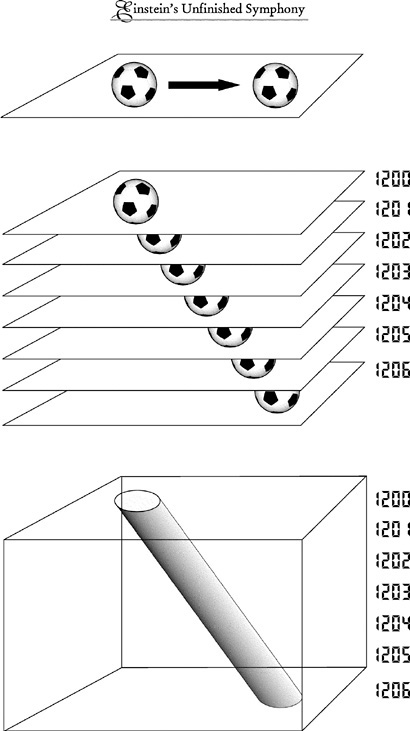
The teacher who once called Einstein a lazy dog, mathematician Hermann Minkowski, brilliantly cut to the quick and discerned an even deeper beauty in Einstein's new theory. (“I really wouldn't have thought Einstein capable of that,” he remarked to a colleague about Einstein's accomplishment.) With his expert mathematical know-how, Minkowski recognized that he could recast special relativity into a geometric model. He showed that Einstein was essentially making time a fourth dimension. Space and time coalesce into an entity known as space-time. Time is the added dimension that allows us to follow the entire history of an event. You can think of space-time as a series of
snapshots stacked together, tracing changes in space over the seconds, minutes, and hours. Only now the snapshots are melded together into an unbreakable whole. Dimensionally, time is no different than space. “Henceforth,” said Minkowski in a famous 1908 lecture, “space by itself, and time by itself, are doomed to fade away into mere shadows, and only a kind of union of the two will preserve an independent reality.”
Six years earlier Minkowski had moved from Zürich to become a professor at Göttingen. Although he had made a number of important contributions to number theory and other areas of pure mathematics, he is largely remembered for his reinterpretation of special relativity. It was easy for him to see that special relativity worked within a framework that had already been set up by mathematicians. “The physicists must now to some extent invent these concepts anew, laboriously carving a path for themselves across a jungle of obscurities, while very close by the mathematicians' highway, excellently laid out long ago, comfortably leads onwards,” he said. To his mathematical eyes, special relativity was no more complicated than saying the world in space and time is a four-dimensional Riemannian manifold. To put it more plainly, Minkowski cleverly recognized that, while different observers in different situations may disagree on when and where an event occurred, they will agree on a combination of the two. From one position, an observer will measure a certain distance and time interval between two events. Perched in another frame of reference, a different observer may see more space or less time. But in both cases they will see that the total space-time separation is the same. The fundamental quantity becomes not space alone, or time alone, but rather a combination of all four dimensions at once—height, width, breadth, and time. Einstein, ever the physicist, was not impressed. When first acquainted with Minkowski 's idea, he declared the abstract mathematical formulation “banal” and “a superfluous learnedness.”
Oftentimes it is portrayed that the layman railed against the idea of relativity when it was first introduced, while the scientist greeted it with open arms. But for many scientists of the time, especially those deeply invested in classical physics of the nineteenth century, it was a psychological shock. Of course, opportunities to check the edicts of
relativity were few and far between at first. It was only after several decades had passed and technologies had advanced that seeing its effects became more commonplace. Some, though, would not accept special relativity on aesthetic grounds. William Magie, a professor of physics at Princeton University, stated in an address before the esteemed American Physical Society in 1911 that “the abandonment of the hypothesis of an ether at the present time is a great and serious retrograde step in the development of speculative physics. . . . A description of phenomena in terms of four dimensions in space would be unsatisfactory to me as an explanation, because by no stretch of my imagination can I make myself believe in the reality of a fourth dimension. . . . A solution to be really serviceable must be intelligible to everybody, to the common man as well as to the trained scholar. All previous physical theories have been thus intelligible. Can we venture to believe that the new space and time introduced by the principle of relativity are either thus intelligible now or will become so hereafter? A theory becomes intelligible when it is expressed in terms of the primary concepts of force, space and time, as they are understood by the whole race of man.”
Critics were demanding that direct earthbound experience be the criterion of truth, rather than mathematical formulas. But they were shortsighted in believing that our earthly domain was the sole theater of experience. As the British astronomer Arthur Eddington noted in a lecture: “ It has been left to Einstein to carry forward the revolution begun by Copernicus—to free our conception of nature from the terrestrial bias imported in it by the limitations of our earthbound experience. ” Before Copernicus, medieval scholars solemnly concluded that the Earth couldn't possibly be moving and turning. Otherwise, everything on the planet would be torn apart in the motion—clouds would get ripped out of the sky, and objects dropped toward a spinning Earth would obviously miss their mark because the Earth would have rotated around at great speed during the fall. Medieval thinkers had not yet mastered the concept of inertia, the tendency for objects to resist any change in their movement. (A falling object, already moving with the Earth's rotation, remains in sync as it drops.) When Copernicus placed the Sun at the cosmic hub, he thrust Earth into motion. He
taught us to rethink our intuition based on new evidence. Einstein was doing the same.
Special relativity drew a line in the sand. On one side stood our past scientific history, when most physics theories could essentially be explained to the layperson. With a bit of hand waving and a reference to a mechanical model, a physical idea could be popularly illustrated. More important, the explanation did not violate the principles of common sense. But after 1905 the terrain suddenly changed. The world according to special relativity didn't seem to be describing our ordinary humdrum surroundings. Simple mechanical models no longer worked.
There is a reason we are fooled: we live in a rather privileged place. Temperatures are extremely low (compared to a star, for instance), velocities are far from warp drive, and gravitational forces are essentially weak—an environment where the effects of relativity are very, very small. No wonder relativity appears strange to us. But as some physicists have put it, we are not free to adjust the nature of space-time to suit our prejudices. We're perfectly happy to adjust to the fact that thunder—a sound wave—arrives later than the lightning flash. It's part of our normal experience. Harder to accept is the finite and constant speed of light. Light travels so fast—it can wrap around the Earth nearly eight times in one second—that everything appears to occur simultaneously here on terra firma. It's difficult to directly experience the fact that observers, separated by a certain distance, will disagree on the precise time an event occurred. But common sense, said Einstein, is “nothing more than layers of preconceived notions stored in our memories and emotions, for the most part before age eighteen.”
Special relativity was exactly that—special. It dealt only with a specific type of motion: objects moving at a constant velocity. Einstein was determined to extend its rules to all types of motion, things that are speeding up, slowing down, or changing direction. But special relativity was “child's play,” said Einstein, compared to the development of a general theory of relativity, one that would cover these other dynamical situations, in particular gravity. He tried to incorporate gravity
directly into his special theory for a 1907 review article, but he came to recognize that it could not be done so readily.
Over the ensuing years Einstein's reputation would grow and soar. He finally left the Swiss patent office in 1909 when he received his first academic appointment at the University of Zürich. Two years later he moved on to the German University in Prague. After a year he went back to Zürich as a professor at his old haunt, the Polytechnic, where he had been so undistinguished as a student. He attained the peak of professional recognition when, in 1914, he moved to the University of Berlin as a full professor and member of the Prussian Academy of Sciences. Over these many years he waged a mental battle, amid teaching responsibilities, a failed marriage, and World War I. He struggled with the problem of recasting Newton's laws of gravity in the light of relativity.
The first thing he recognized was that the forces we feel upon acceleration and the forces we feel when under the control of gravity are one and the same. In the jargon of physics, gravity and acceleration are “equivalent.” There is no difference between being pulled down on the Earth by gravity or being pulled backward in an accelerating car. To arrive at this conclusion, Einstein imagined a windowless room far out in space, magically accelerated upward. Anyone in that room would find their feet pressed against the floor. In fact, without windows to serve as a check, you couldn't be sure you were in space. From the feel of your weight, you could as easily be standing quietly in a room on Earth. The Earth, with its gravitational field keeping you in place, and the magical space elevator are equivalent systems. Einstein reasoned that the fact that the laws of physics predict exactly the same behavior for objects in the accelerating room and in Earth 's gravitational hold means that gravity and acceleration are, in some fashion, the same thing.
These thought experiments, which Einstein carried out liberally to get a handle on his questions, led to some interesting insights. Throw a ball outward in that accelerating elevator in space and the ball's path will appear to you to curve downward as the elevator moves upward. A light beam would behave in the same way. But since acceleration
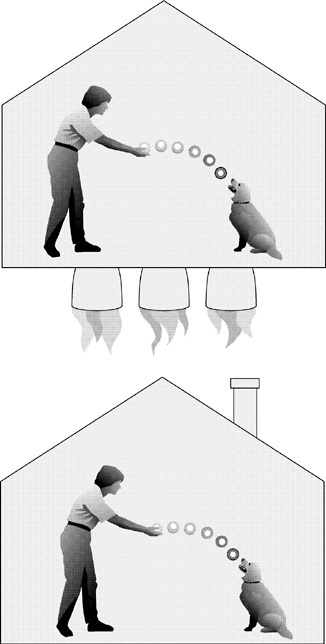
Thought experiment carried out by Einstein: a ball thrown in an accelerating room out in space falls toward the floor just as it does on Earth under the pull of gravity. Gravity and acceleration are equivalent. Einstein realized from this that a light beam should behave the same way, bending under the influence of gravity.
and gravity have identical effects, Einstein then realized that light should also be affected by gravity, being attracted (bent) when passing a massive gravitational body, such as the Sun.
Driven by his powerful physical intuition, Einstein began to pursue these ideas more earnestly around 1911 while he was in Prague. At that time he was beginning to confirm that clocks would slow down in gravitational fields (an effect never before contemplated by physicists). He was also coming to understand that his final equations would likely be “non-Euclidean.” It was slowly dawning on him that gravity might involve curvatures of space-time. He was finally appreciating Minkowski's mathematical take on special relativity and its creation of space-time, that “banal” four-dimensional Riemannian manifold. Without Minkowski's earlier contribution, said Einstein contritely, the “general theory of relativity might have remained stuck in its diapers. ” Minkowski did not live to hear that; he had died in 1909 of appendicitis at the age of 44.
Returning to Zürich in August 1912, Einstein was eager to fashion his burgeoning conjectures into the proper mathematical format. Ignorant of non-Euclidean geometries, though, he joined up with mathematician Marcel Grossmann, an old college chum, to assist him in mastering the intricacies of this new mathematics. It was Grossmann who pointed out to Einstein that his ideas would best be expressed in the language of Riemann's geometry, by then advanced and extended by other geometers. In the spring of 1913 their collaboration generated a paper with all the essential elements of a general theory of relativity. As science historian John Norton would note, “Einstein and Grossmann had come within a hair's breadth of . . . the final theory.” But they backed off from their findings. The two convinced themselves, based on some misconceptions, that their equations could not reproduce Newton's laws of gravity for the simplest cases. Newton 's laws might be incomplete, but they were not wrong. They would still hold when gravity was weak and velocities were low. But unable to retrieve Newton under those simpler conditions, Einstein and Grossmann abandoned this line of attack, assuming it was the wrong choice. This misunderstanding, as well as the knowledge that their equations were not as yet completely universal, kept them from grasping success. For
the equations to work, they still had to use a special reference frame, which meant they hadn't met the standard of developing a “general” theory. By April 1914, Einstein moved from Zürich to Berlin, which ended the collaboration with his friend. Einstein continued on his own, inexorably amending and tweaking his solutions, but now additionally armed with the mathematical insights introduced to him by Grossmann.
By the autumn of 1915, Einstein was becoming increasingly frustrated. His current theory, as it then stood, could not accurately account for a particular motion in the orbit of Mercury. Einstein was then predicting a shift of 18 arcseconds per century for this peculiar motion. He was aiming for the measured change of 45 arcseconds (measurements today peg it at 43). From his earliest days of contemplating a general theory of relativity, Einstein knew that a successful formulation of a new law of gravity would have to account for that anomaly.
The orbit of Mercury, a planet positioned about 36 million miles from the Sun, slowly revolves in the plane of the solar system. Imagine the orbit as an elongated ring. The point of the ring that is closest to the Sun—what is known as a planet's perihelion—shifts around over time. For Mercury the perihelion advances about 574 arcseconds each century.* Most of this shift is due to Mercury's interaction with the other planets; their combined gravitational tugging alters the orbit. But that can account for only 531 arcseconds. The remaining 43 arcseconds were left unexplained, a nagging mystery to astronomers for decades. Newton's laws couldn't resolve the discrepancy, at least given the known makeup of the solar system. That led some to speculate that Venus might be heavier than previously thought or that Mercury had a tiny moon. The most popular solution suggested that another planet, dubbed “Vulcan” for the Roman god of fire, was orbiting closer to the Sun than Mercury, providing an extra gravitational pull. There were even a few reports of Vulcan sightings, but none were reliable.
|
*A circular orbit encompasses 360 degrees. There are 60 arcminutes in a degree and 60 arcseconds in each minute. Thus, 574 arcseconds is about 1/2,500 of an orbit. Mercury's orbital axis makes a complete revolution in roughly a quarter million years. |
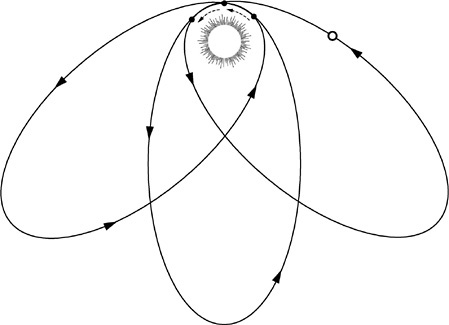
Over time, the point of Mercury's closest approach to the Sun—its perihelion—advances. The perihelion makes a complete turn around the Sun in 250,000 years. (The orbit's ellipticity is exaggerated for illustrative purposes.)
Then Einstein noticed a mistake in one step of the derivations he had conducted with Grossmann. This spurred him to consider that approach once again. He began to modify the equations and in the process became aware of his earlier misunderstandings. This allowed him to begin seeing that he could recover Newton's equations when gravitational fields were weak. His major effort took place during November 1915. On each of the four Thursdays of that month he reported his incremental progress to the Prussian Academy. A breakthrough came soon after his second report on November 11. That week he was at last able to successfully calculate the orbit of Mercury. He would later remark that he had palpitations of the heart upon seeing this result: “ I was beside myself with ecstasy for days.” It was the theory's first empirical success, grounding it in the real world. Moreover, Einstein's new formulation also predicted that starlight would get deflected around the Sun twice as much as he had earlier calculated
(and twice the amount if Newton's theory is used). Triumph arrived on November 25, the day he presented his concluding paper entitled “The Field Equations of Gravitation. ” In this culminating talk he presented the final modifications to his theory, which no longer needed a special frame of reference. At last it was truly a general theory of gravity. In a letter to fellow physicist Arnold Sommerfeld, Einstein noted that he had just experienced “one of the most exciting, most strenuous times of my life, also one of the most rewarding. ”
What he discovered by working within his new universal framework was the very origin of gravity. Written in the deceptively simple notation of tensor calculus, shorthand for a larger set of more complex equations, the general theory of relativity displays a mathematical elegance:

On the left side of the equation are quantities that describe the gravitational field as a geometry of space-time. On the right side is a representation of mass-energy and how it is distributed. The equal sign sets up an intimate relationship between these two entities. The two are intertwined: matter becomes the generator of the geometry. Consequently, gravity is not a force in the usual sense. It is actually a response to the curvatures in space-time. Objects that appear to be manipulated by a force are just following the natural pathways along those curves. Light, as it gets bent, is following the twists and turns of the space-time highway. Mercury, being so close to the Sun, has more of a “dip” to contend with, which partly explains the extra shift in its orbit.
Space-time and mass-energy are the yin and the yang of the cosmos, each acting and reacting to the other. The very cause of gravity is rooted in this image: it is the manifestation of the geometry of space-time. What Riemann suspected, Einstein firmly established. Einstein was not at all influenced by Riemann's vague yet prescient thoughts about a metrical field (Riemann never imagined the necessary ingredient called space-time), but he was greatly beholden to Riemann 's mathematics. Space, Einstein taught us, may be thought of not as an enormous empty expanse but as a sort of boundless rubber sheet.
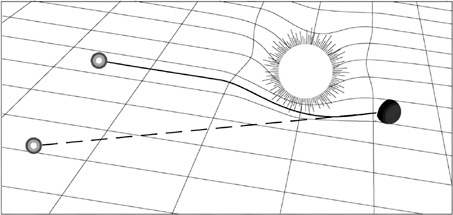
According to general relativity, space-time is like a vast rubber sheet. Masses, such as the Sun, indent this flexible mat, curving space-time. A star's light (solid line) traveling through the cosmos follows these space-time curves. Tracing the light back as a straight-line path (dashed line), it appears to us that the star has shifted its position in the celestial sky.
Such a sheet can be manipulated in many ways: it can be stretched or squeezed; it can be straightened or bent; it can even be indented in spots. This image of space-time as a two-dimensional sheet is often used to help us visualize the concept, but the curvatures, of course, are imprinted on the full four dimensions of space and time. So, massive stars like our Sun are actually sitting in a flexible four-dimensional mat, creating deep depressions. Planets then circle the Sun, not because they are held by invisible lines of force, as Newton had us think, but because they are simply caught in the natural hollow carved out by the star. The more massive the object, the deeper the depression. Earth, for instance, is not holding onto an orbiting satellite with some phantom towline. Rather, the satellite is moving in a “straight” line—straight, that is, in its local frame of reference.
Think of two ancient explorers, who imagine the Earth as flat, walking directly north from the equator from separate locations. They move not one inch east or west but only push northward. But they hear they are moving closer to one another. They might then conclude that
some mysterious force is pushing them together. A space traveler high above knows the truth. The Earth's surface is, of course, curved, and they are merely following the spherical contour. Likewise, a satellite is following the straightest route in the four-dimensional warp of space-time carved out by the Earth. As long as a heavenly body continues to exist, the indentations it creates in space-time will be part of the permanent landscape of the cosmos. What we think of as gravity—the tendency of two objects to be drawn toward each other—is a result of these indentations. Newton's empty box was suddenly gone. Space was no longer just an inert arena. Einstein showed us that space-time, the new physical quantity he introduced to physics, is a real-time player in the universe at large. Years later, reminiscing on this accomplishment, Einstein would write, “Newton, forgive me.”