Einstein's Unfinished Symphony: Listening to the Sounds of Space-Time (2000)
Chapter: Starlight Waltz
Starlight Waltz
 t was the distinctive elegance of his theory that gave Einstein confidence in its validity. “Its artistry resides in its inevitability, the economy of its structure, the basic simplicity that shines through its complexities, and a pervasive beauty that, like all beauty, defies analysis,” said Banesh Hoffmann, who once collaborated with Einstein. In 1930 Einstein himself wrote that he did “not consider the main significance of the general theory of relativity to be the prediction of some tiny observable effects, but rather the simplicity of its foundation and its consistency.” And yet it would be one of those “tiny observable effects” that turned Einstein into a living legend.
Of course, the anomalous precession of Mercury was already known, and general relativity could explain it. But Einstein also predicted another effect only pondered by Newton but never pursued. Once physicists thought of light as a wave, they generally assumed that it was different from matter, that it was immune from gravitational
attractions.* General relativity, on the other hand, asserted that light must bend—that is, be attracted—by massive objects like the Sun, just like matter. More than that, the attraction would be twice the bending calculated when Newton 's law of gravity is used. The extra contribution comes from the warping of space-time, especially near the mass, an effect that Newton's theory couldn't account for at all. Observing how a star's light got deflected around the Sun was thus a way of detecting the curvatures—the sloping space-time valleys—that Einstein was proposing in his theory. Of course, it's not the light that is actually bending, although that is how it is commonly described. More correctly, it is light 's space-time path being flexed.
Near the Sun, a relatively lightweight star, the effect is very, very tiny. Einstein calculated that a ray of starlight just grazing the Sun's surface should get deflected by a mere 1.7 arcseconds (about 1/2,000 of a degree). That's roughly the width of the lead in a pencil seen from a football-field's length away. The bending diminishes the farther the light beam is situated away from the Sun and out of the solar space-time valley. In the spring of 1919, shortly after the close of World War I, Arthur Eddington, the British astronomer noted for his work on stellar physics, led a government-sponsored expedition to the tiny Isle of Principe, off the coast of West Africa, to look for this miniscule light deflection during a solar eclipse. An eclipse offered the perfect opportunity to view a star near the Sun as the Moon blocked its dazzling glare. Luckily, the eclipse was occurring in a part of the celestial sky with an exceptional patch of bright stars. To minimize the risk of bad weather, another team of astronomers journeyed to the village of Sobral in northern Brazil.
On the fateful day, May 29, Eddington and his teammate took 16 photographs, most of them ultimately useless because of intervening clouds. “ We have no time to snatch a glance at [the Sun],” wrote Eddington of his adventure. “We are conscious only of the weird half-light of the landscape and the hush of nature, broken by the calls of the
|
*Before Einstein, there were a few sporadic attempts to consider the effect of gravity on light. In 1804 J. Soldner, a German, published a short paper predicting the deflection of starlight by the Sun by an amount that follows from Newtonian theory, half that predicted by general relativity. |
observers, and beat of the metronome ticking out the 302 seconds of totality.” In the end, two pictures did turn out to have good images of the essential stars. Within a few days, as a precaution against any mishaps on the voyage back, one of the plates was examined on the spot. Eddington and his companion carefully compared the picture to another photo of the same celestial region, taken months earlier in England when the Sun was not in the way. Eddington, who freely admitted he was unscientifically rooting for Einstein, was elated to see that the stars near the Sun had indeed shifted their apparent positions and by an amount that matched Einstein's prediction, give or take 20 to 30 percent. For Eddington that was close enough. It was certainly a larger bending than one would get using Newton's laws alone to calculate light's gravitational attraction. Here was proof, marginal as it was, that the long-reigning king of gravity, Newton, had been overthrown. Eddington would later remark that this was the most exciting moment in his life as an astronomer.
The Sobral expedition, which had fine weather and so was able to take many more photographs, confirmed the verdict. Einstein, ever confident, never doubted that the light deflection would be verified but was pleased, nonetheless, when he was informed via the scientific grapevine. He quickly dashed off a postcard to his mother to tell her the good news. The Royal Astronomical Society and the Royal Society of London, a scientific organization that Newton himself once presided over, held a special joint meeting that fall to officially announce the results, an example of the universality of science. A devastating war had just ended between Germany and Great Britain, and yet the British scientists were honoring a theoretical achievement made in enemy territory.
With its front-page reports of the solar eclipse experiment, the press on both sides of the Atlantic turned the name Einstein into a synonym for genius. His life in public was never the same again. Over the years, celebrities, from presidents to movie stars, clamored to wine and dine him. He was besieged with autograph requests. Photographers and artists regularly arrived at his doorstep to do his portrait. Even Cole Porter included the acclaimed physicist's name in a 1943 song entitled It's Just Yours: “Your charm is not that of Circe's with her
swine/Your brain would never deflate the great Einstein.” To this day his bushy mustache, helter-skelter hair, and world-weary eyes are instantly recognizable and remain an icon in cartoons and advertisements. “I have become rather like King Midas, except that everything turns not into gold but into a circus,” remarked Einstein on his superstardom. For a man of thought, who yearned for a life of quiet contemplation, it was a state of affairs that he deemed “a dazzling misery.”
Einstein died in 1955 and so did not live to see the further experimental triumphs of his theory in the latter half of the twentieth century. With the entrance of new astronomical techniques, light deflection experiments could be performed with much finer care than Einstein ever dreamed of. Solar eclipse experiments were carried out nine more times between 1922 and 1973, yet with only modest improvements in accuracy. Far better have been observations using a network of radio telescopes electronically linked around the globe. In this way one huge radio telescope as big as the Earth is created. Those who continued to question the validity of the coarse solar eclipse measurements were at last satisfied. By using this globe-spanning radio network to observe distant quasars, extremely intense and compact sources of radio waves, radio astronomers have been able to monitor how the apparent separation between close pairs of quasars changes as their radio signals pass close to the Sun. The accuracy in this type of measurement is nearly a thousand times better than Eddington 's first crude try.
One of the most recent light deflection checks was a space-age version of the 1919 test but without the solar eclipse. The Hipparcos satellite, launched by the European Space Agency in 1989, spent four years making the most accurate measurements of stellar positions ever assembled. It did this for stars down to a magnitude of 10 (roughly 1,500 times fainter than the stars in the Big Dipper). The result: Einstein' s prediction continues to hold up and with near perfection. In fact, Hipparcos's data were so precise that the Sun's ability to bend starlight could be detected halfway across the celestial sky. Stars located far from the Sun on the celestial sphere were observed to experience a shift in their apparent position, though far more weakly than for stars positioned closer to the Sun.
In 1964 Harvard-Smithsonian astronomer Irwin Shapiro, then with MIT 's Lincoln Laboratory, came up with an entirely new and interesting variation to general relativity's light-bending effects. Shapiro suggested transmitting a radar pulse from Earth and reflecting it off another planet. This technique had already been used to measure distances to nearby planets. But if the pulse passed by the edge of the Sun, Shapiro figured the radar signal's excursion to and from the planet should take a bit longer than what it would take were the Sun not there. That's because the Sun's warp of space-time, in a sense, adds a tad more distance to the journey; the radar beam must “dip into” the depression. Within two years the test was carried out. Radar signals were transmitted to both Venus and Mercury, as the planets were about to pass behind the Sun. For Venus the round-trip took about 30 minutes. Three hundred kilowatts of power were sent from a radar transmitter at the Haystack observatory in northeastern Massachusetts; the echo that returned was as small as 10-21 watt. But that was enough to notice that it took the signal about 1/5,000 second longer to return to Earth when the signal passed near the Sun. The pathlength had lengthened by nearly 40 miles. Later, signals from the Viking landers on Mars, which set down in 1976, also were found to be delayed when passing near the Sun. Agreement between the measurements and the delay predicted by general relativity was within 0.1 percent, one part in a thousand.
The most beautiful example of light bending in the universe is gravitational lensing. Take the case of Abell 2218, a compact and rich cluster of galaxies situated more than a billion light-years from Earth. The view is breathtaking. Several bulbous elliptical galaxies sit like contented Buddhas in the middle of Abell 2218. A number of bright disks—spiral galaxies most likely—surround them. But there's more. Wispy arcs, 120 in all, encircle the entire heart of the cluster. The streaks are arranged like the rings of a dartboard. It is one of the universe's most wondrous illusions, created when Einsteinian light deflection is taken to the extreme.
When starlight passes by the Sun and gets bent, or deflected, the Sun is really acting like a lens. Recall that when you look through an optical lens it allows the object behind it to be magnified and brightened. It's a simple magnifying glass. A gravitational lens acts in a
similar manner, only now it is gravity doing the work rather than a curved piece of glass. Soon after Eddington's successful solar eclipse test, Einstein and others discussed the possibility of light deflections—lensing—occurring farther out in space, as light passed by faraway stars. Depending on the orientation of the “lens,” objects behind it could be simply magnified or split into multiple images, as if some giant fun-house mirror were at work. But by 1936 Einstein concluded that “there is no great chance of observing this phenomenon” beyond the Sun, since the chances for two stars being properly aligned were too small. Caltech astronomer Fritz Zwicky, though, had a grander vision. In 1937 he declared that galaxies offered “a much better chance than stars for the observation of gravitational lens effects.” Zwicky was right, although it would take four more decades before his visionary insight was confirmed. The first such cosmic lens was sighted in 1979 (totally by accident). Since then dozens of lenses have been found. Some are single galaxies; others are entire clusters of galaxies, like Abell 2218. The cluster, trillions of times more massive than a single star like our Sun, collectively acts like a monstrous spyglass, greatly brightening the objects that lie far behind it. The faint blue arcs that surround Abell 2218 are actually the distorted ghostlike images of distant galaxies that reside some 5 to 10 times farther out. This makes gravitational lensing more than a cosmic curiosity. As witnessed by Abell 2218, lenses can act as a giant zoom lens. They take distant galaxies too faint to be seen and bring them into view. In this way astronomers manage a peek at the universe when it was far younger. No wonder lensing has been called “Einstein's gift to astronomy.” Awareness of lensing effects is actually becoming quite vital to astronomers. Otherwise, it can lead to some astronomical bloopers. When galaxy FSC 10214+4724 was first discovered in 1991, for example, it was heralded as the most luminous galaxy in the universe. Though bright, it's not that brilliant. The Keck telescope in Hawaii later revealed that this galaxy is being brightened by a gravitational lens, a foreground galaxy located closer in. Oops, fooled by a gravitational illusion!
When Einstein first proposed his theory of general relativity in 1915, he made another prediction that could not be detected as readily as light deflection. Scientists then had neither the instruments nor the
techniques to measure this extremely tiny effect. It was Einstein 's declaration that time will pass more slowly in a gravitational field. To put it another way, a clock in space will tick more quickly than one “weighed down” by Earth's gravity. This situation is best imagined when we think of the gravitational force—the way Einstein first did—as equivalent to the force one feels in an accelerating room out in space. Picture a clock on the floor of that space elevator, with you on the ceiling observing it. But the room is accelerating upward. By the time the clock's ticks (marked by pulses of light) reach you at the ceiling, you and the ceiling have moved away in the motion upward. As the elevator moves faster and faster to mimic gravity, the peaks of the light waves will arrive at the ceiling at a slower rate. (In other words, the frequency will decrease.) Thus, the clock to you appears to be slowing down.
But, as Einstein taught us, the force experienced in this accelerating elevator is exactly mimicking the gravitational force on Earth. Hence, a clock on Earth would also tick away slower than one freely floating in space. This was a prediction unanticipated by any other physical theory. It was entirely new to physics. We don't notice this effect ourselves, for the atoms in our body are slowing down as well. We would know only by comparison. For example, any person who could miraculously survive on the surface of a neutron star, whose gravitational field is a trillion times stronger than Earth's, would age noticeably slower than a person more loosely grounded on terra firma. While a decade passes by on Earth, Neutronians would experience around eight years. Black holes, the mightiest gravitational sinkholes in the universe, carry this effect to the extreme. When a fraction of a second ticks away near the edge of a hole, many eons pass by in the rest of the universe. Relativity, in this case, lives up to its name. During a conversation with Einstein, writer Ashley Montagu once regaled the physicist with a popular joke concerning this paradox. It involved two men from the Bronx:
“What is relativity?” asks the first man.
The second man replies: “Supposing an old lady sits in your lap for a minute, a minute seems like an hour. But if a beautiful girl sits in your lap for an hour, an hour seems like a minute.”
“And this is relativity?” responds the first.
“Yes,” answers his companion. “That's relativity.”
“And from this Einstein earns a living?”
There's another way to look at this effect. You might think of light waves as springs—coils that get stretched as they attempt to climb out of the “gravitational well” dug into space-time by a massive celestial object. Shorter waves, such as blue or yellow light, would thus get longer as they soar upward, shifted toward the other end of the electromagnetic spectrum. They would get redder. Hence, the name for this effect —gravitational redshift. The reddening is so miniscule in the neighborhood of the Earth and Moon that scientists had to wait until 1959 to measure it. Robert Pound, along with his student Glen Rebka, detected the redshift by setting up an experiment on the campus of Harvard University. They measured how gamma rays shifted their frequency ever so slightly as the energetic waves either ascended or descended a 74-foot-high tower within the Jefferson Physical Laboratory. The gamma rays came from a source of radioactive iron. To reduce the chance of the gamma rays getting absorbed by the dense air, a long Mylar bag was run through the tower and filled with lighter helium. The frequency changed within 10 percent of what Einstein predicted. Five years later, Pound and his colleague Joseph Snider got it down to 1 percent.
By the 1970s this gravitational redshift was being measured to levels of astounding accuracy. Atomic clock builder Robert Vessot of the Harvard-Smithsonian Center for Astrophysics rocketed into space one of his extremely accurate timepieces, a hydrogen maser clock, and compared its frequency to a similar clock on the ground. This special 90-pound clock, so regular and exact that its time varied by about a billionth of a second each day (that's roughly equivalent to one second every three million years), was launched aboard a four-stage Scout D rocket from Wallops Island off the eastern shore of Virginia on June 18, 1976. The launch occurred near dawn. Impact was 118 minutes later in the mid-Atlantic Ocean, 1,000 miles east of Bermuda. There was one nervous moment when Vessot and his colleagues lost contact with the spacecraft, but a minute later the signal was reacquired. A
circuit breaker had accidentally cut off the power supply to the uplink transmitter. The basic idea of the experiment was simple— monitor the oscillations of the atomic clock as it traveled almost vertically up some 6,000 miles and then down again. In the end they found that at 6,000 miles above the Earth, where gravity has loosened its grip, the clock did indeed run a bit faster, by some 4.5 parts in 1010. If it had been there in orbit for 73 years, it would have gained a whole second compared to a clock on Earth. The accuracy of the test was within a hundredth of a percent, 100 times better than the gravitational redshift measurements on the Harvard campus.
In 1976 such a test had little practical importance, but that's no longer true. The high-stability clocks aboard the Global Positioning System satellites, perched high above Earth, are regularly affected by the gravitational redshift. Twenty-four in all around the globe, these satellites must be synchronized to within 50 billionths of a second to allow users to know their position on the ground to 15 yards. But without a relativistic correction, the clocks would run faster by 40,000 billionths of a second each day, most of that due to the gravitational redshift. Periodic corrections are programmed in, otherwise the clocks would be out of sync within a minute and a half. Clifford Will knew that general relativity had finally arrived when he had to prepare a briefing on the theory for an Air Force general, as it became a matter of national security that the Global Positioning System be as accurate as possible. Hollywood recognized the drama of this situation in the James Bond movie Tomorrow Never Dies, where an evil genius attempts to insert errors into the system to send British ships into harm's way.
The gravitational redshift was not the only novel and strange effect predicted by general relativity. In a 1913 letter to the Austrian physicist and philosopher Ernst Mach, Einstein mentioned a new force that should come into play with general relativity. He called it “dragging.” This was two years before Einstein had worked out his full theory. In many ways, dragging is to gravity what magnetism is to electricity. In fact, some call it gravitomagnetism. A charged particle as it spins creates a magnetic field that surrounds the particle; similarly, a spinning mass, such as the turning Earth, imparts a rotation to the surrounding medium, which is space-time itself! In 1918 two Aus-
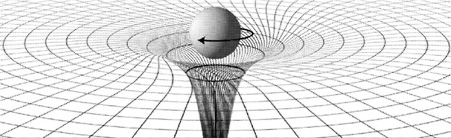
Frame Dragging: As a black hole spins, it twists space-time around itself.
trian scientists, Josef Lense and Hans Thirring, calculated the effect such a spin would have. Consequently, it is sometimes called the Lense-Thirring effect.
Lense and Thirring saw that an object spinning pulls the very framework of space-time around with it, like a cake batter swirling around the beaters in an electric mixer. The whirling is strongest nearest the beaters and gradually diminishes farther away. In 1959 a magazine ad in Physics Today for a new kind of gyroscope sparked some physicists (while swimming naked in the Stanford University pool and musing as they exercised) to imagine the perfect gyroscope and how it could be used to measure this subtle feature of general relativity. By 1963 they obtained support from the National Aeronautics and Space Administration (NASA). For more than 30 years, in fits and starts and rising like a phoenix to survive seven cancellations, the project continues. At a cost of $500 million, the endeavor is highly controversial. Called Gravity Probe B (Vessot's experiment was Gravity Probe A), it is one of the most expensive pure science projects that NASA has ever sponsored (and the longest in preparation).
The plan is to use a set of four gyroscopes and launch them 400 miles above the Earth in polar orbit. A gyroscope is essentially a spinning wheel. For the Gravity Probe B, the spinning gyroscopes will be four quartz globes, each a mere 1½ inches in diameter. The globes are coated with a layer of niobium, giving them a silvery finish. They could be registered in the Guinness Book of World Records as the smoothest, roundest objects on Earth. They have been polished to within 50
atomic layers of being perfect spheres. Such perfection is needed to measure the tiny changes at work; distortions could introduce a mechanical wobble that might be mistaken for space dragging. Once set in motion and free of outside disturbances, the axes of these spinning globes should keep pointing in the same direction. Because of conservation of angular momentum, the globes will resist any change in their orientation. This makes them the perfect tool to measure space-time dragging. Gyroscopes spinning in space can be aligned with a far-off star. But over time, as the spinning Earth drags local space-time around itself, this alignment will slowly drift. Each gyroscope's axis, while maintaining its direction with respect to local space-time, will no longer align on the far-off star. This wobble is not a large effect. The image of the swirling batter is far too strong when it comes to Earth, a lightweight celestial object. According to general relativity, the axis of a spaceborne gyroscope should move an infinitesimal 0.0007 of a degree each year because of Earth's dragging the framework of space-time around itself. That 's the width of a human hair seen from a quarter mile away.
While this effect is virtually meaningless to Earth's cosmic life, such “frame dragging” may have far bigger consequences in other environments, such as in quasars. A powerful young galaxy caught at the edge of the visible universe, a quasar emits the light of tens of normal galaxies, with most of that energy believed to be generated by a supermassive black hole in the quasar's center. The black hole contains the mass of hundreds of millions of suns. With such a large mass spinning, the magnitude of frame dragging is gargantuan. In fact, some speculate that it causes any nearby matter to spiral in toward the black hole 's poles, which then shoots straight outward in spectacular jets that span hundreds of thousands of light-years. In this situation, frame dragging is made highly visible.
The noted Danish physicist Niels Bohr, who first conceived of an atom's inner structure, visited the United States in January 1939 to work a few months with Einstein at the Institute for Advanced Study in Princeton, New Jersey. But right before his ship, the MS Drottningholm, left Europe, he learned that nuclear fission had been discovered.
German scientists had verified that their uranium nuclei were splitting into smaller pieces. Arriving at Princeton greatly excited by the news, Bohr immediately began working on the problem with John Archibald Wheeler, then 27, the Princeton physics department's newest addition and a specialist in atomic and nuclear physics. Together, they developed a general theory of nuclear fission. Using it they predicted that such nuclei as uranium-235 would be effective in sustaining chain fission reactions. Wheeler went on to become a central figure in subsequent historic developments in physics, including World War II's Manhattan Project and the later development of the hydrogen bomb. Upon returning to Princeton in the early 1950s after this war work, though, he chose to move in a completely different direction. “I suppose it was infection,” says Wheeler. “As a student I had read a book called Problems of Modern Physics by H. A. Lorentz, a great father figure in physics. And what were the problems? They were quantum physics and relativity.” Having spent years on the first problem, Wheeler decided to tackle the second. It was a dicey decision. Relativity had turned into a backwater in physics, a field inhabited by lone specialists. “There were all these people working with Einstein who didn't know the rest of physics, ” recalls Wheeler.
For several decades general relativity had been the most admired yet least verified theory in physics. There was the subtle twist of a planetary orbit here, the tiny bending of a beam of starlight there. The theory could also account for the expanding universe discovered by Edwin Hubble in the 1920s. Yet even with that, the experimental evidence was admittedly thin. Not until midcentury did things begin to change, largely due to the new technologies that could better assess the minute changes predicted by relativity. By the 1960s general relativists were entering a golden age of experimentation. Pound and Rebka at last measured the gravitational redshift, while Shapiro came up with an intriguing new way to measure space-time curvatures. But this renaissance would not have occurred without one other vital factor: a concerted effort by theorists to study general relativity more deeply as well. And at the forefront of this movement to bring Einstein's theory back into the thick of mainstream physics and connect it to the universe at large was Wheeler. Almost single-handedly he would change
general relativity's moribund image. He immersed himself in the subject through teaching. “Much of the best teaching comes out of research, and much of the best research comes out of teaching,” notes Wheeler. “If the class hour doesn't end with the teacher having learned something, he doesn't know how to teach.” It was then that Wheeler encapsulated general relativity in one clear sentence: “Mass tells space-time how to curve, and space-time tells mass how to move.”
Einstein gave the last seminar of his life in Wheeler's class, which met in the physics department's former quarters, the Palmer Physical Laboratory. It's an impressive gothic-style building, constructed of red brick with a thick slate roof. Erected in 1907, the building is now used as a center for Asian studies, so the physics themes played out in the stained glass windows and statuary of honored physicists of the past are oddly out of place. Wheeler slowly walks a visitor through his early years in physics. He proceeds past the heavy wooden doors at the entrance and up the wide central staircase. On the second floor, after a turn, the first room on the left is number 309. Here is where Einstein gave his last classroom lecture. The chairs, in dark wood, have widened arms on the right for note taking. Real blackboards, the old-fashioned kind, completely line the walls at the front and along the right side of the room. The seats are eight across and eight deep. The room has the smell of old wood and chalkdust, rather nostalgic and not unpleasant. One can almost picture the elderly Einstein at the front, in his casual attire, stepping the students through his thoughts. Wheeler recalls Einstein talking about three things: first, how he came to relativity; second, what relativity meant to him; and, third, why he didn't like quantum theory, whose edicts went against his scientific philosophy. The role of the observer is central to quantum theory; nothing is known until it is measured by an observer. Wheeler remembers Einstein wondering aloud, “If a being such as a mouse looks at the universe, does that change the state of the universe?” In such timeworn surroundings, Wheeler would revive general relativity, taking it from its minor position in physics to one of its most thriving fields.
It began when Wheeler looked at a problem almost forgotten. What happens to a star that is particularly heavy? What happens to it at its death? J. Robert Oppenheimer (who would later head the Man-
hattan Project that constructed the first atomic bomb) and his student Hartland Snyder published a paper on this very question in the September 1, 1939, issue of Physical Review. (Coincidentally, Bohr and Wheeler had their paper on the theory of fission in the same issue.) They began with a star that has exhausted all its fuel. With the heat from its nuclear fires gone, the star 's core becomes unable to support itself against the pull of its own gravity, and the stellar corpse begins to shrink. If this core is weightier than a certain mass, now believed to be two to three solar masses, Oppenheimer and Snyder confirmed that the core would not turn into a white dwarf star (which will be our own Sun's fate) nor even settle down as a tiny ball of neutrons. From general relativity they calculated that the star would continue to contract indefinitely. It would be crushed to a “singularity,” a condition of zero volume and infinite density conceived earlier by the German astronomer Karl Schwarzschild in 1916 when he was working with Einstein's newly published equations. It was a place where all the current laws of physics break down. The last light waves to flee before the door is irrevocably shut get so extended by the enormous pull of gravity (from visible, to infrared, to radio and beyond) that the rays become invisible and the star vanishes from sight. What remains is a spherical region of space out of which nothing—no signal, not a glimmer of light or bit of matter—can escape. The ethereal boundary of this sphere has come to be known as the “event horizon.” It is not a solid surface but rather a gravitational point of no return. Once you've stepped inside that invisible border, there would be no way out, only a sure plummet into the singular abyss at the center. Space-time around the collapsed core becomes so warped that the stellar remnant literally closes itself off from the rest of the universe. “Only its gravitational field persists,” wrote Oppenheimer and Snyder in their historic paper. For Schwarzschild such a condition was an interesting mathematical solution to Einstein's equations; Oppenheimer and Snyder were arguing that it could be the actual fate of a massive star.
But in 1939 Oppenheimer and Snyder didn't consider all of the forces that might possibly prevent such a dire finale. Coming back to the problem in the 1950s, Wheeler wondered if pressure, the resisting power of a substance, might change the result. Perhaps the pressure of
the star's material would prevent the ultimate collapse. Or maybe in its death throes an aging star throws off so much radiation and matter that gravitational collapse is averted, and it settles down as a white dwarf or neutron star. “I was looking for a way out,” says Wheeler. Kip Thorne, Wheeler's graduate student in the early 1960s, today speculates that Wheeler's resistance to accepting the star's dark fate may also have been partly due to the idea originating with Oppenheimer. Wheeler, a political conservative, had reservations about Oppenheimer, who was long publicly challenged for his liberal beliefs. They had been on opposite sides during the first governmental debate on the need for a hydrogen bomb. “There was something about Oppenheimer's personality that did not appeal to me,” confessed Wheeler in his autobiography. “He seemed to enjoy putting his own brilliance on display—showing off, to put it bluntly. . . . I always felt that I had to have my guard up.”
After Oppenheimer had worked briefly on the problem of “continued gravitational contraction,” as he called it, he inexplicably dropped it, never taking it up again. “He didn't recognize the importance of it,” explains Thorne. “But Oppenheimer's work with Snyder is, in retrospect, remarkably complete and an accurate mathematical description of the collapse of a black hole. It was hard for people of that era to understand the paper because the things that were being smoked out of the mathematics were so different from any mental picture of how things should behave in the universe.” Wheeler was so skeptical, in fact, that he hardly mentioned the existence of Oppenheimer's paper in his early work on general relativity. His attitude didn't appreciably change until 1962 when David Beckedorff, an undergraduate student then completing a senior thesis at Princeton, reexamined the Oppenheimer solution and recast it in a simpler form. “It was a real eye-opener for me, ” says Thorne, just then starting his graduate work with Wheeler. With other loopholes closed off as well, particularly due to the introduction of computers that could simulate the difficult physics of an imploding star, Wheeler was finally convinced that the star had to collapse. “Even if you put in the most powerful attempt to fight collapse, you can't prevent it,” he says. “You always end up with a ‘gravitationally completely collapsed object, '” as he was then awkwardly calling it.
When pulsars were discovered in 1967, and not yet understood, a conference was quickly set up at NASA's Goddard Institute for Space Studies in New York City to discuss the possible suspects. Could they be red giant stars, white dwarfs, or neutron stars? Wheeler lectured that astronomers should consider the possibility that they were his gravitationally collapsed objects. “Well, after I used that phrase four or five times, somebody in the audience said, ‘Why don't you call it a black hole.' So I adopted that,” says Wheeler today (although some suspect Wheeler carefully crafted the term himself after years of thought). Whatever the origin, Wheeler used the term again in a scientific lecture several weeks later. The name became official. Black hole—a term so appropriate as it is truly a pit dug into the fabric of space-time—went into the scientific lexicon. The catchy phrase caught the public's imagination (and caused blushes for a while in France where trou noir has obscene connotations).
While doing his graduate work at Princeton, Thorne observed this rebirth of general relativity firsthand. As experimentalists were testing their cherished theory in ways impossible to perform in the past, Thorne came to recognize that these scientists needed theorists like him to help them out. In general relativity it is not easy to decide what to measure. It's a slippery theory. Depending on the coordinates you use, you can come up with apparently different answers. When carrying out his radar experiments, Shapiro was continually challenged, forced to justify his calculations to others again and again. It is one of the reasons that experimental relativity took nearly a century to bloom and flourish. It's a difficult business to decide what you will measure, how you will measure it, and how to interpret the results. Many have stumbled along the way. Controversies have broken out over what is and what is not possible to observe. Partly to resolve these conflicts, theorists realized they had to construct a more comprehensive scaffolding that contained not just Einstein's theory but alternate theories of gravity as well. “Although Einstein's theory of general relativity is conceptually a simple theory, it's computationally complex,” says Thorne. “If you want to identify what it is you are testing in any given experiment, you basically need a larger framework than relativity itself gives. You need some other possibilities. You will then have a large
class of conceivable theories of gravity in which relativity is one. These other theories then act as a foil against which to examine relativity.” Observers could set up experiments that tested for certain differences between these various theories, to see if Einstein's held up. Clifford Will, who studied under Thorne at Caltech and is now at Washington University in St. Louis, and Kenneth Nordtvedt of Montana State University analyzed and categorized many of these alternative theories and even invented a few of their own. “Partly as strawmen,” explains Will. “It was a way of motivating an experiment and interpreting the results.” Others offered revised equations of gravity because they truly believed that general relativity needed to be amended for various theoretical reasons. All these theories, says Will, “forced general relativity to confront experiment as never before. ” The most famous alteration to Einstein's equations—and for a while its most serious challenger—was the Brans-Dicke theory.
Princeton University was the center of the renaissance in general relativity and not solely in the theoretical arena. While Wheeler wrestled with gravitationally collapsed objects on paper, Princeton physicist Robert Dicke was reinvigorating relativity on the experimental end. “They thought about things in very different ways,” notes Thorne. “Wheeler was a dreamer, driven to a great extent by physical intuition wrapped up in philosophy. Dicke was a gadgeteer who had theoretical dreams as well. But his ideas were radically different from Wheeler's. Wheeler thought about the universe in terms of geometry; Dicke thought about it in terms of field theory.”
Dicke was a very generous scientist. In 1965 he helped Arno Penzias and Robert Wilson figure out that a pesky noise in their radio telescope at Bell Laboratories in New Jersey was actually the fossil whisper of the Big Bang, a buzz that had been echoing through the corridors of the universe for some 15 billion years. Dicke was just getting ready to look for this cosmic microwave background himself. Penzias and Wilson later won the Nobel Prize in Physics for their accidental discovery, but Dicke was not bitter by this turn of events at all. He simply said he was “scooped.”
Dicke, who died in 1997, was revered by an entire generation of physicists as the premier experimentalist of his time. “Dicke made ex-
perimental discoveries or elucidated theoretical principles that led to, among other things, the lock-in amplifier, the gas-cell atomic clock, the microwave radiometer, the laser, and the maser,” Will has written. “He was involved, directly or indirectly, in so many discoveries for which Nobel Prizes were awarded, that many physicists regard it as a mystery (and some as a scandal) that he [never received] that honor.” Trained in nuclear physics, Dicke began thinking about gravity around 1960 when he concluded that gravitational tests up to that point were woefully imprecise. One of his earliest ventures in this arena was to redo the famous experiments of Baron Roland von Eötvös of Hungary, who in 1889 and 1908 tested the equivalence of inertial mass (the aspect of a body that resists acceleration) and gravitational mass (the mass that feels a gravitational attraction) with exquisite precision. That mass is affected by these separate forces in the exact same way is the very cornerstone of both Newtonian physics and general relativity. It is the reason that different masses, both light and heavy, fall at the same rate when dropped from a tall height (say, from the Leaning Tower of Pisa). A heavier mass is more attracted to the Earth than a lighter one. Yet at the same time it has a greater resistance to the acceleration—enough resistance to slow its progress and match the speed of its lighter companion in the overall fall. Eötvös found this match to be exact to a few parts in a billion. Dicke and his co-workers got it down to a few parts in 100 billion, and later a Moscow team headed by Vladimir Braginsky made some improvements. In the mid-1990s a group led by Eric Adelberger at the University of Washington in Seattle reached the part-in-a-trillion level. They called their experiment “Eot-Wash,” a pun on the good baron's name, which is pronounced “ut-vush.”
In turning to these questions Dicke began thinking very deeply about the foundations of gravitational theory itself. He came to believe in what is known as “Mach's principle,” named after Ernst Mach who first voiced the concept decades earlier. Essentially, this principle states that the strength of gravity depends on the distribution of matter throughout the entire universe. If that is true, then gravity's forcefulness should diminish as the universe expands and diffuses its cosmic density. Dicke estimated at the time that the change would be roughly one part in 20 billion with each passing year. Einstein's general relativ-
ity did not allow for this at all. Working with his graduate student Carl Brans, Dicke incorporated Mach's principle into an alternate theory of gravity by adding an extra term to Einstein's equations. As a result, the Brans-Dicke theory came up with slightly different numbers on certain gravitational measurements, such as the perihelion of Mercury. Einstein seemed to have gotten that right, but he had assumed that the Sun was fairly spherical. What if the Sun were more oblate, more squished down than people were aware of, perhaps due to a rapidly spinning core? If so, Einstein would be wrong and the Brans-Dicke theory more useful. To find out, Dicke set out to measure the Sun's oblateness to a finer degree than had ever before been done. Then a postdoctoral researcher (postdoc) at Princeton, Rai Weiss recalls Dicke disappearing for a few weeks when he first got this idea. One Monday he walked back into the office with a fat sheaf of rolled-up drawings, about 50 or 60. Dicke had stepped through the entire experiment in his mind. He had designed the telescope, the electronics, and all the optics, as well as the supporting structure. The two assistants assigned to build the apparatus eventually saw that Dicke had anticipated every correction, adjustments usually not discovered until an instrument is under construction. He had done it all with pure thought.
“We called it a very Dickesque experiment,” says Kenneth Libbrecht, a former graduate student of Dicke's, “because all really subtle and clever experiments that had everything chopping back and forth were called that among my graduate student friends.” Dicke's experiment involved gathering two differing signals in quick succession, which is the purpose of a lock-in amplifier. It automatically shifts a detection back and forth in synchronization. It will first take data of both a signal and its background and then measure just the background. The instrument is programmed to do this continuously, cycle upon cycle. In the end, by subtracting the background from the overall data, a weak signal can emerge from the noise. Dicke was a coinventor of the lock-in amplifier and founded a company, Princeton Applied Research, to build such devices commercially. “As graduate students, we'd sit around and buzz about what Dicke was worth,” recalls Libbrecht. “The rumor was about $10 million.” His sole splurge was a cabin in Maine, where he spent a month each summer. “Other than
that, he never acted rich. He wore his frumpy old tennis shoes to work, like everybody else.”
Dicke, along with H. Mark Goldenberg, measured the Sun's roundness in 1966 by placing a circular disk—an occulting disk—in front of the Sun's image in the telescope. What remained was the very edge or limb of the Sun. Photodetectors basically scanned this thin circle of light to discern any fattening at the Sun's equator. Though the Sun does bulge due to its rotation, Dicke and Goldenberg reported far more bulging than previously assumed, enough to favor the Brans-Dicke theory over general relativity. It looked like Einstein was about to be overthrown. The sheer possibility is what motivated many to continue carrying out the classic tests of general relativity—light deflection, time delays, gravitational redshifts—to higher and higher degrees of precision so that the differing predictions of Einstein and Brans-Dicke could be appraised more rigorously. Over time, though, the enhanced measurements were found to match the predictions of Einstein's general theory of relativity far more than the predictions from Brans-Dicke or any other alternate theory of gravity. Yet Dicke 's oblateness result, which seemed to hold up (or at least was not yet refuted) was still a lone and nagging concern. To settle the controversy, Libbrecht redid the solar measurements. Dicke had looked at the Sun from Princeton, which often has clouds in the sky. In the summer of 1983 Libbrecht set up a shack atop Mount Wilson just north of Pasadena in sunny California. “As a graduate student I was thinking, ‘Not only am I going to knock down general relativity, but I'm going to revolutionize solar physics at the same time.' Then the whole thing fell down like a house of cards,” says Libbrecht. All the effects that Dicke had analyzed over those many years appreciably disappeared. Princeton's cloudy skies had likely introduced errors. The Sun's oblateness is actually quite small. “That was Bob's last hurrah,” notes Libbrecht. “But that's why he was such a hero. When the data said his theory was wrong, then for him his theory was wrong. It was as simple as that. He soon retired after that.”