Einstein's Unfinished Symphony: Listening to the Sounds of Space-Time (2000)
Chapter: Pas De Deux
Pas De Deux
 hrough the work of theorists and experimentalists such as John Wheeler and Robert Dicke, space-time joined an ever-growing cast of characters in the universe's cosmic drama. This new participant took on a definite role and personality. Space-time became the universe's flexible stage, a rubbery structure that stars, planets, and galaxies could bend and dent in intriguing ways. This new outlook had dramatic consequences. It meant that, when an object embedded in space-time gets moved or jostled, it can generate ripples in this pliable space-time fabric. Jiggle a mass to and fro and it will send out waves of gravitational energy, akin to the way a ball that is bounced on a trampoline sends vibrations across the canvas. These gravitational (or gravity) waves will uniformly radiate outward much like light waves. But while electromagnetic waves move through space, gravity waves are undulations in space-time itself. They alternately stretch and squeeze space—stretch and squeeze somewhat like the bellows of an accordion in play. And as these ripples encounter planets,
stars, and other cosmic objects, they will not be stopped. Rather they will simply pass right on through, as they expand and contract all the space around them.
Anything in the universe that has mass is capable of sending out gravity waves—all it has to do is move. But the strength of the signal depends on the amount of mass and the nature of its movement. A mammoth body like a star has a powerful gravitational pull, but since it remains essentially stationary (aside from its steadfast motion within the galaxy), it emits little gravitational radiation. Earth also continually emits weak gravitational energy as it circles the Sun, although it would take the age of the universe before we'd notice any effects from the emission. The Moon sends out still weaker waves as it moves around the Earth. Even hopscotch players have an infinitesimal chance of emitting a gravity wave or two as they jump up and down. The strongest waves, though, emanate from the most violent and abrupt motions the universe has to offer: stars crashing into one another, supernovas erupting, and black holes forming. Some of these events are not seen directly with electromagnetic radiation; thus, gravitational radiation offers a new means of exploring the universe. Gravity waves will not just extend our eyesight, they will provide an entirely new sense. “Gravitational waves could prove to be the most penetrating waves in nature. That is in part their charm but also their curse, since it makes them so difficult to detect,” Rainer Weiss and LIGO director Barry Barish have written.
Einstein first discussed the concept of gravitational radiation in 1916, shortly after he introduced his theory of general relativity. * His paper on the topic was tucked away in the Sitzungsberichte der Königlich Preussichen Akademie der Wissenschaften (Proceedings of the Royal Prussian Academy of Science) next to articles on the perception of light by plants and the use of first person in Turkish grammar. An algebra mistake led Einstein to a misconception about the origin of gravity waves in this initial paper, but he made the correction in a follow-up
|
*As early as 1908, Henri Poincaré did mention that a relativistic theory of gravitation, yet to be established, would likely involve the emission of gravitational waves (“onde d'accélération”). |
paper in 1918. He recognized that just as electromagnetic waves, such as radio waves, are generated when electrical charges travel up and down an antenna, waves of gravitational radiation are produced when masses move about. Moreover, they would also travel at the speed of light. To picture the generation of a gravity wave, Einstein imagined a cylindrical rod spinning around, like a game of spin the bottle. In this case the frequency of the gravity wave emission would be twice that of the rotation. These waves would flow smoothly outward from the source, but because gravitational energy moving through space would disperse and grow weaker, in the same way starlight does, Einstein doubted that gravity waves would ever be observed, even from the most violent astronomical sources. By the time the gravity waves from an exploding star in our galaxy strike Earth, for instance, they are little more than subatomic flutters. Were a gravity wave from a supernova in the center of the Milky Way to hit this page, it would be so weak that it would squeeze and stretch the sheet' s dimensions by a mere hundred-thousandth of a trillionth of an inch —a measure 10,000 times smaller than the size of an atomic nucleus.
Given the extreme weakness of the signal, few scientists were interested in the phenomenon when Einstein first described it. Why bother with an effect too small to detect? Furthermore, a lively debate ensued for some four decades on whether gravity waves existed at all. Many seriously wondered whether they were just artifacts—unreal ghostly products—in the equations of relativity. That possibility inspired Arthur Eddington to mischievously ponder whether the waves really “traveled at the speed of thought.” Even Einstein had doubts at one point while he was working at the Institute for Advanced Study. These suspicions lingered into the 1960s. The doubts initially arose because there is a pitfall in general relativity: its equations are written in such a way that they are independent of all coordinate systems. So when a theorist dives in and chooses a particular system of measurement, the results can be tricky to interpret. For example, if your measurement system happens to have its coordinates fastened to the masses, a gravity wave passing by wouldn't budge them off the coordinates (within your calculations, that is), leaving the impression that the wave had no effect on space-time whatsoever. “A few years ago here at Syracuse Uni-
versity,” recalls gravitational wave physicist Peter Saulson, “the department received a paper that seemed to prove that gravity waves would get absorbed by the interstellar medium. But it took the physicists here at the time several months to figure out exactly where the author of this paper went wrong. He had chosen a coordinate system unfamiliar to them. Each generation seems to have to work this out.”
The controversy today is pretty well laid to rest to everyone's satisfaction. No one really questions anymore whether gravity waves truly exist. With all the evidence amassed in favor of Einstein' s view of gravity, physicists are convinced that gravitational radiation is a natural consequence of the theory. This confidence, though, is not based on faith alone. Indirect yet exquisite evidence that gravity waves are real arrived in the 1970s, when radio astronomers uncovered one of nature's most dependable gravity wave emitters in the celestial sky. Their tale of discovery is comprised of one part ingenuity, one part serendipity, and two parts sheer pigheadedness.
Only a month after finishing his Ph.D. in radio astronomy at Harvard University in 1967, Joseph Taylor heard about the discovery of a strange new object in the heavens. “This was a time when the journals were always publishing something quite new, but this was more unexpected than anything I can remember at the time,” recalls Taylor. The discovery had been made using a sprawling radio telescope—more than two thousand dipole antennas lined up like rows of corn—near Cambridge University in Great Britain. Jocelyn Bell (now Burnell), then a Cambridge graduate student, was one of the laborers. “I like to say that I got my thesis with sledgehammering,” she has joked. The telescope was designed by Cambridge radio astronomer Antony Hewish to search for quasars, and it was Bell's job to analyze its river of data. At a radio astronomy conference in 1983, Bell Burnell recalled the moment when she realized that some of the squiggles recorded on her reams of strip-chart paper didn't look quite right:
We had a hundred feet of chart paper every day, seven days a week, and I operated it for six months, which meant that I was personally responsible for quite a few miles of chart recording.
It was four hundred feet of chart paper before you got back to the same bit
of sky, and I thought—having had all these marvelous lectures as a kid about the scientific method—that this was the ideal way to do science. With that quantity of data, no way are you going to remember what happened four hundred feet ago. You're going to come to each patch of sky absolutely fresh, and record it in a totally unbiased way. But actually, one underestimates the human brain. On a quarter inch of those four hundred feet, there was a little bit of what I call “scruff,” which didn't look exactly like [man-made] interference and didn't look exactly like [quasar] scintillation. . . . After a while I began to remember that I had seen some of this unclassifiable scruff before, and what's more, I had seen it from the same patch of sky.
The 81.5-megahertz radio signal was emanating from a spot midway between the stars Vega and Altair. A higher-speed recording revealed that the signal was actually a precise succession of pulses spaced 1.3 seconds apart. The unprecedented clocklike beeps caused Hewish and his group to label the source LGM for “Little Green Men.” This was done only half in jest. At one point some consideration was given to the possibility that the regular pulsations were coming from a beacon set up by an extraterrestrial civilization. Within a month Bell ferreted out, from the yards upon yards of strip chart that were spewing from the telescope, the telltale markings of a second suspicious source. Its period was 1.19 seconds. By the beginning of 1968, two more were uncovered. When the phenomenon was announced to the public, a British journalist dubbed the freakish sources pulsars.
Remaining at Harvard as a postdoctoral fellow, Taylor quickly rounded up a team to observe the four pulsars with the imposing 300-foot-wide radio telescope at the National Radio Astronomy Observatory in Green Bank, West Virginia (a dish that dramatically collapsed in 1986). While the original pulsars had been found by visually searching for specific peaks—pulses—on a paper chart recorder, Taylor developed a different strategy to look for more. A pulsar, of course, beeps with a regular beat, but it also has a sort of echo. As the pulsar signal travels through the thin plasma of interstellar space, its various frequencies propagate at varying speeds: the high radio frequencies travel faster than the lower frequencies. (The speed of light can vary when not in a vacuum.) Consequently, like horses on a racetrack, the differing radio waves start spreading apart. They get dispersed. By the time they reach Earth, the high-frequency pulse arrives first, followed by the
lower frequencies in quick succession. Overall, the pulse appears extended, sweeping rapidly downward in frequency. Taylor and his colleagues wrote a special program to look for this distinctive profile in their streams of celestial radio data, automating the search with the use of a computer. “No one had thought about doing this kind of thing before with a computer,” says Taylor. With use of this strategy, the Harvard team found the fifth-known pulsar. Within a year they found nearly half a dozen more, a sizable jump in number. And by then theorists at last figured out what a pulsar is.
It was agreed that a pulsar is a neutron star, an object first imagined in the early 1930s. Soviet theorist Lev Landau had initially suggested that the compressed cores of massive stars might harbor “neutronic ” matter. The neutron, a major constituent of the atom along with the proton and electron, was a hot item at the time, having been recently discovered by experimentalists. Caltech astronomers Walter Baade and Fritz Zwicky picked up on the idea and proposed that under the most extreme conditions—during the explosion of a star to be exact—ordinary stars would transform themselves into naked spheres of neutrons. But their proposal was considered wildly speculative, and only a handful of physicists even bothered to ponder the construction of such a star. They would be so tiny that no one figured such miniscule stars would ever be detectable anyway. Jocelyn Bell proved them wrong.
A neutron star squeezes the mass of our Sun into a space only 10 or so miles in diameter. This occurs when the core of a particularly massive star runs out of fuel. No longer able to withstand the force of its own gravitation, the core collapses. The core had encompassed a volume about the size of the Earth, but in less than a second it becomes one giant atomic nucleus the size of Manhattan. All the positively charged protons and negatively charged electrons are compressed to form a solid ball of neutron particles. But like a compressed coil, the newly squeezed core rebounds a bit, generating a powerful shock wave that eventually blows off the star's outer envelope as a brilliant supernova.
The neutron star that remains behind spins very fast. Like an ice skater bringing in her arms—compressing herself to whirl ever faster —
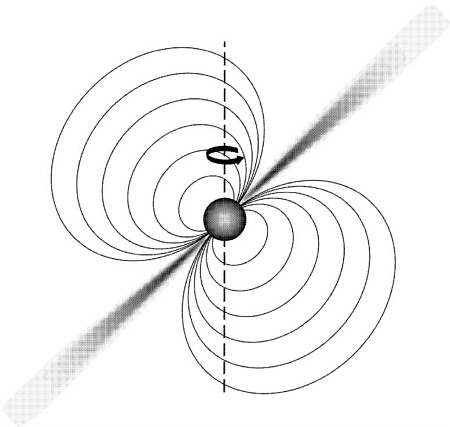
As a neutron star rapidly spins, radiation beams outward from its magnetic poles. Sweeping around like a lighthouse beacon, these beams are detected on Earth as clocklike pulses (hence the term pulsar).
a collapsing stellar core spins faster and faster during its compression as it conserves angular momentum. Its magnetic field grows very intense as well, to a trillion gauss or so. (The Earth's magnetic field, by comparison is a feeble half a gauss, the strength of a toy magnet.) Such a rapidly spinning and highly magnetized body becomes no less than an electrical generator. As a result, narrow and intense beams of electromagnetic waves are emitted from the neutron star's north and south magnetic poles. As on Earth, these poles don't necessarily line up with the star's rotational axes. So as the star spins around, the beams regularly sweep across earthbound telescopes, much the way a lighthouse beam regularly skims across a coastline. Radio telescopes pick it up as a periodic radio pulse. In the fall of 1969 Taylor joined the faculty of the University of Massachusetts at Amherst to help establish the Five College Radio Astronomy Observatory in the woods of western Massachusetts and to continue his pulsar research, which was an opportunity to study the final stages of stellar evolution. By then
astronomers had detected a few dozen pulsars, but to truly understand them they needed a much larger sample. Researchers wanted to know how they are distributed through the Milky Way. Could all pulsars be associated with past supernova explosions? Just studying the radio pulses themselves seemed futile. “I have a friend in India who said that trying to understand a pulsar by looking at its radio pulses was like trying to understand the innards of a complicated factory by standing in the parking lot and listening to the squeaks of the machinery. In some cases, only a tenth of a percent of a pulsar' s energy comes out in radio,” notes Taylor. To get answers, Taylor wanted to double or triple the number of known pulsars by extending his computerized method for finding these radio beacons. He seemed destined for such a task since childhood.
Taylor grew up in the 1940s on a farm along the New Jersey shore of the Delaware River, just north of Philadelphia. Perhaps it was the farm machinery, but he and his older brother Hal became avid mechanics. They fiddled with all kinds of motors, both gasoline-driven and electrical. They even erected ham radio antennas on the roof of their family's three-story Victorian farmhouse. Taylor's interest in electronics continued through his undergraduate days at Haverford College, where he built a radio telescope for his senior thesis. He was able to detect the Sun and about five radio galaxies, some of the most distant objects then known in the universe. In Massachusetts, though, pulsars became Taylor's passion. He recognized that, with a large sample of pulsars on hand, astronomers could begin to use them as tools for probing interstellar space, seeing how the radio signals slowed, scattered, and polarized as they traversed the diffuse gases between the stars. Perhaps there were even new species of pulsars yet to be revealed. In his funding proposal to the National Science Foundation (NSF), Taylor did note—almost as an afterthought—that “even one example of a pulsar in a binary system [a pair of stars in orbit around one another] . . . could yield the pulsar mass, an extremely important number.” It was a minor wish; he figured the odds would be against him. All the pulsars detected so far were solitary creatures. Since neutron stars are the remnant cores of exploded stars, it seemed reasonable to assume that the explosion would have disrupted the orbit of
any companion star. Convinced of the merits of a large computerized pulsar search, though, the NSF allotted $20,000 for Taylor's project, a sizable sum in its day.
Needing assistance, Taylor sought out Russell Hulse, a graduate student then looking for a thesis project. Taylor offered him the perfect dissertation topic, a survey that would combine all three of Hulse 's top interests: radio astronomy, physics, and computer science. Hulse readily accepted, entitling his project, “A High Sensitivity Search for New Pulsars.” Like Taylor, Hulse had been a tinkerer since his youth. When he was nine years old, he helped his father build a summer vacation home in upstate New York, putting in walls, rafters, and siding. “I was always building things,” he says. “Fortunately, I came through the experience with all my fingers intact.” An eclectic child, he first went through his chemistry and biology phases, dissecting frogs and mixing chemicals. By the age of 13, electronics had captured his fancy; at that time he was also admitted to the legendary Bronx High School of Science, notable for its Nobel-Prize-winning graduates. Sparked by a library book on amateur radio astronomy, he built a radio telescope out of old television parts and army surplus in the backyard of his family 's summer home. “Electronics was a lot more accessible than it is now,” he recalls. “If you opened up a radio or TV set, there were all these parts: resistors, capacitors, tubes, wires, and coils. And you could take these electronic parts and build an antenna that had the potential to detect radio waves from the Milky Way.” It was magical for him, the idea of detecting signals out of the ether. “I don't have cable TV even today,” he says. “I still get my signals the old-fashioned way, out of the air with an authentic antenna.” His handmade telescope consisted of two flat sheets, each about 4 feet by 8 feet, covered with wire mesh and meeting at right angles. Strung down the middle were a couple of dipole antennas. He tuned it to 180 megahertz, what would be channel 8 on a television dial. It didn't work, but he was never bored by the attempt. Through these experiences he developed a freewheeling, “I'll-do-it-myself” attitude that served him well in his schooling. He later taught himself programming on an early IBM computer at his undergraduate institution, Cooper Union, a college in lower Manhattan. One of his first programs was an orbital simulation.
Hulse chose the University of Massachusetts at Amherst for graduate work so he could combine his interest in electronics with astronomy. “Radio astronomy was still new, still rough and tumble,” he says. And UMass, as it's familiarly called, was building a new radio telescope, what turned out to be an array of four 120-foot-wide radio dishes. He arrived on campus in 1970. By the time he was ready to tackle his thesis three years later, pulsars were still being found using a hodgepodge of techniques. His and Taylor's plan was to conduct a more systematic search taking advantage of the latest technology—called a “minicomputer,” although still as large as a couple of microwave ovens—to dig deeper into the galaxy for both weaker and faster pulsars. This required the use of the Arecibo Observatory in Puerto Rico, the largest single radio telescope in the world. More than three decades in service, this telescope is legendary for the range of its observations. It made the first accurate measurement of Mercury's rotation, discovered planetary systems outside the solar system, and listened for signs of extraterrestrial life. Nestled in a natural bowl-shaped valley in central Puerto Rico, the telescope was initially built to explore a layer of the Earth 's upper atmosphere known as the ionosphere. That required an antenna 1,000 feet in diameter, encompassing the area of a dozen football fields. A limestone sink hole in a valley near the town of Arecibo provided a natural framework for such a mammoth structure. The large collecting area also made it perfect for picking up pulsar signals, which are very weak.
The minicomputer, a Modcomp II/25, was programmed to sweep across a wide range of possible pulse periods and pulse widths in assembly-line fashion as the radio telescope scanned the sky overhead in Puerto Rico. The aim was to look for a range of pulsars, ones that beeped as fast as 30 times a second or as slow as once every 3.3 seconds. They also looked over a range of dispersions, the amount of spread between a pulsar's high and low frequencies. All in all there were half a million possible combinations. “At each point in the sky scanned by the telescope,” notes Hulse, “the search algorithm examined these 500,000 combinations of dispersion, period, and pulse width.” This made the search 10 times more sensitive than previous surveys.
The computer was housed in two crude wooden boxes, a combi-
nation packing crate and equipment cabinet that Hulse had built out of plywood. It had 32,000 bytes of core memory, a goodly amount for its day but thousands of times less than today's desktop computers, which now routinely incorporate tens of millions of bytes. A teletype was used for input and output, while a reel-to-reel tape drive stored the data. To get the maximum processing speed possible, Hulse programmed the computer in assembly code—the machine's internal digital language—using 4,000 punch cards, an experience he does not long to repeat.
Hulse carted the minicomputer to Puerto Rico at a fortunate time. The telescope was then undergoing a major upgrade. Many observations were impossible at this time, but pulsar searching could still be carried on. This afforded him more time for his searches than he would have received normally, working in and around the construction and other people's observations. In fact, he stayed at Arecibo for some 14 months—from December 1973 to January 1975—with only the occasional trip back to Massachusetts for a break.
The huge Arecibo dish does not move. It just serenely watches as the heavens continually turn above it. To look for a potential pulsar signal as the telescope carried out its passive sweep, Hulse examined a particular spot on the sky for 136.5 seconds. Then he would begin to examine the next spot over. Hulse's prime-time viewing each day was when the plane of the Milky Way, toward the inner parts of our galaxy, passed overhead for some three hours.
Just before that critical time, Hulse conducted the same routine. First he ran a tape, loading his program into the computer's memory. “As a classic computer hacker—and I'm using hacker in the positive sense—I had to make this program run fast enough so that all the data it collected over that three-hour observation window could be processed within 24 hours, before the next observation came up,” he says. “I spoke fluent hexadecimal.” During the observation itself, the computer would carry out the dispersion analysis and write its streams of digitized data onto a big magnetic tape. Over the remaining hours of the day, some 21 hours, the computer would review the resulting data and look for telltale signs of a pulsar. If the computer found a suspect, it would awaken the teletype and have it type out a cryptic line of
information, which Hulse could easily translate. “You would know immediately,” says Hulse. “The teletype started going chunk-chunk-chunk-chunk. It had a long line to print out if it found something. If there were interference, it was a nuisance, then you'd get all sorts of junk. Paper would start overflowing.” False leads could arrive from nearby thunderstorms, which were common during the summer in Puerto Rico. There was one pesky candidate signal that turned out to be emanating from an aircraft warning light on one of the telescope 's support towers. And then there were the days that the U.S. Navy held exercises off the coast. “I just sat in the control room,” recalls Hulse, “watching signals from the naval radars . . . jump around on the observatory spectrum analyzer.” But Hulse learned quickly to distinguish a false signal from a real one just by looking at the teletype print-out.
By the end of his 14-month stay, Hulse had cornered 40 new pulsars, all located in the roughly 140 square degrees of the Milky Way observable with the big Arecibo dish. With each new find he drew a hash mark on the side of his trusty Modcomp II/25. All in all he quintupled the number of known pulsars in that particular sector of the sky. That alone made a nice thesis for Hulse. But “it was of course eclipsed by the discovery of what was to become by far the most remarkable of these 40 new pulsars, PSR 1913 +16,” he points out.
PSR is astronomical shorthand for pulsar, while 1913 is the pulsar 's right ascension in celestial coordinates. It stands for 19 hours and 13 minutes. Astronomers have divided the sky into 24-hour segments, akin to longitude but in this case the time it takes the Sun to make one complete circuit. The 16 is the pulsar's declination or latitude on the celestial sphere. That placed the pulsar midway between the Aquila and Sagittarius constellations, close to the galactic plane that passes overhead at Arecibo. Hulse had started perusing this sector in the summer of 1974.
Things were pretty routine at that point. Hulse had already found about 28 pulsars and by then even had pretyped forms to fill in the pertinent information on his finds. July 2 started out as just another day until one particular signal squeaked by the threshold Hulse had set—just barely. With a bit of interference he would never have seen it. It was the teletype, automatically reporting any interesting finds, that
first informed Hulse. It was an unusual candidate, as its signal was particularly fast with a period of about 58.98 milliseconds (17 “beeps” a second). “It would be the second-fastest pulsar known at that time, which made it exciting,” says Hulse. (The faster pulsar was then the famous 33-millisecond pulsar [30 beeps a second] situated in the Crab Nebula, the remains of a supernova that was seen to explode in 1054.) Being such a weak signal, though, Hulse was still skeptical. “I put it on my suspect list,” he says. “After the list got long enough, I'd devote a whole session reobserving them.” Weeks later he was able to confirm the source. He proceeded to write down the signal's characteristics, tacking on a flourish at the end: “Fantastic!” he wrote on the bottom of his discovery sheet. His contact with Taylor was irregular, since phone service on the island often didn't work and e-mail was decades away. Through regular mail Hulse let his advisor know that he may have discovered a fast pulsar.
Hulse got back to PSR 1913 +16 and his other suspects once again on August 25. This time it was the opportunity to measure their periods —the rates of their radio pulsing—more accurately. For the most part this was a standard and easy procedure: he just measured the candidate once and then measured it again about an hour or so later, to gather extra data for a more accurate measurement. But for PSR 1913 +16 the period actually changed over that hour. The two measured periods differed by 27 microseconds (0.000027 second). “An enormous amount,” says Hulse, at least for a pulsar. “My reaction . . . was not ‘Eureka—it's a discovery' but instead a rather annoyed ‘Nuts—what's wrong now?' ” Figuring it was an instrument error, he simply went back and measured it again another day. He kept marking down a new period on his discovery sheet, one after another. After the fourth one he just scratched them all out in frustration. Obtaining accurate pulse periods was not a requirement for his thesis, but his compulsive nature took over. Perhaps his equipment wasn't sampling the pulsar fast enough to obtain an accurate fix on its period, thought Hulse. He then spent a full week writing a special computer program for the Arecibo mainframe to handle a faster data stream. He dropped all his other investigations and for two days solely observed this persnickety pulsar. But the problem only got worse. “Instead of a few data points
that didn't make sense, I now had lots of data points that didn't make sense,” says Hulse. Yet he did notice some regularities. He saw that the pulsing rate had decreased; the next day it decreased yet again. “My thesis wasn't going to fail if I didn't do this measurement, but beyond some point it became a sheer challenge, ” says Hulse. “I couldn't live with myself until I understood what was happening.”
His thinking shifted at this point. He became convinced that the pulsar's period was actually changing, that it wasn't just an instrument error. He spent hours visualizing a spinning pulsar, trying to imagine how it might slow down. Finally, the image of a binary pulsar came to mind. Perhaps his undergraduate experience simulating stellar orbits paid off at last. At that point Hulse didn't know that Taylor had mentioned the possibility of finding such a system in the NSF proposal. In such a binary the pulsar would be orbiting another star. And that's why the pulsar's period varied. The pulsar period would regularly change—rise and fall, rise and fall—due to the orbital motion. When the pulsar moves toward the Earth, its pulses are piled closer together and its frequency appears to rise slightly; when moving away from us, the pulses get stretched and the frequency decreases. Optical astronomers have been acquainted with this effect for decades when observing the visible light of binary star systems. An audio version happens right here on Earth as well—the familiar rise and fall in the pitch of a train whistle, as the train first races toward us and then away.
In his gut Hulse knew that he was right, but he had to see the “turnaround,” the moment when the pulsar started approaching the Earth in its orbit. If the pulsar were indeed a binary, its frequency should at some point start to increase. Finally, on September 16, he saw it. His notebook records the proof. He had been processing the data in five-minute intervals, and every time the computer arrived at a period for that five-minute span, he marked it down on his graph paper. “I clearly remember chasing the period. Every one of those dots was a separate little triumph. The real exaltation was seeing it hit the bottom and then turn around. There wasn't any doubt that it was a binary system. I drove back home that night, down the winding roads from the observatory, thinking ‘Wow, I don't believe this is happening.'” It was also a relief. The chase had been stressful and had delayed work on his thesis.
Fairly soon, Hulse could tell that the pulsar was orbiting another object roughly once every eight hours. He quickly mailed Taylor a letter—a remarkably grumpy letter, actually—moaning about the extra work the pulsar had created for him. Today, Hulse says the isolation and lack of sleep had probably gotten to him. But even with the letter on its way, he decided the news couldn't wait. With telephone connections so difficult from Arecibo, Hulse used the observatory's short-wave radio link to Cornell University. Cornell, in turn, patched the call via a phone line to Amherst. Taylor, immediately recognizing the import of Hulse's find, got someone to take over his classes and flew down to Puerto Rico within a couple of days with better pulsar-timing equipment.
Taylor and Hulse soon confirmed that the two objects were orbiting one another every 7 hours and 45 minutes. That meant they were moving at a rather speedy clip, about 200 miles per second, a thousandth the speed of light. While one was surely a neutron star, because of the pulsing, the other was likely a neutron star as well, since it was not big enough to eclipse the pulsar. (Pulsing is not detected in this second star because its beam is most likely not aimed at the Earth.)
The size of the binary's orbit is not much bigger than the radius of the Sun, a relatively slim 435,000 miles. A light beam could cross it in two seconds. With such intriguing properties, Taylor and Hulse immediately recognized that they had been handed on a silver platter the perfect relativistic test bed. Hulse remembers going to the library at Arecibo fairly soon after his find and consulting a copy of Misner, Thorne, and Wheeler's Gravitation. In their paper announcing the discovery, they wrote that the “binary configuration provides a nearly ideal relativity laboratory including an accurate clock in a high-speed, eccentric orbit and a strong gravitational field.” Over just a few months they could actually detect the orbit of the binary system precessing, slowly dragging around. “That's the analog of the change in Mercury's orbit, but in this system it's much larger,” says Taylor.
Up until the discovery of the binary pulsar, tests of general relativity were primarily carried out within our solar system. But with PSR 1913 +16, the entire galaxy opened up to experimental testing of the rules of space-time. When Einstein first derived the formula indicat-
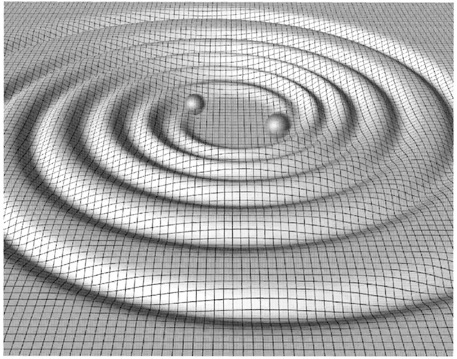
As two neutron stars orbit each other, they generate gravitational waves in space-time that spread outward like ripples in a pond.
ing that two objects orbiting one another would release gravity waves,he also recognized that the two objects would be drawn closer and closer together, due to the loss of energy that the waves carry off into space. PSR 1913 +16 was the perfect candidate to test this out. Here were two test masses—so compact and so dense—continually moving around one another. It was the ideal setup for detecting gravity waves (at least indirectly). Imagine a twirler's baton spinning in a pool of water. The motion would create a set of spiraling waves that move outward. Similarly, the motion of these two neutron stars should emit waves of gravitational energy that spread outward from the system. With energy leaving the binary system, the two neutron stars would then move closer together. At the same time their orbital period would get shorter. “As they depart for outer space, the gravitational waves push back on the [stars] in much the same way as a bullet kicks back on the gun that fires it,” Thorne once explained. “The waves' push drives the
[stars] closer together and up to higher speeds; that is, it makes them slowly spiral inward toward each other.” But seeing such an effect required great patience. It could not be observed immediately but only over years.
While Hulse went on to other endeavors, Taylor and several colleagues, particularly Joel Weisberg, now at Carleton College in Minnesota, continued to travel to Arecibo to monitor the evolution of PSR 1913 +16. Year by year they would spend two weeks—sometimes more—measuring the system as precisely as they could. Their major goal was to pinpoint the pulsar's timing. The tick of this pulsar clock is very regular, a sharp pulse every 0.059 second. Its blips are so regular and stable that its accuracy can rival the most accurate atomic clock on Earth. But to detect any changes in the binary's orbital motions, via the pulsar's precise tick, required extraordinary measurements. The system is located some 16,000 light-years away, so its signal is very weak. Taylor's group had to build a special receiver that could better focus the signal. It took four years of monitoring before they could finally detect a very slight change in the orbit of the two neutron stars. The answer arrived after analyzing some 5 million pulses. The orbit was definitely shrinking. The two stars were revolving around each other a little faster. That meant the binary system was losing energy and the neutron stars were drawing closer together. Moreover, the energy loss was exactly what was expected if the system were losing energy in the form of gravity waves alone. It was a tough problem in relativity. Indeed, at the time, no general relativist had actually worked it out exactly. Taylor had to use an approximation that he found as a homework problem in a classic textbook on general relativity. But even before handling the calculation, he and his group had to make a number of corrections to the data. They had to correct for the motion of the Earth in the solar system as well as the perturbations introduced by the other planets. Variations in the Earth's rotation affect the signal's timing. There is also a slight delay of the signal due to the interstellar medium. “We measure and remove, measure and remove, ” says Taylor. They even had to adjust for the motion of the solar system around the center of the galaxy.
The gravity wave news was first released at the Ninth Texas Sym-
posium on Relativistic Astrophysics, held in Munich, Germany, in December 1978. (The conference series originated in Texas, hence the name.) It was the highlight of the meeting. A report came out two months later in the journal Nature. But, initially, there were doubts. Some wondered whether there was a third object in the system, which would upset the calculations. Or maybe dust and gas surrounded the pair, which could also explain the energy losses. But additional measurements over the years—with better and better receivers—only improved the accuracy. Taylor's graph, plotting the ever-decreasing orbital period, is a showpiece of science. The measured points lie smack dab on the path laid down by general relativity. The measured energy loss due to gravitational radiation agrees with theory to within a third of a percent. Such accuracy has been described as “a textbook example of science at its best.” Each year the binary's orbital period decreases by about 75 millionths of a second. During each spin around each other, in the continuing pas de deux, the two neutron stars in PSR 1913 +16 draw closer by a millimeter. Over a year that adds up to a yard. The two stars will collide in about 240 million years. So clean and precise is this system that Taylor once remarked it was “as if we had designed the system ourselves and put it out there just to do this measurement.”
In 1981 Taylor moved to Princeton University, but he continued to glean information on PSR 1913 + 16 from the simple ticks of its clock. After a couple of decades of measurement, some of the relativistic changes are fairly dramatic. The binary's orbital precession, for example, is quite vigorous. Taylor and his group now measure the change as 4.2 degrees per year; that's 35,000 times larger than the annual change in Mercury's orbit. The reason is clear: two neutron stars, so close together, affect the warping of space-time far more than our less dense Sun. Tightly bound together, they pack quite a wallop. Since its discovery, the binary pulsar has shifted its orbit a full quarter turn. Using this information, along with other orbital parameters, Taylor and his colleagues have been able to peg the masses of the two neutron stars to four decimal places. One is 1.4411 solar masses; the other is 1.3873. That's quite an accomplishment from a distance of 16,000 light-years, given that each neutron star is a superdense nugget only 10 miles
wide. “One has to marvel at how much is learned from so sparse a signal, ” says Rainer Weiss.
The Hulse-Taylor binary, as it is now called, is no longer the sole member of its species. More than 50 binary pulsars are now known, with most of the pulsars paired up with white dwarf stars rather than neutron stars. These particular pulsars spin much faster and so were not seen right away with older equipment. Stealing material from the white dwarf, the pulsar whirls itself up to faster and faster speeds, like a twirling ice skater on overdrive, hundreds of times each second. Hulse left it to others to discover these new binaries. He actually left the field of radio astronomy just a few years after his momentous find. He was not looking forward to the wandering life of a postdoc and the scarcity of secure academic positions. Wanting to be near his girlfriend, he took a job at the Princeton Plasma Physics Laboratory in 1977, where he continues to work as a principal research scientist on computer modeling. Hulse hasn't changed much since his graduate school days. He still has his dark hair and beard. And he remains an ebullient and engaging talker, like a young kid explaining his favorite hobby. Taylor, meanwhile, continues his pulsar work, in and around his new duties as dean of the faculty at Princeton. His tasteful office in historic Nassau Hall is decorated with an antique grandfather clock, which he dutifully winds every morning, even though it is far less accurate than his beeping neutron stars. The team's old minicomputer is gone, long since cannibalized for parts, but Hulse does retain his original printouts, on newspaper-like green paper. “It's such hacker stuff. I read it now in a daze,” says Hulse with a chuckle. “I enjoyed doing it once.”
Hulse had sighted the first pulsar of his extended search on December 8, 1973. Exactly 20 years later to the day, he was at a podium in Sweden delivering a lecture on the work he did to garner his Ph.D. He and Taylor had just received the 1993 Nobel Prize for Physics for their masterpiece of measurement, one of the few times that prize over its century-long history has been awarded to astronomers. In the lecture Hulse described his work as “a story of intense preparation, long hours, serendipity, and a certain level of compulsive behavior that tries to make sense out of everything that one observes.” He didn't ignore a troublesome observation. He tackled it with fervor, finding for Taylor
and the astrophysics community the perfect laboratory for relativistic physics.
There had been controversy when Jocelyn Bell Burnell was denied a share of the 1974 Nobel Prize in Physics for her role in the discovery of the pulsar. The coveted award went to her advisor, Hewish, instead. This antistudent bias changed with the discovery of the binary pulsar. “It was very much a joint effort,” says Taylor, a man well known in the astronomical community for his generosity and gentlemanly spirit. “Yes, one of us was a student, but there was no question that Hulse's work was an essential part of the operation.” A longtime friend of Bell Burnell, Taylor invited Jocelyn to accompany him and his wife to Sweden for the award ceremonies.