Einstein's Unfinished Symphony: Listening to the Sounds of Space-Time (2000)
Chapter: A Little Light Music
A Little Light Music
 he Hanford Nuclear Reservation, operated by the U.S. Department of Energy and currently the nation's prime repository for nuclear waste, sprawls over hundreds of square miles of scrub desert within the rain shadow of the Pacific Cascade Mountains in south-central Washington state. John Wheeler first came to this isolated site in the 1940s when the government set up a manufacturing plant in Hanford to produce plutonium, an element that does not occur naturally, for use in the bomb that was dropped on Nagasaki. Settling in nearby Richland at the time, Wheeler remembers “a community of houses, stores, and schools that had been erected in a matter of months by the Army Corps of Engineers. The sidewalks were tar that had been squeezed out like toothpaste. Asparagus sprouted through cracks in the sidewalks from the farm that had been there before the Corps' bulldozers moved in. ” The town continues to thrive by the banks of the Columbia River.
It is 10 miles from Richland to the Hanford facility, proceeding
west along Route 240. The turnoff is not obvious. At the key intersection the road signs direct travelers to either continue west or turn south. There is no sign at all to explain the highway going north, the entrance to the reservation. It is a habit left over from Hanford's many years as a national secret. Five miles down that desolate two-lane road is a duplicate of the LIGO complex in Louisiana—the same cream, blue, and gray colors. Standing alone on the vast plain, a landscape long ago carved flat by the immense outflow of an ancient glacial lake, the observatory resembles either a tasteful warehouse or a modern art museum inexplicably placed in the middle of nowhere. It is a rent-free guest on the Hanford site. The observatory's nearest neighbors, though still miles away, are a nuclear power plant and a moth-balled research reactor. They share a vast, cloud-studded sky that stretches from horizon to horizon. Only to the southwest is this blue vault interrupted by the Horse Heaven Hills and the smoothly sculpted Rattlesnake Mountain.
Tumbleweeds, the dense Russian thistles accidentally introduced to the west, are ubiquitous. They continually roll over the barren terrain and pile up along the arms of the interferometer. “We baled 200 tons of it last year,” says Fred Raab, head of the Hanford observatory. “We have a crew out every week.” The strawlike balls are gathered and baled like hay and then used for erosion control around the site. Otherwise, the roads along the miles-long arms would be completely blocked.
Raab enjoys his job immensely. “Being first, you get to write the playbook,” he notes. Raab joined LIGO when he was convinced that there would be gravity wave detections in his lifetime. Considering his background, it's the ultimate challenge. Trained in atomic physics, he has long dealt with precision measurements on the tiniest of scales. “To me a table is a bowl of Jello,” he says, a reference to the constant jitters that occur on the atomic level. The gravitational jitters he seeks with LIGO, though, will be even smaller.
The journey begins in the complex's center station, an enclosed city of metal gleaming under bright fluorescent light. One and a half million pounds of metal were used to construct the instrument. Seven hundred truckloads of concrete were brought in to build the floors
and beam-tube roadways. The vacuum chambers, where the test masses reside, look like the tanks in a microbrewery, though unpolished. “It's more like a sewage treatment plant,” says Raab with a laugh. There is no noise, however. Only a whisper of wind from the air ducts. Gravity wave detection starts with the laser, set in an alcove of the main hall. The laser sends its light into the vacuum system, where it is divided into two beams, each directed into a separate 4-kilometer arm. As in Louisiana, the arms shoot outward to form the familiar L shape. In Hanford one arm is directed toward the northwest, the other to the southwest.
Given Hanford's legacy of covert operations, some locals harbor the suspicion that the observatory is just a cover-up for a secret laser weapon project. They imagine the arms are somehow hinged, able to rise up and fire a powerful ray blast into space. Raab, an enthusiast for outreach education, built a small tabletop interferometer to take to local schools to demonstrate what is really happening in those miles-long tubes. Its light source is a toy laser pointer, the kind often used by lecturers. It's held up by a clothespin. The vivid red light is directed into a “beam splitter,” which creates two separate beams that are sent off at right angles. Each beam reflects off a mirror. On their return, the two beams are recombined and aimed at a white screen. When the two beams are “in phase,” wave peak matching wave peak, a bright red spot is seen on the screen. When the two beams are “out of phase,” the trough of one wave canceling the peak of the other (like +1 and -1 summing up to zero), a dark spot is seen. By pulling on a string to move a mirror ever so slightly, which changes the distance in one of the arms, the spot changes from bright to dark or dark to bright. The kids take delight in this effect. It is exactly what is happening inside LIGO. A tiny change of distance in an arm translates into a change of light intensity at the interferometer's output.
LIGO is a direct descendent of the Michelson-Morley experiment, whose failure to detect any variation in the speed of light led to the theory of relativity. But where a detectable change in that experiment would have been relativity's downfall, a change in the LIGO detectors will support one of general relativity's key predictions. Michelson was the greatest experimenter of his day. His interferometer was capable of
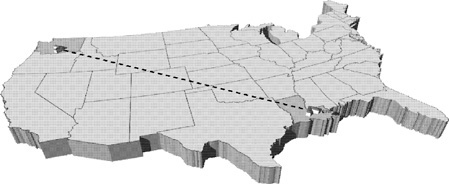
To rule out local disturbances, the LIGO sites are separated by 1,900 miles.
detecting a length change equal to one-twentieth the width of a light wave. In LIGO's early phases, researchers anticipate doing nearly a hundred billion times better. In terms of measuring a change in distance, it is currently science's most sensitive instrument. The very nature of this endeavor seems paradoxical. To detect the very small—shifts in space-time smaller than a subatomic particle—requires an instrument that is very big, 4 kilometers long. To boost the sensitivity to such exquisite levels, researchers have applied an added trick: the laser beams complete the round trip up and down the arms more than a hundred times, a total of some 800 kilometers (500 miles). This makes the arms act even longer, which increases the chances of detecting a feeble gravity wave.
Working together, the Hanford and Livingston observatories form a single instrument that slashes diagonally across the continental United States. Separated by 1,900 miles (or a hundredth of a second at the speed of a gravity wave) the two locations were among 19 sites proposed in 17 states. The final choice was made through a combination of politics and scientific practicalities. The chosen areas, of course, had to be fairly flat. They also had to be seismically and acoustically quiet, have such amenities as telecommunications and nearby housing readily available, and be set at least 1,500 miles apart to eliminate signals generated by local noises. As with Weber's setup, when the vibra-
tions from a passing train, truck, or other jostling event shows up in only one of the detectors and not the other, it can be ignored. Operating in unison, the two facilities have the potential to vastly broaden the search for gravity waves. Bars now in operation can theoretically detect a supernova going off in our galaxy, but the chances of that occurring are slim, once every 30 to 100 years. Two neutron stars colliding somewhere in the Milky Way occurs only once every 100,000 years. That's not good odds for a steady career. LIGO was sold on the idea that it will expand the search to the myriad galaxies beyond our galactic borders, so researchers will have a better chance of seeing gravity wave events on a more regular basis.
The structures in Washington and Louisiana are very similar but more like fraternal twins than identical. The Hanford facility actually houses two interferometers, which operate side by side through the arms. There is the full-length interferometer of 4 kilometers but also one half as long. Midstations situated 2 kilometers down the arms accommodate the end masses for the truncated detector. With different optical configurations, each interferometer could be tuned like a radio, hunting for gravity waves of different frequencies. It's also the means to get three chances at verifying a gravity wave detection with only two sites. Alternatively, one of the Hanford interferometers can at times operate round the clock, always on the lookout for gravity waves, while the other setup is used for tinkering, allowing researchers to learn more about the technology while they steadily upgrade the equipment. The dual system offers great versatility.
The LIGO detectors on each coast are best receptive to frequencies from 100 to 3,000 hertz. On the musical scale that roughly extends from an extremely low A note to a very high F sharp. Within that broad band observers will be looking for all kinds of signals from the cosmos. Given the audio range of the signal, there might be single cymbal crashes from exploding stars, periodic drumbeats from a swiftly rotating pulsar, an extended glissando—a rapid ride up the scale—from the merger of two black holes, as well as a faint background hiss, the gravitational equivalent of the cosmic microwave background (more on gravity wave events in the chapter entitled “The Music of the Spheres”). Moreover, LIGO will always be comparing its findings with
other heavenly data gatherers, such as bar detectors, astronomical telescopes, and neutrino detectors, just in case another spectacular event, such as Supernova 1987A, occurs on its watch.
A true gravity wave washing up on the shores of Earth will affect both detectors simultaneously. But in the process the interferometers face an array of interferences that Weber never had to worry about, which makes this endeavor seem all the more astounding. Take ocean waves, for example. Each LIGO detector is located miles from a sea, but that doesn't prevent the planet's bodies of water from introducing a noise. When waves hit the shores of North America, all over the edges of the continent, they collectively produce a low reverberation roughly every six seconds, a microseismic growl that peaks at 0.16 hertz. That's a low note to best all low notes. In fact, it's so low that the vibration travels through the Earth with ease. “If you just have a mirror sitting there, ” says LIGO researcher Michael Zucker, “it feels that rumble.” So LIGO's mirrors get a tiny push. “It's a headache, a huge headache during Louisiana hurricane season,” adds Zucker. LIGO is also affected by “Earth tides,” deformations of the Earth caused by the gravitational pull of both the Sun and the Moon. The effect is slight—several millionths of an inch—but still noticeable enough that LIGO has to take it into account. “Tidal actuators” cyclically push and pull on the optical tables to compensate.
More worrisome, perhaps, are thunderstorms within the vast heartland of the United States. It's the one outside source of interference that does have a chance of being felt simultaneously by both widely separated detectors. When a thunderstorm, say in Utah, unleashes a lightning bolt with millions of amps of current, that bolt produces a magnetic field that propagates over the entire country. It's possible that both sites will see it at the same time. Such a coincident signal could be misinterpreted as a gravity wave event. To filter out such noises, magnetic coils have been set up at each site to monitor these magnetic pulses. No CB radios or cell phones are allowed on the sites as well, since they might also interfere.
Two decades ago LIGO started out with a small complement of researchers. Today, it has evolved into a vast enterprise. Its final construction cost of $292 million, plus nearly $80 million more for com-
missioning and upgrades, made it the single most expensive project ever funded by the National Science Foundation. (The doomed Superconducting Super Collider, which was to cost some $8 billion or more, was mostly funded by the U.S. Department of Energy.) Along with LIGO's in-house staff, working at Caltech, MIT, and the two detector sites, are researchers at other universities who are also funded to actively work on future improvements. Together, they comprise the LIGO Scientific Collaboration. Their job is largely to conquer the array of instrument noises that can potentially hide a gravity wave signal.
Stan Whitcomb has seen this development firsthand. Having previously worked on instrumentation for submillimeter radio astronomy telescopes, he first came to Caltech in 1980 to help put together the 40-meter prototype designed by Drever. Within five years, though, he left for industry, partly due to his discouragement over the slow rate of progress. “In 1980 we had assumed that we'd have large detectors in place within eight years. But we hadn't recognized all the technical problems. We didn't appreciate how difficult it would be to make the sensitivity improvements. We might not have gone forward if we knew ahead of time,” he says. “We have six chunks of glass—the four test masses, a beam splitter, and a recycling mirror —all suspended on wires. We cannot touch them, yet we must still be able to position them to within a billionth to one hundred-trillionth of a meter.” He returned in 1991 when he saw NSF make its stronger commitment to the project. Advances in technology made him more optimistic as well. “We were blissfully ignorant and lucky that technologies have since advanced to help us—advances in supermirrors, lasers, and vacuum systems,” he says. Each piece of the detector is a marvel of engineering.
Mirrors
GariLynn Billingsley is the guardian of the mirrors. Working from Caltech, she monitored each and every step of the production. “Their manufacture was a heroic effort,” she says. These pieces of glass pushed the limits of mirror construction, as their specifications were well beyond normal industry standards. Since the end mirrors are parked 4 kilometers away from the laser, they must reflect the light up and down those long
corridors extremely accurately. What was required was a mirror surface so smooth that its surface does not vary by more than 30 billionths of an inch, especially in the central 2 inches where the laser beam will be aimed. “Imagine the Earth were that smooth. Then the average mountain wouldn't rise more than an inch,” points out Billingsley. The process started with choosing a material that helps reduce one of the major sources of interference in an interferometer: thermal noise. At room temperature the atoms within the mirror are continually vibrating, movements that could easily mask an incoming gravity wave. But if the mirror material acts like a bell (the engineering term is having a “high Q” for quality factor), those jiggles are confined to certain narrow frequencies. Restricting the noise to those specific bands allows other frequency windows to remain open for gravity wave searches, free of interfering noise. It's akin to pushing the furniture in a room off to one side, leaving the remaining space clear for use.
Fused silica was the material of choice. It is a type of glass that can be manufactured exquisitely pure and uniform. This was carried out by both Corning in the United States and Heraeus in Germany. The glass was then sent to both General Optics in California and CSIRO (the Commonwealth Scientific and Industrial Research Organization), a government lab in Australia, for polishing. What resulted were cylindrical disks 10 inches in diameter and 4 inches thick. Each weighs 22 pounds. The final step was applying the reflective coating, a job performed by Research Electro-Optics in Boulder, Colorado, expert in low-loss mirrors. The thin covering is composed of alternating layers of silicon dioxide and tantalum pentoxide. For every million photons of light hitting the mirror, only a few are lost with each bounce off this surface. Twenty-four mirrors were ultimately made. Each interferometer uses four of them as test masses. The rest are spares. In addition, an assortment of secondary optical pieces were polished and coated to the same standards for use in aiming and guiding the laser beam in the interferometer.
The spares are kept in the LIGO optics laboratory, situated in the bowels of the Bridge Building on the south end of the Caltech campus. The disks are stored in what look like aluminum cake covers set on shelves in earthquake-proof cabinets. The lab itself, a windowless
room, resembles a hospital operating room. Visitors and technicians wear masks, caps, and booties at all times to keep the environment clean, for just a short breath on a mirror would seriously contaminate its surface. Looking down upon a glass disk is like looking into a pond of pure, perfectly still water. To the naked eye there is nary a bubble or scratch. “I've lifted the glass some 95 times so far and every time I hold my breath until I get it down again,” says LIGO optical engineer Steve Elieson. He has good reason to be nervous: each mirror costs $100,000 to manufacture from start to finish.
Suspension and Seismic Isolation
The mirrors are hung from what looks like a gallows. By hanging freely, the mirrors feel no other forces except gravity. It separates them from the rest of the equipment. Mounting them in this way, though, was a nerve-wracking process for the engineers. Each cylindrical mirror is balanced on the slimmest of supports: one steel wire, as thin as dental floss, that is attached to the gallowslike frame. This fine wire is very similar to guitar string, just one-hundredths of an inch thick. Like the silica of the mirrors, this wire has a high Q as well. In this case, heat causes it to vibrate like a stringed instrument at around 340 hertz. The material was chosen to keep both the tone as pure as possible and the string vibrating as long as possible. It's like a having a concert where the single tone of a violin doesn't die down for several minutes after the music is over. In this way a gravity wave with a lower or higher frequency can be better distinguished and not hidden within a cacophony of thermal noise.
Cradled on its wire like a child on a sling swing, the mirror can actually move back and forth without disturbing the measurement. Gravity waves will cause the mirrors to move quickly, anywhere from 100 to 3,000 times each second (100 to 3,000 hertz). (Or looking at it from another perspective—a relativistic one—the space measured between the mirrors will jitter.) The movements induced by normal geologic processes, on the other hand, are relatively “slow.” They can cause a mirror to oscillate just one time each second. The motion is usually quite tiny, the width of a bacterium. Such extremely low-frequency
motions are hard to filter out. But if the mirror should do this, move back and forth over one second (a 1-hertz vibration), observers can simply ignore the motion, essentially subtract it out. It's one of the tricks that enables researchers to zero in on the incredibly tiny space-time movements introduced by a gravity wave. Seismic and tidal movements are so sluggish, compared to a gravity wave signal, that they don't mask the cosmic signal at all.
Nevertheless, LIGO must be isolated from any number of ground motions: a work truck driving by, a toilet flushing in the main building, or a seismic tremor. Such noises might still introduce a vibration that mimics a gravity wave. The first line of defense is the floor itself. It is a slab of concrete, 30 inches thick, which is not coupled to the walls, so any outside vibration—such as a good stiff wind—will not reverberate into the system. As a second line of defense, all the masses and other optical equipment, housed in the vacuum chambers, have their own seismic isolation system. The optics rest atop a series of four monolithic stainless steel platforms, stacked one on top of the other. Each level is separated by a set of elastic springs, which highly damp any ground motions, not unlike the suspension in a car. It cuts down the seismic noise by a factor of a million.
Vacuum System
The largest portion of the funds for LIGO, about 80 percent, did not go into sophisticated equipment, such as electronics or computers. Rather, it went into the low-tech items of this high-tech enterprise: constructing the pipes, laying the mortar, and building the vacuum pumps. The stainless steel tubes were fabricated by a method regularly used to make oil pipelines. Temporary factories were set up near both LIGO sites to carry out the task. In Louisiana the beam tubes were constructed in a vast warehouse next to a shopping center some 20 miles from the observatory. Over 11 straight months, Chicago Bridge and Iron workers produced 400 separate pipes, each 65 feet long. The stainless steel arrived at the warehouse on immense rolls, like giant-sized rolls of kitchen foil. On an automated conveyor, a roll unwound, with the continuous sheet sent into a machine that coiled it helically
and then welded it automatically with a high-frequency pulse of energy. Rolling along at 40 inches per minute, a 65-foot-long section could be completed in about 45 minutes. The finished tube shimmered with stripes of dull red, blue, and cream, resembling a designer barber pole. Each pipe was individually tested for leaks (not one failed) and then taken to its final cleanup. In a separate room a small robotic cart was sent into each tube, which washed and steam rinsed the entire interior. In the end what remained was one part dirt for every million parts of water. “Each detail is like this,” says LIGO engineer Cecil Franklin. “And any one error can cause problems down the line. ” Each tube was finally encased in a plastic bag—what looked like a body bag—for transport to the site, where the separate tubes were finally welded in line to form the long arms. All in all a complete interferometer has 30 miles of welds.
The ends of each arm are actually situated several feet higher off the ground than their starting point at the center station. That 's to compensate for the Earth's curvature. The gradual rise keeps the laser beam tubes positively straight as the Earth curves downward. With the Hubble Space Telescope debacle on his mind, where a small measuring error in the factory led to an out-of-focus mirror, Weiss was waking up at night in a sweat during LIGO's construction wondering if the tubes were truly arrow straight. Then he realized they could just look down a completed arm and check. “We got down at the end of one tube in Livingston and asked someone to hold a big searchlight at the other end,” recalls Weiss. “We could talk to them because the tube is a good acoustic waveguide. The light was turned on, and when we looked it was about 30 centimeters low. We called out, ‘Why don't you put it in the center?' They replied, ‘It is in the center.' Within 15 seconds, it dawned on me what was happening: bending of light by the atmosphere, due to both the change in air density from the top of the tube to the bottom as well as temperature differences. The laugh is we were lucky. It was early morning, before the Sun really beat down on the apparatus. If we had waited just three hours, we wouldn't have seen any light at all. I would have assumed we had left something in the tube and demanded to go back in, which would have been expensive.”
Air is the biggest obstacle to a laser beam, which is why the arms
are evacuated down to a trillionth normal atmospheric pressure. That 's to prevent light from scattering off stray gas molecules and introducing a noise. With each detector taking up 300,000 cubic feet of space, LIGO ended up creating the largest artificial vacuum in the world. The atoms that manage to remain in the pipes would fill only a thimble under normal atmospheric pressure. LIGO accomplished this feat by not following conventional wisdom. Instead, it took a risk on a radically new procedure. LIGO researchers arranged for a special steel, an alloy that was cooked for several days to remove excess hydrogen to levels a hundred times less than those of commercial vacuum systems. Ordinarily, hydrogen atoms leak out of steel, which can clog up a vacuum. Designers of particle accelerators deal with this problem by heating their pipes after assembly. This excites the hydrogen molecules enough to coax them out of the metal, where they can be vacuumed away. But such pumping would have been a terribly expensive process for pipes 4 feet wide and miles long. Limiting the hydrogen in the steel from the start made the price of LIGO affordable. Though the pipes were still heated to eliminate the last remaining gases, the number of pumps required to suck away those stray molecules was sharply reduced. “Otherwise, LIGO would have been far too costly to construct,” says Whitcomb.
Lasers
As Ron Drever discovered early in his investigations, a gravity wave interferometer requires a laser that is as steady as a rock. Any change in frequency or intensity might be mistaken for a gravity wave effect. Originally, LIGO was designed to use an argon ion laser, a type of laser that emits a brilliant green light. “But having the argon ion laser was like using a radio with vacuum tubes after the development of transistors,” says Barry Barish. At the last minute they switched to a solid-state infrared laser, which is extremely stable. Small and powerful, they are called neodymium YAG (for the yttrium-aluminum-garnet crystal that lases). Over a billion trillion cycles of light, its frequency doesn't vary by more than one cycle. Moreover, such a laser shows promise in scaling up its power. Initially, LIGO will use a laser with 10 watts of
power but plans are under way to upgrade to 100 watts, which would appreciably reduce an interference known as “shot noise.” As Einstein first noted in his Nobel-Prize-winning discovery, light travels in discrete bundles called photons. When those particles of light hitting a mirror are few, the count is rather noisy. Consider the noise emanating from a slow-dripping bathroom sink. The sound of the individual drops is easily noticeable (and quite annoying) when the flow is small. But the noise smoothes out and gets quieter when the flow increases to a steady stream. Similarly, when the laser power is increased in an interferometer, the relative strength of its shot noise is lessened. Recycling the light—returning it to the interferometer some 100 times—also decreases shot noise. By increasing the laser power in these ways, LIGO will be able to “see” much farther out into the cosmos. It's because the strain—the warp in space-time that LIGO can measure—is directly linked to its laser power. A 10 times improvement in laser power—and the concomitant decrease in shot noise —will allow the detector to measure smaller space-time strains arriving from events far more distant.
Interferometer
Together, these varied pieces of equipment form the interferometer itself, the very heart of LIGO. Nothing gets done without its working. Zucker at MIT, who cut his teeth on the Caltech prototype as a graduate student in the 1980s, now heads up the LIGO task group on interferometer control. “It's the glue that holds the optics in alignment, to make sure that the lasers are resonating in the proper way,” says Zucker. The strategy is to have the photons circulate as long as possible (which improves sensitivity). Based on the current reflectivity of the mirrors, they expect about 130 bounces. In each journey down an arm and back, the waves must march lockstep in synchrony with one another. They must stay “in phase.” To do this, exquisite timing is demanded. The software must know exactly what time it is, so every element of the system can stay in synch. Like a human heartbeat skipping a beat, losing track of time would lead to trouble. When the light waves are getting out of step because a mirror has moved, a force is
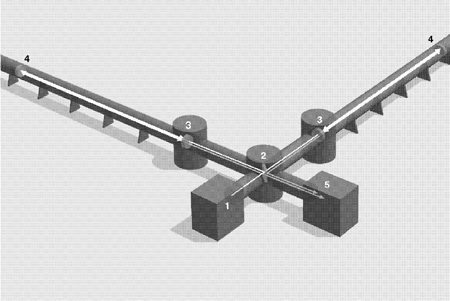
The beam of an infrared laser (1) enters the interferometer and passes through a beam splitter (2) to form two beams. Each beam is directed down an arm and reflected many times between a central mirror (3) and an end mirror (4). Eventually, the beams exit the arms and are recombined. If a gravity wave passes through, altering the length of the arms, a photodetector (5) will detect the change in the resulting light pattern of the recombined beams.
applied to keep the arm lengths equal. In other words, when a gravity wave pushes on a mirror, the controls will be programmed to pull it back into place. The gravity wave signal will actually be hidden in those manipulations. By keeping track of the forces needed to keep the arms firmly fixed, the interferometer will in essence be recording the gravity wave itself. The mechanical movements needed to counter the gravity wave will mirror the strength and frequency of the wave itself.
LIGO has consulted the field of control system engineering to develop its elaborate feedback system. “But we have a pretty unique situation, ” says Zucker. “Most control system engineers' jaws drop when they hear what we're trying to do.” Fine-tuning the position of each mirror is done with tiny magnets. Six in all, each no bigger than an ant, are attached to a mirror —four magnets on the back and two on the
sides. Made of rare-earth metals, these magnets are extremely strong for their size. To pitch a mirror forward, its top magnets are pushed while the bottom magnets are pulled. For yaw the magnet on the right side is pushed, the one on the left pulled (or vice versa). To adjust the length of the arm itself, the interferometer can be directed to either push or pull on all four back magnets. In this way the mirrors can conceivably be moved a maximum of 20 millionths of a meter and a minimum of 10-18 meter. These are precision movements done nowhere else in science.
Simulations
In particle physics experiments, physicists are often searching for specific discrete events. Particles collide at a fateful moment in an accelerator, creating a burst of energy that instantly transforms into a plethora of new particles. The debris is there to sift through. The long history of particle physics has given physicists a good feel for distinguishing a real event from a fake. In gravitational physics, on the other hand, researchers will be dealing with a continuous stream of unknown data. Where to begin looking? How do you recognize a gravity wave, when one has never before been seen?
LIGO will partly depend on simulations to point the way to the science. A series of programs can mimic all the known sources of interference in the interferometer, such as the seismic, thermal, and shot noises. LIGO researchers are like doctors learning and characterizing every symptom of their patient. When first turned on, LIGO might have a noise level a million times higher than must be attained. The simulation will help them locate and correct the initial sources of noise, be it a misaligned mirror or a noisy cable line. “There are diagnostic probes all over the instrument,” notes Hiro Yamamoto, who directs the simulation efforts. Over time they will come to understand the detector's unique “personality” and maintain a catalog of its typical noises. A gravity wave, it is hoped, will stand out as something different.
Yamamoto first worked on simulations for the superconducting supercollider. “It took me some time to adjust my common sense, the
way to understand an event in gravity wave physics,” he says. But there is some common ground: in both particle physics experiments and gravity wave searches, scientists have to understand the instrument down to the smallest nut and bolt to be able to distinguish the background noise from the signal. “In gravity wave detection, though, we don't know the background as well,” points out Yamamoto. “People have thought hard about the possible noises and the perceived noises. But no one knows if you make all those noises go away what is hidden, what will remain. That is the challenge. We're attempting to find a jewel within a dense forest.”
Data Analysis
Learning how to handle the immense sets of data that will be flowing out of the gravitational wave observatory is almost as large an enterprise as setting up the instrument itself. Sensors are installed throughout LIGO, all providing data on the detector's condition as well as any signal it might be receiving. These sensors keep track of the laser noise (changes in the light's intensity and frequency, which could mimic a wave), electromagnetic interferences, and any geophysical or terrestrial phenomena that might wiggle the test masses, such as seismic tremors or particularly loud acoustic noises. Data streams in from seismometers, tiltmeters, magnetometers, weather stations, and cosmic-ray shower detectors. “The slamming of a door or flushing of a toilet could conceivably introduce pressures that might affect the masses,” notes Albert Lazzarini, although tests show that normal office noise will not likely affect the system. These data are collected in several thousand separate channels simultaneously, tracking an event like a movie. Each frame is a snapshot of an interval in time —the signal plus all the attendant instrument noises. At each site this information continually flows at 6 million bytes per second, 24 hours a day. The hard drive on a home computer would fill up in a matter of minutes. With around 31 million seconds in a year, each interferometer will be gathering some 500 trillion bytes (terabytes) of data annually. The data are shuttled in real time to a bank of computers, where the bytes are filtered, compressed, and ultimately put on tape. LIGO's annual
budget for tapes alone is around $100,000. These tapes are transported to Caltech for analysis and storage. The data are kept in a standardized format, a procedure that is also being used at other gravity wave observatories around the world. This will allow each observatory to exchange and compare data, which is vital for confirming a potential signal.
The movements of the mirrors themselves, monitored by the laser light, are recorded on a special channel—the gravity wave channel. It accounts for less than 1 percent of the total data collected, but if a gravity wave comes by, that is the channel where it will be found. Unlike with an optical telescope, no pretty picture of the source is obtained. Visible light waves are quite small compared to their sources, be they gas clouds, stars, or galaxies. Such waves can hit a receiver, say a photographic plate, and produce an image of the celestial object. Gravity waves, on the other hand, are often as large or even larger than their source. A gravity wave with a frequency of 1,000 hertz, for example, spans nearly 200 miles from peak to peak. Such a signal resides in the audio frequency band. You can actually listen to the signal once it is electronically recorded, just as Robert Forward did with his early Malibu detector. Some LIGO workers have analyzed the tapes from the Caltech prototype interferometer in this way. “It sounds like a hiss,” notes Lazzarini, leader of the data analysis group. “Actually, a hiss with warbles in it, due to the suspension. It's eerie, in some ways like whale songs.”
Computers, not ears, though, will be sifting through LIGO's data. Picking out a definitive signal from a chaotic profusion of bits and bytes is not a totally new endeavor. Though difficult and challenging, it will be similar to the way in which military sonar experts search for the distinctive sound of a submarine amid the many noises of the sea. Essentially, as the data stream comes in, it will be compared to a “template,” a theoretical guess at what a gravity wave signal might look like. Take, for example, the case of two neutron stars spiraling into one another. Of course, the exact nature of the gravity waves being emitted from such a system will depend on both the masses of the neutron stars and their orientation as viewed from Earth. So there are many possible wave patterns. To do a proper search, LIGO will have to compare its stream of data against some 20,000 to 30,000 signal patterns
continuously throughout the day and night, each pattern representing the waves emitted by differing configurations of stellar mass and at various orientations. Fortunately, computers have now achieved speeds that can handle such a load. One commercial workstation alone can handle from 500 to 1,000 template comparisons in real time. For each interferometer LIGO links a few dozen such stations to form a master machine that handles the search on that detector. “They will be just crunching away all the time,” says Lazzarini. If a candidate pops up, it will then be compared with the environmental and instrument channels to see if it was just terrestrial noise.
Both sites will be on the lookout for certain classes of events that don't get repeated—a supernova or gamma-ray burst, for example—by continually comparing for timing, similarity of waveform, and local interferences (to reject spurious coincidences). Events that don't look like false alarms will be identified quickly at both Livingston and Hanford. Rapidly, hopefully in less than a day, the evidence will be reviewed by the science team. If the candidate appears genuine, the astronomical community will be notified to maximize the possibility of catching any electromagnetic radiation emanating from the transient event.
A true challenge, says Lazzarini, will be finding the distinctive and continuous call of a pulsar. This much weaker signal will be buried in a year's worth of data. “But what if the strongest gravitational wave signal, ” says Lazzarini, “is a belch or burp that arrives sporadically? Then what? You have to assure yourself it wasn't just an amplifier or a bad wire.” Those sorts of signals, the unexpected or nonregular, will be the most difficult of all, “but also where the biggest surprises and most profound discoveries may lie,” adds Lazzarini.
It has now become routine to compare LIGO to a high-energy physics endeavor in its administration, structure, and complexity. And key managers, like Barish and LIGO's deputy director Gary Sanders, were long immersed in that atmosphere. “One day I was part of a group of 1,000 people, working on one of the superconducting supercollider detectors. The next day we were closing shop,” says Sanders. Moving over to LIGO, Sanders brought with him a particle physics sensibility, learned from the start of his graduate school days. “You're
part of a team, all coordinated, delivering a piece of a larger apparatus, ” he explains. And that apparatus was a natural evolution from earlier accelerator facilities, which operated quite successfully. The territory was well mapped. Veterans in gravity wave detection, however, have no such assured history to fall back on. No laser interferometer prototype built to date has conducted a continuous observation run longer than several days, and no signals have yet been recorded (although, to be fair, none were expected during those early engineering trials). LIGO scientists are taking a direct leap from laboratory to large facility. LIGO, with its 4-kilometer arms, is a hundredfold jump in size from previous detectors. “It's both an exciting and overpowering change,” says Sanders. “Overpowering in that it's a whole new set of tools. But I'm here because the physics is ‘classy.' There's almost a romantic attraction, this chance to look at a whole new window on the universe.”
Since the field of gravity wave interferometry is still so new, the researchers involved come from diverse backgrounds. Solar physicist Ken Libbrecht, who had moved from Princeton to Caltech after his work with Dicke, eagerly switched from studying oscillations of the Sun to oscillations in space-time. “I looked down the hall here at Caltech and saw all these LIGO people around. I decided to join in, ” he says. The challenge has attracted young physicists from around the world as well. Walid Majid, a member of LIGO's data analysis group, emigrated with his parents from Afghanistan two decades ago during the Soviet invasion of his homeland. Trained in high-energy physics, he was involved in particle searches at both the Stanford Linear Accelerator and Brookhaven National Laboratory. Yet he readily switched fields. “The standard model in physics was so successful that it was no longer an age of unexpected discoveries,” he says. “The experiments were just going after the nitty-gritty details.” He wanted to move into a field of physics that still offered surprises. Once LIGO builds up a substantial archive of data, Majid wants to search the tapes for specific events, such as the distinctive periodic signal of a pulsar. He hopes to develop the techniques to recognize and zoom in on the specific frequency of its “cry.”
Biplab Bhawal came to LIGO from India. He works on the computer simulations of the detector. First trained in electrical engineer-
ing, he went on to obtain a doctorate in quantum field theory but was soon concerned that the exotic topic he was working on wouldn 't be verified in his lifetime. Noticing a paper in the Astrophysical Journal on the Hulse-Taylor binary pulsar, he decided to pursue gravity waves, even though friends warned him that “searching for gravity waves would be like searching a dark room for a black cat that isn 't there.” His engineering background came in handy. He wrote a paper on how shot noise might be reduced by manipulating the laser light in a certain way. It got noticed, allowing him to join the new effort. Perhaps he was destined. Biplab, means “revolution,” a name inspired by a politically minded uncle.
Serap Tilav arrived from Turkey, via the universities of Delaware and Wisconsin, where she worked on experiments in particle astrophysics. As a postdoc, she set up detectors deep in the ice of the South Pole to catch neutrinos from the Sun. “With neutrino astrophysics I was dealing with the very high part of the energy spectrum, trillions and hundreds of trillions of electron volts. Now with gravity waves I'm absolutely at the opposite end. I will be wonderfully well-rounded in the end covering the energy spectrum from one end to the other, ” she says with a smile. Sitting at her desk, studying potential signal patterns on her computer screen, she talks of gaining a feel for the instrument. “Theorists often talk about neutron stars coming together. When they merge, they say, you will see this particular signal. In reality it's not like that. When you go where no one has gone before, you really don't know what to expect. So we have to train ourselves on the detector characteristics so well that when we see something different we can say ‘What is that?'” She saw this in her neutrino experiments at the South Pole. The data looked completely different than what was anticipated. The researchers had not taken into sufficient account the true nature of the ice. It turns out that in such arctic conditions the ice was in an unexpected state. They had to recalibrate for its new properties, which affected the particle reactions. “ Changing to gravity waves, I feel very young again,” she says. “It's like being a student all over again.”
LIGO is more than an experiment. It is a case study in advancing technologies. New materials and new equipment had to be designed and constructed just for this pioneering observatory. And research is
ongoing. Even as the initial detectors were installed, laboratories around the globe have been working on the next-generation instrumentation. Research and development is being handled by the LIGO Scientific Collaboration, which extends far beyond MIT and Caltech. It includes Thorne's colleagues from Moscow, Drever's former cohorts in Glasgow, groups in both Germany and Australia, and scientists from Stanford, Penn State, Syracuse, and the universities of Colorado, Florida, Michigan, Oregon, and Wisconsin. They are studying new materials, improving the lasers, and testing new vibration isolation methods.
LIGO will be upgraded. LIGO workers are always mindful of improvements in sensitivity. By making LIGO just twice as sensitive, for instance, observers will be able to register events two times farther out. But that also means the total volume of space accessible to LIGO has increased by a factor of eight. Consequently, they will see eight times more extragalactic events. For their advanced detector, LIGO II, they hope to improve their sensitivity—their ability to see additional sources—by a factor of 10 to 15. (The detectors will be progressing from an initial strain of 10-21 to 10-22 or less.) That translates into 1,000-3,000 times more volume in the universe to examine.“That gives us a factor of 1,000 for finding some extragalactic thing like a coalescing black hole. You go from one event every 10 years, which is pretty painful, to an event every three days, which is very nice. Reasonably small gains are very important, ” points out Libbrecht. But the overall performance of LIGO depends on lowering all the various sources of noise together, not just one or two. “It's like a limbo dance,” suggests Libbrecht. “You have to lower the bar for all of them.”
Consequently, LIGO is a work in progress. The improvement of just one detector element can be highly involved. Take the material used for the mirrors, for example. Is fused silica the best substance possible? One alternative is sapphire, which has certain advantages. For one it has good reflectivity. But such an optical quality is not what drives interest in sapphire. It is its mechanical properties. Sapphire has a “Q” that is 10 to 100 times higher than silica, which means it resonates for a much longer time at a narrow frequency. That's because sapphire is a denser and more rigid material. Such a high Q
Expected Rates of Gravitational-Wave Detections
|
Event and Region of Space Scanned |
LIGO I |
LIGO II |
|
Supernova (within our galaxy) |
1 to 3 per century |
|
|
Supernova (60 million light-years, out to Virgo cluster) |
2 to 3 per year |
|
|
Black Hole/Black Hole Merger (300 million light-years) |
1 per 1,000 years to 1 per year |
|
|
Black Hole/Black Hole Merger (6 billion light-years) |
10 per year to 10 per day |
|
|
Neutron Star/Neutron Star Merger (60 million light-years) |
1 per 10,000 years to 10 per century |
|
|
Neutron Star/Neutron Star Merger (1.5 billion light-years) |
1 per year to 1 per day |
|
|
Neutron Star/Black Hole Merger (130 million light-years) |
1 per 10,000 years to 10 per century |
|
|
Neutron Star/Black Hole Merger (3 billion light-years) |
1 per year to 10 per day |
|
|
The black holes visible to LIGO will be in the range of a few dozen solar masses. A black hole has a larger mass then a neutron star, which results in a stronger gravitational-wave signal, hence their easier detectability over neutron stars. Future upgrades should increase LIGO's sensitivity by ten to fifteen times. These upgrades include a more powerful laser, better cushioning against seismic vibrations, silica wiring, and pure sapphire mirrors. The merger of two black holes, an event that LIGO I can at best barely register at 300 million light-years, should be readily detectable by LIGO II at 6 billion light-years. The numbers above display large ranges because they depend heavily on the theoretical assumptions being made, parameters that won't be known for sure until the first detections come in. |
||
could conceivably decrease thermal noise in a laser interferometer by 10 times. But no one has ever polished a sapphire object as big as a LIGO mirror. That's an unknown. The success of LIGO is dependent on a multitude of such individual details: the choice of the test mass material, the type of laser, the method of seismic isolation. Before the
science comes a plethora of engineering decisions. If sapphire is chosen, LIGO researchers must then learn how to suspend it properly so that its chief benefit—its high Q—is retained. Each decision affects another in a seemingly endless stream.
What keeps LIGO researchers on course amidst these storms of detail? “People take pleasure in solving these technical challenges,” answers Peter Saulson, “much the way medieval cathedral builders continued working knowing they might not see the finished church. But if there wasn't a fighting chance to see a gravity wave during my career, I wouldn't be in this field. It's not just Nobel fever. Maybe it was a risky choice when I was just coming out of graduate school, but now it looks like a good decision. The levels of precision we are striving for mark our business; if you do this, you have ‘the right stuff.' ”
After finishing his doctorate at Princeton in astrophysics in 1981, Saulson read the book Cosmic Discovery by Martin Harwit, a book that stresses the idea that key discoveries in astronomy usually arrive when scientists examine the universe with new instruments. With that in mind, Saulson hoped to work with Rai Weiss on the cosmic microwave background. Weiss had no money to support another assistant on that line of work, but he did have funds for gravity wave research. “I remember thinking, ‘It sounds dangerous. I'll do it,'” says Saulson.
Saulson assisted Weiss on LIGO's first proposals but after eight years at MIT set up his own laboratory at Syracuse University, which has a long history in gravitational research. It's the stereotypical physics lab. A waist-level shelf runs across one end, littered with the usual scientific debris: an assortment of notebooks and manuals, wire, screws, floppy disks, and pieces of aluminum. Saulson added one artistic touch, a large poster on the wall of an old Chinese painting by the sixteenth-century artist T'ang Yin. It shows a mountain scene, with a scholar in a thatched cottage looking off to the horizon. A poem in Chinese characters scrolls down the left side. Loosely translated it says, “When I eat the mushroom of tranquillity, my soul drifts off.” It is the one island of order amidst the cluttered surroundings.
Saulson is concerned with a laser interferometer's thermal noise. He is one of the world's experts on this problem, which many consider the field's most challenging obstacle. There in the basement of the
physics building on the Syracuse campus, he and his assistants—at the time one graduate student and a postdoc—are measuring the internal friction of materials used for LIGO's mirror suspension system. There are two ways of testing them. One is to impart a “ring” to the materials and see how long they resonate, much like sounding a gong. They are also squeezing the materials, to see how long it takes for each material to return to its original state. The more internal friction a material has, the longer it takes to recover. For the suspension wires they are testing such materials as steel, tungsten, glass, and diamond fibers. The mirror materials include varied glasses, fused silica, and sapphire.
For the first generation of LIGO, steel wire is being used to suspend the mirrors, but glass fibers would decrease noise 10 times over, if they can learn how to handle such material. That's what Saulson 's lab is testing. The tests are conducted in a cylindrical vacuum chamber 18 inches wide, the size of an oversized trash can. At the moment the chamber is open. The heavy steel cylinder had been lifted overhead by a ceiling crane. The experiment remains on the lab table right below. Graduate student Andri Gretarsson has just suspended a long thin string of fused silica, about a foot long, and made it ready for “plucking.” Once a vibration is set into motion, the ringdown in a vacuum can last for hours, even an entire day. The problem he is confronting, though, is frustrating. How to pluck the fiber? For a metal wire he was able to use an electrostatic device that imparted a gentle push. He's worried that such a procedure won't work for the delicate glass fiber. Sound waves won't work, since the fiber will be suspended in a vacuum. At the moment they can measure vibrations in the fiber as tiny as 100 billionths of a meter. But eventually they will need to do 10,000 times better to see the thermal movements they are after. “Most of the time experimental physicists are worried about their instrumentation. Here we have that rare wonderful moment when we get to worry about the problem itself,” says Saulson.
When new optical telescopes come online, such as the twin Keck telescopes in Hawaii or the Hubble Space telescope, there is usually a celebratory “first light” event, the moment when the instrumentation is turned on and the first picture taken. LIGO's initiation was not so dramatic. Because of the complexity of its engineering and optics,
LIGO will require a few years for its initial shakedown before it reaches the point when all three interferometers—the two at Hanford, the other in Louisiana—can work in concert with one another 24 hours a day. Then and only then can the search for gravity waves really begin.
LIGO researchers concede that their first detectors may not register a thing. “We're amateurs in a way,” says Weiss. “We just hope we've made all the right decisions.” Weiss never worried like this with the COBE satellite because COBE was an extension of past measurements. Everyone knew in some way what to expect. Gravity wave astronomy, on the other hand, is virgin territory. Its scientists have built instruments for an effect that has never been detected directly. Failure, fears Weiss, could stall the field for a very long time. For its critics that made LIGO technologically unjustifiable and premature. However, LIGO was built on the belief that solutions could not have been obtained without first building a full-sized facility to carry out the needed preliminary tests. For now the detectors have only a miniscule chance of observing the only source that seems guaranteed: two neutron stars spiraling into one another. But as noted earlier there is a reason LIGO is called an “observatory.” Its builders do not intend to carry out a single experiment but to operate the facility for decades to come, much the way the great 200-inch telescope on California's Palomar Mountain has been used and upgraded since 1948. Improvements will be added, the chances for detection increased, as time goes on and development proceeds. The U.S. decision to start construction was also an important signal to other countries to speed up their own plans for gravity wave observatories. If LIGO had not been funded, it may have stalled the construction of similar facilities around the world. With the decision to build LIGO, a momentum was established for setting up a worldwide network.