What could we learn by landing humans on Mars?
Based on Science
Landing humans on Mars could teach us whether life ever existed beyond Earth, how planets change over time, and how humans can live on other worlds. By studying Mars up close, astronauts could answer some of the biggest questions in science, including whether we are alone in the universe.
Last update May 29, 2026
Searching for Life Beyond Earth
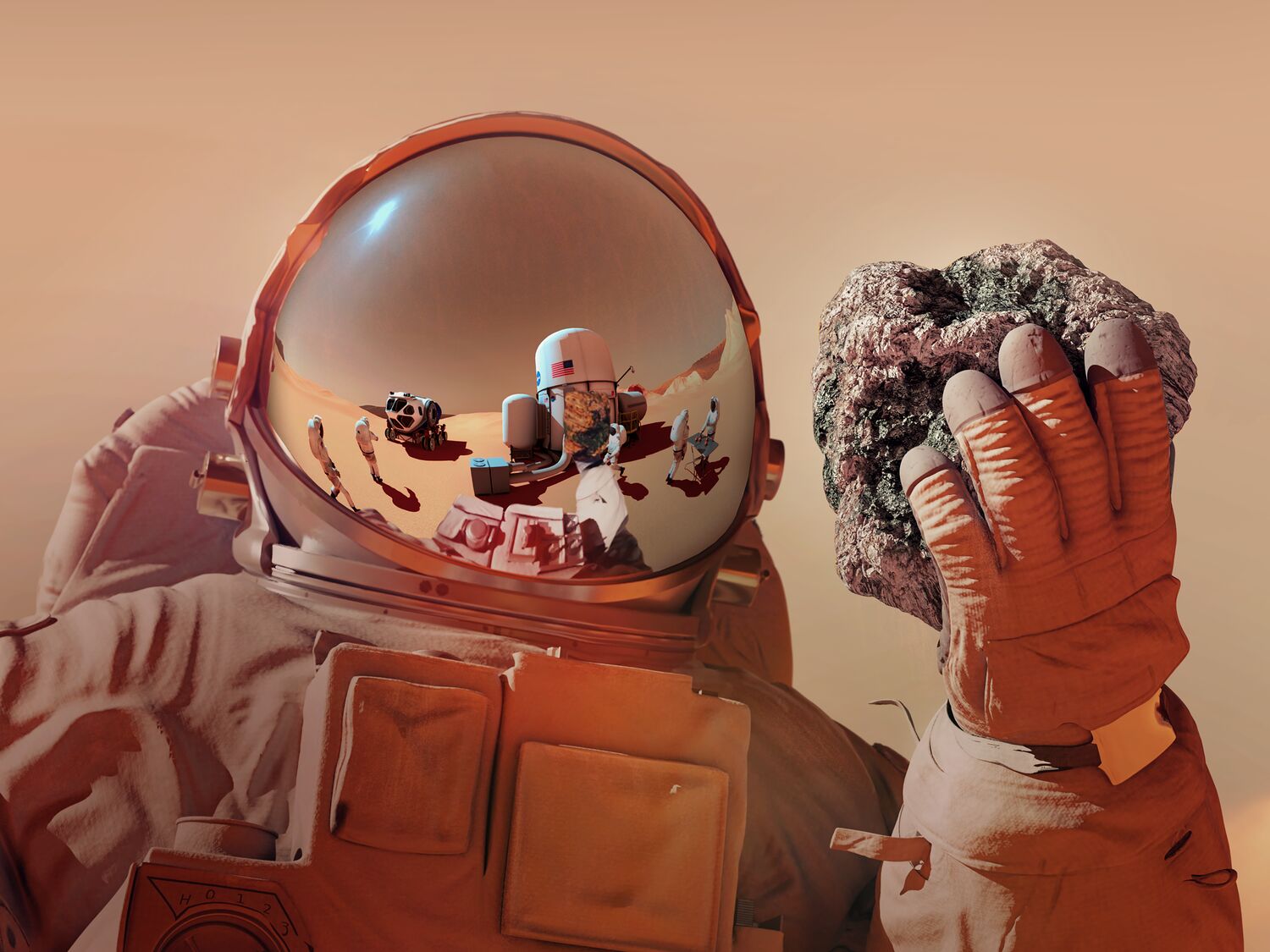
One of the most important things we could learn from landing humans on Mars is whether life ever existed there. Scientists believe Mars is the most likely place in our solar system, besides Earth, where life could have formed. At times throughout its history, Mars has likely had abundant liquid water on its surface, which is a key ingredient for life as we know it.
Human explorers could search for signs of past or present life in a variety of places, including caves, icy ground, and salty deposits. Sheltered environments may have protected tiny life forms, if they ever existed. Finding even simple life—past or present—would be a huge discovery. It would help scientists understand how life begins and whether it can form on other planets. Even finding evidence of extinct life, such as fossils or chemical traces, would answer the question: Are we alone?
Understanding Mars’s History and Climate
Landing humans on Mars would also help us learn how the planet has changed over billions of years. Mars has a rich geological history, including volcanoes, glaciers, and giant canyons. Unlike Earth, many of these features are still well preserved, making Mars a kind of time capsule of early planet history.
Astronauts could collect rock samples from different locations to study how Mars formed and evolved. For example, igneous rocks and impact craters can help scientists figure out the age of the planet’s surface. By comparing Mars’s craters to those on the Moon, researchers can better understand how often planets were hit by asteroids, meteoroids, or comets in the past.
Sedimentary rocks are important because they record changes in climate over time. These rocks may show when Mars had more water and when it became dry. This helps scientists understand how a planet that once had rivers and lakes turned into the cold, dry world we see today.
Studying Mars’s atmosphere and weather is also key. Dust storms, which can cover the entire planet, play a big role in its climate. By placing monitoring stations and studying these storms, astronauts could learn how Mars’s atmosphere works. This knowledge could also improve our understanding of climate systems on Earth.
Preparing Humans to Live on Other Worlds
Another major lesson from landing humans on Mars is how to survive and work on another planet. Mars is a harsh environment, with extreme cold, thin air, and high levels of radiation. Learning how to deal with these challenges is essential for future space exploration.
Astronauts will test new technologies for living on Mars, such as building habitats, protecting against radiation, and using local resources. For example, Mars has water ice and carbon in its atmosphere and in its regolith. These could be used to make drinking water, oxygen, and even fuel. This process is called in situ resource utilization, and it is key to long-term missions.
Plans are underway to test many of these technologies on the Moon. Lessons learned there—like how to build shelters from local regolith or extract water from ice—can be applied to Mars. By improving these systems, scientists can make Mars missions safer and more efficient.
Human missions also allow for faster and more flexible science. Astronauts, working together with robots, can explore larger areas, dig deeper, and respond quickly to new discoveries. This creates a more complete picture of Mars, combining information from the surface, underground, and atmosphere over time.
In the end, landing humans on Mars is not just about exploring one planet. It is about understanding life, planets, and our place in the universe. What we learn on Mars could shape the future of science and human exploration for generations.
ADDITIONAL RESOURCES
REVIEWED BY
Lindy T. Elkins-Tanton, Director, UC Berkeley Space Sciences Laboratory
Erika B. Wagner, Lead for U.S. Business Development, The Exploration Company
Initial brainstorming and outlining for articles in this series, produced in 2025, may include input generated with the assistance of artificial intelligence. Human experts review all AI-supported content to ensure factual accuracy, relevancy and the appropriate context.