A New Vision for Center-Based Engineering Research (2017)
Chapter: Appendix C: Strategic Planning and Organizational Infrastructure of Engineering Research Centers
C
Strategic Planning and Organizational Infrastructure of Engineering Research Centers
ERC STRATEGIC PLANNING
Strategic planning for technology development is currently based around the “3-plane diagram” (Figure C.1) that proceeds from fundamental knowledge through enabling technologies to system test beds. An industry/practitioner advisory board conducts an annual analysis of strengths, weaknesses, opportunities, and threats (SWOT) of the engineering research center’s (ERC’s) operations and progress. Ideally, the ERCs form productive relationships with university and industry partners such that after their 10-year NSF funding life, they “graduate” into independently funded “ERC-like” entities whose stakeholders will translate the ERC work product into useful new products and other innovations. The convergent engineering research center (CERC) model described in this report emphasizes the need for much greater collaboration between the levels and with stakeholders at all levels.
ERC ORGANIZATIONAL INFRASTRUCTURE
ERCs, particularly multi-institution centers of the Gen-3 variety, which have additional elements compared with their predecessor Gen-2 cousins, are complex entities with many moving parts. As noted in the ERC Association’s Best Practices Guide:1
The challenges for multi-institution ERCs are obvious. They are more intricate organizations, composed of many institutions with different systems, complex administrations, and varied financial needs and accounting systems. Getting things done requires cooperation, communication, and talented administration.
The committee recognizes the need for oversight but also emphasizes the need for making the processes more efficient and effective.
Today’s ERCs answer to a number of advisory boards: a Scientific Advisory Board that meets annually with the ERC and site visit review teams to guide the research; an Industrial/Practitioner Advisory Board, which meets at least twice a year (including a private meeting with the site visit team) to provide feedback to the ERC leadership on research directions and positioning with respect to the state-of-the-art; a Workforce Development
___________________
1 ERC Association, 2012, Section 9.3.1, “Administrative Challenges Unique to Multi-Institution ERCs,” in Best Practices Manual, http://erc-assoc.org/best_practices/best-practices-manual.
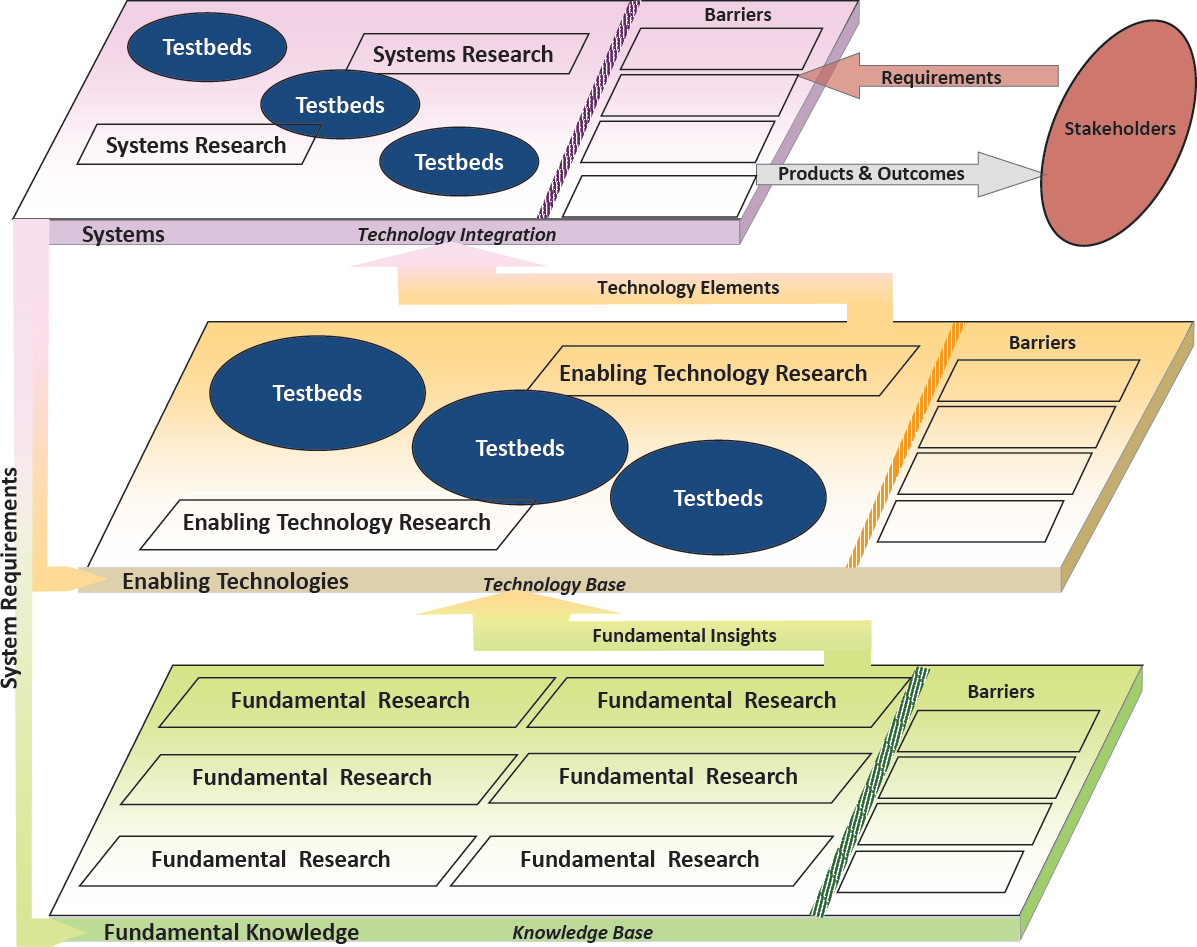
SOURCE: National Science Foundation, 2015, “ERC Solicitation 15-589 Webinar: Guidance for Preliminary Proposal Development,” August 31, https://www.nsf.gov/attachments/135960/public/NSF15-589_ERCwebinar.pdf.
Advisory Board, which meets annually with ERC and site visit teams to provide guidance for achieving diversity and pre-college outreach objectives; a Deans’ Council, which oversees both internal departmental interactions and cross-university partnerships and policies; and a Management Systems group, which meets annually or biennially to discuss project selection, refinement, or sunsetting with input from Advisory Boards, site visitors, and NSF. ERCs are required to produce an extensive annual report to NSF and, in years 8-10, an extensive “post-graduation” plan.
Thus successful management of centers entails layers of administrative processes that take staff time to develop and execute. For example, extensive, ongoing data collection is needed to fulfill NSF reporting requirements2 (e.g., annual and renewal reports), and this can be hard when some key information may be held by dispersed team members. Due to privacy concerns, collecting demographic information to demonstrate progress on diversity goals may pose challenges, and considerable effort may be required to capture data reflective of interaction with industry partners. ERCs also must undergo annual site visits, which require considerable planning, and longer site visits when they apply for renewal in years three and six.
Additional staff time and administrative work are needed to establish and maintain the various external and internal boards and councils NSF requires as part of the ERC structure. ERCs must also design and maintain a website for outside constituents, negotiate intellectual property and member agreements with industry partners, and craft agreements with foreign university partners.
___________________
2 The 52-page National Science Foundation (NSF) guidance document intended to help centers prepare annual reports is entitled FY 2017 Guidelines for Preparing Annual Reports and Renewal Proposals for the Engineering Research Centers and Nanoscience Engineering Research Centers: Classes of 2006-2015 (NSF, 2017, January, https://www.erc-reports.org/public/download-document?fileName=FY2017_Annual_Reporting_Guidelines.docx). The 60-page ICF International document designed to support centers’ use of the agency’s online data system, ERCWeb, is entitled Guidelines for ERCWeb Data Entry for the Engineering Research Centers. FY2017 (ICF International, 2017, prepared for National Science Foundation, Directorate for Engineering, Division of Engineering Education and Centers, January, https://www.erc-reports.org/public/download-document?fileName=FY2017_ERCWeb_Data_Entry_Guidelines.doc).


