Physics of Life (2022)
Chapter: Appendix E: Details Regarding National Science Foundation and National Institutes of Health Grants
E
Details Regarding National Science Foundation and National Institutes of Health Grants
To assess the current scope and structure of funding for biological physics in the United States, the committee gathered data from publicly accessible databases at the National Science Foundation (NSF) and the National Institutes of Health (NIH), and distributed a questionnaire to a wide range of centers, institutions, foundations, and other funding agencies and stakeholders (Appendix C). This effort generated valuable insights into the amount of funding flowing into our field, the types of projects and training efforts being supported, and the priorities of different funders. The headline funding over the decade 2010–2020 is shown, by agency, in Figure 9.1. This appendix focuses on details at NSF and NIH.
NIH STUDY SECTIONS
NIH awards to principal investigators with their primary affiliations in physics and biophysics departments were reviewed by 75 different standing scientific study sections, 237 different special emphasis panels, 3 National Cancer Institute subcommittees, and 5 training/career/workforce development subcommittees. The following is a list of the relevant standing scientific study sections:
- AIDS Molecular and Cellular Biology Study Section (AMCB)
- Anterior Eye Disease Study Section (AED)
- Arthritis and Musculoskeletal and Skin Diseases Special Grants Review Committee (AMS)
- Atherosclerosis and Inflammation of the Cardiovascular System Study Section (AICS)
- Auditory System Study Section (AUD)
- Basic Mechanisms of Cancer Therapeutics Study Section (BMCT)
- Basic Neuroscience of Aging Review Committee (NIA-N)
- Biochemistry and Biophysics of Membranes Study Section (BBM)
- Biodata Management and Analysis Study Section (BDMA)
- Bioengineering, Technology and Surgical Sciences Study Section (BTSS)
- Bioengineering of Neuroscience, Vision and Low Vision Technologies Study Section (BNVT)
- Biology of the Visual System Study Section (BVS)
- Biomaterials and Biointerfaces Study Section (BMBI)
- Biomedical Computing and Health Informatics Study Section (BCHI)
- Biomedical Imaging Technology A Study Section (BMIT-A)
- Biomedical Imaging Technology B Study Section (BMIT-B)
- Biomedical Imaging Technology Study Section (BMIT)
- Biomedical Library and Informatics Review Committee (BLR)
- Biophysics of Neural Systems Study Section (BPNS)
- Cancer Etiology Study Section (CE)
- Cancer Immunopathology and Immunotherapy Study Section (CII)
- Cell Death in Neurodegeneration Study Section (CDIN)
- Cellular, Molecular and Integrative Reproduction Study Section (CMIR)
- Cellular and Molecular Biology of Glia Study Section (CMBG)
- Cellular and Molecular Biology of Neurodegeneration Study Section (CMND)
- Cellular and Molecular Biology of the Kidney Study Section (CMBK)
- Cellular and Molecular Immunology—A Study Section (CMIA)
- Cellular and Molecular Technologies Study Section (CMT)
- Clinical Molecular Imaging and Probe Development (CMIP)
- Clinical Neuroscience and Neurodegeneration Study Section (CNN)
- Clinical Translational Imaging Science Study Section (CTIS)
- Cognitive Neuroscience Study Section (COG)
- Communication Disorders Review Committee (CDRC)
- Development—2 Study Section (DEV2)
- Developmental Biology Subcommittee (CHHD-C)
- Developmental Therapeutics Study Section (DT)
- Digestive Diseases and Nutrition C Subcommittee (DDK-C)
- Drug Discovery and Molecular Pharmacology Study Section (DMP)
- Enabling Bioanalytical and Imaging Technologies Study Section (EBIT)
- Gene and Drug Delivery Systems Study Section (GDD)
- Imaging Technology Development Study Section (ITD)
- Instrumentation and Systems Development Study Section (ISD)
- Intercellular Interactions Study Section (ICI)
- International and Cooperative Projects—1 Study Section (ICP1)
- Lung Cellular, Molecular, and Immunobiology Study Section (LCMI)
- Macromolecular Structure and Function A Study Section (MSFA)
- Macromolecular Structure and Function B Study Section (MSFB)
- Macromolecular Structure and Function C Study Section (MSFC)
- Macromolecular Structure and Function D Study Section (MSFD)
- Macromolecular Structure and Function E Study Section (MSFE)
- Medical Imaging Study Section (MEDI)
- Membrane Biology and Protein Processing Study Section (MBPP)
- Microbiology and Infectious Diseases B Subcommittee (MID)
- Microbiology and Infectious Diseases B Subcommittee (MID-B)
- Microscopic Imaging Study Section (MI)
- Minority Programs Review Subcommittee A (MPRC-A)
- Modeling and Analysis of Biological Systems Study Section (MABS)
- Molecular and Integrative Signal Transduction Study Section (MIST)
- Molecular Genetics A Study Section (MGA)
- Molecular Neuropharmacology and Signaling Study Section (MNPS)
- Nanotechnology Study Section (NANO)
- Neural Basis of Psychopathology, Addictions and Sleep Disorders Study Section (NPAS)
- NeuroAIDS and other End-Organ Diseases Study Section (NAED)
- Neurobiology of Learning and Memory Study Section (LAM)
- Neurodifferentiation, Plasticity, and Regeneration Study Section (NDPR)
- Neuroscience and Ophthalmic Imaging Technologies Study Section (NOIT)
- Neurotechnology Study Section (NT)
- Neurotransporters, Receptors, and Calcium Signaling Study Section (NTRC)
- NIDR Special Grants Review Committee (DSR)
- NST-2 Subcommittee (NST-2)
- Nuclear and Cytoplasmic Structure/Function and Dynamics Study Section (NCSD)
- Oral, Dental and Craniofacial Sciences Study Section (ODCS)
- Prokaryotic Cell and Molecular Biology Study Section (PCMB)
- Radiation Therapeutics and Biology Study Section (RTB)
- Sensorimotor Integration Study Section (SMI)
- Skeletal Biology Structure and Regeneration Study Section (SBSR)
- Synapses, Cytoskeleton and Trafficking Study Section (SYN)
NIH FUNDING MECHANISMS
NIH offers research support through a wide variety of different mechanisms, each with a defined “activity code.” From 2010 through August 2020, 1,770 NIH awards received by recipients whose primary departmental affiliation was Physics or Biophysics came through 47 of these different mechanisms. These are listed here, in larger categories, with number of awards in parentheses for individual programs. Note that in keeping with NIH reporting practices each award represents a single funding year such that, for example, a 5-year grant is counted as five awards.
Innovator and Pioneer Awards: 22 awards, $26,777,038
- DP1: Pioneer Award (15)
- DP2: New Innovator Award (7)
Research Training and Fellowships: 147 awards, $17,879,386
- F30: Kirchstein Predoctoral award for dual degree (5)
- F31: Kirchstein Predoctoral award (43)
- F32: Kirchstein Postdoctoral award (30)
- F99: Predoctoral to Postdoctoral Transition award (2)
- R25: Education Project Grant (35)
- R36: Dissertation Award (3)
- T32: Kirchstein Institutional Pre/Postdoctoral Training award (26)
- T34: Kirchstein Institutional Undergraduate Training award (3)
Career Development Awards: 105 awards, $14,995,424
- DP5: Early Independence Award (1)
- K01: Mentored Research Scientist Career Development Award (14)
- K08: Mentored Clinical Scientist Research Career Development Award (1)
- K22: Career Transition Award (22)
- K25: Mentored Quantitative Research Career Development Award (21)
- K99: Pathway to Independence Award, phase 1 (28)
- R00: Pathway to Independence Award, phase 2 (18)
Program Project/Center Awards: 77 awards, $87,485,518
- P01: Program Project (10)
- P30: Center Core Grant (3)
- P41: Biotechnology Resource Grants (18)
- RF1: Multi-Year Funded Research Project Grant (1)
- RL5: Linked Education Project (linked to U54) (7)
- U19: Multi-Project Cooperative Agreements (with NIH Intramural) (8)
- U54: Specialized Center-Cooperative Agreements (11)
- UF1: Multi-Year Funded Research Cooperative Agreement (3)
- UG3: Exploratory/Developmental Cooperative Agreement Phase I, large budget (4)
- UH2: Exploratory/Developmental Cooperative Agreement Phase I (1)
- UH3: Exploratory/Developmental Cooperative Agreement Phase II (4)
- UL1: Linked Specialized Center Cooperative Agreement (linked to U54) (7)
Research Grants: 1,293 awards, $438,145,936
- R01: Research Project Grant (950)
- R03: Small Grant Program (14)
- R15: Academic Research Enhancement Awards (48)
- R21: Exploratory Developmental Research Grant (157)
- R33: Second Phase of Exploratory Developmental Research Grant (4)
- R35: Maximizing Investigator’s Research Award (MIRA) (45)
- R37: Method to Extend Research in Time (MERIT) Award (29)
- R56: High Priority, Short-Term Project Award (4)
- R61: First Phase of Exploratory Developmental Research Grant (2)
- RC1: Challenge Grant (5)
- RC2: High Impact Interdisciplinary Science (1)
- U01: Cooperative Agreement (with NIH Intramural) Award (34)
Conference Grants: 5 awards, $70,100
- R13: NIH Support for Conferences and Scientific Meetings (5)
Resource and Shared Instrumentation Grants: 13 awards, $7,449,944
- S10: Shared Instrumentation Grant (12)
- U24: Resource-Related Research Cooperative Agreement (1)
Diversity/Capacity Building Grants: 82 awards, $21,129,177
- SC1: Support of Competitive Research Award (SCORE), undergrad (18)
- SC2: Support of Competitive Research Award (SCORE), grad (21)
- SC3: Support of Competitive Research Award (SCORE), post-doc (36)
- TL4: Kirchstein Undergraduate Training award for URM Institutions (7)
NSF FUNDING LEVELS
To survey the state of funding for biological physics at NSF, the committee used the publicly accessible (advanced) award search tool.1 Selecting for the Physics of Living Systems program and start dates after January 1, 2010, produces a list of 416 awards, many of which are co-funded with other programs. Of these, 60 are in support of conferences, workshops, and summer schools, and 16 are single grants in support of centers or large research networks. This leaves 340 awards to individual investigators or small groups.
As an aside, NSF also has a “collaborative research” mechanism, which involves making multiple parallel grants to individual investigators working together, sometimes bound only by a loose theme. This is in contrast to center grants, which involve one large award to a group. The committee concluded that individual components of the collaborative research grants, which are reported as distinct awards, are meaningfully grouped with the individual investigator awards.
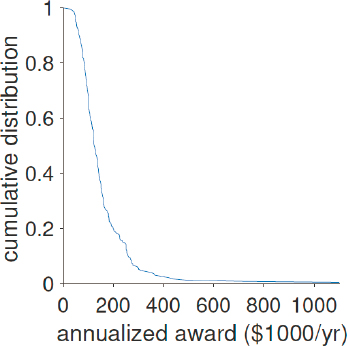
As noted in the main text, NSF attaches all award funding to the initial award date, even as it accumulates in increments. For the 224 awards with end dates before December 31, 2020, however, all of the funds have been awarded and one can annualize the award amount. Figure E.1 shows the cumulative distribution of these annualized awards. Although there is a small tail of large awards, the mean annual award is just over $150,000 per year and the median is $122,600 per year. One can also make a distribution over award years, which would be more comparable to how NIH reports its data, and this is shown in Figure 9.6 of the main text.
___________________
1 National Science Foundation, “Awards Advanced Search,” https://www.nsf.gov/awardsearch/advancedSearch.jsp.


