International Talent Programs in the Changing Global Environment (2024)
Chapter: Appendix D: United States Incentive Programs
Appendix D
United States Incentive Programs1
DOMESTIC INCENTIVE PROGRAMS
Research Fellowships
This section provides an overview of research fellowships that are available from government and nongovernment sources for graduate students, postdocs, and faculty.
Survey of Existing Programs and Fellowships
Graduate Student Research Fellowships
Many federal scientific agencies offer research fellowships for graduate students to conduct full-time research at their universities (see Box D-1). These research fellowships generally provide 3 years of support, which usually includes a stipend of $30,000 to $40,000 per year, health insurance, travel funding, and full or partial tuition coverage. Every year, these government programs award fellowships to a few hundred to a few thousand students. They tend to be quite competitive, with about 5 to 20 times as many applicants as available fellowships (see Figures D-1 and D-2). The stated missions of many of these programs include language such as “to help
___________________
1This appendix incorporates material from the commissioned paper “Survey of Current U.S. Programs to Attract and Retain Talent” by Tamara Savage.
BOX D-1
Examples of U.S. Government-Sponsored Fellowships
National Science Foundation—Graduate Research Fellowship Program (NSF GRFP)
Department of Defense—National Defense Science and Engineering Graduate Fellowship Program (DOD NDSEG)
National Institutes of Health—Kirchstein Individual National Research Service Award (NIH F30 & F31)
National Aeronautics and Space Administration—Space Technology Graduate Research Opportunities
Department of Transportation—Dwight D. Eisenhower Transportation Fellowship Program
Department of Energy—Computational Science Graduate Fellowship (DOE CSGF)
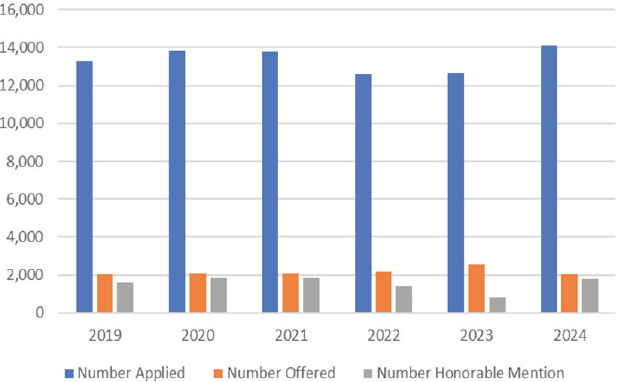
SOURCE: NSF, 2023, 2024b.
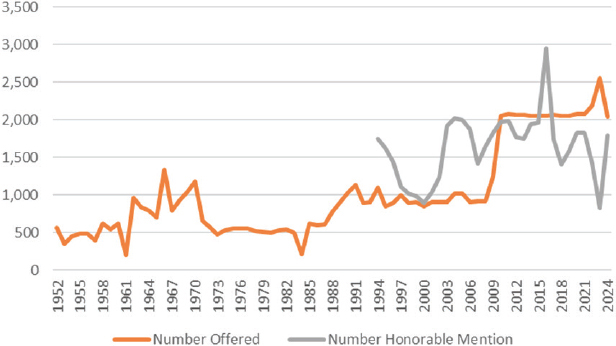
SOURCE: NSF, 2024a.
ensure the quality, vitality, and diversity of the scientific and engineering workforce of the United States” and “to attract the nation’s brightest minds to the field of transportation … [and] retain top talent in the U.S. transportation industry” (Federal Highway Administration, 2024; NSF, n.d.a).
The National Defense Science and Engineering Graduate (NDSEG) Fellowship program was established by Congress in 1989 to increase the number of United States citizens receiving doctoral degrees in science and engineering disciplines of military importance (NDSEG, n.d.; Systems Plus, n.d.). Since its inception, the highly competitive fellowship program has awarded nearly 4,700 fellowships to U.S. citizens and nationals from more than 70,000 applications. Selected fellows can choose the U.S. institution to attend for pursuit of their doctoral degree. The NDSEG Fellowship is sponsored by the Air Force Office of Scientific Research, the Army Research Office, and the Office of Naval Research under the direction of the Office of the Under Secretary of Defense for Research and Engineering. The NDSEG Fellowship is an equal opportunity program open to all qualified U.S. citizens and U.S. nationals.
The citizenship requirements for these fellowships are not uniform, even among the different U.S. government agencies. For most of these opportunities, applicants need to be a U.S. citizen, national, or permanent resident. However, to be considered for the Department of Transportation’s Dwight D. Eisenhower Transportation Fellowship Program, applicants
need only to be a student at a U.S. institution. The programs are also administered differently; some are done entirely in-house (such as the National Institutes of Health fellowships), while some use external contractors to run parts of the application process (such as the National Science Foundation Graduate Research Fellowships Program [NSF GRFP] and Department of Defense [DOD] NDSEG).
There are also fellowships outside of government that are funded and administered by private industry, philanthropy, and nonprofit organizations (see Box D-2). These fellowships offer approximately the same level of funding per student as the government-funded fellowships, but are usually awarded to fewer students, approximately 20 to 100 students per year. Nongovernment fellowships generally do not have citizenship requirements, so international students studying in the United States are eligible to apply and receive funding. Of the fellowships listed below, only the Hertz Foundation requires applicants to be U.S. citizens.
Fellowships specific to a particular institution, such as the Amazon Fellowship at Carnegie Mellon University, which funds about five students per year and for which international students are eligible (Gantenbein, 2021), represent another nongovernment funding mechanism. Other universities have similar fellowships sponsored by various companies that are available only to the students at that institution.
The principal funding mechanism for science, technology, engineering, and mathematics (STEM) graduate student research is through the grants awarded to their principal investigator by government agencies, nonprofit foundations, and private companies. Principal investigators can use these grants to fund graduate research assistants and postdocs. Many students are also funded as teaching assistants by their institutions.
BOX D-2
Examples of Nongovernmental Fellowships
Google Ph.D. Fellowship
Hertz Foundation Fellowship
Meta Research Ph.D. Fellowship (formerly the Facebook Fellowship)
Apple Ph.D. Fellowship in AI/ML
IBM Ph.D. Fellowship
Smithsonian Institution Fellowship Program
Opportunities Available to International Students
Many of the previously mentioned government-funded research fellowships are not available to international students and foreign nationals, but the privately funded fellowships are. One program that brings international students and researchers to the United States is the Fulbright Program (Bureau of Educational and Cultural Affairs, n.d.b). The Fulbright Program, an international academic exchange program, was founded in 1946 to increase mutual understanding and support friendly and peaceful relations between the people of the United States and the people of other countries. It is one of the largest programs for bringing international students and researchers to the United States and sending U.S. students and scholars abroad. The program is funded by an annual appropriation from Congress to the State Department’s Bureau of Educational and Cultural Affairs and from participating governments, host institutions, corporations, nongovernmental organizations, and foundations providing direct and indirect support.
The Fulbright Program provides awards to approximately 8,000 students, scholars, teachers, artists, and professionals each year from the United States and 160 countries. This includes approximately 2,000 domestic students and 800 domestic scholars departing the United States to study abroad, and 4,000 foreign students and 900 foreign scholars coming from abroad to study in the United States (Fulbright Program, n.d.a, n.d.b). These individuals hail from a wide variety of academic disciplines. Fulbright Program participants from abroad enter the United States on an Exchange Visitor J-1 visa subject to the 2-year home country residence requirement. This means that following the completion of a Fulbright fellowship, foreign students and scholars are generally required to return to their home country for 2 years before they are eligible to apply for a visa to return to the United States.
For a list of graduate fellowships that international students are eligible for that provide at least 1 year of full-time funding to at least one student, see Appendix E. Additional opportunities that noncitizens are eligible for have been compiled by Johns Hopkins University, the University of Pennsylvania, and the University of Illinois Urbana-Champaign.
Postdoctoral Research Fellowships
Some government agencies and nonprofit organizations offer postdoctoral research fellowships, with the number of fellowships and the
amount of funding dependent on the funding organization and the nature of the proposed research (see Box D-3). For the fellowships that offer stipends, the pay is usually higher than the graduate student stipends and are usually offered for 1 to 3 years. These fellowships are awarded directly to the researchers and not their institutions. For the government-funded fellowships, applicants generally need to be a U.S. citizen, national, or permanent resident. To be eligible, applicants usually need to have received their Ph.D. within the last few years.
One way for foreign postdoctoral researchers to enter or remain in the United States is to be hired at a Department of Energy (DOE) national lab. Most national labs are federally funded research and development centers, so employees are contractors, not federal government employees, which gives them additional flexibility in hiring (Lawrence Livermore National Laboratory, n.d.). In addition, these researchers are hired into positions that do not require a security clearance. There are also a small number of circumstances where noncitizens can be hired by DOD Science and Technology Reinvention Laboratories, such as when no qualified citizens are available (Balakrishnan et al., 2013). Postdocs are eligible for Fulbright fellowships. For a list of other postdoctoral fellowships that international students are eligible for that provide at least 1 year of full-time funding to at least one student, see Appendix E.
BOX D-3
Examples of Postdoctoral Fellowships
National Institutes of Health Kirschstein National Research Service Award Postdoctoral Fellowships (F32)
National Science Foundation Postdoctoral Fellowships
Department of Energy ORISE (Oak Ridge Institute for Science and Education)
Postdoctoral Fellowships
NASA Postdoctoral Fellowships
Schmidt Science Fellowships
Faculty Research Fellowships
Following the completion of graduate and postdoctoral studies, many early-career researchers look to programs, fellowships, and other opportunities for research funding or full-time employment to continue their work and provide opportunities to stay in the United States. The U.S. government is a source of some of the largest and most highly funded programs for such individuals.
Some examples of faculty research fellowships include the NSF Faculty Early Career Development Program (NSF CAREER), DOD Vannevar Bush Faculty Fellowship, and the Sloan Foundation Fellowship. Again, the mission statements of these programs include language such as “train the next generation of scientists and engineers” and to exchange “scientific knowledge between the Fellows and the government to benefit the country” (DOD and Office of the Under Secretary of Defense for Research and Engineering, n.d.). These fellowships are generally quite prestigious and provide significant funding on single-investigator grants. There are about 500 CAREER awards given every year, administered through the directorates at NSF; the amounts are usually around $100,000 per year for 4 or 5 years. The citizenship requirements are again not uniform, as NSF CAREER award applicants do not need to be citizens, just working at an eligible U.S. institution and pre-tenure. The DOD Bush Fellowship awards only 8–10 fellowships per year, but has much higher funding, at $3 million per person. Applicants need to be U.S. citizens or permanent residents and already have tenure. The Sloan Foundation fellowships are $75,000 each, to be used over the course of 1 to 2 years, and with 125 awards per year. Applicants do not need to be a citizen for the Sloan fellowships, but they do need to be pre-tenure at a U.S. or Canadian institution.
Professional Fellowships
Professional fellowships are opportunities for people who have advanced degrees and/or are already in the workforce to work for the federal government for a limited time. One of the largest professional fellowships is the American Association for the Advancement of Science’s (AAAS) Science and Technology Policy Fellowship. AAAS fellows are typically Ph.D. scientists and engineers who are given 1- or 2-year appointments in the federal government, mostly at the executive branch agencies (with a few in the legislative and judicial branches) to work on science and technology policy
issues. The goal of the fellowship is to expose the fellows to policymaking and bring scientific and technical expertise into the federal government. At the end of the 2 years, fellows move on to permanent jobs in academia, industry, and nonprofits, and some are hired on to permanent positions with the government. There are about 250 AAAS fellows per year. Applicants must be U.S. citizens to be eligible to participate in the main fellowship via AAAS, but some partner scientific societies,2 such as the American Chemical Society and Biophysical Society, do not have citizenship requirements, though they do require proof that they are eligible to work in the United States (ACS, n.d.; Biophysical Society, n.d.). In addition, several states have science policy fellowships modeled on the AAAS program, where fellows work in state legislatures and agency offices.3
The Presidential Innovation Fellows program brings mid-career entrepreneurs, technologists, and designers into government service for yearlong appointments. These fellows use their expertise to help build stronger public services using data science, design, engineering, and systems thinking. The fellows work on projects such as improving data sharing across the healthcare ecosystem, creating more efficient regulatory review processes at the Food and Drug Administration, and improving decision transparency at the Department of Justice. There are about 25 Presidential Innovation fellows per year. Applicants must be U.S. citizens or nationals.
Another professional fellowship is the U.S. Digital Service (USDS), which was started after the problems with the healthcare.gov website rollout. In this fellowship, technology workers are hired from the private sector to help improve digital government services by making them more user-friendly. One of the USDS’s stated objectives is to “bring top technical talent into civic service” (USDS, n.d.). Examples of projects USDS fellows have worked on include creating a website to help people find COVID-19 vaccines and modernizing the Medicare payment system. USDS fellows must be U.S. citizens.
___________________
2A list of AAAS partner scientific societies is available at https://www.aaas.org/programs/science-technology-policy-fellowships/partner-societies-st-policy-fellowships?adobe_mc=MCORGID%3D242B6472541199F70A4C98A6%2540AdobeOrg%7CTS%3D1714414687#partner.
3A list of state-level science and technology policy fellowships is available at https://ccst.us/wp-content/uploads/State-Level-Science-Technology-Policy-Fellowships.pdf.
Hiring Initiatives
In contrast to the professional fellowships, the purpose of government hiring initiatives is to permanently bring talent into the federal government workforce. Through funding from the Bipartisan Infrastructure Law (P.L. 117-58, November 15, 2021), the DOE launched a hiring initiative called the Clean Energy Corps to hire many new government employees to work on clean energy deployment, decarbonizing the economy, and other aspects of addressing climate change. DOE is looking for new employees from many areas, including engineering, the physical sciences, project management, finance, legal, and communications. DOE has streamlined their hiring process to make it easier and faster to fill hundreds of positions. Potential new employees need to be U.S. citizens.
The Biden administration recently launched a National AI (Artificial Intelligence) Talent Surge to rapidly hire talent to work on many areas of AI technology and governance (AI.gov, n.d.). The government is hiring for these roles through USAJobs.gov at a range of federal government agencies, including the Internal Revenue Service, Census Bureau, Department of Commerce, and Department of Energy. These jobs are generally open to U.S. citizens and nationals.
The Federal Trade Commission recently created an Office of Technology to enable the FTC to better keep pace with technology and digital policy issues. The FTC is hiring Technologists in Residence to ensure a vibrant and competitive technology marketplace that benefits consumers. Technologists in Residence are usually experts with experience at technology companies or academic researchers. Applicants must be U.S. citizens and can apply using a streamlined application.
DOD offers the SMART Scholarship-for-Service program, where the agency provides scholarships for undergraduate and graduate students pursuing STEM degrees. DOD pays for recipients’ tuition and stipends and guarantees them employment with the DOD after graduation for the same number of years that the DOD funded their education. Applicants must be citizens of the United States or another Five Eyes country (Australia, Canada, New Zealand, or the United Kingdom).
Internships
The federal government also offers internship opportunities to STEM students—from high school all the way to graduate school—through the
Pathways Program, which places students in agencies across the government (OPM, n.d.). Students who complete Pathways internships are usually eligible to be converted to permanent government employees at the end of their internships.
Coding It Forward is a nonprofit organization that offers summer internships for undergraduate and graduate students in software engineering, data analysis, cybersecurity, and product management (Coding It Forward, n.d.). Coding It Forward matches students with opportunities in local, state, and federal government offices. International students are eligible for internships with state and local government offices.
The Department of Energy’s Oak Ridge Institute for Science and Education (ORISE) program offers many internships to undergraduate and graduate students during the summer, fall, and spring semesters at the Department of Energy in Washington, DC, and at many national labs. These internships cover topics of interest to the DOE, such as geothermal technologies, energy security, vehicle electrification, environmental management, and energy efficiency. Interns need to be U.S. citizens.4
Competitions
Some government agencies offer competitions where students can compete for prizes both to develop talent and solve government challenges. In the Gateways to Blue Skies competition run by NASA, student teams compete on aerospace challenges to win NASA internships (NIA, n.d.). The 2024 competition’s project is designing aviation-related systems that could help the government prepare for natural disasters, lessen their impacts, and speed up recovery efforts. International students can participate in the competition, but only U.S. citizens are eligible for the NASA internships. The Defense Advanced Research Projects Agency (DARPA) holds competitions each year called DARPA Challenges (DARPA, n.d.). In these challenges, student teams compete to solve problems on topics such as robotics and cybersecurity to win cash prizes.
___________________
4Other ORISE research participation programs are open to foreign nationals, with such opportunities categorized into those available to Lawful Permanent Residents and Conditional Permanent Residents ONLY, and those open to everyone (ORISE, n.d.). For example, ORISE sponsors J-1 status for those participating in the Research Scholar and Short-Term Scholar programs on a case-by-case basis for select, eligible participants (ORISE, n.d.).


