Previous Chapter: 13 Rural Highway Example Calculations
Page 150
Suggested Citation: "14 Computational Engine Overview." National Academies of Sciences, Engineering, and Medicine. 2024. Reliability and Quality of Service Evaluation Methods for Rural Highways: A Guide. Washington, DC: The National Academies Press. doi: 10.17226/27895.

CHAPTER 14

Computational Engine Overview

The computational engine, which can be downloaded from https://github.com/swash17/HCM-CALC, includes calculations for the following roadway components, as well as the overall facility calculations for various combinations of these components:

  • Multilane highway segments.
  • Two-lane highway segments.
  • Signalized intersections.
  • Roundabout intersections.
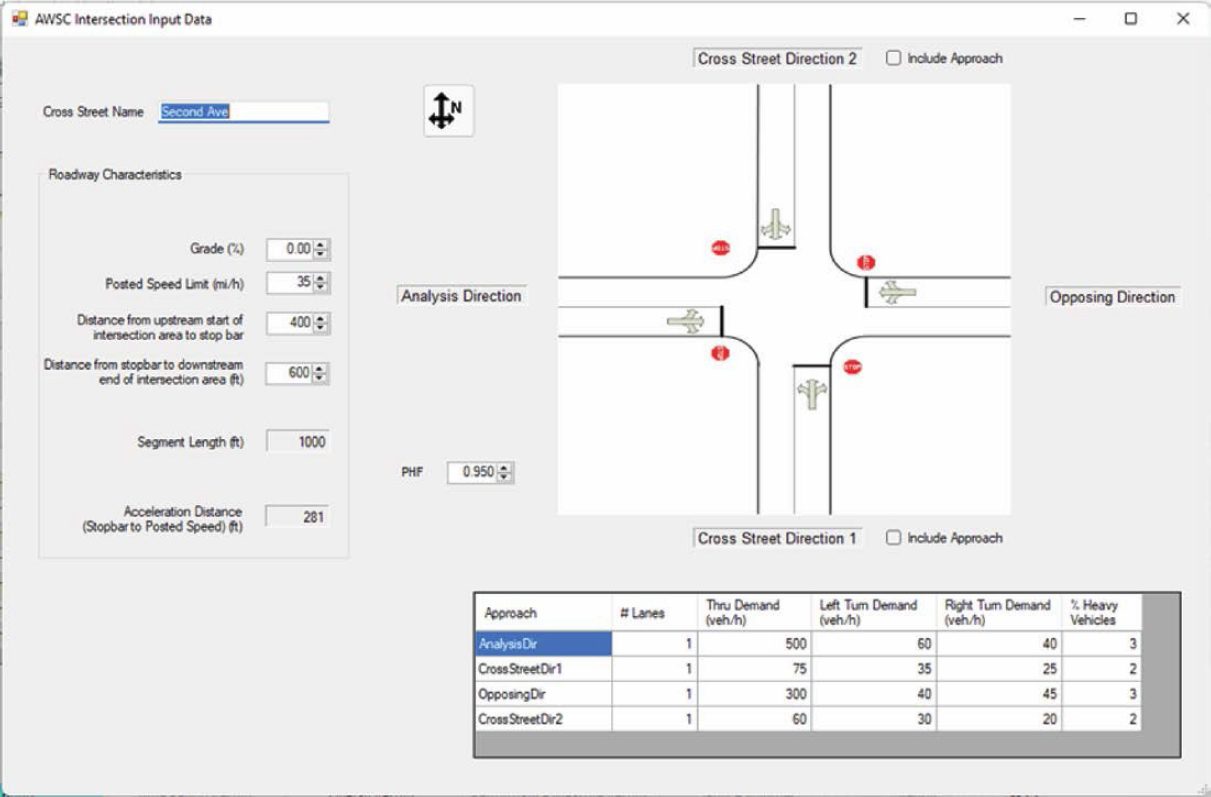
  • AWSC intersections.
  • Urban street (with signalized or uncontrolled intersections, AWSC, and roundabouts in progress).

Figures 14.1 through 14.17 display various screens in the program.

Page 151
Suggested Citation: "14 Computational Engine Overview." National Academies of Sciences, Engineering, and Medicine. 2024. Reliability and Quality of Service Evaluation Methods for Rural Highways: A Guide. Washington, DC: The National Academies Press. doi: 10.17226/27895.

When you start the program (HCMCalc.exe), you will be presented with the following screen.
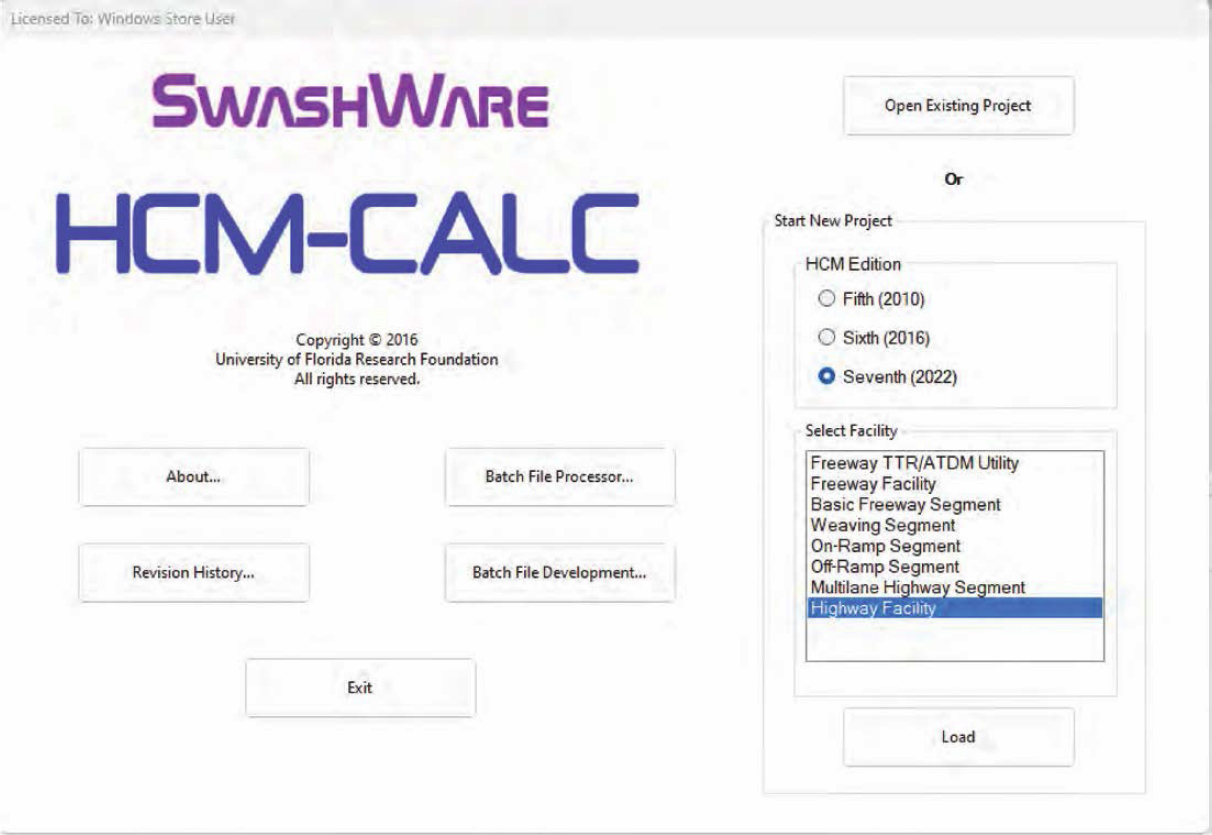
HCM-CALC startup screen
Figure 14.1. HCM-CALC startup screen.
Page 152
Suggested Citation: "14 Computational Engine Overview." National Academies of Sciences, Engineering, and Medicine. 2024. Reliability and Quality of Service Evaluation Methods for Rural Highways: A Guide. Washington, DC: The National Academies Press. doi: 10.17226/27895.

Select the “Highway Facility” module on the right side of the screen. Either press “enter” or double-click on the entry with the left mouse button. The following screen will be displayed.
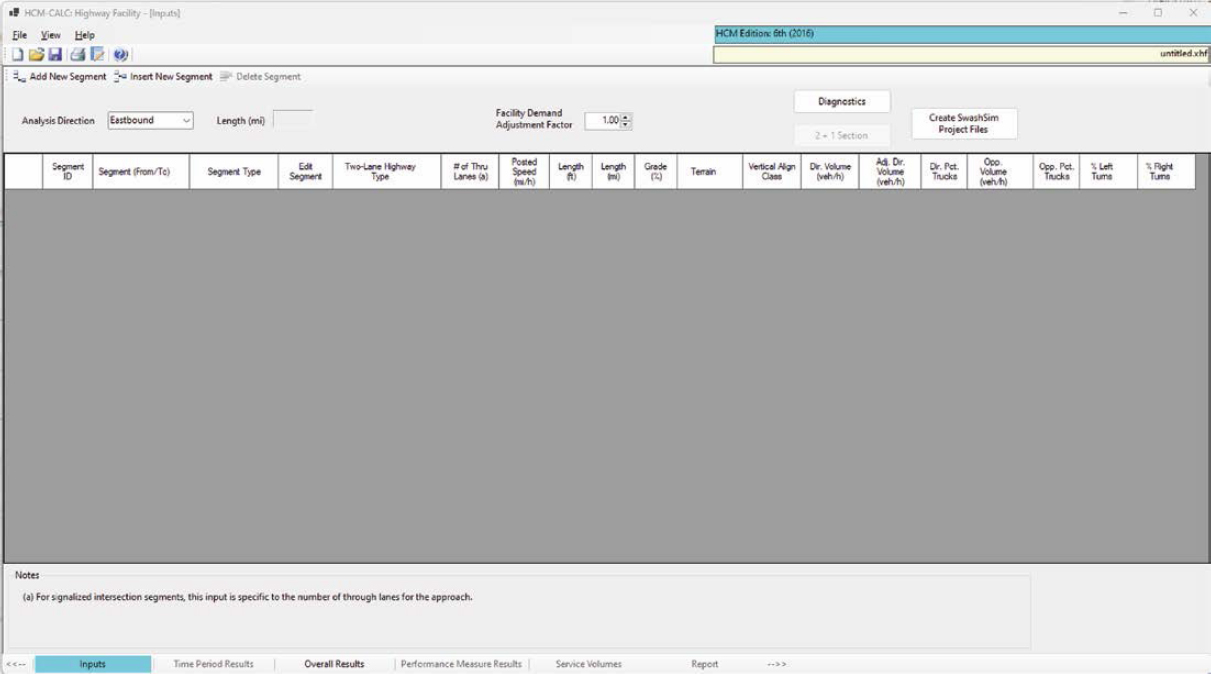
New facility screen
Figure 14.2. New facility screen.

Note that the “Inputs” tab, lower left part of the screen, will be highlighted.

Page 153
Suggested Citation: "14 Computational Engine Overview." National Academies of Sciences, Engineering, and Medicine. 2024. Reliability and Quality of Service Evaluation Methods for Rural Highways: A Guide. Washington, DC: The National Academies Press. doi: 10.17226/27895.

To create your facility, use the “Add New Segment,” “Insert New Segment,” and/or “Delete Segment” buttons in the toolbar near the top of the screen. When pressing “Add New Segment” or “Insert New Segment,” the following screen will be displayed.
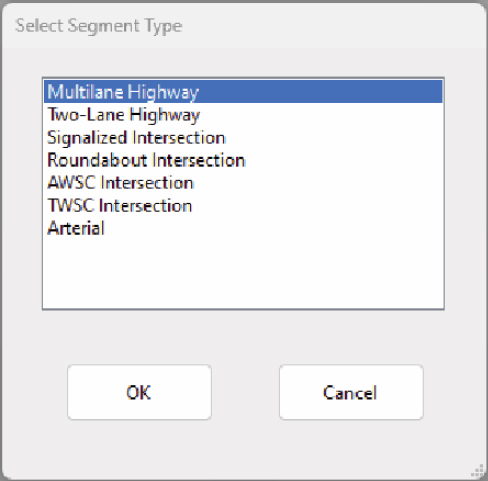
Add New Segment screen
Figure 14.3. Add New Segment screen.
Page 154
Suggested Citation: "14 Computational Engine Overview." National Academies of Sciences, Engineering, and Medicine. 2024. Reliability and Quality of Service Evaluation Methods for Rural Highways: A Guide. Washington, DC: The National Academies Press. doi: 10.17226/27895.

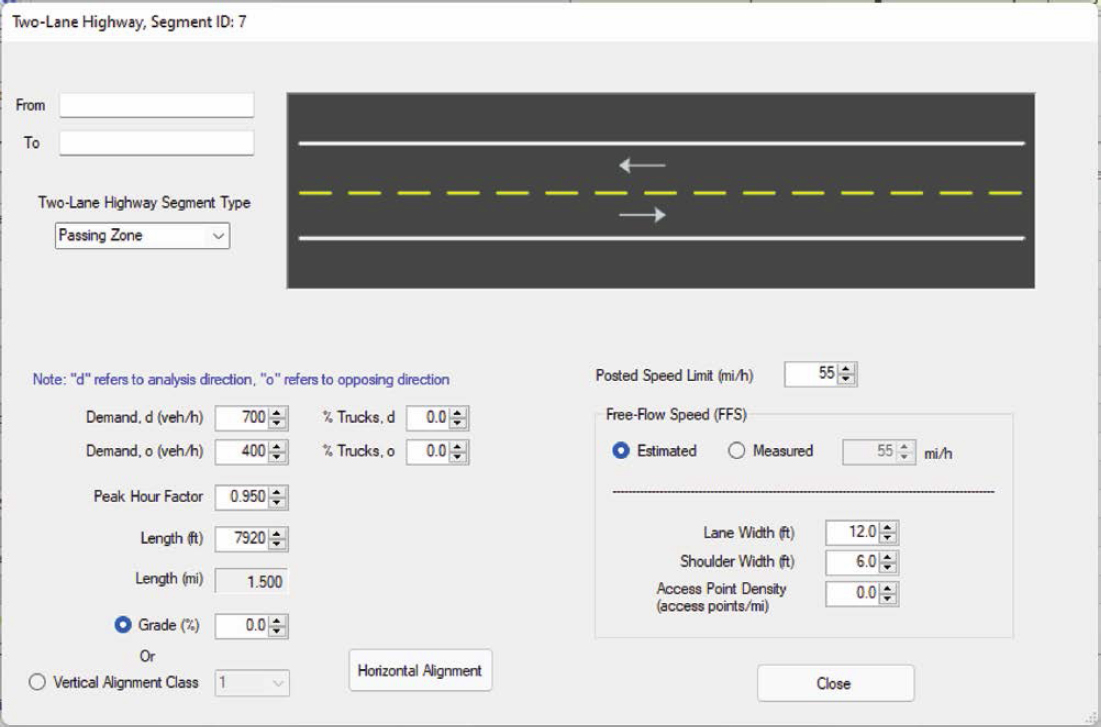
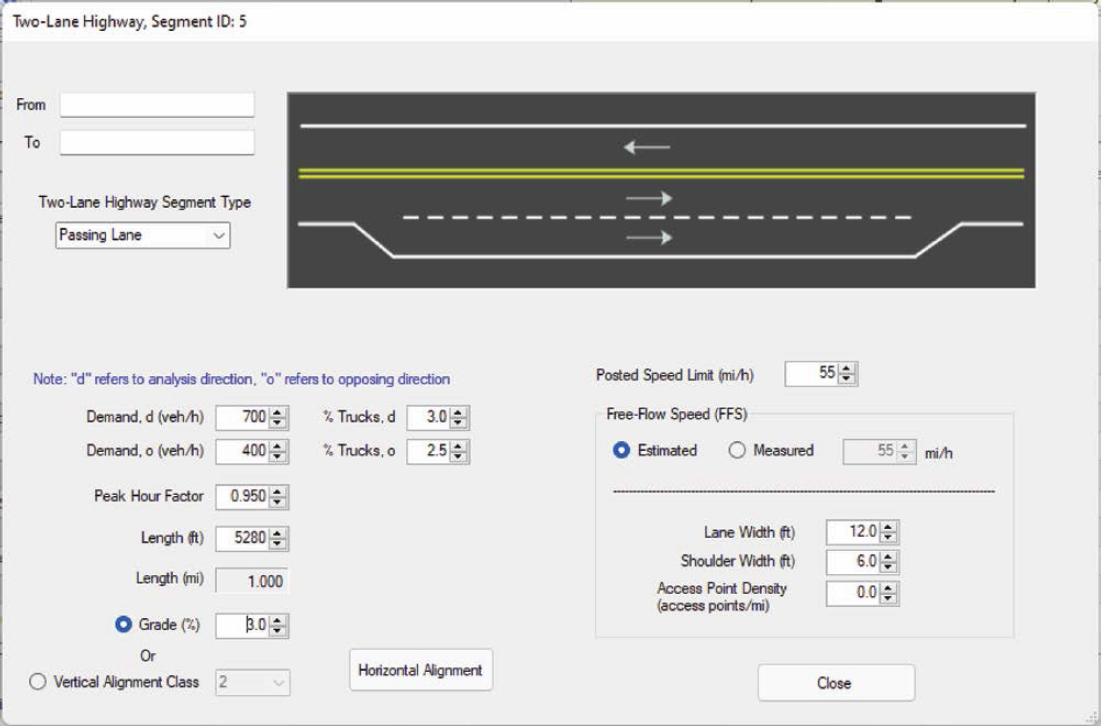
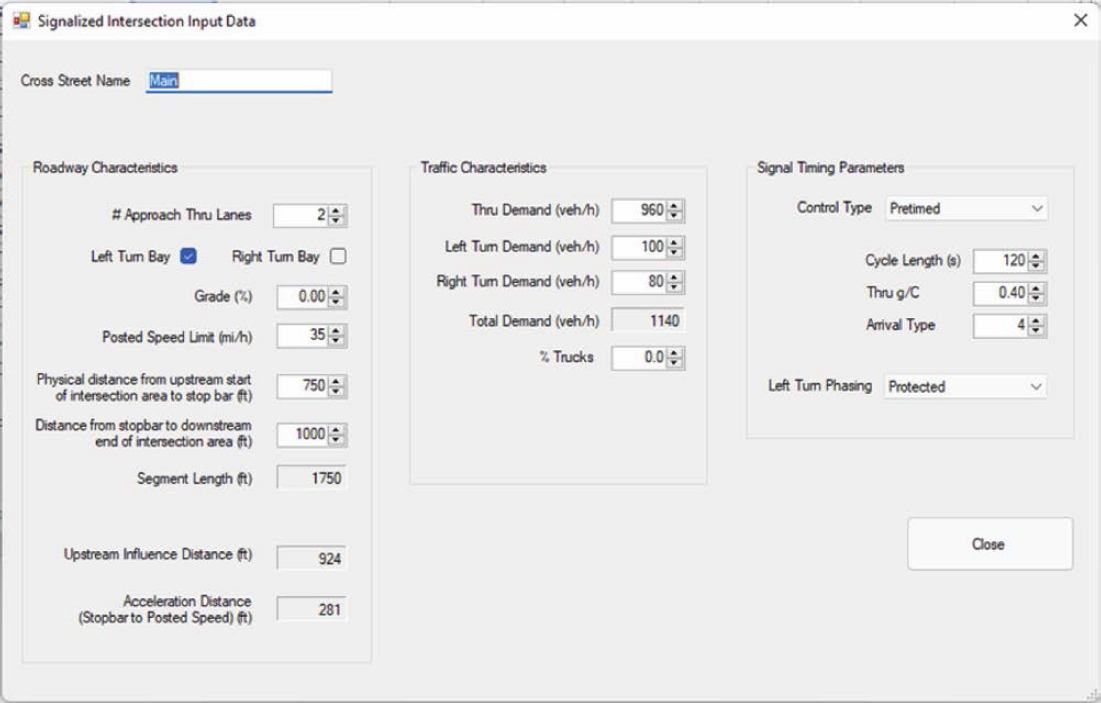
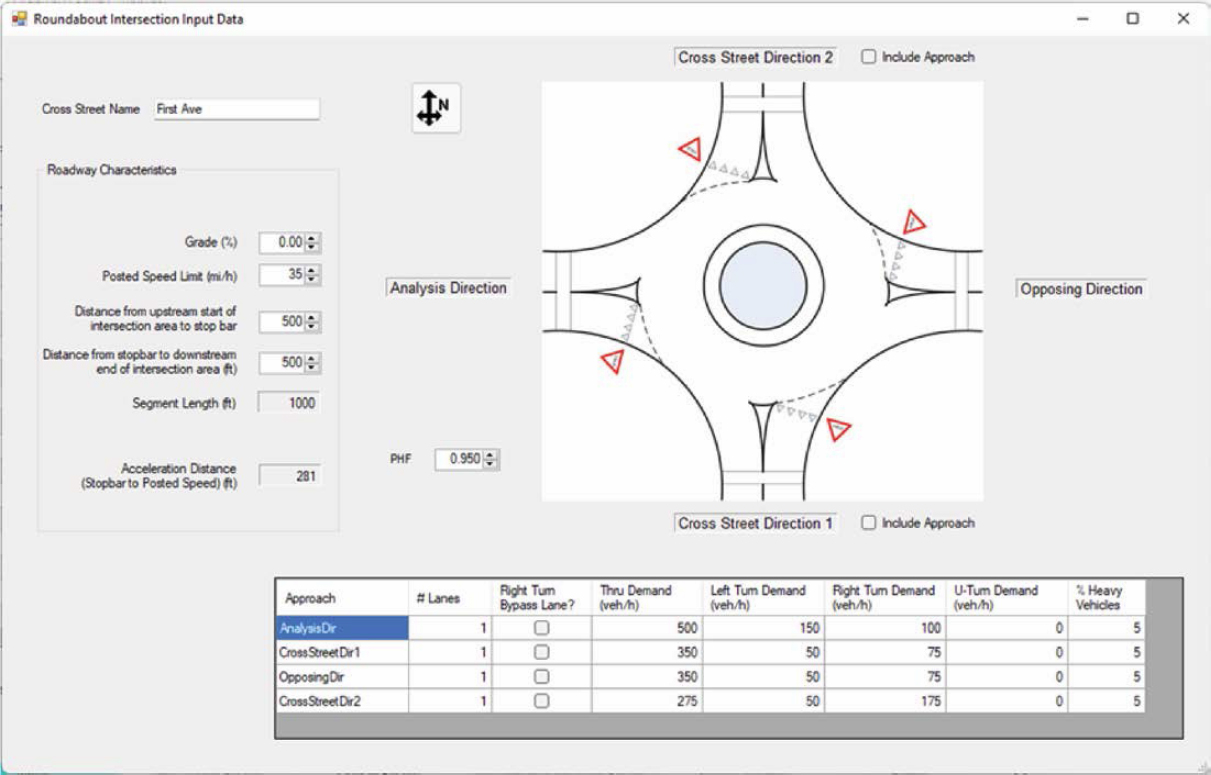
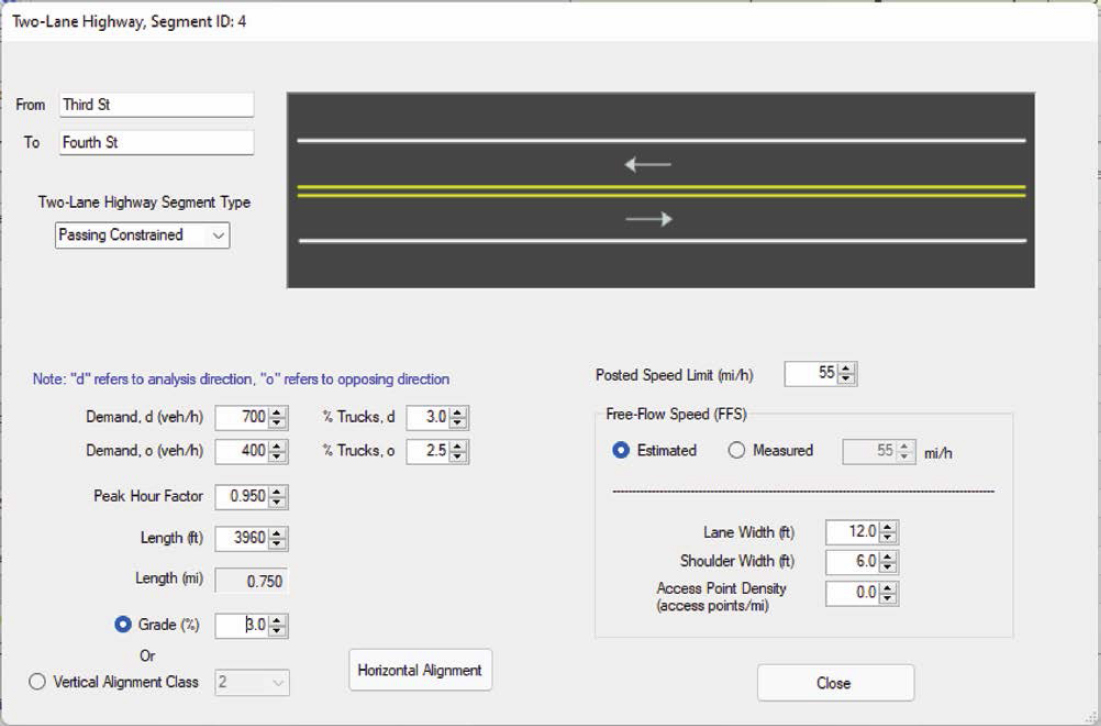
Select the desired segment type and press “OK.” The input data screen for the corresponding segment type will be displayed. Those screens are as follows.
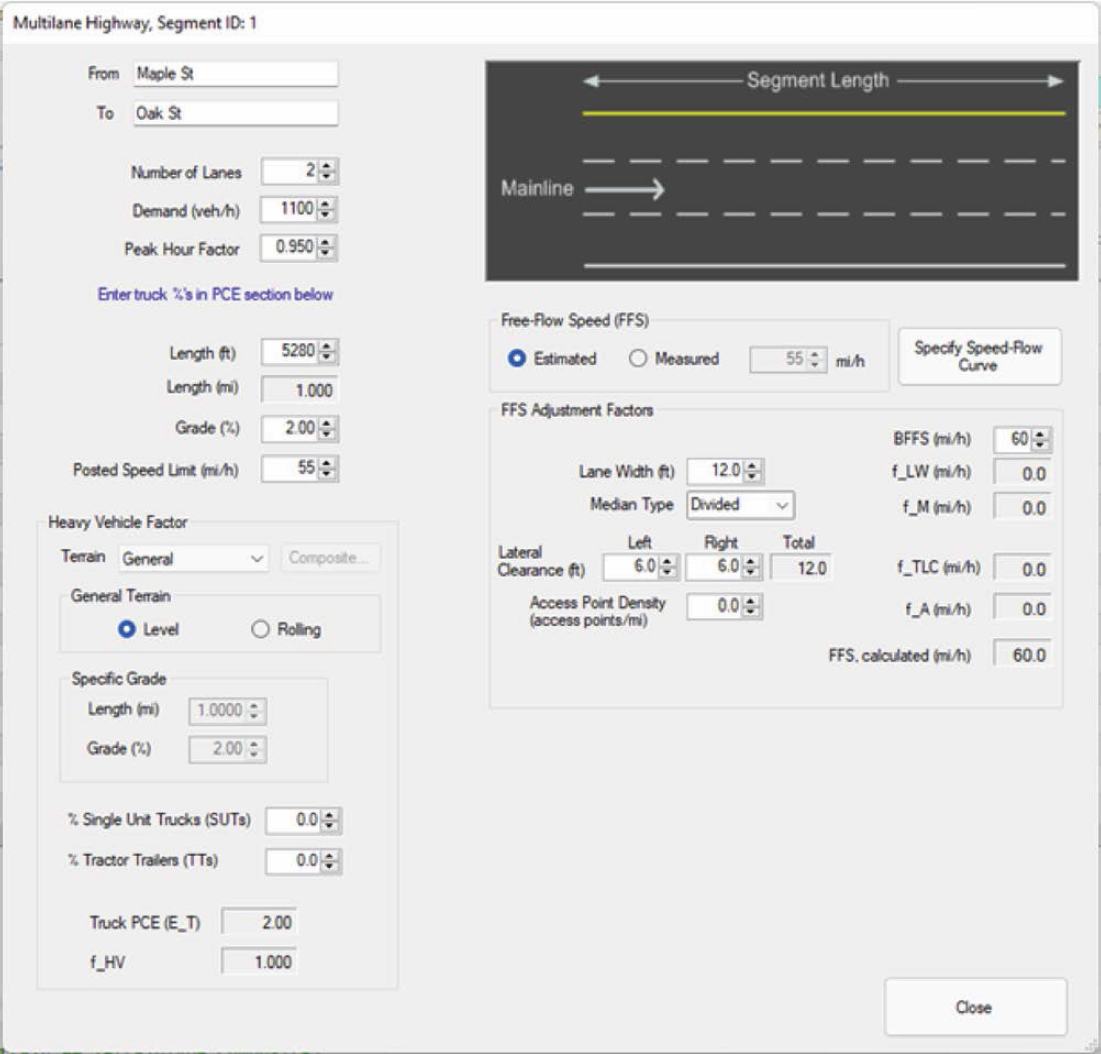
Multilane highway segment inputs screen
Figure 14.4. Multilane highway segment inputs screen.
Page 155
Suggested Citation: "14 Computational Engine Overview." National Academies of Sciences, Engineering, and Medicine. 2024. Reliability and Quality of Service Evaluation Methods for Rural Highways: A Guide. Washington, DC: The National Academies Press. doi: 10.17226/27895.
Two-lane highway passing constrained segment inputs screen
Figure 14.5. Two-lane highway passing constrained segment inputs screen.
Two-lane highway passing zone segment inputs screen
Figure 14.6. Two-lane highway passing zone segment inputs screen.
Page 156
Suggested Citation: "14 Computational Engine Overview." National Academies of Sciences, Engineering, and Medicine. 2024. Reliability and Quality of Service Evaluation Methods for Rural Highways: A Guide. Washington, DC: The National Academies Press. doi: 10.17226/27895.
Two-lane highway passing lane segment inputs screen
Figure 14.7. Two-lane highway passing lane segment inputs screen.
Signalized intersection inputs screen
Figure 14.8. Signalized intersection inputs screen.
Page 157
Suggested Citation: "14 Computational Engine Overview." National Academies of Sciences, Engineering, and Medicine. 2024. Reliability and Quality of Service Evaluation Methods for Rural Highways: A Guide. Washington, DC: The National Academies Press. doi: 10.17226/27895.
Roundabout intersection inputs screen
Figure 14.9. Roundabout intersection inputs screen.
Page 158
Suggested Citation: "14 Computational Engine Overview." National Academies of Sciences, Engineering, and Medicine. 2024. Reliability and Quality of Service Evaluation Methods for Rural Highways: A Guide. Washington, DC: The National Academies Press. doi: 10.17226/27895.
AWSC intersection inputs screen
Figure 14.10. AWSC intersection inputs screen.
Page 159
Suggested Citation: "14 Computational Engine Overview." National Academies of Sciences, Engineering, and Medicine. 2024. Reliability and Quality of Service Evaluation Methods for Rural Highways: A Guide. Washington, DC: The National Academies Press. doi: 10.17226/27895.

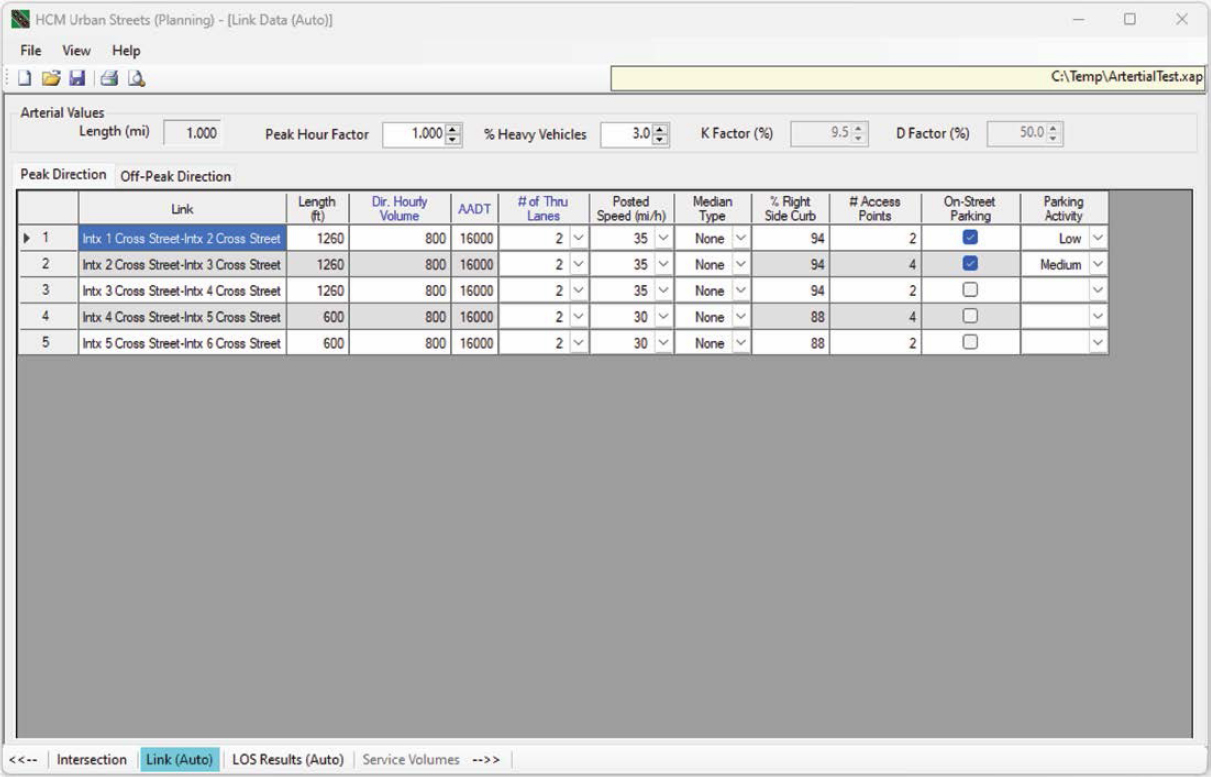
The arterial data are specified in a module that currently runs separately from HCM-CALC. Some screenshots from this module are shown in the following figures. The resulting file saved from this program will have an “xap” extension.
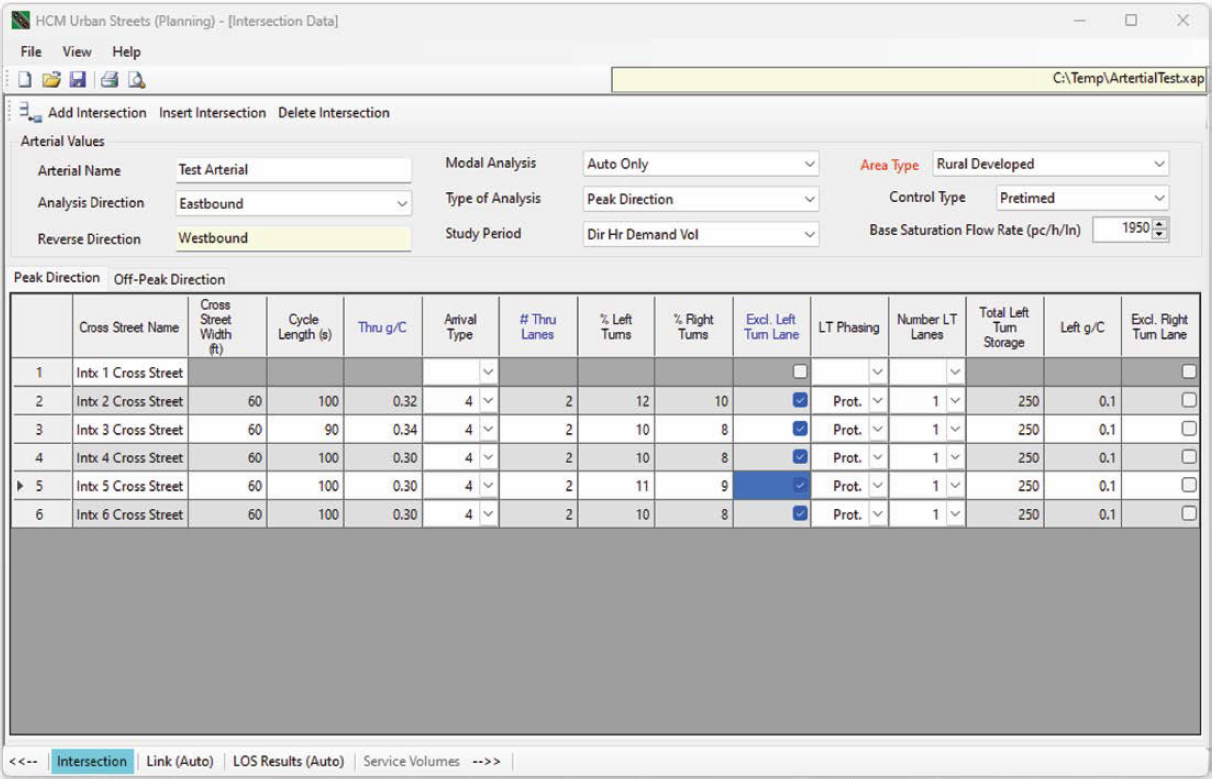
Urban street inputs screen (1)
Figure 14.11. Urban street inputs screen (1).
Page 160
Suggested Citation: "14 Computational Engine Overview." National Academies of Sciences, Engineering, and Medicine. 2024. Reliability and Quality of Service Evaluation Methods for Rural Highways: A Guide. Washington, DC: The National Academies Press. doi: 10.17226/27895.
Urban street inputs screen (2)
Figure 14.12. Urban street inputs screen (2).
Page 161
Suggested Citation: "14 Computational Engine Overview." National Academies of Sciences, Engineering, and Medicine. 2024. Reliability and Quality of Service Evaluation Methods for Rural Highways: A Guide. Washington, DC: The National Academies Press. doi: 10.17226/27895.

To include the arterial within the highway facility, add a new “Arterial” segment. The corresponding inputs screen is shown in the following figure.
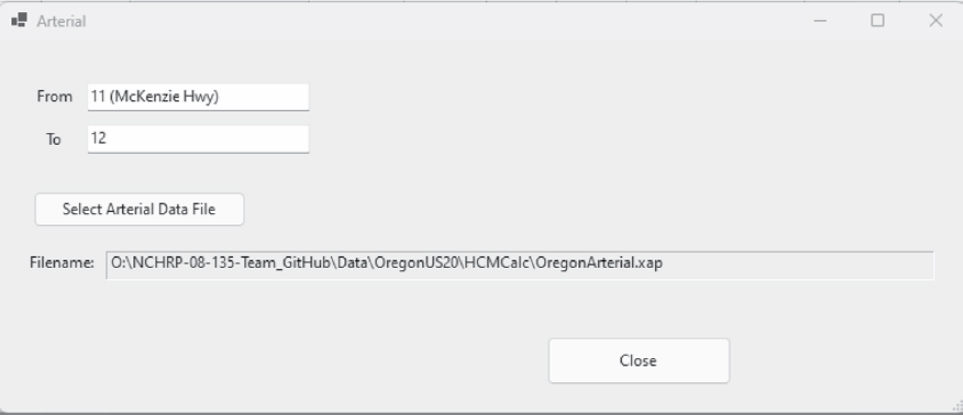
Arterial segment inputs screen
Figure 14.13. Arterial segment inputs screen.

Within this screen, specify the desired arterial file (*.xap) by pressing the “Select Arterial Data File.”

When using the “Add New Segment” button, the new segment will be inserted after all currently included segments. To insert a segment elsewhere among the existing segments, select the row where you would like the new segment inserted by clicking on the row number (far left column of table) with the left mouse button. Then press the “Insert New Segment” button. On closing the segment data entry screen, the new segment will be inserted at that row. The segment that was previously in that row will be shifted downward, along with any other successive segments.

If you need to delete a segment, select the row for the segment you would like to remove, again by clicking on the row number at the far left column of table with the left mouse button. Then press the “Delete Segment” button. That segment will be removed, and all successive segments will be shifted upward one row.

Page 162
Suggested Citation: "14 Computational Engine Overview." National Academies of Sciences, Engineering, and Medicine. 2024. Reliability and Quality of Service Evaluation Methods for Rural Highways: A Guide. Washington, DC: The National Academies Press. doi: 10.17226/27895.

As you create segments for your facility, some of the common inputs will be displayed on the main segment input data screen. For example, the input screen for the Test Highway discussed in Appendixes A and B is as follows.
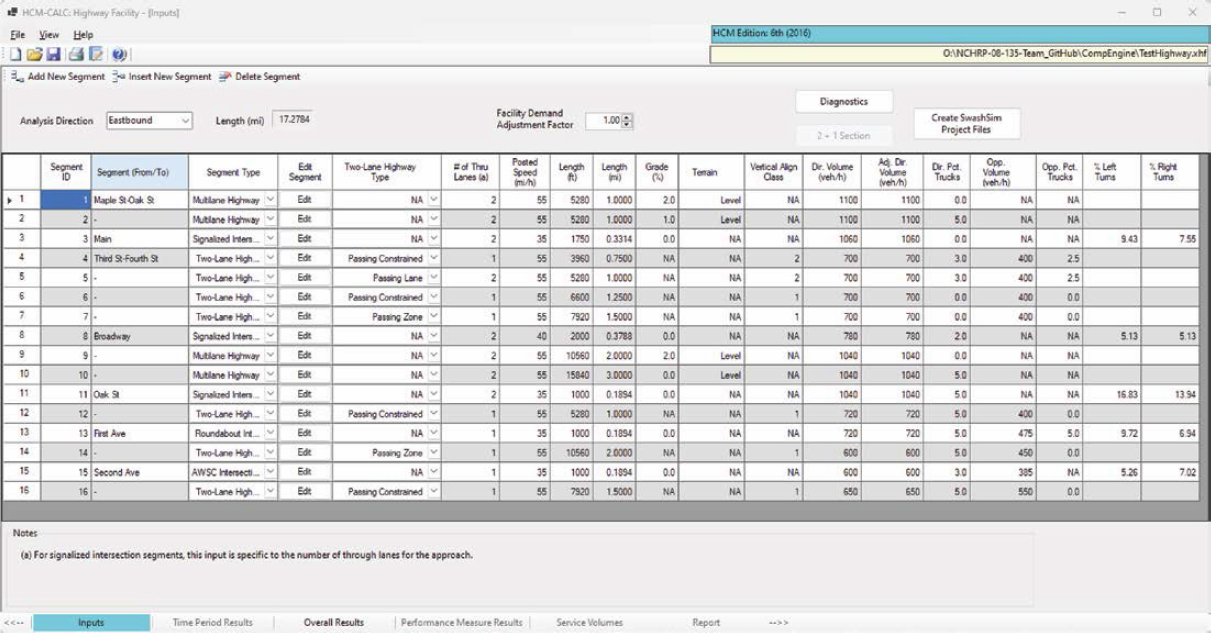
Facility with 16 segments
Figure 14.14. Facility with 16 segments.
Page 163
Suggested Citation: "14 Computational Engine Overview." National Academies of Sciences, Engineering, and Medicine. 2024. Reliability and Quality of Service Evaluation Methods for Rural Highways: A Guide. Washington, DC: The National Academies Press. doi: 10.17226/27895.

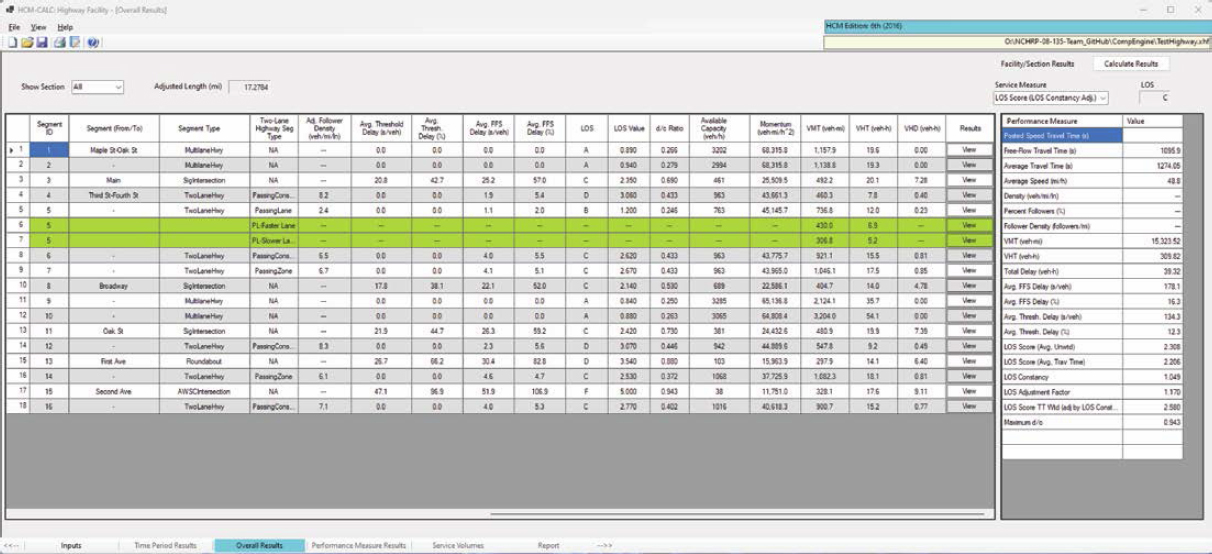
After you have specified all the segments for your rural highway facility, and the corresponding input data, click on the “Overall Results” tab in the lower toolbar. This action will run the calculations and display the results on the following screen (shown in two separate screenshots).
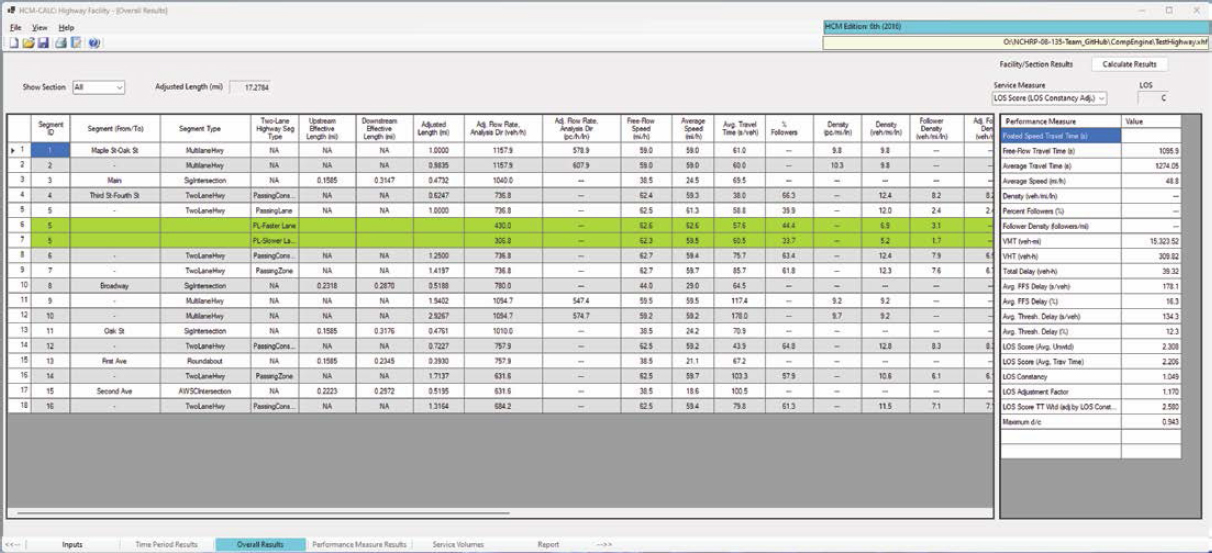
Facility outputs screen (1)
Figure 14.15. Facility outputs screen (1).
Facility outputs screen (2)
Figure 14.16. Facility outputs screen (2).
Page 164
Suggested Citation: "14 Computational Engine Overview." National Academies of Sciences, Engineering, and Medicine. 2024. Reliability and Quality of Service Evaluation Methods for Rural Highways: A Guide. Washington, DC: The National Academies Press. doi: 10.17226/27895.

The segment-specific results are shown in the table on the left side of the screen. The overall facility results are shown in the table on the right side of the screen.

Also, note that it is possible to view output results to a specific section of the highway. Sections are identified by contiguous segments of the same type and can be selected from a drop-down list input in the upper-left part of the output data summary screen. An example of two-lane highway sections (Segments 4–7) is shown in the following screen.
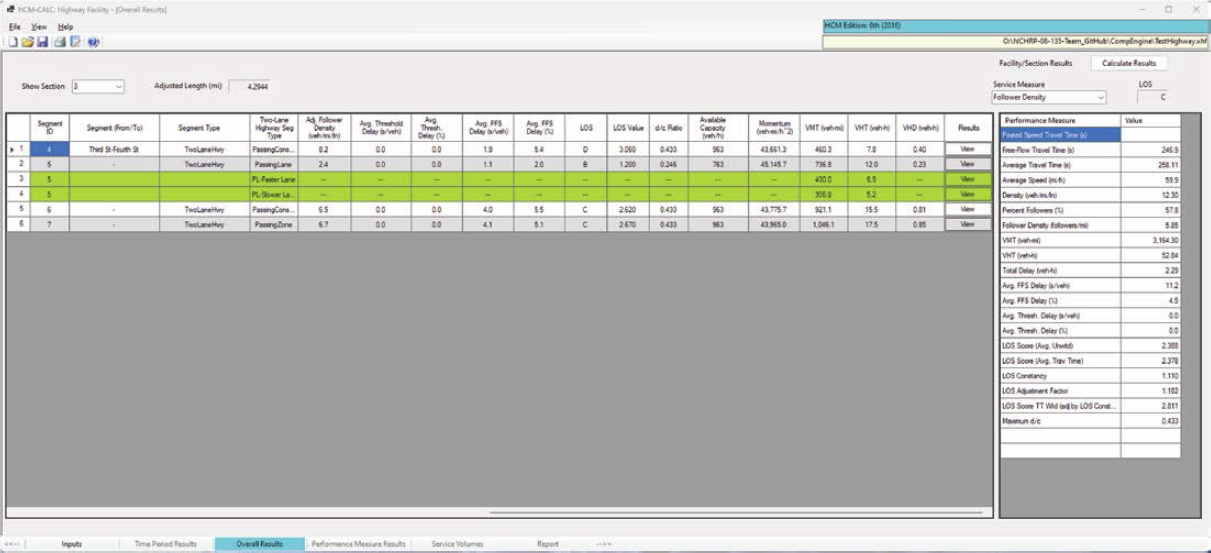
Two-lane highway section outputs screen
Figure 14.17. Two-lane highway section outputs screen.

Typically, the applicable service measure for that type of roadway, follower density in this case, and the corresponding LOS will be displayed in the upper-right part of the screen.

Page 150
Suggested Citation: "14 Computational Engine Overview." National Academies of Sciences, Engineering, and Medicine. 2024. Reliability and Quality of Service Evaluation Methods for Rural Highways: A Guide. Washington, DC: The National Academies Press. doi: 10.17226/27895.
Page 150
Page 151
Suggested Citation: "14 Computational Engine Overview." National Academies of Sciences, Engineering, and Medicine. 2024. Reliability and Quality of Service Evaluation Methods for Rural Highways: A Guide. Washington, DC: The National Academies Press. doi: 10.17226/27895.
Page 151
Page 152
Suggested Citation: "14 Computational Engine Overview." National Academies of Sciences, Engineering, and Medicine. 2024. Reliability and Quality of Service Evaluation Methods for Rural Highways: A Guide. Washington, DC: The National Academies Press. doi: 10.17226/27895.
Page 152
Page 153
Suggested Citation: "14 Computational Engine Overview." National Academies of Sciences, Engineering, and Medicine. 2024. Reliability and Quality of Service Evaluation Methods for Rural Highways: A Guide. Washington, DC: The National Academies Press. doi: 10.17226/27895.
Page 153
Page 154
Suggested Citation: "14 Computational Engine Overview." National Academies of Sciences, Engineering, and Medicine. 2024. Reliability and Quality of Service Evaluation Methods for Rural Highways: A Guide. Washington, DC: The National Academies Press. doi: 10.17226/27895.
Page 154
Page 155
Suggested Citation: "14 Computational Engine Overview." National Academies of Sciences, Engineering, and Medicine. 2024. Reliability and Quality of Service Evaluation Methods for Rural Highways: A Guide. Washington, DC: The National Academies Press. doi: 10.17226/27895.
Page 155
Page 156
Suggested Citation: "14 Computational Engine Overview." National Academies of Sciences, Engineering, and Medicine. 2024. Reliability and Quality of Service Evaluation Methods for Rural Highways: A Guide. Washington, DC: The National Academies Press. doi: 10.17226/27895.
Page 156
Page 157
Suggested Citation: "14 Computational Engine Overview." National Academies of Sciences, Engineering, and Medicine. 2024. Reliability and Quality of Service Evaluation Methods for Rural Highways: A Guide. Washington, DC: The National Academies Press. doi: 10.17226/27895.
Page 157
Page 158
Suggested Citation: "14 Computational Engine Overview." National Academies of Sciences, Engineering, and Medicine. 2024. Reliability and Quality of Service Evaluation Methods for Rural Highways: A Guide. Washington, DC: The National Academies Press. doi: 10.17226/27895.
Page 158
Page 159
Suggested Citation: "14 Computational Engine Overview." National Academies of Sciences, Engineering, and Medicine. 2024. Reliability and Quality of Service Evaluation Methods for Rural Highways: A Guide. Washington, DC: The National Academies Press. doi: 10.17226/27895.
Page 159
Page 160
Suggested Citation: "14 Computational Engine Overview." National Academies of Sciences, Engineering, and Medicine. 2024. Reliability and Quality of Service Evaluation Methods for Rural Highways: A Guide. Washington, DC: The National Academies Press. doi: 10.17226/27895.
Page 160
Page 161
Suggested Citation: "14 Computational Engine Overview." National Academies of Sciences, Engineering, and Medicine. 2024. Reliability and Quality of Service Evaluation Methods for Rural Highways: A Guide. Washington, DC: The National Academies Press. doi: 10.17226/27895.
Page 161
Page 162
Suggested Citation: "14 Computational Engine Overview." National Academies of Sciences, Engineering, and Medicine. 2024. Reliability and Quality of Service Evaluation Methods for Rural Highways: A Guide. Washington, DC: The National Academies Press. doi: 10.17226/27895.
Page 162
Page 163
Suggested Citation: "14 Computational Engine Overview." National Academies of Sciences, Engineering, and Medicine. 2024. Reliability and Quality of Service Evaluation Methods for Rural Highways: A Guide. Washington, DC: The National Academies Press. doi: 10.17226/27895.
Page 163
Page 164
Suggested Citation: "14 Computational Engine Overview." National Academies of Sciences, Engineering, and Medicine. 2024. Reliability and Quality of Service Evaluation Methods for Rural Highways: A Guide. Washington, DC: The National Academies Press. doi: 10.17226/27895.
Page 164
Next Chapter: III Case Studies
Subscribe to Email from the National Academies
Keep up with all of the activities, publications, and events by subscribing to free updates by email.