Supporting Responsible Innovation of Synthetic Cells: Biosafety, Biosecurity, and Environmental Considerations (2026)
Chapter: Appendix A: Biotechnology Governance: Historical Foundations and Emerging Relevance for Synthetic Cells
Appendix A
Biotechnology Governance: Historical Foundations and Emerging Relevance for Synthetic Cells
Governance of synthetic cell research and development, the technical focus of this report, is situated within a broader historical and policy landscape for biotechnology that encompasses biosafety, biosecurity, environmental risk, and responsible scientific conduct. Existing oversight systems, however, were not developed with synthetic cells in mind. Many synthetic cell designs occupy a conceptual space between chemical systems and living organisms, complicating how they are defined and governed (see Chapter 2). In some cases, this ambiguity places them under chemical safety oversight when they fall outside traditional biosafety frameworks. In addition, synthetic cells may incorporate novel, non-traditional biochemistries or hybrid biological-chemical features, raising questions about how established risk-benefit assessment approaches and existing oversight and regulatory frameworks apply.
Many of the factors that inform risk assessment for chemicals, microbes, or other engineered biological systems are also relevant to synthetic cells. However, key information needed to support those assessments, including environmental persistence, toxicity, detectability, and interactions with natural systems, may be limited, incomplete, or difficult to predict, particularly for early-stage or highly novel designs (see Chapter 3). Responsibility for oversight is also distributed across multiple policy instruments, institutional processes, and agencies, with differing scopes and triggers. This fragmentation contributes to gaps, overlaps, and inconsistencies in the application of governance mechanisms as synthetic cell research progresses toward application (see Chapter 4). These challenges reflect a recurring historical pattern in which governance systems evolve reactively, often lagging behind scientific and technological advances (Marchant, 2011; Trump et al., 2020).
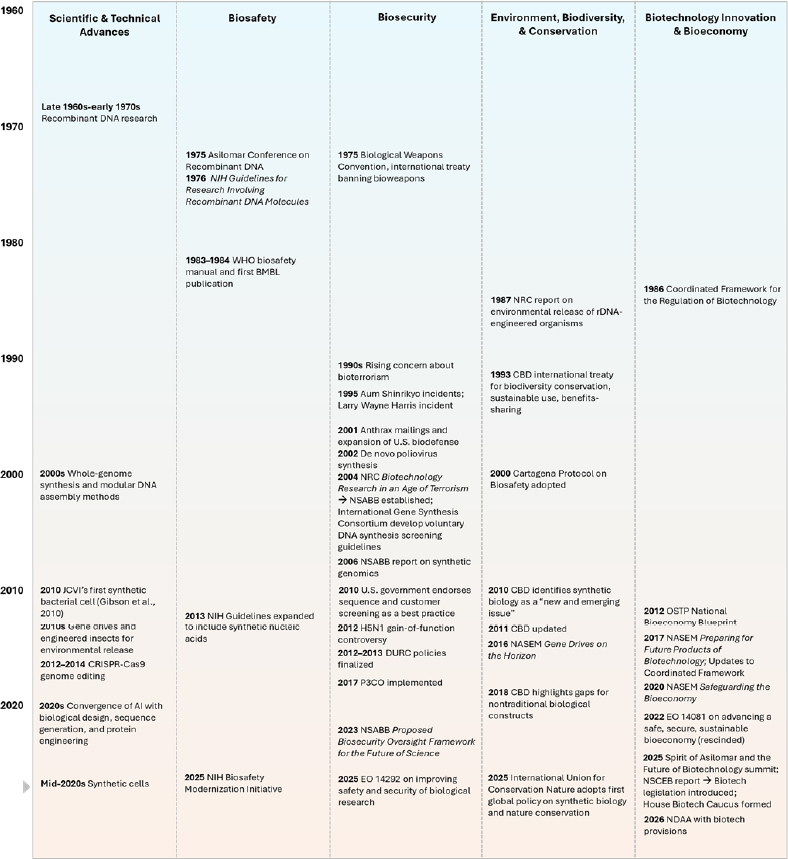
NOTE: JCVI: J. Craig Venter Institute; AI: artificial intelligence; WHO: World Health Organization; BMBL: Biosafety in Microbiological and Biomedical Laboratories; NRC: National Research Council; NSABB: National Science Advisory Board for Biosecurity; DURC: dual use research of concern; P3CO: Framework for Guiding Funding Decisions about Proposed Research Involving Enhanced Potential Pandemic Pathogens; EO: Executive Order; CBD: Convention on Biological Diversity; NASEM: National Academies of Sciences, Engineering, and Medicine; OSTP: Office of Science and Technology Policy; NSCEB: National Security Commission on Emerging Biotechnology; NDAA: National Defense Authorization Act.
Since the 1970s, governance systems have evolved in response to scientific advances, changing societal expectations, and shifting perceptions of risk (Figure A-1) (Epstein, 2025; Gillum, 2025a). Throughout this period, policy makers have repeatedly confronted the challenge of balancing scientific innovation with responsible oversight. Historical analysis shows that most U.S. biosafety and biosecurity policies and instruments designed to address environmental risks have been largely reactive, emerging in response to biocrimes, laboratory accidents, and global outbreaks, rather than anticipatory frameworks designed in advance (Gillum, 2025a). This historical evolution forms the backdrop for evaluating whether existing systems are prepared for emerging technologies such as synthetic cells, which may challenge traditional chemical-biological distinctions and fall outside list-based or pathogen-centered paradigms.
Early Foundations in Biotechnology Governance: 1960s-1980s
Concerns about the occupational and environmental risks associated with recombinant DNA research in the late 1960s and early 1970s prompted scientists to voluntarily pause work and develop norms for responsible conduct (Berg et al., 1974; Singer and Soll, 1973). The 1975 Asilomar Conference on Recombinant DNA established principles for containment, risk assessment, and transparency that directly informed the National Institutes of Health (NIH) Guidelines for Research Involving Recombinant DNA Molecules (NIH Guidelines) (NIH, 2024). First published in 1976, the NIH Guidelines provided safety and containment standards for recombinant DNA research and remain the backbone of U.S. biosafety oversight (Berg et al., 1975).
During this period, the World Health Organization published its first biosafety manual in 1983 (WHO, 1983), and the first edition of the Biosafety in Microbiological and Biomedical Laboratories (BMBL) manual was published jointly by the Centers for Diseases Control and Prevention and the NIH in 1984 (Richardson and Barkley, 1984). These documents established combinations of microbiological practices, engineering controls, safety equipment, and facility characteristics that define Biological Safety Levels (BSLs) 1 through 4 for handling infectious agents in laboratory settings.
The 1980s also marked the emergence of a federal framework for regulating products of biotechnology. A central policy question at the time was whether existing laws governing products developed through traditional genetic manipulation adequately covered those produced with newer techniques, including microbes and plants developed through recombinant DNA and genetic engineering (Carter et al., 2014; Johnson et al., 2025). In response, the Office of Science and Technology Policy (OSTP) issued the 1986 Coordinated Framework for the Regulation of Biotechnology, clarifying how the Environmental Protection Agency, the Food and Drug Administration, and the U.S. Department of Agriculture would regulate biotechnology products in environmental, consumer, and agricultural contexts under existing statutes (OSTP, 1986). The framework aimed to protect health and the environment while supporting innovation.
Around the same time, a 1987 National Research Council (NRC) report, Introduction of Recombinant DNA-Engineered Organisms into the Environment: Key Issues (NRC, 1987), concluded that organisms engineered using recombinant DNA technologies did not pose unique risks compared with other organisms. The report emphasized
evaluating organismal traits, intended use, environmental context, and the capacity to survive, persist, or transfer genetic material, rather than focusing on the engineering technique itself.
Expansion of Biosecurity Concerns: 1990s-early 2000s
Earlier discussions of biotechnology risk, such as those surrounding the 1975 Asilomar conference, deliberately separated accidental release (biosafety) from intentional misuse (biosecurity) (Hurlbut, 2015; Wright, 1994). By the 1990s, biosecurity had become a central policy concern following incidents of bioterrorism (Berger et al., 2018; Gillum, 2025a). Attempts by the Aum Shinrikyo cult to acquire and release Bacillus anthracis, albeit a vaccine rather than pathogenic strain; its 1995 sarin attack on the Tokyo subway; and a concurrent incident involving Larry Wayne Harris’s fraudulent purchase of Yersinia pestis, highlighted the potential for terrorist misuse of biological and chemical agents (Pravecek, 2011).
The 2001 anthrax mailings, which caused 22 cases of anthrax and resulted in five deaths, further underscored these concerns (GAO, 2003). Together, these events increased policy attention on the possibility that non-state actors might exploit advances in the life sciences for malicious purposes and prompted greater scrutiny of how biological research was conducted, secured, and communicated. This period saw a substantial expansion of U.S. biodefense policy and investment, including enhanced controls for select biological agents and toxins by restricting who could access them (where previously only their transfer was regulated); expanded prevention, detection, and response capabilities; and increased oversight of laboratory security and access to regulated pathogens.1
The 2004 NRC report Biotechnology Research in an Age of Terrorism (NRC, 2004) introduced the concept of the dual use dilemma in the life sciences, namely that beneficial research could be misused to cause harm. The report led to the establishment of the National Science Advisory Board for Biosecurity (NSABB) and laid the groundwork for the first federal policies addressing dual use research governance. It also examined risks associated with synthetic genomics and synthetic biology, created criteria for dual use research of concern (DURC), engaged international partners, and promoted education and communication activities.
Discussions under the Biological Weapons Convention, the 1975 international disarmament treaty banning the development, production, and stockpiling of biological weapons (including microbial agents and their delivery vehicles),2 also provided a forum for considering advances in the life sciences, including synthetic genomics and synthetic biology and their relevance to the treaty.
Escalating concerns about bioterrorism, combined with the rapid emergence of enabling biological tools, produced a policy landscape that was primarily oriented
___________________
1Pub L. 107-188, 116 STAT. 594 (2002).
2The Biological Weapons Convention is an international treaty that entered into force in 1975 and bans the development, production, acquisition, transfer, stockpiling, and use of biological and toxin weapons. See https://disarmament.unoda.org/en/our-work/weapons-mass-destruction/biological-weapons/biological-weapons-convention, accessed December 1, 2025.
toward non-state actors. This focus shaped the design of select agent regulations, DURC frameworks, and biosecurity policies governing the possession, transfer, and manipulation of pathogens, toxins, and genetic elements. More recently, however, biosecurity debates have increasingly refocused on state actors with far greater financial resources, sophisticated infrastructure, and broader access to biological technologies (ODNI, 2025). At the same time, expanding attention beyond pathogen-centric research to areas of biology that do not involve regulated agents, such as biomanufacturing or activities related to the bioeconomy, raises questions about the applicability and effectiveness of legacy biosecurity tools, risk frameworks, and associated oversight mechanisms for emerging biotechnologies (NASEM, 2020; NSCEB, 2025).
Synthetic Genomics and the Emergence of Synthetic Biology: 2000s
During the 2000s, the rise of synthetic biology raised new governance challenges. Early synthetic genomics capabilities, including whole-genome synthesis and modular assembly methods, preceded and enabled the development of synthetic biology and contributed to concerns about accessibility of sequence-based construction of biological systems (Cello et al. 2002; Engler et al., 2008, 2009, Gibson et al., 2008, 2010; Iverson et al., 2016; Weber et al., 2011). As synthetic biology began to emerge as a discipline distinct from traditional genetic engineering (Endy, 2005), questions grew about whether existing recombinant DNA policies were adequate for these rapidly advancing tools. Publications demonstrating de novo construction of viral genomes, such as the poliovirus synthesized by Cello et al. (2002), also raised concerns about the increasing accessibility of potentially harmful biological methods.
In 2006, the NSABB issued a report on synthetic genomics (NSABB, 2006) that led to a 2010 NRC study on sequence-based classification (NRC, 2010). In parallel, industry developed voluntary DNA synthesis screening practices, including the International Gene Synthesis Consortium (IGSC) Harmonized Screening Protocol, first developed after the IGSC formed in 2009 and updated in later years (EBRC Security Working Group, 2022; IGSC, 2024). These screening practices became an important complement to policy efforts by reducing the likelihood that synthesized sequences could be used for malicious purposes.
Building on these voluntary industry efforts, the U.S. government issued federal guidance on DNA synthesis screening to promote more consistent risk mitigation across providers. In 2010, the Department of Health and Human Services released the Screening Framework Guidance for Providers of Synthetic Double-Stranded DNA, which outlined recommended practices for screening customers and ordered sequences against lists of regulated pathogens and toxins (HHS, 2010). The guidance was intended as a nonbinding, risk-based framework that complemented existing biosecurity policies and supported responsible conduct by commercial DNA synthesis providers. Subsequent updates and policy actions reaffirmed the importance of DNA synthesis screening as a core biosecurity measure as synthesis technologies became faster, cheaper, and more widely accessible (HHS, 2023).
Responding to these developments, the NIH Guidelines were revised in 2013 to expand scope beyond recombinant DNA to “recombinant or synthetic nucleic acid
molecules,” reflecting the growing governance relevance of synthetic nucleic acids and sequence-based engineering (HHS and NIH, 2012). These revisions expanded oversight beyond whole pathogens to include certain synthetic or naturally derived viral nucleic acids capable of encoding infectious forms or functional toxins, reflecting growing recognition that genetic material itself could pose security concerns. Together, federal guidance on DNA synthesis screening, updates to the NIH Guidelines, and complementary industry-led practices underscored the need for governance frameworks that evolve alongside increasingly accessible biological design and engineering technologies.
Oversight of Gain-of-Function and DURC Policies: 2010s
In the 2010s, experiments involving respiratory-droplet transmission of highly pathogenic avian influence H5N1 between ferrets reignited debates about openness versus security and prompted scrutiny of whether and how key methodological details should be shared (Epstein, 2025; Herfst et al., 2012; Imai et al., 2012). The NSABB recommended redactions for one manuscript (Herfst et al., 2012), while another study (Imai et al., 2012) was not viewed as requiring redactions before publication. Subsequent policy attention to enhanced-pathogen research was shaped by these publications and by later incidents that heightened concerns about laboratory biosafety and oversight.
Conversations about the risk and benefits considerations surrounding gain-of-function research included two symposia by the National Academies (IOM and NRC, 2015; NASEM, 2016, Chapter 3) and a risk-benefit assessment by Gryphon Scientific. These discussions occurred alongside growing recognition that biosafety outcomes can be strongly influenced by human and organizational factors, including procedural variability and error, which are difficult to quantify and were not well characterized in early quantitative models.
This period produced key U.S. policies, including the 2012 United States Government Policy for Oversight of Life Sciences Dual Use Research of Concern and the 2014 United States Government Policy for Institutional Oversight of Life Sciences Dual Use Research of Concern. These policies operationalized DURC using a defined list of pathogens and toxins and a defined set of experimental effects (the seven experiments of concern outlined in the 2004 NRC report), which shaped how institutions scoped review and triggered oversight. In 2017, the Department of Health and Human Services issued the Framework for Guiding Funding Decisions about Proposed Research Involving Enhanced Potential Pandemic Pathogens (the P3CO framework), establishing an additional review process for federally funded research that is reasonably anticipated to create, transfer, or use enhanced potential pandemic pathogens through enhancement of transmissibility and/or virulence in humans (HHS, 2017). These DURC and P3CO policies represent overlapping but distinct categories of concern: Research may qualify as one but not the other depending on whether risks arise from misuse of data, knowledge, technologies, or equipment, or from enhanced transmissibility or virulence of a pathogen.
In addition to pathogen-focused debates, the 2010s through the 2020s also saw governance attention expand in response to genome editing (including clustered regularly
interspaced short palindromic repeat [CRISPR]-Cas systems; Doudna and Charpentier, 2014), renewed national bioeconomy strategies, and the growing integration of artificial intelligence (AI) with biological design and automation, developments that collectively broadened the scope of biosecurity and governance concerns beyond select agents and traditional pathogen paradigms (Doudna and Charpentier, 2014; NASEM, 2017a, 2018; OECD, 2018; OSTP, 2012, 2023; The White House, 2022). Related international governance discussions also address chemical-biological convergence, including work by the Organization for the Prohibition of Chemical Weapons Scientific Advisory Board on implications of emerging life sciences for chemical threats, which can be relevant when synthetic biology enables new pathways to chemical production (OPCW, 2018).
In 2023, the federal government began substantial efforts to reexamine and update oversight frameworks for high-consequence biological research. The NSABB released its Proposed Biosecurity Oversight Framework for the Future of Science, recommending expanded review criteria, clearer institutional responsibilities, and updated definitions of research with potential biosecurity implications. Complementing this, OSTP and the National Security Council launched a joint policy review to harmonize federal oversight across DURC and research involving enhanced potential pandemic pathogens. This review emphasized the need for structured, transparent risk-benefit assessments and consistent federal processes. Together, these initiatives reflected an emerging consensus that existing frameworks must be modernized to address increasingly diverse biological research practices.
At the same time, governance of high-risk biological research has become increasingly shaped by public trust, political narratives, and heightened scrutiny of high-containment laboratories (i.e., facilities categorized as BSL-3 or BSL-4), factors which are now integral to the policy environment. Recent scholarship has highlighted life cycle–based approaches to oversight, including upstream considerations about whether research should proceed, midstream attention to how the research is conducted, and downstream deliberation about how results are disseminated and used (Fisher et al., 2006; Gillum, 2025a; Woodruff et al., 2008). These approaches offer a structured way to evaluate risk in modern bioscience and can help link technical assessments to governance decisions across the research life cycle.
These developments illustrate how traditional biosafety and biosecurity systems, including foundational tools such as the NIH Guidelines and the BMBL manual, remain central, yet are increasingly challenged by emerging research activities. In particular, next-generation biotechnologies such as synthetic cells straddle conventional categories, occupying a conceptual gray zone between chemical constructs and living organisms. Existing guidance was not written with such entities in mind.
Environmental Risk Governance for Emerging Biotechnologies: 2000s-2010s
In parallel with pathogen-focused biosafety and biosecurity, international discussions under the Convention on Biological Diversity (CBD) increasingly focused on implications of synthetic biology for ecosystems, biodiversity, and equitable benefit-sharing (CBD, 2010, 2014). While the United States is not a party to the CBD, its
processes have shaped international norms and contributed to global expectations for environmental risk assessment and governance of emerging biotechnologies.
The Cartagena Protocol on Biosafety (CBD, 2000, 2011) provided early frameworks for addressing transboundary movement, ecological impacts, and access to genetic resources. Discussions around these frameworks became more prominent with advances such as gene editing (i.e., the 2014 emergence of CRISPR-Cas9 system and subsequent tools) and genetically engineered sterile mosquitoes (including both Wolbachia bacteria in mosquitoes and CRISPR-based gene drives), which raised the prospect of deploying engineered organisms into natural environments (Gantz and Bier, 2015; Hammond et al., 2016; Jinek et al., 2012).
As synthetic biology advanced, scholars and policy makers highlighted ecological concerns associated with organisms whose traits, modularity, or modes of interaction with ecosystems were not anticipated by earlier genetic engineering frameworks (Keiper and Atanassova, 2020). These concerns were further intensified by the development of engineered insects and gene drive systems. In 2016, the National Academies’ report Gene Drives on the Horizon (NASEM, 2016b) provided a comprehensive assessment of ecological risks, phased testing requirements, monitoring approaches, and the need for meaningful community and public engagement. This report became an influential reference point in global deliberations, shaping how environmental release of novel biological systems was evaluated (CBD, 2019; WHO, 2021).
Building on this momentum, international debates within the CBD continued to expand. Beginning in 2010, the CBD had identified synthetic biology as a “new and emerging issue,” and by 2018, its Ad Hoc Technical Expert Group on Synthetic Biology underscored the potential environmental impacts of synthetic organisms, including those not derived from traditional genetic engineering (CBD, 2017). These discussions emphasized challenges associated with environmental persistence, reversibility, gene flow, and ecological uncertainty. They also highlighted a key definitional issue: Many CBD biosafety instruments were developed for living modified organisms (LMOs) under the Cartagena Protocol, which presumes entities that are living, replicating, and genetically modified by techniques of modern biotechnology.
This LMO definition raises questions regarding emerging biotechnologies relevant to the discussion of synthetic cells, some of which may not be considered “living” in a regulatory sense, may not self-replicate, or may incorporate biochemical components not derived through conventional genetic modification (CBD, 2017). Synthetic cells may fall partially or wholly outside legal triggers designed for LMOs, even though they could interact with ecosystems or other organisms (Keiper and Atanassova, 2020). CBD discussions increasingly recognized these gaps, highlighting the need for risk-assessment approaches capable of addressing non-traditional biological constructs, hybrid systems, and entities assembled from digital sequence information (CBD, 2016, 2018a, 2018b). More recently, debates about synthetic biology have also engaged conservation governance institutions, including the International Union for Conservation of Nature adoption of a global policy on synthetic biology and nature conservation in 2025 (IUCN, 2025).
Collectively, these governance developments strengthened expectations for precaution, case-by-case ecological risk assessment, environmental monitoring, and community
engagement. At the same time, they revealed the limitations of existing frameworks that rely on organism-based or lineage-based definitions, underscoring the difficulty of applying traditional biosafety paradigms to synthetic cells. These precedents therefore provide guidance as well as indications of where future governance will require adaptation to accommodate biological systems that blur long-standing distinctions between living organisms and engineered biochemical constructs.
Ethical and Responsible Innovation Frameworks in the Life Sciences: 2000s-2010s
In addition to biosafety, biosecurity, and environmental considerations, ethical and responsible science frameworks have played a significant role in biotechnology governance. These considerations have long been intertwined with biosafety and biosecurity, including through norms and practices that emphasize transparency, accountability, precaution, and attention to societal impact. From the 1975 Asilomar conference onward, scientific communities articulated norms emphasizing transparency, accountability, and precaution in research involving powerful biological technologies. During the 2000s and 2010s, these norms were further developed into responsible research and innovation (RRI) frameworks that emphasized anticipation of societal impacts, reflexivity by researchers, engagement with affected communities, and responsiveness in design choices (Guston and Sarewitz, 2002; Stilgoe et al., 2013). These approaches expanded the scope of risk discussions beyond physical hazards to include questions about purpose, equity, benefit-sharing, environmental health,3 and long-term societal consequences.
Synthetic biology became a focal domain for applying RRI frameworks, as applications such as engineered microbes, genome editing, and gene drive organisms raised questions about social license, distribution of benefits and burdens, and meaningful community participation, including issues that intersect with access and benefit-sharing discussions in international governance, such as the Nagoya Protocol (Barnhill-Dilling and Delborne, 2021; de Campos et al., 2017; Hartley et al., 2022). Lessons from these debates highlighted that governance must attend not only to technical risk but also to issues of consent, trust, and fairness, particularly when technologies may affect specific populations or ecosystems. These ethical frameworks offer important guidance for emerging areas such as synthetic cell research.
Modernization of the U.S. Biotechnology Regulatory System: 2017 and 2022
In 2017, OSTP updated the Coordinated Framework for the Regulation of Biotechnology to clarify agency roles, improve coordination and transparency, and prepare for future biotechnology products (OSTP, 2017). The update aimed to provide clearer
___________________
3Environmental health “centers on the relationships between people and their environment. When people are exposed to hazards like polluted air and lead in their drinking water, they can develop serious conditions, such as asthma, heart disease, cancer and dementia.” See https://www.apha.org/topics-and-issues/environmental-health.
pathways for oversight in agricultural, environmental, and consumer applications, while maintaining the framework’s product-based regulatory philosophy. A concurrent National Academies’ report, Preparing for Future Products of Biotechnology (NASEM, 2017b), emphasized the increasing diversity and complexity of engineered biological systems and recommended improved interagency coordination, enhanced risk-analysis tools, and expanded capacity for evaluating nontraditional products. These 2017 updates marked an important step, but further advances in engineering biology and increased attention to bolstering U.S. biotechnology and biomanufacturing soon prompted calls for further modernization.
In 2022, Executive Order 14081 on Advancing Biotechnology and Biomanufacturing Innovation for a Sustainable, Safe, and Secure American Bioeconomy (The White House, 2022), which was rescinded in 2025, signaled a renewed federal commitment to modernizing the U.S. biotechnology governance system. The Executive Order directed federal agencies to review and update the Coordinated Framework, identify regulatory uncertainties affecting developers, and streamline oversight processes to better accommodate the expanding diversity of biotechnology products. This modernization push also aligns with earlier calls to safeguard the bioeconomy by strengthening risk governance, improving interagency coordination, and expanding analytical capacity (NASEM, 2020). It emphasized the need for clearer regulatory pathways, stronger interagency coordination, improved analytical tools, and attention to novel biotechnologies that fall outside traditional organism-based definitions, while also reinforcing the importance of biosecurity safeguards within a growing bioeconomy. In response, federal agencies submitted implementation plans outlining targeted steps to refine regulatory processes and strengthen coordination under the Coordinated Framework.
Governance in the Era of AI and Engineering Biology: 2020s-present
In recent years, the convergence of AI and the life sciences has introduced new opportunities and risks (NSABB, 2023). AI-enabled protein-design systems, generative sequence models, and autonomous experimentation tools may accelerate discovery while introducing novel pathways for misuse. The National Academies’ 2025 report The Age of AI in the Life Sciences: Benefits and Biosecurity Considerations recommended an “if-when” approach to evaluating AI-enabled biosecurity threats, emphasizing continuous monitoring of technological thresholds such as availability of new datasets or model capabilities. Updated federal guidance on nucleic acid synthesis screening also reflects considerations for biosecurity risks related to nucleic acid synthesis in the age of AI design tools, including the potential for generating harmful biological sequences or circumventing existing sequence-based screening practices. These developments are relevant to synthetic cells because the field depends on many of the same enabling capabilities, including sequence design, synthesis, assembly, and increasingly automated build-test-learn cycles that can reduce barriers to constructing and scaling biologically active systems.
A 2025 report by the National Security Commission on Emerging Biotechnology (NSCEB) underscored that predictable, reliable, and engineerable biotechnology
depends on standardized design principles and coordinated national governance, features that are particularly relevant for future synthetic cell systems (NSCEB, 2025). The NSCEB recommended that a National Biotechnology Coordination Office (NBCO) be established under the Executive Office of the President to harmonize interagency oversight and support consistent policy implementation. Legislative proposals have sought to operationalize this concept through a National Biotechnology Initiative and an NBCO charged with interagency coordination across national security, research and development, biological data, regulatory streamlining, biosecurity, biosafety, workforce development, and international engagement.4 This idea was further endorsed and expanded on with the suggestion of establishing a national biotechnology institute or governance office under the NBCO (Endy et al., 2025; Gillum et al., 2024; Snyder et al., 2025). The report also included a list of critical knowledge gaps that need to be addressed to realize the full potential of biotechnology, many of which are foundational, and applied research needs that are relevant to synthetic cells and engineering biology more broadly.
Building on these recommendations and broader congressional attention to biotechnology governance, the 2026 National Defense Authorization Act (signed into law in December 2025) included multiple biotechnology-related provisions, reflecting increased integration of biotechnology into national security planning and oversight discussions.5 Congress has also introduced the National Biotechnology Safety Act, which would authorize the National Science Foundation to conduct biotechnology risk-assessment research addressing environmental, human, and animal-health impacts, laying the groundwork for evidence-based regulatory pathways.6
In this broader context of renewed federal attention to biotechnology oversight, the proposed Risky Research Review Act (RRRA) represents a parallel legislative effort to modernize governance of high-risk biological research. The RRRA would establish a federal-level Life Sciences Research Security Board to serve as a centralized body to evaluate the risks and benefits of proposed federally funded life-science research involving high-consequence pathogens or “gain-of-function.”7 However, its effectiveness would depend heavily on the balance of expertise and how deliberative authority is exercised within the Board (Gillum, 2025b).
Implications for Synthetic Cell Governance
Collectively, these developments demonstrate a long-standing pattern: Technological advances repeatedly expose gaps in legacy oversight frameworks, prompting incremental but significant governance adaptation. As AI, engineering biology, and synthetic cell research continue to converge, maintaining safety, security, public trust, and global coherence will require policies that are anticipatory, flexible, and grounded in real-world data.
___________________
4H.R. 2756, 119th Cong. (2025); S.1387, 119th Cong. (2025).
5S. 2296, 119th Cong. § 241-248, 851, 1068, 1207, 1635, 6404, 6611-6616, 6703, 6708, (2025).
6S.2697, 119th Cong. (2025).
7S.854, 119th Cong. (2025).
Synthetic cells exemplify these emerging challenges, operating at the interface of chemistry and biology and testing the definitional boundaries that anchor current biosafety and biosecurity systems. The 2025 Spirit of Asilomar Summit, convened to reflect on the legacy of the 1975 Asilomar meeting for contemporary biotechnology, underscored the need for proactive guidance extending beyond pathogen-centered oversight. Participants highlighted gaps in environmental governance, ethical frameworks, and life cycle–based approaches relevant to synthetic cells, noting that oversight must consider ecological interactions, unintended impacts, responsible innovation, and questions about appropriate uses of life-like constructs. The summit resulted in 27 “entreaties,” signed statements that participants created to offer recommendations for the governance of biotechnology.8
Several of the 2025 Spirit of Asilomar entreaties speak directly to the governance of synthetic cells. These include calls to safeguard the benefits of synthetic cell engineering through global collaboration, open and inclusive education, and coordinated international governance (Smith et al., 2025); to initiate global discussion on synthetic human chromosomes and other genome-scale constructs that blur the line between traditional genetically modified organisms and wholly synthetic entities (Tan et al., 2025); to establish risk-classification frameworks and assessment tools tailored to synthetic cells intended for environmental release, including distinctions between replicating or evolving and non-replicating constructs (Abbott et al., 2025); and to evaluate the biosafety and biosecurity implications of “mirror life” or orthogonal biochemical systems that may fall outside current definition-based regulatory triggers (Rice University, 2025). Additional entreaties concerning environmental release, AI-enabled biotechnology, and equitable access emphasize the need for anticipatory, globally inclusive, and adaptable governance approaches for biotechnology, which could also apply to synthetic cell research and development.
As synthetic cell research progresses, governance systems will need to incorporate environmental risk assessment, ethical and responsible innovation principles, and societal-value considerations alongside biosafety and biosecurity. Anticipatory, flexible, and life cycle–based oversight approaches will therefore be essential to ensuring safe, responsible, and trusted development of synthetic cell technologies.
REFERENCES
Abbott, Z., Z. N. Adelman, Y. Elani, P. Freemont, C. I. Kiattisewee, K. A. Molla, R. M. Murray, and L. Rudenko. 2025. 4.3 Synthetic Cells for Environmental Release. The Spirit of Asilomar and the Future of Biotechnology Summit. Rice University. https://doi.org/10.25611/TRA2-AT67.
Barnhill-Dilling, S. K., and J. A. Delborne, 2021. Whose Intentions? What Consequences? Interrogating “Intended Consequences” for Conservation with Environmental Biotechnology. Conservation Science and Practice 3 (4): e406. https://doi.org/10.1111/csp2.406,
___________________
8See https://hdl.handle.net/1911/118546, accessed March 4, 2026.
Berg, P., D. Baltimore, H. W. Boyer, S. N. Cohen, R. W. Davis, D. S. Hogness, D. Nathans, R. Roblin, J. D. Watson, S. Weissman, and N. D. Zinder. 1974. Potential Biohazards of Recombinant DNA Molecules. Science 185 (4148): 303–303. https://doi.org/10.1126/science.185.4148.303.
Berg, P., D. Baltimore, S. Brenner, R. O. Roblin, and M. F. Singer. 1975. Summary Statement of the Asilomar Conference on Recombinant DNA Molecules. Proceedings of the National Academy of Sciences 72 (6): 1981–1984. https://www.pnas.org/doi/abs/10.1073/pnas.72.6.1981.
Berger, K. M., D. DiEuliis, C. Meyer, and R. Venkat. 2018. Roadmap for Biosecurity and Biodefense Policy in the United States. https://wmdcenter.ndu.edu/Portals/97/Documents/Publications/1A%20Full%20Report.pdf?ver=.
Carter, S., M. Rodemeyer, M. S. Garfinkel, and R. M. Friedman. 2014. Synthetic Biology and the US Biotechnology Regulatory System: Challenges and Options. Rockville, MD: J. Craig Venter Institute. https://www.jcvi.org/research/synthetic-biology-and-us-biotechnology-regulatory-system-challenges-and-options.
CBD (Convention on Biological Diversity). 2000. Cartagena Protocol on Biosafety to the Convention on Biological Diversity: Text and Annexes. Secretariat of the Convention on Biological Diversity.
CBD. 2010. COP 10 Decision 10/1: Access to Genetic Resources and the Fair and Equitable Sharing of Benefits Arising from their Utilization. Secretariat of the Convention on Biological Diversity. https://www.cbd.int/doc/decisions/cop-10/cop-10-dec-01-en.pdf.
CBD. 2011. Nagoya Protocol on Access to Genetic Resources and the Fair and Equitable Sharing of Benefits Arising from Their Utilization to the Convention on Biological Diversity: Text and Annexes. Secretariat of the Convention on Biological Diversity.
CBD. 2014. COP 12 Decision 12/24: New and Emerging Issues: Synthetic Biology. Secretariat of the Convention on Biological Diversity. https://www.cbd.int/doc/decisions/cop-12/cop-12-dec-24-en.pdf.
CBD. 2016. COP 13 Decision 13/17: Synthetic Biology. Secretariat of the Convention on Biological Diversity. https://www.cbd.int/doc/decisions/cop-13/cop-13-dec-17-en.pdf.
CBD. 2017. Report of the Ad Hoc Technical Expert Group on Synthetic Biology, Montreal, Canada, 5–8 December 2017. Secretariat of the Convention on Biological Diversity. https://www.cbd.int/doc/c/aa10/9160/6c3fcedf265dbee686715016/synbio-ahteg-2017-01-03-en.pdf.
CBD. 2018a. COP 14 Decision 14/19: Synthetic Biology. Secretariat of the Convention on Biological Diversity. https://www.cbd.int/doc/decisions/cop-14/cop-14-dec-19-en.pdf.
CBD. 2018b. COP 14 Decision 14/20: Digital Sequence Information on Genetic Resources. Secretariat of the Convention on Biological Diversity. https://www.cbd.int/doc/decisions/cop-14/cop-14-dec-20-en.pdf.
CBD. 2019. Report of the Ad Hoc Technical Expert Group on Synthetic Biology: Montreal, Canada, 4–7 June 2019 (CBD/SYNBIO/AHTEG/2019/1/3). Secretariat of the Convention on Biological Diversity. https://www.cbd.int/doc/c/b2bb/cf58/b09729bb00be6abf72325a1a/synbio-ahteg-2019-01-03-en.pdf.
Cello, J., A. V. Paul, and E. Wimmer. 2002. Chemical Synthesis of Poliovirus cDNA: Generation of Infectious Virus in the Absence of Natural Template. Science 297 (5583): 1016–1018. https://pubmed.ncbi.nlm.nih.gov/12114528/.
de Campos, A. S., S. Hartley, C. de Koning, J. Lezaun, and L. Velho. 2017. Responsible Innovation and Political Accountability: Genetically Modified Mosquitoes in Brazil. Journal of Responsible Innovation 4 (1): 5–23. https://doi.org/10.1080/23299460.2017.1326257.
Doudna, J. A., and E. Charpentier. 2014. The New Frontier of Genome Engineering with CRISPRCas9. Science 346 (6213): 1258096. https://doi.org/10.1126/science.1258096.
EBRC (Engineering Biology Research Consortium) Security Working Group. 2022. Security Screening in Synthetic DNA Synthesis: Recommendations for Updated Federal Guidance. Compiled and edited by B. Mackelprang. Engineering Biology Research Consortium. https://ebrc.org/wp-content/uploads/2022/04/Syn-DNA-Screening-Final.pdf.
Endy, D. 2005. Foundations for Engineering Biology. Nature 438 (7067): 449–453. https://doi.org/10.1038/nature04342.
Endy, D., S. Moront, V. A. Alexopoulos, R. Patel, R. Jain, and B. Bennett. 2025. Biosecurity Really: A Strategy for Victory. Hoover Institution, Bio-Strategies & Leadership Initiative. https://www.hoover.org/research/biosecurity-really-strategy-victory.
Engler, C., R. Kandzia, and S. Marillonnet. 2008. A One Pot, One Step, Precision Cloning Method with High Throughput Capability. PLoS One 3 (11): e3647. https://doi.org/10.1371/journal.pone.0003647.
Engler, C., R. Gruetzner, R. Kandzia, and S. Marillonnet. 2009. Golden Gate Shuffling: A One-Pot DNA Shuffling Method Based on Type IIs Restriction Enzymes. PLoS One 4 (5): e5553. https://doi.org/10.1371/journal.pone.0005553.
Epstein, G. L. 2025. The Evolution of United States Governance Policies for Research Using Pathogens with Enhanced Pandemic Potential. Applied Biosafety 30 (2): 79–96. https://doi.org/10.1089/apb.2024.0049.
Fisher, E., R. L. Mahajan, and C. Mitcham. 2006. Midstream Modulation of Technology: Governance from Within. Bulletin of Science, Technology & Society 26 (6): 485–496. https://doi.org/10.1177/0270467606295402.
Gantz, V. M., and E. Bier. 2015. The Mutagenic Chain Reaction: A Method for Converting Heterozygous to Homozygous Mutations. Science 348 (6233): 442–444. https://doi.org/10.1126/science.aaa5945.
GAO (U.S. Government Accountability Office). 2003. Bioterrorism: Public Health Response to Anthrax Incidents of 2001. https://www.gao.gov/assets/gao-04-152.pdf.
Gibson, D. G., G. A. Benders, C. Andrews-Pfannkoch, E. A. Denisova, H. Baden-Tillson, J. Zaveri, T. B. Stockwell, A. Brownley, D. W. Thomas, M. A. Algire, C. Merryman, L. Young, V. N. Noskov, J. I. Glass, J. C. Venter, C. A. Hutchison III, and H. O. Smith. 2008. Complete Chemical Synthesis, Assembly, and Cloning of a Mycoplasma genitalium Genome. Science 319 (5867): 1215–1220. https://www.science.org/doi/abs/10.1126/science.1151721.
Gibson, D. G., J. I. Glass, C. Lartigue, V. N. Noskov, R.-Y. Chuang, M. A. Algire, G. A. Benders, M. G. Montague, L. Ma, M. M. Moodie, C. Merryman, S. Vashee, R. Krishnakumar, N. Assad-Garcia, C. Andrews-Pfannkoch, E. A. Denisova, L. Young, Z.-Q. Qi, T. H. SegallShapiro, C. H. Calvey, P. P. Parmar, C. A. Hutchison III, H. O. Smith, and J. C. Venter. 2010. Creation of a Bacterial Cell Controlled by a Chemically Synthesized Genome. Science 329 (5987): 52–56. https://doi.org/10.1126/science.1190719,
Gillum, D. R. 2025a. Balancing Innovation and Safety: Frameworks and Considerations for the Governance of Dual-Use Research of Concern and Potential Pandemic Pathogens. Applied Biosafety 30 (2): 69–78. https://doi.org/10.1089/apb.2024.0033.
Gillum, D. R. 2025b. The Role of Biosafety Professionals in Biotechnology Governance: Assessing Oversight of Dual Use Research of Concern and Pathogens with Enhanced Pandemic Potential. Arizonia State University. Doctoral Dissertation.
Gillum, D. R., R. Mortiz, and G. D. Koblentz. 2024. Establishing a National Biosafety and Biosecurity Agency for the United States. Frontiers in Bioengineering and Biotechnology 12: 1474120. https://doi.org/10.3389/fbioe.2024.1474120.
Guston, D. H., and D. Sarewitz. 2002. Real-Time Technology Assessment. Technology in Society 24 (1): 93–109. https://www.sciencedirect.com/science/article/pii/S0160791X01000471.
Hammond, A., R. Galizi, K. Kyrou, A. Simoni, C. Siniscalchi, D. Katsanos, M. Gribble, D. Baker, E. Marois, S. Russell, A. Burt, N. Windbichler, A. Crisanti, and T. Nolan. 2016. A CRISPRCas9 Gene Drive System Targeting Female Reproduction in the Malaria Mosquito Vector Anopheles gambiae. Nature Biotechnology 34 (1): 78–83. https://doi.org/10.1038/nbt.3439.
Hartley, S., A. Kokotovich, and C. McCalman. 2022. Prescribing Engagement in Environmental Risk Assessment for Gene Drive Technology. Regulation & Governance 17 (2): 411–424. https://doi.org/10.1111/rego.12452.
Herfst, S., E. J. A. Schrauwen, M. Linster, S. Chutinimitkul, E. de Wit, V. J. Munster, E. M. Sorrell, T. M. Bestebroer, D. F. Burke, D. J. Smith, G. F. Rimmelzwaan, A. D. M. E. Osterhaus, and R. A. M. Fouchier. 2012. Airborne Transmission of Influenza A/H5N1 Virus Between Ferrets. Science 336 (6088): 1534–1541. https://doi.org/10.1126/science.1213362.
HHS (U.S. Department of Health and Human Services). 2010. Screening Framework Guidance for Providers of Synthetic Double-Stranded DNA. https://aspr.hhs.gov/S3/Documents/syndna-guidance.pdf.
HHS. 2017. Framework for Guiding Funding Decisions About Proposed Research Involving Enhanced Potential Pandemic Pathogens (P3CO). U.S. Department of Health and Human Services. https://aspr.hhs.gov/S3/Documents/P3CO.pdf.
HHS. 2023. Screening Framework Guidance for Providers and Users of Synthetic Nucleic Acids. U.S. Department of Health and Human Services, Administration for Strategic Preparedness and Response. https://aspr.hhs.gov/S3/Documents/SynNA-Guidance-2023.pdf.
HHS and NIH (National Institutes of Health). 2012. Final Action under the NIH Guidelines for Research Involving Recombinant or Synthetic Nucleic Acid Molecules. Federal Register 77 (178): 54584–54588. https://www.govinfo.gov/content/pkg/FR-2012-09-05/pdf/2012-21849.pdf.
Hurlbut, J. B. 2015. Remembering the Future: Science, Law, and the Legacy of Asilomar. In Dream scapes of Modernity: Sociotechnical Imaginaries and the Fabrication of Power. University of Chicago Press. Pp. 126–151. https://doi.org/10.7208/chicago/9780226276663.003.0006.
IGSC (International Gene Synthesis Consortium). 2024. Harmonized Screening Protocol v3.0. https://genesynthesisconsortium.org/wp-content/uploads/IGSC-Harmonized-Screening-Protocol-v3.0-1.pdf.
Imai, M., T. Watanabe, M. Hatta, S. C. Das, M. Ozawa, K. Shinya, G. Zhong, A. Hanson, H. Katsura, S. Watanabe, C. Li, E. Kawakami, S. Yamada, M. Kiso, Y. Suzuki, E. A. Maher, G. Neumann, and Y. Kawaoka, Y. 2012. Experimental Adaptation of an Influenza H5 HA Confers Respiratory Droplet Transmission to a Reassortant H5 HA/H1N1 Virus in Ferrets. Nature 486 (7403): 420–428. https://doi.org/10.1038/nature10831.
IOM (Institute of Medicine) and NRC (National Research Council). 2015. Potential Benefits of Gain-of-Function Research. In Potential Risks and Benefits of Gain-of-Function Research: Summary of a Workshop. Washington, DC: The National Academies Press. Chap. 4. https://www.ncbi.nlm.nih.gov/books/NBK285583/.
IUCN (International Union for Conservation of Nature). 2025. IUCN Agrees First Global Policy on Synthetic Biology—News Release. IUCN World Conservation Congress. https://iucn.org/news/202510/iucn-agrees-first-global-policy-synthetic-biology.
Iverson, S. V., T. L. Haddock, B. Jacob, and D. M. Densmore. 2015. CIDAR MoClo: Improved MoClo Assembly Standard and New E. coli Part Library Enable Rapid Combinatorial Design for Synthetic and Traditional Biology. ACS Synthetic Biology 5 (1): 99–103. https://doi.org/10.1021/acssynbio.5b00124.
Jinek, M., K. Chylinski, I. Fonfara, M. Hauer, J. A. Doudna, and E. Charpentier. 2012. A Programmable Dual-RNA–Guided DNA Endonuclease in Adaptive Bacterial Immunity. Science 337 (6096): 816–821. https://doi.org/10.1126/science.1225829.
Johnson, A. L., D. R. George, K. R. W. Matthews, and A. S. Iltis. 2025. The Regulatory Landscape for Synthetic Biology. Baker Institute for Public Policy, Rice University. Accessed February 13, 2026. https://www.bakerinstitute.org/research/regulatory-landscape-synthetic-biology.
Keiper, F., and A. Atanassova. 2020. Regulation of Synthetic Biology: Developments Under the Convention on Biological Diversity and Its Protocols. Frontiers in Bioengineering and Biotechnology 8: 310. https://doi.org/10.3389/fbioe.2020.00310.
Marchant, G. E. 2011. Addressing the Pacing Problem. In The Growing Gap Between Emerging Technologies and Legal-Ethical Oversight: The Pacing Problem, edited by G. E. Marchant, B. R. Allenby, and J. R. Herkert. Springer. Pp. 199–205. https://link.springer.com/book/10.1007/978-94-007-1356-7.
NASEM (National Academies of Sciences, Engineering, and Medicine). 2016a. Gain-of-Function Research: Summary of the Second Symposium. Washington, DC: The National Academies Press. https://doi.org/10.17226/23484.
NASEM. 2016b. Gene Drives on the Horizon: Advancing Science, Navigating Uncertainty, and Aligning Research with Public Values. Washington, DC: The National Academies Press. https://doi.org/10.17226/23405.
NASEM. 2017a. Human Genome Editing: Science, Ethics, and Governance. Washington, DC: The National Academies Press. https://doi.org/10.17226/24623.
NASEM. 2017b. Preparing for Future Products of Biotechnology. Washington, DC: The National Academies Press. https://doi.org/10.17226/24605.
NASEM. 2018. Biodefense in the Age of Synthetic Biology. Washington, DC: The National Academies Press. https://doi.org/10.17226/24890.
NASEM. 2020. Safeguarding the Bioeconomy. Washington, DC: The National Academies Press. https://doi.org/10.17226/25525.
NASEM 2025. The Age of AI in the Life Sciences: Benefits and Biosecurity Considerations. Washington, DC: The National Academies Press. https://doi.org/10.17226/28868.
NIH (National Institutes of Health). 2024. NIH Guidelines for Research Involving Recombinant or Synthetic Nucleic Acid Molecules. https://osp.od.nih.gov/policies/biosafety-and-biosecurity-policy#tab1/.
NRC (National Research Council). 1987. Introduction of Recombinant DNA-Engineered Organisms into the Environment: Key Issues. Washington, DC: National Academy Press. https://doi.org/10.17226/18907.
NRC. 2004. Biotechnology Research in an Age of Terrorism. Washington, DC: The National Academies Press. https://doi.org/10.17226/10827.
NRC. 2010. Sequence-Based Classification of Select Agents: A Brighter Line. Washington, DC: The National Academies Press. https://doi.org/10.17226/12970.
NSABB (National Science Advisory Board for Biosecurity). 2006. Addressing Biosecurity Concerns Related to the Synthesis of Select Agents. National Institutes of Health Office of Science Policy. https://aspr.hhs.gov/S3/Documents/Final_NSABB_Report_on_Synthetic_Genomics.pdf.
NSABB. 2023. Proposed Biosecurity Oversight Framework for the Future of Science (Final Report). U.S. Department of Health and Human Services, Office of Science Policy. https://osp.od.nih.gov/wp-content/uploads/2023/03/NSABB-Final-Report-Proposed-Biosecurity-Oversight-Framework-for-the-Future-of-Science.pdf.
NSCEB (National Security Commission on Emerging Biotechnology). 2025. Charting the Future of Biotechnology: An Action Plan for American Security and Prosperity. https://www.biotech.senate.gov/final-report/
ODNI (Office of the Director of National Intelligence). 2025. Annual Threat Assessment of the U.S. Intelligence Community: Unclassified Report. https://www.dni.gov/files/ODNI/documents/assessments/ATA-2025-Unclassified-Report.pdf.
OECD (Organisation for Economic Cooperation and Development). 2018. Meeting Policy Challenges for a Sustainable Bioeconomy. Paris: OECD Publishing. Accessed February 13, 2026. https://www.oecd.org/en/publications/policy-challenges-facing-a-sustainable-bioeconomy_9789264292345-en.html.
OPCW (Organisation for the Prohibition of Chemical Weapons). 2018. Report of the Scientific Advisory Board on Developments in Science and Technology for the Fourth Special Session of the Conference of the States Parties to Review the Operation of the Chemical Weapons Convention (RC4/DG.1). OPCW.
OSTP (Office of Science and Technology Policy). 1986. The Coordinated Framework for Regulation of Biotechnology. Federal Register 51: 23302. Executive Office of the President. https://www.aphis.usda.gov/sites/default/files/coordinated_framework.pdf.
OSTP. 2012. National Bioeconomy Blueprint. Washington, DC: White House Office of Science and Technology Policy. https://obamawhitehouse.archives.gov/sites/default/files/microsites/ostp/national_bioeconomy_blueprint_april_2012.pdf.
OSTP. 2017. Modernizing the Regulatory System for Biotechnology Products: Final Version of the 2017 Update to the Coordinated Framework for the Regulation of Biotechnology Products. Washington, DC: White House Office of Science and Technology Policy. https://obamawhitehouse.archives.gov/sites/default/files/microsites/ostp/2017_coordinated_framework_update.pdf.
OSTP. 2023. Bold Goals for U.S. Biotechnology and Biomanufacturing: Harnessing Research and Development to Further Societal Goals. Per Exec. Order No. 14081. The White House. https://bidenwhitehouse.archives.gov/wp-content/uploads/2023/03/Bold-Goals-for-U.S.-Biotechnology-and-Biomanufacturing-Harnessing-Research-and-Development-To-Further-Societal-Goals-FINAL.pdf.
Pravecek, T. L. 2011. Lest We Forget: A Critical Analysis of Bioterrorist Incidents, National Exercises, and US Prevention, Response and Recovery Strategies. https://organizedabuse.support/wp-content/uploads/2025/01/lest-we-forget.pdf.
Rice University. 2025. 4.4 Risks from Mirror Life. The Spirit of Asilomar and the Future of Biotechnology Summit. Rice University. https://repository.rice.edu/items/5ab21bd0-1574-43c5-a854-b4ac2b75d523.
Richardson, J. H., and W. E. Barkley. 1984. Biosafety in Microbiological and Biomedical Laboratories. Washington, DC: Centers for Disease Control and National Institutes of Health.
Singer, M., and D. Soll. 1973. Guidelines for DNA Hybrid Molecules. Science 181 (4105): 1114.
Smith, J. A., J. Wagstaff, J. Glass, D. M. de C. Bittencourt, A. S. Mitra, L. Chitayat, and K. P. Adamala. 2025. Safeguarding the Benefits of Synthetic Cell Engineering. Rice University. https://doi.org/10.25611/CE39-RH50.
Snyder, B. C., G. L. Epstein, J. Wentzel, R. P. Kadlec, and G. W. Parker. 2025. Envisioning an Independent Bioresponsibility Authority to Safeguard U.S. Leadership in the Life Sciences. Texas A&M University. https://bush.tamu.edu/wp-content/uploads/2025/01/Envisioning-an-Independent-Bioresponsibility-Authority-Jan-2025-2.pdf.
Stilgoe, J., R. Owen, and P. Macnaghten. 2013. Developing a Framework for Responsible Innovation. Research Policy 42 (9): 1568–1580. https://doi.org/10.1016/j.respol.2013.05.008.
Tan, C., P. Freemont, P. Cai, and R. Smith. 2025. 4.2 Synthetic Human Chromosomes—A Call for Global Discussion. The Spirit of Asilomar and the Future of Biotechnology Summit. Rice University. https://repository.rice.edu/items/d806fe86-595a-4170-a24e-0b63d76c30b9.
Trump, B. D., J. M. Keisler, S. E. Galaitsi, J. M. Palma-Oliveria, and I. Linkov. 2020. Safety-by-Design as a Governance Problem. Nano Today 35: 100989. https://doi.org/10.1016/j.nantod.2020.100989.
Weber, E., C. Engler, R. Gruetzner, S. Werner, and S. Marillonnet. 2011. A Modular Cloning System for Standardized Assembly of Multigene Constructs. PLoS One 6 (2): e16765. https://doi.org/10.1371/journal.pone.0016765.
The White House. 2022. Executive Order on Advancing Biotechnology and Biomanufacturing Innovation for a Sustainable, Safe, and Secure American Bioeconomy. Executive Office of the President. https://bidenwhitehouse.archives.gov/briefing-room/presidential-actions/2022/09/12/executive-order-on-advancing-biotechnology-and-biomanufacturing-innovation-for-a-sustainable-safe-and-secure-american-bioeconomy/.
WHO (World Health Organization). 1983. Laboratory Biosafety Manual. 1st ed. Geneva: World Health Organization.
WHO. 2021. Guidance Framework for Testing of Genetically Modified Mosquitoes. 2nd ed. Geneva: World Health Organization. https://www.who.int/publications/i/item/9789240025233.
Woodruff, T. J., D. A. Axelrad, J. C. Caldwell, and R. Morello-Frosch. 2008. Meeting Report: Moving Upstream—Evaluating Adverse Upstream End Points for Improved Risk Assessment and Decision-Making. Environmental Health Perspectives 116 (11): 1568–1575. https://pmc.ncbi.nlm.nih.gov/articles/PMC2592280/.
Wright, S. 1994. Molecular Politics: Developing American and British Regulatory Policy for Genetic Engineering, 1972-1982. University of Chicago Press. https://books.google.com/books?id=vTL8ufJl3asC.


