Supporting Responsible Innovation of Synthetic Cells: Biosafety, Biosecurity, and Environmental Considerations (2026)
Chapter: 2 Defining Synthetic Cells: Scientific, Technical, and Conceptual Foundations
2
Defining Synthetic Cells: Scientific, Technical, and Conceptual Foundations
Synthetic cells represent a new frontier in engineering biology, uniting efforts to reconstruct life-like systems from non-living components and to understand the fundamental principles of life. These systems have potential applications in areas such as biomedicine, environmental monitoring and bioremediation, and biomanufacturing. Yet across the research community, no single, universally accepted definition of a “synthetic cell” exists. The term is applied to a wide range of systems, from minimal vesicles capable of basic enzymatic reactions to complex, genome-containing entities that can self-replicate. This ambiguity poses challenges for consistent oversight, funding, communication, and governance.
Emerging synthetic cells increasingly blur the traditional boundaries between chemical and biological systems, and between engineered artifacts and natural entities. To ensure that governance frameworks remain effective as the field evolves, a clear yet adaptable conceptual foundation is needed—one that can accommodate both present and future technological diversity while enabling consistent evaluation of risks and benefits.
This chapter develops such a foundation. It introduces a continuum model for understanding synthetic cells according to their structural and functional attributes, avoiding rigid definitions that could exclude future innovations. The chapter explains how this continuum could support a two-layer approach based on a core set of questions to inform decision making across funding, oversight, and policy domains. It also describes related areas, such as synthetic genomics and xenobiology, clarify what falls outside and adjacent to this definition and situates synthetic cell research within its scientific and historical context. Together, these discussions establish the conceptual and technical basis for assessing opportunities, risks, and governance challenges, setting up the more detailed discussion of risk-benefit analysis, oversight, and governance presented in Chapters 3, 4, and 5.
DEFINITIONAL DILEMMAS AND GOVERNANCE
Understanding what constitutes a synthetic cell is foundational in evaluating the risks and benefits associated with synthetic cell research and development (R&D). However, many definitions currently circulate within the research community. Researchers often rely on project-specific working definitions that reflect diverse goals, approaches, and technologies. Consequently, the term “synthetic cell” is applied in varied, and sometimes inconsistent, ways (Adamala et al., 2024; Giaveri et al., 2025; Liu et al., 2022; Poldosky and Devaraj, 2021; Rothschild et al., 2024). This lack of definitional consensus creates potential governance challenges including inconsistent approaches to risk scoping, oversight, regulation, funding, and communication with the public. At the same time, overly narrow definitions might exclude future innovations and hinder the adaptability of oversight frameworks.
Recognizing that synthetic cells vary widely in their features, complexity, and resemblance to natural cells, the committee developed a conceptual continuum to provide a consistent basis for understanding. This framing also supports a two-layer evaluative logic, in which fundamental features (e.g., replication and genetic content) and contextual factors (e.g., intended use and environment) together inform risk-benefit assessments and governance decisions. The next section introduces this continuum framework as a common foundation for describing synthetic cells of differing complexity and origin, and for guiding oversight consistent with their characteristics.
THE SYNTHETIC CELL CONTINUUM
Synthetic cells can be described by both functional features and structural composition. They are constructed, encapsulated systems that may or may not replicate and may exhibit cellular attributes such as metabolism, information processing, and self-organization. These systems may comprise biological or chemical components and exist along a continuum ranging from minimal, non-replicating assemblies to complex, genome-containing entities (Figure 2-1). Architectures that fall within the synthetic cell continuum include lipid-based compartments, proteinosomes, polymer-based compartments, coacervate assemblies, and matrix-contained designs (Contreras-Llano et al., 2023; Cook et al., 2023; Joesaar et al., 2019). This wide range of encapsulation strategies, together with different levels of complexity, highlights the wide spectrum of approaches captured by this study’s framing of synthetic cells.
The continuum concept presented herein acknowledges “synthetic cell” as an umbrella term encompassing multiple categories of constructs, organized according to functional and structural complexity and resemblance to natural systems. For example, vesicle-based systems lacking nucleic acids but capable of enzymatic reactions may qualify, as might more complex constructs containing synthetic or non-natural genomes. By situating constructs along this continuum, stakeholders can make informed, consistent, decision-relevant distinctions for purposes of classification, funding, and oversight. Such framing supports assessments by entities that fund and govern research, such as the National Science Foundation and by entities that coordinate and advise on federal science and technology policy strategy, such as the Office of Science and Technology Policy. This enables alignment between scientific characterization and governance.
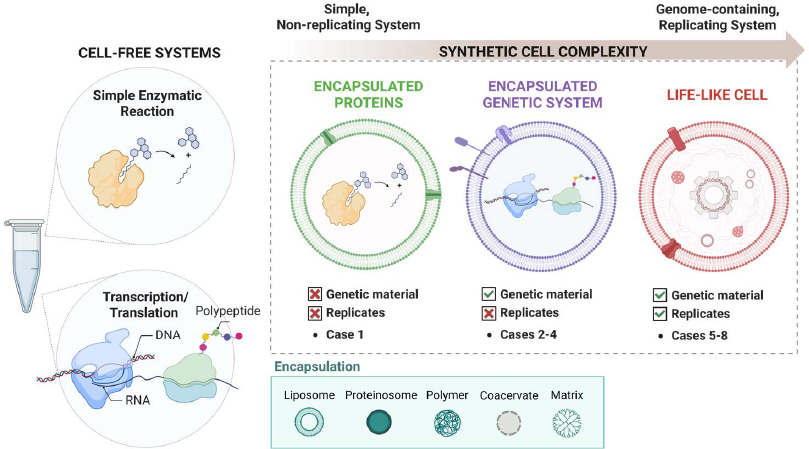
SOURCE: Figure was inspired by Figure 2 from Rothschild et al. (2024) and adapted to depict the conceptual framing of synthetic cells, as defined by the committee. Created in https://BioRender.com.
Core Questions Guiding Classification and Risk-Benefit Evaluation
A central component of the committee’s framing is a set of questions designed to guide classification and oversight decisions. These questions form the foundation for potential decision-support tools, including classification matrices, checklists, and decision trees. They provide an initial logic for determining where specific synthetic cell cases may fall within existing governance frameworks and for structuring subsequent risk-benefit evaluations.
Two questions are foundational: Does the synthetic cell contain genetic material? and Does it replicate (with or without genetic material)? Together, these provide a practical starting point for evaluation, as answers to them may broadly distinguish constructs that more closely align with chemical governance pathways from those requiring biological oversight. When the answer is “no” to both questions, the construct is typically best understood within chemical safety frameworks; when the answer is “yes” to one or both questions, the construct likely falls within the scope of biological governance (see further discussion of frameworks in Chapter 4). The less-likely combination of self-replicating synthetic cells without genetic material was not considered by the committee.
Beyond these two primary questions, additional questions provide the contextual specificity necessary for more detailed risk-benefit evaluation and relevant biosafety, biosecurity, and environmental considerations.1 These include:
- What is the synthetic cell’s intended function or application?
- In what environment or setting is it designed to operate or be deployed?
- Does it introduce any novel substances into the environment?
- What is its expected persistence, survivability, or capacity for interaction with living systems?
- Can it evolve, adapt, or acquire new functions over time?
- Do specific features either enhance or impede transfer of genetic material?
- How are the synthetic cells likely to interface with existing social, cultural, economic, and governance practices? Does the research lower technical barriers to constructing, scaling, or deploying harmful biological systems?
- Does the work combine multiple enabling technologies in ways that could increase misuse potential?
These contextual factors are important for determining the scale and nature of potential risks and benefits. However, as the details of each case become increasingly specific, developing a simple or universal decision-support tool becomes more challenging. The committee sought to enumerate more of these considerations with the cases described in Chapter 5 and with the discussion of available tools in Chapters 3 and 6.
Many of the questions above parallel those used in assessing genetically modified organisms, yet synthetic cells extend such considerations into new conceptual and material territory, where distinctions between chemical, biological, and hybrid systems
___________________
1 The final two questions are specific to issues of biosecurity; see Appendix D for an extended list of biosecurity-relevant questions.
blur. Accordingly, the committee envisions a two-layer approach to classification and evaluation. Initial screening questions concerning replication and genetic content would guide evaluators toward an appropriate oversight track (see Chapter 4), followed by a contextual layer of inquiry addressing intended use, environment, and persistence. This two-layered structure balances the need to codify a definition with the flexibility required to accommodate emerging technologies and evolving scientific understanding.
Clarifying Boundaries: What Is Not a Synthetic Cell
In developing a conceptual framework for defining synthetic cells, it is also important to clarify what falls outside that definition. These exclusions delineate the lower and upper bounds of the synthetic cell continuum, identifying cases that do not differ sufficiently from natural systems or purely chemical assemblies to warrant inclusion. The committee identified several categories that fall outside this definition because they do not differ sufficiently from natural systems, microorganisms, or chemicals:
- Purely chemical systems without cellular characteristics: Chemical systems lacking cellular properties such as encapsulation are excluded.
- Conventional genetically engineered organisms: Organisms modified through standard genetic engineering techniques (e.g., transgene insertion into existing bacterial strains, gene-edited organisms) are more appropriately classified as genetically modified organisms rather than synthetic cells.
- Synthetic genomes identical to natural genomes: Cells containing a completely synthetic genome that is otherwise identical to the genome of a natural organism are not considered synthetic cells in this framing.
Blurred Lines
Even with clear exclusions, the emergence of synthetic cells creates gray areas in which traditional biological categories no longer apply cleanly. Natural cells are considered living systems, whereas natural viruses are generally viewed as non-living entities. Viruses occupy an ambiguous space between life and non-life because they require living host cells to carry out cellular processes. In natural systems, it is rarely difficult to distinguish a cell from a virus. Synthetic cells, however, blur these traditional boundaries. Some display virus-like characteristics, such as protein capsids or proteinosomes designed to deliver molecular cargo or interact with or “infect” living cells (Cash et al., 2023; Gao et al., 2024). Such examples underscore the challenge of applying conventional biological definitions and risk assessment frameworks to emerging synthetic systems.
Intersections with Adjacent Research Domains
Framing what constitutes synthetic cells also requires recognizing adjacent research domains with overlapping governance implications. Synthetic cells may intersect with or be adjacent to the following research domains:
- Synthetic genomics: Advances in large-scale DNA synthesis enable assembly of whole genomes, whether novel or natural. Although they are important enabling technologies for synthetic cell construction, activities that fall under synthetic genomics are not necessarily considered synthetic cell research in and of themselves.
- Mirror biochemistry and xenobiology: Research on mirror-image biomolecules or alternative biochemistries is adjacent but does not define a synthetic cell per se. While not always encompassed by the committee’s working definition of synthetic cells, such work raises analogous concerns and could inform governance deliberations. Safeguarding synthetic cells based on non-natural chemistries (like xenonucleic acid genomes or mirror enantiomer biopolymers) could potentially address environmental and human health concerns for other types of synthetic cell architectures.
By emphasizing functionality, structure, and context relevance, and by explicitly delineating boundaries with related fields, this framing provides an adaptable basis for researchers, funders, and policymakers. Examples of categories of constructs, how they fit into the synthetic cell framing presented here, and possible governance implications are summarized in Table 2-1.
Cases Across the Continuum
Cases were developed to illustrate the range of possibilities for synthetic cells across the continuum (Table 2-2). These cases will be discussed further in Chapters 3, 4, and 5 in the context of biosafety, biosecurity, and environmental considerations that affect risk-benefit assessment, oversight, and governance. Some cases are based on published literature, while others are hypothetical. While they do not encompass all combinations of the attributes described above, the cases are intended to give a sense of the breadth of constructs the committee considered, reflecting various levels of complexity, functional features, and applications. These cases were also selected to illustrate a broad range of potential benefits and risks. A more extensive compendium of synthetic cell R&D can be found in Rothschild et al. (2024).
BUILDING A SYNTHETIC CELL
Having established conceptual foundations, this section turns to the technical methods by which synthetic cells are assembled. As alluded to earlier in this chapter, a defining feature of a synthetic cell is its encapsulation, or the presence of a boundary that separates the cell from its external environment. This boundary, analogous to the phospholipid bilayer of natural cells, may consist of biological or non-biological materials, but in all cases provides the physical separation necessary for internal components to function with partial independence.
For boundary construction, researchers commonly employ three methodologies:
- Microfluidics, for droplet-based encapsulation of biochemical components in highly controlled formats (Martino and deMello, 2016; Ugrinic et al., 2019);
- Self-assembly, for the spontaneous organization of lipids, polymers, or mixed chemistries into membrane-like structures (Belluati et al., 2024; Yandrapalli, 2025); and
- Templated assembly, for compartment formation guided by solid supports, interfacial forces, or other biophysical materials (Shang and Zhao, 2021).
Lipid bilayers form the cell membranes for most organisms, with other lipids, carbohydrates, and proteins comprising the mixture. However, many different chemistries make up the cell walls of known organisms, including chitin in arthropods, silica in diatoms, and peptidoglycans in bacteria (Fuertes-Rabanal et al., 2025), illustrating the expansive chemistries possible for cells to form this boundary. While lipids are
TABLE 2-1 Definitional Boundaries for Synthetic Cells
| Category | Description | Considered a Synthetic Cell? | Governance Implications |
|---|---|---|---|
| Vesicle-based systems | Non-replicating cell-like assemblies (e.g., lipid vesicles) designed to perform metabolic or compartmental functions | Yes | Risks generally lower but context dependent |
| Genome-containing constructs | Systems with synthetic or non-natural genomes, potentially capable of replication and information processing | Yes | Governance depends on replication capacity and nucleic acid content |
| Synthetic genomes identical to natural genomes | Organisms with completely synthesized genomes otherwise identical to natural ones | No | Classified as synthetic genomics, not synthetic cells |
| Genetically modified organisms | Organisms modified via conventional genetic engineering (e.g., Escherichia coli with added transgene) | No | Covered under existing frameworks |
| Purely chemical systems | Chemical systems lacking cellular attributes such as encapsulation | No | Governed as chemical materials |
| Mirror biochemistry/xenobiology | Systems employing mirror-image biomolecules or alternative biochemistries | Adjacent | Not automatically defined as synthetic cells; relevant to risk-benefit considerations |
| Virus-like synthetic constructs | Minimal designs (e.g., capsids with payloads) that blur categories between viruses and cells | Ambiguous | Highlights definitional uncertainty; raises oversight challenges akin to virology and synthetic cell governance |
TABLE 2-2 Synthetic Cell Cases Across the Continuum1
| Case Number and Purpose | Description | Genetic Material | Self-Replicating |
|---|---|---|---|
|
A lipid vesicle encapsulating enzymes and a pore protein, it moves toward a specific chemical cue (chemotaxis) through enzyme-driven gradients | No | No |
|
A biosensor for consumer use, it detects trace household hazards (e.g., mold) on surfaces and produces a visible color change. | Yes | No |
|
Designed for environmental deployment, it senses chemical contaminants (e.g., phenol) in soil and degrades them into less harmful products. | Yes | No |
|
Delivered orally in a capsule, it senses a specific gut pathogen and conditionally produces an antibiotic at the site of infection. | Yes | No |
|
Intended for soil use, it migrates toward the roots of specific crops and produces nutrients locally (replicating only in association with crop roots) | Yes | Yes |
|
A contained bacterium with a synthetic genome that includes a novel genetic code, it manufactures specialty proteins with non-standard amino acid building blocks, providing immunity to production-disrupting bacteriophages, and enabling built-in biocontainment features. | Yes | Yes |
|
A bacterial cell with a minimal synthetic genome constructed from the “bottom up” using non-living components, it replicates under a controlled set of conditions and serves as a model for defining the minimal functions required for life. | Yes | Yes |
|
A bacterial cell based on biochemistry that is an exact mirror image of the molecules used by all life observed on Earth, it sequesters carbon dioxide while remaining biochemically isolated from natural ecosystems due to its incompatible molecular chirality. | Yes | Yes |
1 Table summarizes illustrative cases spanning a continuum of synthetic cell designs and representing a range of applications and containment or deployment contexts. The cases are used to examine how biosafety, biosecurity, and environmental considerations and governance needs vary with system characteristics, intended use, and context.
the more common chemistry used in synthetic cell development, polymers (natural and synthetic), nucleic acids (Jahnke and Göpfrich, 2023), peptides (Daly et al., 2024; Yandrapalli, 2025), and even metal-organic shells (Liu et al., 2019) have also been used to form the boundary in question.
Three main methods used to form synthetic cell construction: bottom-up, top-down, and middle-out approaches (Rothschild et al., 2024). Each construction method reflects a distinct strategy for assembling or redesigning cellular systems.
- Bottom-up methods assemble non-living molecular components into cell-like systems exhibiting emergent properties, often employing purified biochemical ingredients, cellular extracts or minimal reconstructed environments.
- Top-down methods simplify or refactor naturally occurring cells and genomes, such as those derived from Mycoplasma or Escherichia coli, to remove complexity, enhance predictability, and improve control.
- Middle-out approaches combine natural and synthetic modules, such as translation machinery, membrane vesicles, or engineered components, into hybrid systems.
HISTORY AND MOTIVATIONS OF SYNTHETIC CELL R&D
The development of synthetic cells reflects both enduring scientific questions about the nature of life and pragmatic engineering goals. This section traces the historical origins of synthetic cell research and describes the scientific and technological motivations that have shaped the modern field.
History of Synthetic Cells
In the 19th century the development of organic chemistry, chemical physiology, and cell theory sparked debates over the nature and basis of life at the cellular level. While many were adamant that the basis of life was material, at the cellular level, the nature of life evaded physical and chemical understanding (Liu, 2017). Notable experiments like those conducted by microbiologist Louis Pasteur suggested that life could not arise from its physical antecedents alone (Geison, 1995). Efforts to manipulate or create cells from inorganic constituents were a core element in debates about the origin of life throughout the late 19th century. These discussions became intertwined with questions of purpose and design following Darwin’s theory of evolution via natural selection.
In the early 20th century scientists developed new approaches grounded in the idea that basic chemical processes such as diffusion gradients or osmosis could give rise to “synthetic” biology—forms of life that would self-assemble. This chemical manipulation of life came to be known as the engineering tradition in biology—an approach that emphasizes achieving knowledge through manipulation rather than examination, i.e., “technologies of living substance” (Campos, 2010).
By the mid-20th century the pre-history of synthetic cells diverged. In one direction, biomedical researchers remained interested in simulating the biophysical properties of
cell membranes, potentially as a means of delivering substances to the body that would otherwise be destroyed. These methods focused on cell membranes as enclosed spaces, beginning with efforts to create artificial red blood cells in the late 1950s and early 1960s (Chang, 1964; Jiang et al., 2022).
In the other direction several conceptual and experimental advances led to the establishment of bioinformatics. Viewing DNA as the operating “code” of life, researchers drew on advances in computing to read and consider editing this code, first in simulation and then in the laboratory. Although researchers had used different means of altering the genomes of cells for experimental and commercial purposes since the early 20th century, the invention of recombinant DNA in the 1970s and the development of bioinformatics in the 1990s laid the groundwork for the emergence of the modern synthetic biology movement in the early 2000s, spurring efforts to consider how cells might be refashioned from fundamental components. The focus on fundamental components, or “minimal life,” aims not just to synthesize life from chemical precursors but to use bioinformatics to predict and control its behavior. Subsequent years have seen a growing interest in synthesizing minimal life, reflecting a renewed effort to define life by recreating it at the most basic level (Forster and Church, 2006; Lartigue et al., 2007; Szostak et al., 2001).
Efforts to create a synthetic cell have yielded many approaches, from synthesizing minimal genomes that will produce a cell, to systematically removing genes to test their functions in cells or using physiological methods to evacuate DNA from an existing cell and inserting new DNA (Gibson et al., 2010; Hutchison et al., 2016). Each development has reinvigorated discussions of how to define life and what distinguishes synthesis from control or engineering.
Those who seek to create synthetic cells do so with intellectual and practical goals in mind. Many see them as flexible platforms to produce materials more cheaply, efficiently, and flexibly than would be possible with their biological counterparts (Fletcher, 2018; NRC, 2015). While it is intriguing to consider the wide-scale use of synthetic cells in scenarios such as manufacturing or environmental deployments, these scenarios also raise new questions and potential risks.
Motivations of Synthetic Cell R&D
Fundamental Understanding of Life and Scientific Curiosity
Several complementary scientific motivations drive research on synthetic cells. One seeks to understand the fundamental nature of life itself, either by simplifying existing living systems to their minimal functional components (“top-down” approaches) or by constructing life-like entities entirely from non-living materials (“bottom-up” approaches). These efforts are driven by a central question: What is the minimal set of components required for a system to exhibit life-like behavior? Another driver is scientific curiosity: Many researchers are motivated by the challenge of constructing an artificial device that can replicate, mimic, or extend the behaviors of living systems and curious about what new insights will be revealed through such efforts. Blurring
traditional boundaries between biology, chemistry, and engineering, these drivers have spurred the development of the interdisciplinary field now recognized as synthetic cell science.
Engineering to Overcome Natural Cell Constraints
A second, more engineering-oriented motivation stems from the desire to overcome the intrinsic limitations of working with natural cells. Biological systems are subject to core processes such as mutation and adaptation and limiting factors such as metabolic burden and toxicity, which complicate their use as reliable engineering substrates. In contrast to synthetic cells, natural cells are products of billions of years of evolution. While evolutionary pressures and genetic redundancy have given rise to remarkable complexity and adaptability, they also produce features such as unpredictable regulatory interactions, energetically wasteful processes, and context-dependent outputs that can limit reliability in bioengineering applications. These limitations provide motivation for the development of synthetic cells as purpose-built systems designed for greater control and predictability.
Synthetic cells offer a means to bypass evolutionary constraints, while maintaining biological functionality. They can be engineered from defined molecular components, allowing researchers to precisely design, test, and refine systems that perform specific biochemical or physical functions without the confounding variability of natural evolution.
Progress toward these goals has been largely limited to the conceptual or proof-of-principle stage. Researchers have demonstrated the ability to recapitulate specific biological functions like gene expression, environmental sensing, compartmentalization, or rudimentary metabolism in controlled laboratory settings. However, most synthetic cell systems have not yet been shown to operate in real-world, non-laboratory environments, such as field conditions or other open settings outside contained experimental facilities. Reviews by Groaz et al. (2020), Sato et al. (2021), and Rothschild et al. (2024) provide comprehensive overviews of these developments and identify key technical and conceptual frontiers.
Novel Capabilities Through Biohybrid Systems
Another subfield involves hybrid synthetic cells. These constructs integrate biological components with non-biological technologies such as microfluidics or polymer-based scaffolds (Elani et al., 2018). This hybridization allows for novel capabilities, for instance, the combination of programmable biochemical reactions with precisely engineered physical architectures. Other work explores the integration of synthetic and living cells, in which synthetic constructs interact with or augment natural organisms to perform coordinated tasks (Elani, 2020).
Collectively, these efforts underscore a rapid broadening of the synthetic cell landscape that ranges from minimal systems designed to probe the origins and nature of
life, to increasingly sophisticated, hybrid systems aimed at practical applications across health, materials science, and the environment.
EMERGING OPPORTUNITIES AND TECHNICAL CHALLENGES
Although the field of synthetic cell science and engineering remains largely in the conceptual or demonstration stage, many possible applications have been identified. Some near-term opportunities derive from extrapolations of existing laboratory systems, while other proposed applications are more speculative but technologically plausible. Together, these envisioned applications highlight the potential value of synthetic cells as programmable, controllable entities capable of performing biological-like functions in novel contexts.
Illustrative Near-term Opportunities
Environmental Sensing, Recording, and Response
One promising area of research involves distributed environmental sensing, recording, and response. Collections of synthetic cells could be designed to monitor and react to environmental conditions—whether chemical, optical, mechanical, or thermal—for purposes such as biomedical diagnostics, agriculture, or environmental surveillance. For example, a synthetic cell might display surface proteins or molecular complexes enabling it to localize to specific environmental features or microenvironments relevant to its intended functions. Upon detecting a defined combination of environmental signals, the cell could record the event at a molecular level such as through DNA-based memory systems that use conditionally activated integrases to modify genetic material in predictable ways. Later, sequencing could be used to recover the environmental information recorded by these cells. Alternatively, the synthetic cell could produce or release a chemical or protein signal in response to the detected event, creating local feedback mechanisms.
Adaptive Materials Systems
Another emerging direction lies in adaptive materials systems, in which synthetic cells are integrated with engineered materials to produce dynamic, responsive behaviors. Synthetic cells could be embedded within three-dimensional printed matrices, hydro-gels, or bioplastics to modulate mechanical, chemical, or optical properties in response to environmental stimuli. For instance, such a material could alter its reflectivity or color depending on temperature, pH, or chemical exposure. This capability opens new possibilities for smart coatings, biointerfaces, antifouling systems, and biomanufacturing platforms that combine the programmability of biological systems with the stability of engineered materials.
Engineered Microbes for Environmental Release
A third direction involves synthetic cells as replacements for engineered microbes for environmental release (EMERs). EMERs are being developed for applications in agriculture, environmental remediation, biomining, and therapeutic delivery. However, their deployment raises biosafety, ecological, and regulatory challenges, as conventional containment strategies are not applicable to EMERs (Chemla et al., 2025; Marken et al., 2024). Non-replicating synthetic cells could serve as safer, more predictable alternatives for performing similar biochemical functions (e.g., nitrogen fixation, phenol degradation, or waste processing) without the ecological and regulatory concerns associated with living systems.
Foundational Scientific Questions Limiting Progress
Achieving functional, autonomous synthetic cells will require progress on several fundamental scientific questions that remain unresolved. These questions focus on core processes—energy use, replication, and evolution—that underpin life-like behavior. Gaps in our understanding of these processes currently constrain how complex synthetic cells can become. While in some applications it may be advantageous for synthetic cells to be short-lived or unable to persist, in other contexts features such as sustained growth, replication, or evolvability may be intentionally incorporated to enable longer-term function. Progress on these fronts would thus expand the capabilities of synthetic cells and could reshape our understanding of what constitutes life-like behavior in engineered systems.
Some representative scientific questions include:
- Metabolism, energy, and growth: How can synthetic cells obtain and use energy to allow them to operate for longer periods of time and/or to produce materials required to sustain their operations and growth?
- Replication and cell division: What mechanisms would allow synthetic cells to divide, maintain structure, and potentially differentiate into specialized forms?
- Mutation and evolution: A key feature of living organisms is the role of evolution and selection as a mechanism for improving functionality. When and how might these features be implemented in synthetic cells, and what are the governance implications?
Addressing these questions will likely depend on cross-disciplinary advances spanning biophysics, chemistry, systems biology, and materials science. For example, progress in artificial metabolism may depend on integrating enzymatic and non-enzymatic reaction networks that can operate sustainably, while replication and evolution may require novel information carriers beyond DNA and RNA. Together, these challenges define the scientific frontier that separates complex biochemical systems from fully synthetic life-like entities.
Practical Challenges
As researchers work to address foundational scientific questions surrounding synthetic cell construction, a parallel set of practical engineering problems must be solved to enable real-world applications. These challenges concern the ways synthetic cells sense, respond to, and interact with their environments—and have implications for their potential functionality, scalability, and safety in use. Principles and technologies from synthetic biology, microfluidics, and materials engineering are relevant to many of these problem, but addressing them will require adaptation in light of the distinctive architectures and constraints of synthetic cells.
- Sensing, transport, and communication: There remain unresolved questions about how synthetic cells interact with the environment, such as by sensing environmental conditions, transporting materials into and out of synthetic cells, and communicating between synthetic cells (or with living organisms). Efforts focused on sensors, transport, and communications technologies are advancing knowledge in these areas (Adamala et al., 2017; Booth et al., 2016; Garenne et al., 2021; Hilburger et al., 2019; Joesaar et al., 2019; Majumder et al., 2017; Moghimianavval et al., 2025; Niederholtmeyer et al., 2018; Parkes et al., 2025).
- Regulation and logic: In many applications, it would be useful to be able to carry out computations within the synthetic cell, either to maintain internal conditions or to guide the actions of the synthetic cell. Research is well developed within this space in synthetic biology (e.g., Nielsen et al., 2016; Roquet et al., 2016) and may be transferable to synthetic cells once barriers such as the ability to provide energy for sustained periods of time are overcome (Bashor and Collins, 2018).
- Motility and adhesion: In many potential applications, it might be useful for synthetic cells to adhere to each other or to elements of their environment and/or to move around in their environment. There has been some work in this area, although it is not as well developed as the others (Allen et al., 2023; Shrivastava et al., 2023).
Together, these engineering problems define the bridge between laboratory demonstrations and practical deployment. Each capability—sensing, logic, or motility—represents a modular function that could be combined with others to build increasingly complex systems. However, integration of these modules into robust, energy-efficient, and controllable synthetic cells remains an unsolved systems-engineering problem.
At present, the state of synthetic cell R&D remains far from producing anything beyond relatively simple demonstrations of the individual components required for more advanced behaviors. The development of a replicating synthetic cell constructed from the bottom-up would represent a potentially disruptive inflection point that could accelerate progress or initiate new governance checkpoints to assess risks. Such a milestone would not only represent a technical triumph but could also redefine long-standing boundaries between engineered and living systems (Olivi et al., 2021).
SUMMARY AND CONCLUSIONS
The conceptual and technical framing presented in this chapter establishes a foundation for consistent classification and evaluation of synthetic cells. By recognizing synthetic cells as existing along a continuum of structural and functional complexity and applying a two-layer decision-support approach based on a core set of questions, this framework provides a basis for distinguishing constructs by their core biological attributes (e.g., replication, genetic content), their contextual characteristics (e.g., intended use, environment, persistence), and biosecurity considerations (Box 2-1). This approach offers a flexible structure for evaluating emerging synthetic cells as scientific understanding evolves, ensuring that oversight can remain proportionate to potential benefits and risks.
BOX 2-1
Core Questions Guiding Classification and Risk-Benefit Evaluation
Layer 1
- Does the synthetic cell contain genetic material?
- Does it replicate (with or without genetic material)?
Layer 2
- What is the synthetic cell’s intended function or application?
- In what environment or setting is it designed to operate or be deployed?
- Does it introduce any novel or exotic substances into the environment?
- What is its expected persistence, survivability, or capacity for interaction with living systems?
- Can it evolve, adapt, or acquire new functions over time?a
- Do specific features either enhance or impede transfer of genetic material?
- How are the synthetic cells likely to interface with existing social, cultural, economic, and governance practices?
- Does the research lower technical barriers to constructing, scaling, or deploying harmful biological systems?
- Does the work combine multiple enabling technologies in ways that could increase misuse potential?
__________________
a The question of whether a synthetic cell can evolve, adapt, or acquire new functions may not always be definitively answerable at early stages of research and development. Evolvability can depend on design features such as replication fidelity, mutation rates, selection pressures, and the presence or absence of mechanisms for horizontal gene transfer, as well as on environmental context. Accordingly, assessment of evolvability should be treated as iterative and revisited as constructs increase in complexity, move toward replication, or are deployed in new settings.
Establishing this definitional and analytic foundation is critical for aligning research, funding, and governance systems. It enables policymakers, agencies, and research institutions to determine where existing oversight frameworks apply and where new guidance may be needed. The continuum and two-layer evaluative approach also provide a conceptual bridge to Chapter 3, which examines how these principles translate into practical mechanisms for risk assessment, benefit evaluation, and adaptive governance of synthetic cell R&D.
Conclusion 2-1: The research community does not yet share a common definition of “synthetic cell,” and clear boundaries for what qualifies as such remain unsettled. This definitional uncertainty creates challenges for consistent oversight, funding, communication, and governance.
Conclusion 2-2: Synthetic cells vary widely in their features, functions, and degree of similarity to natural cells. Framing synthetic cells as a continuum of structural and functional complexity provides a more effective and adaptable basis for governance than fixed or overly narrow definitions.
Conclusion 2-3: Risks and benefits associated with specific synthetic cells depend on both functional and structural characteristics—such as genetic content and replication potential—and contextual factors, including their intended use, environment of operation, and interactions with living systems. These characteristics determine where synthetic cells fall within existing oversight frameworks and what level of governance attention is warranted.
Conclusion 2-4: The development and deployment of synthetic cells present potentially novel applications across health and medicine, the environment, sustainability, and biomanufacturing. As with other emerging biotechnologies, uncertainty remains regarding the scale and distribution of benefits and risks, particularly as systems combine biological and chemical features and move into new deployment contexts. Frameworks that promote responsible innovation and integrated evaluation of biosafety, biosecurity, and environmental risks can help realize societal and economic benefits of synthetic cells while mitigating environmental and societal harms.
REFERENCES
Adamala, K. P., D. A. Martin-Alarcon, K. R. Guthrie-Honea, and E. S. Boyden. 2017. Engineering Genetic Circuit Interactions Within and Between Synthetic Minimal Cells. Nature Chemistry 9 (5): 431–439. https://doi.org/10.1038/nchem.2644.
Adamala, K. P., D. Agashe, Y. Belkaid, D. M. de C. Bittencourt, Y. Cai, M. W. Chang, I. A. Chen, G. M. Church, V. S. Cooper, M. M. Davis, N. K. Devaraj, D. Endy, K. M. Esvelt, J. I. Glass, T. W. Hand, T. V. Inglesby, F. J. Isaacs, W. G. James, J. D. G. Jones, M. S. Kay, R. E. Lenski, C. Liu, R. Medzhitov, M. L. Nicotra, S. B. Oehm, J. Pannu, D. A. Relman, P. Schwille, J. A. Smith, H. Suga, J. W. Szostak, N. J. Talbot, J. M. Tiedje, J. C. Venter, G. Winter, W. Zhang, X. Zhu, and M. T. Zuber. 2024. Confronting Risks of Mirror Life. Science 386 (6728): 1351–1353. https://doi.org/10.1126/science.ads9158.
Allen, M. E., J. W. Hindley, N. O’Toole, H. S. Cooke, C. Contini, R. V. Law, O. Ces, and Y. Elani. 2023. Biomimetic Behaviors in Hydrogel Artificial Cells Through Embedded Organelles. Proceedings of the National Academy of Sciences 120 (35): e2307772120. https://doi.org/10.1073/pnas.2307772120.
Bashor, C. J., and J. J. Collins. 2018. Understanding Biological Regulation Through Synthetic Biology. Annual Review of Biophysics 47: 399–423. https://doi.org/10.1146/annurev-biophys-070816-033903.
Belluati, A., S. Jimaja, R. J. Chadwick, C. Glynn, M. Chami, D. Happel, C. Guo, H. Kolmar, and N. Bruns. 2024. Artificial Cell Synthesis Using Biocatalytic Polymerization Induced Self Assembly. Nature Chemistry 16 (4): 564–574. https://doi.org/10.1038/s41557-023-01391-y.
Booth, M. J., V. Restrepo Schild, A. D. Graham, S. N. Olof, and H. Bayley. 2016. Light Activated Communication in Synthetic Tissues. Science Advances 2 (4): e1600056. https://doi.org/10.1126/sciadv.1600056.
Campos, L. 2010. That Was the Synthetic Biology That Was. In Synthetic Biology: The Techno-science and Its Societal Consequences, edited by M. Schmidt, A. Kelle, A. Ganguli-Mitra, and H. Vriend. Dordrecht: Springer. Pp. 5–21. https://doi.org/10.1007/978-90-481-2678-1_2.
Cash, B., N. J. Gaut, C. Deich, L. L. Johnson, A. E. Engelhart, and K. P. Adamala. 2023. Parasites, Infections, and Inoculation in Synthetic Minimal Cells. ACS Omega 8 (7): 7045–7056. https://doi.org/10.1021/acsomega.2c07911.
Chang, T. M. S. 1964. Semipermeable Microcapsules. Science 146 (3643): 524–525. https://doi.org/10.1126/science.146.3643.524.
Chemla, Y., C. J. Sweeney, C. A. Wozniak, and C. A. Voigt. 2025. Design and Regulation of Engineered Bacteria for Environmental Release. Nature Microbiology 10 (2): 281–300. https://doi.org/10.1038/s41564-024-01918-0.
Cook, A. B., S. Novosedlik, and J. C. M. van Hest, 2023. Complex Coacervate Materials as Artificial Cells. Accounts of Materials Research 4 (3): 287–298. https://doi.org/10.1021/accountsmr.2c00239.
Contreras-Llano, L. E., Y. H. Liu, T. Henson, C. C. Meyer, O. Baghdasaryan, S. Khan, C. L. Lin, A. Wang, C. M. J. Hu, and C. Tan. 2023. Engineering Cyborg Bacteria Through Intracellular Hydrogelation. Advanced Science 10 (9): 2204175. https://doi.org/10.1002/advs.202204175.
Daly, M. L., K. Nishi, S. J. Hinton, Y. Gao, and R. Freeman. 2024. Designer Peptide–DNA Cytoskeletons Regulate the Function of Synthetic Cells. Nature Chemistry 16 (8): 1229–1239. https://doi.org/10.1038/s41557-024-01509-w.
Elani, Y. 2020. Interfacing Living and Synthetic Cells as an Emerging Frontier in Synthetic Biology. Angewandte Chemie 133 (11): 5662–5671. https://doi.org/10.1002/ange.202006941.
Elani, Y., T. Trantidou, D. Wylie, L. Dekker, K. Polizzi, R. V. Law, and O. Ces. 2018. Constructing Vesicle-Based Artificial Cells with Embedded Living Cells as Organelle-Like Modules. Scientific Reports 8 (1): 4564. https://doi.org/10.1038/s41598-018-22263-3.
Fletcher, D. 2018. Which Biological Systems Should Be Engineered? Nature 563 (7730): 177–179. https://doi.org/10.1038/d41586-018-07291-3.
Forster, A. C., and G. M. Church. 2006. Towards Synthesis of a Minimal Cell. Molecular Systems Biology 2 (1): 45. https://doi.org/10.1038/msb4100090.
Fuertes-Rabanal, M., D. Rebaque, A. Largo-Gosens, A. Encina, and H. Mélida. 2025. Cell Walls: A Comparative View of the Composition of Cell Surfaces of Plants, Algae, and Microorganisms. Journal of Experimental Botany 76 (10): 2614–2645. https://doi.org/10.1093/jxb/erae512.
Gao, M., D. Wang, M. Wilsch Bräuninger, W. Leng, J. Schulte, N. Morgner, D. Appelhans, and T. Y. D. Tang. 2024. Cell Free Expression in Proteinosomes Prepared from Native Protein PNIPAAm Conjugates. Macromolecular Bioscience 24 (3): 2300464. https://doi.org/10.1002/mabi.202300464.
Garenne, D., S. Thompson, A. Brisson, A. Khakimzhan, and V. Noireaux. 2021. The All-E. coli TXTL Toolbox 3.0: New Capabilities of a Cell-Free Synthetic Biology Platform. Synthetic Biology 6 (1): ysab017. https://doi.org/10.1093/synbio/ysab017.
Geison, G. L. 1995. The Private Science of Louis Pasteur. Princeton University Press.
Giaveri, S., Z. Abil, S. Kohyama, M. Fu, A. Levrier, K. Adamala, W. Chinantuya, C. Dekker, N. Deng, J. Fredens, K. Hagino, K. Jahnke, X. Li, A. B. Lindner, C. Liu, S. Majumder, V. Noireaux, P. Schwille, and I. N. Westensee. 2025. Building a Synthetic Cell Together. Nature Communications 16 (1): 7488. https://doi.org/10.1038/s41467-025-62778-8.
Gibson, D. G., J. I. Glass, C. Lartigue, V. N. Noskov, R. Y. Chuang, M. A. Algire, G. A. Benders, M. G. Montague, L. Ma, M. M. Moodie, C. Merryman, S. Vashee, R. Krishnakumar, N. Assad-Garcia, C. Andrews-Pfannkoch, E. A. Denisova, L. Young, Z. Qi, T. H. SegallShapiro, C. H. Calvey, P. P. Parmar, C. A. Hutchison III, H. O. Smith, and J. C. Venter. 2010. Creation of a Bacterial Cell Controlled by a Chemically Synthesized Genome. Science 329 (5987): 52–56. https://doi.org/10.1126/science.1190719.
Groaz, A., H. Moghimianavval, F. Tavella, T. W. Giessen, A. G. Vecchiarelli, Q. Yang, and A. P. Liu. 2020. Engineering Spatiotemporal Organization and Dynamics in Synthetic Cells. WIREs Nanomedicine and Nanobiotechnology 13 (3): e1685. https://doi.org/10.1002/wnan.1685.
Hilburger, C. E., M. L. Jacobs, K. R. Lewis, J. A. Peruzzi, and N. P. Kamat. 2019. Controlling Secretion in Artificial Cells with a Membrane AND Gate. ACS Synthetic Biology 8 (6): 1224–1230. https://doi.org/10.1021/acssynbio.8b00435.
Hutchison, C. A., III, R. Y. Chuang, V. N. Noskov, N. Assad-Garcia, T. J. Deerinck, M. H. Ellis-man, J. Gill, K. Kannan, B. J. Karas, L. Ma, J. F. Pelletier, Z. Q. Qi, R. A. Richter, E. A. Strychalski, L. Sun, Y. Suzuki, B. Tsvetanova, K. S. Wise, H. O. Smith, J. I. Glass, C. Merryman, D. G. Gibson, and J. C. Venter. 2016. Design and Synthesis of a Minimal Bacterial Genome. Science 351 (6280): aad6253. https://doi.org/10.1126/science.aad6253.
Jahnke, K., and K. Göpfrich. 2023. Engineering DNA-Based Cytoskeletons for Synthetic Cells. Interface Focus 13 (5): 20230028. https://doi.org/10.1098/rsfs.2023.0028.
Jiang, W., Z. Wu, Z. Gao, M. Wan, M. Zhou, C. Mao, and J. Shen. 2022. Artificial Cells: Past, Present and Future. ACS Nano 16 (10): 15705–15733. https://doi.org/10.1021/acsnano.2c06104.
Joesaar, A., S. Yang, B. Bögels, A. van der Linden, P. Pieters, B. V. V. S. P. Kumar, N. Dalchau, A. Phillips, S. Mann, and T. F. A. de Greef. 2019. DNA-Based Communication in Populations of Synthetic Protocells. Nature Nanotechnology 14 (4): 369–378. https://doi.org/10.1038/s41565-019-0399-9.
Lartigue, C., J. I. Glass, N. Alperovich, R. Pieper, P. P. Parmar, C. A. Hutchinson III, H. O. Smith, and J. C. Venter. 2007. Genome Transplantation in Bacteria: Changing One Species to Another. Science 317 (5838): 632–638. https://doi.org/10.1126/science.1144622.
Liu, A. P., E. A. Appel, P. D. Ashby, B. M. Baker, E. Franco, L. Gu, K. Haynes, N. S. Joshi, A. M. Kloxin, P. H. J. Kouwer, J. Mittal, L. Morsut, V. Noireaux, S. Parekh, R. Schulman, S. K. Y. Tang, M. T. Valentine, S. L. Vega, W. Weber, N. Stephanopoulos, and O. Chaudhuri. 2022. The Living Interface Between Synthetic Biology and Biomaterial Design. Nature Materials 21 (4): 390–397. https://doi.org/10.1038/s41563-022-01231-3.
Liu, D. 2017. The Cell and Protoplasm as Container, Object, and Substance, 1835–1861. Journal of the History of Biology 50 (4): 889–925. https://doi.org/10.1007/s10739-016-9460-9.
Liu, D., Z. Guo, and K. Liang. 2019. Biocatalytic Metal-Organic Framework-Based Artificial Cells. Advanced Functional Materials 29: 1905321. https://doi.org/10.1002/adfm.201905321.
Majumder, S., J. Garamella, Y. L. Wang, M. DeNies, V. Noireaux, and A. P. Liu. 2017. Cell Sized Mechanosensitive and Biosensing Compartment Programmed with DNA. Chemical Communications 53: 7349–7352. https://doi.org/10.1039/C7CC03455E.
Marken, J. P., M. E. Maxon, and R. M. Murray. 2024. Policy Recommendations for the Regulation of Engineered Microbes for Environmental Release. Linde Center for Science, Society, and Policy, Caltech. https://doi.org/10.57959/bgny-v542.
Martino, C., and A. J. deMello. 2016. Droplet-Based Microfluidics for Artificial Cell Generation: A Brief Review. Interface Focus 6 (4): 20160011. https://doi.org/10.1098/rsfs.2016.0011.
Moghimianavval, H., C. Newell, P. Parvizian, M. J. Booth, and A. P. Liu. 2025. Strategies and Applications of Synthetic Cell Communication. Nature Chemical Biology 21: 1317–1329. https://doi.org/10.1038/s41589-025-02002-2.
Niederholtmeyer, H., C. Chaggan, and N. K. Devaraj. 2018. Communication and Quorum Sensing in Nonliving Mimics of Eukaryotic Cells. Nature Communications 9 (1): 5027. https://doi.org/10.1038/s41467-018-07473-7.
Nielsen, A. A. K., B. S. Der, J. Shin, P. Vaidyanathan, V. Paralanov, E. A. Strychalski, D. Ross, D. Densmore, and C. A. Voigt. 2016. Genetic Circuit Design Automation. Science 352 (6281): aac7341. https://doi.org/10.1126/science.aac7341.
NRC (National Research Council). 2015. Industrialization of Biology: A Roadmap to Accelerate the Advanced Manufacturing of Chemicals. Washington, DC: The National Academies Press. https://doi.org/10.17226/19001.
Olivi, L., M. Berger, R. N. P. Creyghton, N. De Franceschi, C. Dekker, B. M. Mulder, N. J. Claassens, P. R. ten Wolde, and J. van der Oost. 2021. Towards a Synthetic Cell Cycle. Nature Communications 12 (1): 4531. https://doi.org/10.1038/s41467-021-24772-8.
Parkes, E., A. Al Samad, G. Mazzotti, C. Newell, B. Ng, A. Radford, and M. J. Booth. 2025. Magnetic Activation of Spherical Nucleic Acids Enables the Remote Control of Synthetic Cells. Nature Chemistry 17 (10): 1505–1513. https://doi.org/10.1038/s41557-025-01909-6.
Podolsky, K. A., and N. K. Devaraj. 2021. Synthesis of Lipid Membranes for Artificial Cells. Nature Reviews Chemistry 5 (10): 676–694. https://doi.org/10.1038/s41570-021-00303-3.
Roquet, N., A. P. Soleimany, A. C. Ferris, S. Aaronson, and T. K. Lu. 2016. Synthetic Recombinase-Based State Machines in Living Cells. Science 353 (6297): aad8559. https://doi.org/10.1126/science.aad8559.
Rothschild, L. J., N. J. H. Averesch, E. A. Strychalski, F. Moser, J. I. Glass, R. C. Perez, I. O. Yekinni, B. Rothschild-Mancinelli, G. A. R. Kingman, F. Wu, J. Waeterschoot, I. A. Ioannou, M. C. Jewett, A. P. Liu, V. Noireaux, C. Sorenson, and K. P. Adamala. 2024. Building Synthetic Cells—From the Technology Infrastructure to Cellular Entities. ACS Synthetic Biology 13 (4): 974–997. https://doi.org/10.1021/acssynbio.3c00724.
Sato, W., T. Zajkowski, F. Moser, and K. P. Adamala. 2021. Synthetic Cells in Biomedical Applications. WIREs Nanomedicine and Nanobiotechnology 14 (2): e1761. https://doi.org/10.1002/wnan.1761.
Shang, L., and Y. Zhao. 2021. Droplet-Templated Synthetic Cells. Matter 4 (1): 95–115. https://doi.org/10.1016/j.matt.2020.10.003.
Shrivastava, A., Y. Du, H. K. Adepu, R. Li, A. S. Madhvacharyula, A. A. Swett, and J. H. Choi. 2023. Motility of Synthetic Cells from Engineered Lipids. ACS Synthetic Biology 12 (10): 2789–2801. https://doi.org/10.1021/acssynbio.3c00271.
Szostak, J. W., D. Bartel, and P. L. Luisi. 2001. Synthesizing Life. Nature 409 (6818): 387–390. https://doi.org/10.1038/35053176.
Ugrinic, M., A. DeMello, and T.-Y. D. Tang. 2019. Microfluidic Tools for Bottom-Up Synthetic Cellularity. Chem 5 (7): 1727–1742. https://doi.org/10.1016/j.chempr.2019.03.012.
Yandrapalli, N. 2025. Bottom-Up Development of Lipid-Based Synthetic Cells for Practical Applications. Trends in Biotechnology 43 (9): 2150–2169. https://doi.org/10.1016/j.tibtech.2025.03.009.


