Supporting Responsible Innovation of Synthetic Cells: Biosafety, Biosecurity, and Environmental Considerations (2026)
Chapter: 6 A National Strategy Supporting Responsible Synthetic Cell Innovation
6
A National Strategy Supporting Responsible Synthetic Cell Innovation
Synthetic cells represent a frontier in engineering biology, comprising systems built from defined molecular components to emulate selected functions of life. They span a continuum (see Chapter 2), from non-replicating biochemical assemblies to genome-based, self-replicating constructs. This diversity underpins their scientific promise while also complicating classification within existing oversight structures. Synthetic cell research and development (R&D) has the potential to advance fundamental science and engineering while enabling applications in health, environmental sustainability, and biomanufacturing. Realizing these opportunities requires proactive attention to potential risks and uncertainties, so that benefits can be realized and unintended consequences are minimized.
Responding to the need for thoughtful governance, this chapter integrates earlier analyses to outline a national strategy and associated lines of effort for supporting responsible innovation in synthetic cell R&D. The chapter describes how national leadership, federal implementation, regulatory oversight, and institutional practice interact to translate strategic direction into operational governance, as illustrated in Figure 6-1. It is grounded in four core values that underpin the report as a whole: responsibility, balance, coordination, and adaptability. These principles reflect themes introduced in earlier chapters, including anticipatory risk management, proportionate oversight, interagency coherence, and the need for governance systems that can adapt alongside rapidly advancing science. This strategy is intended to guide governance of synthetic cells as one component of a broader national biotechnology policy landscape.
Because synthetic cell R&D is a rapidly evolving field, it is neither practical nor desirable to make all policy decisions a priori. Accordingly, the chapter emphasizes that governance grounded in enduring values, rather than rigid rules, would enable oversight systems to remain agile and responsive as technologies, risks, and opportunities change. The framework presented herein envisions coordinated and cooperative action
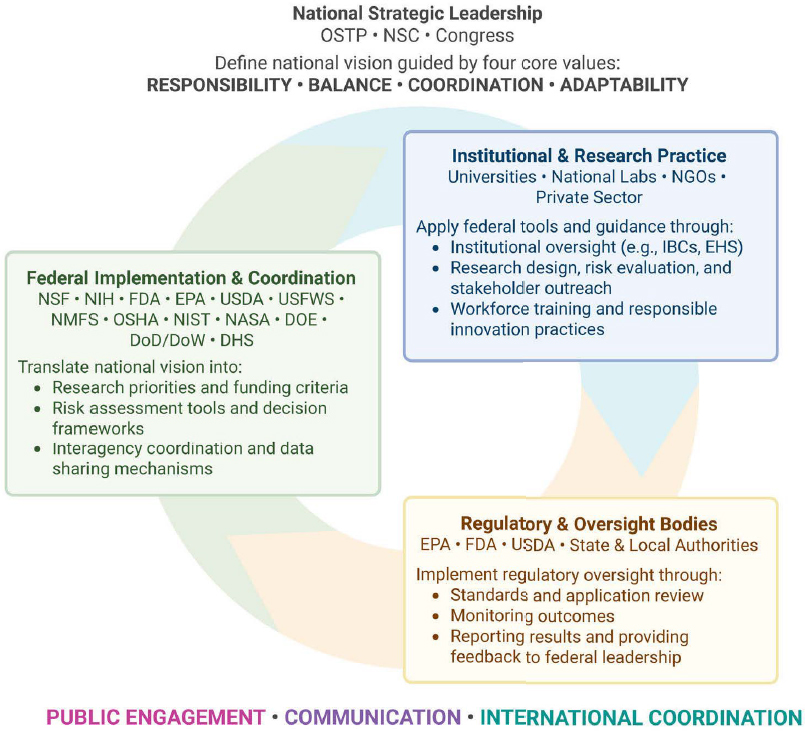
NOTE: NGOs: nongovernmental organizations; IBCs: institutional biosafety committees; EHS: environmental health and safety. SOURCE: Created in https://BioRender.com.
by the relevant federal agencies to align research investment, standards development, and governance mechanisms. It emphasizes translation from strategic vision to practice through adaptive oversight systems that can evolve as evidence and technologies advance. Within this structure, the chapter articulates concrete mechanisms for interagency collaboration, data sharing, workforce development, and international engagement, ensuring that governance keeps pace with innovation.
This strategic framing builds directly on the risk, benefit, and uncertainty considerations discussed in Chapter 3, the governance frameworks evaluated in Chapter 4, and the case-based oversight insights presented in Chapter 5, establishing a foundation for a national approach that is both forward-looking and adaptable. This synthetic cell–focused strategy is intended to function as a priority component within a broader national biotechnology governance framework, rather than as a standalone governance system, as will be described in Chapter 7.
OVERARCHING OBJECTIVES FOR A NATIONAL GOVERNANCE STRATEGY
To translate the core values articulated above into actionable governance, the framework centers on four overarching objectives that guide policy development, coordination, and implementation across the synthetic cell research ecosystem. These objectives provide a shared reference point for aligning federal leadership, institutional practice, and oversight activities, and they serve as a basis for evaluating whether governance approaches remain proportionate, coherent, and adaptive as the field evolves.
- Advance responsible innovation: Enable scientific and technological advances while promoting anticipation, inclusivity, reflexivity, and responsiveness in research practice (Owen et al., 2013). This objective reflects the value of responsibility by emphasizing research practices that anticipate potential impacts, incorporate reflection on values and assumptions, engage relevant stakeholders, and respond to new evidence as it emerges.
- Navigate benefit, risk, and uncertainty: Promote governance approaches that seek to maximize societal benefit while identifying, reducing, and managing potential risks, recognizing uncertainty as an inherent, but tractable, feature of emerging technologies such as synthetic cells. This framing aligns with bioethical principles of beneficence and nonmaleficence, which emphasize realizing benefits while minimizing harm, and provides a practical lens for decision making under uncertainty.
- Strengthen coordination and accountability: Promote information sharing, clearly defined roles, and measurable outcomes across the research and oversight ecosystem. This objective reflects the value of coordination by addressing fragmentation across agencies, institutions, and oversight pathways and by promoting shared understanding of responsibilities and expectations.
- Build adaptive and resilient governance: Ensure oversight systems can adjust as evidence, technology, and societal expectations evolve. This objective reflects the value of adaptability by emphasizing learning, feedback, and iterative improvement as technologies, risks, and social contexts change over time.
Together, these four objectives articulate the core values that inform and guide governance mechanisms for synthetic cell research and development. Throughout this chapter, these values shape specific choices, including the emphasis on proportionate oversight (balance), interagency collaboration (coordination), iterative learning (adaptability), and anticipatory risk management (responsibility). Collectively, the objectives provide a clear structure for translating policy intent into governance practice across the synthetic cell research ecosystem. Grounding oversight in these values allows the framework to remain agile, proportionate, and forward-looking, providing coherence and direction even as scientific understanding and technological capabilities evolve. This values-based approach enables continuous learning and adaptation without the need to predetermine every regulatory or policy decision.
A UNIFYING FEDERAL VISION
Synthetic cell R&D can be situated within a coordinated federal vision that links national policy, research investment, and implementation across agencies and sectors. At the federal level, this vision connects the scientific enterprise to broader objectives in innovation, security, and public trust. Rather than a single program or statute, it functions as a connective architecture that integrates several complementary elements:
- Recognition of synthetic cells as a continuum of constructs defined by function, properties, and context, alongside recognition of the potential national benefits of synthetic cell and broader engineering biology research across health, sustainability, and economic domains;
- A shared vocabulary and guiding principles that promote consistent understanding among agencies, funders, and institutions;
- Integration of research priorities with oversight, standards, and communication practices; and
- Mechanisms for transparency, coordination, and periodic evaluation so that governance evolves with the science.
This integrated approach reflects the challenges described in previous chapters regarding fragmented oversight, varying agency missions, and a lack of shared situational awareness about the scope, maturity, applications, and risk profiles of synthetic cell research activities across the federal landscape, and provides a mechanism to align diverse activities under a coherent national structure.
Figure 6-1 depicts this federal vision as an operational strategy, illustrating how high-level objectives and values are translated into coordinated implementation across multiple levels of the research and governance ecosystem. National strategic leadership (OSTP, NSC, and Congress) defines the overarching vision and guiding principles. Federal agencies (e.g., the National Science Foundation [NSF], National Institutes of Health [NIH], Food and Drug Administration [FDA], Environmental Protection Agency [EPA], United States Department of Agriculture [USDA], U.S. Fish and Wildlife Service [USFWS], National Marine Fisheries Service [NMFS], Occupational Safety and
Health Administration [OSHA], National Institute of Standards and Technology [NIST], National Aeronautics and Space Administration [NASA], Department of Energy [DOE], Department of Defense/Department of War [DoD/DoW], and Department of Homeland Security [DHS]) translate this vision into implementation through research priorities, funding criteria, risk assessment tools, and interagency coordination. Regulatory and oversight bodies establish standards, review applications, and monitor outcomes. Research institutions and the private sector apply these tools through institutional oversight, responsible research practices, and workforce training. Surrounding all levels are public engagement and international coordination, which provide transparency, accountability, and continuous learning to sustain adaptive governance.
COORDINATION NEEDS ACROSS THE FEDERAL GOVERNMENT
Federal oversight of synthetic cell research is distributed across agencies with responsibilities for biosafety, biosecurity, chemical safety, environmental protection, and human, animal, and plant health. As described in Chapters 3–5, these authorities have developed along separate statutory paths, resulting in fragmentation and occasional ambiguity, especially when synthetic cells do not fit clearly within existing categories such as chemical substances, genetically engineered organisms, or infectious agents.
Because synthetic cells vary widely in their structure and function, different components of a single construct may intersect with multiple oversight frameworks. Early-stage research may fall under the NIH Guidelines for Research Involving Recombinant or Synthetic Nucleic Acid Molecules via institutional biosafety committees; workplace exposures connect to OSHA requirements; environmental applications raise questions for EPA or USDA Animal and Plant Health Inspection Service authorities responsible for review related to agricultural uses, crop protection, or livestock health; and uses involving human or animal therapeutics, biologics, food additives, or dietary supplements involve FDA. These intersections can create uncertainty for institutions about how existing pathways apply to new constructs, particularly those that incorporate hybrid materials or non-canonical chemistries.
Earlier chapters also noted that coordination challenges extend beyond regulatory jurisdiction. Shared definitions, consistent classification practices, and interoperable data and monitoring systems influence how effectively agencies can evaluate risks and benefits across the synthetic cell continuum. Without such coordination, agencies may lack a shared understanding of emerging applications and associated governance needs.
In this context, federal coordination emerges as an important consideration for ensuring coherence across research, oversight, and policy activities as synthetic cell technologies evolve. These themes provide the foundation for the committee’s recommendation in Chapter 7 to strengthen interagency coordination and strategic alignment in this domain, including the establishment of an interagency Synthetic Cell Working Group to support shared situational awareness, data sharing, and coordinated development of decision-support tools across agencies.
The effectiveness of governance ultimately depends on how well risk assessment, institutional oversight, and policy authority are coordinated across the stakeholder
ecosystem. Oversight operates as a continuous and adaptive system, linking laboratory containment practices with interagency coordination and, where relevant, international collaboration. Integrating day-to-day risk management with coherent policy frameworks enhances safety, strengthens public trust, and supports responsible innovation.
Effective regulatory oversight also depends on adequate institutional capacity within federal agencies responsible for implementing statutory authorities. Agencies such as EPA, FDA, USDA, and OSHA must have sufficient appropriations, staffing, and technical expertise to conduct timely risk assessments, coordinate across domains, evaluate novel constructs, and monitor compliance. Without adequate resources, fragmentation and ambiguity in regulatory pathways may be exacerbated, and oversight systems may struggle to keep pace with scientific advances. Ensuring that regulatory institutions are appropriately resourced is therefore a foundational component of a coherent and adaptive biotechnology governance system.
Such integration allows risk assessment and governance structures to evolve in parallel with scientific advances, operational uncertainties, and societal expectations. It also promotes consistent practices across institutions and agencies, reduces ambiguity for researchers, and aligns oversight activities with the overarching objectives outlined earlier in this chapter.
SOCIAL FOUNDATIONS FOR RESPONSIBLE SYNTHETIC CELL GOVERNANCE
Effective governance of synthetic cell research depends not only on technical oversight and institutional coordination but also on social legitimacy, public trust, and transparent engagement. As synthetic cell technologies evolve and move toward broader application, societal perceptions, values, and expectations will increasingly shape whether governance frameworks are viewed as credible and whether innovation can proceed responsibly. This section outlines the social foundations that support effective governance, focusing on responsible research and innovation and on communication and engagement practices that help manage uncertainty, build trust, and align scientific advances with societal priorities.
Responsible Research and Innovation
Beyond technical and safety assessments, responsible innovation provides the social, ethical, and governance foundation for ensuring that synthetic cell research develops in ways that reflect societal values and sustain public trust. In fields such as synthetic cells, where risks and uncertainties evolve alongside potential benefits, a structured approach that integrates ethical and societal reflection from the outset helps innovation flourish while safeguarding the public interest.
One useful approach is the Responsible Research and Innovation (RRI) framework developed in the broader science and technology governance literature (Stilgoe et al., 2013). This framework is built around four dimensions:
- Anticipation, exploring potential impacts, benefits, and harms early in research design;
- Reflexivity, encouraging researchers, funders, and institutions to question their own assumptions, motivations, and values;
- Inclusion, engaging diverse publics, communities, and stakeholders in decision making; and
- Responsiveness, adapting priorities and practices as knowledge, contexts, and public perspectives evolve;
Together, these dimensions encourage democratic governance and continuous learning by embedding questions of product, process, and purpose into each stage of technology development. Applied to synthetic cells, RRI underscores the importance of early deliberation, intentional engagement, and transparent evaluation of benefits and tradeoffs before pursuing large-scale investment or deployment. As the astronomer and renowned science communicator Carl Sagan observed: “The world-altering powers that technology has delivered into our hands now require a degree of consideration and foresight that has never before been asked of us.” Responsible innovation challenges researchers, funders, and policy makers to match technological ingenuity with social and ethical foresight, ensuring that advances in synthetic cell science serve collective well-being rather than narrow interests.
Communicating Technical Concepts and Uncertainty
Synthetic cell applications may also resemble other discontinuous innovations that require users and institutions to change established practices. Analyses of technology adoption suggest that people are more likely to resist such changes when benefits, risks, and accountability are not clearly established and articulated. Early public engagement, clear and proportionate safety frameworks, and visible institutional responsibility can help reduce these barriers and support responsible uptake of synthetic cell technologies.
Thus, effective governance of synthetic cell research depends not only on technical risk assessment and regulatory decision making but also clear communication, meaningful public engagement, and intentional cultivation of trust. Across risk contexts, these elements shape how different audiences interpret uncertainty, how institutions demonstrate responsibility, and how communities evaluate the legitimacy of emerging technologies. Research in risk communication and governance consistently shows that these social dimensions are central determinants of whether risk-mitigation strategies achieve their intended effects (Klinke and Renn, 2021; Lundgren and McMakin, 2018).
Communication and engagement support several foundational objectives. First, they help translate complex or unfamiliar scientific concepts into information that is accessible and meaningful to diverse audiences. Synthetic cells may incorporate nontraditional biochemistries, biologically inspired architectures, or hybrid computational components that differ from conventionally engineered organisms. Evidence from risk-perception research demonstrates that comprehension depends heavily on clarity, message design, and the framing of consequences and values (Cummings, 2017).
When technical details are not communicated effectively, public audiences often rely on preexisting beliefs or analogical reasoning, which can lead to misunderstanding or misinterpretation. Clear and consistent explanations therefore play a critical role in fostering informed evaluation of benefits, risks, and uncertainties.
Second, communication provides a structured way to address scientific and operational uncertainty. Synthetic cell technologies are characterized by evolving evidence bases, incomplete ecological data, and potential emergent properties that may not be fully predictable during early research. Governance frameworks emphasize that transparent acknowledgment of uncertainty, combined with explanations of how uncertainty is monitored and managed, can strengthen institutional credibility and improve public trust (IRGC, 2015). Such transparency aligns with principles of responsible innovation, which call for anticipation, reflection, responsiveness, and openness to new evidence. Building and maintaining public trust will determine whether synthetic cell innovations achieve their societal promise. Transparency, two-way dialogue, and humility about uncertainties are key. Failing to engage early can delay progress, as seen in other industries (Fisher et al., 2006; Woodruff et al., 2008).
Third, engagement processes inform not only the public but also scientists. Engagement helps expose misunderstandings and misinformation and helps surface values, concerns, perspectives, and lived experiences among communities that may not be captured by technical analyses alone (IRGC, 2015). Local communities, civil society organizations, and stakeholder groups often possess contextual knowledge related to ecological sensitivities, occupational exposures, historical land use, or socio-economic vulnerabilities. Experience from agricultural biotechnology and gene editing shows that early engagement can reduce conflict, inform design choices, and contribute to more socially robust governance structures (Selfa et al., 2023). These insights are particularly relevant for synthetic cells with environmental applications or distributed deployment contexts, where local priorities and place-based considerations may shape acceptability. Engaging with the public can also raise scientific literacy, surface new research ideas, inform scientists of public values, and raise the social relevance of their work (Woodruff et al., 2008). It also provides a chance to inspire what might become the next generation of scientists.
Fourth, communication and engagement are essential for building and maintaining trust. Public trust is influenced by the magnitude of risk and also by perceptions of institutional transparency, accountability, and alignment with societal values (NASEM, 2017). Research on innovation governance indicates that trust is strengthened when institutions clearly articulate decision rationales, communicate the evidence informing oversight, and create opportunities to listen and to engage in meaningful dialogue rather than relying on one-directional dissemination. Conversely, limited transparency or inconsistent messaging can amplify perceived risk and heighten skepticism—even when technical risks remain low.
Experience from other high-consequence domains underscores these points. In the nuclear sector, accidents and insufficient transparency eroded public confidence and constrained innovation for decades, while early debates over recombinant DNA, including the 1975 Asilomar conference, illustrate how community-led guidelines and
visible commitments to safety can foster legitimacy and sustain research trajectories. Similar lessons from chemical safety and cybersecurity show that shared standards, clear allocation of responsibility, and proactive risk management can help balance innovation with protection.
Experience also suggests that integrating communication, engagement, and trust-building across research, oversight, and potential deployment does not imply a uniform approach across all applications. Instead, it highlights the need for continuous, context-sensitive practices that are embedded throughout the research and governance life cycle. By incorporating principles of responsible innovation including anticipation, inclusivity, and responsiveness, institutions can strengthen legitimacy, align innovation trajectories with societal priorities, and better manage the uncertainties inherent in synthetic cell development (Macnaghten et al., 2014).
Finally, communication supports coordination across the broader governance ecosystem. Synthetic cell research involves distributed roles across research institutions; funding agencies; institutional biosafety committees; environmental regulators; health-related authorities spanning human, animal, and plant domains; and international partners (e.g., Build-a-Cell, SynCELL, FabriCell, SynCell Asia, Japan Society for Cell Synthesis Research, North Atlantic Treaty Organization Science for Peace Security Program). Differences in risk cultures, institutional incentives, and communication practices can complicate coordinated risk governance (Trump et al., 2023). Clear communication channels, shared expectations for incident reporting, and transparent articulation of oversight responsibilities help reduce fragmentation and support coherent decision making. Consistent communication across institutions also mitigates the risk of conflicting messages, which can undermine confidence in risk-management systems.
OPERATIONALIZING RESPONSIBLE SYNTHETIC CELL GOVERNANCE
The preceding sections establish the values, objectives, federal vision, coordination needs, and social foundations that underpin responsible synthetic cell governance. This section marks the transition from strategic framing to practical implementation, outlining key lines of effort that translate these principles into operational approaches across research funding, oversight, and governance activities.
Key Lines of Effort
Building on the strategic objectives, federal vision, coordination needs, and social foundations articulated above, the lines of effort serve as the bridge from strategy to implementation. Implementation of this vision can be described through several mutually reinforcing lines of effort:
- Policy and coordination mechanisms: Define scope, terminology, and guiding principles; ensure interagency collaboration and data exchange.
- Development of practical tools: Create adaptable methods (risk-tier matrices, technology readiness level–linked checklists, decision trees) for evaluating benefits and oversight needs.
- Adaptive oversight and learning: Incorporate feedback to refine review criteria and containment practices.
- Case-based testing: Use illustrative examples, such as contained research, environmental applications, and boundary cases, to test frameworks.
- Communication and engagement: Support transparency, stakeholder involvement, and public understanding.
- Regulatory capacity and resourcing: Support sustained implementation of statutory authorities through adequate staffing, expertise, and operational resources within relevant federal agencies.
Institutional design choices can also play an important role in operationalizing responsible innovation. For example, the Advanced Research Projects Agency for Health has established a lead for responsible innovation, embedding ethical, safety, and societal considerations directly into program development and portfolio management. This approach illustrates how anticipatory governance can be incorporated upstream, shaping research priorities and funding decisions rather than addressing implications only after technologies mature. Such models demonstrate how agencies can align ambitious scientific initiatives with broader public values while preserving flexibility and adaptability.
Additional analytic and decision-support tools that complement these lines of effort are provided below, offering structured methods for evaluating benefits, risks, and uncertainty in synthetic cell research and development. Together, these efforts operationalize the federal vision, creating a feedback system that links strategy with practice across agencies and institutions.
Decision-Support Tools for Implementing Responsible Synthetic Cell Governance
Risk assessment for emerging technologies with deep uncertainty requires careful attention. Quantitative analyses may be used when risks can be precisely identified and measured, while complementary approaches may be needed when there is greater uncertainty surrounding possible hazards or their likelihood. Chapter 3 describes several approaches that can be adapted into decision-support tools for structuring choices under uncertainty, comparing development pathways, and supporting proportionate governance throughout the synthetic cell life cycle; Chapter 5 introduces example scenarios in which those tools could be relevant. These tools, summarized in the sections below, build on relevant analysis and uncertainty concepts described throughout the report and help operationalize analysis in decision contexts.
Decision Tree Analysis
Where a specific application of synthetic cells has been developed and adequate data have been gathered about its potential risks and their probability, decision tree analysis can be applied to guide choices for researchers or developers. For example, as researchers gain data about risks associated with novel synthetic cells used in chemotaxis (see Case 1, Chapter 5), they can use those data in a decision tree analysis to guide decisions about monitoring and precautions.
Robust Decision Making and Multicriteria Decision Analysis
When possible risks have been identified but their likelihood is unknown, both robust decision making and multicriteria decision analysis can be used to guide decision making. Several cases in Chapter 5 provide examples in which these decision tools could be of use given the uncertainties involved: Synthetic cells used in hazard detection may interact with household pets (Case 2), bioremediation technology may lead to horizontal gene transfer (Case 3), cells used in agriculture may unexpectedly persist (Case 5), and cells used for biomanufacturing may escape detection and pose a biosecurity threat (Case 6).
Design for Flexibility, Precautionary Principle, and Adaptive Risk Management
Approaches such as design for flexibility, the Precautionary Principle, and adaptive risk management can provide decision makers with practical toolkits for navigating uncertainty (when the likelihood of known risks is unknown), as well as under ignorance (when the identity of all possible risks is unknown). Two relevant examples are the bioremediation scenario (Case 3) and the agricultural applications (Case 5) in Chapter 5, which point to the unknown risks that may arise if synthetic cells develop unexpected interaction with native microbiota, flora, or fauna when introduced into the environment. These toolkits can be helpful in such scenarios by focusing decision makers on monitoring, early action, and resilience.
The wide range of technological approaches and application areas for synthetic cells requires governance that is structured yet adaptable across funding decisions, laboratory practices, testing protocols, risk assessment and management, and potential environmental release. No single governance framework can address this diversity. Instead, a set of complementary decision-support tools can help policy makers, agencies, and institutional review boards evaluate complex and uncertain choices in a systematic way. Many of these tools are already used in technology assessment and risk analysis and can be adapted to the specific challenges of synthetic cell research and development.
Toward Future Governance Mechanisms and Coordination
Emerging mechanisms could strengthen national and international governance for synthetic cells and connect informal norms with formal oversight:
- Training programs for synthetic cell researchers and institutional environmental health and safety (EHS) professionals (in both biosafety and chemical safety) can help identify and manage possible risks across domains such as human, animal, and plant health; the environment; and broader societal considerations associated with proposed synthetic cell research activities (De Haro, 2025; Evans, 2025).1 This training would ideally apply to research contexts involving both public and private funding sources.
- Standards development, led by expert organizations such as the National Institute of Standards and Technology (NIST) and involving stakeholders from the public and private sectors, could include developing and managing measurement and traceability protocols for synthetic cells, validating technical safeguards (e.g. biocontainment measures, barcodes), and supporting the development and maintenance of registries for sharing information and data. Standards organizations could publish reference materials and validation procedures for detecting non-traditional biochemistries and mirror biochemistry; inter-laboratory comparisons and open registries of assay performance would enable interoperability and reliability.
- International agreements or instruments can support safety and security while facilitating collaboration and responsible innovation. If synthetic cells are considered for use in transnational contexts or for space missions, existing and new international treaties (e.g., transborder movements of genetically modified organisms, planetary protection policies [CBD, 2000; COSPAR, 2026]) will be important guiding instruments (De Haro, 2025).
-
Cross-cutting coordination mechanisms can reduce fragmentation and help harmonize principles, standards, and practices. Possible examples include
- An interagency working group to align federal roles, share incident and lessons-learned data, and publish annual state-of-practice updates;
- Shared detection and monitoring standards for non-traditional biochemistries (assays beyond polymerase chain reaction or sequencing, mirror-biochemistry analytics); and
- Public-facing transparency measures (risk summaries, field-trial dashboards) to support trust and accountability.
Standards development and coordination activities together support detection, interoperability, and learning across institutions. An interagency lessons-learned and incident-reporting function aggregates de-identified data and disseminates periodic updates to improve oversight practice.
___________________
1 Capacity-building is important for effective discernment, given the wide range of synthetic cell systems discussed during the committee’s state-of-the-art technical sessions (July 2025) spanned chemical entities, “wimpy” minimal cells appropriate for Biological Safety Level 1, and more speculative, high-uncertainty constructs such as mirror-biochemistry-based microorganisms.
SUMMARY AND CONCLUSIONS
Together, the elements described in this chapter provide the foundation for a coordinated national strategy for responsible innovation in synthetic cell research and development. The framework links high-level objectives to a unifying federal vision, clarifies coordination needs across agencies, and integrates social and ethical considerations that shape responsible governance. It also outlines practical lines of effort and emerging mechanisms that can help translate strategic intent into operational practice.
As this strategy is implemented, indicators such as strengthened biosafety and environmental safeguards, improved interagency collaboration, enhanced transparency and engagement, and regular updates to guidance informed by new knowledge can help assess progress and guide iterative improvement. Overall, this chapter offers the conceptual bridge between national policy objectives and the practical approaches needed to support adaptive, trustworthy oversight of synthetic cell technologies.
Conclusion 6-1: A values-driven governance framework for synthetic cells that emphasizes responsibility, risk-benefit balance, interagency coordination, and adaptability will provide the foundation for oversight that encourages innovation while remaining proportionate and responsive as synthetic cell technologies evolve.
Conclusion 6-2: Effective oversight of synthetic cell R&D depends on coordinated and cooperative action among relevant federal agencies. Integrated alignment across diverse agencies and statutory frameworks is essential to resolve potential fragmentation and ambiguity that could arise when synthetic cell applications straddle multiple traditional regulatory categories.
Conclusion 6-3: Incorporating responsible research and innovation principles (anticipation, reflexivity, inclusion, and responsiveness) into synthetic cell research, along with proactive communication of potential benefits, risks, and uncertainties, will align technological development with societal values. This approach helps maintain public trust and social legitimacy for governance as synthetic cell applications advance.
Conclusion 6-4: Structured decision-support tools and adaptive risk-management practices are critical for navigating the uncertainty and complexity inherent in synthetic cell applications. Using such methods enables proportionate oversight decisions that can be adjusted as scientific evidence, technological capabilities, and contextual conditions change over time.
Conclusion 6-5: Implementing a national synthetic cell strategy will require enhanced capacity-building and coordination measures. Key needs include specialized training for researchers and biosafety professionals, the development of shared technical standards for synthetic cell detection and biocontainment, and proactive interagency and international collaboration, all of which are necessary to address oversight challenges that extend beyond the purview of any single agency.
Conclusion 6-6: Effective implementation of synthetic cell governance depends on adequate institutional capacity within federal regulatory agencies. Sufficient appropriations, staffing, technical expertise, and analytic infrastructure are necessary to conduct timely risk assessments, coordinate across domains, implement statutory authorities, and adapt oversight practices as synthetic cell technologies evolve.
REFERENCES
CBD (Convention on Biological Diversity). 2000. Cartagena Protocol on Biosafety to the Convention on Biological Diversity: Text and Annexes. Secretariat of the Convention on Biological Diversity.
COSPAR (Committee on Space Research). 2026. COSPAR Policy on Planetary Protection. Space Research Today 224: 17–39. https://doi.org/10.60970/012026SRT224/PPP.
Cummings, C. L. 2017. Comprehension of Products and Messages. In Consumer Perception of Product Risks and Benefits, edited by G. Emilien, R. Weitkunat, and F. Lüdicke. Cham: Springer. https://doi.org/10.1007/978-3-319-50530-5_8.
De Haro, L. P. 2025. Open Session Day 1, Presented to the Committee on Environmental, Biosafety, and Biosecurity Considerations for Synthetic Cell Research and Development. Accessed February 13, 2026. https://www.nationalacademies.org/projects/DELS-BLS-22-12/event/44603.
Evans, S. W. 2025. Open Session Day 1, Presented to the Committee on Environmental, Biosafety, and Biosecurity Considerations for Synthetic Cell Research and Development. Accessed February 13, 2026. https://www.nationalacademies.org/projects/DELS-BLS-22-12/event/44603.
Fisher, E., R. L. Mahajan, and C. Mitcham. 2006. Midstream Modulation of Technology: Governance from Within. Bulletin of Science, Technology & Society 26 (6): 485–496. https://doi.org/10.1177/0270467606295402.
IRGC (International Risk Governance Council). 2015. Guidelines for Emerging Risk Governance. EPFL Press. https://www.slideshare.net/slideshow/irgc-guidelines-for-emerging-risk-governance/74810497.
Klinke, A., and O. Renn. 2021. The Coming Age of Risk Governance. Risk Analysis 41 (3): 544–557. https://doi.org/10.1111/risa.13383.
Lundgren, R. E., and A. H. McMakin. 2018. Risk Communication: A Handbook for Communicating Environmental, Safety, and Health Risks. 6th ed. Wiley-IEEE Press.
Macnaghten, P., R. Owen, J. Stilgoe, B. Wynne, A. Azevedo, A. de Campos, J. Chilvers, R. Dagnino, G. di Giulio, E. Frow, B. Garvey, C. Groves, S. Hartley, M. Knobel, E. Kobayashi, M. Lehtonen, M. J. Lezaun, L. Mello, M. Monteiro, J. Pamplona da Costa, C. Rigolin, B. Rondani, M. Staykova, R. Taddei, C. Till, D. Tyfield, S. Wilford, and L. Velho. 2014. Responsible Innovation Across Borders: Tensions, Paradoxes and Possibilities. Journal of Responsible Innovation 1 (2): 191–199. https://doi.org/10.1080/23299460.2014.922249.
NASEM (National Academies of Sciences, Engineering, and Medicine). 2017. Human Genome Editing: Science, Ethics, and Governance. Washington, DC: The National Academies Press. https://doi.org/10.17226/24623.
Owen, R., J. Stilgoe, P. Macnaghten, M. Gorman, E. Fisher, and D. Guston. 2013. A Framework for Responsible Innovation. Responsible Innovation, 1st ed. Wiley. https://media.wiley.com/product_data/excerpt/61/11199663/1119966361-3.pdf.
Selfa, T., C. Cummings, M. Dahlstrom, S. Lindberg, D. Peters, C. Wolf, and C. Bain. 2023. Gene Editing in Agriculture: Social Concerns, Public Engagement, and Governance. Science, Technology, & Human Values 48 (6): 1249–1259. https://doi.org/10.1177/01622439231194817.
Stilgoe, J., R. Owen, and P. Macnaghten. 2013. Developing a Framework for Responsible Innovation. Research Policy 42 (9): 1568–1580. https://doi.org/10.1016/j.respol.2013.05.008.
Trump, B., C. L. Cummings, N. Loschin, J. M. Keisler, E. M. Wells, and I. Linkov. 2023. The Worsening Divergence of Biotechnology: The Importance of Risk Culture. Frontiers in Bioengineering and Biotechnology 11: 1250298. https://doi.org/10.3389/fbioe.2023.1250298.
Woodruff, T. J., D. A. Axelrad, J. C. Caldwell, and R. Morello-Frosch. 2008. Meeting Report: Moving Upstream—Evaluating Adverse Upstream End Points for Improved Risk Assessment and Decision-Making. Environmental Health Perspectives 116 (11): 1568–1575.


