Supporting Responsible Innovation of Synthetic Cells: Biosafety, Biosecurity, and Environmental Considerations (2026)
Chapter: 1 Introduction
1
Introduction
Engineering biology, the intentional design, construction, and testing of biological systems, is enabling the development of new medicines, more sustainable food and fuel production, and innovative approaches to manufacturing (EBRC, 2025; Endy, 2005; NSCEB, 2025). Advances in tools such as artificial intelligence (AI), automation, and cloud-based experimentation are accelerating this progress by improving the speed, scale, and predictability of biological design (Carbonell et al., 2019; Eslami et al., 2022; Groff-Vindman et al., 2025; NASEM, 2024).
Within this broader landscape, synthetic (or artificial) cells have emerged as a promising approach for investigating fundamental biological principles and engineering new biological functions. Although many envisioned applications remain speculative, researchers are exploring how synthetic cells can contribute to advances in health, environmental remediation and monitoring, agriculture and food production, manufacturing, and even space applications (Rothschild et al., 2024). Synthetic cells are constructed, encapsulated systems built from biomolecular components, and they emulate one or more life-like processes such as metabolism, information processing, and self-organization. While the field is still at an early stage of development, synthetic cells may ultimately provide valuable tools for scientific discovery and technological innovation.
Fully realizing the potential of synthetic cells depends on clear processes for evaluating and managing risks, uncertainties, and anticipated uses so that human, animal, plant, and environmental health are protected and societal benefits can be achieved. Because synthetic cell systems range in complexity from simple, non-replicating biochemical assemblies to entities that contain genetic material and can grow and replicate (see Chapter 2), they may not align neatly with existing governance frameworks, including risk and benefit assessment practices, oversight mechanisms, and policy instruments pertaining to biosafety, biosecurity, and environmental considerations. Synthetic cells often fall in a conceptual space between purely chemical systems and living cells, which
makes it less clear how established approaches and tools, many of which rely on list-based classification or categorization, apply.
This report evaluates current knowledge and practices related to biosafety, biosecurity, and environmental considerations for synthetic cells, identifies gaps and needs, and considers how policy and governance approaches can support their safe, secure, and societally aligned development. Chapter 1 introduces the potential benefits and risks of synthetic cell research, explains the motivations for pursuing such research, and outlines why safeguards against potential harms are needed to realize those benefits. It also situates synthetic cell governance issues within the broader history of biotechnology governance, and concludes with the committee’s charge, scope, and approach.
THE POTENTIAL PROMISE OF SYNTHETIC CELLS
The possible societal benefits of synthetic cells span scientific, engineering, and applied domains (Figure 1-1). At present, most work focuses on understanding fundamental principles and developing enabling technologies to build synthetic cells. Over the longer term, advances may support practical applications in biomedicine, environmental monitoring and bioremediation, biomanufacturing, and other sectors, particularly where controllable biological activity is desirable but using conventional genetically engineered organisms presents reproducibility, predictability, or safety challenges.
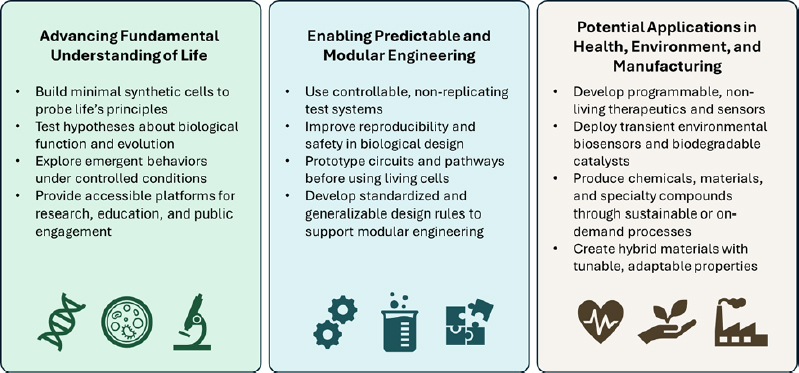
Advancing Understanding of Life
Synthetic cell research is motivated in large part by its potential to advance understanding of the physical and chemical principles underlying life. By reconstructing minimal functional systems from defined biomolecular components, researchers can test hypotheses about core biological processes such as gene expression, metabolism, membrane transport, homeostasis, mutation, and evolution. These controllable “build-to-understand” systems, including cell-free extracts and encapsulated constructs, allow bottom-up exploration of adaptive behaviors, spatial organization, and emergent properties such as self-assembly or pattern formation (Rothschild et al., 2024). Synthetic cells capable of replication offer further opportunities to investigate differentiation, development, and selection. These efforts complement efforts to articulate general “rules of life” that govern biological structure and function (NASEM, 2023). In addition to supporting fundamental research, synthetic cells provide accessible, interdisciplinary training platforms and can help communicate core biological concepts to broader audiences (Smith et al., 2025).
Enabling Predictable and Modular Engineering of Biological Functions
Alongside advancing knowledge, synthetic cells may also support a more predictable and modular approach to engineering biological functions1 by enabling the design of systems that, in many applications, do not replicate, mutate, or evolve. This can allow their composition and behavior to remain fixed over time and can improve reproducibility and safety, particularly for applications in which environmental release is either desired or of concern. This controllability makes synthetic cells useful as standardized testbeds for investigating genetic circuits, biochemical pathways, and signaling networks under defined conditions (Groaz et al., 2020). Their simplicity and programmability also position them as intermediate platforms for prototyping and model validation, such as examining feedback loops or assessing how membrane properties and energy flux influence encapsulated reactions (Jeong et al., 2020; Rothschild et al., 2024). Although not a replacement for engineering living organisms, synthetic cells can complement work in microbial and cellular engineering by reducing uncertainty in the design process and improving the reliability of downstream applications (Cooper, 2025; Kriebisch et al., 2025).
Potential Applications in Health, Environmental Management, and Manufacturing
Synthetic cell technologies, although still in the research phase, have been proposed for a range of applications in health, environmental management, and sustainable manufacturing, drawing on their controllable biochemical functions and designable biosafety
___________________
1 Efforts to engineer life have coexisted with efforts to understand life since Jacques Loeb’s first studies of artificial parthenogenesis, a form of reproduction in which an embryo develops from an unfertilized egg (Crowe, 2020).
features. In biomedicine, synthetic cells could act as programmable, non-living carriers for sensing or delivering therapeutic molecules or as simplified models for studying immune interactions and cell communication (Allen et al., 2023; Moghimianavval et al., 2025; Parkes et al., 2025; Sato et al., 2021), with recent work exploring their use in bacteriophage therapy research (Kulkarni et al., 2025). In environmental contexts, they may function as transient biosensors or biodegradable biocatalysts for pollutant detection or remediation (Rothschild et al., 2024; Thavarajah et al., 2020), with non-replicating designs and the potential use of non-canonical DNA helping to limit persistence and gene transfer (Abbott et al., 2025).
Synthetic cells also offer opportunities in biomanufacturing. Compartmentalized systems could improve reaction coupling, energy regeneration, and product isolation; support production involving non-traditional biochemistries (e.g., nonstandard amino acids, xenonucleic acids or XNAs, and alternate chiralities) not easily accessible by existing biological systems; or enable small-scale, on-demand synthesis of specialty compounds (Noireaux and Libchaber, 2004; Rothschild et al., 2024). Hybrid systems that integrate synthetic cells with inorganic or polymeric materials may eventually support adaptive materials or microreactors (Rothschild et al., 2024). Although many applications remain speculative, several of these possibilities are explored through hypothetical case study illustrations in Chapter 5, underscoring both the potential of synthetic cells and the importance of considering associated risks and uncertainties as the field advances.
Synthetic cells represent an emerging approach for understanding and applying biological principles in a controllable, modular, and potentially less risky manner. In the near term, they are likely to have their greatest impacts as tools for discovery and education. Over the longer term, advances in synthetic cell research could enable applications in medicine, environmental management, and sustainable manufacturing. As with other emerging biotechnologies, realizing these benefits requires careful attention to potential risks and uncertainties. Because synthetic cells are an emerging class of technologies, anticipating potential risks and understanding areas of uncertainty is important for supporting their responsible development and use. The following section describes the primary categories of risks that may accompany the development and application of synthetic cells.
THE POTENTIAL RISKS OF SYNTHETIC CELLS
Synthetic cells pose a range of potential risks that depend on their properties, intended applications, and the environments into which they may be introduced. As in other areas of biotechnology, established risk domains such as exposure pathways, persistence, and ecological interactions remain important considerations for synthetic cells. A 2017 National Academies analysis examining future products of biotechnology concluded that although such products, including synthetic cells, are not expected to
introduce new human health or environmental risk-assessment endpoints,2 the pathways leading to those endpoints may be more complex and may require new analytical approaches, expertise, or additional information to address (NASEM, 2017b).
Assessing risks associated with synthetic cells requires attention to both the likelihood and consequences of potential adverse events, including their severity, reversibility, and broader social and economic implications, while recognizing that inaction also carries risk (IRGC, 2010; Lundgren and McMakin, 2018; OECD, 2025; Schoch-Spana et al., 2019). Assessing synthetic cell risks will also require incorporation of temporal dynamics as the stability of these systems is a time-dependent variable that will determine the duration of potential exposure. At present, significant uncertainty remains regarding the operational timescales of these systems in non-laboratory settings. While some architectures will be designed for rapid degradation following a programmed task, others could exhibit prolonged environmental persistence due to the absence of natural predatory or degradative pathways. Uncertainties may be greater for constructs that incorporate non-traditional biochemistries or synthetic components. This section organizes potential risks into four broad categories—accidental or unanticipated release, intentional release for beneficial purposes, deliberate misuse or dual use, and broader ecological and societal effects. Methods for assessing risks and benefits in the presence of uncertainty are discussed in Chapter 3.
Accidental or Unanticipated Release
Accidental release refers to the unintended escape of synthetic cells or associated materials from contained environments, such as laboratories or production facilities, due to equipment failures, improper waste management, or transportation accidents. The consequences of these events depend on the nature and stability of the synthetic cells involved and the environments into which they are released. Key considerations include whether a synthetic cell can replicate or persist, whether it is intended solely for contained use or for limited- or open-release applications, and whether it employs biochemistries not found in nature (see further discussion on core evaluative questions in Chapter 2). Even synthetic cells designed to be non-viable or self-limiting may behave unpredictably outside of controlled conditions, particularly if environmental factors influence survival, replication, or interactions with natural organisms. Potential adverse events, such as occupational exposure, localized contamination, or ecological disruption, can lead to impacts that include harm to humans, animals, plants, or the environment. Economic costs associated with containment, cleanup, and reputational harm to institutions or sectors involved could also be incurred.
___________________
2 Defined in the National Academies’ 2016 report Gene Drives on the Horizon: Advancing Science, Navigating Uncertainty, and Aligning Research with Public Values, risk-assessment endpoint refers to “a societal, human health, or environmental value that is to be managed or protected. Endpoints reflect decisions that need to be made, and are sometimes determined by regulatory requirements” (NASEM, 2016, Chapter 6).
Intentional Release for Beneficial Uses
Certain applications may involve the deliberate release of synthetic cells into the environment, for example, to support bioremediation, agriculture, or biosensing (see cases for each of these applications in Chapter 5). The open-environment context introduces uncertainties not traditionally present in contained laboratory settings (Brooks and Alper, 2021; Lea-Smith et al., 2025). For example, environmental variability, interactions with other organisms, and horizontal gene transfer could alter performance or introduce secondary risks. Potential consequences include changes in microbial community dynamics, effects on soil chemistry or plant growth, and the emergence of unintended byproducts or toxic intermediates. These risks can be weighed alongside the intended benefits, such as pollutant removal or improved crop yield, when evaluating overall impact.
Deliberate Misuse, Dual Use, and Security Concerns
Synthetic cell technologies, because of their programmability and modularity, could present dual use or security risks if their capabilities were intentionally repurposed for harm. While these platforms enable beneficial innovation, hostile actors could misapply such systems to create or deliver hazardous agents, circumvent detection or surveillance systems, or conceal prohibited biological activities (NRC, 2004). Deliberate misuse could also generate economic impacts, including costs associated with incident response, supply-chain disruption, or reputational damage to institutions or sectors involved (NSCEB, 2025). The consequences of such misuse, similar to those associated with accidental release or intentional release for beneficial purposes, could impact public health, environmental safety, and national security and undermine public confidence in biotechnology.
The feasibility of these scenarios depends heavily on actor attributes. The National Academies’ 2018 report Biodefense in the Age of Synthetic Biology emphasizes that expertise, access to specialized equipment, and organizational capacity shape the likelihood of misuse (NASEM, 2018). Many misuse scenarios are not practical for unskilled or resource-limited actors, but well-resourced state or non-state groups may be better positioned to exploit emerging synthetic cell capabilities as the field advances. Some analyses also note that adversarial actors could seek military or strategic advantage through advanced biotechnologies (NSCEB, 2025), underscoring the need for continued attention to potential pathways for deliberate misuse.
Broader Ecological, Occupational, and Societal Risks
Beyond specific incidents or deliberate misuse, synthetic cell research intersects with broader systemic risks that affect ecosystems, workers, and societies. Ecologically, synthetic cells could disrupt nutrient cycles, alter microbiomes, or affect keystone species, with cascading consequences for ecosystems. At the same time, ecological systems have the capacity to damp perturbations and recover from disturbance, as described in
foundational work on ecosystem stability and resilience (May, 1972; Zhu et al., 2025). Although these ecosystem dynamics are not fully understood, they are an inherent feature of environmental systems and may influence how perturbations unfold over time.
Occupational risks may arise from exposure to novel biomolecules or metabolites of uncertain toxicities, particularly where workplace controls, training, or monitoring systems have not yet been adapted for engineered, non-living, biologically active systems (Howard et al., 2017; Murashov et al., 2020). Possible scenarios include potential exposure to biological vectors, novel biological constructs, or hazardous materials associated with scaled-up synthetic biology workflows, highlighting a need for updated risk assessment and occupational safety guidance.
Societal risks may emerge if synthetic cells challenge ethical norms, displace community activities, disrupt livelihoods, or create new privacy or security concerns. New technological capabilities may prompt the reassessment of existing ethical frameworks, as occurred with reproductive cloning and later with human genome editing (Funk et al., 2016; NASEM, 2017a). Societal and political contexts can also evolve in ways that shift public interpretations of what constitutes acceptable or unacceptable use. The integration of synthetic cells into sectors such as agriculture, waste management, or biomanufacturing could alter traditional practices, redistribute economic opportunities, or raise concerns about control, consent, and data stewardship when synthetic cells are used in sensing or monitoring applications (Attal-Juncqua et al., 2024). Public trust may be undermined if communication is insufficient or perceived as opaque.
Economic impacts on labor markets, supply chains, or public budgets form another dimension of potential risk meriting continued analysis within mitigation planning. These impacts could include shifts in workforce skill requirements, changes in demand for specialized materials or infrastructure, vulnerabilities associated with scaling biomanufacturing, or increased dependence on specific inputs, standards, or intellectual property (NSCEB, 2025; OECD, 2023). Although synthetic biology is often envisioned as a source of economic resilience and supply-chain independence, transitions may create uneven burdens or expose new points of fragility. Assessing economic risks therefore involves evaluating both potential benefits and potential disruptions as synthetic cell applications expand.
Taken together, these potential benefits and risks show that synthetic cells advance scientific and societal opportunities while also introducing uncertainties that may not fit neatly within existing oversight approaches. Placing these considerations in historical context helps clarify how current biosafety, biosecurity, and environmental frameworks evolved, where they remain robust, and where new capabilities like synthetic cells may challenge long-standing assumptions. The next section situates synthetic cell research within this broader governance landscape to highlight how past experience can guide future policy adaptation.
HISTORICAL AND POLICY CONTEXT FOR SYNTHETIC CELL GOVERNANCE
Governance of synthetic cell research and development is embedded within a broader historical and policy landscape for biotechnology that has evolved in response to scientific advances, shifting societal expectations, and changing perceptions of risk. Since the 1970s policy makers have repeatedly confronted the challenge of balancing scientific innovation with responsible oversight as new biological capabilities have tested the adequacy of existing governance frameworks. This evolution has been shaped by recurring cycles in which technological advances expose gaps in legacy oversight systems, prompting incremental but significant policy adaptation, discussed further in Appendix A.
Historical analysis shows that most U.S. biosafety and biosecurity policies and mechanisms designed to address environmental and societal risks have largely been reactive rather than anticipatory, emerging in response to biocrimes, laboratory accidents, and global outbreaks (Gillum, 2025). This pattern forms the backdrop for evaluating whether existing systems are prepared for emerging technologies such as synthetic cells, which may challenge traditional chemical-biological distinctions and fall outside the categorical or pathogen-centered paradigms common in biosafety and biosecurity frameworks.
Together, existing biosafety, biosecurity, chemical safety, and environmental protection policies provide the core oversight and regulatory structures most likely to apply as synthetic cells move from research toward application. However, many biosafety policies were developed during earlier phases of biotechnology and were originally designed to address recombinant DNA constructs and conventional genetically engineered organisms. As a result, some synthetic cells may not explicitly fall under these oversight frameworks, particularly when they lack genomic material or do not meet traditional definitions of living organisms. Similarly, many biosecurity tools rely on list-based regulation of specific organisms, agents, or sequences, an approach that can become less applicable for synthetic cells that lack clear lineage, taxonomic identity, or conventional biological attributes. Chemical oversight adds additional complexity, because synthetic cells may incorporate non-biological components, catalysts, polymers, or nanomaterials that fall under occupational safety and chemical regulatory frameworks rather than biological ones. Environmental governance further varies depending on whether activities fall under research oversight, such as institutional biosafety review, or under regulatory review triggered by specific applications, including intentional environmental release under the authority of the Environmental Protection Agency, Food and Drug Administration, or United States Department of Agriculture (Brooks and Alper, 2021; Chemla et al., 2025; Lea-Smith et al., 2025).
Governance of emerging technology has long faced a pacing problem, in which technologies advance more rapidly than the development or adaptation of mechanisms for oversight and control (Marchant, 2011; Trump et al., 2020). And, although these biosafety, biosecurity, chemical safety, and environmental protection instruments provide important foundations for overseeing biotechnology research and development,
they were primarily developed in response to earlier generations of biological technologies (Epstein, 2025; Gillum, 2025; Millet et al., 2023; NSCEB, 2025). Consequently, responsibilities for preventing accidental harm, mitigating environmental risks, and addressing risks of deliberate misuse are distributed across multiple policy instruments, institutional processes, and agencies, each with distinct triggers, scopes, and points of intervention. For emerging areas such as synthetic cell research, this distribution can lead to gaps, overlaps, and inconsistent application of governance mechanisms as research progresses toward application.
The Coordinated Framework for the Regulation of Biotechnology, which allocates regulatory responsibility among federal agencies based on product characteristics and statutory authority rather than method of creation, operates across statutes enacted at different times and under distinct policy mandates (OSTP, 2017). As a result, agencies may apply differing regulatory standards, evidentiary thresholds, and procedural requirements when evaluating comparable risks, depending on statutory jurisdiction. Although this structure has provided flexibility and allowed agencies to act within established authorities, it can also contribute to fragmentation, inefficiencies, and uncertainty, particularly for technologies such as synthetic cells that span biological, chemical, and hybrid domains. Strengthening interagency coordination and promoting greater consistency in how existing authorities are applied may therefore improve coherence without requiring the creation of a separate regulatory category for synthetic cells.
Present-day governance discussions underscore that emerging technologies increasingly require oversight approaches that extend beyond pathogen-focused risk models traditionally emphasized in biosafety and biosecurity frameworks. Recent initiatives to modernize and strengthen biosafety oversight (NIH Office of Science Policy, n.d.) that call for improving the safety and security of biological research (The White House, 2025) have further shaped this discussion (NSCEB, 2025). The 2025 Spirit of Asilomar Summit, convened to reflect on the legacy of the 1975 Asilomar Conference for contemporary biotechnology, highlighted the need for proactive guidance that addresses environmental impacts, ethical considerations, and life cycle–based governance for technologies such as synthetic cells. Participants identified gaps in existing governance approaches related to ecological interactions, unintended consequences, responsible innovation, and questions about appropriate uses of life-like constructs. The summit produced 27 “entreaties,” signed statements offering recommendations intended to inform future biotechnology governance, several of which speak directly to issues raised by synthetic cell research (Rice University, 2025).
Collectively, these developments illustrate a long-standing pattern in biotechnology governance: As scientific capabilities expand, particularly at the boundaries between established regulatory domains, oversight systems must evolve to remain effective. As AI, engineering biology, and synthetic cell research continue to converge, maintaining safety, security, public trust, and global coherence will increasingly depend on governance approaches that are anticipatory, flexible, and grounded in empirical evidence (Trump et al., 2026).
STUDY CHARGE, SCOPE, AND APPROACH
Recognizing the potential of engineering biology and its broad societal impacts, Congress, through the CHIPS and Science Act of 2022, directed the National Science Foundation (NSF) to enter into an agreement with the National Academies of Sciences, Engineering, and Medicine to “conduct a review, and make recommendations with respect to, the ethical, legal, environmental, safety, security, and other appropriate societal issues related to engineering biology research and development” (CHIPS and Science Act, H.R. 4346, § 10405).
Given the unique potential of synthetic cells, a subfield of engineering biology research and development (R&D), NSF asked the National Academies in April 2025 to narrow the study’s focus to biosafety, biosecurity, and environmental considerations for synthetic cell research. The National Academies appointed a committee of experts to review and make recommendations on biosafety and biosecurity considerations for synthetic cell R&D in both contained laboratory and environmental release applications (see Box 1-1). As part of its charge, the committee was asked to provide guidance to the White House Office of Science and Technology Policy (OSTP), the National Security Council (NSC), and the broader interagency community to ensure that the public benefits of synthetic cell R&D are maximized while potential safety, security, and environmental risks are minimized.
BOX 1-1
Statement of Task
The National Academies of Sciences, Engineering, and Medicine (NASEM) will appoint an ad hoc committee to review and make recommendations on the biosafetya and biosecurityb issues related to synthetic cells, focusing on assessing and reducing risks in both laboratory contained and environmental release applications. The committee will address the scholarship and practice of addressing these issues, focusing specifically on:
- An assessment of the current knowledge and practice on assessing and mitigating environmental and biosafety issues of synthetic cells,
- A description of the gaps and needs relating to such issues, and
- Actionable recommendations for the generation of decision-frameworks and approaches that would help NSC and OSTP as well as other federal agencies develop policy to ensure public safety.
__________________
a Biosafety refers to measures for preventing occupational infections in a biomedical environment or release of organisms to the environment (ABSA, https://absa.org/biosafety/).
b Biosecurity refers to both measures for protecting and managing “risks associated with food, agriculture, health, and environment”, and for preventing “loss, theft, or deliberate misuse of biological material, technology,” or research related to information (BMBL 6th Edition, CDC and NIH, 2020).
Committee Assembly and Study Process
A committee of 15 experts was convened by the National Academies, with expertise spanning engineering biology, synthetic cells, life sciences, environmental sciences, social sciences, biosafety and biosecurity, regulatory science, and policy. A full list of committee members and biographies is provided in Appendix B.
To fulfill its charge, the committee held a series of meetings between February and December 2025, including public information-gathering sessions featuring invited experts and closed sessions for deliberation. The topics covered in these sessions, along with speaker lists and agendas, are detailed in Appendix C. The committee also reviewed relevant literature and policy documents and used evidence gathered through these activities to develop the report’s conclusions and recommendations.
Interpreting and Addressing the Statement of Task
Although the statement of task focuses on assessing and managing risks, the committee interpreted the evaluation of potential benefits as an essential part of that charge, an interpretation reinforced by sponsor input during the first information-gathering session. Decisions about research that carries some degree of risk necessarily depend on the value of the outcomes the research could enable. The committee therefore viewed risk assessment not as separate from benefit assessment but as a process that helps achieve scientific, societal, and economic goals, including those related to national security.
Definitions of synthetic cells vary across the scientific community. For this study, the committee adopted a continuum-based framework centered on characteristics most relevant to biosafety, biosecurity, and ecological assessment (see Chapter 2). The goal of this report is not to resolve ongoing definitional debates but to provide guidance for a rapidly evolving area of research and policy. The synthetic cell continuum introduced herein offers a practical framework for current and foreseeable technologies, and the cases illustrate how constructs along this continuum differ from both conventional genetically engineered organisms and standard chemical systems (see Chapter 5).
In reviewing governance and regulatory issues, the committee recognized that many challenges relevant to synthetic cells also arise across the broader field of engineering biology. The committee therefore considered, on a case-by-case basis, which issues warranted inclusion to remain responsive to its charge, while situating synthetic cells within the broader policy landscape for biotechnology and engineering biology. This same consideration guided the development of conclusions and recommendations, particularly in determining how synthetic cells should be understood within the broader policy landscape for biotechnology and engineering biology.
The report is focused primarily on U.S. regulatory pathways for synthetic cells, reflecting the policy context most directly relevant to the statement of task. It does not attempt to assess or harmonize regulatory systems globally, nor does it compare the performance of different national approaches to biotechnology governance. Given long-standing challenges in international regulatory harmonization, the committee uses the U.S. framework as a case study for how existing statutes, institutions, and oversight mechanisms may be interpreted and applied to an emerging area of biotechnology.
Many of the governance principles and considerations discussed may nevertheless be informative for other jurisdictions, particularly where similar regulatory structures or policy objectives exist.
Finally, consistent with the committee’s charge, the report does not undertake a comprehensive evaluation of the ethical or economic arguments for or against pursuing synthetic cell research. At the same time, the committee recognizes that decisions about whether and how to advance such research are not purely technical. Judgments about acceptable risk, anticipated benefit, and appropriate oversight reflect broader societal values and may warrant attention to transparency, stakeholder engagement, and public trust. These considerations are noted throughout the report, including in discussions of governance frameworks in Chapter 4, case-based analyses and public trust considerations in Chapter 5, and the discussion of anticipatory governance and responsible innovation in Chapter 6. Appendix A provides additional context regarding ethical considerations relevant to synthetic cell research. Together, the frameworks, cases, and discussion of uncertainty in this report are intended to inform broader deliberations by agencies, policymakers, and the research community.
Organization of the Report
The report consists of seven chapters. Chapter 1 introduces synthetic cell research, outlines potential benefits and risks, and situates these topics within the historical and policy landscape of biosafety, biosecurity, and environmental governance. Chapter 2 defines “synthetic cells” and presents the conceptual and technical foundations used throughout the report, including the synthetic cell continuum and core evaluative questions. Chapter 3 reviews analytical approaches for assessing risks, benefits, and uncertainties.
Chapter 4 analyzes the current governance ecosystem, identifying oversight gaps and assessing how policies apply to constructs across the synthetic cell continuum. Chapter 5 presents cases illustrating how specific attributes of synthetic cells shape biosafety, biosecurity, ecological, and broader societal considerations. Chapter 6 outlines a national strategy for responsible innovation, highlighting coordination needs, decision-support tools, workforce development, and opportunities for interagency and international collaboration. Chapter 7 summarizes the committee’s conclusions and provides actionable recommendations for policymakers, research institutions, funders, and practitioners. Table 1-1 shows how specific components of the statement of task are addressed throughout the report.
TABLE 1-1 Crosswalk of Statement of Task Elements, Key Questions Addressed, and Report Components
| Statement of Task Element | Key Questions Addressed | Where Addressed in the Report |
|---|---|---|
| Assess the current knowledge and practice for assessing and mitigating biosafety and environmental issues of synthetic cells |
|
Ch. 1 (Overview of potential benefits and risks) Ch. 2 (Synthetic cell continuum and core evaluative questions) Ch. 3 (Risk assessment, benefit-cost analysis, and decision-science tools) Ch. 4 (Existing governance frameworks and oversight mechanisms) Ch. 5 (Cases illustrating biosafety, biosecurity, and environmental considerations across applications) Appendix A (Historical foundations of biotechnology governance) |
| Describe gaps and needs related to biosafety, biosecurity, and environmental considerations for synthetic cells |
|
Ch. 2 (Definitional ambiguity and governance challenges) Ch. 3 (Limits of traditional risk assessment under uncertainty and ignorance) Ch. 4 (Governance gaps, fragmentation, and jurisdictional uncertainty) Ch. 5 (Case-based identification of oversight gaps, especially for environmental and consumer contexts) Appendix D (Supplemental biosecurity and cross-domain oversight questions) |
| Statement of Task Element | Key Questions Addressed | Where Addressed in the Report |
|---|---|---|
| Provide actionable recommendations to support decision frameworks and policy development for ensuring public safety |
|
Ch. 6 (National strategy for responsible innovation; decision-support tools; coordination mechanisms) Ch. 7 (Overarching conclusions and actionable recommendations) Table 7-1 (Crosswalk of conclusions, recommendations, and supporting evidence) |
REFERENCES
Abbott, Z., Z. N. Adelman, Y. Elani, P. Freemont, C. I. Kiattisewee, K. A. Molla, R. M. Murray, and L. Rudenko. 2025. 4.3 Synthetic Cells for Environmental Release. In The Spirit of Asilomar and the Future of Biotechnology. Rice University. https://doi.org/10.25611/TRA2-AT67.
Allen, M. E., J. W. Hindley, N. O’Toole, H. S. Cooke, C. Contini, R. V. Law, O. Ces, and Y. Elani. 2023. Biomimetic Behaviors in Hydrogel Artificial Cells Through Embedded Organelles. Proceedings of the National Academy of Sciences 120 (35): e2307772120. https://doi.org/10.1073/pnas.2307772120.
Attal-Juncqua, A., G. Dods, N. Crain, J. Diggans, D. Dodds, S. Evans, N. Fackler, K. Flyangolts, K. Gibson, M. E. Kosal, A. Kunjapur, R. Read, B. Renda, C. D. Scown, K. Tchedre, K. Ternus, B. Vitalis, and G. Gronvall. 2024. Shaping the Future US Bioeconomy Through Safety, Security, Sustainability, and Social Responsibility. Trends in Biotechnology 42 (6): 671–673. https://doi.org/10.1016/j.tibtech.2023.11.015.
Brooks, S. M., and H. S. Alper. 2021. Applications, Challenges, and Needs for Employing Synthetic Biology Beyond the Lab. Nature Communications 12 (1): 1390. https://doi.org/10.1038/s41467-021-21740-0.
Carbonell, P., T. Radivojevic, and H. G. Martin. 2019. Opportunities at the Intersection of Synthetic Biology, Machine Learning, and Automation. ACS Synthetic Biology 8 (7): 1474–1477. https://doi.org/10.1021/acssynbio.8b00540.
Chemla, Y., C. J. Sweeney, C. A. Wozniak, and C. A. Voigt. 2025. Design and Regulation of Engineered Bacteria for Environmental Release. Nature Microbiology 10 (2): 281–300. https://doi.org/10.1038/s41564-024-01918-0.
CDC (Centers for Disease Control and Prevention) and NIH (National Institutes of Health). 2020. Biosafety in Microbiological and Biomedical Laboratories. Edited by P. J. Meechan and J. Potts. 6th ed. Washington, DC: Department of Health and Human Services.
Cooper, V. 2025. Presentation to the NASEM Committee on Environmental, Biosafety, and Biosecurity Considerations for Synthetic Cell Research and Development. Accessed April 1, 2026. https://www.nationalacademies.org/projects/DELS-BLS-22-12/event/44603.
Crowe, N. 2020. The Engineering Ideal: Loeb’s Ghost, or Something Else? Historical Studies in the Natural Sciences 50 (5): 624–632. https://www.jstor.org/stable/48736340.
EBRC (Engineering Biology Research Consortium). 2025. EBRC Research Roadmaps: Engineering Biology. Accessed April 1, 2026. https://roadmap.ebrc.org/2019-roadmap/.
Endy, D. 2005. Foundations for Engineering Biology. Nature 438 (7067): 449–453. https://doi.org/10.1038/nature04342.
Epstein, G. L. 2025. The Evolution of United States Governance Policies for Research Using Pathogens with Enhanced Pandemic Potential. Applied Biosafety 30 (2): 79–96. https://doi.org/10.1089/apb.2024.0049.
Eslami, M., A. Adler, R. S. Caceres, J. G. Dunn, N. Kelley-Loughnane, V. A. Varaljay, and H. G. Martin. 2022. Artificial Intelligence for Synthetic Biology. Communications of the ACM 65 (5): 88–97. https://doi.org/10.1145/3500922.
Funk, C., B. Kennedy, and E. P. Sciupac. 2016. 2. U.S. Public Opinion on the Future Use of Gene Editing. Pew Research Center. https://www.pewresearch.org/internet/2016/07/26/u-s-public-opinion-on-the-future-use-of-gene-editing/.
Gillum, D. R. 2025. Balancing Innovation and Safety: Frameworks and Considerations for the Governance of Dual-Use Research of Concern and Potential Pandemic Pathogens. Applied Biosafety 30 (2): 69–78. https://doi.org/10.1089/apb.2024.0033.
Groaz, A., H. Moghimianavval, F. Tavella, T. W. Giessen, A. G. Vecchiarelli, Q. Yang, and A. P. Liu. 2020. Engineering Spatiotemporal Organization and Dynamics in Synthetic Cells. WIREs Nanomedicine and Nanobiotechnology 13 (3): e1685. https://doi.org/10.1002/wnan.1685.
Groff-Vindman, C. S., B. D. Trump, C. L. Cummings, M. Smith, A. J. Titus, K. Oye, V. Prado, E. Turmus, and I. Linkov. 2025. The Convergence of AI and Synthetic Biology: The Looming Deluge. Biomedical Innovations 2 (1): 20. https://doi.org/10.1038/s44385-025-00021-1.
Howard, J., V. Murashov, and P. Schulte. 2017. Synthetic Biology and Occupational Risk. Journal of Occupational and Environmental Hygiene 14 (3): 224–236. https://doi.org/10.1080/15459624.2016.1237031.
IRGC (International Risk Governance Council). 2010. Guidelines for the Appropriate Risk Governance of Synthetic Biology (Policy Brief). International Risk Governance Council. https://irgc.org/wp-content/uploads/2018/09/irgc_SB_final_07jan_web.pdf.
Jeong, S., H. T. Nguyen, C. H. Kim, M. N. Ly, and K. 2020. Toward Artificial Cells: Novel Advances in Energy Conversion and Cellular Motility. Advanced Functional Materials 30 (11): 1907182. https://doi.org/10.1002/adfm.201907182.
Kriebisch, C. M. E., O. Bantysh, L. B. Pellejero, A. Belluati, E. Bertosin, K. Dai, M. de Roy, H. Fu, N. Galvanetto, J. M. Gibbs, S. S. Gomez, G. Granatelli, A. Griffo, M. Guix, C. O. Gurdap, J. Harth-Kitzerow, I. S. Haugerud, G. Häfner, P. Jaiswal, S. Javed, A. Karimi, S. Kato, B. A. K. Kriebisch, S. Laha, P.-W. Lee, W. P. Lipinski, T. Matreux, T. C. T. Michaels, E. Poppleton, A. Ruf, A. D. Slootbeek, I. B. A. Smokers, H. Soria-Carrera, A. Sorrenti, M. Stasi, A. Stevenson, A. Thatte, M. Tran, M. H. I. van Haren, H. D. Vuijk, S. F. J. Wickham, P. Zambrano, K. P. Adamala, K. Alim, E. S. Andersen, C. Bonfio, D. Braun, E. Frey, U. Gerland, W. T. S. Huck, F. Jülicher, N. Laohakunakorn, L. Mahadevan, S. Otto, J. Saenz, P. Schwille, K. Göpfrich, C. A. Weber, and J. Boekhoven. 2025. A Roadmap Toward the Synthesis of Life. Chem 11 (3): 102399. https://doi.org/10.1016/j.chempr.2024.102399.
Kulkarni, V., N. Laohakunakorn, and S. B. W. Liyanagedera. 2025. Synthetic Cells for Phage Therapy: A Perspective. Frontiers in Cellular and Infection Microbiology 15: 1690404. https://doi.org/10.3389/fcimb.2025.1690404.
Lea-Smith, D. J., F. Hassard, F. Coulon, N. Partridge, L. Horsfall, K. D. J. Parker, R. D. J. Smith, R. R. McCarthy, B. McKew, T. Gutierrez, V. Kumar, G. Dotro, Z. Yang, Z., EBIC partners, and N. Krasnogor. 2025. Engineering Biology Applications for Environmental Solutions: Potential and Challenges. Nature Communications 16 (1): 3538. https://doi.org/10.1038/s41467-025-58492-0.
Lundgren, R. E., and A. H. McMakin. 2018. Risk Communication: A Handbook for Communicating Environmental, Safety, and Health Risks, 6th ed. Wiley-IEEE Press.
Marchant, G. E. 2011. Addressing the Pacing Problem. In The Growing Gap Between Emerging Technologies and Legal-Ethical Oversight: The Pacing Problem, edited by G. E. Marchant, B. R. Allenby, and J. R. Herkert. Dordrecht: Springer Netherlands. Pp. 199–205. https://doi.org/10.1007/978-94-007-1356-7_13,
May, R. M. 1972. Will a Large Complex System Be Stable? Nature 238 (5364): 413–414. Accessed April 1, 2026. https://doi.org/10.1038/238413a0.
Millett, P., T. Alexanian, K. R. Brink, S. R. Carter, J. Diggans, M. J. Palmer, R. Ritterson, J. B. Sandbrink, and N. E. Wheeler. 2023. Beyond Biosecurity by Taxonomic Lists: Lessons, Challenges, and Opportunities. Health Security 21 (6): 521–529. https://doi.org/10.1089/hs.2022.0109.
Moghimianavval, H., C. Newell, P. Parvizian, M. J. Booth, and A. P. Liu. 2025. Strategies and Applications of Synthetic Cell Communication. Nature Chemical Biology 21: 1317–1329. https://doi.org/10.1038/s41589-025-02002-2.
Murashov, V., J. Howard, and P. Schulte. 2020. Synthetic Biology Industry: Biosafety Risks to Workers. In Synthetic Biology 2020: Frontiers in Risk Analysis and Governance, edited by B. D. Trump, C. L. Cummings, J. Kuzma, and I. Linkov. Cham: Springer International Publishing. Pp. 165–182.
NASEM (National Academies of Sciences, Engineering, and Medicine). 2016. Gene Drives on the Horizon: Advancing Science, Navigating Uncertainty, and Aligning Research with Public Values. Washington, DC: The National Academies Press. https://doi.org/10.17226/23405.
NASEM. 2017a. Human Genome Editing: Science, Ethics, and Governance. Washington, DC: The National Academies Press. https://doi.org/10.17226/24623.
NASEM. 2017b. Preparing for Future Products of Biotechnology. Washington, DC: The National Academies Press. https://doi.org/10.17226/24605.
NASEM. 2018. Biodefense in the Age of Synthetic Biology. Washington, DC: The National Academies Press. https://doi.org/10.17226/24890.
NASEM. 2023. Understanding the Rules of Life Program: Scientific Advancements and Future Opportunities. Washington, DC: The National Academies Press. https://doi.org/10.17226/27021.
NASEM. 2024. Artificial Intelligence and Automated Laboratories for Biotechnology: Leveraging Opportunities and Mitigating Risks: Proceedings of a Workshop—in Brief. Washington, DC: The National Academies Press. https://doi.org/10.17226/27469.
NIH (National Institutes of Health) Office of Science Policy. n.d. Biosafety and Biosecurity Policy. Accessed April 1, 2026. https://osp.od.nih.gov/policies/biosafety-and-biosecurity-policy/#tab1/.
Noireaux, V., and A. Libchaber. 2004. A Vesicle Bioreactor as a Step Toward an Artificial Cell Assembly. Proceedings of the National Academy of Sciences 101 (51): 17669–17674. https://doi.org/10.1073/pnas.0408236101.
NRC (National Research Council). 2004. Biotechnology Research in an Age of Terrorism. Washington, DC: The National Academies Press. https://doi.org/10.17226/10827.
NSCEB (National Security Commission on Emerging Biotechnology). 2025. Maximize the Benefits of Biotechnology and Defense. Chapter 3 in Charting the Future of Biotechnology: An Action Plan for American Security and Prosperity. NSCEB. Accessed April 1, 2026. https://www.biotech.senate.gov/final-report/chapters/chapter-3/.
OECD (Organisation for Economic Co-operation and Development). 2023. The Bioeconomy to 2030: Designing a Policy Agenda. Paris: OECD Publishing. Accessed April 1, 2026. https://doi.org/10.1787/9789264056886-en.
OECD. 2025. OECD Science, Technology and Innovation Outlook 2025: Driving Change in a Shifting Landscape. Paris: OECD Publishing. Accessed April 1, 2026. https://doi.org/10.1787/5fe57b90-en.
OSTP (Office of Science and Technology Policy). 2017. Modernizing the Regulatory System for Biotechnology Products: Final Version of the 2017 Update to the Coordinated Framework for the Regulation of Biotechnology Products. Washington, DC: The White House. https://obamawhitehouse.archives.gov/sites/default/files/microsites/ostp/2017_coordinated_framework_update.pdf.
Parkes, E., A. Al Samad, G. Mazzotti, C. Newell, B. Ng, A. Radford, and M. J. Booth. 2025. Magnetic Activation of Spherical Nucleic Acids Enables the Remote Control of Synthetic Cells. Nature Chemistry 17 (10): 1505–1513. https://doi.org/10.1038/s41557-025-01909-6.
Rice University. 2025. The Spirit of Asilomar and the Future of Biotechnology. Accessed April 1, 2026. https://hdl.handle.net/1911/118546.
Rothschild, L. J., N. J. H. Averesch, E. A. Strychalski, F. Moser, J. I. Glass, R. C. Perex, I. O. Yekinni, B. Rothschild-Mancinelli, G. A. R. Kingman, F. Wu, J. Waeterschoot, I. A. Ioannou, M. C. Jewett, A. P. Liu, V. Noireaux, C. Sorenson, and K. P. Adamala. 2024. Building Synthetic Cells—From the Technology Infrastructure to Cellular Entities. ACS Synthetic Biology 13 (4): 974–997. https://doi.org/10.1021/acssynbio.3c00724.
Sato, W., T. Zajkowski, F. Moser, and K. P. Adamala. 2021. Synthetic Cells in Biomedical Applications. WIREs Nanomedicine and Nanobiotechnology 14 (2): e1761. https://doi.org/10.1002/wnan.1761.
Schoch-Spana, M., C. Hurtado, D. Meyer, K. Moore-Sheeley, S. Ravi, and M. Snyder. 2019. Risk Communication Strategies for the Very Worst of Cases: How to Issue a Call to Action on Global Catastrophic Biological Risks. Johns Hopkins Center for Health Security. https://centerforhealthsecurity.org/sites/default/files/2022-12/190304-risk-comm-strategies.pdf.
Smith, J. A., J. Wagstaff, J. Glass, D. Matias de Carvalho Bittencourt, A. S. Mitra, L. Chitayat, and K. P. Adamala. 2025. 4.1 Safeguarding the Benefits of Synthetic Cell Engineering. In The Spirit of Asilomar and the Future of Biotechnology. Rice University. Accessed April 1, 2026. https://repository.rice.edu/items/68032baa-915f-4777-b613-9641824be028.
Thavarajah, W., M. S. Verosloff, J. K. Jung, K. K. Alam, J. D. Miller, M. C. Jewett, S. L. Young, and J. B. Lucks. 2020. A Primer on Emerging Field-Deployable Synthetic Biology Tools for Global Water Quality Monitoring. npj Clean Water 3 (1): 18. https://doi.org/10.1038/s41545-020-0064-8.
Trump, B. D., J. M. Keisler, S. E. Galaitsi, J. M. Palma-Oliveria, and I. Linkov. 2020. Safety-by-Design as a Governance Problem. Nano Today 35: 100989. https://doi.org/10.1016/j.nantod.2020.100989.
Trump, B. D., C. L. Cummings, B. Ellinport, S. Galaitsi, T. Janisko, E. Pinigina, H. Herzig, C. S. Groff-Vindman, M. Schmidt, G. Epstein, R. Mampuys, C. Haggenmiller, T. Novossiolova, T. Tubbs, J. H. Lambert, A. Titus, and I. Linkov. 2026. Governing the AI–Biotech Convergence: The Rapid Progress in and the Dual-Use Nature of Biotechnology and AI Requires Adaptive and Resilient Regulatory Frameworks to Address Potential Risks. EMBO Reports. Advance online publication. https://doi.org/10.1038/s44319-025-00628-w.
The White House. 2025. Executive Order on Improving the Safety and Security of Biological Research. Exec. Order No. 14292. Accessed January 6, 2026. https://www.whitehouse.gov/presidential-actions/2025/05/improving-the-safety-and-security-of-biological-research/.
Zhu, Y., J. Wu, and O. Gaidai. 2025. The Impact of Volume, Damping, and Resilience of Environmental Ecosystems on Their Comprehensive Resilience from the Perspective of Second-Order Differential Equations. Journal of Physics: Conference Series 2969: 012003. https://doi.org/10.1088/1742-6596/2969/1/012003.


