Automated Traffic Signal Performance Measures: Management, Operation, and Maintenance (2026)
Chapter: 4 Case Examples

CHAPTER 4
Case Examples
This chapter describes key findings from case examples conducted with five state DOTs that responded to the survey. These DOTs were selected based on their willingness to participate in the follow-up interviews as indicated in the survey responses (15 out 35 DOTs) as well as their diverse geographic location and diversity of practices pertaining to SPM solutions. Case examples were executed during an hour-and-a-half web conference with agency staff. Case example interviews were semi-structured, beginning with scripted opening questions to guide the discussion. The interviews also explored topics beyond the script, providing additional insights into the use of traditional and crowdsourced ATSPMs.
The chapter first describes the key operational characteristics of these DOTs and then presents key findings from each case example. Appendix C provides the questions used to facilitate the web conferences with DOT staff. It should be mentioned that the information included in this chapter was reviewed by the case example DOTs and confirmed for accuracy.
Overview of Case Example DOTs
Table 8 provides an overview of the case example DOTs, with a particular focus on traditional and crowdsourced ATSPMs.
North Carolina Department of Transportation
Operational Environment
The traffic signal environment of the North Carolina DOT (NCDOT) spans a mixture of urban, suburban, and rural contexts. While larger municipalities are responsible for managing their own signal systems, NCDOT directly operates approximately 2,500 traffic signals across about 200 closed-loop systems that are primarily located outside of major city jurisdictions. These systems include a range of configurations, such as arterial corridors in suburban areas, traditional grid layouts, and isolated rural intersections, including ramp termini. Although some municipal systems are designed to accommodate multimodal transportation, including transit, cyclists, and pedestrians, the signals managed by NCDOT are largely unimodal, serving vehicular traffic but also basic pedestrian needs (i.e., providing pedestrian phases with appropriate walk and clearance interval durations).
As a large agency that operates approximately 2,500 traffic signals, NCDOT has a dedicated team of three to four individuals who lead efforts in developing strategic roadmaps and piloting innovative technologies, including traditional and crowdsourced ATSPMs. These initiatives are supported by sustained funding and a mature signal timing and operations program.

Long Description.
The column headers are Case Example Agency, Number of signals operated, Number of signals with traditional ATSPM, Year traditional ATSPM implemented, Traditional ATSPM platform, Number of signals with crowdsourced ATSPM, Year crowdsourced ATSPM implemented, Crowdsourced ATSPM platform. The date given in the table row-wise is as follows: Row 1: North Carolina DOT: 2,500, approximately equal to 1,000, 2018 or 2023, UDOT ATSPM or Q-Free Kinetics, greater than 1,000, 2020 or 2022 or 2024, Iteris Clear Guide or INRIX Signal Analytics or Flow Labs. Row 2: Maryland DOT: 2,265, lesser than 50, 2017 or 2024, Econolite Centracs or NoTraffic, greater than 1,000, 2023, INRIX Signal Analytics. Row 3: Minnesota DOT: 1,400, approximately equal to 1,400, 2017 or 2019, UDOT ATSPM or Q-Free Kinetics, lesser than 50, 2025, Flow Labs. Row 4: Georgia DOT: 4,000, approximately equal to 4,000, 2015, UDOT ATSPM or Q-Free Kinetics, approximately equal to 4,000, Not reported, RITIS. Row 5: Utah DOT: 1,390, approximately equal to 1,390, 2012, UDOT ATSPM, Not using crowdsourced ATSPM.
The agency has also recently launched a large-scale modernization initiative aimed at upgrading all 10,000 state-owned signals to enable performance-monitoring capabilities.
Traffic Signal Management Program
NCDOT is in the process of formalizing its traffic signal management approach through the development of a statewide traffic signal management plan, which is approximately 75% complete. Historically, many operational and maintenance practices for signal system projects have been informally implemented, with limited documentation or formal adoption as policy. The agencyʼs current focus is on establishing a reliable baseline for signal operations and maintenance by ensuring that traffic signals are operational, modernized, and centrally connected. The overarching goal is to create structured procedures and prioritize resource allocation to support a more systematic and efficient traffic signal management program.
NCDOT does not have formally defined procedures for the use of traditional and crowdsourced ATSPMs, even though there is a high level of awareness of the technology among agency staff. Approximately 1,000 signals across the state are connected to the central system and capable of generating high-resolution controller data. However, NCDOT is still in the process of determining how best to interpret these data and apply them proactively to day-to-day operations and maintenance of signals. Developing structured procedures to bridge the gap between ATSPM data availability and actionable insights is a main focus moving forward, and plans are underway to support staff and leadership in using traditional ATSPMs to guide system performance improvements.
Deployment of SPM Solutions
Deployment History
The deployment of traditional ATSPMs in North Carolina began around 2018 and was initiated through a research partnership with North Carolina State University and local consultants.
Drawing upon key findings from the resulting research project, NCDOT selected the Utah open-source ATSPM software as the foundation for its system. This choice was made before the acquisition of compatible hardware, which prompted a broader initiative to modernize traffic signal infrastructure statewide. A key element of the deployment strategy was to frame traditional ATSPMs as part of a larger signal modernization vision that emphasized safety improvements and readiness for connected vehicle technology, and this helped secure internal support and funding.
The crowdsourced ATSPM process began with the use of vehicle probe data using the RITIS platform. Since then, NCDOT has piloted studies with different vendors. NCDOT is moving forward with a third-party vendor to obtain access to probe data for all its signals. NCDOT is planning to use the data from the third-party vendor for real-time corridor signal performance measurement and to better support prioritization of its corridors for signal retiming projects (see the Use Cases for SPM Solutions section).
System Integration
NCDOT uses Q-Freeʼs Kinetic Mobility platform as its advanced traffic management system. This platform includes integrated capabilities for traditional ATSPMs through kinetic signals that are derived from UDOTʼs open-source software. NCDOT had made prior efforts to implement UDOTʼs open-source software independently on internal servers. However, these efforts were unsuccessful due to a lack of scalability. This led to the adoption of the Kinetic Mobility platform as an integrated solution for traditional ATSPMs. Representatives from NCDOT mentioned that this integration provides seamless access to signal performance data without requiring additional system build-out, which facilitates centralized management and analysis of signal operations data across the network.
Funding and Training
NCDOT was able to secure funding for deployment of traditional ATSPMs under the broader context of a statewide signal modernization initiative. This funding effort began with a $2 million software contract, which required the acquisition of modern signal controllers and other compatible hardware. To support this initiative, NCDOT was able to secure an additional $30 million investment to upgrade traffic signal equipment statewide. While the development of traditional ATSPMs was not the primary focus of the funding request, NCDOT framed this opportunity as part of the modernization effort, which helped justify the upgrade. These upgrades enabled high-resolution data collection and the transfer of data to the central system for processing and analysis to generate traditional ATSPMs.
While NCDOT has not conducted formal workforce training programs for traditional ATSPMs, representatives mentioned that some exposure to ATSPM tools has occurred through the broader signal modernization process. To date, NCDOTʼs initial workforce development program has focused on familiarizing staff with the central signal system platform. With this technological foundation now in place, NCDOT intends to place greater emphasis on structured ATSPM training and expand knowledge of performance-based signal management across divisions. Regarding crowdsourced ATSPMs, NCDOT staff received training from vendors as part of the deployment of the platforms. This trainings provided insight into performance data and analytics tools offered by these vendors.
Use Cases for SPM Solutions
NCDOT primarily uses traditional ATSPMs for prioritizing future signal retiming projects and evaluating performance of already completed signal system projects rather than for full-scale optimization (i.e., optimizing cycle lengths, splits, and offsets along corridors). For full-scale optimization
projects, the use of widely available signal timing software tools remains the primary method for developing timing plans. Additionally, the agency has recently piloted third-party platforms for corridor-level evaluations and before-and-after assessments. These platforms supplement floating car-travel time runs and sometimes help validate signal timing adjustments. Additionally, as with traditional ATSPMs, NCDOT uses third-party vendors to evaluate intersections or corridors that are performing poorly and to help prioritize future improvements in a more data-driven fashion.
NCDOT also leverages automated alerts (sometimes also referred to as “watchdog alerts”) provided by traditional and crowdsourced ATSPMs. These alerts are particularly valuable for NCDOT field staff, who are more involved in daily maintenance and operations of signals. While NCDOTʼs central office is not directly engaged in real-time alert monitoring, local division staff are more likely to leverage these alerts to identify malfunctioning detectors or other operational issues.
Data Storage and Security
While NCDOT does not have a formal data storage and retention policy, it is in the process of finalizing a policy, particularly as it aims to scale up deployment of traditional ATSPMs. Initially, NCDOT was planning to retain raw high-resolution signal controller data for 1 to 2 years. However, due to the large number of intersections with high-resolution data-logging capability, concerns were raised regarding the amount of data that would need to be stored on its servers. As a result, it decided to reduce its data-retention period to 6 months.
NCDOT representatives mentioned that the agency has not experienced major security challenges during the implementation of traditional ATSPMs. However, representatives noted the importance of coordinating with the IT department to overcome potential concerns. NCDOTʼs most notable issue has been related to security certificates expiring, which occasionally disrupts access to systems like Q-Freeʼs Kinetic Mobility platform. While there has not been a major security incident, NCDOT recognizes the need to document security procedures more thoroughly, particularly regarding virtual private networks (VPNs), security certificates, and the overall IT infrastructure, as these are areas new to team members with signal timing backgrounds.
Challenges, Experience Gained, and Benefits
Challenges and Experience Gained
During the deployment of traditional ATSPMs, a key challenge for NCDOT was the need to upgrade many existing controllers because they did not support high-resolution data logging. Upgrading the infrastructure and establishing communications with the field devices were a major initial hurdle.
The challenges experienced by NCDOT that hinder the effective use of traditional ATSPMs are mostly related to institutional structure and staff resources. For example, one of the main obstacles is the uneven distribution of technical knowledge across the agencyʼs 14 divisions; another is uncertainty about how to integrate traditional ATSPMs into daily workflows. Additionally, NCDOT raised concerns related to existing staff capacity and the potential for information overload for agency staff. Another challenge is to determine how to best tailor traditional ATSPM results for varying audiences with different knowledge and skillsets (e.g., management, technicians, external stakeholders), and a related challenge is deciding what information should be shared with the public versus what should be reserved for internal stakeholders.
The key experience gained includes the importance of breaking down the deployment into manageable components, especially when dealing with large systems. NCDOT found that starting with smaller, digestible projects while focusing on strategic areas like probe data and
hardware upgrades can be more effective than attempting to overhaul the entire system all at once. Another lesson that would be applicable for most state DOTs is that the full scale of deployment of traditional ATSPMs is vast, and taking a phased approach can help in progressively achieving full system integration. NCDOT also realized that the process of learning and progressing with ATSPMs is a collective effort, and many states are at different stages, with some only beginning or still in pilot phases.
Observed Benefits
NCDOT has not yet conducted a benefit–cost analysis for traditional or deployment of crowdsourced ATSPMs. However, as part of ongoing signal upgrade projects, NCDOT is collaborating with a consultant to explore various performance and ROI metrics. During these efforts, NCDOT recognized that, while the cost associated with these deployments is typically well understood, including the costs of software licensing and hardware investments, estimating the associated benefits (e.g., reduction in delay) has proven to be more complex, particularly when quantifying operational improvements.
Goals for Application and Use of SPM Solutions
In the near future, one of the main goals of NCDOT is to establish formal procedures and guidance for using SPM solutions effectively at the state level. This will ensure that signal engineers have quick, practical resources to help resolve common issues. Additionally, NCDOT would like to increase staff understanding and adoption of traditional ATSPMs by promoting simple, easy-to-understand metrics that can easily identify issues for operations and maintenance improvements.
For future applications, NCDOT is interested in integrating emerging technologies, especially in municipalities that are testing connected vehicle systems. Additionally, technologies such as cameras and enhanced detection systems (e.g., video detection and lidar) are being explored. NCDOT is also interested in expanding the use of nonintrusive detection methods, which could provide better coverage and reduce maintenance needs compared to the use of traditional inductive loops. It is worth noting that, while NCDOT is interested in leveraging emerging technologies, it also stated that there were challenges scaling them up statewide due to high deployment costs and maintenance requirements.
Maryland Department of Transportation
Operational Environment
The Maryland DOT State Highway Administration (MDOT SHA) operates in a predominantly suburban environment, with some urban pockets such as College Park and Hyattsville, where traffic signal timing has evolved over the past decade to reflect more urban conditions. While rural intersections exist, they largely operate in a stand-alone manner and receive maintenance only as needed. The overall network features a mix of grid networks, corridors, and isolated intersections, and although the system is mostly unimodal and heavily focused on vehicular traffic, there has been long-standing attention to pedestrian infrastructure and safety improvements, indicating a gradual shift toward multimodal considerations.
Traffic signal operations and management have been primarily ad hoc within the agency and are typically driven by individuals with specialized knowledge and immediate operational needs. Historically, MDOT SHAʼs organizational structure has created silos between groups that focus on operational day-to-day activities and those that focus on programmatic, broader-level planning. As a result, maintenance often has priority over broader system planning. Despite
these challenges, MDOT SHA has addressed challenges and adopted practices in response to evolving traffic environments.
Traffic Signal Management Program
MDOT SHA is in the process of refining its operational goals and strategies by leveraging consultants. For this update, it utilizes monthly performance data using crowdsourced ATSPMs to identify operational issues and inefficiencies. This data-driven approach allows for signal timing adjustments that are more targeted and supports the development of measurable outcomes to justify investments and improve accountability.
MDOT SHA does not have procedures for using SPM solutions. However, it is actively working to develop a repeatable process that can be applied by various users (e.g., signal engineers, technicians) on future projects. Current efforts involve integrating performance data into routine reviews, adding personnel to daily analytic reports, and identifying problem areas through signal analytics tools to support more structured decision-making.
Deployment of SPM Solutions
Deployment History
MDOT SHA initially used traditional ATSPMs on corridors with adaptive traffic signals to validate the system and assess the ATSPMsʼ effectiveness. However, due to the challenges it faced during deployment and maintenance (see the Challenges, Experience Gained, and Benefits section for details), it has not expanded the use of traditional ATSPMs. The deployment of crowdsourced ATSPMs began with vendor outreach that demonstrated the value and scalability of subscription-based models. The decision to proceed with crowdsourced ATSPMs was influenced by the low cost and integration potential with existing state data contracts. The process was informal and mostly driven by operational needs.
System Integration
MDOT SHA uses Econoliteʼs Centracs as its Advanced Traffic Management System (ATMS). For crowdsourced ATSPMs, it uses a vendor product, which operates as a stand-alone web-based service that is supported under the stateʼs Coordinated Highways Action Response Team (CHART) program. There is no direct integration between the Centracs ATMS and the vendor platform.
Funding and Training
MDOT SHA secured funding for the crowdsourced ATSPM vendor by incorporating the platform into annual procurement processes managed by the stateʼs CHART and Office of Transportation Mobility and Operations (OTMO) offices. The CHART and OTMO offices already handle other traffic data services, and this bundling approach allowed MDOT SHA to overcome the limitations of short-term contracts and leverage existing funding mechanisms.
To more effectively utilize the vendor-provided platform and help with workforce development, MDOT SHA offered multiple rounds of training to its staff. These training efforts were provided by the vendor, and recent efforts have focused on expanding user access and ensuring that personnel responsible for day-to-day operations are equipped to interpret and act on performance data.
Use Cases for SPM Solutions
MDOT SHA primarily uses crowdsourced ATSPMs for signal maintenance and troubleshooting and for identifying split failures rather than for full-scale optimization (i.e., cycle length, split,
offset optimization). The crowdsourced ATSPMs assist in identifying problem intersections and allow supervisors to monitor issues more proactively. Additionally, the agency often uses daily performance reports (similar to “watchdog” alerts) that highlight top-performing or underperforming intersections, allowing for quicker response to citizen complaints and field issues. These reports are distributed to all regional signal supervisors, which prompts regular review and action in each district.
MDOT SHA mainly uses crowdsourced ATSPMs for intersection-level analysis rather than for corridor- or network-level analysis. While there has been some limited use by the agency at the corridor level through monitoring corridor speeds, most analysis remains at each intersection and focuses on identifying maintenance and operational issues.
To help with decision-making, MDOT SHA uses system-level dashboards provided through the vendor platform. Specifically, representatives mentioned the use of daily intersection performance tables that provide delay-per-vehicle ranking at each intersection. The dashboard supports proactive detection of maintenance issues, which often allows the agency to identify problems before it receives citizen calls.
Data Storage and Security
MDOT SHA does not have a data storage or retention policy. This is because all SPM data for crowdsourced ATSPMs is hosted externally by the vendor. The system operates as a cloud-based subscription service with limited local storage requirements.
Because the crowdsourced ATSPMs operate as software-as-a-service, many traditional security concerns for MDOT SHA have been minimized. However, while not directly related to SPM solutions, earlier deployments of adaptive systems faced potential security vulnerabilities due to the use of third-party cellular modems.
Challenges, Experience Gained, and Benefits
Challenges and Experienced Gained
The primary challenge faced by MDOT SHA during deployment of traditional ATSPMs was scalability due to limited staff resources and organizational capacity. MDOT SHA determined that the ongoing staffing constraints would make it infeasible to pursue a more scaled implementation of traditional ATSPMs. As a result, MDOT SHA has transitioned to a crowdsourced ATSPM solution, citing its cost-effectiveness and the minimal staffing resources required for deployment and ongoing use. Another challenge faced by MDOT SHA is a lack of formal procedures that can help it better integrate SPM solutions into routine workflows.
The key experience gained during the deployment, operation, and management of SPM solutions involved the difficulty of maintaining reliable detection infrastructure and the importance of securing funding mechanisms for software solutions. Funding barriers combined with inadequate support for maintenance have had an impact on the scalability and sustainability of SPM solutions and other intelligent transportation system (ITS) initiatives.
Observed Benefits
MDOT SHA has not yet conducted a benefit–cost analysis for traditional or crowdsourced ATSPMs. However, it has plans to start tracking improvements and potential savings, which could be used for benefit–cost analysis. For MDOT SHA, the efforts so far have been more on observation rather than quantitative economic evaluation.
Goals for Application and Use of SPM Solutions
In the short term, one of the primary goals for MDOT SHA is to perform more extensive monitoring of weekend conditions using crowdsourced ATSPMs. Because current weekend operations are mainly informed by generalized midday travel patterns supplemented with engineering judgment, MDOT SHA would like to generate and analyze performance reports specific to weekend operations and leverage that information to iteratively adjust and refine weekend signal-timing plans.
For future applications, MDOT SHA is interested in having access to corridor-level performance measures to allow it to conduct proactive corridor-level analysis. Another metric of interest is estimated turning movement counts through the use of crowdsourced ATSPMs. Additionally, the agency is interested in integrating emerging technologies such as connected vehicle systems, AI-based detection, and improved transit signal priority. However, representatives also mentioned that adoption has been limited due to scalability and cost concerns related to these systems.
Minnesota Department of Transportation
Operational Environment
The traffic signal environment of the Minnesota DOT (MnDOT) spans a diverse range of urban, suburban, and rural contexts. MnDOT operates approximately 1,400 signals, and roughly half of them are in metropolitan areas where the signals are owned and operated by MnDOT. These systems include a range of configurations such as arterial corridors in suburban areas, traditional grid layouts, and isolated rural intersections. While the signals operated by MnDOT largely have a vehicular focus, they also meet pedestrian needs at intersections with crosswalks.
For operation and maintenance of traffic signals, MnDOT has adopted a champion-driven leadership model, in which key individuals advocate for more advanced signal system solutions. Persistent efforts from these champions led to a cultural shift within the agency, and further efforts such as the establishment of MnDOTʼs Transportation Systems Management and Operations (TSMO) program have supported leadership by unlocking funding for future signal system projects, in particular communication infrastructure such as fiber-optic cables and cellular modems. This enabled remote management of signals across the state, which also facilitated the adoption of traditional ATSPMs.
Traffic Signal Management Program
Operational goals and strategies at MnDOT are typically not guided by formal documentation but are rather shaped through recurring needs and technological advancements. A key strategic focus has been achieving remote connectivity to reduce travel costs required for staff field visits and to efficiently respond to complaints. The metro areaʼs long-standing goal of improved coordination is being extended statewide and is driven by TSMO-supported funding and initiatives. Strategic efforts are also informed by statutory requirements that mandate signal retiming every 3 to 5 years, which ensures sustained investment and prioritization of high-impact corridors.
MnDOT uses traditional ATSPMs to support its signal management objectives, particularly for maintenance and performance monitoring, although this use is not yet holistic. Initially, traditional ATSPMs like watchdog alerts were employed using UDOTʼs ATSPM open-source software; however, as MnDOTʼs ATMS evolved, these functions were integrated into the agencyʼs central system. This enables MnDOT to provide real-time alarms instead of summary reports. These tools are used primarily for proactive maintenance and help to detect and address issues
such as malfunctioning detection or communication loss. There is an ongoing interest in evolving toward a more comprehensive, dashboard-style ATSPM system that provides centralized status updates and performance insights.
Deployment of SPM Solutions
Deployment History
The deployment of traditional ATSPMs at MnDOT was largely champion-driven and was initiated by internal advocates rather than through an established program. Signal retiming efforts were historically advanced by a long-tenured staff member who advocated for coordination improvements across the network, and these gradually became institutionalized. The TSMO office, established around 2016, later formalized and expanded these efforts by unlocking funding for statewide signal connectivity upgrades (e.g., modems and fiber-optic cables), which enabled broader ATSPM applications. While the initial effort began locally, decision-making evolved to include TSMO-led funding and prioritization, especially for the greater Minnesota districts, which often lacked historical data or infrastructure for traditional retiming methods.
System Integration
MnDOT uses Q-Freeʼs Kinetic Mobility as its primary traditional ATSPM platform, complemented by crowdsourced ATSPMs for remote data collection and analysis. Integration challenges persist for traditional ATSPMs due to the lack of standardized, exportable detection and signal layout formats (i.e., the metadata required to set up traditional ATSPMs). This hinders scalability and cross-platform compatibility for traditional ATSPMs.
Funding and Training
As mentioned previously, formalized processes since 2016 allowed for infrastructure improvements that support deployment of traditional ATSPMs. For crowdsourced ATSPMs, no dedicated or recurring funding source is currently in place. Most subscriptions and tools with the third-party vendors are funded through MnDOTʼs Technology Infrastructure and Management office, often using year-end budget surpluses. This approach has proven unsustainable, prompting discussions around incorporating such services into MnDOTʼs programmed funding cycles.
MnDOT has no traditional ATSPM training program. Informal training has occurred on an as-needed basis and typically consists of brief walk-throughs with staff on high-resolution controller data. While there are plans to incorporate traditional ATSPM material into the biennial signal retiming and coordination class provided by MnDOT, the variety of tools and platforms along with limited standardization pose challenges in delivering vendor-agnostic training.
Use Cases for SPM Solutions
MnDOT primarily uses traditional ATSPMs for maintenance and troubleshooting tasks, which account for approximately 90% to 95% of ATSPM usage. These tasks include validating public complaints, diagnosing system issues remotely, and responding to legal inquiries regarding signal timing without the need for field visits. There is some use of traditional ATSPMs for fine-tuning operations at specific intersections based on ad hoc issues, such as unexpected increases in traffic demand.
Watchdog alerts are employed as part of maintenance practices, although they are not the primary use case for traditional ATSPMs. MnDOT also uses traditional ATSPMs to support incident verification and obtain a better understanding of unusual traffic patterns.
In addition to maintenance-related activities, MnDOT uses traditional and crowdsourced ATSPMs for fine-tuning signal operations rather than for comprehensive corridor-level optimization, except in specific pilot projects that were conducted by consultants. Currently, MnDOT does not have a system-wide dashboard for decision-making. While vendor-specific dashboards exist, they are not interoperable or comprehensive enough to be used for decision-making. MnDOT believes the lack of an integrated, agnostic dashboard is a major limitation of the current system and needs to be a priority for future development of SPM solutions.
Data Storage and Security
Data retention for traditional ATSPMs currently follows legacy signal documentation policies, requiring storage for approximately 10 years. However, due to the data volume (e.g., 20 TB for ATSPMs, 560 TB for video), MnDOT is evaluating the need for a dedicated ATSPM retention policy. Video data are retained for approximately 4 days due to storage constraints. Future strategies may involve data compression or aggregation similar to practices used by UDOT.
Because traditional ATSPMs are integrated into its central traffic signal systems, MnDOT did not face additional security challenges resulting from traditional ATSPM implementation.
Challenges, Experience Gained, and Benefits
Challenges and Experience Gained
The main challenges experienced during deployment of traditional ATSPMs were data storage (e.g., managing 20+ TB of log data), internal staff bandwidth, and the labor-intensive process of detector mapping to set up intersections. A lack of a consistently defined workflow for integrating traditional ATSPM data into actionable field decisions further complicated adoption. In addition, limited dedicated funding sources, absence of standardized workflows, and the intensive effort required for accurate detector mapping inhibited expansion of traditional ATSPMs and limited their integration into business practices.
Key experiences gained were related to the need to integrate detection configuration into initial system contracts to avoid underutilization of traditional ATSPMs, the challenges of retrofitting older signals, and the importance of planning for storage and data management early in the deployment process. Additionally, MnDOT believes that outsourcing key setup components may offer long-term benefits despite initial cost concerns.
Observed Benefits
No benefit–cost analysis specific to traditional ATSPMs has been conducted internally. However, MnDOT anticipates gaining indirect benefit–cost insights from a pilot project featuring SPM solutions. That analysis will be part of the projectʼs final documentation and can be shared publicly once available.
Goals for Application and Use of SPM Solutions
MnDOTʼs short-term goals include exploring and evaluating the effectiveness of various crowdsourced ATSPMs through a market analysis to determine the most beneficial solution for long-term use. Additionally, a key objective is the development of a comprehensive system dashboard to monitor signal performance at the network level.
MnDOT would like to see improved signal performance measures that go beyond current capabilities. A few examples include more accurate estimates of turning movement counts and broader, system-level metrics that can support strategic decision-making and resource allocation.
Also, MnDOT expressed interest in incorporating emerging technologies such as CV and autonomous vehicle (AV) data, AI-powered tools (e.g., smart cameras), and enhanced TSP. Representatives stated that existing deployments are limited, and future adoption of emerging technologies will depend on cost, staff training requirements, and maintenance capabilities. Some nonintrusive detection methods and probe-based tools have been piloted. These efforts have so far been at the project level and were typically funded within the overall project budget. Training, maintenance, and configuration remain resource-intensive, and MnDOT is considering outsourcing configuration tasks in future contracts to enhance efficiency.
Georgia Department of Transportation
Operational Environment
GDOT operates a statewide traffic signal network encompassing urban, suburban, and rural areas. This diverse environment includes grid networks, arterial corridors, and isolated intersections. Through extensive deployment of wireless communications infrastructure, GDOT has enabled effective traditional ATSPM coverage across nearly all signals, regardless of geographic location. While the system is primarily unimodal and vehicle-focused, it does incorporate select multimodal elements such as pedestrian button actuation data and limited TSP and emergency vehicle preemption. These integrations, though not comprehensive in terms of pedestrian or nonmotorized mode detection (e.g., lidar-based or other advanced sensing technologies), demonstrate an evolving interest in enhancing multimodal data collection and performance-monitoring capabilities.
GDOTʼs leadership in traffic signal operations and management has evolved over more than a decade and is built on strong foundations established by regional partnerships and collaboration in metropolitan areas such as Atlanta. Initial involvement in the FHWAʼs ATSPM Pooled Fund Study, alongside institutions like Purdue University and Indiana DOT, helped initiate GDOTʼs statewide efforts. This leadership has been sustained through coordinated investments, strategic partnerships, and the establishment of robust data-driven frameworks. An area of difference in GDOTʼs approach is the agencyʼs commitment to continuous improvement, achieved through leveraging high-resolution detector data, probe data (including historical Bluetooth sensor deployments), and advanced analytics from various internal teams, including those focused on safety. This multidisciplinary collaboration has positioned GDOT at the forefront of deployment and utilization of SPM solutions.
Traffic Signal Management Program
GDOT employs a structured and inclusive process for defining operational goals and strategies related to traffic signal management. This process is periodically revisited to ensure alignment with evolving transportation needs and technological advancements. A recent example is an upcoming agency-wide workshop dedicated to re-evaluating and updating goals, objectives, strategies, and tactics. Historically, these have been developed in consultation with local stakeholders and informed by federal guidance, including FHWAʼs GcOST framework. GDOTʼs methodology emphasizes scalability and institutional buy-in, ensuring that documented strategies are reflective of statewide priorities while remaining adaptable to regional nuances.
GDOT has established a set of defined procedures and workflows for utilizing traditional ATSPMs to support and achieve its operational goals. The following goals guide the statewide operation and maintenance of traffic signals in Georgia. They can be classified as safety, reliability, efficiency, and customer service goals:
- Safety Goals:
- Provide a safe, efficient, and well-maintained statewide traffic signal system
- Reliability Goals:
- Facilitate informed data-driven decision-making through technology
- Efficiency Goals:
- Efficiently manage and allocate financial and contract resources
- Provide a flexible, accountable, scalable, and transparent traffic signal program
- Promote collaboration and cooperation between statewide, regional, and local partners
- Customer Service Goals:
- Provide a high level of customer satisfaction for traffic signal operations and maintenance
The defined procedures mentioned previously leverage the GDOTʼs extensive data infrastructure and communication networks, enabling continuous performance monitoring and targeted diagnostics at the signal level. The use of detector-based high-resolution data remains foundational but is complemented by alternative data sources and integrations with crowdsourced ATSPMs and preemption systems. While procedures are still evolving with emerging technologies, GDOT places a strong emphasis on institutional knowledge, data transparency, and leveraging partnerships across departments to optimize signal performance. GDOT continues to refine these processes through workshops, interagency collaboration, and experience gained from ongoing deployments of SPM solutions. Table 9 shows a set of maintenance performance measures and their relationships to strategies alongside target and timing of reporting.
Deployment of PM Solutions
Deployment History
The deployment of traditional ATSPMs within GDOT was the result of a collaborative and incremental process originating from earlier foundational work and partnerships. Conversations around traditional ATSPM adoption were initiated through GDOTʼs participation in the ATSPM Pooled Fund Study led by Purdue University and Indiana DOT, which provided exposure to the technical potential and strategic value of performance-based signal management. Leadership
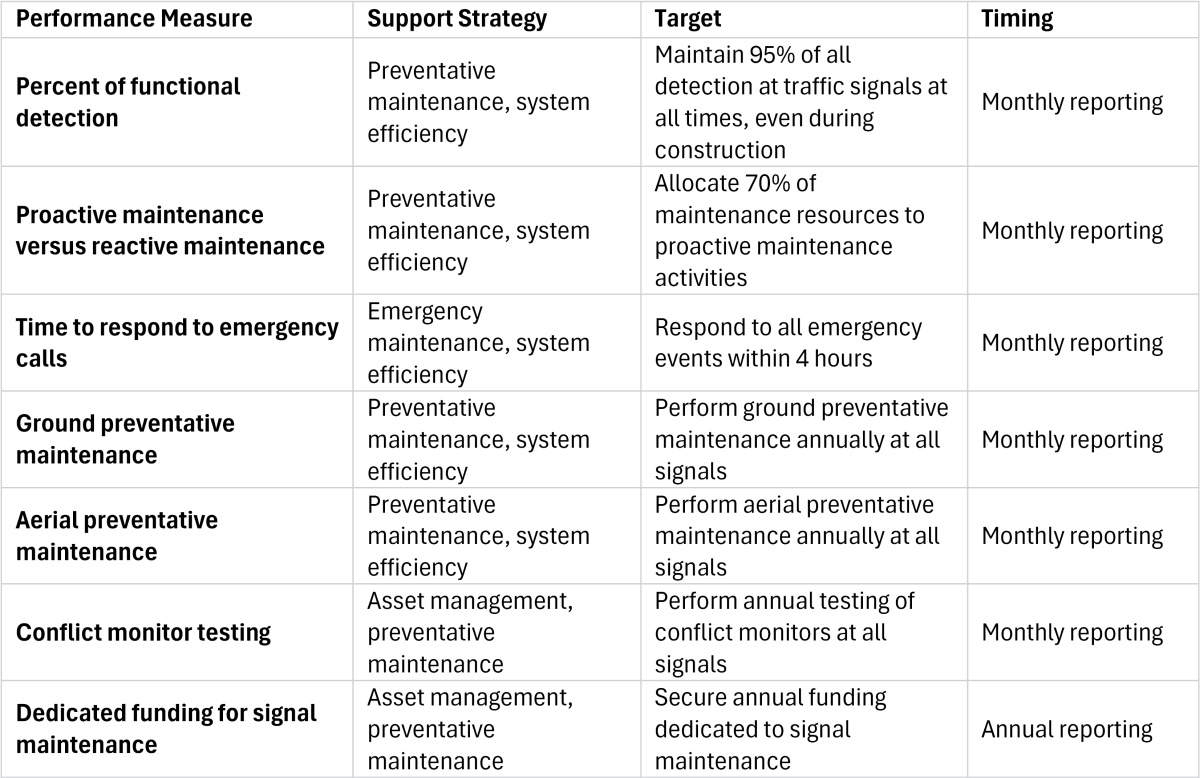
Long Description.
The column headers are Performance Measure, Supports Strategy, Target, and Timing. The data given in the table row-wise are as follows: Row 1: Percent of functional detection: Preventative maintenance, system efficiency, Maintain 95 percent of all detection at traffic signals at all times, even during construction, Monthly reporting. Row 2: Proactive maintenance versus reactive maintenance: Preventative maintenance, system efficiency, allocate 70 percent of maintenance resources to proactive maintenance activities, and Monthly reporting. Row 3: Time to respond to emergency calls: Emergency maintenance, system efficiency, respond to all emergency events within 4 hours, and Monthly reporting. Row 4: Ground preventative maintenance: Preventative maintenance, system efficiency, Perform ground preventative maintenance annually at all signals, Monthly reporting. Row 5: Aerial preventative maintenance: Preventative maintenance, system efficiency, Perform aerial preventative maintenance annually at all signals, Monthly reporting. Row 6: Conflict monitor testing: Asset management, preventative maintenance, Perform annual testing of conflict monitors at all signals, Monthly reporting. Row 7: Dedicated funding for signal maintenance: Asset management, preventative maintenance, Secure annual funding dedicated to signal maintenance, Annual reporting.
within GDOT, including staff with operational and data analysis expertise, helped maintain advancing internal efforts to explore and eventually scale deployment of traditional ATSPMs statewide.
The decision-making process was inclusive and built upon a long-standing framework of regional collaboration, particularly in the Atlanta metropolitan area, where coordinated signal management was already a priority. This framework facilitated broader statewide deployment. Technical leadership and institutional advocacy played key roles in transitioning from traditional methods, such as monthly field detector checks, to a continuous statewide performance-monitoring model. For GDOT, it was critical to have the ability to leverage existing communications infrastructure, especially wireless technologies, which enabled deployment even in suburban and rural environments. Another important aspect of the deployment was the replacement of all signal controllers within the state in 2014 to ensure the capability of collecting high-resolution data.
System Integration
GDOTʼs system integration strategy for traditional ATSPMs is multifaceted and leverages a combination of platforms and data sources to address various levels of signal performance analysis. The integration is structured around three primary channels: (1) a central signal-management system, (2) the UDOT open-source ATSPM software, and (3) the SigOps system/dashboard, which is used primarily for corridor-level analysis. A fourth channel is the Regional Integrated Transportation Information System (RITIS), which supports probe data analytics and broader regional performance insights. For GDOT, each system serves a distinct function, as described in the following:
- The central signal management system serves as the hub for other platforms,
- The UDOT open-source ATSPM software is used for intersection-level diagnostics and performance measures,
- SigOps, which provides a dashboard, supports corridor and regional operations, and
- RITIS enables macro-level analysis using probe data and trajectory data.
GDOT continues to advance its capabilities by incorporating frameworks and methodologies derived from ATSPM pooled fund studies, and this has supported the agencyʼs growing national role in signal analytics. Ongoing efforts include a 50-signal pilot to explore integration of advanced vehicle trajectory data through crowdsourced ATSPMs. The intent of this pilot is to enhance the depth and precision of traditional ATSPM-based performance measurement.
Funding and Training
GDOTʼs deployment of traditional ATSPMs has been supported through a stable and sustained funding structure that has primarily leveraged federal formula funds allocated annually. This funding is strategically planned in phases to ensure long-term continuity and the scalability of traffic signal operations across the state. Core programs such as the TMC, TSMO, and the Arterial Operations Program receive consistent yearly funding and form the financial backbone for traditional ATSPM-related initiatives. Additionally, GDOT uses a mix of funding sources, including federal-aid lump-sum allocations and specific program-based support, which allows flexibility to adjust funding strategies as needed. This multi-stream funding approach has enabled GDOT to maintain and expand its traditional ATSPM capabilities effectively.
GDOTʼs workforce development strategy for traditional ATSPMs has involved a combination of internal initiatives and external partnerships with substantial support from contracted consultants. While there was initial hesitation among consultants and in-house staff about the use of traditional ATSPMs (due to the shift in operational mindset), the agency has made targeted efforts to expand resources over time. Key among these efforts has been a series of targeted workshops, both internal and in collaboration with professional organizations such as the Institute
of Transportation Engineers (ITE), that are focused on educating staff on the fundamentals and application of traditional ATSPM tools. Internally, GDOT has faced challenges related to the varying levels of familiarity with modern signal control frameworks, particularly in transitioning from formalized traffic modeling software to a data-driven performance approach. A significant training gap emerged, especially for those who were not engaged in daily signal timing tasks, since understanding traditional ATSPM outputs requires foundational knowledge of signal operations. As a result, GDOT has emphasized practical learning through applied use cases and iterative training, which has fostered a culture of continuous learning and adapting to the data-driven nature of ATSPM implementation.
Use Cases for SPM Solutions
GDOT leverages traditional ATSPMs extensively for day-to-day signal operations and maintenance, particularly at the intersection level. Some example use cases include identifying issues such as detector malfunctions or inefficient phase utilization and supporting fine-tuning of signal timing. Consultants often use traditional ATSPMs with common intersection analysis and modeling tools. This process typically entails developing timing plans in modeling tools and using traditional ATSPMs to validate and refine timings post-implementation. At the corridor level, the SigOps platform aggregates performance data (both traditional and crowdsourced ATSPM data) to support broader optimization strategies such as to identify priority corridors for future retiming efforts. This tiered approach enables both targeted maintenance and system-wide improvements.
While GDOT does not only rely on the watchdog alerts provided by the UDOTʼs open-source ATSPM software, the agency has implemented similar functionality within the SigOps platform. This enables staff to quickly identify and respond to potential issues. The systemʼs built-in filtering and color-coded visualizations help narrow down areas of interest, allowing users to focus on signals that deviate from expected performance thresholds. This targeted approach enhances situational awareness and supports proactive maintenance by identifying anomalies in real time.
The SigOps platform was developed as a system-level performance-monitoring tool in response to a strong desire from agency leadership to gain a comprehensive understanding of statewide signal operations. Prior to its implementation, engineers manually aggregated data from various reports to develop similar metrics, which was a labor-intensive process and was thus typically conducted on a monthly basis. SigOps was initially developed by consultants and has evolved significantly over the course of approximately 8 years. The agency is currently enhancing the platformʼs back-end infrastructure and improving computational processes to support more efficient and scalable analysis. The SigOps platform is planned to be incorporated into the UDOT ATSPM Version 5.0 with minimal configuration requirements from deploying DOTs. As long as data flows are properly established, the long-term vision is to achieve seamless integration of SigOps within the UDOT ATSPM framework. Additionally, GDOT leverages vendor-based, crowdsourced ATSPMs at selected locations to further evaluate operational performance and quantify benefits.
Data Storage and Security
GDOT does not have a data storage and retention policy. Older data are archived and highly compressed. However, there is a desire to move data to cloud-based services.
GDOT encountered several security challenges during the implementation and upgrades of traditional ATSPMs, particularly when sharing data across systems and platforms. Additionally, UDOTʼs open-source ATSPM software was initially identified as posing security vulnerabilities, which prompted the agency to take extra precautions to address potential risks. These challenges
led GDOT to prioritize strengthening security protocols as part of ongoing system upgrades, and to explore alternatives that are more secure as part of future enhancements.
Challenges, Experience Gained, and Benefits
Challenges and Experience Gained
One of the most significant challenges GDOT encountered during the deployment of traditional ATSPMs was the absence of accurate ground-truth data that limited the ability to validate signal performance metrics. Initially, the effort was focused on addressing structural and foundational issues because there was not a common framework to benchmark or validate performance consistently across the system. As deployment scaled statewide and the number of monitored signals grew substantially, maintaining consistent performance monitoring and data quality became increasingly difficult. This scalability introduced ongoing challenges in keeping up with system maintenance, data integrity, and operational oversight. To address these gaps, GDOT developed internal standard operating procedures (SOPs), often in response to localized operational issues. These SOPs were then adapted and expanded to support broader deployment. While this reactive-to-proactive approach helped establish a more robust process over time, the ongoing challenge of scaling support and ensuring uniform practices across jurisdictions remains a critical area of focus.
Through the deployment of traditional ATSPMs, GDOT has recognized that it is only beginning to leverage the full spectrum of functionalities these systems are capable of providing. The agency has learned through experience that the integration of traditional ATSPMs into traffic signal operations requires a comprehensive understanding of the entire process, including planning, implementation, operation, and management. While it is important for signal engineers to have a foundational understanding of basic signal configurations, relying solely on this knowledge is insufficient for maximizing the potential of traditional ATSPMs. The agency recognizes the importance of evolving its approach to encompass more advanced data-driven strategies, which require a shift in operational mindset and ongoing adaptation to emerging technologies.
Observed Benefits
GDOT was involved in a benefit–cost study conducted by FHWA for traditional ATSPMs. Except for that study, GDOT has not conducted any benefit–cost analyses, primarily because existing assessments would not reflect a comprehensive or accurate evaluation of the systemʼs full impact. While such an analysis is theoretically possible, GDOT has found that the value of traditional ATSPMs and platforms like SigOps is more effectively demonstrated through operational improvements, enhanced situational awareness, and the ability to proactively manage traffic signals. Qualitative and performance-based benefits, such as reduced field visits, faster issue identification, and improved coordination, offer substantial value, even in the absence of a formal economic analysis.
Goals for Application and Use of SPM Solutions
In the near future, GDOT intends to deploy Version 5.0 of UDOTʼs open-source ATSPM software while addressing some back-end issues identified by the IT team to ensure seamless functionality. One of the immediate priorities is to improve the back end of the SigOps platform, particularly by refining the metrics and database structure by leveraging professional web developers for enhanced system performance.
Additionally, GDOT seeks to advance its traditional ATSPM capabilities by integrating more sophisticated features into signal timing processes. This will include incorporating trajectory-based probe data to monitor individual signal performance, which will give the agency the ability
to track the number of stops and analyze queue lengths. The goal is to establish a central system capable of processing trajectory data, which is critical for more accurate performance analysis and the continuous optimization of signal operations.
Looking ahead, GDOT is interested in expanding the range of performance metrics captured by traditional ATSPMs. Key metrics of interest include the number of stops and accurate pedestrian delay times, which would provide more comprehensive insights into signal performance and user experience. Although GDOT is not primarily focused on transit operations, there is also an interest in adopting metrics related to transit reliability, which would enhance the ability to monitor and prioritize transit vehicles. Furthermore, GDOT plans to incorporate ATSPM datasets into engineering studies (similar to left-turn gap analysis reports), combining traditional traffic management concepts with the rich, data-driven insights provided by traditional ATSPMs. The work that has been performed by UDOT in expanding performance metrics has served as a valuable reference in shaping these goals.
GDOT is also interested in integrating emerging technologies into its ATSPM system to enhance operational capabilities. In particular, there is strong interest in the potential of CV data. When contrasted with traditional ATSPMs, CV data can serve as a valuable tool for validating signal phase and timing messages, helping to ensure that they are consistent and reliable. High-resolution data could serve as an essential data source and potentially improve real-time traffic flow management and support better decision-making. The adoption of emerging technologies like smart cameras or AI-based products is being considered for future deployment with the intent of enhancing real-time monitoring and decision-making. Staff training and maintenance for these technologies are currently being planned, and the focus will be on building internal expertise. As for costs, the agency is assessing the financial implications of using these technologies and will factor in initial investment, ongoing maintenance, and potential staffing requirements for integration and long-term sustainability.
Utah Department of Transportation
Operational Environment
UDOT manages 57% of all state signals, including signals in rural, suburban, and urban areas. Network layout is a combination of grids, corridors, and isolated signals. While the agencyʼs primary focus has been on vehicular traffic, it has recently made efforts to focus on multimodal operations.
UDOTʼs growing national role in traffic signal operations and management stems from a transformative legislative mandate in the 1980s and 1990s that unified 52 separate jurisdictions into a collaborative transportation network. The state legislature required these jurisdictions to work together, creating a subcommittee that meets quarterly and mandating open participation for cities wanting to join the integrated transportation infrastructure. This foundational approach established a culture of cooperation and shared resources such as joint traffic management systems, CCTV cameras, and electronic logbooks.
In 2015, UDOT further demonstrated leadership by elevating traffic signals to a “tier one” asset status, which is the highest organizational priority. This strategic initiative resulted in a significant budget increase and a clear mandate from senior leadership to advance toward becoming a leading organization in the traffic signal operation and maintenance area. As a result, UDOT has invested heavily in advanced technologies, participated in national research initiatives, and continuously advanced signal performance measurement practices. Its approach includes developing open-source tools, exploring emerging technologies like connected vehicle systems, and focusing on multimodal transportation that prioritizes moving people efficiently rather than just managing vehicle traffic.
Traffic Signal Management Program
Traditional ATSPMs have been integrated in UDOTʼs practice. While UDOT does not have formally documented SOPs for traditional ATSPM usage, it has developed a more organic, practice-based approach to implementing traditional ATSPMs. Its traditional ATSPM utilization is primarily driven by practical applications, and consultants and staff use the tools for various purposes. For example, during signal retiming efforts, consultants typically analyze various ATSPM reports (e.g., split failures, arrivals on green) to identify potential issues and make timing adjustments to address these issues. Additionally, traditional ATSPM reports are commonly used for before-and-after analysis. Consultants also rely on commonly available traffic signal timing software such as Synchro.
UDOT is in the process of developing higher-level dashboards and data aggregation tools in UDOT open-source ATSPM software Version 5.1, which is a step toward a more structured ATSPM implementation procedure. The agencyʼs current methodology relies more on hands-on experience and real-world application than on formalized, documented procedures.
Deployment of SPM Solutions
Deployment History
UDOT was an early adopter of traditional ATSPMs. UDOTʼs ATSPM development and implementation effort began in the late 2000s as part of its ambition to improve traffic signal operations using high-resolution data. Recognizing the limitations of traditional signal timing evaluations, UDOT began collecting data directly from traffic signal controllers to create performance metrics. By 2012, it had developed the UDOT open-source ATSPM software, which allowed engineers to visualize and diagnose signal performance in almost real time. Other states have followed and used the UDOT examples for their ATSPM deployment with the intent of improving mobility and safety at signalized intersections through data-driven signal management.
System Integration
UDOTʼs system integration process is characterized by a collaborative, statewide approach that leverages the shared infrastructure of 52 jurisdictions. Its central system is jointly managed and has traffic signal data, CCTV cameras, and electronic logbooks that are shared across different municipal partners. As UDOT evolves its traditional ATSPM capabilities, it is expanding the system by incorporating diverse, emerging data sources beyond traditional traffic detection. These sources include measured vehicle speeds for speed management, trail counters, and ramp meters, and there are plans to integrate connected and autonomous vehicle data. UDOTʼs open-source philosophy ensures that its system integration process remains flexible, scalable, and accessible to other transportation agencies seeking to improve their signal performance measurement capabilities.
Funding and Training
UDOTʼs traditional ATSPM program is entirely funded by the state, and no federal funding is allocated to traffic signal operations. UDOTʼs budget for traffic signal management has grown significantly over time and now stands at approximately $12 million per year. This budget covers maintenance, operations, and outsourced consulting work for signal timing and management. A significant budget increase was directly tied to the agencyʼs designation of traffic signals as a “tier one” asset, which reflected a strong organizational commitment to advancing traffic management technologies.
UDOTʼs approach to traditional ATSPM workforce training has been predominantly informal. UDOT primarily relies on quarterly half-day meetings where traditional ATSPM topics are
occasionally discussed, with learning occurring more through hands-on experience on projects and through peer knowledge transfer. Some team members, particularly in the operations team, use traditional ATSPM tools extensively, while others have a more limited involvement with these tools. The current training methodology is considered inconsistent, and it is recognized that there is a need to develop more systematic training approaches. UDOTʼs training challenges are compounded by concerns about staff turnover, especially within the operations team, where the work requires significant expertise and specialized knowledge.
Use Cases for SPM Solutions
UDOT uses traditional ATSPMs primarily for maintenance, troubleshooting, and fine-tuning signal timings rather than for full-scale optimization. Consultants and staff leverage traditional ATSPM reports to identify detector malfunctions, analyze intersection performance, and validate detector functionality. While current tools do not allow real-time offset adjustments, UDOT is moving closer to that capability with the UDOT open-source ATSPM software Version 5.0 by leveraging the newly introduced time–space diagram report. Consultants typically use metrics such as split failure rates to assess intersection performance, and UDOT is expanding ATSPM applications to include multimodal performance measures, such as pedestrian crossing times, crossing compliance, and TSP settings.
UDOT does not use any system-level dashboards/visualization tools to help with decision-making. However, with the updated version of the UDOT open-source ATSPM software, it will be using the SigOps system-level dashboard that is also used by GDOT. At the time of this writing, UDOT was planning to release the SigOps system-level dashboard during the second quarter of 2025.
Data Storage and Security
UDOT does not have a data storage and retention policy for traditional ATSPM data. With the implementation of Version 5.0, it now has the tools to compress data, which can reduce storage requirements by approximately 85% to 90%. UDOTʼs traditional ATSPM data archive extends back to 2018 and covers approximately 7 years. UDOT does not have a state-mandated retention requirement for this type of data, unlike other data types (which need to be retained for 7 years). UDOT noted that its approach is mostly pragmatic, and it will continue storing data based on server space availability and will develop a more structured retention strategy as its data aggregation capabilities evolve. The agency is evaluating the use of differentiated retention periods for raw versus aggregated data. It could potentially retain raw data for 3 to 5 years before purging but preserve aggregated data for a longer duration to support historical analysis and reporting needs.
UDOT experienced security-related challenges during traditional ATSPM implementation and upgrading, particularly concerning data transfer protocols. One of the main issues emerged when transitioning from traditional FTP to Secure File Transfer Protocol (SFTP) methods. The transition was complicated by vendor-controlled signal controller licenses. Specifically, controller manufacturers remapped file storage locations, which temporarily prevented traditional ATSPM data access until Version 5.0 was developed. To address this issue, UDOT had to make firmware upgrades and security modifications to retrieve signal performance data. UDOT representatives noted that these security updates, while initially disruptive, were ultimately necessary to improve data transfer security. The challenges were mainly technical and involved how data were stored and transferred from controllers, rather than being broader cybersecurity concerns. UDOT was able to address these issues by collaborating with vendors and continuously adapting its software to meet evolving security standards.
Challenges, Experience Gained, and Benefits
Challenges and Experience Gained
One of the key challenges for UDOT during deployment of traditional ATSPMs was software development, which required substantial financial investment and ongoing technical refinement. UDOT representatives stated that the agency has been spending a substantial amount every year (in the range of hundreds of thousands of dollars), with a particular focus on creating and improving the UDOT open-source ATSPM software. An unexpected technical challenge emerged with the new open-source ATSPM software Version 5.0 and was specifically related to controller firmware upgrades. UDOT discovered that older controllers were unable to retrieve logs with the new system, necessitating firmware updates across its extensive intersection network.
Secondary challenges included those related to data transfer protocols and security considerations, particularly the transition from traditional FTP to SFTP methods. However, UDOT viewed these challenges as opportunities for innovation and consistently opted to develop open-source solutions designed to benefit the broader transportation community. The agencyʼs proactive approach transformed potential roadblocks into strategic improvements in traffic signal performance measurement capabilities.
UDOT does not anticipate major obstacles to the effectiveness of its traditional ATSPMs because the agency has already developed a mature and sophisticated approach to performance measurement that it has been using on a regular basis. However, a challenge is the variation in staff skillsets for using traditional ATSPMs, combined with the complexity of interpreting ATSPM data and converting them into actionable insights, since effective use of traditional ATSPMs requires specialized expertise.
The main experience UDOT gained from deployment of traditional ATSPMs centered on the critical importance of software development and continuous technological adaptation. Controller firmware updates presented unexpected challenges and required significant effort to ensure compatibility with newer ATSPM versions. UDOT recognized that without traditional ATSPMs, its resource needs for traffic management would be significantly higher, particularly for manual field counts and maintenance investigations. Also, investing in open-source, collaborative technologies can drive innovation and benefit the broader traffic signal community. The agency also recognized the challenges of staff training and technological adoption related to varying levels of ATSPM utilization across different team members. Staff turnover, particularly within the technical operations team, was identified as another concern. UDOT noted that while general operations staff could be relatively easily replaced, the specialized knowledge required in the technical operations team posed significant challenges.
Observed Benefits
UDOT was also involved in the benefit–cost study conducted by FHWA for traditional ATSPMs. Additionally, UDOT is tracking the annual use of each traditional ATSPM metric. It was reported that in the last year, approximately 100,000 metrics were retrieved by the users, which indicates strong usage of traditional ATSPMs.
Goals for Application and Use of SPM Solutions
UDOTʼs immediate goal for SPM solutions is to expand multimodal performance measurement and technological integration. For example, UDOT is in the process of developing an automated tool to determine appropriate TSP time allocation using traditional ATSPM data. UDOT is also integrating crowdsourced ATSPMs and emerging technologies such as lidar and
connected vehicle systems to improve performance measures for vulnerable road users. Other specific near-term objectives include speed-management tracking, deploying trail counters, ramp metering analytics, and preparing to integrate connected and autonomous vehicle data. Additionally, UDOT is developing system-level dashboards to provide more comprehensive visualization of traffic signal performance.
UDOTʼs future performance-metric goals using crowdsourced ATSPM and lidar technology include detailed pedestrian crossing time analysis, measuring pedestrian walking speeds, and evaluating pedestrian crossing patterns. UDOT intends to shift from a vehicle-centric approach to a people-centric approach for signal performance measurement.
Key Findings from the Case Examples
The project team conducted five case examples with state DOTs to gain insights into deployments of SPM solutions. Table 10 summarizes the case examples and includes information on SPM use cases, challenges, and experience gained.
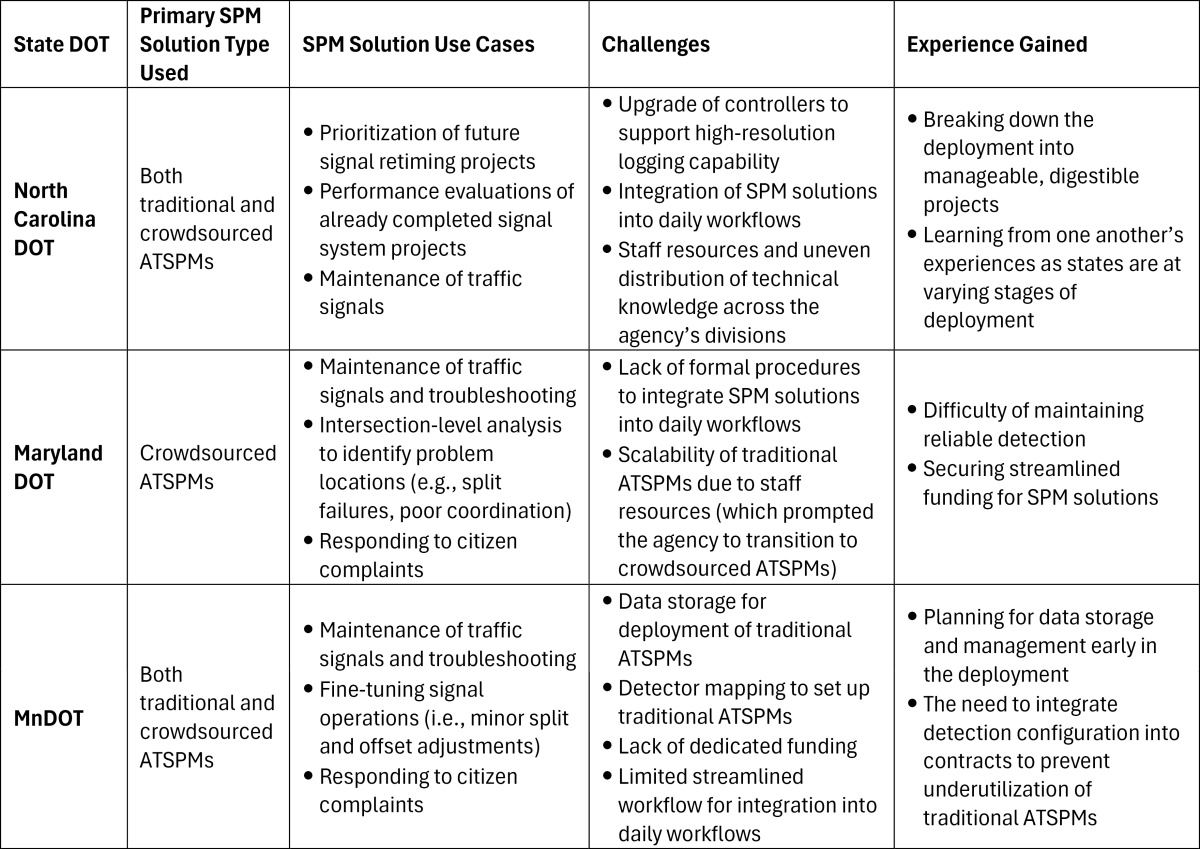
Long Description.
The column headers are State DOT, Primary SPM Solution Type Used, SPM Solution Use Cases, Challenges, and Experience Gained. The data given in the table row-wise are as follows: Row 1: North Carolina DOT: Both traditional and crowdsourced ATSPM, Prioritization of future signal retiming projects; Performance evaluations of already completed signal systems projects; Maintenance of traffic signals, Upgrade of controllers to support high-resolution logging capability; Integration of SPM solutions into daily workflows; Staff resources and uneven distribution of technical knowledge across the agency’s divisions, Breaking down the deployment into manageable, digestible projects; Learning from one another’s experiences as states are at varying stages of deployment. Row 2: Maryland DOT: Crowdsourced ATSPM, Maintenance of traffic signals and troubleshooting; Intersection-level analysis to identify problem locations (e.g., split failures, poor coordination); Responding to citizen complaints, Lack of formal procedures to integrate SPM solutions into daily workflows; Scalability of traditional ATSPM due to staff resources (which prompted the agency to transition to crowdsourced ATSPM), Difficulty of maintaining reliable detection; Securing streamlined funding for SPM solutions. Row 3: Minnesota DOT, Both traditional and crowdsourced ATSPM, Maintenance of traffic signals and troubleshooting; Fine-tuning signal operations (i.e., minor split and offset adjustments); Responding to citizen complaints, Data storage for traditional ATSPM deployment; Detector mapping to set up traditional ATSPM; Lack of dedicated funding; Limited streamlined workflow for integration into daily workflows, Planning for data storage and management early in the deployment; The need to integrate detection configuration into contracts to prevent underutilization of traditional ATSPM.
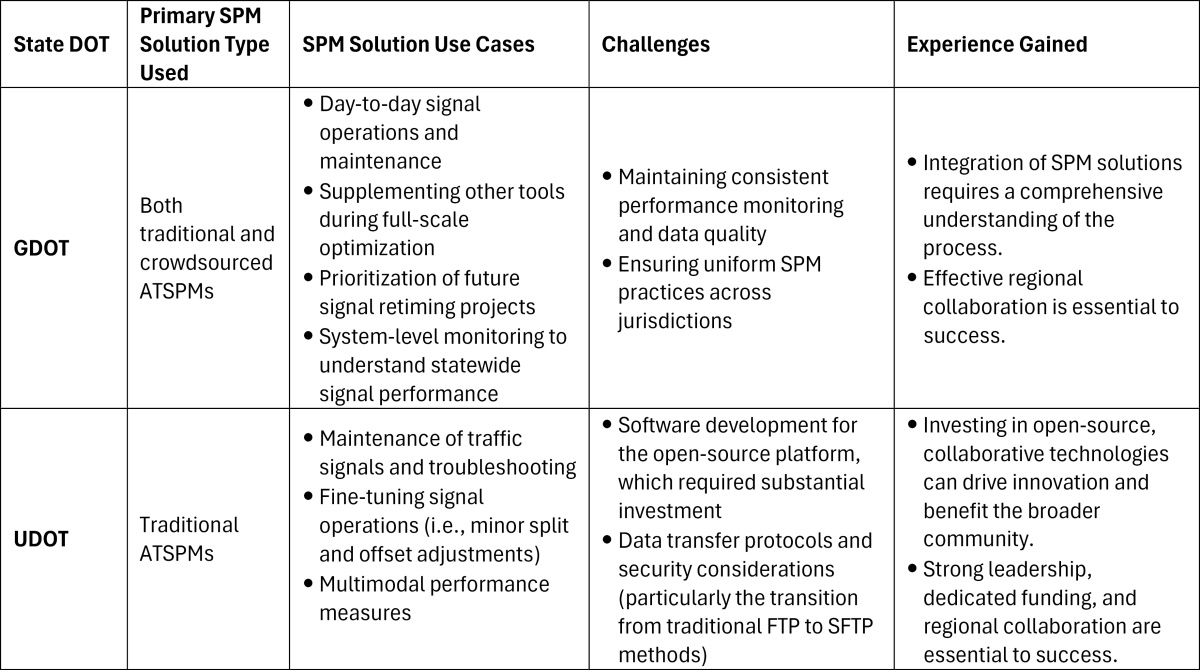
Long Description.
The column headers are State DOT, Primary SPM Solution Type Used, SPM Solution Use Cases, Challenges, and Experience Gained. The data given in the table row-wise are as follows: Row 4: Georgia DOT: Both traditional and crowdsourced ATSPM, Day-to-day signal operations and maintenance; Supplementing other tools during full-scale optimization; Prioritization of future signal retiming projects; System-level monitoring to understand statewide signal performance, Maintaining consistent performance monitoring and data quality; Ensuring uniform SPM practices across jurisdictions, Integration of SPM solutions requires a comprehensive understanding of the process; Effective regional collaboration is essential to their success. Row 5: Utah DOT: Traditional ATSPM, Maintenance of traffic signals and troubleshooting; Fine-tuning signal operations (i.e., minor split and offset adjustments); Multi-modal performance measures, Software development for the open-source platform, which required substantial investment; Data transfer protocols and security considerations (particularly the transition from traditional FTP to SFTP methods), Investing in open-source, collaborative technologies can drive innovation and benefit the broader community; Strong leadership, dedicated funding, and regional collaboration are essential to their success.


