Crash Modification Factors for Automated Traffic Signal Performance Measures (2026)
Chapter: 1 Background
CHAPTER 1
Background
Overview
Automated traffic signal performance measures (ATSPMs) have been shown to be a promising tool for proactively monitoring and managing signalized intersections. The use of ATSPMs to improve operations has been thoroughly researched and is generally well-established in the industry. In contrast, the use of ATSPMs to improve safety has not been as well researched. To overcome this knowledge gap, NCHRP Project 17-109 developed crash modification factors (CMFs) for several ATSPM reports being used for monitoring and managing signalized intersections. Additionally, this project estimated the potential return on investment in ATSPM deployment based on consideration of both the safety and operational benefits of this deployment.
This report documents the research approach and results of NCHRP Project 17-109, Crash Modification Factors for Automated Traffic Signal Performance Measures. The report is organized as follows:
| Chapter | Description |
| 1. Background | Overview of the project’s background and objectives; and explanation of key terms and definitions. |
| 2. State of the Practice Review | Synthesis of a review of relevant literature and agency outreach; and identification of key knowledge gaps. |
| 3. Prioritization of Knowledge Gaps | Description of the process used to identify and prioritize knowledge gaps related to the safety effects of ATSPMs. |
| 4. Research Approach | Description of the data collection process and a summary of collected data. |
| 5. Case A CMF Development and Results | Description of the analysis methods and computed CMFs. |
| 6. Case B CMF Development and Results | Description of the analysis methods and computed CMFs. |
| 7. Benefit-Cost Analysis Case Study | Description of the benefit-cost analysis methodology and the results of its application in several case studies. |
| 8. Conducted Webinars | Summary of the webinars conducted to disseminate research findings and gather feedback on the research results. |
| 9. Conclusions and Future Research | Summary of key findings and suggested future research topics to address remaining knowledge gaps. |
| 10. References | Reference list for Chapters 1-9. |
Research Approach
Background
NCHRP Project 17-109 was undertaken to assist DOTs and local transportation agencies quantify the safety benefits resulting from the deployment of ATSPM signal timing by developing a set of CMFs that predict the effect of a change in signal timing or operation on the change in crash frequency or severity.
Objective
The objectives of the project were: (1) to develop crash modification factors (CMFs) for ATSPM-based signal timing for various conflict types and levels of severity, and (2) to estimate the potential return on investment in ATSPM deployment based on consideration of both the safety and operational benefits of this deployment.
Research Tasks
The research tasks were planned to be conducted in three phases. A data collection plan and an analysis plan were developed in Phase I based on information obtained from the literature review and survey of targeted agencies. A methodology for evaluating the safety effect of ATSPM-based signal timing was developed in Phase II. The methodology was revised in Phase III based on two webinars with state DOT representatives. The task titles are identified in the following list.
Phase I – Planning
- Task 0. Prepare Amplified Work Plan
- Task 1. Review Literature and Conduct Survey
- Task 2. Identify Required Data
- Task 3. Identify Knowledge Gaps
- Task 4. Develop Data Collection Plan, Analysis Plan, and Implementation Roadmap
- Task 5. Prepare Interim Report No. 1
Phase II – Development of Methodology
- Task 6. Develop Methodology for Evaluating the Safety Effects of ATSPM-based Signal Timing
- Task 7. Prepare Interim Report No. 2
Phase III – Final Deliverables
- Task 8. Develop and Conduct Webinars
- Task 9. Revise Methodology and Related Materials
- Task 10. Prepare Final Deliverables
The key research products are the ATSPM Evaluation Methodology and the Implementation Roadmap. The ATSPM Evaluation Methodology was delivered as a stand-alone guidebook that describes a methodology for using the CMFs developed in this project. It includes a list of required data, procedural steps, and sample calculations.
The Implementation Roadmap describes a framework of goals, objectives, and strategies for implementing the research products in the American Association of State Highway and Transportation Officials (AASHTO) Highway Safety Manual (HSM) and the FHWA CMF Clearinghouse. The roadmap describes a series of implementation steps (and their associated timeline) that are intended to promote inclusion of Project 17-109’s CMFs in the HSM and Clearinghouse.
Overview of ATSPM Evaluation Methodology
The research team developed an evaluation methodology for the development of CMFs describing the safety effects of ATSPM-based signal timing and operation. The terms included in the methodology to categorize these CMFs are defined in this section. The researchers grouped the CMFs to be developed into two categories (i.e., cases) based on the spatial scope of the safety evaluation. These two CMF cases and their associated evaluation scopes are identified in the following list:
- “Case A CMFs” for overall evaluation of ATSPM-based signal systems, and
- “Case B CMFs” for site-based evaluation of individual ATSPM reports.
An overview of the evaluation methodology for cases A and B is provided in Table 1 and Table 2 respectively. The overview describes the spatial analysis scope, application scenarios, and analytic framework for each case. The proposed approach incorporates safety performance functions (SPFs) from the HSM and similar predictive models from the Highway Capacity Manual (HCM) into the ATSPM Evaluation Methodology, thereby leveraging the associated research such that the resources of Project 17-109 can be focused on the development of CMFs for a wide range of ATSPMs.
Table 1. Overview of the ATSPM Evaluation Methodology based on Case A CMFs.
| Components |
Spatial Analysis Scope: signal system
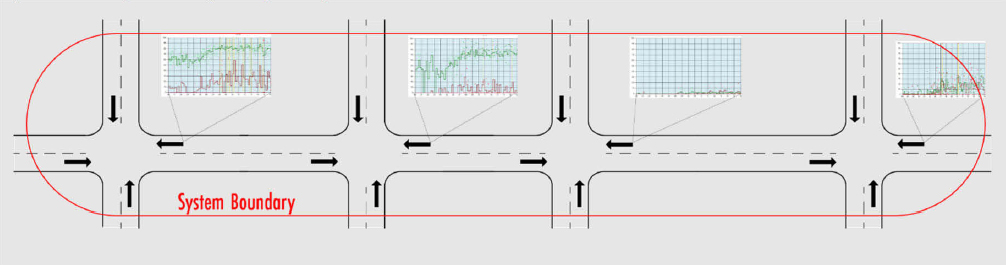 |
| Example Application Scenario |
|
Analytic Framework
|
Table 2. Overview of ATSPM Evaluation Methodology based on Case B CMFs.
| Components |
Spatial Analysis Scope: one, two, ..., or all sites in a signal system, where a “site” is an intersection leg.
 |
Example Application Scenarios
|
Analytic Framework
|


