Cooperating with Nature: Confronting Natural Hazards with Land-Use Planning for Sustainable Communities (1998)
Chapter: 9 Policies for Sustainable Land Use
CHAPTER NINE
Policies for Sustainable Land Use
RAYMOND J. BURBY1
WE CONCLUDE WITH OUR IDEAS about the types of land use policies and the requisite governmental action that could lead to safer and more sustainable communities. For more than two centuries the United States and its people have been on a collision course with nature. Nowhere is this more evident than in the exploitation of shorelines, floodplains, and other areas exposed to natural hazards. The cycle of hazard-zone use, disaster, hazard control, more intensive use, larger disasters, and more elaborate (and expensive) hazard control has been repeated in every state and to varying degrees in most localities. Now hazard policy has reached a breaking point—further large-scale hazard control is unaffordable, the prospect of short-term national economic disruption in the wake of a severe earthquake is no longer just idle speculation, disaster-induced strains on financial institutions such as the U.S. insurance industry are becoming chronic, and the siphoning of billions from the U.S. Treasury for relief is an annual event. To a large extent government policies—federal, state, and local—helped to produce
this outcome. In this chapter we show how government policies can help reverse it.
There are several reasons for the seemingly foolish behavior that produces the cycle that proceeds from hazard-zone use to disaster to hazard control and back again. Many hazard zones are attractive for development, for which some level of use is reasonable. The amount of use that makes sense, however, is usually unclear. Risks are poorly understood and frequently misperceived. Even accurate knowledge does not often change behavior, because many people have a high tolerance for risk from natural hazards. The costs of risk avoidance are immediate. The benefits of losses avoided are only apparent at some future date. People tend to greatly discount these benefits, which makes risk avoidance or investment in hazard mitigation unattractive.
Government policies by the score further depreciate the gains from risk avoidance, making those who practice it seem like suckers. Instead, hazard-prone occupants are protected from the full consequences of using these areas by programs to reduce coastal erosion by pumping more sand on ocean beaches (at government expense), to control flooding by building ever higher levees (at government expense), to blunt losses by garnering additional tax write-offs (at government expense), and to shift costs through ever more generous disaster relief payments (at government expense). In short, government policy, rather than countering psychological factors that make it difficult for people to deal rationally with natural hazards, has compounded the problem, making it seem foolish to avoid or limit the use of hazardous areas.
A NEW SET OF PRINCIPLES
The ease of securing government intervention to aid in the use of hazardous areas, or to at least shield users from the adverse consequences of their actions, historically has made restrictive government policy politically unattainable. Nevertheless, we believe change is possible. It can come only if we as a society subscribe to a new set of standards for dealing with natural hazards. The following five principles offer a foundation upon which public policies can be built to break away from the disaster cycle.
-
First, governments must limit the practice of subsidizing the risks involved in using hazardous areas.
-
Second, governments must build and share a base of knowledge
-
about the nature of risks and sustainable ways of living with hazards.
-
Third, all levels of government must develop commitment and capacity to change the way they manage the use of hazardous areas.
-
Fourth, governments must do a better job of coordinating policies to manage exposure to hazards with policies to accomplish economic, social, and environmental objectives through community development.
-
Fifth, governments must foster innovation in governance and land management to better match institutional systems and tools with the nature of the problems posed by natural hazards.
In combination, these principles can point the way toward new governmental actions to deal with natural hazards and can be used as a litmus test for evaluating the efficacy of current policies and programs. Gilbert White (1996) has observed that too little attention is paid to post-audits of existing efforts to deal with environmental problems. As a result, little is learned about the effects of public policies in easing (or aggravating) the problems they address, and little progress is made in finding lasting solutions. In the following section, we look at present and past efforts by government to cope with natural hazards to see whether they follow our five principles or have basic flaws that make it impossible to make headway in limiting future disasters. Then we offer our suggestions for new federal and state policies to achieve the vision of sustainability we presented in Chapter 8.
A LEGACY OF MISSED OPPORTUNITIES
Federal and state programs affecting natural hazards have created a legacy of missed opportunities that complicates efforts to find a path to reforms based on appropriate decisions about land use. Political scientist Peter May (1996) notes that this legacy can best be understood in terms of four factors: objectives, approaches, governance, and scope. Looking at objectives, we see how federal and state agencies provide local governments, which bear the brunt of responsibility for land use management, with conflicting (and often confused) signals about hazards. In terms of approaches, we see that federal and state government unwillingness to directly embrace land use management, while pursuing approaches that indirectly skew local land use decisions toward intensive
development of hazard zones, effectively limits local discretion to employ the land use approach argued for in this book. Looking at governance, we see the muddle of institutions and competing bureaucracies that disjointed, incremental policy making has created and the need to completely remodel the system now in place. Looking at the scope of hazards policy, we see that most government programs have been narrowly conceived and stand in the way of land use planning and management that is comprehensive in terms of hazards considered, objectives sought, and participants involved in its formulation and execution. In what follows, we explain why the governmental choices of the past have been shortsighted, and therefore are in need of reform.
Objectives
In examining government objectives toward risks posed by natural hazards we find it useful to think first about the types of losses on which government has focused its attention. Policymakers have to deal with four basic kinds of harm: destruction of real and personal property; damage to property; loss of income or increased costs that accrue from losses of property; and injury and death. These losses may occur directly to government personnel and assets, directly to the private sector, and indirectly as with the loss of income to the private sector or tax revenue to government. Once risks are identified, governments have to consider the likelihood that an event will occur and at what severity. In this way, they can differentiate chronic risks (high frequency/low loss) from catastrophic risks (low frequency/high loss) and decide which will be the focus of attention.
In making choices about exposure to loss, government policy has been inconsistent. On the one hand, when government finds it difficult to control the source of risk (that is, to reduce the destructive forces of a hazard), policy tends to focus on limiting the loss of life rather than losses of property or income, and on catastrophic rather than chronic events. Examples of this bias include building codes and emergency warning and evacuation, both of which strongly emphasize life safety rather than protection of property and apply to rarely occurring extreme events, such as hurricanes and earthquakes, rather than chronic events such as flooding. On the other hand, if it is possible technically to control hazards, policy focuses on limiting losses of property, in addition to loss of life, and on chronic rather than catastrophic events. Examples of this bias include policies to deal with flooding through storm drainage
and flood control works; shoreline erosion through sea walls, groins, and pumping sand on beaches; and wildfire through enhanced capacity for suppression.
The consequence for localities of these choices made at the federal and state levels are momentous but seldom discussed. Most serious is that while the nation and many states view losses of life in catastrophic events as unacceptable, catastrophic losses of property are viewed as a reasonable risk. The reason is largely economic. Control works capable of stemming truly catastrophic storms are prohibitively expensive and are used only when billions of dollars in property are already at risk. Works that reduce losses in more frequently occurring smaller events (e.g., the 2- to 100-year storm) are more affordable. The consequence, however, is encouragement of development in areas with less than complete protection, and increase in the likelihood that when rarely occurring events happen, they will be accompanied by truly extraordinary losses of lives and property.
In making choices about acceptable risk and creating this consequence, federal and state governments have violated three of the five principles we espouse. First, they have subsidized some (not all) risk by sharing with or wholly relieving local governments and the owners of private property of the cost of hazard control works. Second, they have created a base of knowledge about the location and probability of haz-
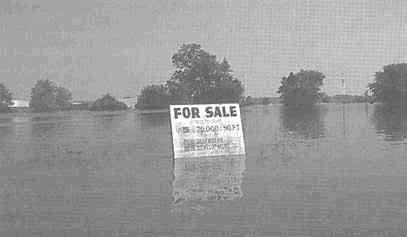
Did the Midwest floods of 1993 dampen potential buyers' enthusiasm for this property? (FEMA)
ard occurrence (e.g., seismic, flood hazard and storm surge maps), but the knowledge provided is incomplete in most cases because it does not extend to estimation of losses of lives and property from using hazardous areas. Third, government has not adequately shared decision making nor sought consensus from the whole array of stakeholders. Instead, it has preferred to deal with economic interests and intergovernmental partners and to largely ignore collaboration with other interests (such as good-government and environmental groups) that are less likely to heavily discount future benefits from risk avoidance and might prefer a more cautious stance toward risk.
Government's formulation of objectives for managing risk has long been criticized on other grounds. The most significant criticism is that the federal government and many state governments focus narrowly on risk reduction (e.g., mitigating property and income loss) to the exclusion of the environmental and social equity concerns of people living in and near hazardous areas. Environmental degradation resulting from hazard control measures is too familiar to need elaboration here. Safe development, however, can be equally damaging to the environment when environmentally sensitive areas are cleared, filled, and polluted with stormwater run-off. The neglect of social equity has received less attention, although it too is serious. The narrow focus on property loss reduction benefits property owners at the possible expense of other community interests who share the cost of local matches for building and maintaining federally subsidized hazard control measures, or who might benefit from dollars spent on other community needs rather than loss reduction. By largely ignoring broader community goals, federal and state policies in dealing with hazards violate our principle of coordinating and integrating policies to accomplish social and environmental, as well as economic, objectives.
Approaches
Choices the federal government and states have made among approaches for dealing with risk are similarly skewed. When faced with risk, policymakers have to decide which of several alternatives will be embraced. They can let people assume risk; or they can try to eliminate or reduce risk; or they can put in place mechanisms to transfer risk. For a variety of reasons, federal and state policymakers have viewed risk assumption and elimination as undesirable and have emphasized risk reduction and risk transfer instead. This bias severely limits choices lo-
cal governments can make about the use of land in hazardous areas and, in particular, their ability to pursue risk elimination and environmental enhancement as complementary policy objectives. Let us explain.
The loss of life and property chronicled in Chapter 1 long ago led policymakers to conclude that risk assumption—that is, letting individuals and businesses deal with risk, and with damages caused by natural forces, on their own—is unacceptable. But risk assumption may be a rational objective in a number of circumstances if decision makers are given adequate information about the nature of the risks they face. The costs of risk reduction or transfer, for example, may be far greater than losses that are likely to be incurred in a disaster. Individuals and governments have a remarkable ability to absorb loss as a normal operating expense or cost of daily living. One study found, for example, that two-thirds of losses local governments incurred in a typical natural disaster were under $50,000, which is well within the means of all but the most impoverished governments to absorb using available contingency funds (see Burby et al., 1991, p. 31). In spite of the logic of risk assumption and in direct violation of our principles regarding building a shared base of knowledge about risk management, relatively little attention has been given to communicating the risks of natural hazards (beyond short-term warnings to evacuate or take shelter in the face of an oncoming flood, hurricane, or tornado), the importance of responsible individual and local government decision making related to hazards, and appropriate self-protective behavior.
Risk elimination also has received short-shrift when federal and state governments formulate policy, but for opposite reasons. Risk assumption, however rational on economic grounds, is viewed as inviting truly catastrophic losses when individuals and firms expose themselves to risk as a result of misperceiving the potential for loss rather than as a result of rational calculation of gains versus potential losses. Risk elimination—for example, by relocating development out of the way of hazards and preventing future intensive use of hazard zones—would greatly reduce the possibility of catastrophic losses, but at an economic (and consequently political) cost that more often than not is viewed by federal and state policymakers as equally unacceptable.
Risk reduction and risk transfer have been central objectives of federal and state policy toward natural hazards. With the Federal Emergency Management Agency announcement in 1995 that mitigation is now a FEMA priority, risk reduction objectives have assumed even more importance. Risk reduction makes sense when risk lies somewhere in
between modest losses best dealt with by risk assumption and catastrophic losses best dealt with by risk elimination (or risk transfer). In this circumstance, employing hazard control measures such as levees or safe development practices such as mandatory building standards may be prudent, at least from the narrow perspective of risk management (more about their environmental costs later).
Risk reduction as a central objective of federal and state policy, however, raises four issues. First, opportunities for cost-effective areawide risk reduction through hazard control are limited at present. Second, while imposition of safe development standards remains a viable option, it suffers from limited applicability to existing development because of economic burdens on property owners, and possibly limited effectiveness for new development because of the potential for widespread evasion by builders and developers. Third, safe development assumes intensive use of hazardous areas is in society's best interest, but these areas often have environmental value that is incompatible with development. Hazard avoidance plus environmental gains can justify low-intensity land uses that simultaneously eliminate risk to both humans and plants and animals. This option is difficult to follow when the federal and state governments single-mindedly promote safe development. Fourth, in some local circumstances it is appropriate to use hazardous areas and risk assumption. When the federal government and states impose uniform risk reduction standards (as with the federal flood insurance program) and uniform treatment of hazards (as in the national model building codes and many state codes), the flexibility to identify areas where risk assumption is appropriate and modify policy objectives accordingly is effectively eliminated.
Transferring risk—through disaster relief, insurance, and tax code provisions that allow deductions for losses in natural disasters—is the other approach favored by the federal government and states in dealing with natural hazards. Since millions of households are at risk in the United States, relief payments and tax deductions help to minimize the human suffering and blunt the adverse financial consequences of disasters. If risk is transferred through insurance, the premiums give decision makers better signals about the true costs of their locational choices. Insurance also has a strong economic justification, since it allows the benefits of using hazardous areas to be realized (in exchange for a small administrative fee and payment of average annual losses), when they otherwise might be foregone because of fears that a disaster would completely wipe out the investment.
To varying degrees, however, both relief and insurance violate our principle of not subsidizing risk. Some economists criticize relief programs for promoting unwarranted and excessive use of hazardous land (most recently, see Lichtenberg, 1994). Insurance is another matter. Initially espoused as a way to share losses without subsidizing risk, in actual application it has departed from that principle. In order to garner enough votes for passage, the National Flood Insurance Act of 1968 provided for subsidization of insurance rates for the millions of structures that already existed in flood hazard areas, therefore effectively eliminating relocation (i.e., risk elimination) as a viable policy objective for dealing with those buildings. Twenty-five years after passage of the act, fully 40 percent of flood insurance policies continued to be subsidized (Interagency Floodplain Management Review Committee, 1994, p. 130). A variety of other subsidies then crept into the flood insurance program as administrators found it impossible to adequately adjust premiums upward to account for coastal erosion (National Research Council, 1990), as banks evaded mandatory insurance requirements for mortgages on new structures (U.S. Congress, General Accounting Office, 1990b; this problem was dealt with through new legislation in 1994), and as flood insurance rate maps were not updated to reflect changes in risk.
Subsidies built into federal insurance and relief programs undoubtedly help account for the massive increase in development in hazard-prone coastal regions (Burby and French et al., 1985, p. 88; and Beatley et al., 1994, p. 101). Ironically, the commercial property insurance industry, which helped create this huge increase in exposure to risk by insuring wind damage, has been having second thoughts. It has fostered the creation of special ''wind pools" in several hurricane-prone states and is actively lobbying Congress to relieve it of excess risk without, we hasten to add, much attention to the imposition of risk reduction measures to lessen the likely drain on the federal treasury.
In summary, the federal and state focus on risk reduction and risk transfer, besides increasing exposure to risk, has effectively shifted liability for the occupation of hazardous areas to Washington and, to a lesser degree the state capitols, thus relieving local governments of their traditional responsibility for managing these areas and violating our principles regarding risk subsidies and intergovernmental coordination. Federal and state governments have dealt with local stakeholders in a top-down and in some cases highly coercive manner (e.g., the National Flood Insurance Program). Such an approach has done little to foster the
"local involvement, responsibility, and accountability" called for in the most recent comprehensive review of federal policy (Interagency Floodplain Management Review Committee, 1994, p. 82) or the spirit of sharing (decisions not just dollars) espoused by the Federal Emergency Management Agency in its 1995 effort to reinvent itself.
In contrast to tendencies on the part of federal and (most) state governments to address hazards in isolation from each other and in isolation from broader societal objectives, more than a dozen states have adopted statewide growth management programs that are much more inclusive. These programs, which we describe in Chapter 3, ask local governments to integrate their methods of dealing with hazards with their methods for reaching an array of other community development goals. State growth management programs use local comprehensive plans as a tool for building knowledge about community problems, building consensus among stakeholders about policy objectives, and for analyzing policy alternatives and deciding upon the best course of action given each community's unique circumstances. In this way, the states encourage localities to pay attention to serious problems, such as natural hazards, but they let each local government craft a solution to the problem that makes sense to it and its citizens. As explained in Chapters 1 and 4, we think this emphasis on planning holds much promise for the nation as a whole. Later in this chapter, we explain how the federal government can foster a planning emphasis in all 50 states.
Governance
The patchwork of governmental institutions and programs recounted in Chapter 3 is a serious obstacle to reform. Governmental leadership from above imposes on localities the policy objectives and approaches favored in Washington and the state capitols, with all of the serious shortcomings noted above. In addition, however, governance is highly fragmented and resistant to change, thus violating our fourth principle, which calls for integration and coordination of efforts to manage exposure to hazards, and our fifth principle, which calls for innovation to craft truly effective measures.
In the case of flooding, for example, 12 federal departments and independent agencies have significant programs dealing with some aspect of the flood problem (Interagency Task Force on Floodplain Management, 1986). Many programs were adopted in the wake of a disaster, but others reflect the entrepreneurial initiatives of individual bureaucrats
and departments. The overall result is hazards governance willy-nilly with little consideration for how its various parts fit together across hazards or even among programs dealing with one particular hazard such as flooding or earthquakes.
There have been a number of efforts to rationalize hazards governance at the national level. In 1965 the U.S. Water Resources Council and river basin planning commissions were created to foster interagency and federal-state coordination, but they ceased operation in the early 1980s when funding was eliminated in response to opposition to their command-and-control, top-down style and alleged inefficiencies in their operations (e.g., see Viessman and Welty, 1985). In 1977 President Carter issued Executive Order 11988 directing federal agencies to avoid using floodplains for federal activities and to avoid fostering floodplain development by the private sector. According to the Interagency Floodplain Management Review Committee, however, "it has become apparent that some federal agencies either are unaware of or misunderstand the requirements of the EO and either build or support building in floodplains" so that they "weaken the effectiveness of existing local or state floodplain management regulations and place pressure on local governments to relax their regulations" (1994, p. 78). A similar executive order issued in 1990 (EO 12699) regarding the exposure of federal assets to seismic hazards seems likely to suffer a similar fate.
More recent federal reports that address governance issues, such as the Unified National Program for Floodplain Management (Interagency Task Force on Floodplain Management, 1986) or the Assessment Report prepared for the same task force (L. R. Johnston and Associates, 1992) have not been acted upon and, at any rate, do little more than describe the irrationality of the system and note the need for better coordination. More visionary efforts, such as the Interagency Floodplain Management Review Committee's Sharing the Challenge (1994), have bounced off the same impervious federal bureaucracy and an indifferent Congress with little discernible impact.
The division of responsibility for approaches to hazards is another important aspect of governance. While the federal government has centralized in Washington key aspects of decisions about most ways of dealing with hazards, with only a few exceptions it has steadfastly ignored the planning and management of land use in the mistaken and inconsistent belief that regulation of land is solely the responsibility of state and local entities (e.g., see Interagency Floodplain Management Review Committee, 1994, p. 74). Curiously, this belief has not afflicted federal ef-
forts to solve other societal problems. The government directly regulates wetlands, for example. It indirectly regulates, through incentives for state and local planning and regulation, a number of other land use practices to reduce air and water pollution, groundwater contamination, traffic congestion, exposure to airport noise, and coastal zone and other problems. In the case of hazards, however, the government prefers to act as if land use is not its concern, while at the same time its policies toward hazards have marked effects on the land use choices available to landowners and local governments.
Just as hazards invariably involve land use and thus require decisions about how land use management responsibilities will be shared, they also tend to produce effects that spill over both state and local governmental boundaries, which requires multijurisdictional cooperation horizontally (among governments at the same level) and vertically (among governments at different levels). This characteristic of hazards has produced a few remarkable innovations in governance (e.g., the Tennessee Valley Authority), but for the most part the federal government and most states have had difficulty formulating and sustaining regional hazard mitigation strategies.
Scope of Policies
Reflecting policy choices made on an ad hoc basis (often in response to needs that became apparent following various natural disasters), federal programs and many state programs for dealing with hazards are partial, not comprehensive. They are partial in that they deal more with some hazards than others (earthquakes, floods, and hurricanes garner most of the attention), and partial in the ways in which they deal with these hazards—that is, in isolation from each other, in isolation from related aspects of disaster management (mitigation, preparedness, response, and recovery), and in isolation from other local, state, and federal policy objectives and programs. While our fourth principle and a number of earlier policy studies and documents call for more comprehensive approaches (as discussed above), the federal government has made few perceptible moves in that direction, although some states have been much more innovative.
The Federal Emergency Management Agency has advocated what it calls an Integrated Emergency Management System (IEMS) (McLoughlin, 1985). However, a similar recognition of the interrelated nature of mitigation, preparedness, response, and recovery and of the need to think in
terms of multiple hazards as well as multiple objectives is not evident in other federal agencies. Nor has much progress occurred at the state and local levels, where institutional fragmentation of responsibility for these functions and hazards has so far frustrated efforts by FEMA to take a holistic approach. Typically, at the local level emergency preparedness and response are the domains of civil defense and the fire and police services, while mitigation and recovery are the domains of planning, engineering, and public works departments. Occasionally special agencies, such as flood control districts, have responsibility for particular hazards. The various local departments and agencies with responsibilities related to hazards may be located in separate buildings and in any case communicate with each other infrequently. Similar diffusion of responsibility characterizes most of the states.
More progress has been achieved in integrating hazards considerations into local planning and land use management, particularly in the states that have moved forward with comprehensive growth management programs. Research recounted in Chapter 3 suggests that these programs have fostered attention to hazards in the preparation of local land use plans, which tend to be of higher quality in states with mandates than in states that leave planning and land management solely to local discretion. Plans, in turn, have been found to produce land use management programs that are broader in scope and presumably more effective (Burby and May et al., 1997; May et al., 1996).
A POLICY AGENDA
Viewed against the gloomy picture presented in the preceding pages, it might seem that little progress can be made in fostering the vision of sustainability presented in the preceding chapter. However, we believe progress is possible. Each level of government can take action now to foster sustainability by reducing vulnerability to natural hazards. Although we focus on actions needed from the federal government and states, this does not mean that local governments should stand by idly waiting for initiatives from above. The heart of this book, in fact, is devoted to actions local governments and partners in the private sector can take to foster sustainability. These include systematically assessing vulnerability and risk, establishing planning processes to weigh information and possible courses of action, and working collaboratively with stakeholders to devise land use management strategies. The planning processes we recommend increase the likelihood that local governments
will discover ways of dealing with hazards that are feasible given local political, financial, and institutional constraints. In many cases, this planning will reveal that local governments already have in place basic mechanisms such as zoning ordinances and subdivision regulations that can be employed in hazard reduction. The key task, as we explained in Chapters 4 and 8, is to harness the power of planning and land use management to enhance sustainability.
As we see it, the federal government and the states have two important roles to play. The first is to actively support the land use approach by building local commitment to deal with hazards and local capacity to assess vulnerability and risk, plan for sustainability, and manage land use appropriately. The second is to give local land use planning and management a chance by not violating the five principles we introduced at the beginning of this chapter and thus skewing local decision making toward unsustainable choices about land use. In the remainder of this section, we examine each of these principles and their implications for federal and state policies.
Our analysis yields an agenda for action and an agenda for research. We call for action because experience with planning for safety from hazards over the past three decades makes some needed actions self-evident, and we can propose policy adjustments with confidence in the results that can be achieved. We call for research because in some areas further research is needed before policymakers can proceed with the ideas we espouse here; these are ideas that have promise, but they need careful study before policymakers can be certain they will be worth the resources required. In addition, research is needed on a number of fronts to further strengthen the capacity of government to deal with hazards.
Government Must Limit the Practice of Subsidizing Risk
The following subsidies seem ripe for careful examination leading to either sharp reduction or outright repeal: disaster relief, flood insurance, shoreline protection, flood control, and tax write-offs of losses to property located in identified hazard zones. In each case, if people are more effectively informed about the risks of natural hazards and if state and local governments adopt appropriate land use management measures, returning risk-management decisions to individuals and businesses will foster more prudent decisions about initial and continued exposure to loss, and it will foster support for local risk reduction efforts.
The Federal Emergency Management Agency and a number of re-
searchers have called for reductions in disaster relief through imposition of thresholds of loss that better reflect the ability to recover from loss without federal subsidies. Like deductibles in most private insurance policies, losses to state and local governments might have to exceed some amount (e.g., $5 per capita) before disaster assistance is provided, and truly extraordinary losses (e.g., over $75 per capita) would be required before the federal government assumes responsibility for all losses. A similar policy makes sense for state governments. This idea could be acted upon without a large investment in additional research.
In 1994 Congress called on the Federal Emergency Management Agency to investigate the impacts of repeal of subsidized flood insurance for structures built prior to the date their communities entered the regular phase of the National Flood Insurance Program. We believe the low rates of voluntary purchase of insurance indicates that subsidies could be repealed with little adverse effect on individuals who own property in flood hazard areas; on the contrary, any adverse effects would be far outweighed by signaling the intent of Congress to return more responsibility for risk management to state and local government and the private sector. Short of outright repeal of these subsidies, we believe they could be reduced if surcharges were placed on premiums charged repetitively flooded structures. These surcharges would give property owners a needed incentive to either relocate buildings beyond the reach of flood waters or retrofit structures to reduce flood damages and the amount of the insurance surcharge. Appropriate adjustments could be made to ensure that surcharges do not work an unjust hardship on low- and moderate-income households.
Congress also has requested study of shoreline erosion rates and the effect of no longer insuring against damage due to erosion. An end to the shoreline erosion subsidy, which is also highly inequitable since it benefits the wealthy much more than others, is long overdue.
The U.S. insurance industry effort in recent years to have the federal government assume greater financial responsibility for property insurance risks from natural hazards is the latest attempt to subsidize risk by shifting costs to the taxpayers. We believe this and all similar efforts to create risk subsidies should be strongly resisted. The private sector must assume responsibility for the consequences of its actions.
To ease the impacts on property owners as subsidies are reduced or eliminated, we believe Congress should appropriate funds to acquire land in hazardous areas for public use (and non-use). This acquisition effort could target repeatedly flooded buildings, which would no longer
be eligible for subsidized flood insurance, and property with high environmental value, which will decrease in economic value when it no longer can be developed partially at public expense. In order to reduce the expense of maintaining what would be a widely scattered inventory of property, title to parcels acquired could be transferred to local governments or nongovernmental land trusts such as those examined in Chapter 7.
Finally, we believe federal subsidies for hazard control should be sharply reduced or even eliminated by requiring that most, if not all, of the costs of flood- and other hazard control structures be covered directly by the states, localities, and private interests that would benefit from them. This could be accomplished by phasing out federal appropriations to the agencies providing these services and requiring that they operate on a full cost-recovery basis. States and localities would bear more of these costs initially, but they in turn could pass costs back to the owners and occupants of hazardous areas through mechanisms such as benefit assessment districts and impact fees and taxes. We believe initial steps in this direction can be taken now (for instance, to recover costs from new development in hazardous areas); and, we advocate research to develop cost-recovery mechanisms and estimate likely economic consequences for people and property currently at risk.
Government Must Build a Shared Base of Knowledge
Knowledge about natural hazards and popular understanding of risk has increased enormously over the past three decades, as massive evacuations from hurricane-threatened areas illustrate. However, understanding of long-term, not just immediate, risk is necessary for fully informed decisions about land use. That is a more difficult task, but one that can be achieved.
First and foremost is the need for information about risk, not just about hazards. State and local policymakers and citizens need to know not just that an area is subject to seismic or flood hazards, but that certain levels of loss can be expected with existing or proposed use of such areas, and that those losses will have certain undesirable consequences, particularly if existing federal subsidies are no longer available. For example, if local officials understood that allowing development of flood hazard areas could cause local property tax rates to increase sharply in 1 of every 20 years to cover the loss of tax revenues and infrastructure in the wake of a flood, they might make different decisions when faced with
land development proposals. If households purchasing a home in that floodplain had the same information, they might choose a safer location, which would make developers think twice about building in hazardous areas. Currently this information is not available in most jurisdictions, and it is not likely to become available without investment in research to develop and disseminate risk analysis tools to local governments.
In essence what is needed is the type of product-labeling information that has enabled households to make informed decisions about the energy consumption of products they purchase. If hazard-zone property had a similar label, consumers could avoid high-hazard areas, just as they avoid energy-guzzling products, and there would be an incentive to invest in the front-end costs of stronger buildings that would reduce average annual losses.
In addition to information that will facilitate local risk analysis, federal and state agencies can provide information that will encourage local government and citizen use of hazard information. Flood insurance maps are a potentially invaluable source of information about the potential for flooding, but they frequently contain too little additional information (for example, about property lines and existing buildings and landmarks) to be useful in local planning. In addition, detailed mapping needs to be expanded to more communities, and maps need to be more reliable. For land use planning, particularly important improvements would include extension of flood hazard mapping to watersheds of less than one square mile and formulation of floodplain maps that take into account not only existing development but also future development that increases peak discharges from watersheds. The omission of small watersheds in current mapping efforts leaves out the areas of the most rapid urban growth. By adding a full-development scenario to floodplain maps, property owners whose land would become vulnerable to flooding would understand the full consequences of urban growth for their property, and they would likely ask local officials to require detention basins and other measures that reduce peak run-off and the likelihood of flooding. As it stands now, property owners learn the impacts of watershed development after the fact, when what was once flood-free land periodically becomes submerged.
The needed floodplain map improvements have not been implemented for two reasons. First, they will increase the costs of mapping; and, second, they reflect the failure of the flood insurance program to promote the land use adjustments to flooding called for in the National Flood Insurance Act. That is, the program has been operated on the
basis of very narrowly conceived insurance aims and not on the basis of the broader loss reduction goals sought by Congress.
Even with their deficiencies, maps provided by the National Flood Insurance Program have enabled far more sophisticated planning for flood hazard areas than was possible prior to the advent of the NFIP. The same can be said for hurricane storm surge maps provided by the government to aid evacuation planning. Local planners would benefit from more widespread federal provision of maps for other hazards, including earthquakes, landslides, and wildfire. Mapping these hazards can be very time- and resource-intensive, as discussed in Chapter 5. But without federal support similar to that provided for the National Flood Insurance Program, needed mapping for hazard delineation is likely to be very slow in coming.
Local decision making can be enhanced by other improvements to the knowledge base. Local hazard assessments cannot be used effectively to support land use planning or decision-making initiatives without empirically validated damage functions, which relate land use and development conditions to probable levels of damage from foreseeable extreme natural events. As we also detailed in Chapter 5, damage functions for private property, public facilities and infrastructure, personal injuries, and death are limited for all hazards except flooding. Better information also is needed on the impacts resulting from lost economic production following natural disasters.
The provision of information and the communication of information are two different matters. In addition to providing better information about hazards, steps need to be taken to ensure that the information is available to and understood by the public. The local planning processes we describe in this book are one important way of doing this, since planning begins by developing information and sharing it with stakeholders. Beyond that, the federal government and states can underwrite public awareness campaigns, as they have for other health risks such as cigarette smoking and auto safety belts. These would include media campaigns, as well as the equivalent of product labeling, such as requiring that information about hazards be included in the deeds to property financed with federal mortgage assistance.
Knowledge must continue to be shared with the various professional groups, in and out of government, whose day-to-day decisions affect exposure to hazards. Targets for improved training materials and courses include professionals in land use planning, civil engineering and public works, building design and code enforcement, public finance, and the
emergency services. We think that personnel in each of these professions must have more information in order to see how natural hazards affect their own decisions and how their decisions about hazards affect the choices of sister professions involved in planning and managing urban development. The federal government has taken important steps in working with a number of relevant groups to expand knowledge (e.g., wind and seismic engineering, city and regional planning), which we believe should be continued and expanded.
Finally, knowledge about retrofitting existing buildings to reduce their vulnerability to various hazards has to be diffused among the building trades and do-it-yourself enthusiasts. The national effort to improve the energy efficiency of the building stock can be used as a model. This effort involved all segments of society, from church groups who retrofitted the housing of the poor to utility companies who offered professional assistance with energy audits and rate reductions to households whose homes met energy-efficiency standards. We think that with adequate awareness of hazards and knowledge about how to deal with risk in a cost-effective manner it will be possible to create consensus and commitment to hazard reduction.
Building consensus for action will be more effective if local governments reach out and work with nongovernmental groups. In Chapter 7, we describe a number of groups and ways of working with them to create a broader constituency for efforts to deal with hazards through land use management. Although the federal government and states can work with such groups directly (as they do with the Red Cross, for example), we believe the most effective approach would be to encourage partnerships between local governments and nongovernmental groups to retrofit homes of the poor and elderly located in hazardous areas and to acquire hazardous land as open space and natural areas. These partnerships can be promoted by setting aside grant-in-aid funds for hazard mitigation projects proposed by consortia of governmental and nongovernmental groups, and by authorizing localities to use hazard mitigation grant funds to assist the work of nongovernmental groups.
Government Must Develop Commitment to Manage Hazardous Areas
Lack of state and local government commitment has been the Achilles' heel of previous efforts to deal with natural hazards. Commitment is the willingness of public officials to work energetically to deal with is-
sues posed by natural hazards before, not just after, problems are revealed by a disaster. Previous efforts by the federal government to foster local attention to hazards have produced a sort of pseudo-commitment—officials go through the motions of complying with requirements of the National Flood Insurance Program and preparation of emergency response plans, but their efforts often are careless and only infrequently exceed the bare minimum needed to avoid censure. We think the government can do much more to create genuine commitment, characterized by local enthusiasm for accomplishing sustainable development patterns.
Each of the principles discussed to this point will help build genuine commitment to deal with hazards. A central goal of the planning processes we advocate is social learning, which is why citizen participation is crucial. By increasing personal and community responsibility for the consequences of decisions made, enhancing knowledge, and building understanding of alternative development options, various stakeholders will discover that they can accomplish their goals—economic, social, or environmental—in ways that can be sustained over time. As various groups become mobilized, they will insist that elected officials make decisions about land use that are in the long-term interest of the community.
In the case of flood hazards, the federal government has taken a step in this direction by providing incentives, through the Community Rating System, for local governments to undertake planning processes for flood hazard areas. This is a useful step, but we believe planning must be mandated and not just encouraged through incentives such as insurance rate reductions. The incentive employed by the Community Rating System is effective only after local governments experience flood problems because they have allowed extensive development to occur in floodplains. For communities with floodplains that have not been developed extensively (but are highly likely to be in the future), the Community Rating System provides little incentive to begin planning before these hazardous areas are committed irreversibly to urban development. A key advantage of mandating planning, rather than just encouraging it, is that communities can find paths to sustainability that are right for their unique local circumstances before (as well as after) development pressures mount.
In addition to mandating planning, the federal government and states can take other actions that will foster genuine commitment. A particular problem has been lagging jurisdictions that for one reason or another fail to embrace sustainability as a growth management goal and ignore natural hazards in making decisions about land development. These governments are untouched by conventional programs that use incentives such
as technical and financial assistance to secure local participation; they do not recognize the problems such assistance is aimed at and therefore pass it by. Instead, the federal government and states need to reach out to them with more meaningful measures. In particular, we think that virtually all federal and state aid for infrastructure and economic development could be tied to community participation in land use planning processes, since natural hazards, if ignored, have the potential to wreck these federal investments. Also, recalcitrant local governments could be targeted for particularly close attention in monitoring their compliance with the requirements of a variety of other federal and state assistance programs. The key is to make clear to them that the federal government and states will no longer tolerate inattention to hazards.
Finally, we believe genuine commitment can be enhanced if the insurance industry, once it learns that it cannot foist risk off on the U.S. taxpayer, becomes a strong local advocate for sustainable development. The insurance industry is beginning to take steps in this direction with its initiation of a system to rate local building departments and give insurance rate reductions to property owners in communities with exemplary code enforcement. This will help in developing a constituency for local efforts to reduce susceptibility to hazards. In addition, the industry could enlist its army of local insurance agents as advocates for sustainability. They have a direct economic stake in avoiding disasters and could counteract economic interests that advocate shortsighted development decisions.
Government Must Coordinate and Integrate Hazard Policies
Government efforts to cope with natural hazards are fragmented horizontally at each level of government, vertically between levels of government, and across different types of hazards. This dispersal of authority and responsibility makes it extremely difficult for local governments to deal with hazards in a coherent way. In Chapter 8 we recounted the experience of Soldiers Grove, Wisconsin, in overcoming recurrent flooding from the Kickapoo River. When the village decided to move its central business district out of the river's floodway, it took a flood disaster and the intervention of Wisconsin's two U.S. senators before local officials could sidestep an Army Corps of Engineers proposal to solve flood problems with a dam and levees instead of relocation; then further work was needed to cut through red tape and marshal resources from seven different federal grant-in-aid programs to bring about the
relocation. Most localities do not have the time and entrepreneurial talent that it took Soldiers Grove to pursue a land use solution.
The federal government has experimented with a number of different ways of coordinating and integrating hazards policies, but in our opinion none has been particularly effective. These approaches tend to focus on a single hazard, such as earthquakes (e.g., the National Earthquake Hazard Reduction Program) and floods (e.g., the Unified National Program for Floodplain Management). Other federal single-hazard efforts have tried to foster federal-state-local coordination, as in the government's effort from 1965 to 1981 to formulate river basin plans, its attempts to ease hazard mitigation after disasters through the use of interagency hazard mitigation teams, and to prevent future disasters by requiring state hazard mitigation plans. The one federal attempt to integrate policy across hazards, FEMA's Integrated Emergency Management System, has not been replicated by other federal agencies.
Every recent federally inspired evaluation of national hazards policies has noted the problems caused by policy fragmentation and called for more integration. In the latest of these, the Interagency Floodplain Management Review Committee's Sharing the Challenge (1994) calls for establishment of an interagency task force to develop a coordination strategy to guide the actions of federal agencies. We believe that, in addition to federal efforts to develop a coordinated strategy, coordination also should occur at the state and local levels, where property is exposed to hazards and the impacts of natural disasters are felt first and most severely. The coordinating mechanism we propose is land use planning. If the needed planning occurs and, just as importantly, federal agencies are required to act in ways consistent with state and local plans, then many of the problems localities experience as a result of fragmentation will disappear.
Government Must Foster Innovation in Governance and Land Management
Innovative governance is the final principle we advocate for guiding reform of federal and state hazard management efforts. Clearly, the context that gave rise to the existing approaches to hazards is changing. The public is disillusioned with large government-funded projects and centralized command-and-control regulation, both of which are viewed as too expensive and inefficient. State and local officials too have increasingly voiced concern about federal mandates that they view as overly
expensive, prescriptive, and coercive. Concern for the costs of regulation and government infringement on property rights also is widespread, although in some states and localities support for environmental protection remains strong. This changing context for hazards management calls for rethinking the approaches government uses to bring about sustainable development and reduced risk from natural hazards.
We believe a central role of the federal government must be to foster systematic, collaborative planning processes at the state and local levels rather than to promulgate vast new public investment programs to control hazards or to attempt direct regulation of the use of hazardous areas. Similar to the federal Coastal Zone Management Program's nurturing of state and local planning for balanced use of coastal resources, the new planning processes would encourage all levels of government to define for themselves the meaning of sustainability and the ways in which it can be accomplished. In this way, the federal government would lead by example, providing technical and financial assistance for planning processes states and localities put in place. In place of uniform national goals and standards, federal officials would foster the formulation of goals and standards appropriate to the vastly diverse local situations that exist across America. The federal government's new style would feature cooperation and collaboration with state and local governments, while also being consistent with principles regarding ending subsidies, enhancing information, fostering consensus and commitment, and acting in ways consistent with state and local plans and policies.
THE FEDERAL ROLE IN REALIZING THE PROMISE OF LAND USE PLANNING AND MANAGEMENT
We have shown in this book that land use planning and management can pay large dividends in charting a course toward a safer, sustainable future, and in ensuring that public and private decisions deal with risk and consider community objectives for the use of land exposed to natural hazards. However, as noted in Chapter 6, many local governments, of their own accord, are not likely to employ planning and land use management to the extent that is optimal.
A handful of states have experimented with state growth management programs that feature the formulation of integrated and internally consistent state goals and policies along with state mandates that local governments engage in systematic processes to plan and manage land use. Policy evaluations indicate that these programs can be very effective
in dealing with natural hazards and improving sustainability. We believe it is time for the federal government to take steps to speed the adoption of similar programs by all states.
Federal action to foster state and local planning can be thought of in terms of three levels of effort. At the lowest level, incremental adjustments can be made to existing programs. An intermediate level encompasses these incremental changes along with a new executive order to force the new policies upon recalcitrant federal agencies. The third level adds a new, system-changing federal program to bring about responsible land management by state and local governments and the private sector.
Five Changes to Existing Programs
There are five steps the federal government can take now to see that state and local planning and land use management take natural hazards into account. First, the Federal Emergency Management Agency could require local preparation of floodplain management plans, already authorized by Congress, as a condition for continued participation in the National Flood Insurance Program. Second, the government could require areawide hazard adjustment plans that give full consideration to land use, not just plans for individual projects, as a condition for federal assistance with hazard management measures such as flood control structures and beach nourishment. Third, the federal government could increase the immediate payoffs for planning by increasing the insurance rate reduction credit given by the National Flood Insurance Program's Community Rating System for floodplain management plans. Fourth, the government could take steps to reduce the costs of planning by expanding hazard-zone mapping efforts and by providing, in addition to maps, risk analyses that help state and local decision makers better understand the trade-offs inherent in developing hazardous areas. Finally, by reducing subsidization of risk, as discussed earlier, the federal government could increase the relevance of state and local planning and land use management to policymakers. We believe each of these actions is justified on the basis of what is already known about land use and hazards and can be mounted without additional research.
A New Executive Order
The small steps that constitute the lowest level of effort will spur needed state and local planning and land use management, but the pro-
cess could be painfully slow, and a number of federal agencies undoubtedly would never get the message that the land use approach to hazards is both effective and necessary. To combat such foot dragging, a new all-hazards executive order could insist that federal agencies address hazards adequately in their own planning and that they use existing authorities, where appropriate, to foster planning and land use management by state and local governments. An executive order could also specify that federal agencies act in ways consistent with state and local plans, which would also provide an incentive to prepare plans where they do not now exist. This intermediate level of effort also is justified by the existing policy research.
A Federal Hazardous Area Management Act
To have a more dramatic impact, Congress would have to enact new legislation, similar to the Coastal Zone Management Act, to stimulate planning and management of hazardous areas to accomplish a balanced mix of economic development and environmental goals. A national hazardous area management act would not impose national standards on state and local governments, but it would require them to initiate planning and management processes so that exposure to risk from all natural hazards is carefully considered in public and private decisions about development and redevelopment. Obviously, additional research would be required to fully specify the provisions of a new national hazards mandate and to evaluate its likely costs and benefits. Here we provide a brief sketch of the key provisions of the legislation we have in mind.
The key carrot to induce state and local governments to participate could be federal assistance for planning, using some of the funds diverted from disaster relief when subsidization of risk is curtailed. In addition, the government could coordinate and expand its existing hazard-zone mapping and other technical assistance efforts to lower planning costs and provide additional incentives for states and localities to participate. This new national effort could be spearheaded by several agencies, including the Federal Emergency Management Agency (which has hazard mitigation expertise), the Department of Housing and Urban Development (which has community planning and development expertise), or either the Department of the Interior or Department of Commerce (both of which have geophysical and resource management technical expertise).
In fostering state planning processes and state mandates for local planning, the federal government needs to ensure that the states take
three additional steps that are essential for success: (1) provide adequate authority for state agencies to monitor and enforce prescriptions about the content of plans (e.g., consistency with state hazard reduction goals) and plan-preparation processes (e.g., adequate risk analysis and citizen participation); (2) take measures to foster commitment to hazard reduction by state and local officials (e.g., adequate sanctions and incentives); and (3) provide tools to build capacity, such as technical and financial assistance, model-plan elements, and hazard maps and other information. In other words, we are calling for plans and land use management efforts that have substance, not paper exercises. Because some localities will lag behind regardless of the strength of state mandates, we also believe it is essential for the states to have in place the ability to regulate hazard-zone development directly, so that future disasters are not created by recalcitrant localities that refuse to adhere to sound planning and land management practices. Many states already have in place critical area laws of one sort or another (e.g., wetland protection programs) that can serve as models for hazard-zone regulations.
Research Strategies to Sustain Land Use Policy
In addition to charting a new course for federal policy, we believe new strategies are needed for research on natural hazards. Comparison of this book with a similar effort by Baker and McPhee in 1975 indicates dramatic progress in accomplishing four objectives. First, researchers have developed a good understanding of the tools that can be used to manage land use in hazardous areas. Second, a good start has been made in developing the technology and methods needed to identify vulnerability to hazards in ways that are useful for planning. Third, the characteristics of good plans have been identified, and intergovernmental planning processes that can foster such planning have been evaluated. Fourth, evaluations of local government efforts to deal with flood, coastal storm, and earthquake hazards have highlighted factors that foster and hinder land use planning and management. As a whole, this research effort has demonstrated that land use planning and management have promise for reducing losses to life and property and enhancing sustainability, but their potential is not being realized in thousands of hazard-prone communities.
We believe future research should be encouraged in three strategic areas: plan making, vulnerability assessment, and implementation. In the first area, while we know what a good plan looks like, we do not
know enough about how to craft such a plan in a way that will foster and sustain commitment to sustainability. In the second, important strides have been made in developing the technology needed to assess vulnerability, but emphasis now needs to be given to translating it into computer software and procedures that are accessible to local government personnel. In the third, we recognize that plans, regulations, and other land use management measures, once adopted, require complex chains of supportive decisions by public agencies and private decision makers if they are to be effective, but the keys to ensuring compliance with planning recommendations and regulatory prescriptions are elusive. These three strategic directions provide guidance to both researchers and research-funding agencies in identifying more specific targets for study. Here we briefly enumerate some of those we think will be most beneficial.
Research on plan making is needed to help planners make selections in each of the four dimensions of choice identified in Chapter 4. Specifically, research should investigate: (1) consensus building and other ways to encourage stakeholders and nongovernmental organizations to participate in plan making, plan adoption, and plan implementation; (2) mechanisms for building the capacity of local and state governments and nongovernmental organizations to analyze hazards and formulate strategies that are cost effective; (3) procedures for making appropriate choices between integrating hazard mitigation into comprehensive plans or making stand-alone plans; (4) factors affecting the flexibility, effectiveness, and equity of various mitigation strategies; and (5) the actual practical value of the principles proposed for creating high-quality plans. We also think research is needed to document the outcomes of hazard mitigation plans in terms of costs incurred by the public and private sectors, gains in reduced vulnerability, and the manner in which planning processes, choices, and principles generate community consensus and effective action. Particularly helpful would be identification of regional approaches to planning and hazard mitigation that have proven to be institutionally feasible and cost effective.
The second strategic direction for future research is vulnerability assessment. New hazard assessment technologies have been developed over the past decade, and some of these systems are widely deployed, but we do not know how (or even if) they are affecting community-wide planning or planning for specific development projects. In a related vein, we need better validation of damage functions across many types of hazards—earthquakes, fire, landslides, storm surges, and wind. With the
exception of floods, no consensus has yet developed about appropriate damage functions, which are essential in justifying sustainable land use choices to local officials and, when challenged by aggrieved landowners, in court.
The third strategic direction for future research, and arguably the most important, is investigation of ways to improve the implementation of planning mandates, plans, and hazard mitigation prescriptions contained in building codes and land use regulations. A variety of strategies are available for managing land use, but little is known about their relative effectiveness. Particularly useful would be studies that compare the benefits and costs of strategies that feature avoidance of development in hazardous areas versus those that emphasize safe development practices. Implementation requires commitment to sustainability and capacity for undertaking measures that enhance it. Both have been lacking in a significant number of state and local governments and in private sector decision makers, but evidence is accumulating that commitment is the key missing ingredient. Research is needed to find the ways to build commitment that are not overly coercive or costly to undertake. A number of alternative strategies have been identified, some involving the use of persuasive information, some involving incentives, some using monitoring and sanctions to compel compliance, and others using moral persuasion, as argued for in the preceding chapter. We do not know the extent to which these strategies, acting alone or in combination with each other, are effective in building commitment to hazard mitigation and sustainability, but knowing how effective they are is essential for improving the implementation of land use plans and regulatory measures.
While research has established the efficacy of state planning mandates in inducing local planning for hazard mitigation, little is known about other institutional arrangements for land use management. Research is needed to classify and evaluate the success of various institutional arrangements, such as multistate consortia, state seismic safety advisory boards, watershed planning partnerships, and state-local cooperative programs. In addition, research is needed on the roles of key intermediaries and the prospective roles of other entities in translating mandates and plans into action—that is, state and local agencies, nongovernmental organizations, and other interest groups concerned with sustainable futures for communities.
A FINAL NOTE
In conclusion, we have no illusions about the difficulties in bringing about a new land use approach to dealing with natural hazards in thousands of local governments and by millions of public and private decision makers. It will not be an easy task, and it cannot be accomplished by edict. Leadership from the federal government is critical. We call for a new National Hazardous Area Management Act and program to foster improved planning and management at the state and local levels. Short of this step, a new executive order and numerous smaller changes in the way the federal government does business can ensure that its actions more nearly correspond to the principles we espouse. All of these efforts will be more effective if informed by the results of federally funded research to help overcome key stumbling blocks.
State and local governments have a particularly strong interest in and responsibility for prudent planning and management of land exposed to natural hazards. They must collaborate more closely with each other in dealing with exposure to hazards. Collaboration, however, must extend beyond government to embrace professional groups, nongovernmental citizens' groups, and most importantly, private citizens. Critical to all of this is fuller understanding of sustainability so that the concerns about the use of land in hazardous areas expressed in this book are shared widely, and so that consensus begins to form about appropriate courses of public and private action.