Cooperating with Nature: Confronting Natural Hazards with Land-Use Planning for Sustainable Communities (1998)
Chapter: 6 Managing Land Use to Build Resilience
CHAPTER SIX
Managing Land Use To Build Resilience
ROBERT B. OLSHANSKY AND JACK D. KARTEZ
LOCAL GOVERNMENTS IN THE United States always have had the lead role in influencing the process of community development. This is still true, even with the significant intervention into municipal and county land use regulation by a number of state governments since the late 1960s. The local role, however, has become increasingly complex.
Since the early 1970s, local governments have moved beyond zoning and subdivision regulations and traditional capital investments as their only mechanisms for guiding land use. Techniques and instruments have been added to the local implementation toolbox that can work in tandem with conventional regulation and budgeting to influence private development decisions. Today local governments make use of a wide array of additional regulatory, impact assessment, urban service control, and even educational tools to consciously guide the location, type, design, quality, timing, and distribution of costs of development. Taken together, the complex of tools and policies applied in each locality represents a land use management guidance system (Einsweiler, 1975). Twenty years ago little empirical work had been done on the
use and effectiveness of land use management tools in mitigating losses from natural hazards (Baker and McPhee, 1975). In contrast, the intervening period has seen a large number of such studies, many of them focused on the effectiveness of these tools in mitigating hazards. This chapter presents a synthesis of that work.
In the following sections, we examine local use of a variety of land use management tools for hazard mitigation—their type, extent, and effectiveness, and factors that ease their adoption. Although the frequencies with which such tools have been adopted by local government can be easily summarized, it is much more difficult to reach conclusions about their effectiveness in mitigating hazards.
Use Of Land Use Management Tools For Hazard Mitigation
Land use management has evolved to meet a variety of community needs, such as public safety, wise use of natural resources, and efficient public services. Nelson and Duncan (1995) identify 49 growth management techniques currently in use, with goals including resource preservation, special-area protection, rural growth management, urban containment, adequacy and timing of public facilities, and financing of public facilities. Hazard mitigation would seem to be another logical objective of integrated land use management.
Local governments, however, traditionally have not placed a high priority on hazard reduction. When local governments do address hazards, the impetus has often had to come from state and federal mandates and incentives, as discussed in Chapter 3. State mandates contribute to the quality of local plans, and can help to ensure that these plans address hazards, particularly when local commitment to act and the capacity to do so are present. But plans must still be implemented through specific mechanisms that are adopted and actually carried out locally, jurisdiction-by-jurisdiction. To carry out hazard mitigation plans, local governments must carefully choose an appropriate mix of land use management tools. Choices of the most effective implementation tools may not take place at all unless local government commitment and capacity are quite strong and problems are solvable. Local choices and the factors influencing them are profiled in this chapter.
Integrating Hazard Mitigation with Other Programs: An Example
An intentionally integrated set of land use management tools for hazard mitigation is still rare at the local government level. For example,
although most local governments participate in the National Flood Insurance Program (NFIP), few have built the tools encouraged by the NFIP into an effective system of land use management procedures and regulations. One example of an integrated approach is the Tulsa, Oklahoma's floodplain and stormwater management program. By the 1980s, Tulsa was called the "flood capital of the world" because of repeated flooding of the same areas of the city. Another flood in 1984 that killed 14 and caused $180 million in damage finally galvanized local political interest in mitigation. As city official Ann Patton has described it, "The best time to stop a flood—or at least to cut your losses—is before the storm. That's why the City of Tulsa is doing its flood hazard mitigation planning now, before the water rises again. Flood hazard mitigation has many current shades of meaning. As used in the Tulsa program [it] is defined to mean [land] acquisition, relocation, floodproofing, and related actions taken before, during and after a flood. . . . [Tulsa] has found few model plans from other communities, although emerging federal policies tout the benefits of pre-disaster planning and nonstructural mitigation" (Patton, 1994). Tulsa's program pursues multiple objectives that contribute to overall management of development and redevelopment, such as neighborhood renewal, outdoor recreation/greenway development, and better utility service delivery. Tulsa's approach also is one of the small number of cases of local mitigation using housing relocation prior to the Midwest floods of 1993.
The Midwest floods of 1993 led the federal government to dramatically alter policy to support and fund permanent relocation on a large scale in a number of communities. Particularly noteworthy is that protection of the population (and taxpayers) from future flood losses was tied to the objective of preserving recreational and environmentally sensitive lands along the Mississippi River.
As discussed in Chapter 8, the emerging vision of environmental sustainability wedded to economic vitality and social equity is becoming an important rationale for reducing risk to human settlements from natural hazards. Tulsa's program, for example, has reduced future flood exposures while simultaneously improving recreation, neighborhood quality, and housing opportunity. That approach begins to realize the promise of sustainable development to meet human needs without squandering natural resources, damaging ecosystems, burdening future generations, or perpetuating injustices within society. The integrated use of appropriate land use management tools is necessary to achieve this vision, by reducing the intensity of development in hazardous areas, reduc-
ing the need for obstructing and altering natural processes, and reducing the social costs of vulnerable settlement patterns.
A Land Use Management Tool Kit
Local governments today use a wide variety of techniques to influence the location, type, intensity, design, quality, and timing of development. Many of these tools can help mitigate natural hazards. Local governments may choose from a range of approaches that can enhance a community's resilience, or ability to recover from hazards. These approaches include use of traditional zoning and subdivision powers to guide development away from hazardous areas, or to influence the type and density of development in hazard-prone areas. These traditional tools can also be used to regulate the design of sites and structures in hazardous areas. And many governments may choose to use some of the more sophisticated tools now available to encourage the private sector to plan and build more hazard-resistant developments. Hazard researchers have classified land use management tools into the following six categories:
Building standards regulate the details of building construction. These typically are administered by building departments, although the standards are often triggered by requirements of planning departments. They include traditional building codes, flood-proofing requirements, seismic design standards, and retrofit requirements for existing buildings.
Development regulations are the traditional site development tools of current planning—the zoning and subdivision ordinances—which regulate the location, type, and intensity of new development. Development regulations can include flood-zone regulations; setbacks from faults, steep slopes, and coastal erosion areas; and zoning overlay zones which apply additional development standards for sensitive lands, such as wetlands, dunes, and hillsides. In some states, environmental impact assessment is used to assess site-specific hazards and recommend ways to mitigate their effects.
Critical and public facilities policies affect public or quasi-public facilities, which local governments can control more readily than they can control private facilities. These policies include long-term capital improvement programs, siting of schools and fire sta-
tions, location of streets and storm sewers, and siting of public utilities. One obvious policy is to avoid placing public facilities in hazardous locations. In addition, because public facility siting is a key determinant of the location of new privately financed growth in a community, facilities should not be sited where they would encourage growth in hazardous areas.
Land and property acquisition means purchasing properties in hazardous areas with public funds, and then using these properties in minimally vulnerable ways. This can include acquisition of undeveloped lands, acquisition of development rights, transfer of development rights to safer locations, relocation of buildings, and acquisition of damaged buildings.
Taxation and fiscal policies are used to more equitably distribute the public costs of private development of hazardous property, specifically, to shift more of the cost burden directly onto the owners of such properties. These policies can include impact taxes to cover the public costs of hazardous area development, or tax breaks for reducing land use intensities in hazardous areas.
Information dissemination is intended to influence public behavior, particularly, the behavior of real estate consumers. This category includes public information, education of construction professionals, hazard disclosure requirements for real estate sellers, and posting of warning signs in high-hazard areas.
There is a logic to the order of the above discussion of development management techniques: the more specific, traditional, and short-term strategies were described first, while longer-term, less site-specific policies were described last. The categories of development management techniques encompass a wide variety of approaches. Some emphasize long-range strategies, while others react to current development proposals. Some try to reduce development in hazardous areas, and others accept such development but focus on site design as a solution. Some redirect public investment, but most seek to regulate or influence private development. Some are regulatory, others are voluntary. Where hazards can be clearly delineated (see Chapter 5), the most appropriate land use management tools are those that reduce land development in high-hazard areas (such as setback regulations, public facilities location policies, and acquisition and/or relocation of hazardous properties). The remainder of this chapter evaluates the use and effectiveness of these tools for hazard mitigation.
Research Findings
Table 6-1 presents the proportion of local governments in the United States that have reported use, since 1975, of specific land use management tools to mitigate hazards. The table draws from several studies of hazard-prone areas.
Tables 6-1a and 6-1b, on pages 176-178, describe in more detail the data on which Table 6-1 is based, drawing on several major cross-sectional survey studies conducted between 1979 and 1993. These were studies of local government approaches to floodplain hazards (Burby and French, 1981; Burby and French et al., 1985), coastal storms and hurricanes (Godschalk et al., 1989), earthquakes (Berke and Beatley, 1992a) and across multiple natural hazards (Dalton and Burby, 1994; and Kartez and Faupel, 1995). The sample frames, types of specific informants, and survey response rates differ among the studies (see Table 6-lb). But all involved cities and counties as the units of analysis, used sample selection methods that allow some statistical generalization, and had very high survey response rates of 75 to 90 percent, permitting confidence that results are representative of the sample population in each study. Table 6-lb identifies characteristics of the sample frames in each study that are important to interpreting the results.
This summary of findings from a number of studies reveals some important patterns. Since 1975 the number of different hazard mitigation tools used by local governments has increased. As pointed out in Chapter 2, zoning was the basic tool in use for decades before the National Flood Insurance Program spurred the widespread extension of local land use controls to floodplain management. Table 6-1 suggests how local approaches have expanded from regulation alone to occasional use of strategies such as public facilities location and public and developer-builder education efforts as part of land use management for hazard mitigation. Still, the most frequently used tools are regulation of private development and construction in hazard areas.
Some land use management tools appear to be used infrequently or hardly at all except in the states vulnerable to coastal hurricanes. A climate has arisen in some communities that is more conducive to aggressive modification of development through a mixture of controls and incentives (as in Nags Head, North Carolina; see Chapter 4). Factors contributing to development of such a climate include the high economic returns from coastal development and high growth rates, more accurate hazard zone delineation, and state programs and state and federal man-
TABLE 6-1 Application of Development Management Tools to Mitigation of Natural Hazards
Development Management Tools | Percentagea of Localities Reporting Use of Each Tool, for Communities Subject to | ||
| Floods | Hurricanes | Earthquakes |
Building Standards | |||
Floodproofing requirements, or special seismic building code | +++ | — | ++++ |
Development Regulations | |||
Zoning ordinance | ++++ | ++++ | ++++ |
Subdivision ordinance | ++++ | ++++ | ++++ |
Shoreline setback regulations | — | ++++ | — |
Special hazard area ordinance, flood hazard area ordinance or fault-setback ordinance | — | +++ | ++ |
Dune protection regulations | + | +++ | — |
Wetlands protection regulation | +++ | — | — |
Natural hazards identified in city environmental assessments | — | — | — |
Critical and Public Facilities Policies | |||
Capital improvements program | — | ++++ | +++ |
Location of public facilities outside of hazard areas (to discourage development) | ++ | +++ | ++ |
Location of public facilities to reduce damage risks | — | +++ | +++ |
Land and Property Acquisition | |||
Acquisition of open space/recreation/ undeveloped lands for mitigation | — | + | + |
Relocation of existing hazard area development | + | + | + |
Acquisition of development rights or scenic easements | — | ++ | + |
Transfer of development potential from hazard areas to safer sites | ++ | ++ | ++ |
Taxation and Fiscal Policies | |||
Reduced or below-market taxation for open space or reduced land use intensity in hazardous areas of sites | + | ++ | + |
Impact taxes or special assessments to fund the added public costs of hazard area development | — | + | + |
Development Management Tools | Percentagea of Localities Reporting Use of Each Tool, for Communities Subject to | ||
| Floods | Hurricanes | Earthquakes |
Information Dissemination | |||
Public information program | +++ | — | +++ |
Construction practice seminars or builder/developer mitigation education | — | ++ | — |
Hazard disclosure required in real estate transactions | — | +++ | ++ |
a ++++, Most communities (greater than 50 percent); +++, many communities (25 to 50 percent); ++, some communities (5 to 25 percent); +, few communities (less than 5 percent); -, no data. SOURCES: Berke and Beatley, 1992b; Burby and French et al., 1985; Godschalk et al., 1989. | |||
dates for coastal zone planning. By contrast, using acquisition and relocation to change land usage in hazard-prone areas occurred very rarely (e.g., in Tulsa) until the great Midwest floods of 1993. In earthquake-risk areas as well, aggressive modification of new development patterns has been rare, because hazard zones cannot be so clearly delineated (see Chapter 5).
Other tools also are used only infrequently because of their costs—both monetary and in terms of the political or organizational efforts required to carry them out, rather than because they challenge property rights. These include land and property acquisition and, in particular, taxation and fiscal policies. Burby et al. (1991) studied local government approaches to the problem of paying for hazard damages to public facilities that were serving hazard area development. These researchers found little local interest in adopting hazard zone impact taxes or fees. Local officials viewed levying such taxes as much less feasible than purchasing insurance for future public facility losses, including self-insurance through loss reserves. Yet less than 50 percent of localities had actually purchased flood insurance for public facilities, and less than 25 percent had insured for earthquakes as of 1988. Very recently, Lee County, Florida, proposed an emergency public shelter impact fee to be based on area differences in risk to life and property and the consequent demand placed on emergency public shelters. As an impact fee, it is
designed as a one-time fee for funding capital facilities only (Lee County Division of Public Safety, 1993). Lee County, whose public shelter impact fee is one of the first of its kind, has a history of interest and initiative in allocating the costs of public services in proportion to use throughout its growth management system. Applying impact fees to hazards should be seen as evidence of the county's commitment to and expertise in growth management generally, in the context of a very strong statewide planning law in Florida.
Seismic planning experts George Mader and Martha Tyler evaluated the state of earthquake mitigation through planning and land use management for a congressional review of the National Earthquake Hazards Reduction Program in 1991. They observed that even in California ''the local use of [land use management] strategies is largely hit or miss without state mandates" (1993, p. 99). Mader and Tyler identified 11 of the more frequently used land use management and planning tools that they judged to be central to improving local efforts in California. Techniques such as reduced taxation and impact taxes were not included and indeed have not seen much use at all anywhere.
But Mader and Tyler pointed out that many existing land use management tools that are widely used at the local level could contribute more to hazard mitigation if each tool was simply extended to include a hazards component. An example is the use of environmental impact assessment (EIA), which all cities and counties in California must consider when taking any action subject to the California Environmental Quality Act (CEQA) (Calif. Public Resources Code, section 21000). In California, EIAs almost always consider seismic hazards. Kartez and Faupel's 1995 survey of city hazards management programs shows that EIA review procedures by local governments in California consider hazard mitigation objectives 95 percent of the time. Reviewing the environmental impact assessment can lead local officials to require specification of mitigation measures before projects are approved. Other states and localities mandate EIA reviews, but outside California only 44 percent of planning departments conducting these reviews report considering hazards in the process.
Mader and Tyler argue that "important lessons for local governments elsewhere are to be found in California's experience." One of these lessons is the recognition that existing and routinely used land use management tools can be used for hazard mitigation. "A key advantage to these strategies is that they require only relatively minor adjustments to normal local government practice to be effective. Once adopted, they
TABLE 6-1a Application of Land Use Management Tools in Mitigation of Natural Hazards, 1979-1993 (Estimates from Multiple Studies)
Development Management Tool | Percent of Localities Reporting Use of Each Tool (Study Authors/Data Year/Hazard) | ||||||
| Burby et al./ 1979, 1983a/ FLOOD | Godschalk et al./ 1984b/ HURRICANE & FLOOD | Berke & Beatley/ 1986c/ SEISMIC | Kartez & Faupel/ 1993d/ | Burby et al./ 1991e/ | ||
| 1979 | 1983 |
| CA. | U.S | ALL | ALL |
Building Standards | |||||||
Floodproofing requirements, or special seismic building codes | 59 | 41 | * | 69 | 0 | * | 83 |
Development Regulations | |||||||
Zoning ordinances | 75 | 58 | 88 | 56 | 66 | * | 68 |
Subdivision ordinances | 75 | 51 | 86 | 52 | 59 | * | * |
Shoreline setback regulations | * | * | 54 | * | * | 47 | 35e |
Special hazard area ordinance, flood hazard area ordinance, or faultsetback ordinance | * | * | 27 | 21 | 8 | 39 | 35e |
Dune protection regulations | 6 | 3 | 38 | * | * | 5 | * |
Wetlands protection regulations | 25 | 13 | * | * | * | 38 | * |
Natural hazards identified in city environmental assessments | * | * | * | * | * | 44 | 41 |
Critical and Public Facilities | |||||||
Capital improvements program | * | * | 54 | 27 | 33 | * | * |
Location of public facilities outside of hazard areas (to discourage development) | 22 | 8 | 31 | 15 | 10 | 39 | * |
Location of public facilities to reduce damage risks | * | * | 46 | 26 | 9 | 73 | * |
TABLE 6-lb Characteristics of Local Hazards Management Surveys
Study and Hazard Focus | Sample Frame | Response Rate | N | Type of Informants |
1. Burby and French et al., 1985 (Flood) | In 1979, 1,415 cities and counties | 85% | 1,203 | Local flood coordinators |
2. Burby and French et al., 1985 (Flood) | In 1983, 1,219 cities and counties | 78% | 959 | Local food coordinators |
3. Godschalk et al., 1989 (Hurricane) | In 1984, 602 localities | 67% | 403 | Local planning director or designee |
4. Berke and Beatley, 1992b (Earthquakes) | In 1986, 104 communities in California; 156 communities in other states | 83%,, 78% | 85, 122 | Local planning director or designee |
5. Kartez and Faupel, 1995 (All Hazards) | In 1993, 375 municipalities surveyed in 1986 | 90% | 337 | City planning director or designee |
6. Burby and May et al., 1997 | In 1991, 176 counties in California, Washington, North Carolina, Texas, Florida. Half (88) in planning mandate states and half (88) in non-mandate states | 98% | 176 | Local planning director or designee |
readily become institutionalized, making consideration of seismic hazards a routine matter in approving new development or building modifications" (Mader and Tyler, 1993, p. 98). That advice applies to land use management strategies for other types of natural hazards as well.
EASING ADOPTION OF LAND USE MANAGEMENT TOOLS
For a variety of reasons, mainly perceptual and political, local governments resist taking action to regulate today's private property for the promise of a safer tomorrow. It is possible in many areas to identify land vulnerable to natural hazards, and many techniques exist to restrict land uses in these areas. Identifying vulnerable areas and restricting the use of those areas would be considered rational behavior. But, human society does not necessarily behave rationally. Natural hazards are not high on the political agenda because they occur infrequently and are overshadowed by more immediate, visible issues. Seismic safety or flood hazard mitigation have rarely elected a governor or mayor.
Nevertheless, mitigation policies do get adopted by local governments. Many communities have implemented them successfully. What can we learn from these successes? What are the ingredients for success? What factors help communities to enact and enforce land use restrictions in hazardous areas? How can citizens move their local governments to take action?
Over the past 20 years a number of researchers have attempted to identify the key factors that influence the adoption of hazard mitigation policies (Alesch and Petak, 1986; Berke, 1989; Berke and Beatley, 1992a; Burby and French et al., 1985; Dalton and Burby, 1994; Drabek et al., 1983; Godschalk et al., 1989; Hutton et al., 1979; Lambright, 1984; Olshansky, 1994; and Wyner and Mann, 1986). Their results are as summarized in this section.
Berke and Beatley (1992a) classified these key influencing factors into two groups, depending on whether they are under the control of local government. The controllable factors include: public recognition of the problem; persistent, skillful, and credible advocates; repeated interaction and communication among participants; availability of staff resources; and linkage to well-established precedents, or linkage of hazard policy issues to conventional ones. Uncontrollable factors include: occurrence of a disaster that leads to a "window of opportunity" for change; community wealth and resources to support new mitigation initiatives; political culture that supports regulation of private property for
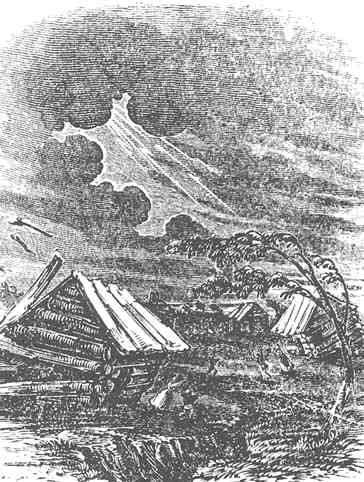
The New Madrid earthquake of 1811 was actually a series of 200 moderate to large earthquakes which occurred from December 1811 to March 1812. Although these quakes caused little loss of life because the region was sparsely settled, the area affected by the New Madrid quakes was two to three times that of the 1964 Alaska earthquake, and ten times as large as that affected by the 1906 San Francisco earthquake (State Historical Society of Missouri, Columbia).
the public good; mandates or assistance from state or federal governments; previous experience with hazards; and presence of a policy solution that is both technically and politically feasible.
Lambright (1984) fitted some of these factors into a chronological sequence of policy development. In a study of seismic policy environments in southern California, South Carolina, and Japan, Lambright outlined the course of earthquake policy innovation as follows: (1) an awareness of a problem by a few "entrepreneur" individuals; (2) a trigger that converts awareness into policy demand; (3) a search for an appropriate response; (4) the adoption of a policy option by government, thereby giving legitimacy to the policy; (5) the translation of policy into program action; and (6) the institutionalization of programs.
All of the studies mentioned agreed that the key initiating factors are the presence of an advocate to promote awareness, and a window of opportunity to trigger action. However, it should be noted that Burby and May et al. (1997), in an empirical study of communities in five different states, found that previous occurrence of a natural disaster did not have a strong effect on the number of mitigation techniques employed by communities.
Most of the cited studies address hazard mitigation in general, and most involve just one type of hazard, usually earthquakes or flooding. The lessons theses studies derived may be extended to all hazards, and the factors that influence all forms of mitigation can be applied to the narrower category of land use regulation.
Factors Controllable by Local Government
Political and institutional roadblocks to hazard mitigation are formidable. Studies of earthquake hazard mitigation have suggested various reasons for the lack of action, even where concern is high: earthquakes themselves are not well understood, there is no public constituency, costs are immediate and benefits uncertain, benefits may not occur during the tenure of current elected officials, public safety is not visible, and other public issues are more immediate. But these roadblocks can be overcome.
Recognition of the Problem
Problem recognition consists of awareness and concern, and clearly both are necessary prerequisites to local action. Local governments and
community organizations, with advocacy and staff resources, can persuade members of the public and elected officials to recognize the importance of natural hazards. But awareness and concern alone are not enough. May (1991) summarizes the results of seven surveys of earthquake awareness and concern in the western and central United States and concludes that all consistently demonstrate that earthquakes are expected but not dreaded. Officials and the public alike are aware that they face an earthquake risk, but it is not a high-priority concern.
Study findings vary regarding the level of concern of local officials. Drabek and others (1983) found that most community leaders sampled in Missouri and Washington felt that seismic risk is a serious problem, and most were concerned that an earthquake could result in major damage and loss of life. Wyner and Mann, in a more limited study (1986), found that most elected public officials and city managers in California considered seismic risk to be moderate or high. Mushkatel and Nigg (1987a, b), in a 1983 survey, found that a substantial proportion of citizens and government officials in the New Madrid seismic area were at least somewhat worried about the possibility of a damaging earthquake before the year 2000. They also found high levels of support for mitigation measures, with strongest support in the areas most at risk. In contrast, Rossi and others (1982) documented that natural hazards have a very low priority on the local political agenda, and most officials have little interest in land use approaches to mitigation.
Even where local officials state that they are concerned, they may not be concerned enough to take action. For example, although Drabek and his colleagues (1983) found high levels of concern for earthquake hazards in Missouri and Washington, the level of earthquake mitigation activity among state agencies was quite low in both states.
Some studies have contrasted the level of concern among officials with that of the public. Mushkatel and Nigg (1987a) found a higher level of concern for seismic safety among residents than among public officials. Ironically, Drabek and colleagues (1983) and Wyner and Mann (1986) found that government officials perceive their awareness and concern to be higher than that of the citizenry.
Governments can improve community-wide recognition of hazards by preparing local comprehensive plans, as described in Chapter 5. Burby and May et al. (1997) found that high-quality plans result in greater knowledge and more understanding of natural hazards among stakeholders in the community. And the more knowledgeable they become, the more likely they are to act on that knowledge.
Advocates
Numerous studies have emphasized the importance of key individuals, acting as advocates or policy champions. Even in their relatively pessimistic assessment, Rossi and others (1982) observed that the viewpoints of key influential people are important in advancing natural hazards on the local agenda. Alesch and Petak (1986, p. 225), in their insightful study of earthquake mitigation policy in Los Angeles and Long Beach, concluded, "The probability that hazard mitigations will be enacted is in direct proportion to the extent that there are inside policy advocates who are persistent and tenacious in their pursuit of the policy, who have access to policymakers, and who have credibility among policymakers."
Interaction Among Participants in Policy Development
Policy development depends on many actors, including agency personnel, professional associations, and civic organizations. Sustained interaction and communication among participants is important in helping to define issues, develop solutions, and bring them to the attention of others. Interaction can consist of repeated communication between agencies, or exchange of information through activities in professional associations. It can take place through organized coordinating bodies, such as seismic advisory councils, as highlighted in the following chapter.
Staff Resources
Limited resources hamper mitigation efforts. Both money and staff time are needed to adequately develop and implement local mitigation programs, even when data and assistance come from external sources. When resources are available, data can be collected and analyzed, solutions developed, and mitigation actions carried out. It is important to be able to retain well-trained local staff, who can develop, analyze, and present the data, and who are familiar with local problems. Local officials need to be committed to mitigation programs and need to have adequate capacity to implement them.
Linkage to Other Issues
Mitigation of natural hazards is more likely to succeed if it can be seen as reinforcing the solution of another problem, such as power plant
siting, school safety (which has been important regarding seismic safety efforts in Arkansas, Kentucky, and Missouri), growth management, or traditional techniques of local land use management. Hazard mitigation programs also are eased by the existence of well-established precedents. Once a precedent is established for one field, accustoming people to new ways of doing things, it can promote similar change in another field.
Factors Not Controllable by Local Government
Many factors that affect the use of hazard mitigation measures are beyond the control of local government. Unlike the controllable factors noted above, which have been explored via detailed qualitative case studies of local processes, these other factors are more easily measured by quantitative empirical means. In many ways, they are easier to measure and explain, but less relevant to local governments seeking actions they can take to facilitate mitigation policy.
Burby and French (1981), in a nationwide study of flood-prone communities, concluded that those that have adopted broader, more stringent programs are communities where flood-prone land is currently in use. Also these communities perceive the flood risk as serious, attach high priority to solving flood problems, have taken other steps to deal with flooding, and have a relatively greater capacity to mount a vigorous program. Many of these factors are inherent in the existing qualities of a community: larger, wealthier communities with vacant upland areas are more likely to have substantial floodplain management programs. Paradoxically, they also found that communities with the strongest development pressures were stimulated to adopt strong floodplain land use management programs.
Godschalk et al. (1989) measured three types of factors affecting mitigation of coastal flooding: environmental factors, policy catalyst factors, and political conversion factors. Their analysis identified three environmental factors that negatively influence mitigation (percentage of floodplain already developed, presence of barrier islands, and existence of a strong private property ethos). With regard to the policy catalysts, their analysis identified five positive factors (recent storm history affecting priority and adoption of mitigation actions, probability of a hurricane, community advancement to the regular phase of the National Flood Insurance Program, number of years in the NFIP, and state active in promoting mitigation) and one negative factor (recent storm damage causing planners to rate their programs as ineffective). The authors iden-
tified two negative political conversion factors (absence of politically supportive groups, and opposition of development interests).
Opening of a Window of Opportunity
Numerous hazard policy studies have emphasized the catalyzing effect of the window of opportunity that opens following a natural disaster. Disasters increase local awareness and concern and attract federal and state resources. Sometimes distant disasters can create windows of opportunity, as a community is reminded of what may someday occur closer to home. Proactive local agencies can plan for mitigation programs in advance, so that they can be introduced into the policy arena shortly after a window opens (and before it shuts again). California's Seismic Hazard Mapping Act, for example, was outlined in the late 1980s, making it ready for rapid introduction and enactment following the 1989 Loma Prieta earthquake. As noted earlier in this chapter, Burby and May et al. (1997) found counter-evidence, to the effect that previous occurrence of a natural disaster did not have a strong effect on the number of mitigation techniques employed by communities. Still, they recognize the value of other types of windows, related more to internal than external factors: plan updates, comprehensive revision of zoning ordinances, or major capital investment decisions.
Community Wealth and Resources
Community wealth can influence local mitigation initiatives in three ways. First, in affluent communities, the costs of mitigation may be seen as acceptable compared to the benefits of loss reduction. Second, a prosperous community with a strong tax base can afford to initiate new, innovative programs. Third, local officials with a strong tax base are willing to restrict development in hazard areas even though it may shift some development to other jurisdictions.
Political Culture Supporting Regulation of Private Property for Public Ends
Communities that are less ''public minded," more individualistic, and more concerned with protection of property rights tend to give little support to hazard mitigation. This is particularly true of mitigation programs that regulate land use type and intensity. The difficult political
and legal problems associated with private property rights considerations are discussed in more detail below. In general, the success of local hazard mitigation plans requires that citizens and elected officials become committed to the planning process and feel a sense of ownership of the plan.
Mandates or Assistance from State or Federal Government
Natural hazards are generally of more concern to higher levels of government than to local governments. The wider the jurisdiction of the government, the more likely the area is to experience disasters; for smaller areas disasters are low-probability events. The federal government must respond to disasters every year, whereas a given local government rarely experiences such an event. Thus, it is in the interests of state and federal governments to encourage local mitigation programs. There have been numerous studies on the effect of federal policies that facilitate local mitigation programs. In some cases, federal programs provide funding or technical assistance. In other instances, the state or federal programs mandate local regulatory and public investment actions. According to Burby and Dalton (1994), local land use plans, to be effective vehicles for mitigation, usually require state or federal mandates, as discussed in detail in other chapters of this book.
Previous Hazard Experience
Communities with previous disaster experience are more likely to be aware and concerned enough to take mitigation actions. This is particularly evident in coastal (hurricane-prone) regions, although the influence of strong state planning and hazard-related mandates in those states (Florida, North Carolina) makes it difficult to ascribe local action to experience alone. Kartez and Faupel (1995) found evidence in a longitudinal study of 400 cities in 1987 and 1993 that land use management actions to mitigate hazards take five to ten-years to become institutionalized once a major disaster has caused damages. Noteworthy cases like Tulsa illustrate that multiple, costly impacts are often necessary for experience to foster action.
Presence of a Feasible Policy Solution
The final ingredient for success is the existence of a policy solution that is feasible, both technically and politically. Alesch and Petak put it
as follows: "In order for hazard mitigation policy to be enacted, there must be an available policy option that includes a technical solution viewed as practical and efficacious by nontechnical policymakers" (1986, p. 224).
Land Use Regulation: Special Considerations
Although only some of the land use management tools identified in this chapter involve applying land use regulation to private property, this type of regulation is potentially the most powerful means of mitigation, because it reduces the number of people and properties in risky locations. But it also is problematic, both legally and politically.
Legally, local governments need to worry about claims that they have taken the value of private property, and hence must compensate the owner. Although the courts have not formulated a clear test that distinguishes between a land use restriction so severe that it constitutes a taking and a permissible restriction upon the use of private property, courts have generally allowed land use regulations that substantially advance legitimate public interests, do not deny owners economically viable use of their land, and do not unduly burden individuals. Thus, to avoid being subject to claims of taking, hazard-related land use regulations should clearly serve a legitimate public interest, be supported by scientific data demonstrating a connection between the regulation and the public interest, and should not render land valueless. In addition to meeting legal requirements, it is often politically prudent to maintain economic value of property to the maximum extent possible consistent with the public safety goals of the regulation (this subject of private property rights is discussed in Chapter 2; also see Kusler, 1980).
THE QUESTION OF EFFECTIVENESS: LOCAL IMPLEMENTATION, AS DISTINCT FROM ADOPTION
Most of the discussion to this point has looked at factors that lead to policy adoption, and not necessarily successful implementation. May and Bolton (1986) argue that planners need to think of implementation when considering the likely effectiveness of hazard reduction measures. With regard to earthquake hazard reduction measures, they assert that theoretical studies "have overstated the benefits of such measures. By assuming away implementation difficulties, the studies provide a 'best case' analysis of the theoretical effectiveness of hazard-reduction mea-
sures" (p. 450). For example, studies after Hurricane Andrew found that the South Florida Building Code was adequate, but actual construction workmanship and code enforcement were deficient (Federal Emergency Management Agency, 1992a). Focusing on adoption alone, therefore, may be unrealistically optimistic. For example, Wyner and Mann (1986), regarding local implementation of seismic mandates in California, found that very few jurisdictions had taken steps to achieve even some of their seismic land use objectives. Palm (1981) found that fault-zone regulations in California, although successful in limiting new construction of homes directly upon active faults, did not affect consumers; they affected neither housing prices nor consumer decisions to buy houses in these zones.
What, then, are the ingredients of successful implementation? Failure in the implementation of local plans is not an issue unique to hazards, of course, even when state mandates exist to force local action. May and Bolton (1986) draw on the implementation literature to warn planners that complex chains of implementing actions and indirect control can undermine implementation, but conclude that the difficulties can be surmounted if the program creates incentives for target groups and key implementers. As an example, they concluded that a proposed hazardous building abatement ordinance in Provo (Utah), though superficially attractive, would be unlikely to work in reality, because key target groups probably would not comply.
A few studies have identified specific pitfalls in trying to regulate land uses for hazard mitigation. For example, Wyner and Mann (1986) concluded that implementation of seismic land use policies does not actually stand in the way of efforts to develop land. Communities prefer building code or site-specific design approaches to land use approaches. Local governments favor regulations that pass costs on to developers on a project-by-project basis. As noted in Chapter 5, regarding local use of spatial hazard information, planners are most likely to use information that (1) is clearly mapped, (2) comes from an authoritative source, and (3) provides guidelines for specific actions they can take.
Burby and others (1988) found that floodplain management programs are effective in protecting new development from flood losses up to the 100-year event. Some lessons from the successful programs: (1) benefits are achieved primarily through influence on the development decisions of builders and land developers—once land is subdivided, habitation and use will follow; (2) the post-flood window of opportunity is best used for targeting households and business firms to retrofit or relo-
cate; (3) NFIP criteria do not discourage floodplain development, but local land use programs often exceed the requirements of the NFIP in discouraging floodplain development; (4) floodplain development pressures can be reduced if cities ensure that a large supply of flood-free land is available for urban development; and (5) land acquisition is always an option.
It is difficult to generalize from these few studies of implementation, but some tentative lessons from what actually works are listed in the following paragraphs.
Use clear and authoritative maps of the hazard
Maps should be clear and unambiguous, so that planners and public officials can tell which zones apply to a particular property. A credible scientific body or expert, who is seen as being unbiased, should issue the maps. Examples include: flood hazard maps issued by the Federal Insurance Administration (although local governments with more specific engineering data may modify the maps); fault-zone maps issued by the California State Geologist; and informational landslide maps prepared by the U.S. Geological Survey and several state geological surveys.
If trying to revise or restrict land uses in hazardous areas, do so before the land is subdivided
Once land is subdivided, the individual parcels may be sold and owners are entitled to the use of their property. If some of the parcels are wholly within hazardous areas, the only way to prevent their development is for the local government to purchase the parcels. Some local governments, under pressure from developers, allow subdivision of properties with the condition that subsequent applications will be carefully reviewed on a parcel-by-parcel basis. If detailed study were to show that one parcel, for example, is located at the foot of a large active landslide, the problem would be unfair and costly to city and property owner alike.
Use project-specific design approaches
Although well-designed comprehensive plans can establish the policy context, the most feasible approaches are actually those that can be implemented on a project-by-project basis. These approaches are easy for local governments to administer because they can be integrated with
normal development review processes, and they do not involve a large number of other institutions. The types of policies that are most likely to be implemented successfully by local governments are policies that call for clustering of development on the least hazardous parts of a property, design of subdivisions sensitive to natural processes, building setbacks, site-specific engineering studies, and building elevation or strengthening. One problem with project-by-project implementation policies is that, like dams and levees, they may encourage development of hazardous areas by creating a false sense of complete safety and thus increase the potential for catastrophic losses. Engineered safety is only provided up to a specified design standard (see Chapter 5, regarding acceptable risk).
Link clear and realistic design guidelines to the map
Local planners need to know what to do with a hazard map. The clearer the instructions, the more likely they will be to follow them. The more realistic the guidelines, the more likely they will be accepted by the community. Floodplain ordinances, for example, usually have detailed lists of design requirements for each zone, such as building elevation, prohibition of storage of hazardous materials, and further studies needed.
Offer incentives to encourage target groups to comply
Incentives for developers might include tax abatements, density bonuses, or waiver of off-street parking requirements. At the very least, programs, in order to be successfully implemented, must be designed to be sensitive to the needs of target groups.
Ensure that hazard-free land is available for development
If an entire jurisdiction is in a flood zone or a zone of high seismic hazard, then it probably would not be feasible to apply strict development restrictions over all properties. Cities need safety valves for growth pressures, and every jurisdiction with hazard areas should also have relatively safe areas designated for development.
Use the post-disaster window of opportunity to encourage individual owners to retrofit or relocate
Individuals are most aware of the hazard in the immediate aftermath of disaster. Owners of tornado-damaged homes are more likely to con-
sider wind-resistant design, for example. The strong desire on the part of many floodplain communities to be relocated following the 1993 Midwest floods is another good example of this phenomenon.
If hazardous land is subdivided and built out, be prepared to purchase selected properties
Property acquisition is always an option. If individual parcels are found to be in highly flood-prone areas, coastal erosion zones, or actively unstable slopes, public agencies should be prepared to purchase the properties. This often is more cost-effective than waiting for extensive property damage, injuries, or loss of life to occur, all of which may also be accompanied by costly litigation.
The above principles are the result of extensive assessments of experience and indicate what ought to be the approach to implementation under some typical conditions.
CONCEPTUAL AND OBSERVED EFFECTIVENESS
To create a report card of the comparative effectiveness of different land use management tools is difficult for several reasons. First, the types of land use management techniques that are part of a local jurisdiction's tool kit differ both in their potential or theoretical effectiveness and their observed effectiveness. In theory, some land use management tools would seem to be more effective than others if consistently and correctly applied. For example, acquisition of hazardous lands would seem to provide a more direct solution than public information systems.
More importantly, it is hard to rate each tool, because the tools are not independent of each other. They can work together, mutually reinforcing each other's contribution, for example, a zoning control and a coordinated building code prohibiting development on unstable slopes (unless the design meets geotechnically safe design requirements).
Other techniques, like educating builders and investors about safe siting and design needs, would not seem a priori to be very effective alone in spurring private hazard mitigation, yet may work well when combined with other measures. Empirical data indicate that education used in concert with regulation is likely to be more effective than regulation alone, as Burby and Paterson found in a detailed study of the effectiveness of construction run-off and sediment control regulatory programs (1993). In fact, not using the education tool may cause regulation, which theoretically speaking ought to be successful, to be ineffective in
actuality. Regulation can fail when the regulated community is uncooperative or ignorant of requirements, and when the public is politically unaware or unsupportive of the purposes of regulation. As part of a system, education is an essential and effective land use management tool; alone, education is a weak tool. The reality of land use guidance in the United States is that no system can rely on regulatory control alone. Burby and May et al. (1997) found that good land use plans help to educate the public, and that this knowledge may lead both to increased public demands for action and to increased commitment of planning staff and elected officials to the planned policies. Education is thus crucial from planning through implementation, and regulations adopted in jurisdictions with uninformed and uncommitted officials and citizens are unlikely to succeed.
The relative costs of the tools are also important. The most effective tools may simply be too expensive to provide widespread safety. For example, tools that remove hazardous lands from development, such as land acquisition or purchase of development rights, are too expensive to be used for all high-hazard areas.
Another reason why the observed (empirical) effectiveness of land use management techniques is difficult to summarize is that their effect depends on context. A good example of how effectiveness is influenced by context comes from the careful investigations of Burby and his colleagues into the effectiveness of local government floodplain management carried out within the framework of the National Flood Insurance Program in the 1970s and 1980s (Burby and French, 1981). The study found that local efforts to prevent floodplain development tend to be less successful when the supply of land outside of floodplains is scarce and/or local growth rates are high. Also communities with more fully developed floodplains, where efforts were likely to be less effective, tended to adopt the more aggressive programs.
Thus the timing of adoption of land use management tools for hazard mitigation makes a difference in effectiveness, as does the total effect of a locality's ongoing growth management system. If the local growth management system allows for sufficient land for development (land with adequate urban services and minimal environmental liabilities), then it is much more likely that restrictions on development of hazardous land will be effective. In other words, land use management for hazard mitigation is much less likely to be effective unless the overall development system approach in the locality is effective.
Finding a single summary measure for the comparative effectiveness
of different tools has severe limitations. For example, Godschalk et al. (1989) undertook an evaluation of the effectiveness of local government mitigation practice in high-hazard coastal localities. They asked planning officials in 4 counties in Hawaii and 598 coastal localities with "velocity-zones" (or V-zones) for their perceptions of the effectiveness of their currently employed mitigation measures. Their findings generally confirm the findings mentioned earlier. The surveyed officials rated building and other structural and siting codes as more effective than land use review and control measures. Yet such summary measures of effectiveness have several limitations. Obviously, a single numeric rating given by a single respondent from each sampled locality tells us little about what effectiveness really means. A less obvious limitation is that such effectiveness ratings tell us more about what has been effective in the past, and very little about what may be effective in the future and under what conditions.
In reviewing for the National Earthquake Hazard Reduction Program the use of planning and land use management to reduce seismic hazards, Mader and Tyler (1993) adopted a qualitative approach to briefly summarize their judgments about the effectiveness of each of the major categories of tools. The authors of this book have extended Mader and Tyler's pragmatic approach to a larger array of tools as listed in Table 6-2. We also have extended the evaluation process by considering findings both from the completed research and from some still-ongoing research. The ongoing research projects, generally supported by the National Science Foundation, include those dealing with FEMA's section 409 mitigation planning process (Godschalk and associates), the possible role of taxation (Deyle and associates), applications of sustainable development principles (Berke and associates), integrating hazard management into local planning (Kartez and associates), use of seismic hazard maps and seismic safety plans by local governments (Olshansky, French), continuing research on the role of mandates and coercive versus cooperative approaches in improving the intergovernmental patchwork (Burby and May and associates), and research on enforcement of regulations (Burby and May and associates).
Two of the themes that occur frequently in the evaluation of different land use management tools in Table 6-2 are the need to extend existing local and state policies and tools to hazard mitigation objectives, and the need to link different tools together into a system in order to be effective. Both of these hazard mitigation implementation issues have only recently begun to be addressed in research.
TABLE 6-2 A Qualitative Assessment of the Effectiveness of Land Use Management Tools for Hazard Mitigation
Land Use Management Tools | Theoretical Effectiveness | Actual Effectiveness |
Building Standards | ||
Special building standards for flood and seismic hazards (floodproofing requirements, or special seismic building codes) | Effective in elevating structures in floodplains to prevent building damages and widely used because of the National Flood Insurance Program. Seismic codes can effectively save lives and dramatically reduce (but not prevent) chances of building collapse. But seismic codes do not necessarily reduce overall damages. | Floodproofing does not reduce areawide flooding because, perversely, it encourages floodplain development. Seismic building codes are only very weakly enforced in central and eastern states and outside metropolitan areas at present. |
Development Regulations | ||
Zoning ordinances | Can limit exposure of new development in hazard areas and protect natural values and functions not yet degraded by development. | Cannot mitigate losses to existing development and infrastructure. Can be subject to politically driven changes. Effectiveness of zoning is constrained to hazards for which risk varies geographically within a given jurisdiction. |
Subdivision ordinances | The key point in land use management where damage can be reduced by design and by relocation of structures and lifelines to safer areas of subdivision. | Although more widely used than even zoning, subdivision regulation is not well tied to hazard mitigation aims in many areas. |
Shoreline setback regulations | Can protect beaches and development- from low-intensity coastal storms and flooding impacts, and prevent the need for sand replenishment. | Long-term limitations in that setbacks are set by mean high tide and not actual erosion conditions. That not only allows for catastrophic damages in extreme hurricanes, but also invites takings-style challenges when shallow lots preclude such setbacks. Too many variances given locally. |
Special hazard area, fault- setback, or flood hazard area regulations | Regulations that combine features of zoning and building codes can be used to trigger more attention to mitigation options at the time of development. | Requires detailed information on the spatial extent and nature of hazard to be effective. Cannot determine the overall pattern of development, but can ensure that case-by-case mitigation opportunities are identified. |
Dune protection regulation | Provides protection against storm surge flooding from low-intensity coastal storms. Few impediments. Generally accepted as wise practice in coastal areas. | Does not prevent development patterns vulnerable to catastrophic coastal storms. |
Wetlands protection regulation | Prevents development of flood-moderating holding areas and also helps to clean urban storm run-off. Has been a fortunate coincidence that wetlands regulations may deal with floodplains, but hazards are tangential to wetlands laws. | Coastal and saltwater marsh regulations have been most effective when part of state and federal coastal management mandates of broader scope. Freshwater wetland regulation varies greatly from one jurisdiction to another. Filling of natural wetlands due to replacement provisions of no-net-loss laws may actually detract from flood reduction. Not well linked to hazard mitigation aims away from coastal storm zones. |
Land Use Management Tools | Theoretical Effectiveness | Actual Effectiveness |
Natural hazards identified in environmental impact assessments | Can be effective in changing the design and possibly overall intensity of of individual projects to mitigate hazards. | Like special hazard area regulations, cannot determine the overall pattern of development that produces hazard exposures. Only mitigates on a project-by-project basis. Can be reduced to meaningless routine in states with EIA/EIR mandates. Follow-up and enforcement of mitigation actions is often lacking. |
Critical and Public Facilities Policies | ||
Capital improvements program (CIP) | Can be useful in steering development away from hazard areas by limiting availability of necessary urban services. | Not widely used for hazard mitigation. Jurisdictions often ignore their own CIPs. Not an effective tool by itself for any land use policy objectives. |
Location of public facilities outside of hazard areas (to discourage development) | Can discourage or reduce the intensity development in hazard areas. | Does not alter the basic spatial pattern of private development in hazard areas. areas. Rarely used for hazard mitigation purposes, and much more effective when linked with complementary land use regulations and tax policies. |
Location of public facilities to reduce risk of damage to infrastructure | Protects lifelines in a disaster and reduces costs of public property damage, which are largely borne by federal government. | Does not alter the basic spatial pattern of private development in hazard areas. Local governments have low incentives to protect noncritical facilities because costs passed on to federal government. |
Land and Property Acquisition | ||
Acquisition of open space/recreation/ undeveloped lands for mitigation | Ownership of site is most effective means to manage it. Multiple objectives are possible (e.g., recreation, flood mitigation, and neighborhood redevelopment in Tulsa). | May be relatively meaningless as a mitigation device unless part of a management system for an entire hazard area. Most open space acquired for reasons unrelated to hazard mitigation and possibly in conflict with it (e.g., in Florida, lands not acquired if subject to erosion hazard). Again, coordination of objectives a problem. Expensive. |
Acquisition of damaged buildings in hazard areas. | An important element of a community relocation effort. | Present use is very limited and effectiveness depends on what happens to acquired structures and subsequent rebuilding on- and off-site. Expensive, with very high demands for commitment and coordination. |
Land Use Management Tools | Theoretical Effectiveness | Actual Effectiveness |
Relocation of existing hazard area development to new site(s) | Removes risk to residents in the hazard area if no vulnerable rebuilding takes place. | Same limitations for building acquisition noted above. In addition, relocations require large investment in new site, with no assurances that former residents will move to relocated development. Timing is a problem because buyouts and relocation are not necessarily at the same time. |
Acquisition of development rights or easements | Potentially very effective if funds are available and adequate authority (such as eminent domain) can be employed to target key sites. | Not used for hazard mitigation very frequently. Mitigation objectives are not linked to other acquisition programs for open space and growth management. Fee-simple acquisition tends to be emphasized more than partial rights/easements. |
Transfer of development rights (TDR) away from hazard areas to safer locations. | Potentially very effective if there are suitable receiving areas for transferred rights and the program is mandatory, not voluntary, | Not used yet for hazard mitigation. Incentives not sufficient for using this complex tool for hazard mitigation aims alone. |
Taxation and Fiscal Policies | ||
Preferential (reduced) taxation for open space or reduced land use intensity of lands in hazard areas | Important as a possible incentive for easements and other partial-fee transactions to limit development in hazard areas. | Has not been used for mitigation aims. Completely ineffective as a stand-alone tool. Requires state enabling legislation or extension of existing farmland and open-space laws to mitigation purposes. |
Impact taxes or special assessments to fund the added public costs of hazard area development | Can shift costs of future public losses due to developing in hazardous locations back onto the developers and owners. Possible disincentive to vulnerable development. | Has not been used for mitigation, although many other public costs of of development are now collected from new development. |
Information Dissemination | ||
Public information program | Better informed citizens and consumers can create a political constituency for hazard mitigation when they know about the location and magnitude of hazards. | Generally, these programs have a mixed record in building local political commitment for hazard mitigation. Targeted self-help programs that provide specialized information on floodproofing or residential earthquake mitigation have been more effective. |
Construction practice seminars or builder/developer mitigation | Essential aspect of effective use of specialized codes and building standards. Can contribute to success of an overall multi-tool mitigation strategy. | Uneven education practices among states, code authorities and professional organizations detracts from the gains possible. |
Hazard disclosure requirement in real estate transactions | Better informed real estate purchasers should create pressure for limiting some of the worst- cases of new development in known hazard locations. | State-mandated disclosure as part of real estate sales has not been effective at all. Disclosure typically is perfunctory and is provided too late in the transaction to affect the purchase decision more than very marginally. |
SOURCE: Based on a conference of the authors of this book, held at the Center for Urban Studies, University of North Carolina at Chapel Hill, March 22, 1996. | ||
CONCLUSIONS
To carry out comprehensive plans, local governments use land use management tools. Logically, then, those governments that have the foresight to address hazard mitigation in their plans can adapt land use management tools to meet their hazard reduction goals. Indeed, many governments, at least since the early 1980s, have been using such tools for just that purpose. Over half of sampled local governments subject to floods, hurricanes, and earthquakes routinely use their zoning and subdivision ordinances to mitigate hazards to new development, and approximately half require use of hazard-resistant building standards. Depending on the nature of the hazard, even more tools are available: policies for location of public facilities, programs for acquisition or relocation of hazardous properties, fiscal policies, and information programs. Jurisdictions with a coherent strategy—and there are many—are able to build communities that will resist natural disasters, will recover quickly from them, and will last for many years with little cost to their inhabitants in dollars or lives. These are resilient, sustainable communities.
This chapter has reviewed the types of tools used, factors that can ease their adoption by local governments, and means of improving their local implementation. It has provided a realistic assessment of their effectiveness. Although local roadblocks are formidable, this chapter summarizes dozens of studies that show that many local governments have been successful in adopting land use management measures to mitigate hazards. Local governments that plan, create public awareness of the hazards they face, have policy advocates, and have adequate staff resources are most successful. In addition, it helps to have mandates and assistance from higher levels of government, previous experience with hazards, adequate community resources, a window of opportunity following a disaster, and a political culture that supports regulating private property for public ends. Governments must be careful in implementing programs, minding both the political and technical details. Some of the lessons from local experience show that communities must be both visionary and pragmatic. They need to be farsighted in gathering credible data, preparing maps, and managing land well before it is developed; but they must also be practical in using site-specific approaches, integrating hazard mitigation into their normal development review procedures, taking advantage of post-disaster windows of opportunity, and being prepared to purchase properties if necessary.
The entire list of potential land use management tools is not for every community. Each community and each local government must make choices, depending on the characteristics of the hazards they face and the political and economic qualities of the community. Use of the information in this chapter can help to inform these choices.