Mitigation Strategies for Deterring Transit Assaults (2025)
Chapter: 7 Interactive Matrix of Countermeasures

CHAPTER 7
Interactive Matrix of Countermeasures
This chapter provides a description of decision-making guidance for practitioners to use when selecting mitigation strategies to address transit assaults. It is intended to be used in conjunction with the interactive matrix, a product of this research project, and serves as a dynamic user guide.
Transit agencies can use the matrix as a tool to aid in the selection of mitigation strategies. A transit agency may come to this matrix with limitations such as the level of concern, size of the agency, or fiscal ability. The interactivity part of the matrix allows filtering to explore options in a one-stop-shop type of tool.
The tool is a standalone Microsoft Excel spreadsheet that contains the fields with evaluation criteria, including location of concern, cost, effectiveness, ease of implementation, and whether it is a common strategy used by other agencies. Agencies can use this interactive tool to select ideal mitigation strategies based on agency circumstances or other considerations. The matrix provides all identified mitigation strategies described in Chapter 5. Appendix B provides a summary table.
Selection Criteria
To narrow the menu of mitigation strategies, the evaluation criteria offer categories to select based on location, ease of implementation, cost, effectiveness and whether the strategy is common. The criteria are defined as follows:
- Implement location classifies the locations to implement mitigation strategies.
- Bus stops: strategies that can be implemented in and around bus stops.
- Rail stations: strategies that can be implemented in and around rail stations.
- Transit center/transit property: strategies that can be implemented in a transit center/building, including platforms, parking lots/garages, and office buildings.
- On vehicles (bus): strategies that can be implemented on buses.
- On vehicles (rail): strategies that can be implemented on rail cars.
- Not applicable: strategies that cannot be implemented at specific locations.
- Cost identifies the cost of certain mitigation strategies as low ($), medium ($$), or high cost ($$$).
- Effectiveness selects the effectiveness of certain mitigation strategies, from low, medium, to high effectiveness.
- Ease of implementation identifies the ease of implementation of a certain mitigation strategy.
- Easy strategies are the easiest and fastest to implement with low operating and capital costs.
- Moderate strategies may require a longer time to implement, higher costs, and/or more detailed coordination with outside partners.
- Hard strategies require complex implementation, high costs, and/or high-level coordination with outside partners.
- Common strategy identifies whether these strategies are commonly used by other transit agencies.
Mitigation Strategy Selection
Transit agencies can use the matrix in Appendix B and the spreadsheet to identify suitable strategies based on the defined criteria. This section presents scenarios that might be faced by transit agencies in real-world situations and the use of filters to identify possible solutions based on that agencyʼs situation. Based on the description of the scenarios, the spreadsheet tool outputs mitigation strategy options for different circumstances.
Example Scenario 1
Transit Agency A has a recurring issue with assaults on passengers and has already tried several common strategies to address the issue but have had only moderate success. They are looking to try a new or less commonly used or known strategy.
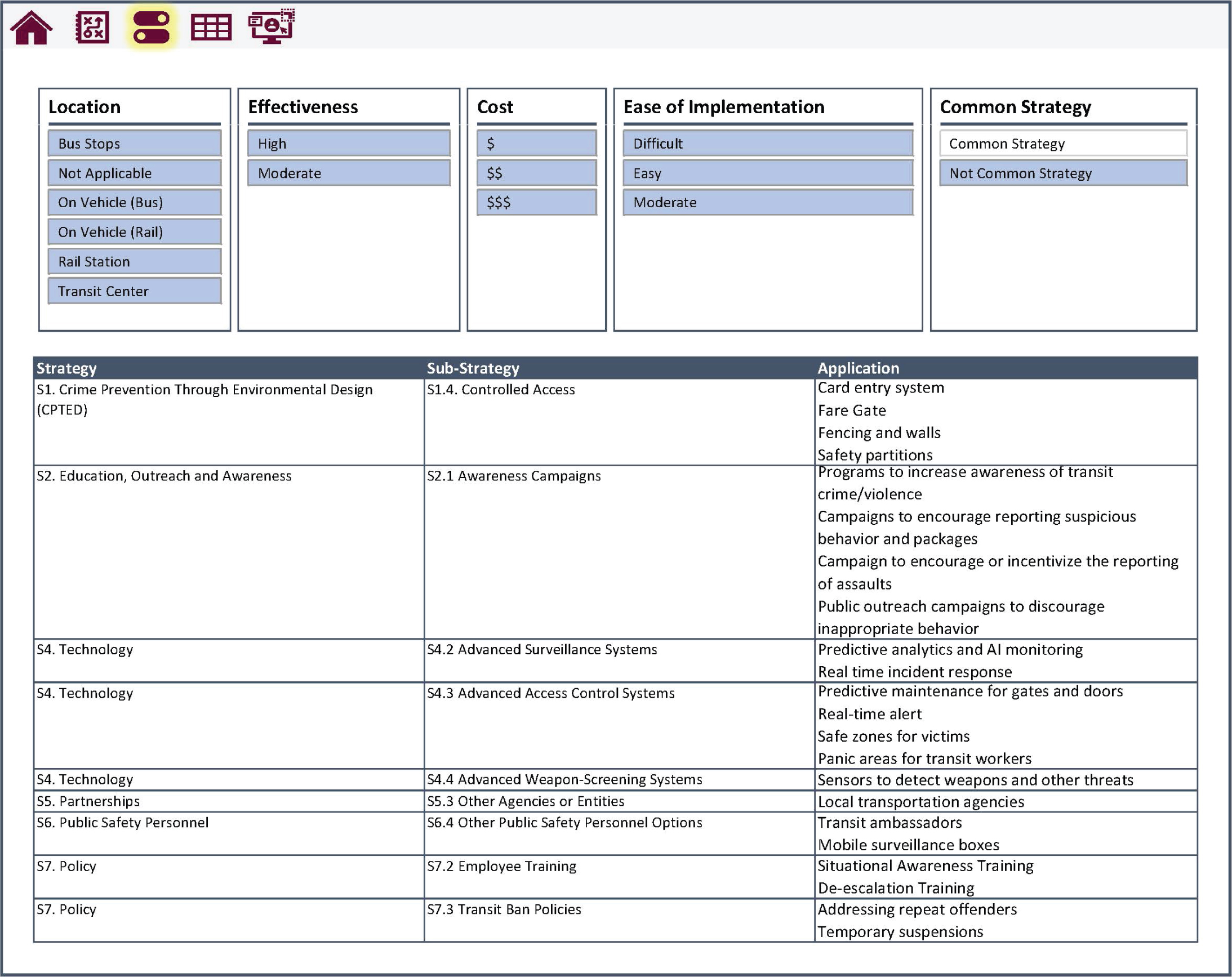
In this case, the agency may choose to only filter for a Not Common Strategy. This will provide a list of possible new strategies to try from various categories (Figure 28).
Long Description.
The matrix helps organize potential interventions by purpose and implementation. The matrix presents a structured output for Scenario 1, showing multiple strategies to improve transit safety. Filters at the top sort by location, effectiveness, cost, ease of implementation, and whether the strategy is common. The strategy column includes crime prevention through environmental design, education, outreach, and awareness, technology, partnerships, public safety personnel, and policy. Each strategy is paired with a sub‐ strategy and its application. For example, controlled access includes card entry systems, fare gates, fencing and walls, and safety partitions.
Awareness campaigns focus on reporting behavior and public outreach. Advanced technology options include surveillance systems, access control, and weapon screening systems. Partnerships and personnel strategies include transit ambassadors and mobile surveillance. Policy efforts focus on employee training and bans for repeat offenders.
Example Scenario 2
Transit Agency B is looking to address an assault issue, but has little money to spend, at least initially. They are looking for inexpensive measures to begin addressing the issue.
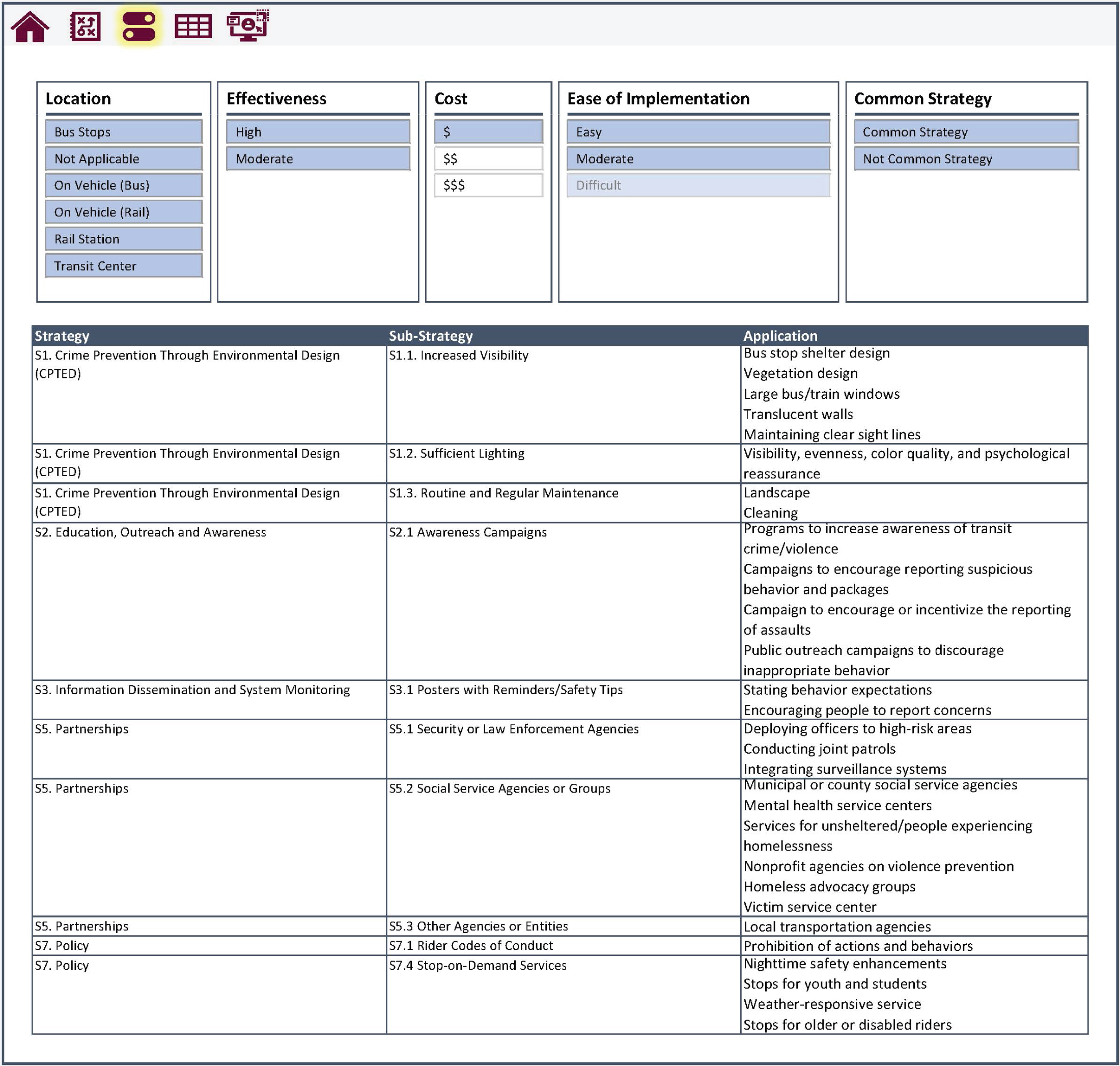
In this case, the agency may only choose to filter Cost and choose the $ to display those strategies with a low implementation cost. This option will provide a list of the least expensive strategies to consider (Figure 29).
Long Description.
The matrix displays Scenario 2 strategies for improving transit safety and comfort, organized by filters for location, effectiveness, cost, ease of implementation, and whether the strategy is commonly used. Main strategies include crime prevention through environmental design, education and awareness, information dissemination, partnerships, and policy. Sub-strategies include increased visibility, sufficient lighting, regular maintenance, awareness campaigns, posters with tips, law enforcement partnerships, and stop-on-demand services. Applications range from bus stop and shelter design, vegetation design, and translucent walls to routine cleaning, awareness programs, and signage about behavior. Partnerships involve security agencies, mental health centers, and homeless outreach groups. Policies include rider conduct rules and flexible stops for youth, seniors, and riders with disabilities. Each row links a strategy to specific, practical transit safety actions.
Example Scenario 3
Transit Agency C leaders have been approached by a neighborhood association that is concerned about the level of crime near a transit station and wants to create a committee to improve security. Transit Agency C may want to invite partners from social services, local law enforcement, business leaders, and others to work together on this concern and develop a long-term solution.
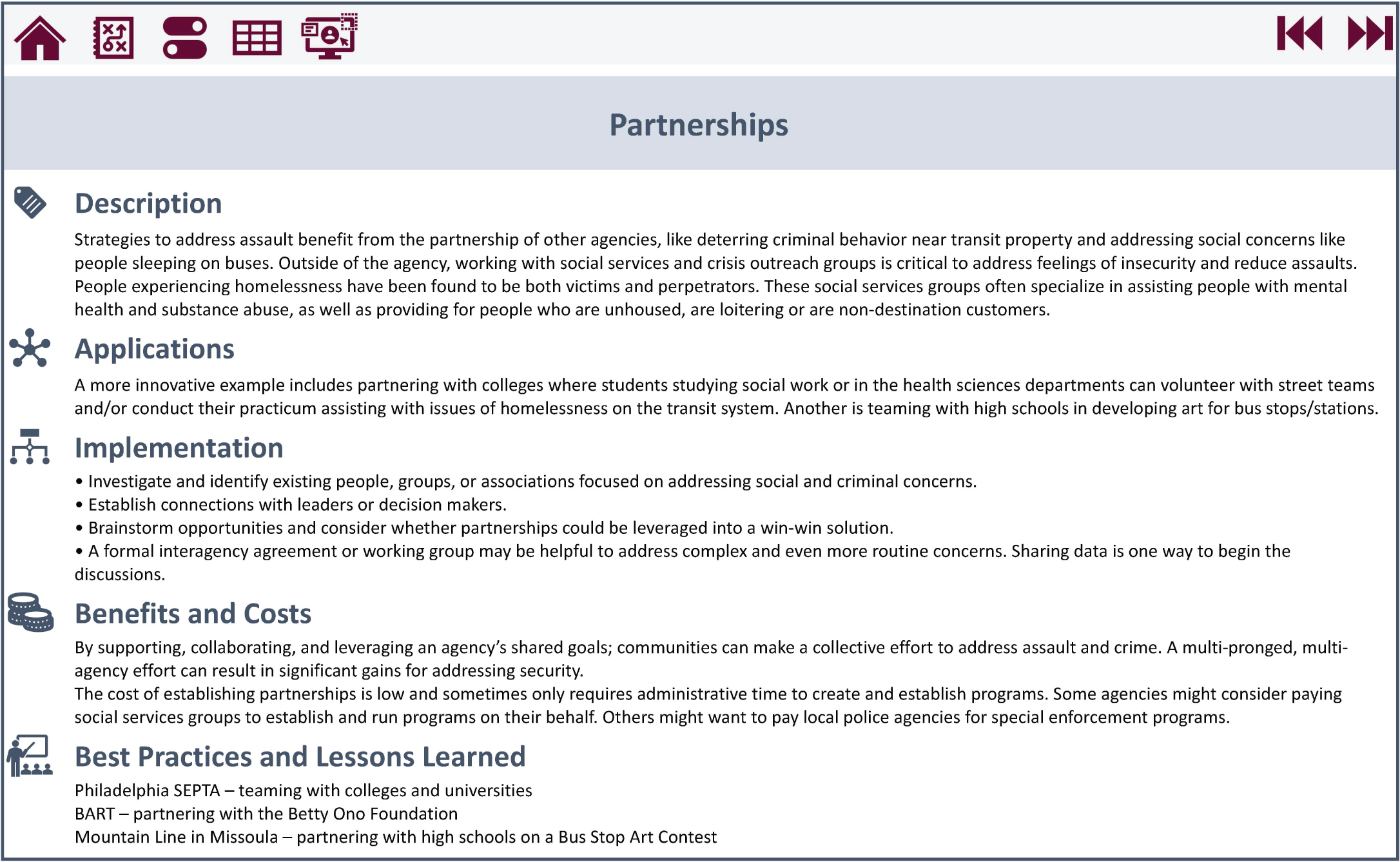
In this case, the agency may choose to filter for Partnerships to see examples of partners to consider (Figure 30).
Example Scenario 4
Transit Agency D has been struggling with disorderly conduct incidents on its bus network, including loud and disruptive behavior, smoking, and public intoxication. Despite deploying common mitigation strategies such as driver training, security cameras, and increased police presence at major stops, these issues persist. The agency wants to explore alternative, lesser-known strategies to improve passenger experience (Figure 31).
Example Scenario 5
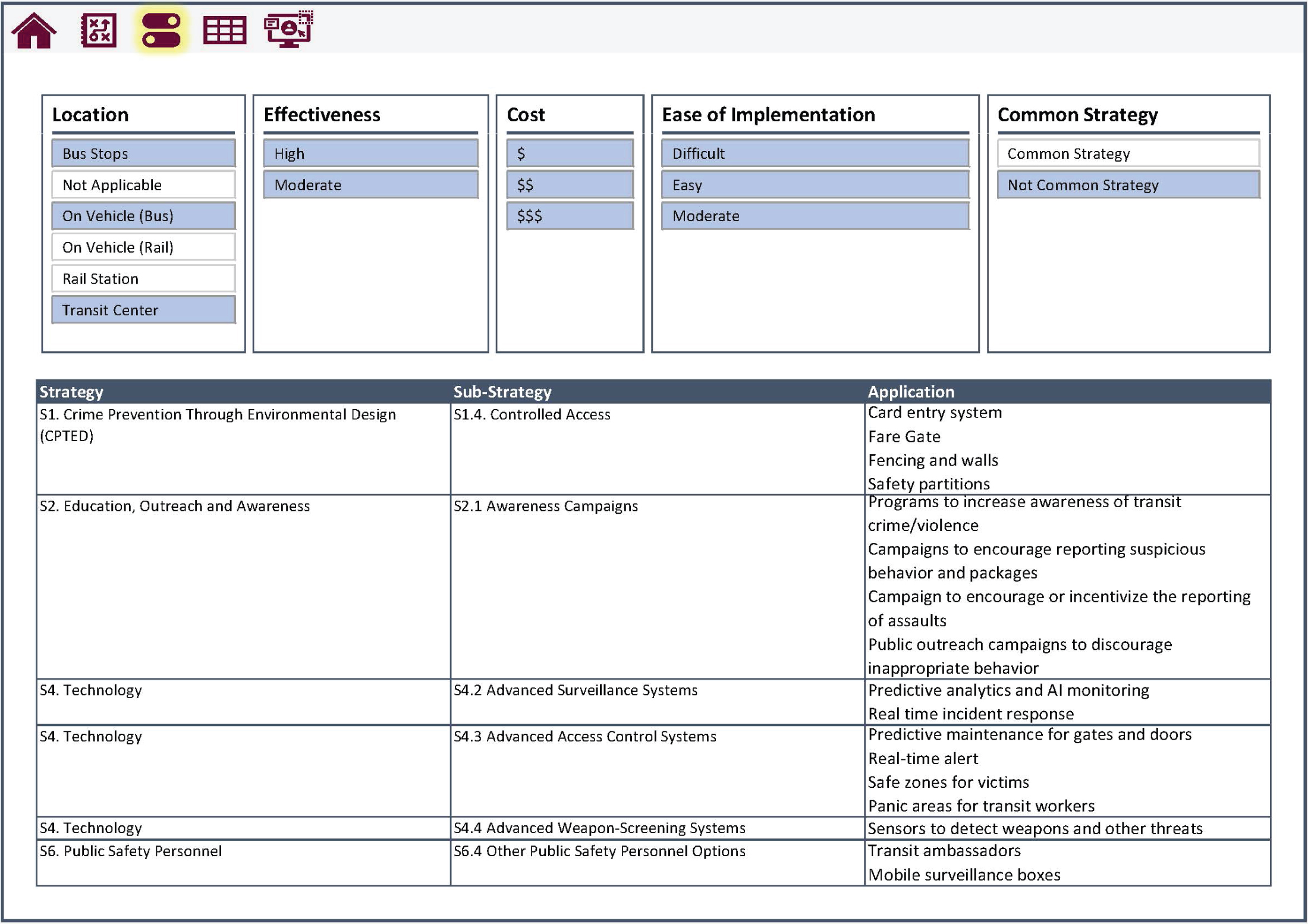
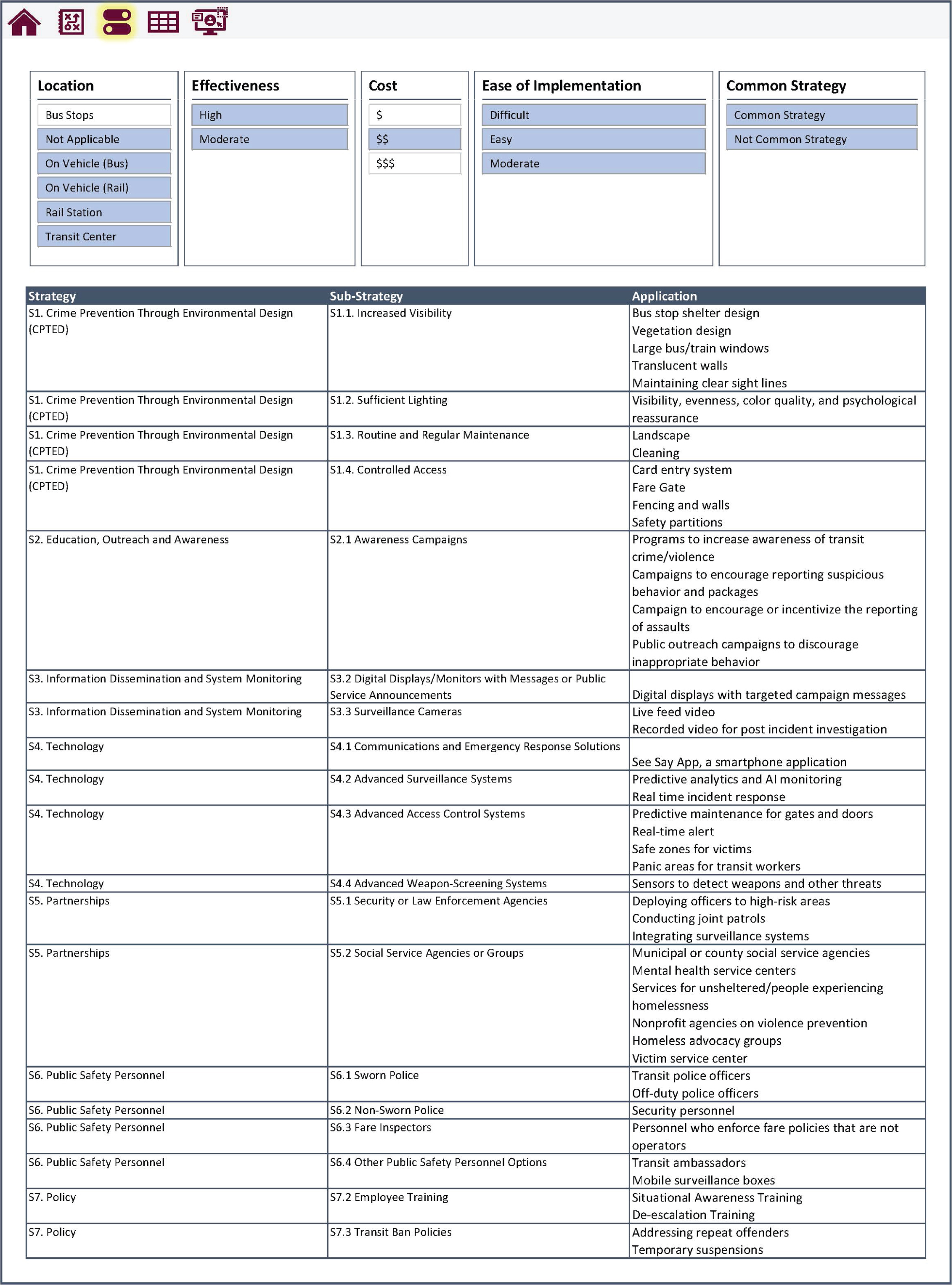
Transit Agency E has received ongoing complaints from passengers about feeling unsafe at bus stops, particularly at night. The agency wants a moderate-cost alternative to improve security. The selected criteria provide strategies falling within their identified parameters (Figure 32).
Long Description.
The panel outlines how partnerships between transit agencies and external organizations can help address assault and related social concerns. The description notes that working with social services, crisis outreach, and other groups supports people experiencing homelessness or mental health issues, who may be victims or perpetrators. Applications include partnerships with colleges for volunteer practicum and with high schools for public art projects. Implementation involves identifying key partners, establishing connections, brainstorming solutions, and formalizing agreements. Benefits include shared resources and improved safety with low costs. Examples of best practices include Philadelphia SEPTA working with universities, BART with the Betty Ono Foundation, and Missoula’s Mountain Line with high schools. These collaborations promote multi-agency efforts to improve transit safety and community engagement.
Long Description.
The Scenario 4 matrix presents strategies to address transit safety, categorized by location, effectiveness, cost, ease of implementation, and whether the strategy is common. The strategies include crime prevention through environmental design, education and awareness, technology, and public safety personnel. Sub‐ strategies and applications include controlled access systems such as card entry, fare gates, fencing, and safety partitions. Awareness campaigns promote reporting of suspicious behavior and assaults. Advanced surveillance systems use predictive analytics and real‐ time response. Access control systems improve gate maintenance, enable alerts, and create safe zones for victims. Weapon‐screening systems detect threats. Public safety personnel strategies involve transit ambassadors and mobile surveillance units. The matrix helps guide the selection of targeted safety measures based on operational needs and constraints.
(NOTE: The term non-sworn police has changed to non-sworn officer.)
Long Description.
The Scenario 5 matrix includes a comprehensive list of strategies to improve transit safety. Filters at the top allow sorting by location, effectiveness, cost, ease of implementation, and whether the strategy is common or not. Strategies are divided into categories such as crime prevention through environmental design, education, system monitoring, technology, partnerships, public safety personnel, and policy. Sub‐strategies include increased visibility, sufficient lighting, routine maintenance, controlled access, awareness campaigns, digital signage, surveillance, emergency response, and communications. Applications cover features like shelter and vegetation design, translucent walls, card systems, safety partitions, live video, surveillance cameras, See Say App, predictive monitoring, law enforcement deployment, social services collaboration, and staff roles such as transit police, fare inspectors, and ambassadors. Policy strategies focus on employee training and transit ban policies. Each strategy includes specific, actionable interventions designed for transit safety improvements.


