Mitigation Strategies for Deterring Transit Assaults (2025)
Chapter: Appendix A: Focus Group Discussion Guide and Interview Guide

APPENDIX A
Focus Group Discussion Guide and Interview Guide
Long Description.
Appendix A
Focus Group Discussion Guide and Interview Guide
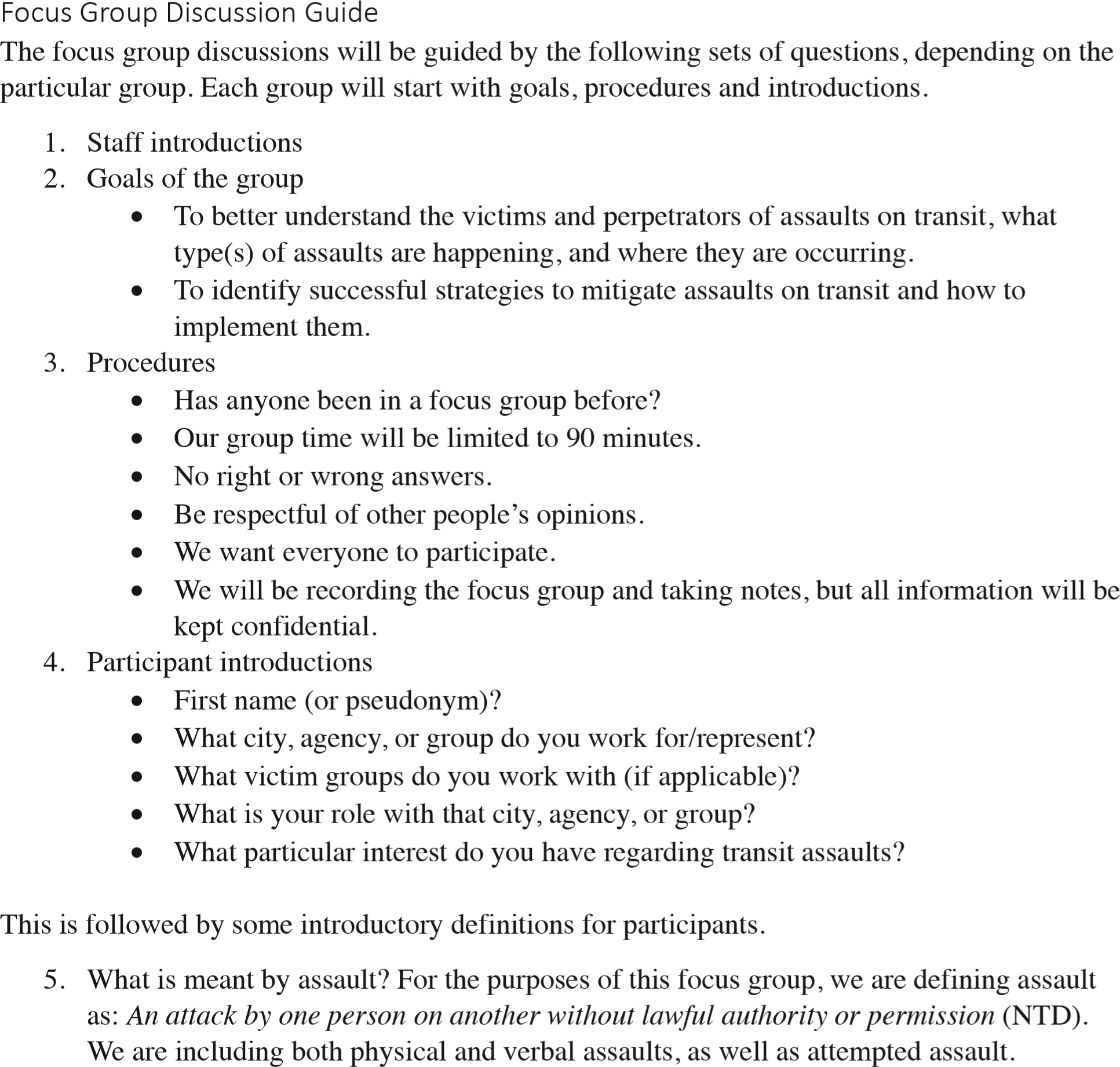
Focus Group Discussion Guide
The focus group discussions will be guided by the following sets of questions, depending on the particular group. Each group will start with goals, procedures and introductions.
1. Staff introductions
2. Goals of the group
- To better understand the victims and perpetrators of assaults on transit, what type(s) of assaults are happening, and where they are occurring.
- To identify successful strategies to mitigate assaults on transit and how to implement them.
3. Procedures
- Has anyone been in a focus group before?
- Our group time will be limited to 90 minutes.
- No right or wrong answers.
- Be respectful of other people’s opinions.
- We want everyone to participate.
- We will be recording the focus group and taking notes, but all information will be kept confidential.
4. Participant introductions
- First name (or pseudonym)?
- What city, agency, or group do you work for/represent?
- What victim groups do you work with (if applicable)?
- What is your role with that city, agency, or group?
- What particular interest do you have regarding transit assaults?
This is followed by some introductory definitions for participants.
5. What is meant by assault? For the purposes of this focus group, we are defining assault as: An attack by one person on another without lawful authority or permission (NTD). We are including both physical and verbal assaults, as well as attempted assault.
Long Description.
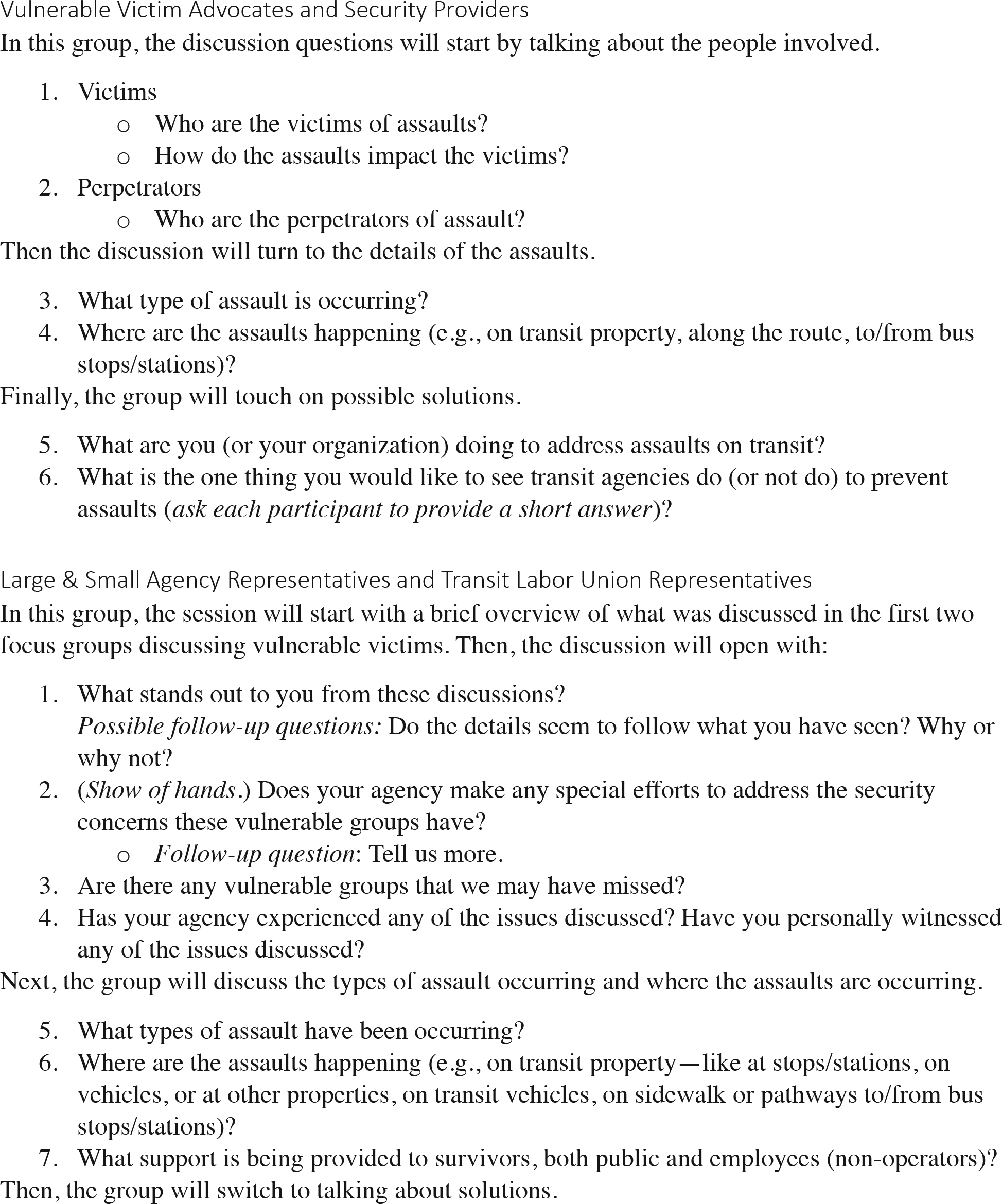
Vulnerable Victim Advocates and Security Providers
In this group, the discussion questions will start by talking about the people involved.
1. Victims
- Who are the victims of assaults?
- How do the assaults impact the victims?
2. Perpetrators
- Who are the perpetrators of assault?
Then the discussion will turn to the details of the assaults.
3. What type of assault is occurring?
4. Where are the assaults happening (e.g., on transit property, along the route, to/from bus stops/stations)?
Finally, the group will touch on possible solutions.
5. What are you (or your organization) doing to address assaults on transit?
6. What is the one thing you would like to see transit agencies do (or not do) to prevent assaults (ask each participant to provide a short answer)?
Large & Small Agency Representatives and Transit Labor Union Representatives
In this group, the session will start with a brief overview of what was discussed in the first two focus groups discussing vulnerable victims. Then, the discussion will open with:
1. What stands out to you from these discussions?
Possible follow-up questions: Do the details seem to follow what you have seen? Why or why not?
2. (Show of hands.) Does your agency make any special efforts to address the security concerns these vulnerable groups have?
- Follow-up question: Tell us more.
3. Are there any vulnerable groups that we may have missed?
4. Has your agency experienced any of the issues discussed? Have you personally witnessed any of the issues discussed?
Next, the group will discuss the types of assault occurring and where the assaults are occurring.
5. What types of assault have been occurring?
6. Where are the assaults happening (e.g., on transit propertylike at stops/stations, on vehicles, or at other properties, on transit vehicles, on sidewalk or pathways to/from bus stops/stations)?
7. What support is being provided to survivors, both public and employees (non-operators)?
Then, the group will switch to talking about solutions.
Long Description.
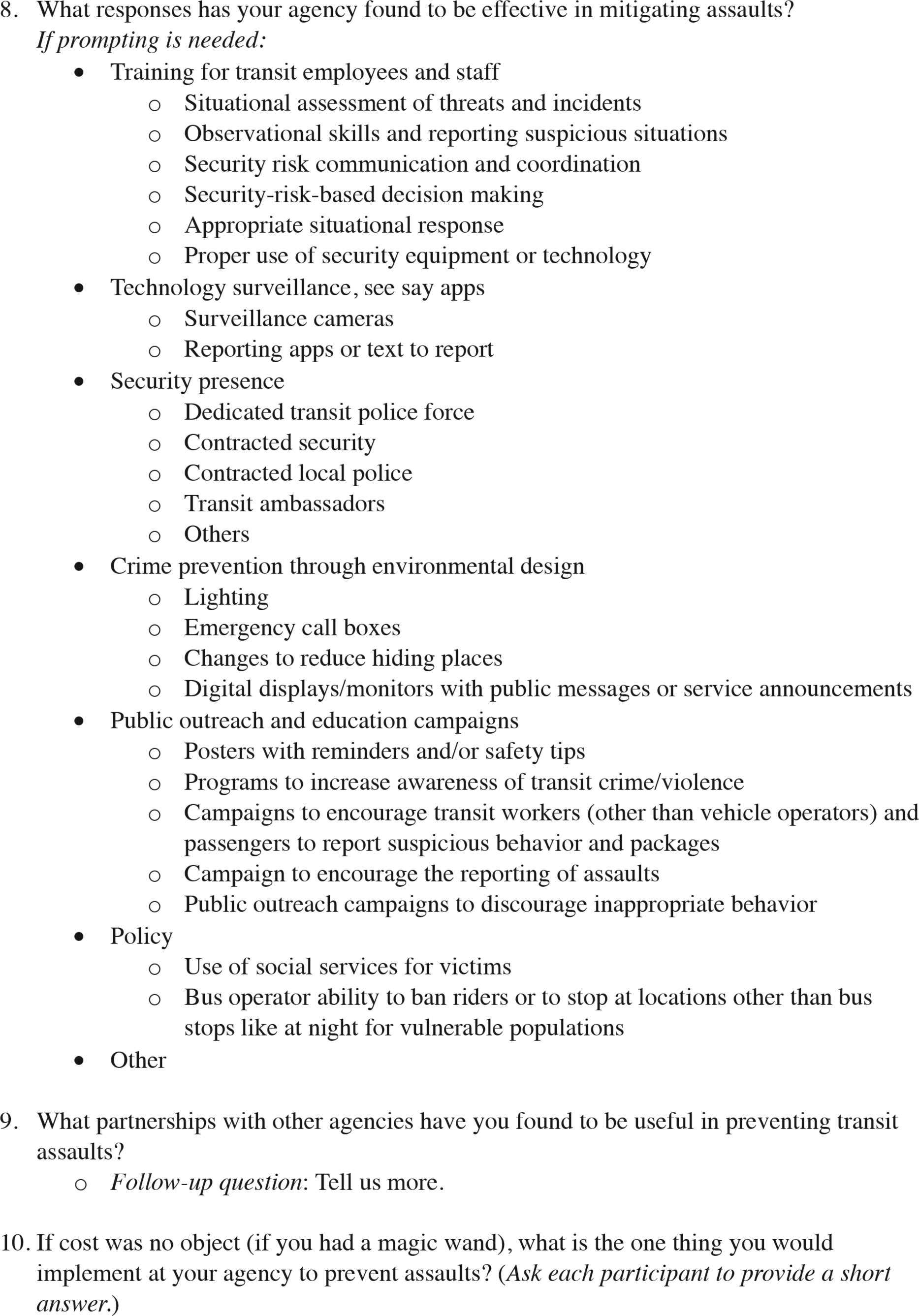
8. What responses has your agency found to be effective in mitigating assaults?
If prompting is needed:
- Training for transit employees and staff
- Situational assessment of threats and incidents
- Observational skills and reporting suspicious situations
- Security risk communication and coordination
- Security-risk-based decision making
- Appropriate situational response
- Proper use of security equipment or technology
- Technology surveillance, see say apps
- Surveillance cameras
- Reporting apps or text to report
- Security presence
- Dedicated transit police force
- Contracted security
- Contracted local police
- Transit ambassadors
- Others
- Crime prevention through environmental design
- Lighting
- Emergency call boxes
- Changes to reduce hiding places
- Digital displays/monitors with public messages or service announcements
- Public outreach and education campaigns
- Posters with reminders and/or safety tips
- Programs to increase awareness of transit crime/violence
- Campaigns to encourage transit workers (other than vehicle operators) and passengers to report suspicious behavior and packages
- Campaign to encourage the reporting of assaults
- Public outreach campaigns to discourage inappropriate behavior
- Policy
- Use of social services for victims
- Bus operator ability to ban riders or to stop at locations other than bus stops like at night for vulnerable populations
- Other
9. What partnerships with other agencies have you found to be useful in preventing transit assaults?
- Follow-up question: Tell us more.
10. If cost was no object (if you had a magic wand), what is the one thing you would implement at your agency to prevent assaults? (Ask each participant to provide a short answer.)
Long Description.
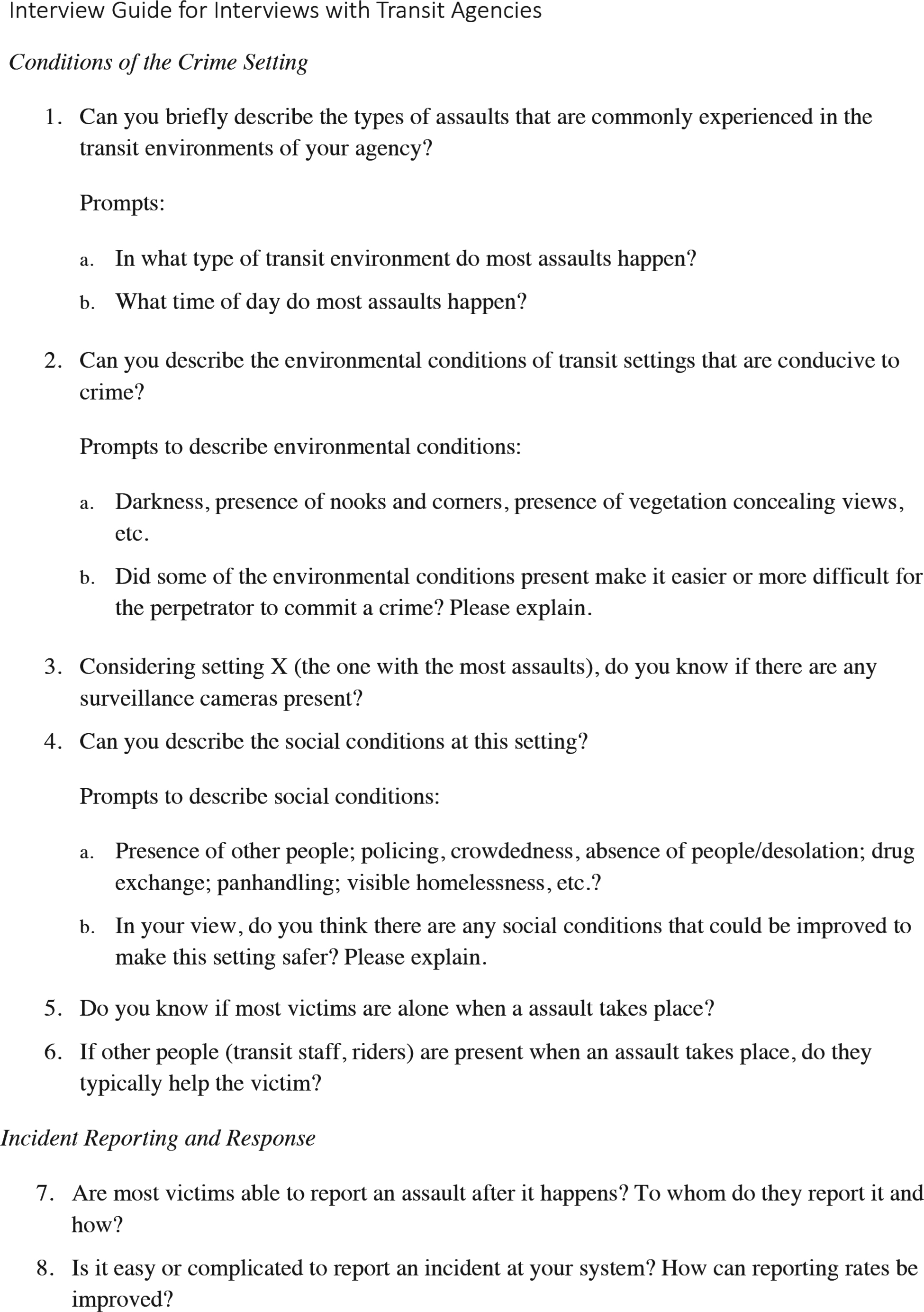
Interview Guide for Interviews with Transit Agencies
Conditions of the Crime Setting
1. Can you briefly describe the types of assaults that are commonly experienced in the transit environments of your agency?
Prompts:
- In what type of transit environment do most assaults happen?
- What time of day do most assaults happen?
2. Can you describe the environmental conditions of transit settings that are conducive to crime?
Prompts to describe environmental conditions:
- Darkness, presence of nooks and corners, presence of vegetation concealing views, etc.
- Did some of the environmental conditions present make it easier or more difficult for the perpetrator to commit a crime? Please explain.
3. Considering setting X (the one with the most assaults), do you know if there are any surveillance cameras present?
4. Can you describe the social conditions at this setting?
Prompts to describe social conditions:
- Presence of other people; policing, crowdedness, absence of people/desolation; drug exchange; panhandling; visible homelessness, etc.?
- In your view, do you think there are any social conditions that could be improved to make this setting safer? Please explain.
5. Do you know if most victims are alone when a assault takes place?
6. If other people (transit staff, riders) are present when an assault takes place, do they typically help the victim?
Incident Reporting and Response
7. Are most victims able to report an assault after it happens? To whom do they report it and how?
8. Is it easy or complicated to report an incident at your system? How can reporting rates be improved?
Long Description.
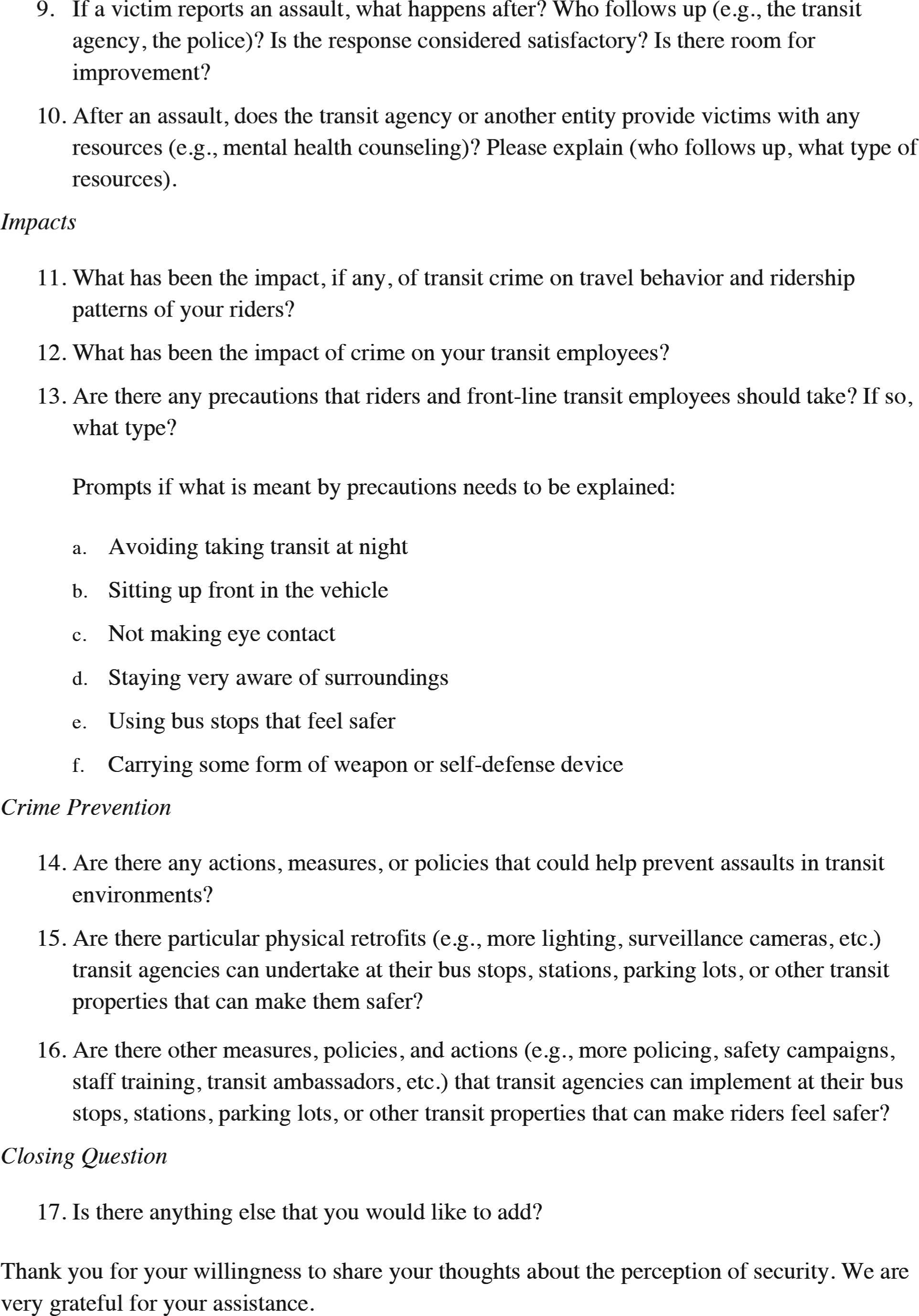
9. If a victim reports an assault, what happens after? Who follows up (e.g., the transit agency, the police)? Is the response considered satisfactory? Is there room for improvement?
10. After an assault, does the transit agency or another entity provide victims with any resources (e.g., mental health counseling)? Please explain (who follows up, what type of resources).
Impacts
11. What has been the impact, if any, of transit crime on travel behavior and ridership patterns of your riders?
12. What has been the impact of crime on your transit employees?
13. Are there any precautions that riders and front-line transit employees should take? If so, what type?
Prompts if what is meant by precautions needs to be explained:
- Avoiding taking transit at night
- Sitting up front in the vehicle
- Not making eye contact
- Staying very aware of surroundings
- Using bus stops that feel safer
- Carrying some form of weapon or self-defense device
Crime Prevention
14. Are there any actions, measures, or policies that could help prevent assaults in transit environments?
15. Are there particular physical retrofits (e.g., more lighting, surveillance cameras, etc.) transit agencies can undertake at their bus stops, stations, parking lots, or other transit properties that can make them safer?
16. Are there other measures, policies, and actions (e.g., more policing, safety campaigns, staff training, transit ambassadors, etc.) that transit agencies can implement at their bus stops, stations, parking lots, or other transit properties that can make riders feel safer?
Closing Question
17. Is there anything else that you would like to add?
Thank you for your willingness to share your thoughts about the perception of security. We are very grateful for your assistance.


