Mitigation Strategies for Deterring Transit Assaults (2025)
Chapter: 5 Mitigation Strategies to Reduce Assaults on Passengers and Transit Workers

CHAPTER 5
Mitigation Strategies to Reduce Assaults on Passengers and Transit Workers
This chapter describes seven mitigation strategies to reduce assaults on passengers and transit workers. These strategies are categorized as follows:
- S1—Crime Prevention Through Environmental Design (CPTED)
- S2—Education, Outreach, and Awareness
- S3—Information Dissemination and System Monitoring
- S4—Technology
- S5—Partnerships
- S6—Public Safety Personnel
- S7—Policy
S1 CPTED
Description
CPTED is an approach to prevent and deter crime that is based on the theory that effective design and use of the built environment can decrease crime and increase security perceptions. CPTED includes five elements: natural access control, surveillance, territoriality, maintenance, and activity support. These elements cover a wide range of strategies in the built environment. This section focuses on visibility (S1.1), lighting (S1.2), maintenance (S1.3), and access control (S1.4).
Applications
CPTED applications include increasing visibility, providing sufficient lighting, performing routine and regular maintenance, and controlling access. These applications will be discussed in this section.
Implementation
CPTED principles should be considered for buses, trains, stations, stops, parking lots, and more.
Benefits and Costs
A design that includes CPTED is one where potential offenders feel exposed and where legitimate users feel safe and secure. It is proactive rather than reactive. It deters crimes more sustainably than measures that rely on post-incident responses. Costs vary significantly.
S1.1 Increased Visibility
Description
A variety of ways exist to increase visibility surrounding bus stops, stations, park-and-ride lots, vehicles, and other properties. Removing places where people can hide is a basic consideration. Lighting (detailed in S1.2, Sufficient Lighting) can be used to enhance visibility and increase the user experience on transit property.
Applications
To provide increased comfort and safety for passengers, visibility can be increased by
- Siting bus stops in front of busy establishments, which allows for natural surveillance;
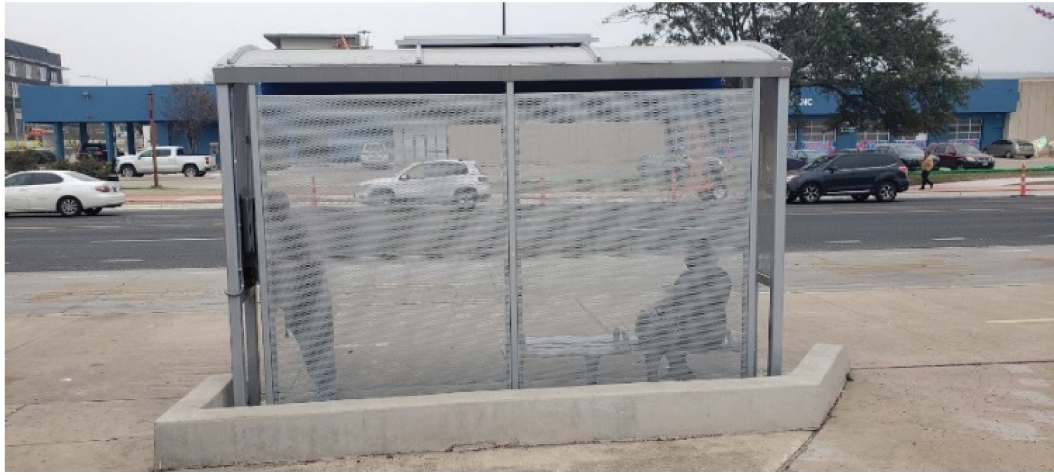
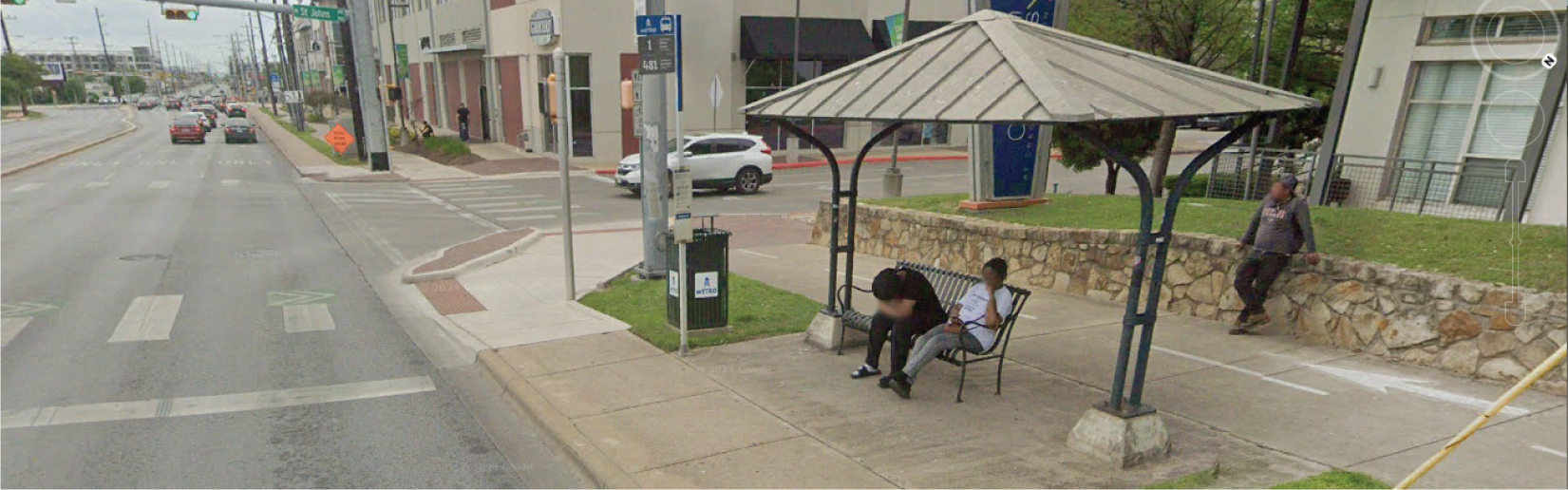
- Including transparent or translucent walls in bus stop shelter designs (Figure 5);
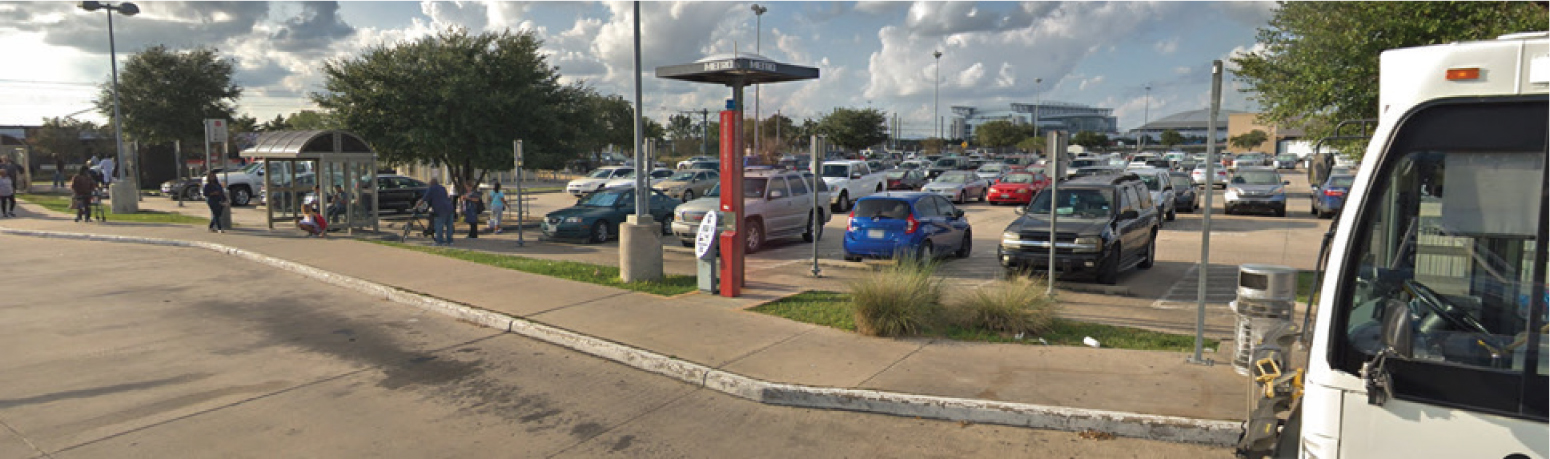
- Keeping vegetation low to and/or high from (i.e., tree canopies) the ground (Figure 6);
- Installing large bus/train windows; and
- Maintaining clear sight lines.
Implementation
To increase visibility, ensure that design standards for bus stop shelters include current best practices that reduce hiding places (e.g., see-through walls, light-emitting diode [LED] lighting, and so forth). Because bus station and bus stop design is likely to vary depending on the unique setting (e.g., available right-of-way, drainage needs, topography, and so forth), it may not be possible to define a standard that fits every situation. Providing a list of approved trees, bushes, grasses, and other landscaping that is appropriate for the local climate and conditions is important.
Benefits and Costs
Design decisions that improve the visibility of settings can encourage natural surveillance because most criminals prefer to act unnoticed. Visibility can either be enhanced or impeded by the design of the environment and can affect criminal activities and the sense of safety felt by individuals in those areas. Hardscape costs can be extensive. Incorporating changes in the planning and design phase will reduce the need for retrofits. Landscaping is less expensive during implementation. However, maintenance might be costly; maintenance costs should thus be considered when selecting grasses, groundcovers, shrubs, and trees.
S1.2 Sufficient Lighting
Description
Good lighting and illumination contribute to overall feelings of safety and decreased crime in transit environments.
Applications
Lighting should be considered for all transit properties, especially parking lots, park-and-ride lots, rail/bus stations, vehicles, and high-frequency route bus stops. If a bus stop is located in a high-crime area, lighting may be one way to deter that activity (Figure 7).
Implementation
When implementing sufficient lighting, many factors should be considered including power/electricity availability, solar options, and lighting types (e.g., warm white LED is easier on the eyes and better for wildlife). Solar-powered LED lights can be directed precisely where needed. Shielded fixtures minimize light pollution. Timers and motion sensors or other smart lighting features may be practical for reducing waste and protecting the night sky. Using natural light via skylights or large windows whenever possible reduces reliance on artificial lighting.

Benefits and Costs
User experience is an important part of lighting for bus stops, stations, and park-and-ride lots. Lighting helps passengers find their way, read signs, and move through crowded areas. Lighting also can help reduce stress for those who are vulnerable or feel insecure. Warm, natural looking light sources can provide a sense of coziness. At its core, lighting provides a sense of security for passengers and transit workers, while also deterring criminal behavior.
Costs vary widely from small installations at bus stops to a lighting plan for a transit system. Consideration of lighting during the planning and design phases can minimize the need for later costly retrofits. Prioritizing improvements based on feedback or criminal activity and tackling installations incrementally may allow for implementation of systemwide changes.
S1.3 Routine and Regular Maintenance
Description
Well-managed and maintained transit environments improve safety perceptions and reduce crime. Unrepaired damage to property gives the impression that the property is not well managed and maintained and may encourage criminal behavior.
Applications
Routine and regular maintenance applies to both landscaping and cleaning as follows:
- Landscaping—Bushes, vegetation, plants, trees, and other elements of landscaping should be maintained to prevent any blockage of signage or cameras.
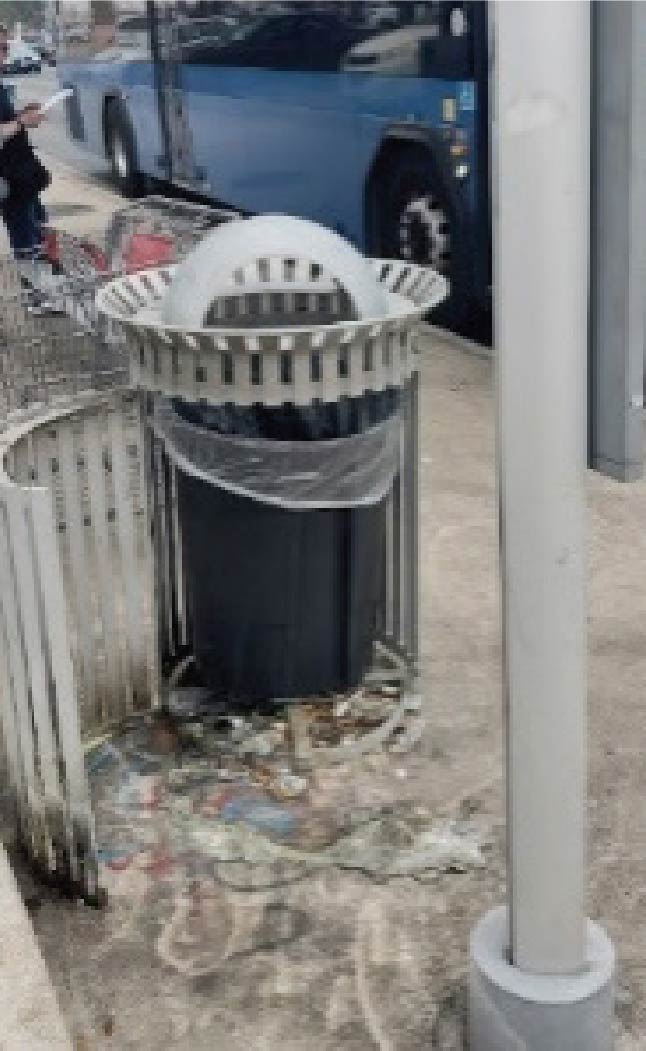
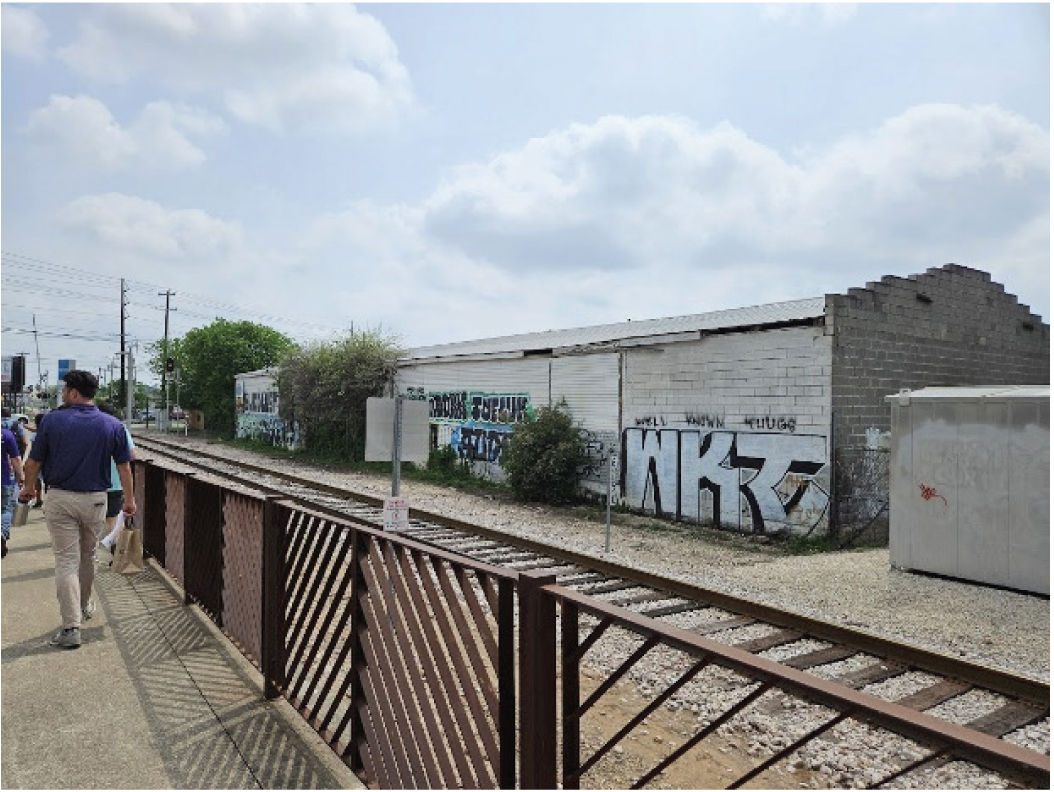
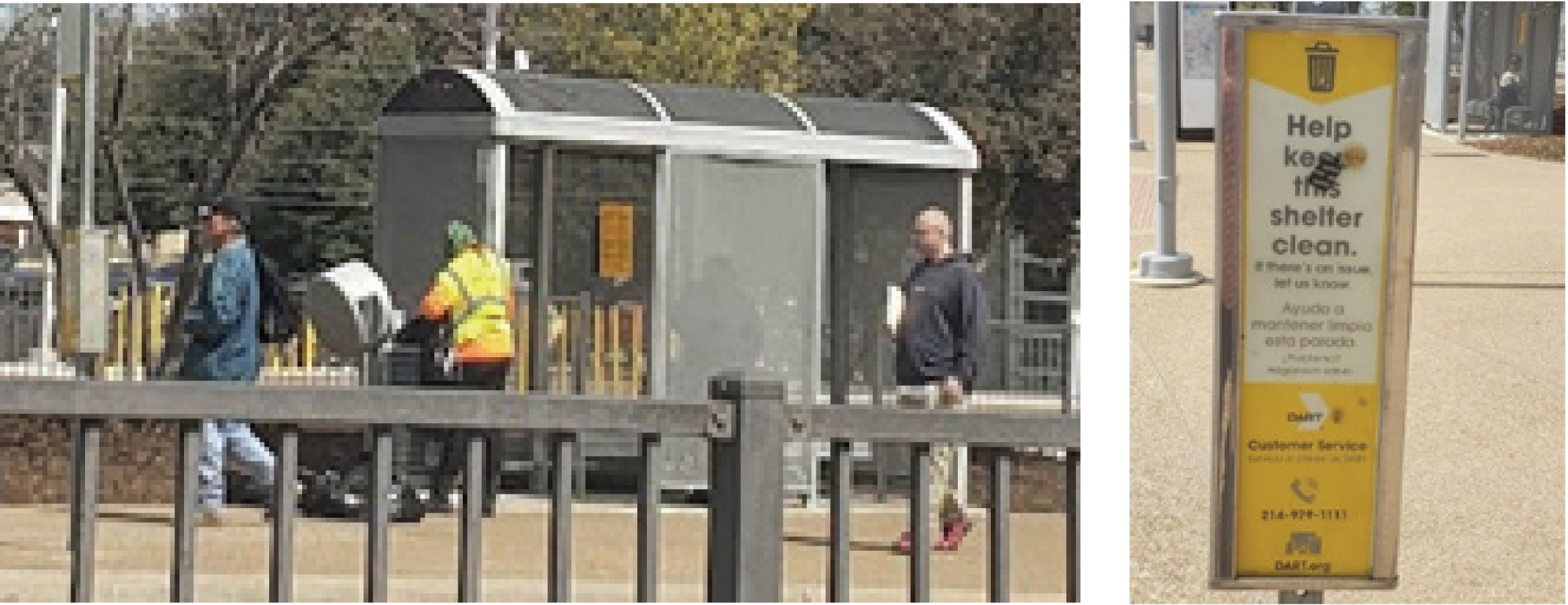
- Cleaning—Routine cleaning of the transit modes and stations/stops enhances the sense of security for passengers and transit workers. Cleaning activities include quickly removing
- graffiti, repairing vandalism, removing loose trash and debris, and emptying trash receptacles. Crews at the transit properties also provide additional eyes on the ground. Figures 8 and 9 illustrate examples of trash and graffiti at bus stops.
Implementation
When implementing a routine and regular maintenance program, establish a regular schedule for maintenance and care at transit properties and on vehicles. Some agencies, such as Houston Metro in Texas and Metro Transit in Minneapolis, Minnesota, have Adopt-a-Stop Programs where
businesses, individuals, community organizations, and schools adopt a stop or station to assist in keeping it clean and damage free. These volunteers are encouraged to alert the agency to any special needs and report any vandalism or suspicious activity. Program participants receive transit passes and sign recognition.
Benefits and Costs
Whether provided by transit agency staff or volunteers, routine visits to the transit stop or station to gather litter shows that people are watching and caring for the transit property. The agency is made aware of any concerns related to maintenance or suspicious activities. A volunteer program of adopted stops would, however, add administrative costs to approve applicants, answer questions, communicate with participants, and operate the program.
S1.4 Controlled Access
Description
Access control uses strategies, design elements, and particular layouts of transit facilities, pathways, and barriers to guide the flow of people and limit access to sensitive and restricted areas.
Applications
Application of the various strategies to control access includes the following:
- Card entry systems limit peopleʼs access to the transit system by utilizing contactless smart cards and mobile payment apps or near-field communication–enabled devices.
- Fare gates are automated entry and exit barriers used in transit systems to regulate passenger flow, enforce fare collection, and ensure security. Fare gates are commonly used in subways, commuter rail systems, and some BRT stations.
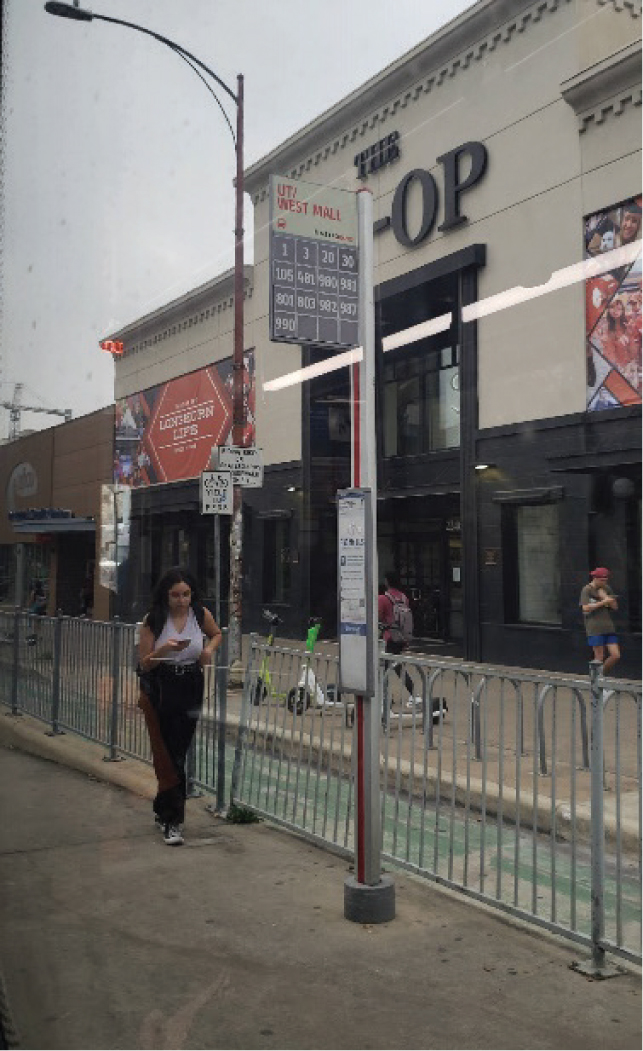
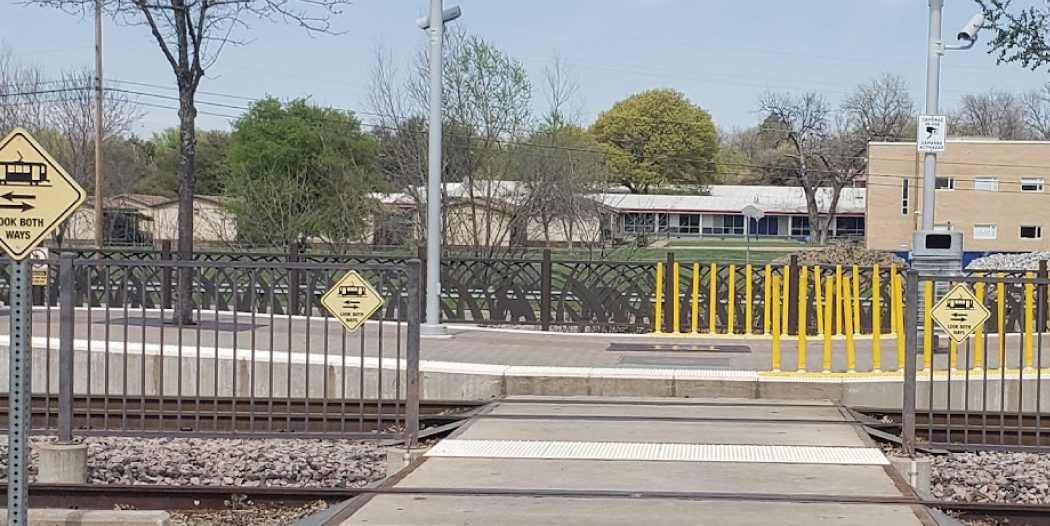
- Fencing and walls are commonly used to enhance safety by guiding passenger movement and restricting unauthorized access to certain areas. Fencing and walls differ in the materials used. Fencing is typically made of chain-link or welded mesh materials, while walls are made of concrete, brick, stone, or steel (Figure 12). Also, fencing is often transparent or semitransparent, while walls typically are not transparent.
- Safety partitions include barriers or dividers that protect people from potential hazards, provide privacy, and control the flow of people. Safety partitions are commonly used to protect transit operators from assault.
Implementation
When implementing access control strategies, their design, technology integration, and continuous monitoring must be considered. Strategies should integrate environmental elements, such as landscaping, into the design and provide spaces that can guide peopleʼs movement in a natural and intuitive way, enhancing both security and user experience. The design process also should consider the different and changing needs of various riders and provide accessibility for all individuals.
Benefits and Costs
Each strategy to control access has a different potential for benefit and associated costs as follows:
- Card entry systems that use contactless cards not only restrict access by unauthorized personnel but also reduce boarding or entry times and speed up fare collection. However, initial installation of card readers, network systems, and other infrastructure can be costly, and the systems require regular maintenance and updates. These systems also may raise data privacy concerns because of the potential for unauthorized access to personal information. Transit agencies should consider access issues, especially for passengers without access to banking or mobile technology.
- Fare gates are a way to ensure that people pay the fare. Higher gates make it more challenging to jump over. Someone who is jumping over the gate can be detected more easily. Like card entry systems, the initial implementation of hardware, software, and infrastructure can be costly, and regular maintenance and updates are required.
- Fencing and walls can effectively prevent unauthorized access to transit facilities. Fencing has lower material and installation costs compared to walls; however, walls are more durable and need less maintenance.
- Safety partitions can physically protect people from offenders; however, they may be costly depending on the material used (e.g., high-quality materials, such as tempered glass or metal, have higher associated costs). Also, safety partitions can impair communication between people.
S2 Education, Outreach, and Awareness
Description
An approach often used is to educate or inform the public and/or targeted groups about a specific topic and actions that can be taken. This approach includes informing transit riders of steps being taken by the agency to increase the safety of passengers and informing them of actions that can be taken to reduce risk. For transit agency employees, this includes providing resources to agency staff that enable them to appropriately respond to situations that may arise.
Applications
The main purpose of outreach and education is to inform. This strategy can work both on the prevention side—to deter assaults or provide information for transit riders or workers on how to avoid being a victim—and on the response side, to provide information on how to report assaults and the resources that are available. Education, outreach, and awareness efforts related to assault reporting practices by the public are hindered by reporting reluctance, poor communication, or mistrust.
Implementation
Education and outreach campaigns often accompany other strategies such as increased security or police presence, new or updated policies, use of technology, or even station design.
Benefits and Costs
The effectiveness of education and outreach campaigns can be difficult to quantify. Surrogate measures can sometimes be used such as follow-up surveys or the use of reach and engagement metrics such as on social or traditional media.
Costs vary depending on the scope of the outreach, the range of targeted groups, and the different platforms used.
S2.1 Awareness Campaigns
Description
Education, outreach, and awareness are tools that are often used to inform the public and/or targeted groups about a specific topic and actions that can be taken. In the case of transit assaults, this includes campaigns to educate, change behavior, or inform transit riders about changes to improve their experience. Transit riders can be informed of actions they can take to reduce risk. Transit agency employees can be provided with resources to appropriately respond to situations that may arise.
Making people aware of the strategies being used by a transit agency to keep them safe and prevent assaults on transit also can make passengers and transit workers more comfortable in the transit environment. Awareness efforts can range from easily visible surveillance cameras to educational campaigns aimed at increasing awareness of the issue.
Applications
Education, outreach, and awareness efforts may include but are not limited to the following:
- Programs to increase awareness of transit crime/violence;
- Campaigns to encourage or incentivize transit workers (other than vehicle operators) and passengers to report suspicious behavior and packages;
- Campaigns to encourage or incentivize reporting of assaults; and
- Public outreach campaigns to discourage inappropriate behavior.
Many measures taken by a transit agency to address security and safety have a specific purpose. For example, the use of surveillance systems on transit vehicles allows the agency to monitor and, in some cases, respond in real time to security threats. These same surveillance systems also can make people aware of the measures being taken by the agency to increase safety. This dual purpose applies for most of the mitigation strategies in this guide. An increased security presence at transit stations or on transit vehicles deters criminal activity but also demonstrates to passengers that someone is there to assist them if needed. Similarly, training for transit employees and staff increases personnel capabilities but also makes them more aware of transit security and safety concerns when performing job duties. Although these awareness measures can serve to deter would-be perpetrators, increased awareness only goes so far. Education, outreach, and awareness efforts should be implemented with other tools and strategies to help increase transit security and safety and prevent assaults.
Implementation
Education, outreach, and awareness often accompany other strategies such as increased security or police presence, new or updated policies, use of technology, or even modified station designs. Education, outreach, and awareness efforts related to assault reporting practices by the public are hindered by
- A reluctance to report something that could be nothing or the anticipated inconvenience of having to report something,
- Communication challenges when reporting something, and
- A lack of trust that the agency will respond.
Benefits and Costs
The effectiveness of education and outreach campaigns can be difficult to quantify. In many cases, agencies do not have the time or resources to assess the effectiveness of their campaigns. Surrogate measures can sometimes be used, such as follow-up surveys or the use of outreach and engagement platforms such as social or traditional media.
The costs of education and outreach campaigns can vary depending on the scope of the outreach. A campaign meant to reach a wide audience can involve the creation of many different types of materials across different platforms, requiring substantial staff time and resources. Conversely, a campaign targeted at a specific group of transit riders can be much less costly. Because it can be difficult to measure who the campaign has reached and if it has affected behavior, it can be hard to quantify the cost and benefits of the campaign.
Awareness of a transit public safety program in and of itself is low cost and, as mentioned, in many cases is a secondary effect of a strategy already being used. Therefore, the costs to implement are low. However, effectiveness is difficult to quantify. For example, it is hard to measure awareness as a deterrent if no incident occurs. Over time, a decrease in incidents can provide some evidence of effectiveness; however, it is difficult to quantify what specific measure led to a decrease in assaults.
Some agencies have used surrogate measures of effectiveness such as follow-up surveys to determine how many riders had increased awareness of an initiative. Overall, awareness has the most benefit when it is used in combination with other strategies or when it is a secondary effect of other strategies.
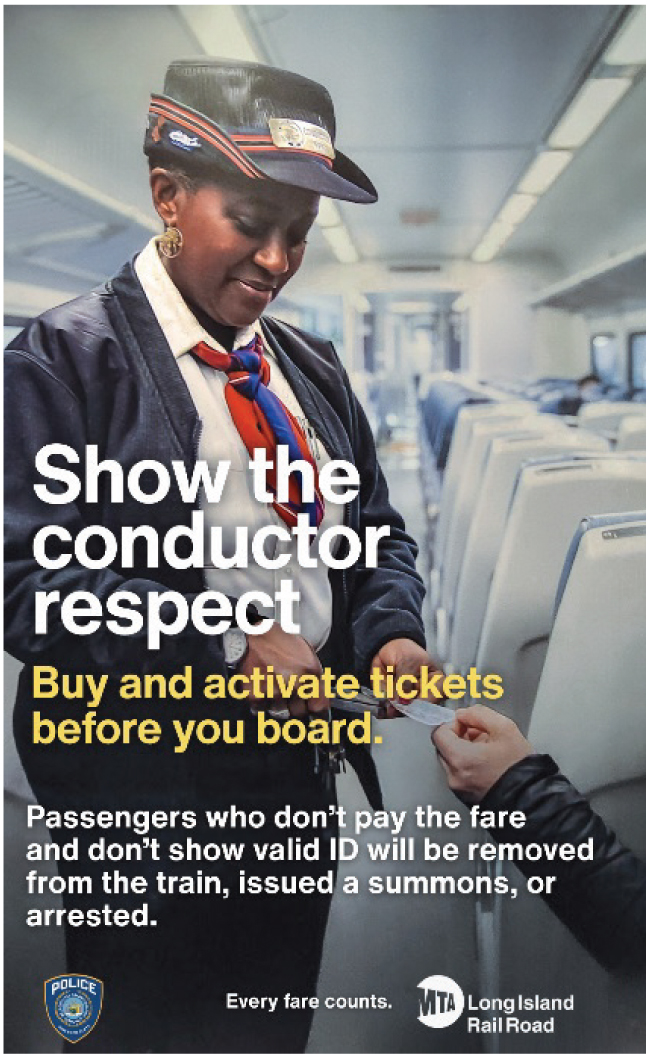
Long Description.
The poster shows a conductor checking a passenger’s ticket inside a train. It displays a message asking riders to show the conductor respect and to buy and activate tickets before boarding. It states that passengers who do not pay the fare and do not show valid identification will be removed from the train, given a summons, or arrested. The poster includes the logos of the Metropolitan Transportation Authority and Long Island Rail Road, with the message, every fare counts.
S3 Information Dissemination and System Monitoring
Description
This strategy includes the distribution of safety information to riders and transit workers and the ongoing observation and analysis of the transit system. A range of strategies can be used to share information and monitor the transit system in an effort to enhance the safety of passengers and transit workers. This section focuses on the use of posters (S3.1), digital displays and monitors (S3.2), and surveillance cameras (S3.3).
Applications
The application of information dissemination and system monitoring includes real-time safety information, digital displays and announcements, mobile applications and websites, printed materials, public alerts, closed-circuit television (CCTV) cameras, live video feeds, data tracking and dashboards, and operator and control center communications systems.
Implementation
To better facilitate information dissemination and system monitoring, agencies may assess data, rider surveys, and operator reports; develop safety messages; choose delivery formats; coordinate with marketing and legal services; procure equipment and services for surveillance; develop an implementation plan; and configure dashboards.
Benefits and Costs
These strategies enhance situational awareness and accountability and allow for rapid intervention if shared in real-time. The costs vary widely with posters being the least expensive and technological strategies being significantly more expensive, especially for large or complex implementations.
S3.1 Posters with Reminders and Safety Tips
Description
Posters with reminders and safety tips are the most simple, common, yet effective strategy to enhance safety awareness for passengers and transit workers. Posters can provide clear, concise information and promote safe behaviors and compliance with transit rules.
Applications
Posters can be used to share safety tips, like reminding riders to stand behind platform lines. They also can be used to encourage riders to report suspicious activity by reinforcing popular campaign slogans like “See Something, Say Something.”
The If You See Something, Say Something Campaign is a national initiative by the U.S. Department of Homeland Security (DHS) aimed at raising public awareness about the indicators of terrorism and terrorism-related crimes. It encourages individuals to report suspicious activities to state and local law enforcement agencies.
The DHS If You See Something, Say Something website provides resources for agencies to implement the campaign.
Implementation
Posters can be placed in stations, on platforms, and in vehicles. Designs should be simple and multilingual when necessary.
Benefits and Costs
Posters can effectively provide passengers and transit workers with useful information and enhance their awareness at a low cost.
(continued on next page)
S3.2 Digital Displays and Monitors with Messages or Public Service Announcements
Description
Digital displays and monitors can provide real-time updates, public service announcements, and safety messages to passengers and transit workers.
Applications
Digital displays and monitors can display timely service updates, emergency alerts, safety tips, and other important information. Monitors also can show local messages, like weather or public health advisories.
Implementation
Screens can be installed at bus stops or stations, on platforms, and/or inside vehicles.
Benefits and Costs
The use of digital displays and monitors can enhance passenger and transit worker awareness and improve safety via visual communication. Costs include hardware installation, software development, and regular maintenance. Agencies also can generate revenue through paid advertisements on the monitors.
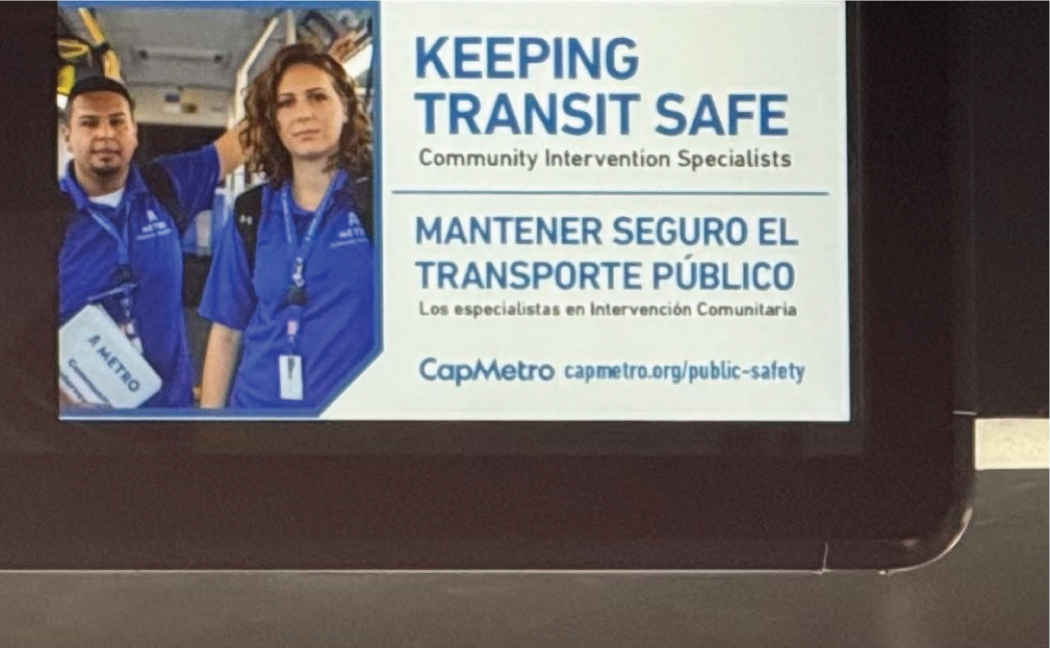
Long Description.
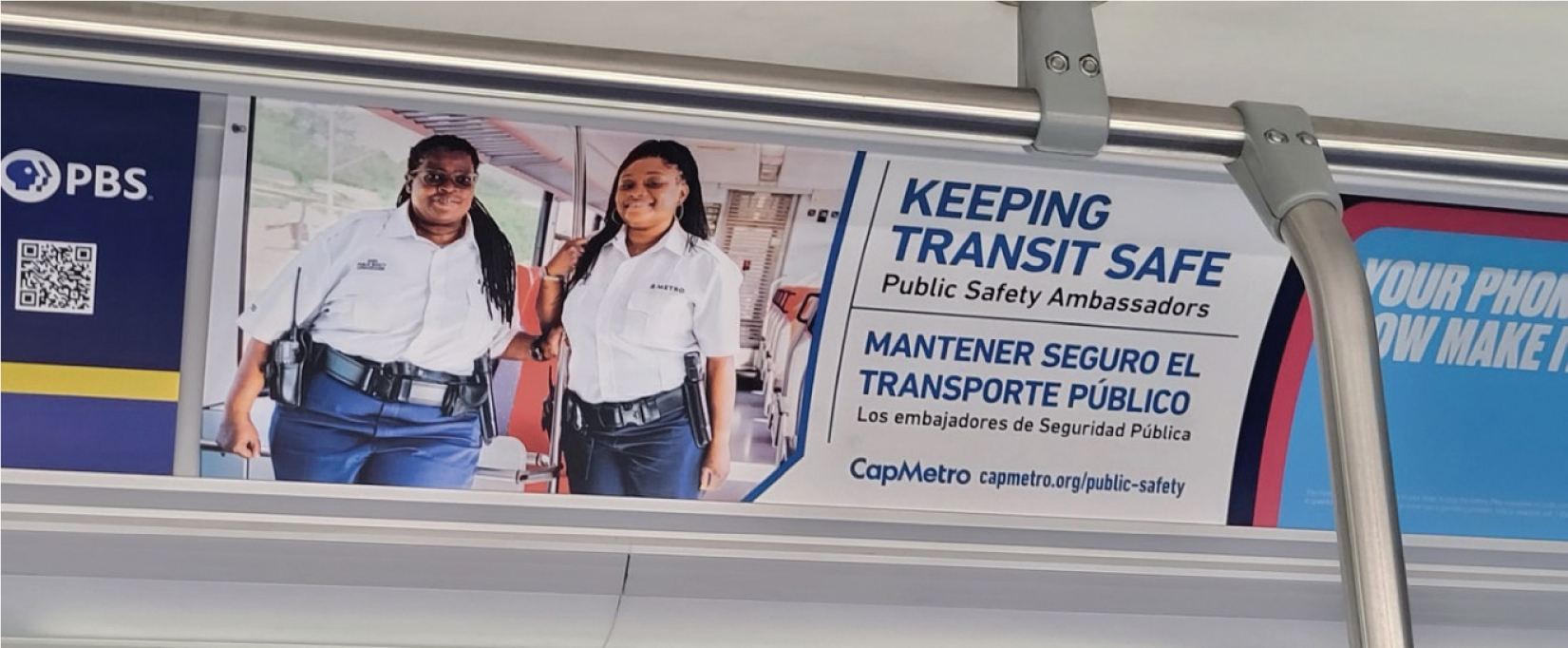
The display shows two people wearing blue shirts with identification cards inside a bus. The message says to keep transit safe and names them as community intervention specialists. The message is repeated in Spanish, saying mantener seguro el transporte público. The display also shows the CapMetro website link for public safety. The purpose is to inform riders about safety support available on transit.
S3.3 Surveillance Cameras
Description
The use of surveillance systems on transit vehicles allows the agency to monitor and, in some cases, respond in real time to security threats. However, surveillance systems also can make people aware of the measures being taken by the agency to increase their safety.
Applications
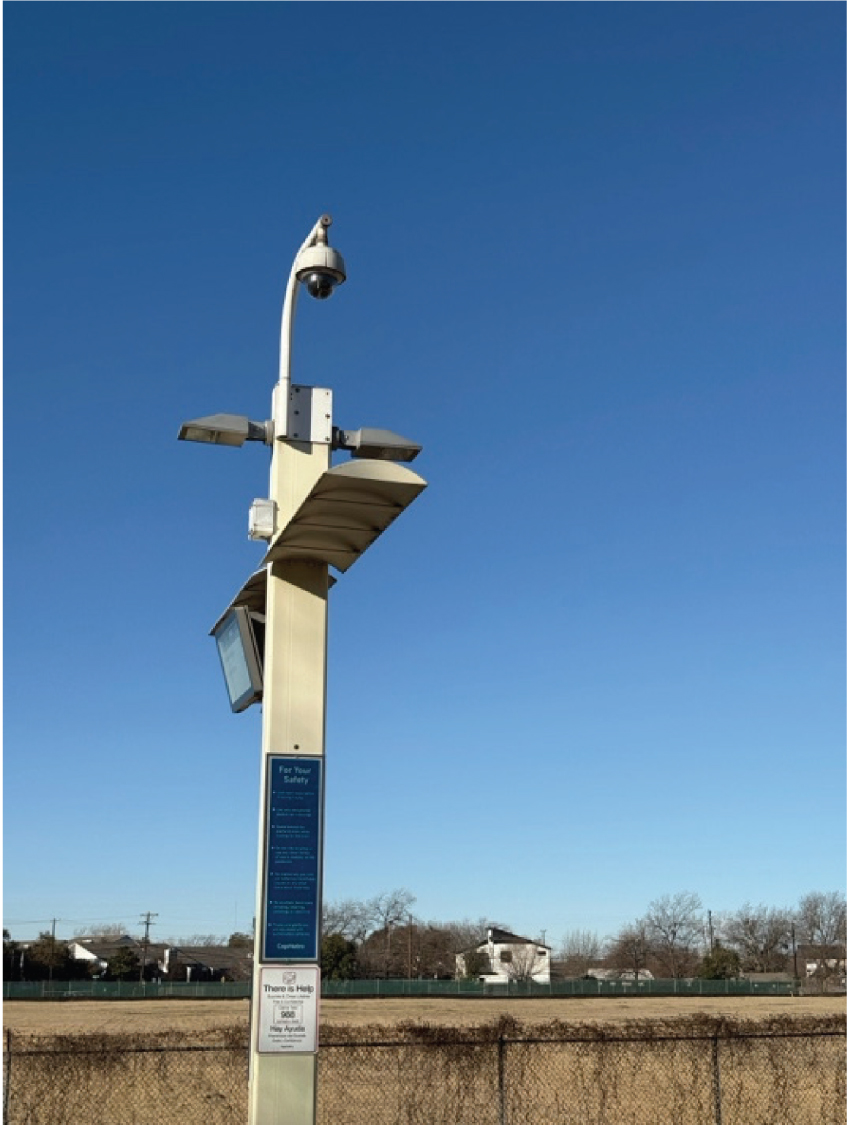
Surveillance cameras can be used at stations and inside vehicles (Figure 16). They also can be integrated with advanced technologies (see S4, Technology).
Implementation
Cameras can be installed in strategic locations such as on platforms, near entrances, in parking lots, and inside transit vehicles. High-resolution and night-vision models ensure effective monitoring in all conditions.
Benefits and Costs
Surveillance cameras are effective in deterring crime and collecting evidence for investigations. They also can improve the transit worker and passenger perceptions of security. Basic costs for surveillance cameras include equipment purchase, installation, and regular maintenance.
S4 Technology
A range of technology tools can be used to enhance the safety of passengers and transit workers. Following this overview of common technologies, this section further details communications and emergency response solutions (S4.1), advanced surveillance systems (S4.2), advanced access control systems (S4.3), and advanced weapon screening systems (S4.4) (47).
Description
Numerous innovative technologies have been identified to address the security and safety issues on transit, including communications and emergency response solutions, advanced surveillance systems, advanced access control systems, advanced weapon screening systems, and advanced lighting systems.
Applications
Application of technology tools to enhance transit safety typically includes the following:
- Communications and emergency response solutions are commonly delivered through mobile software applications that allow transit users to report on and be alerted to certain situations. These apps allow passengers to use their mobile devices (e.g., phones, tablets, or watches) to report incidents to transit agency authorities. Another kind of communication—apps—are often used by transit agencies to tell riders in real time when the next transit vehicles are expected to arrive at the transit stop. This kind of communication reduces unnecessarily long waits at stations and stops, which reduces exposure to crime. Apps with real-time transit arrival information reduce anxiety and improve feelings of security since passengers know when the next vehicle will arrive and can plan accordingly. Real-time vehicle arrival information might also be shared on dynamic display boards at stations and stops, as shown in Figure 17.
- Advanced surveillance is different from basic CCTV cameras. Advanced systems typically include tilt and zoom cameras with virtual analytics that can automatically identify unusual or suspicious behavior. These advanced surveillance systems provide clearer images, faster responses, and boost the effectiveness of security personnel.
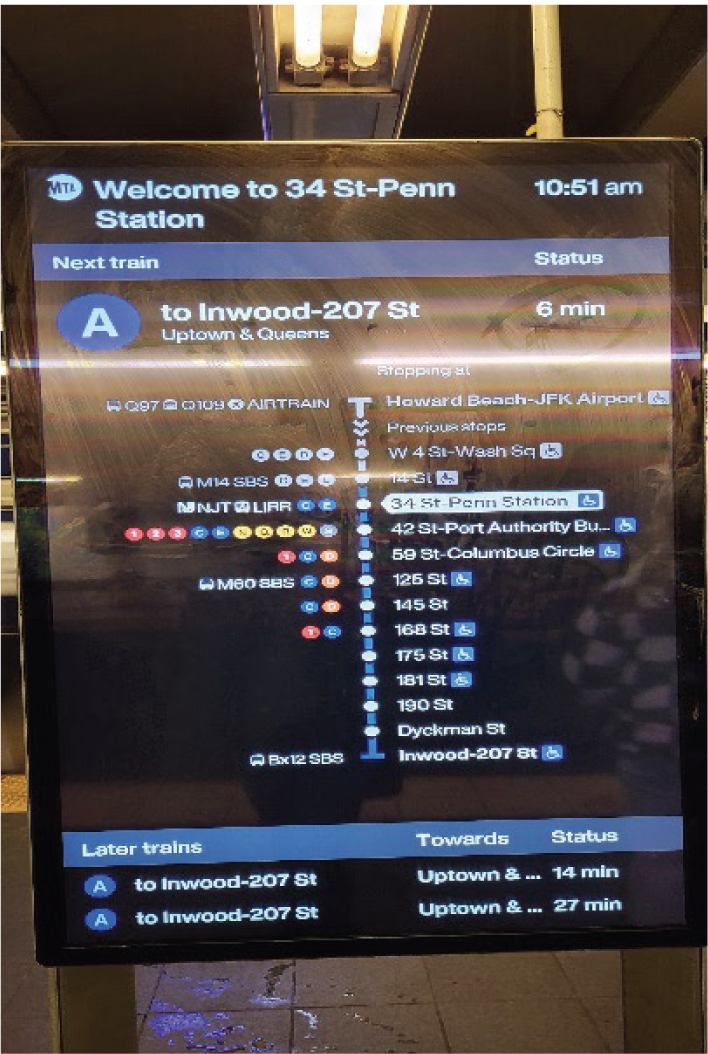
Long Description.
The digital display board shows live arrival information for the A train at 34 Street, Penn Station. The current time is 10:51 a.m., and the next A train to Inwood 207 Street is arriving in 6 minutes. The screen lists stops along the route, including 42 Street, Port Authority Bus Terminal, 59 Street, Columbus Circle, and 168 Street through to Inwood 207 Street. Icons beside each stop show available connections to other train lines and buses. Additional train arrivals are also listed, showing 14 minutes and 27 minutes for later A trains heading uptown.
- Advanced access control systems employ sensors, cameras, and technologies like smart cards or biometrics to restrict unauthorized entry into established virtual perimeters that are integrated with surveillance cameras and lighting controls for a more comprehensive security solution.
- Advanced weapon screening systems are effective in preventing weapons from entering secured areas with advanced versions detecting weapons and complemented by canine detection units and security patrols for layered protection.
- Advanced lighting systems typically include energy-efficient lighting that uses solar power and/or LED bulbs and motion-detecting sensors.
Implementation
The design of communications and response apps should be user friendly, enabling passengers to report their concerns in real time with ease. The apps should be able to locate the incident when reporting.
Benefits and Costs
Technology tools can effectively prevent assault in real time and help to identify crime patterns through the processing of large datasets. However, technology tools generally have a high initial cost due to hardware purchases and software development. These tools require skilled personnel for regular maintenance.
S4.1 Communications and Emergency Response Solutions
Description
Mobile software applications have emerged as a common technology for transit users to report on, and be alerted to, certain situations. These apps allow passengers to use their mobile devices (e.g., phones, tablets, or watches) to report incidents to transit agency authorities.
Applications
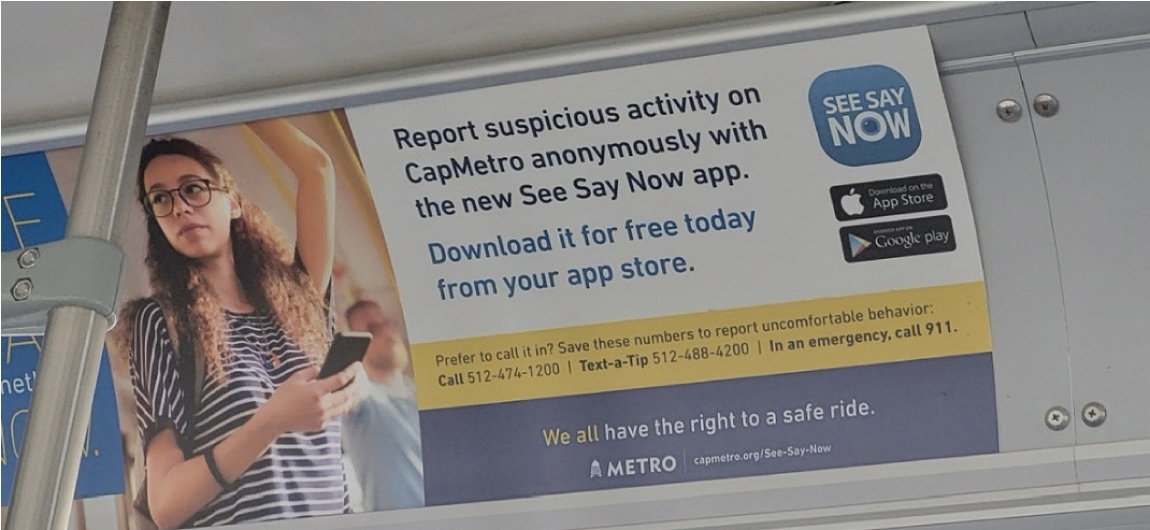
The See Say Now App provides an example of a communications and emergency response solution. This app offers riders a direct line of communication with transit agency personnel for addressing security issues in real time. Users can report concerns by uploading a photo, providing a description and choosing from predefined categories and locations to ensure accurate and efficient response.
Implementation
Communications and emergency response solutions should consider the development of user-friendly apps that integrate with existing communication systems and enable geolocation and tracking. Moreover, response solutions should consider providing more information, like training and awareness for transit workers and passengers.
Benefits and Costs
Like other technologies, communications and emergency response solutions can effectively prevent assault in real time and enable the processing of large datasets. However, they generally have high initial costs due to hardware purchases and software development and require skilled personnel for regular maintenance.
Long Description.
The poster encourages riders to report suspicious activity on CapMetro using the See Say Now app. It shows a person holding a phone and invites users to download the app for free from the app store or Google Play. The message highlights that reports can be made anonymously. It also provides phone numbers to call or text for reporting uncomfortable behavior and reminds riders to call 911 in emergencies. The message ends with a statement that everyone has the right to a safe ride. CapMetro is listed as the source.
S4.2 Advanced Surveillance Systems
Description
Basic surveillance systems include CCTV cameras and monitoring devices. High-tech cameras equipped with tilt and zoom functions enhance image clarity and enable faster and more accurate security response. In addition, virtual analytics and artificial intelligence (AI) can automatically identify suspicious behavior, track and identify individuals, analyze emotions, and detect weapons as well as gun shots, thereby improving the efficiency of law enforcement (48).
Applications
Applications could be anything from real-time incident response, AI monitoring, predictive analytics, automated threat detection, and post-incident investigations, among others.
Implementation
When implementing advanced surveillance systems, agencies should consider camera deployment, emerging technology integration, centralized control center facilities, data storage and management, and emergency response systems.
Benefits and Costs
Like other technologies, advanced surveillance systems can effectively prevent assault in real time and can enable the processing of large datasets for threat detection, pattern analysis, and incident investigation. They also enhance situational awareness, support faster emergency response, and provide valuable evidence for law enforcement. However, advanced surveillance systems generally have high up-front costs due to hardware purchases and software development and require skilled personnel for regular maintenance and system upgrades.
S4.3 Advanced Access Control Systems
Description
Advanced access control systems use sensor-based technology to restrict unauthorized entry into fixed facilities such as transit stations or parking lots. Sensors and cameras can form virtual boundaries in remote or open-air locations that discourage intrusion and activate automated security responses. Access control for fixed facilities can be further strengthened through smart card access or biometric verification. These systems can be connected to surveillance and lighting systems (48).
Applications
Advanced access control systems can be applied for predictive maintenance of gates and doors, secure entry and exit for transit workers, real-time security alerts, designated safe zones for victims, and panic areas to protect transit workers.
Implementation
When implementing advanced access control systems, agencies should consider deployment locations, emerging technology integration, centralized control center facilities, data storage and management, and emergency response systems.
Benefits and Costs
Like other technologies, advanced access control systems can effectively prevent assault in real time and enable the processing of large datasets. However, they generally have a high initial cost due to hardware purchases and software development and require skilled personnel for regular maintenance.
S4.4 Advanced Weapon Screening Systems
Description
Advanced weapon screening systems are effective in mitigating terrorist or mass-shooting threats by preventing weapons from entering secured areas. These systems are suitable for fixed facilities with designated entry points, such as train stations. Advanced weapon screening systems might include sensors to detect weapons of mass destruction, including chemical, biological, radiological, and nuclear threats. They can be complemented by canine detection units and enhanced security patrols for a layered approach to safety.
Applications
Such technology can be used in busy stations during crowded peak hours to prevent mass-casualties and serious crimes.
Implementation
Advanced weapon screening systems should be installed in high-density, high-traffic areas. Agencies should consider integrating these screening systems with existing systems, such as natural access control and alert systems.
Benefits and Costs
Like other technologies, advanced weapon screening systems can effectively prevent assaults in real time by detecting and intercepting threats before they enter secured areas and enable the processing of large datasets for threat pattern analysis, incident reporting, and operational optimization. They enhance passenger safety, deter potential attackers, and can integrate with surveillance and access control systems. However, they generally have high initial costs due to hardware purchases and software development and require skilled personnel for regular maintenance and upgrades.
S5 Partnerships
Partnerships with various agencies or entities can benefit efforts to enhance the safety of passengers and transit workers. Following an overview of common partnerships, this section further details potential partnerships with security or law enforcement agencies (S5.1), social service agencies or groups (S5.2), and other agencies or entities (S5.3).
Description
Strategies to address transit assaults require, or at least benefit from, partnerships with other agencies. Working together, agencies and their partners can deter criminal behavior near transit property and address social concerns. If an agency has its own transit police force, many of the security concerns can be handled in-house. However, most agencies rely on assistance from the local police department. In these cases, partnerships are critical and may be the most important aspect of addressing transit assaults.
Outside of policing agencies, partnering with social services and crisis outreach groups is helpful for assisting people experiencing homelessness, suffering from mental health concerns, or experiencing substance abuse.
Even within one agency, competing concerns may exist. Marketing, finance, security, technology, operations, and planning staff may have different priorities, goals, and objectives that need to be reconciled. Understanding different perspectives is an important step for creating a good partnership.
Sharing information and data about criminal behavior and perpetrators is one way to leverage limited resources. Letting other agencies know about effective mitigation strategies along with context, designs, and implementation techniques can help bridge gaps and have a broad impact. The federal government may be able to support transit agencies and their partners in finding appropriate funding mechanisms for outreach efforts.
Applications
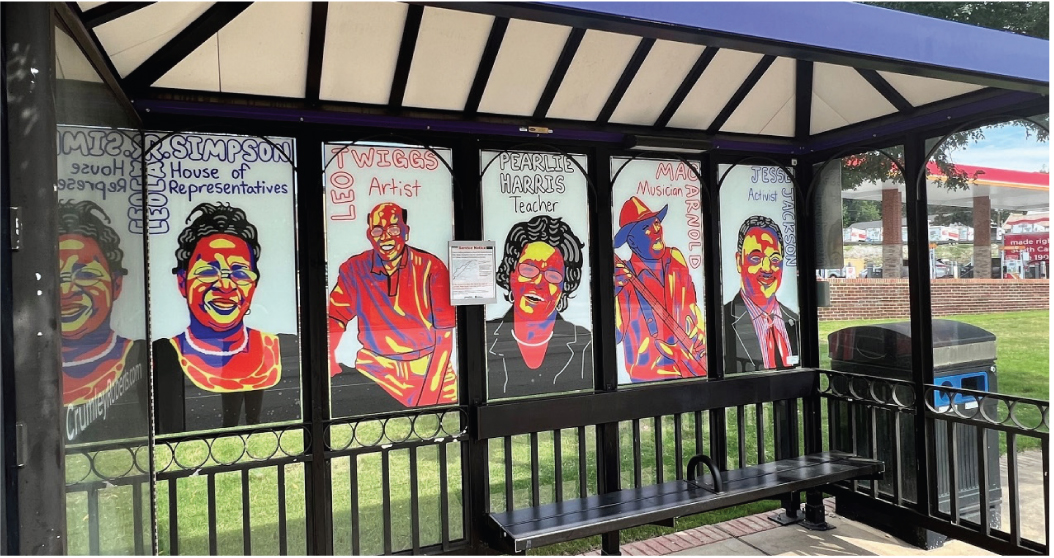
Many examples of established agency partnerships exist. TCRP Project J-07/Topic SB-39, “Improving Transit Customer Perception of Personal Security,” an ongoing project at the time of this writing, identified case examples of partnerships intended to improve customer perceptions of security, as well as reduce crimes such as assaults. One innovative example includes partnerships with colleges where social work or health sciences students can volunteer with street teams and/or conduct a practicum assisting with issues of homelessness on the transit system. For example, Californiaʼs Sacramento Rapid Transit partnered with a local Master of Social Work Program to have student interns ride with transit police officers when responding to a call for assistance and speak with the individuals, offer them services, and connect them with a case manager, if possible. Agencies also have partnered with high schools to develop art for bus stops or stations. Showing care for a transit property (e.g., having art installed), has been shown to improve the sense of security (50).
Implementation
When implementing partnerships, agencies should identify existing people, groups, nonprofits, or other associations focused on addressing social and criminal concerns and establish connections with their leaders or decision makers. They should brainstorm opportunities and consider whether partnerships could be leveraged into win–win solutions. It may be helpful to have a formal interagency agreement or working group to address complex and even more routine concerns. Sharing data is one way to begin these discussions.
Benefits and Costs
From neighborhood associations and hospitals to advocacy groups and the federal government, as well as everything in between, transit agencies have an opportunity to take on projects and programs that might seem outside of their typical mission. Unfortunately, transit agencies often experience the struggles of vulnerable populations. A multipronged, multiagency effort can result in significant gains in addressing security.

Long Description.
The poster shows two young women standing side by side. One wears a headscarf and long-sleeved top, and the other wears a coat and collared shirt. Large bold text says silence is not consent, followed by a hashtag, not one more girl. The background includes bright shapes and colors. The poster is part of a public awareness campaign by BART and Betti Ono Foundation to speak out against sexual harassment and support young women in transit spaces. A website link is included for more information.
Long Description.
The bus shelter features six large, colorful portraits painted on the back panels. Each portrait shows a person in bold shades of different colors. Names and brief titles appear above or beside each face. The portraits appear to be part of a community or school art installation. A bench is placed inside the shelter, which has a black frame and a sloped roof. Grass and other public structures are visible in the background.
S5.1 Security or Law Enforcement Agencies
Description
Partnering with security or law enforcement agencies increases transit safety by combining resources, expertise, and response capabilities. This collaboration ensures a unified approach to preventing and addressing criminal activities in transit systems.
Applications
Applications include deploying law enforcement officers to high-risk areas, conducting joint patrols, and integrating surveillance systems with local law enforcement databases. Public safety personnel can work alongside police to manage incidents and ensure passenger safety.
Implementation
Implementation involves establishing formal agreements with local law enforcement agencies, sharing operational data, and coordinating response protocols. Regular communication and joint training enhance collaboration.
Benefits and Costs
Partnerships with local security or law enforcement agencies can deter crime and speed response to emergencies. Local security and law enforcement agencies also can provide training for de-escalation, active shooter situations, and other skills to protect transit workers and riders. Costs may be incurred for ensuring additional law enforcement presence, providing specialized training, and maintaining integrated systems. Agreements should account for shared responsibilities and resource allocations.
S5.2 Social Service Agencies or Groups
Description
Partnerships with social service agencies and crisis outreach groups are critical to address feelings of insecurity and reduce transit assaults; people experiencing homelessness have been found to be both victims and perpetrators of transit assaults. These agencies and groups often specialize in assisting people with mental health and substance abuse issues and provide resources for unhoused individuals who may be loitering or nondestination transit customers (customers riding the system for purposes other than reaching a final destination).
Applications
Agencies may choose to partner with the following social service agencies or groups:
- Municipal or county social service agencies
- Mental health service centers
- Services for unsheltered people experiencing homelessness
- Nonprofit agencies focused on violence prevention
- Homeless advocacy groups
- Victim service centers
Implementation
To better partner with social service agencies or groups, the transit agency should first identify their needs (what is happening and where), and define their goals (de-escalation, crisis response, linking to services, and so forth). The agency should then find the right partner and establish formal agreements with social service agencies that outline roles, jurisdiction, data sharing, liability and coordinating response protocols. Successful partnerships should also include regular communication and joint training to enhance collaboration, a pilot of the program followed by scaling and adjusting, and communicating with the public.
Benefits and Costs
By supporting, collaborating, and leveraging an agencyʼs shared goals, communities can make a collective effort to address transit assault and crime. The cost of establishing partnerships is low and sometimes only requires administrative time to create and establish programs. Some agencies might consider paying social services groups to establish and run programs on their behalf.
S5.3 Other Agencies or Entities
Description
Agencies can partner with other agencies or entities, such as local communities, universities, and medical schools, based on their needs and vision.
Applications
Partnering with other agencies to improve safety and security using CPTED principles, sharing data, addressing mental health holistically, and having joint safety campaigns.
Implementation
It is important to understand priorities, goals, and objectives of other agencies and entities in order to build a strong partnership.
Benefits and Costs
Partnership benefits include increased access to innovative safety measures and community involvement. Such partnerships also open opportunities for funding, resource sharing, and workforce development through student internships and collaborative projects. Costs are generally related to project funding, resource allocation, and maintaining partnerships. These investments often yield high returns in innovation and community support.
S6 Public Safety Personnel
A strong public safety presence is essential to maintaining a safe and welcoming transit environment. Public safety staff may encompass a variety of configurations and include different personnel—not just sworn officers, such as fare inspectors, contracted security guards, transit ambassadors, community-based outreach workers, and others. Following an overview of public safety staff and other personnel, this section further details security presence using sworn police officers (S6.1), non-sworn officers and fare inspectors (S6.2 and S6.3), and other personnel and equipment options (S6.4).
Description
The presence of people who are watching as part of an official role of the transit agency (staff, contractors, or volunteers) is a large deterrent to criminal activity. These people can be armed police officers, unarmed security guards, transit ambassadors, community partners, and fare inspectors. Public safety personnel can be employed by an agency or contracted from local law enforcement or private firms, and they may serve full-time or during peak times of traffic or criminal activity.
Applications
A public safety personnel presence can be achieved through the following options:
- Transit police officers are armed personnel licensed and specially trained to enforce law and order in a transit system.
- Off-duty or contracted law enforcement are licensed police officers (including officers in a reserve status) contracted through local law enforcement agencies.
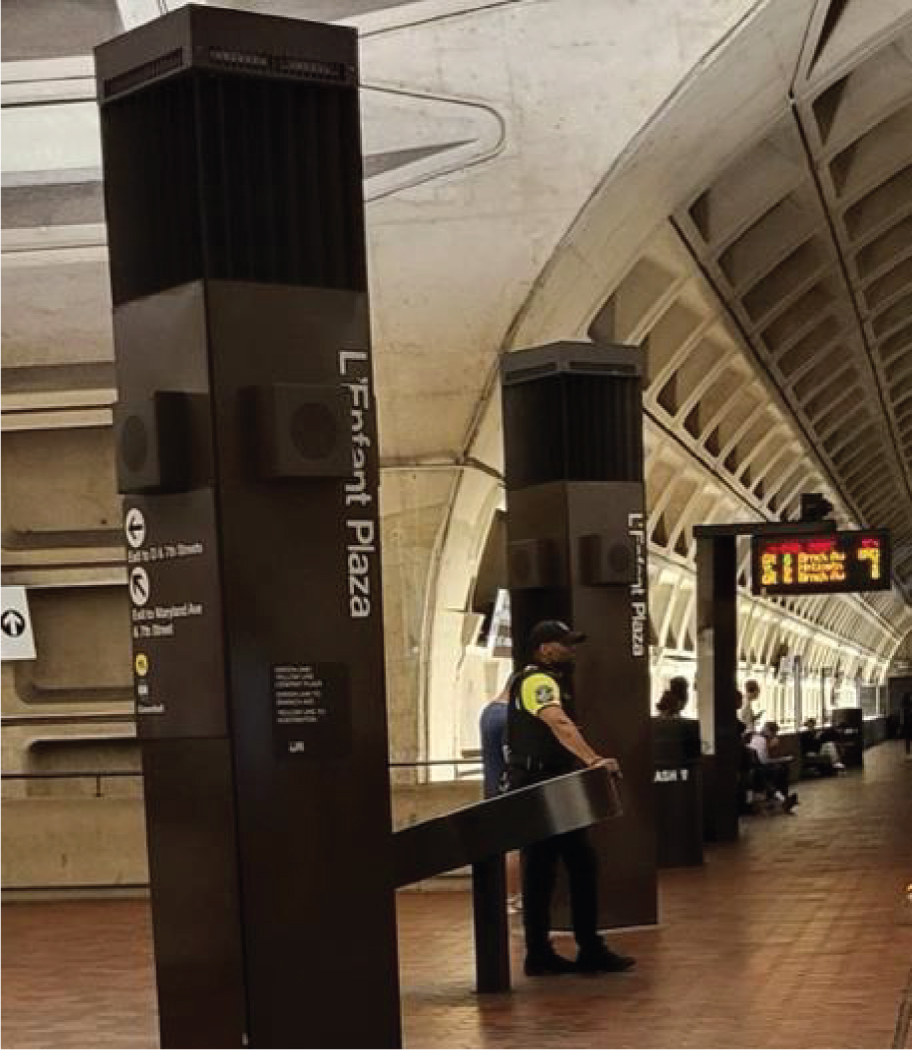
- Security guards are trained to protect people, property, and other assets. They are in uniform and can be armed or unarmed (Figure 21). These personnel could be direct employees of the agency or contracted from an outside company.
Long Description.
The public safety officer in a black uniform with a yellow vest stands beside a large black pillar labeled L’Enfant Plaza. The pillar includes directional signs for metro lines. The transit station has a wide-open space with arched concrete walls and tile flooring. Other people are visible in the background, sitting on benches or walking. An electronic display board shows train information on a nearby platform.
- Fare inspectors are staff who ensure fare compliance, deter fare evasion, and often serve as visible safety personnel.
- Transit ambassadors are plain clothed or uniformed employees assigned to a specific station or area to assist customers in many ways. They engage with customers by answering questions about fares, providing information, and reporting any concerns (e.g., observed crimes, areas with low lighting, graffiti, and so forth).
- Community-based outreach groups include local groups that can provide resources for the unhoused and populations experiencing mental health crises or substance abuse.
Implementation
Public safety personnel are most beneficial when deployed in areas of high traffic and crime. A crime rate analysis can locate trends and hot-spot locations for targeted enforcement.
Benefits and Costs
A public safety personnel presence is beneficial for deterring crime. The cost of implementation varies, depending on the number and training level of personnel used by the agency. For example, utilizing a dedicated police force may be costly, but contracting with local law enforcement to use off-duty police officers is likely to be less expensive. Strategic use of multiple types of personnel allows for cost-effective deployment.
S6.1 Sworn Police
Description
Sworn police officers assigned to transit systems are trained law enforcement professionals with the authority to enforce laws, make arrests, and ensure the safety and security of passengers, employees, and transit infrastructure.
Applications
The high level of training, arrest capabilities, and associated higher cost of sworn police officers indicates that they should be deployed to high-crime areas where their elevated authority could provide the greatest benefit for protecting people, property, and other assets. Sworn police officers are uniformed and, typically, armed.
Implementation
Transit agencies can hire and train their own sworn police officers or partner with local police departments or other organizations.
Benefits and Costs
The presence of sworn police officers can effectively increase the perception of security for transit passengers and workers. However, the cost of personnel can be expensive, and the presence of police officers can increase feelings of insecurity among certain transit rider groups.
S6.2 Non-Sworn Officers
Description
Non-sworn officers, often referred to as transit security officers or public safety officers, play a key role in maintaining order and safety without arrest authority. These personnel handle code enforcement, customer service, and serve as system additional security, complementing the work of sworn officers in maintaining a secure transit environment.
Applications
Non-sworn officers may include security officers and customer service officers.

Long Description.
The sign shows a BART Police badge with text beneath it stating, for security matters, call BART Police. The contact number shown is 510 464 7000. The badge reads Bay Area Rapid Transit Police and includes an image of a train.
Implementation
Transit agencies may have their own in-house security guards, hire a contractor to provide the security, or partner with local law enforcement jurisdictions to support compliance, observe behaviors, and provide security services. Activities could include
- Providing supervision and clerical support for security activities;
- Patrolling revenue vehicles and passenger stations during revenue operations;
- Patrolling and controlling access to yards, buildings, and structures;
- Monitoring security devices such as CCTV and alarm systems; and
- Reporting breaches of security.
Benefits and Costs
The use of non-sworn officers can be a more cost-effective strategy than the use of sworn police officers. The use of non-sworn officers also can relieve some of the stress on the sworn police officers.
S6.3 Fare Inspectors
Description
Fare inspectors are personnel who are not operators but are responsible for enforcing fare policies. They also can serve as a uniformed presence on vehicles and in stations, which can help increase safety and mitigate assaults.
Applications
Fare inspectors can not only deter fare evasion but also help relieve the burden on transit operators. Transit operators are often placed in difficult and sometimes confrontational positions when asked to enforce fare policies. Shifting this responsibility to dedicated fare inspectors can reduce the possibility of conflicts between operators and passengers and allows operators to focus on vehicle operation. This reallocation of duties can contribute to a safer environment for both transit workers and passengers.
Implementation
Successful implementation includes deploying fare inspectors on high-risk routes and during peak hours, based on transit assaults data. Inspectors should receive training—including de-escalation training. Transit agencies should specify the responsibilities and guidelines for fare inspectors and integrate them with real-time communication systems. This allows inspectors to report incidents or request assistance on time.
Benefits and Costs
The benefits of deploying a fare inspector include reducing fare evasion, improving operator and rider safety, and improving the perceptions of security. It also increases operational efficiency by minimizing service interruptions caused by fare evasion.
The costs include hiring and training the personnel.
S6.4 Other Public Safety Personnel Options
Description
A public safety personnel presence can be provided through transit ambassadors or community-based outreach group representatives.
Applications
Other forms of security presence include the following:
- Transit ambassadors are plainclothes employees assigned to a specific station or area to assist transit riders in different ways, such as answering questions about fares, providing information and directions, and reporting any concerns (e.g., observed crimes, areas with low lighting, graffiti, and so forth).
- Community intervention specialists typically are social workers who connect with or assist people with mental health services, housing, food, or healthcare.
- Mobile surveillance boxes include blue-light mobile trailers that contain cameras to monitor the surroundings. They have flashing blue lights that alert the population to their presence.
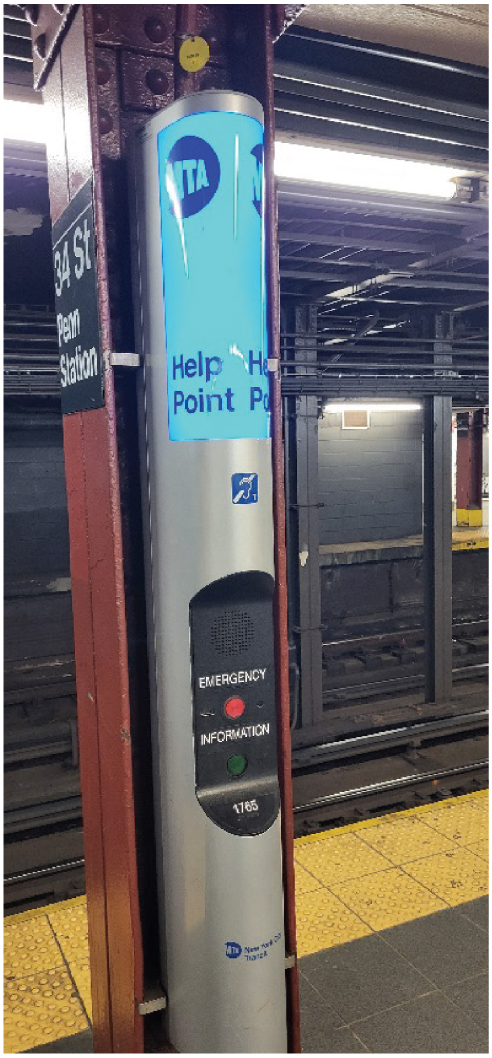
- Emergency call boxes provide transit riders and workers a way to reach emergency personnel for assistance (Figure 23). These also may be called help points (Figure 24).
Implementation
Successful implementation should include designing the program structure, developing a training program, hiring personnel, purchasing or contracting for equipment, and monitoring and evaluating.
Benefits and Costs
Transit ambassadors report harassment and other criminal activities and help passengers navigate the transit system. Acting as the systemʼs eyes and ears, they can help the agency better
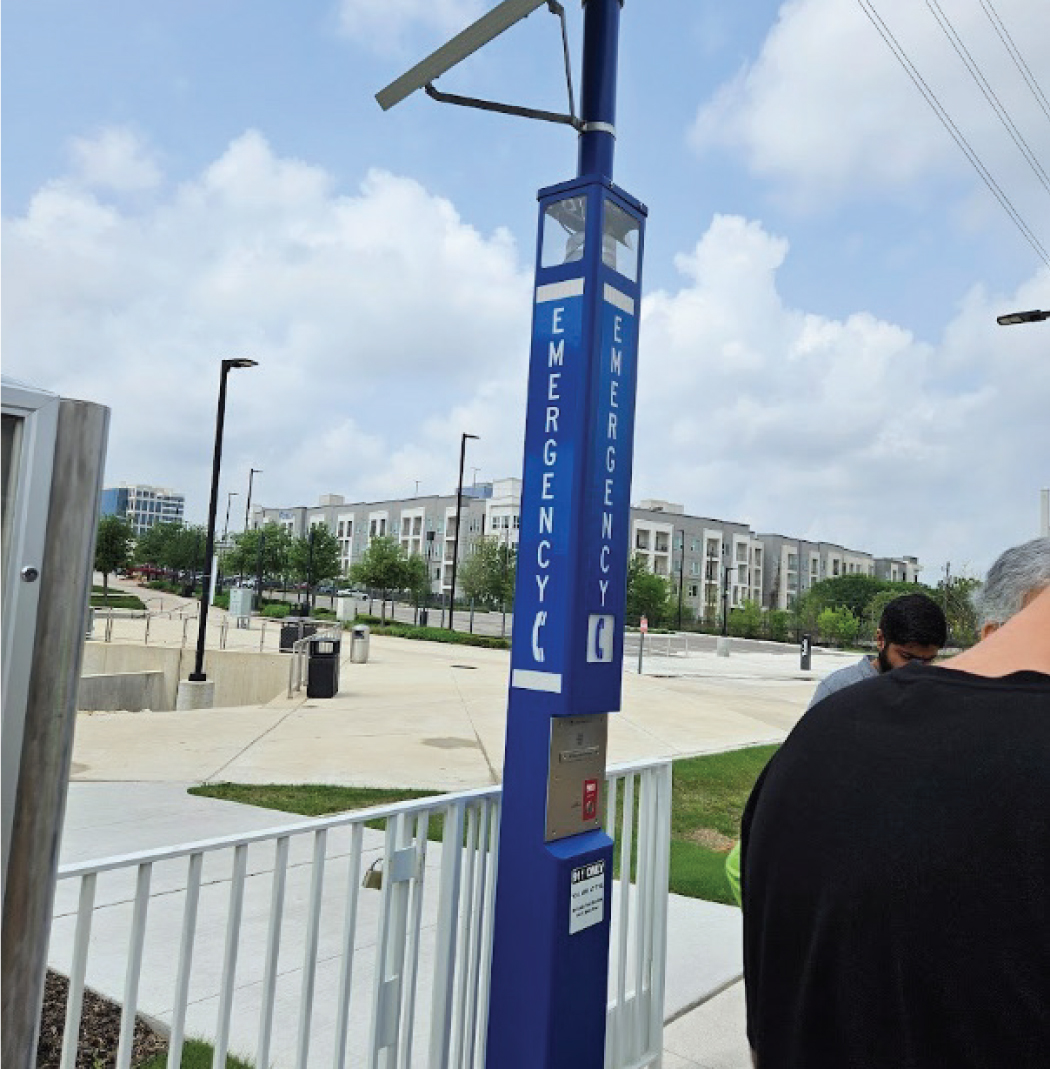
distribute its law enforcement and other limited resources. Figure 25 shows in-vehicle signage used by CapMetro in Austin, Texas, intended to make the public aware of the role of the agencyʼs public safety ambassadors. The signage is bilingual—in both English and Spanish.
S7 Policy
Description
Policy strategies can be used to enhance the safety of passengers and transit workers. This section focuses on rider codes of conduct (S7.1), employee training (S7.2), transit ban policies for individuals who have committed assaults (S7.3), and stop-on-demand services, such as stopping at a location other than a designated stop, typically within a safe and predefined area requested by a passenger under specific circumstances (S7.4).
Applications
Some applications include expectations or codes of conduct for passengers and transit workers, events that require reporting, clear definitions of assault, circumstances that warrant consequences
Long Description.
The sign inside the transit vehicle shows two public safety ambassadors in uniform standing together. The message says keeping transit safe and introduces them as public safety ambassadors. The same message is written in Spanish as mantener seguro el transporte público. The sign includes the CapMetro website for public safety and is placed above passenger seats. It informs riders that safety personnel are present and active in the transit system.
for passengers who assault others, training requirements for transit workers, and stop on demand, or other operational policies to increase security.
Implementation
Policy changes typically require transit administrator and/or transit agency board approval.
Benefits and Costs
Policy changes are generally low in cost to implement and can result in significant increases in safety and security when enforced.
S7.1 Rider Codes of Conduct
Description
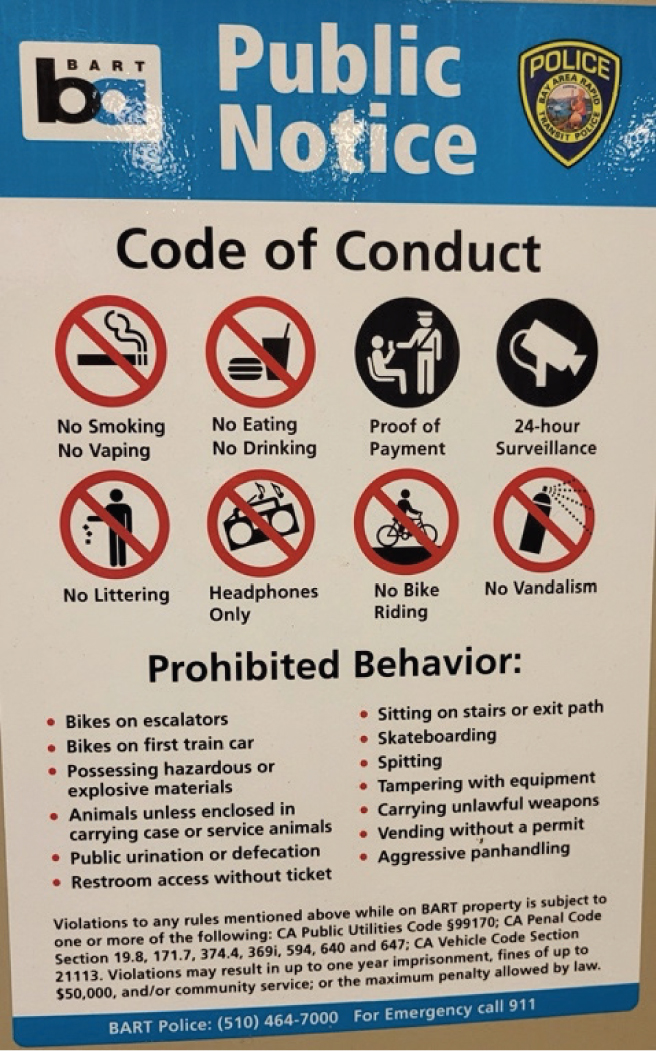
Rider codes of conduct are guidelines that individual riders must follow to ensure the safety, security, and comfort of all riders (Figure 26).
Applications
A rider code of conduct establishes clear expectations, provides grounds for enforcement, and enhances safety and security. This code of conduct can include the prohibition of actions like
Long Description.
The notice is issued by BART and BART Police. It includes a code of conduct with icons showing no smoking or vaping, no eating or drinking, no littering, use of headphones when listening to audio, no bike riding, and no vandalism. Riders must show proof of payment and are under 24‐hour surveillance. The lower section lists prohibited behaviors, including riding bikes on escalators or the first train car, bringing hazardous materials, having unleashed animals, using offensive language, accessing the restroom without a ticket, sitting on stairs or exit paths, skateboarding, spitting, tampering with equipment, carrying weapons, vending without a permit, and acting aggressively. The notice warns that breaking the rules may lead to fines or jail. It provides the BART Police number and emergency contact.
spitting or littering, staring, unlawful possession of drugs or weapons, verbally abusing passengers or transit workers, and so forth.
Implementation
Rider code of conduct rules should be posted throughout the transit system, shared on social media, and publicized through other means of promotion. They should be practical and enforceable.
Benefits and Costs
A rider code of conduct is beneficial because it creates a sense of ownership among the population. Violations can lead to fines or temporary ridership bans. Costs to implement and maintain rider codes of conduct are generally low and include staff training, code promotion, and enforcement.
S7.2 Employee Training
Description
Training is important for transit agency employees. Without proper training, transit employees may not know how to respond to threats, which can increase the risk of property damage and individual harm. By providing regular and comprehensive training, transit agencies can ensure that employees are equipped with the knowledge and skills necessary to respond quickly and effectively to any security threat.
Applications
Types of employee training can include the following:
- Situational assessment training includes assessment of threats and incidents, observational skills, and security risk–based decision making.
- De-escalation training can provide employees with the skills to defuse potentially volatile situations and maintain a safe environment.
Implementation
Training should be required upon employment and reinforced every year or every other year. Training can be conducted in the form of in-person workshops, online modules, or interactive webinars with local police departments.
Benefits and Costs
The training process can equip employees with tools to assess and handle tense situations and reduce the risk of injury and harm. Passengers will feel safer when staff can assess and de-escalate conflicts effectively.
The provision of employee training is challenged by transit agency costs for employee training time; a lack of mobility for employees to attend training; a lack of computer skills; and coordination difficulties among transit agencies, local police, and other responders. Additionally, if an agency is experiencing a high turnover of employees, the costs of training new employees escalate.
S7.3 Transit Ban Policies
Description
A transit ban policy prohibits individuals who commit specific offenses on public transit, like assault, from accessing the system for a defined period.
Implementation
When implementing a transit ban policy, transit agencies should develop guidelines for clearly defining the terms of the ban (e.g., when it starts, for how long), develop an enforcement plan, coordinate with law enforcement, integrate technology, and support rehabilitation of individuals who have been subjected to the ban.
Applications
Some of the transit ban policies include addressing repeat offenders and temporary suspensions.
Benefits and Costs
Transit ban policies can enhance safety and improve public confidence. They also can provide support for transit staff and reduce stress by banning repeat offenders.
S7.4 Stop-on-Demand Services
Description
Stop-on-demand services allow passengers to request that a bus or transit vehicle stop at a location other than a designated stop, typically within a safe and predefined area. These services are often implemented during off-peak hours or in areas with lower ridership to enhance passenger convenience and safety, particularly for vulnerable populations such as older adults, adults with disabilities, or those traveling late at night.
Applications
Applications for stop-on-demand services include nighttime safety enhancements, stops for youth and students, weather-responsive service, and stops for older or disabled riders.
Implementation
Transit agencies can offer courtesy-stop services for riders at night. Riders can ask transit vehicles to stop between regular stops so that they can get off a transit vehicle closer to their destinations.
Benefits and Costs
Stop-on-demand services can enhance safety and increase ridership at little or no cost.


