Mitigation Strategies for Deterring Transit Assaults (2025)
Chapter: 6 Post-Assault Activities

CHAPTER 6
Post-Assault Activities
Detering and preventing assaults and other crimes on passengers and transit workers is the goal. However, as much as an agency and its partners work to deter assaults, sometimes this criminal behavior occurs. Providing assistance to the victim, reporting the assault, restricting access and prosecuting the perpetrator, recording the event and collecting data, analyzing the data, using the data analysis results, applying mitigation measures, and evaluating the success of the mitigation are all important post-assault activities for an agency. Working on all angles—from exclusionary policies that restrict access for repeat offenders to prosecution of perpetrators committing physical assaults—is critical to address safety and security. This chapter describes actions to take after an assault occurs.
Reporting Incidents
Encouraging a victim to report an assault to the appropriate authorities is essential to catching the perpetrator but also may help prevent future assaults. Transit agencies can encourage the reporting of incidents by providing clear guidance on the procedures and making the process as easy as possible. Some agencies allow victims to report assaults through an app, others provide incentives for transit workers who may be a victim of assault to report it. Typically, transit employees do not get paid while filing reports. It is also important that no disincentives exist, especially for transit worker victims, to report their assault.
Restricting Access and Prosecuting the Perpetrator
Decisions about consequences following an assault require careful thinking and sometimes tough decisions. Codes of Conduct and rules for breaking them need to be defined in writing and as a policy. Exclusion policies can help guide decisions. The level of crime and whether the perpetrator is a repeat offender needs to be considered. Criminal prosecution may be warranted; however, there may be challenges to overcome such as the identification of the perpetrator(s) due to a lack of witness information or video evidence. Having an agreement with the county district attorneyʼs office may be helpful to ensure that the transit agency has a close relationship with investigators and prosecutors. If district attorneys are focused on addressing crimes on the transit system, prosecution is likely. With the focus on transit crime, attorneys should have increased knowledge of the transit agency codes and laws specific to transit.
Getting Medical and Emotional Care
After an assault, a victim should seek immediate medical and emotional care. For medical care, transit agencies usually have a protocol in place to respond to physical wounds or other medical trauma. Depending on the severity of the assault, the victim may need to be transferred to a hospital.
Some transit agencies provide emotional care services to all victims, but not all agencies have these resources. A victim may need to seek out these services on their own. For assaults on transit workers, many agencies provide these resources or, if applicable, transit worker victims may have access to resources through their labor unions. The provision of these resources is important for victims to process the incident and heal from the trauma.
Documenting Incidents and Conducting Data-Driven Analyses
Document the Assault Incident
Accurate and timely data collection is critical for understanding the nature and impact of the assault. Transit agencies must ensure that their documentation processes align with federal mandates and internal policies. As noted in Chapter 3, transit agencies are required to comply with federal reporting guidelines, such as those established by the FTA and NTD. Recent directives, including General Directive 24-1, mandate that agencies report and assess assaults on transit workers, implement risk mitigation strategies, and provide detailed safety data. Proper documentation ensures compliance with these requirements and helps agencies secure funding, maintain accountability, and improve transit security.
Transit agencies should establish standardized incident reporting protocols that document key details, including the date, time, and location of an event, a description of the individuals involved, any injuries sustained, and available evidence such as surveillance footage or witness statements. However, there is a tradeoff between the completeness of the data documentation and time and capacity requirements. Transit agencies need to balance comprehensive assault data documentation with operational capacity constraints, ensuring that safety reporting does not overly burden resources or disrupt transit services.
Combining data from various sources can provide a more complete picture of assault incidents. Transit security or police reports provide an official record of the event, including descriptions of
the assailant, victim, and any actions taken by law enforcement. Additionally, emergency medical services or hospital assessments offer critical details on injuries sustained, medical interventions provided, and potential long-term impacts on the victim.
Surveillance videos from transit security cameras serve as an objective record of events, helping authorities verify witness statements and identify suspects. Additionally, automated location tracking data, such as global positioning system logs for buses and train records, can provide precise information on where and when the incident occurred. Further, data from call logs or distress signal activations in the transit control center can help establish a timeline of emergency responses and evaluate the effectiveness of security protocols.
Conducting interviews or surveys with witnesses, including passengers and transit staff, helps corroborate evidence and provides additional perspectives on the event. Input from victims, if they are willing to share their experiences, can reveal critical details that may not be captured through surveillance or official reports. Insights from operators or employees who responded to the incident also can help assess response efficiency and highlight areas for procedural improvements when handling future incidents.
Adopt Data-Driven Decision-Making Processes
By systematically and regularly analyzing data, transit agencies can develop targeted interventions to enhance safety for both passengers and transit workers.
The collected data could help determine high-risk crime patterns. Transit agencies could adopt tools to analyze the data to inform decision making. Geospatial mapping tools can visualize assault hot spots, helping agencies determine which transit stops, routes, or areas require increased security measures. Temporal analysis allows transit officials to assess the frequency of assaults based on the time of day, day of the week, or seasonal trends, ensuring that safety resources are deployed when they are most needed. Additionally, profiling of victims and offenders can help agencies understand who is most affected and what behavioral patterns contribute to these incidents. Categorizing incidents based on their severity and type (e.g., verbal harassment, physical violence, robbery, and so forth) also enables agencies to implement specific interventions tailored to different risks.
Relying on this regularly collected data, transit agencies could establish ongoing performance monitoring. Measures showing reductions in assault rates, improvements in response times, and increases in security perceptions help demonstrate the success of implemented strategies.
Connect the Victim to Social Services
Connecting a victim with social services is important for their healing. Even if the agency does not provide post-assault assistance to assault victims, they can often connect victims with trusted social service organizations for mental health care, counseling, and other related services.
For assaults involving transit workers, some agencies have internal services available or services available through their transit worker union. In some cases, in-house support groups consisting of other assault victims can help provide a safe space to discuss the issue with someone that can relate.
In most cases, a transit agency will benefit from connecting or communicating with partner agencies. These interactions could include:
- Sharing assault data with police partners,
- Referring a victim to a social services agency or counselor, and
- Making surveillance videos available for identifying perpetrators.
An agency may establish a committee or team that meets regularly or as needed to review incidents and assault data and suggest mitigation measures. Such a committee could be internal or could include representatives from partnering agencies.
Check in with the Victim
It is important for agencies to have a process in place to check in with former victims of assault. For transit workers who were victims of assault, they may have to return to work at the same place where they were assaulted, so it is important that they feel supported by the agency and, if applicable, the transit union. Periodic check-ins regarding their processing of the assault, a mental health evaluation, or follow-up counseling are all beneficial.
Conduct Evaluations
After implementing or piloting mitigation strategies, it is important to understand if the strategy achieved its set goals. Before implementation, have a plan for evaluating success. An agency may need to make modifications and reevaluate. Document any unintended consequences, challenges, and limitations.
Share Information with Others
Conducting an evaluation of a mitigation strategy enables an agency to better understand the success and effectiveness of that strategy in meeting the intended goals. Sharing the evaluation results with other agencies allows them to be better informed when considering strategies.
Learning Loop
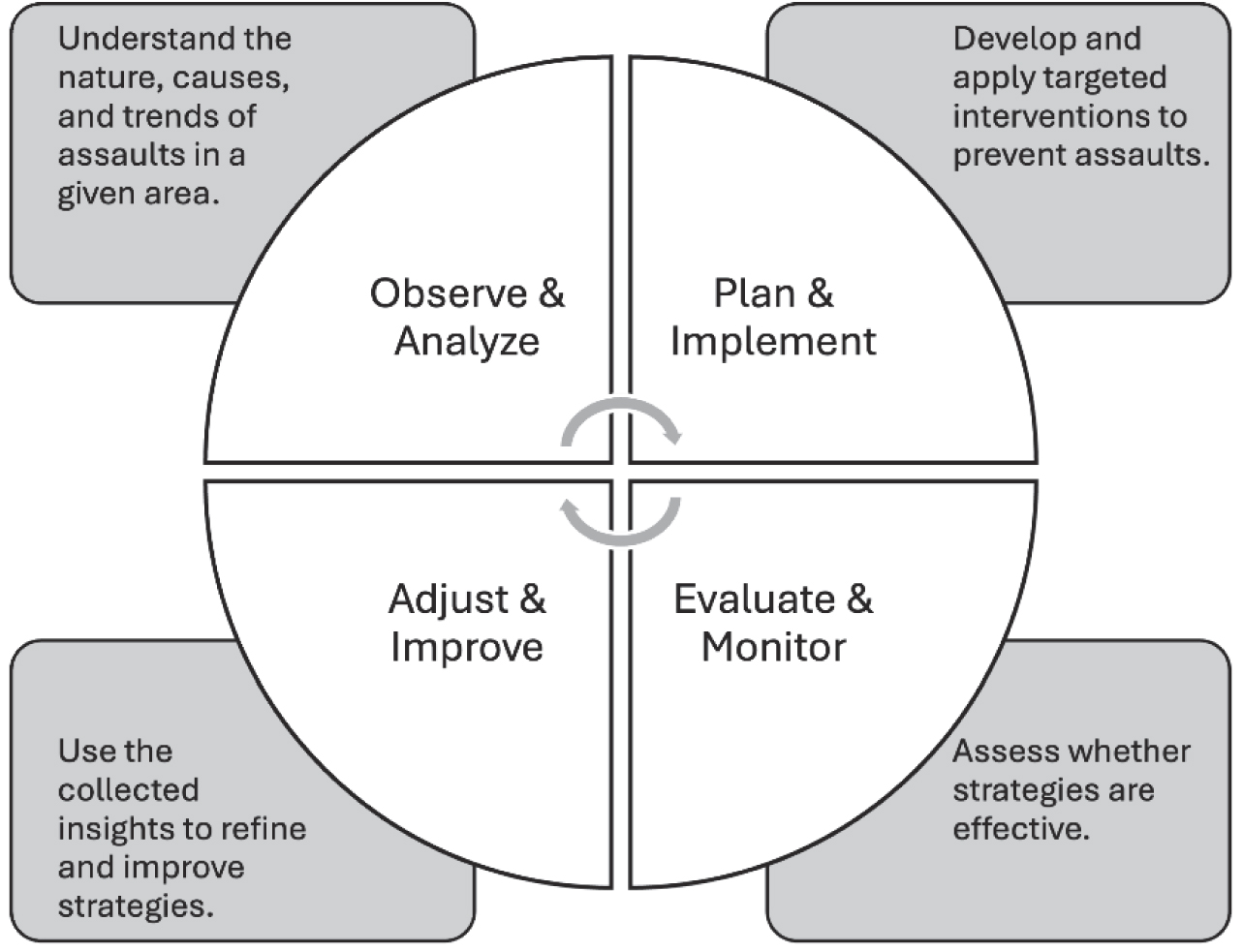
Addressing assaults effectively might include a learning loop. Learning loops require agencies to conduct a set of actions, periodically repeating the process to refine the outcomes, such as:
- Observe and analyze.
- Plan and implement.
- Evaluate and monitor.
- Adjust and improve.
Figure 27 shows a sample learning loop for addressing assaults.
Long Description.
The diagram is divided into four equal sections forming a learning loop for addressing assaults. The first section is to observe and analyze, which involves understanding the nature, causes, and trends of assaults in a given area. The second section is plan and implement, which focuses on developing and applying targeted interventions to prevent assaults. The third section is to evaluate and monitor, which assesses whether strategies are effective. The fourth section is to adjust and improve, which uses the collected insights to refine and improve strategies. Arrows between the sections show the continuous cycle of learning and improvement.


