Measuring Impacts and Performance of State DOT Resilience Efforts: A Guide (2025)
Chapter: 4 Implementation

CHAPTER 4
Implementation
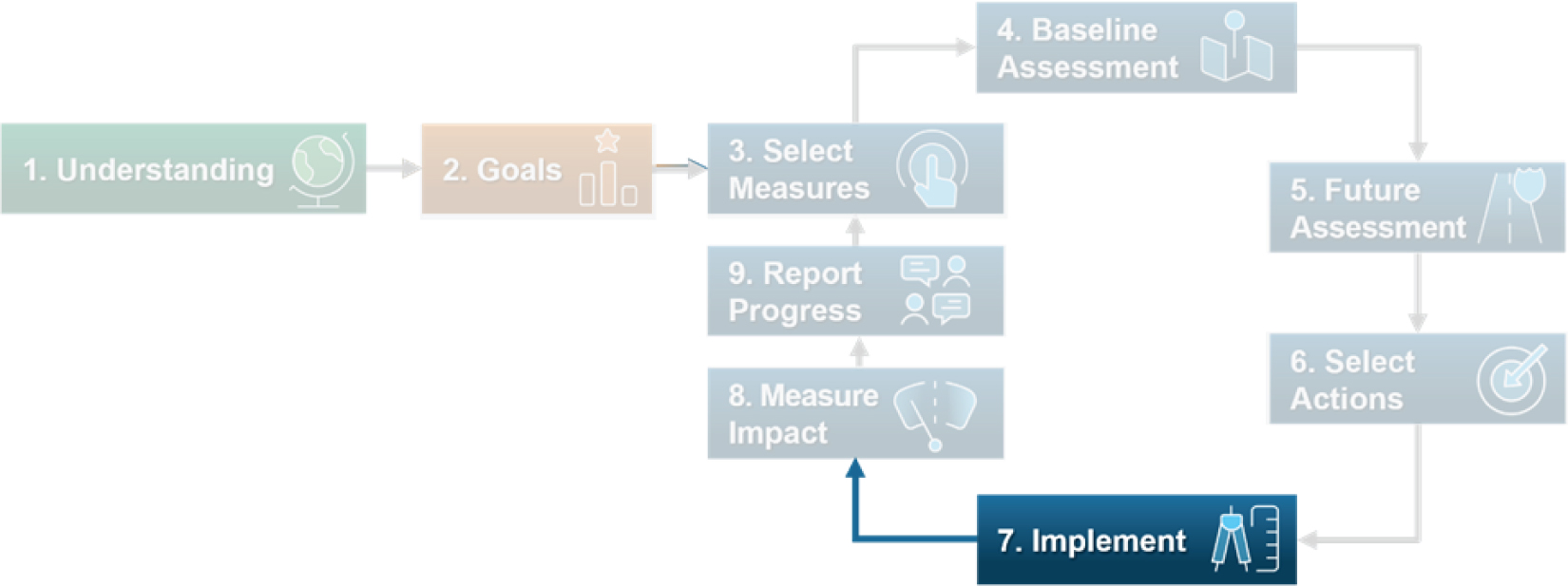
This chapter covers Step 7 of the SIM, agency implementation (Figure 4.1).
Step 7 from the SIM refers to agency implementation of the selected actions identified in Step 6. This chapter provides information showing the linkages and application of performance-based planning and performance-based programming within Step 7.
A critical component within this step is identifying funding needs and potential gaps to support state DOTs as they consider and implement resilience actions and strategies. The enactment of IIJA in 2021 and the creation of the PROTECT formula and discretionary grant programs provide funding to state DOTs and other entities, like MPOs, to support resilience planning efforts and projects to make transportation assets more resilient to natural hazards.
Resilience planning requires state DOTs to consider the probability of events happening and analyze the potential impacts these events may have on the transportation system overall as well as on specific assets. Additionally, integrating resilience into performance management requires the acknowledgment that these probabilities and associated analyses rely on changing future projections and climate considerations, which can make it difficult to set targets based on changing information.
The SIM was developed to assist states with measuring the performance of state DOT resilience-related initiatives and provides a model for implementation. This chapter describes ways transportation agencies can leverage performance-based planning and programming as described in TPM Parts 3 and 4 and how performance-based planning and programming support state DOTs as they implement resilience strategies and actions (FHWA 2024b).
4.1 Performance-Based Planning
This section covers Step 7 of the SIM, which provides details about leveraging performance-based planning to achieve the successful implementation of selected actions.
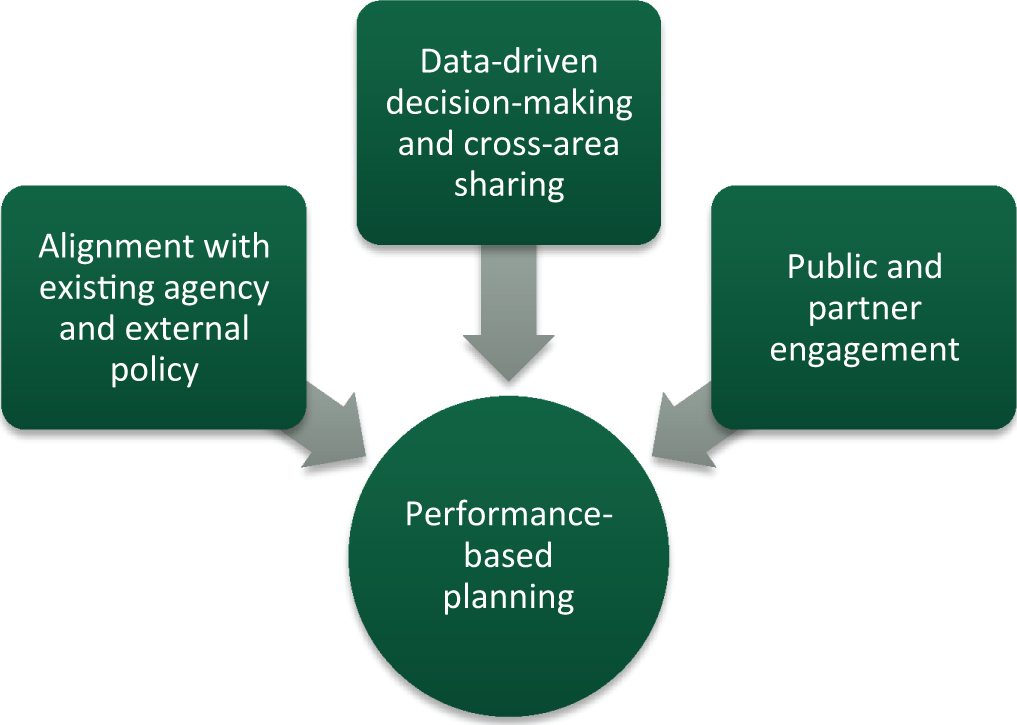
Performance-based planning is an approach used by transportation agencies that leverages agency goals, objectives, and performance trends to identify and develop strategies and determine investment priorities (Figure 4.2). This planning method allows the agency to develop planning documents that serve as a roadmap for the agency to use for goal achievement and overall performance outcomes.
This approach consists of two steps:
- Strategy identification. Develop strategies that align and support agency goals and targets using available data, including forecasts and existing tools within functional areas of a transportation agency.
Long Description.
The implementation model consists of nine steps. They are: 1, Understanding. 2, Goals. 3, Select measures. 4, Baseline assessment. 5, Future assessment. 6, Select actions. 7, Implement. 8, Measure impact. 9, Report progress. Step 7 'Implement' is highlighted.
Source: FHWA 2024c.
Long Description.
The illustration consists of three textboxes reading the following: Alignment with existing agency and external policy; Data-driven decision-making and cross-area sharing; and Public and partner engagement. These textboxes lead to a circle reading, 'Performance-Based Planning.'
- Investment prioritization. Funding within transportation agencies is often constrained and requires evaluations of various investment scenarios as well as an analysis of trade-offs for different investment options. This analysis is based on investment choices and potential outcomes and impacts related to achieving identified targets and goals.
Given that this approach consists of strategy identification as well as investment prioritization, it is a useful tool for transportation agencies to deploy as they plan to make progress on their RPMs. For state transportation agencies to implement performance-based planning for resilience, they need access to resilience data and measures, including climate data. The quality of climate data can be variable. Collaboration within the state DOT across functional areas will ensure a clear understanding of available data related to past events, which can help identify resilience strategies and enable a project and investment prioritization process that ensures selected resilience investments support the achievement of goals and targets.
This cross-functional alignment will help areas within the agency that might have little experience using climate data to make strategy and investment decisions. Additional input from external stakeholders, including partner agencies (such as environmental departments) and members of the community, can also help state DOTs as they identify resilience strategies and align funding to prioritize resilience projects.
Identification of Resilience Strategies
The first step in performance-based planning is the identification of resilience strategies. This can follow from the baseline and future assessment steps conducted earlier in the SIM, in several ways:
- Agencies can leverage the review and analysis of available baseline data trends, forecasting, and other economic analysis tools as well as internal data available through existing systems. For example, identifying effective strategies associated with RPM 10, Strengthening Evacuation Routes, would use data related to historical data of inland flooding as well as projections of future flooding.
- Many transportation agencies employing criticality and vulnerability assessments can use these analyses to inform the selection of resilience strategies, including decisions about prioritizing assets and making investment decisions.
- The information from prior steps can also help determine the best protection method, including nature-based solutions, increased maintenance, alert signs, or the use of flood sensors.
- State DOT resilience strategies can also include the creation of agency-wide policies and procedures that reference resilience in planning documents and communicate the need to include resilience in planning, design, maintenance and operations, and other transportation agency divisions and functions. Within Michigan DOTʼs Resilience Improvement Plan (pending FHWA approval) (Michigan Department of Transportation 2024), the DOT developed resilience improvement strategies from their four assessed climate hazards. Each strategy highlights the associated potential actions, hazards, asset types, and co-benefits. Of those strategies, Michigan DOT developed use scenarios for each with estimated cost and associated project stage. For example, enlargement of culverts (a stormwater management infrastructure strategy) is estimated to cost $1.2M and would fall under the design and operations/maintenance divisions of the DOT.
The baseline and future assessment steps provide the agency with information to identify strategies to achieve goals and set targets based on data and past analyses. In most cases, state DOTs identify resilience strategies that align predominantly with the four Rs of resilience. The RPMs outlined in this guide, in Appendix A, will support the DOT as they assess the effectiveness of the resilience actions and develop a performance-based planning approach to select appropriate strategies and make data-driven investment decisions.
Connecting the RPMs to Resilience Strategies
Once a state DOT has identified resilience strategies, it is important to make the connection to specific measures and metrics. This connection will support the agency as they work to achieve specific goals and objectives, and will set the stage and provide information to the state DOT as to whether they are on track to achieve goals and outcomes, and will support adjustments to strategies and goals to improve outcomes. Successful performance-based planning requires agencies to tie agency goals, objectives, and performance trends with strategies and priorities in long-range transportation planning and other planning.
The resulting plans and processes will serve as a roadmap for the agency to follow as they move toward achieving desired performance outcomes. In the case of resilience, identified strategies lay the groundwork for the state DOT as they set and work toward achieving resilience goals. The use of RPMs in alignment with the implementation of selected actions will strengthen the ability of the state DOT to achieve resilience targets and desired outcomes. Selecting resilience strategies is an important step, but without leveraging RPMs, the state DOT will have a challenging time measuring progress and determining adjustments that need to be made to the strategies to achieve established goals.
Prioritization of Resilience Investments
Identifying and prioritizing investments is a critical step as state DOTs develop resilience strategies and apply RPMs to track progress toward achieving goals. A trade-off analysis can be conducted to better understand the cost of specific investments as well as the likely outcome of selecting one investment in a project or program over another. When making investment decisions, transportation agencies may:
- Develop a project scoring process that includes criteria that connect projects to agency targets and goals.
- Include a per-dollar value analysis in project prioritization.
- Consider budget constraints when selecting projects.
- Conduct trade-off and scenario analysis of potential decisions to determine the impacts on all performance areas.
This prioritization and decision-making process establishes criteria for project prioritization, allows for the evaluation of the efficacy of the delivered projects, and leads directly into performance-based programming.
4.2 Performance-Based Programming
This section discusses the application of performance-based programming within Step 7 of the SIM.
Performance-based programming establishes clear connections between the investments made and the expected performance outcomes of those investments and includes two components: (1) programming within performance areas, and (2) programming across performance areas. Both components include the allocation and prioritization process.
For resilience-related activities and projects, a performance-based programming allocation and prioritization process could involve establishing a documented system for project scoring, leveraging a value-based prioritization process (dollars spent), optimization (selection of projects based on budget constraints), and conducting a trade-off analysis to determine impacts on all the performance areas. For example, a potential resilience project could be assessed to determine the benefits and value of completing the project based on a potential scoring process on performance areas, including maintenance and operations, emergency response, and others.
Performance-based programming within specific performance areas is a relatively new way of doing business for transportation agencies. Therefore, making connections between allocation decisions to strategic goals is something that can sometimes be overlooked. Having a documented process in place helps improve transparency, and creating clear roles and responsibilities can improve accountability, which will increase the likelihood that these linkages will be clearer for practitioners. Establishing a process that connects project scoring and selection with documented strategic goals will support allocation prioritization.
MnDOT provides an instructive case study for other transportation agencies that want to implement Step 7 of the SIM and incorporate performance-based programming. In the early 2010s, MnDOT began to define resilience as an agency-wide practice and created working groups and technical advisory committees to help guide the agency. A multidisciplinary resilience advisory team was also created. These working groups and advisory boards added a layer of accountability and helped define priorities, address potential barriers, and determine a path forward for the agency to measure climate resilience. Furthermore, having these groups in place helped support agency leadership as they championed MnDOTʼs activities to the state legislature and encouraged performance areas to share information across performance areas.
Performance-based programming relies on effective communication across and within performance areas. One way to encourage this communication is to leverage working groups and advisory boards. This approach can help agencies formally link resilience strategies to agency goals. One success factor identified by MnDOT was the creation of the Sustainability and Public Health Office along with a new position within the agency—a Chief Sustainability Officer (CSO). This office was established as a result of innovative leadership who understood that systems are interconnected and changing. The new office and CSO established cross-disciplinary communication, created safe spaces to explore, held staff accountable, and provided encouragement across the agency as they expanded MnDOTʼs resilience practice.
While performance-based programming across performance areas might be considered more mature in terms of practice, it is still an emerging business process within state DOTs, according to the research conducted for NCHRP Report 806: Guide to Cross-Asset Resource Allocation and the Impact on Transportation System Performance (Maggiore et al. 2015). Cross-performance area allocation and prioritization generally include the elements of the process previously described, scoring, linking projects to goals, prioritization based on value, optimization, and conducting a trade-off analysis. For resilience projects, allocation and prioritization across and within performance areas should leverage RPMs and connect directly to the resilience strategies and investment priorities identified through performance-based planning.
4.3 Assigning Roles and Responsibilities
This section provides an overview of the importance of clearly established roles and responsibilities in Step 7 of the SIM.
Successful implementation of identified actions and strategies requires established roles and responsibilities for individuals as well as performance areas. This helps ensure a level of accountability and outlines who is responsible for each step. Establishing clear roles and responsibilities also ensures that action is taken, strategies are implemented, and follow-through to the next step within the TPM Framework or the SIM is achieved. As state DOTs implement performance-based planning and programming, the RPMs will support connections between actions and goals. Assigning roles and responsibilities, not just individually but also according to performance areas, ensures everyone understands the identified resilience strategies and investment priorities, and how those connect to project selection and support program and agency goals.
State DOTs often consider resilience to be a crosscutting function and address it as such. Performance-based programming aligns with this approach because it applies both within specific programs and across programs. RPM 7, Bus Transit Service Restoration Post-Disruption, which measures the percentage of routes recovered within a specific timeframe after a disruption, highlights the importance of assigning roles and responsibilities. Operations as a functional area is responsible for keeping the transportation system running efficiently, while maintenance as a functional area is responsible for ensuring assets are operational and in working condition. Having clear expectations for operations and maintenance related to this RPM and selected actions ensures that practitioners are on the same page. Additionally, the compendium of RPMs (in Appendix A and the Excel workbook) includes the ability to query by functional area, which can assist state DOT practitioners throughout the implementation step as they ensure the right functional areas are involved.
Additionally, some functional areas might have less experience with resilience in general and specifically related to selecting and implementing resilience strategies. Still, these areas may find themselves responsible for specific actions and strategies. For example, planners might find themselves incorporating resilience into their responsibilities by including a review of hardening
and strengthening efforts related to specific assets as they develop the agency transportation asset management plan (TAMP). Related to the RPMs included in the guide (Appendix A), RPM 1, Reduction in Risk, which measures the reduction in cumulative annual risk from project investments or operations and maintenance that address known risks on critical corridors, is an example of ways in which planning efforts would include other functional areas in the selection of resilience strategies.


