Evaluating and Delivering Advanced Driver Assistance Systems (ADAS) Education: A Guide (2025)
Chapter: Appendix D: Content Organization Tool

APPENDIX D
Content Organization Tool
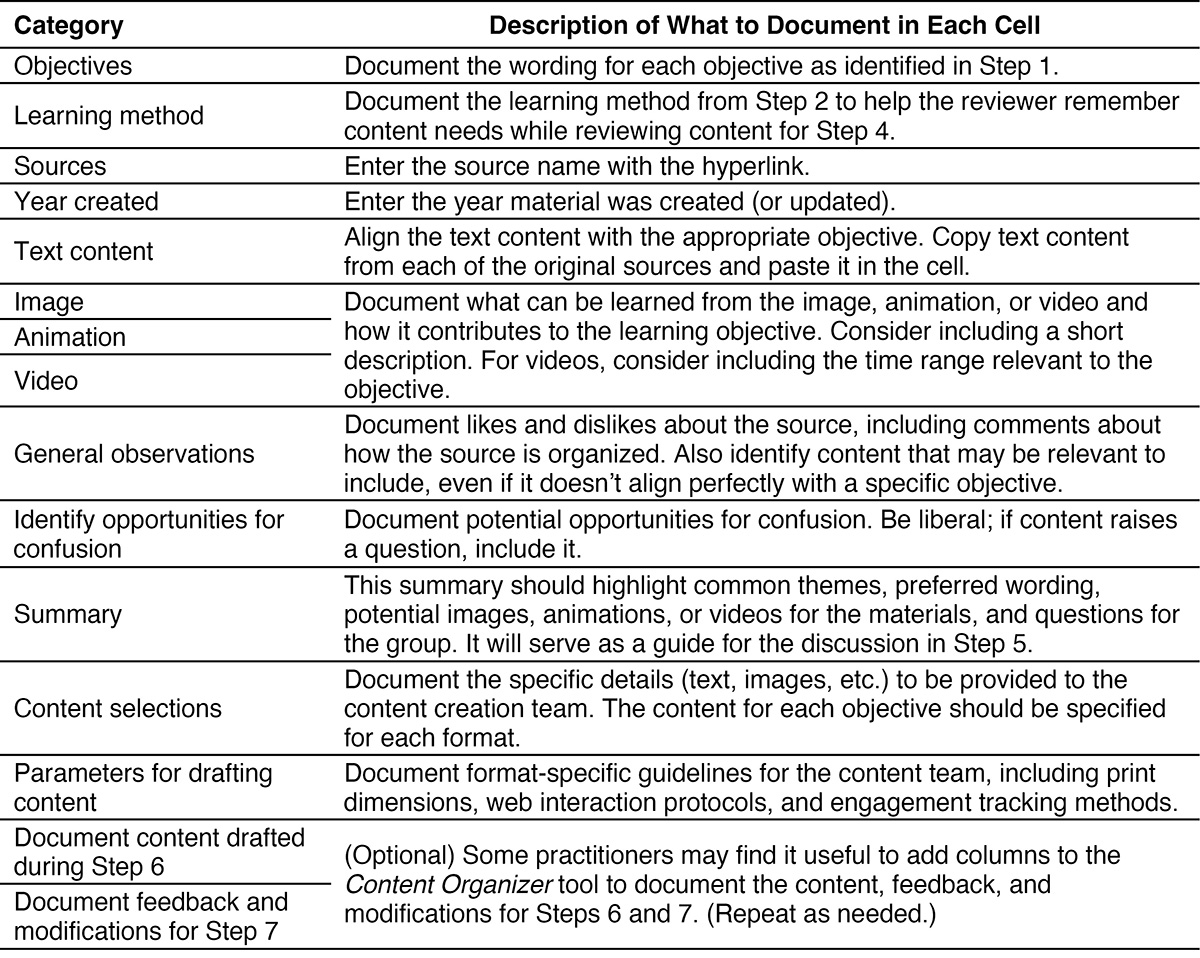
The Content Organization Tool can help practitioners review and organize ADAS content from various sources. It is available on the National Academies Press website (nap.nationalacademies.org) by searching BTSCRP Research Report 18: Evaluating and Delivering Advanced Driver Assistance Systems (ADAS) Education: A Guide. The main worksheet of the Excel workbook can be customized by the practitioner (i.e., add, delete, or modify columns) to meet their organizationʼs needs. Table D-1 lists the columns in the tool. The How to Use sheet details how the practitioner can use the tool. Specifically, the main sheet can be used to collate objectives (Step 1), information sources (Step 3), characterization of ADAS materials (Step 4), and information to be included in ADAS education materials (Step 5). The first row informs the practitioner of the step in the process, and row two identifies which content to include in each cell.
Long Description.
The table has 2 columns and 16 rows. The column headers in Row 1 are Category; Description of What to Document in Each Cell. Row 2: Objectives; Document the wording for each objective as identified in Step 1. Row 3: Learning Method; Document the learning method from Step 2 to help the reviewer remember content needs while reviewing content for Step 4. Row 4: Sources; Enter the source name with the hyperlink. Row 5: Year created; Enter the year the material was created or updated. Row 6: Text content; Align the text content with the appropriate objective. Copy text content from each of the original sources and paste it in the cell. Row 7: Image; Document what can be learned from the image and how it contributes to the learning objective. Consider including a short description. Row 8: Animation; Document what can be learned from the animation and how it contributes to the learning objective. Consider including a short description. Row 9: Video; Document what can be learned from the video and how it contributes to the learning objective. Consider including a short description. Consider including the time range relevant to the objective. Row 10: General observations; Document likes and dislikes about the source, including comments about how the source is organized. Also, identify content that may be relevant to include, even if it does not align perfectly with a specific objective. Row 11: Identify opportunities for confusion; Document potential opportunities for confusion. Be liberal, if content raises a question, include it. Row 12: Summary; This summary should highlight common themes, preferred wording, potential images, animations, or videos for the materials, and questions for the group, It will serve as a guide for the discussion in Step 5. Row 13: Content selections; Document the specific details such as text and images to be provided to the content creation team. The content for each objective should be specified for each format. Row 14: Parameters for drafting content; Document format-specific guidelines for the content team, including print dimensions, web interaction protocols, and engagement tracking methods. Row 15: Document content drafted during Step 6; Optional, Some practitioners may find it useful to add columns to the Content Organizer tool to document the content, feedback, and modifications for Steps 6 and 7, Repeat as needed. Row 16: Document feedback and modifications for Step 7: Optional, Some practitioners may find it useful to add columns to the Content Organizer tool to document the content, feedback, and modifications for Steps 6 and 7, Repeat as needed.
