Evaluating and Delivering Advanced Driver Assistance Systems (ADAS) Education: A Guide (2025)
Chapter: 1 Review of Information Sources

CHAPTER 1
Review of Information Sources
In Phase I of this project, the research team conducted a review of the current state of advanced driver assistance systems (ADAS) education and training materials. The team considered research published in the scientific literature, reviewed standards development organizations and activities, and searched a variety of sources for educational materials containing information about nine types of ADAS listed in Table 1 and defined in Appendix A. The team also evaluated the materials and identified which ADAS were and were not covered, noted what type of content or information was provided in each source, and flagged content that included potential inaccuracies. This section provides a high-level summary of the review findings. The efforts and findings are described in detail in the accompanying technical report.
The team broadly considered materials that provided information about ADAS without classifying whether the materials were “education” or “training.” These terms are often used interchangeably in the literature (Hager and Laurent 1990) and could be considered to represent anchor points on a continuum of learning objectives or aims. Generally, education fosters further development and learning (via intrinsic motivators), whereas training typically provides instruction to help learners achieve a specific level of competence or skill (Hermann et al. 1976). The ADAS materials identified from various organizations were considered educational material because they are more general in nature, whereas most of the materials used in research studies identified in the literature review were considered training because they instruct research participants to obtain an expected competence of ADAS use.
Review of Scientific Literature
The team conducted a scoping literature review using the population, intervention, comparison, outcomes, and study design eligibility criteria to search, screen, and review the scientific literature. Of the 794 identified papers, 44 were included in the review. The studies included 101 participant groups, including 8 groups who did not receive any training (i.e., a control group). Of the comparison groups, participants were most commonly provided with a mock ownerʼs manual that contained text and graphics. Notably, only 20% of the reviewed studies include the training materials that were used. The project report contains descriptions of the participant characteristics, ADAS, training delivery mode, training content, and study outcomes for all 44 studies.
The current literature assesses the preliminary efficacy of different training approaches in research settings rather than the effectiveness in real-world conditions. It remains unclear when education should be provided (i.e., before, during, or after initial use; after becoming familiar with the vehicle; or after experiencing scenarios where the ADAS did not work as expected), how long (i.e., duration), or how often (i.e., frequency). The literature review findings revealed significant research gaps with respect to training for certain driving populations. None of the studies tested the effects of ADAS training for novice drivers, commercial vehicle drivers, professional drivers,
drivers who often drive for their occupation (e.g., police officers, emergency medical responders), fleet/safety managers, or operators of fleet vehicles.
The conceptualization, development, and evaluation of ADAS training is informed by practical (e.g., feasibility) and theoretical considerations (e.g., frameworks or conceptual models). Practical considerations should include an overlap between the training protocol and training objectives, be created for the intended audience (e.g., driving experience, training preferences), and be feasible to implement based on the availability of resources and environmental demands (Zahabi et al. 2020).
Review of Standards Development Organizations and Activities
For this review, the team aimed to document ongoing activities within standards development organizations related to ADAS education. The search yielded only three titled standards or regulations directly related to ADAS education and training for drivers. Two are driver education standards in North America and one is a United Nations Economic Commission for Europe regulation for Driver Control Assistance Systems that includes requirements for vehicle manufacturers to provide the driver with informational materials covering specific topics. Numerous ADAS-related standards exist for system performance requirements, test procedures, operating characteristics, and user interfaces (e.g., standards from the International Organization for Standardization and SAE International); however, they do not mention education or training, outside of a few references to the ownerʼs manual.
Findings from this review indicate a lack of standards for transit and commercial motor vehicles, although the Technology & Maintenance Council, part of the American Trucking Associations, will soon finalize a recommended practices document on the topic of driver training. In collaboration with the American Society of Safety Professionals and National Safety Council, the American National Standards Institute published a technical report that includes ADAS and addresses topics to be included in driver training. Additionally, the American Association of Motor Vehicle Administrators has produced extensive guidance regarding ADAS for motor vehicle administrators, which has also been adopted by Australia and Canada and includes training considerations for several unique populations. One theme that emerged across different sectors and organizations was the call for a standardized nomenclature for ADAS. In conclusion, the review identified one regulation from Europe that required manufacturers to provide ADAS education, and no similar requirements or voluntary standards were identified for manufacturers in the US.
Review of Educational Materials
In the educational material review, the research team aimed to document educational content related to ADAS by conducting a targeted search across different types of sources, including driver education programs, online resources, vehicle dealerships, vehicle rental companies, insurance companies, standards development organizations, driving safety advocacy and research associations, and driver improvement programs. The review included content from websites, brochures, videos, and manuals. The team examined each material to identify content that provided information about ADAS technologies, the intended audience, the inclusion of images or videos, links to other websites or resources, and other characteristics. The Resource Identification Tool (Appendix C) summarizes the sources that contained ADAS educational materials.
Most materials (57%) were aimed toward drivers in general. Materials targeting new car buyers composed 39%, with used car buyers and driving education following at 25% and 14%, respectively. The team noted a lack of materials related to driving rehabilitation and minimal sources of ADAS information for commercial vehicle drivers, fleet/safety managers, and operators of fleet vehicles.
Educational materials commonly included the ADAS that provide warnings, i.e., blind spot warning (BSW), forward collision warning (FCW), lane departure warning (LDW), adaptive cruise control (ACC), automatic emergency braking (AEB), and lane keeping assistance (LKA). Some materials presented each ADAS individually, whereas others described combinations of ADAS. The most frequent pairings are systems that may appear to have similar functions. For instance, LDW, LKA, and lane centering assistance (LCA) all monitor the vehicleʼs lateral position and thus can be easily conflated. Similarly, FCW and AEB both aim to reduce frontal crashes and are often experienced together.
The review also categorized content into the six categories defined in Table 2. The purpose and function of ADAS were found in almost every source of educational material. About half the sources included information about responsibilities (55%), limitations (50%), and the operational design domain (ODD; 41%). Procedures received the least attention, appearing in only 21% of the sources, with most of the content being found in vehicle ownerʼs manuals.
ODD was most frequently found for lane support ADAS (i.e., LDW, LKA, LCA). When ODD was presented for other ADAS, it was usually detailed on a manufacturerʼs website or within the manuals. It is possible that sources providing general information find it too difficult to provide accurate information about possible ODD constraints when technologies are continuously changing.
Summary of Opportunities for Confusion
In the review of educational materials, the team flagged any content that contained potentially inaccurate information. This determination was somewhat subjective, and the team agreed to be liberal when identifying these potential issues. Operationally, researchers documented materials that raised any question about the meaning or accuracy of the information. These flags for inaccuracies were later relabeled as opportunities for confusion and were classified into five categories: incorrect content, ambiguous content, lack of context, inconsistent content, or other. Some flagged items may have fallen into more than one category. For additional information about the opportunities for confusion, see Appendix E.
Every reviewed source contained at least one opportunity for confusion. The team summarized opportunities for confusion as a proportion of educational materials within ADAS and type of content. Overall, content related to function had the highest percentage (81%) of opportunities for confusion, whereas responsibility content was the lowest (8%). The other content types ranged from 27% to 47%. The ADAS that had the highest proportion of materials with opportunities for
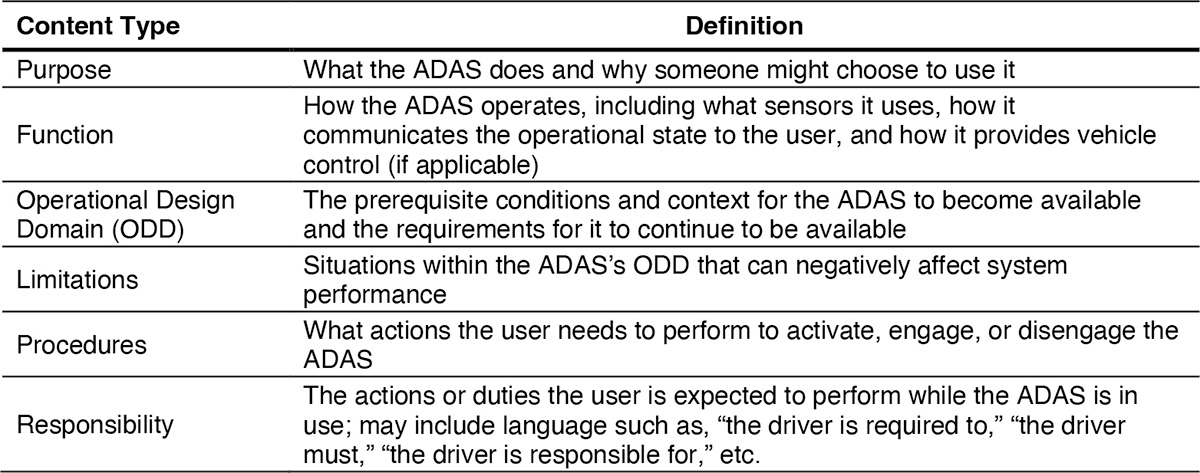
Long Description.
The table has 2 columns and 7 rows, including the header. The column headers in row 1 are Content Type and Definition. Row 2: Purpose, What the ADAS does and why someone might choose to use it. Row 3: Function; How the ADAS operates, including what sensors it uses, how it communicates the operational state to the user, and how it provides vehicle control if applicable. Row 4: Operational Design Domain ODD; The prerequisite conditions and context for the ADAS to become available and the requirements for it to continue to be available. Row 5: Limitations; Situations within the ADASʼs ODD that can negatively affect system performance. Row 6: Procedures: What actions the user needs to perform to activate, engage, or disengage the ADAS. Row 7: Responsibility; The actions or duties the user is expected to perform while the ADAS is in use. It may include language such as the driver is required to, the driver must, the driver is responsible for, et cetera.
confusion was ACC with 56%; other ADAS ranged from 38% to 48%. In particular, 94% and 71% of materials that described the function and ODD of ACC, respectively, contained at least one piece of information that was potentially confusing. The findings from this portion of the review indicate that evaluating the accuracy of ADAS educational materials is a necessary step that may pose a considerable challenge to practitioners.
Summary of Review Activities
The research team found a lack of evidence supporting the effectiveness of ADAS training and little guidance from standards development organizations to guide practitioners who want to provide ADAS education or training. The review of existing ADAS educational materials resulted in several findings that indicate it may be challenging for practitioners to use them. These materials generally fall into two categories.
One category is materials that provide only generic, high-level information about ADAS, which cannot give a learner a full and complete understanding. For instance, procedural information was frequently missing because of its vehicle-specific nature.
The other category mainly includes materials from manufacturers, which present many details for multiple specific ADAS. These materials often combined multiple types of ADAS in one section or grouped different ADAS under umbrella terms (e.g., forward collision prevention), which could confuse learners or lead them to conflate systems. These materials also require the learner to determine on their own which information is pertinent to their vehicle.
Across both categories of materials, ADAS information rarely states learning objectives or identifies the intended audience for the materials. Very few materials present learners an opportunity to apply or assess their knowledge. Materials contain many potential inaccuracies, some of which could be very challenging to identify without existing knowledge or experience with ADAS.
Therefore, practitioners who wish to provide ADAS education or training would benefit from selecting or customizing ADAS education or training materials to fit their organizationʼs aims, audience and learning objectives, and resources. The next chapter outlines a process that guides practitioners in making these decisions.


