Evaluating and Delivering Advanced Driver Assistance Systems (ADAS) Education: A Guide (2025)
Chapter: Summary

SUMMARY
Evaluating and Delivering Advanced Driver Assistance Systems (ADAS) Education: A Guide
Motor vehicles are increasingly equipped with advanced driver assistance systems (ADAS) that support the driving task by issuing warnings, intervening with temporary control, or automating part of the driving task. These systems include adaptive cruise control (ACC), lane keeping assistance (LKA), automatic emergency braking (AEB), and others. In 2021 more than 90% of all new vehicles were equipped with ACC, and half could provide steering and speed control under certain conditions (Bartlett 2021).
Analyses of crashes involving vehicles equipped with ADAS, specifically those with forward collision warning (FCW) or AEB report significant safety benefits (e.g., Cicchino 2019; Cicchino and Kidd 2024). However, ADAS can only assist if drivers choose to use them. Previous research has found that some drivers who own ADAS-equipped vehicles disable ADAS features (Reagan et al. 2018). Some drivers also have gaps in their understanding about the functionality and limitations of ADAS technologies (DeGuzman and Donmez 2021; Mason et al. 2023; McDonald et al. 2018). A strong understanding of ADAS such as ACC leads to less uncertainty and better performance in safety-critical situations (Gaspar et al. 2021).
Many challenges remain in developing and evaluating effective ADAS education. ADAS nomenclature and functions vary between manufacturers, makes, and models. Numerous organizations have called for standardized naming (AAA et al. 2022; TMC RP 547: Guidelines for Advanced Driver Assistance System [ADAS] Nomenclature). Although drivers most often learn about ADAS through the ownerʼs manual (Kaye et al. 2022), the ownerʼs manual often does not detail which ADAS are equipped in the vehicle. In addition, ADAS can be modified via over-the-air software updates, meaning that system functionality can change from one drive to the next. All these factors may lead to driver confusion, misunderstanding, misuse, and disuse. Variability across systems among and within manufacturers and updates within systems make it difficult to create educational and training materials that offer anything but the most basic information. Depending on the source, existing educational materials may be difficult to understand (Oviedo-Trespalacios et al. 2021), contain inaccuracies, or be out of date.
Purpose
The increasing prevalence of ADAS in the vehicle fleet leads to changes in the knowledge, skills, and behaviors required by drivers to safely operate their vehicles. Information about the functions, capabilities, and limitations of ADAS is available from various sources. Although research demonstrates the preliminary efficacy of ADAS education and training in specific research settings, there is a lack of evidence about the effectiveness of ADAS education and training in real-world conditions. In addition, there is no authoritative standard or source of generalizable ADAS educational information.
This document provides practitioners with guidance about how to identify, create, or modify ADAS materials to achieve their specific goals and objectives for providing ADAS education or training. The guide begins by summarizing the findings from the research teamʼs review of informational sources, standards, and the scientific literature. Next the guide describes a process for practitioners to define learning objectives, find materials, evaluate whether the materials fit the practitionersʼ objectives, select content for learning materials, and plan for dissemination of the learning materials. Finally, the guide includes two case studies to demonstrate how the process can be applied.
Audience
Educating drivers about ADAS requires engagement from multiple disciplines and areas of expertise. The target audience for this guide includes those who work in agencies like departments of motor vehicles, departments of transportation, and state highway safety offices and others who interact with drivers and vehicles, such as traffic safety organizations, driver educators, driving rehabilitation specialists, law enforcement officers, transportation companies, dealership employees, and fleet managers.
Overview
Review Findings
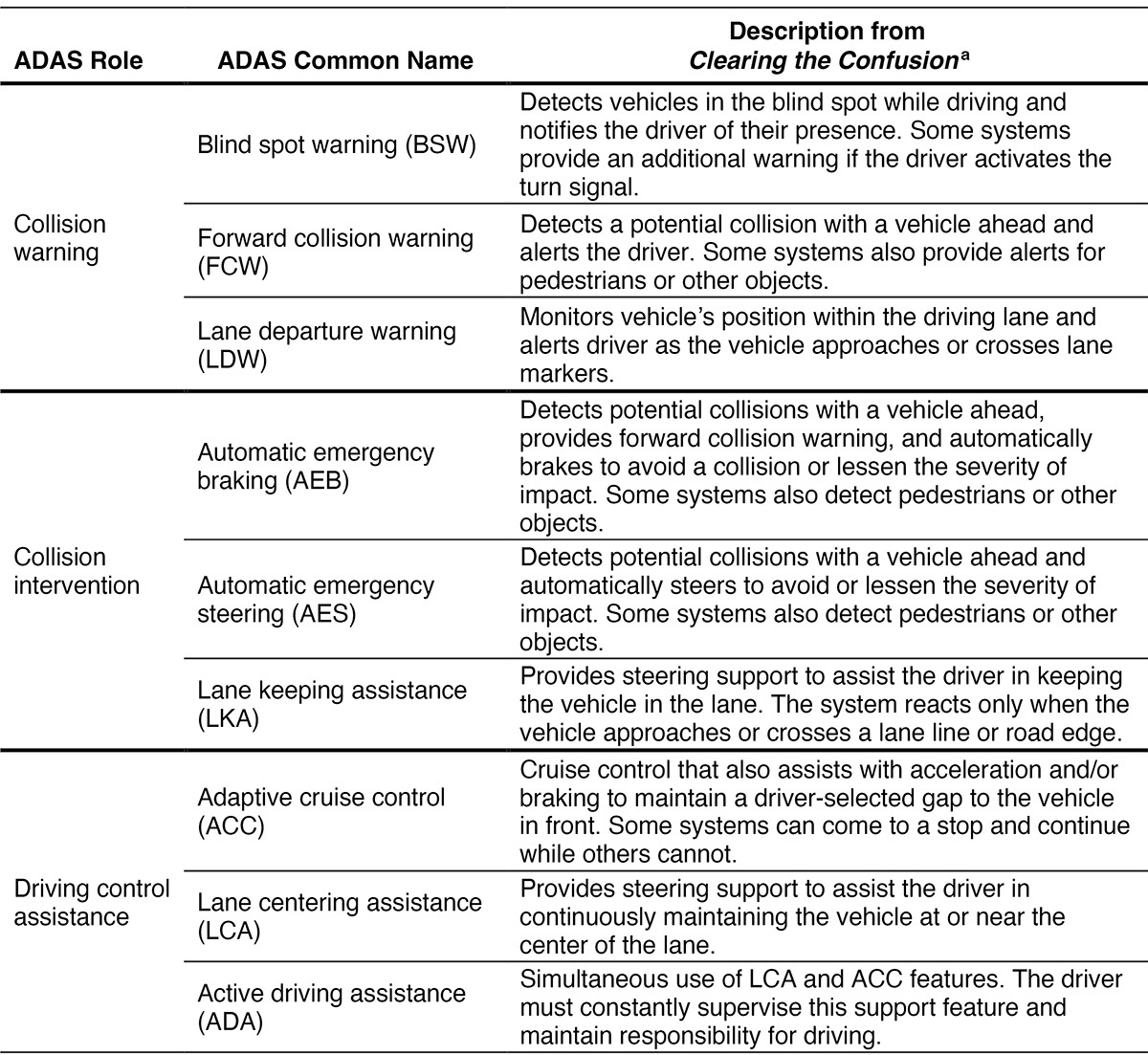
Chapter 1 of this guide summarizes the research teamʼs findings from Phase I of this project. Details of the review are described in the final report for BTS Cooperative Research Program Project 26, Advanced Driver Assistance Systems (ADAS) Education and Outreach. The team reviewed ADAS education and training materials in the scientific literature, from standard development organizations and activities, and from numerous organization types for nine types of ADAS. Collision warning, collision intervention, and driving control assistance technologies are described in Table 1. The research team considered ADAS information from various organizations to be educational materials because they were more general in nature, whereas most of the materials from research studies were considered training because they instructed research participants for the purpose of building skill in using ADAS.
The literature review identified 44 studies that investigated various methods and outcomes of ADAS training. Much of the training content included in these studies was based on content from ownerʼs manuals. Training protocols often included multiple learning methods, different types of content, or ADAS exposure, so when differences in the outcome measures were observed, it is unknown which component or components of the training contributed to the result. Only a few studies provided access to the training materials, and even fewer used a pretest–post-test design to directly measure the effect of the training. The body of literature yielded no clarity on what effective generalizable ADAS education or training looks like.
The review of standards and standards development organizations found very few documents that provided requirements or recommendations related to the content of ADAS education or training.
Overall, the review of materials identified ADAS-related content from different types of organizations. Nearly all materials included content about ADAS purpose and function. Around half the materials included content about the prerequisite conditions in which the ADAS is designed to operate, its limitations, and user responsibilities. Materials rarely stated learning objectives or identified the intended audience. Numerous sources included at least one instance when content was ambiguous, lacked context, was inconsistent, or was potentially incorrect.
Long Description.
The table has 3 columns and 10 rows, including the header. Column headers in row 1 are ADAS role, ADAS common name, and Description from Clearing the Confusion (Triple A et al. 2022). Row 2: Collision warning, Blind spot warning (BSW); Detects vehicles in the blind spot while driving and notifies the driver of their presence. Some systems provide an additional warning if the driver activates the turn signal. Row 3: Collision warning, Forward collision warning (FCW); Detects a potential collision with a vehicle ahead and alerts the driver. Some systems also provide alerts for pedestrians or other objects. Row 4: Collision warning, Lane departure warning (LDW); Monitors vehicleʼs position within the driving lane and alerts the driver as the vehicle approaches or crosses lane markers. Row 5: Collision intervention, Automatic emergency braking (AEB); Detects potential collisions with a vehicle ahead, provides forward collision warning, and automatically brakes to avoid a collision or lessen the severity of impact. Some systems also detect pedestrians or other objects. Row 6: Collision intervention, Automatic emergency steering (AES); Detects potential collisions with a vehicle ahead and automatically steers to avoid or lessen the severity of impact. Some systems also detect pedestrians or other objects. Row 7: Collision intervention, Lane keeping assistance (LKA); Provides steering support to assist the driver in keeping the vehicle in the lane. The system reacts only when the vehicle approaches or crosses a lane line or road edge. Row 8: Driving control assistance, Adaptive cruise control (ACC); Cruise control that also assists with acceleration and or braking to maintain a driver-selected gap to the vehicle in front. Some systems can come to a stop and continue, while others cannot. Row 9: Driving control assistance, Lane centering assistance (LCA); Provides steering support to assist the driver in continuously maintaining the vehicle at or near the center of the lane. Row 10: Driving control assistance, Active driving assistance (ADA); Simultaneous use of lane centering assistance and adaptive cruise control features. The driver must constantly supervise this support feature and maintain responsibility for driving.
The review findings, as well as the concerns and challenges summarized earlier, indicate that to provide the most effective ADAS education or training, practitioners should tailor the materials to fit their organizationʼs circumstances.
Process
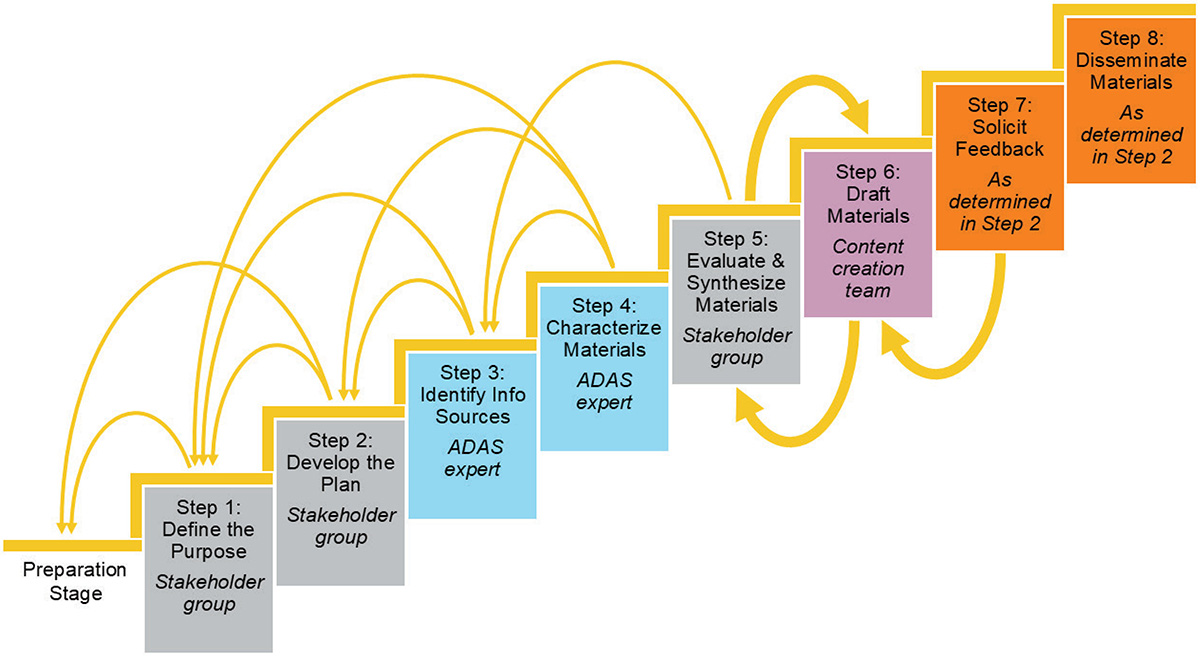
The review of the literature, standards, and educational materials illustrates that there can be no one-size-fits-all solution for ADAS education and training. Practitioners who aim to provide ADAS education or training would benefit from selecting or customizing ADAS education or training materials to fit their organizationʼs intentions, audience and learning objectives, and resources. As a result, the research team developed a process that practitioners can follow to provide ADAS education and training tailored to their specific audience, learning objectives, and organizational constraints. The process, shown in Figure 1 and presented in detail in Chapter 2, begins with a Preparation Stage followed by eight steps. The process was developed with the assumption that most organizations would use a team approach that would include a group of stakeholders, at least one of whom has ADAS expertise, and a content creation team to produce the actual learning materials. The process is expected to be iterative and includes reminders to check back and verify the next steps align with prior ones. Practitioners should modify the process to fit their particular objectives and circumstances.
Long Description.
A flowchart with 8 steps plus a Preparation stage on the left. Step 1 states define the purpose by the stakeholder group. Step 2 states develop the plan by the stakeholder group. Step 3 states identify information sources by the ADAS expert. Step 4 states characterize materials by the ADAS expert. Step 5 states evaluate and synthesize materials by the stakeholder group. Step 6 states draft materials by the content creation team. Step 7 states solicit feedback as determined in Step 2. Step 8 states disseminate materials as determined in Step 2. Many curved arrows connect the steps in sequence and loop back from later steps to earlier steps, showing repeated feedback among the steps.
Preparation Stage
Practitioners gather information to clarify the organizationʼs motivation and goals for providing ADAS education or training. Next is to identify the resources (e.g., time, money, human resources) the organization will provide for the effort and the stakeholders representing different perspectives who will be involved. Most teams will benefit from identifying someone with ADAS expertise to lead the evaluation of ADAS materials. By understanding the constraints up front, practitioners can scope their efforts while staying true to the organizationʼs goals.
Step 1: Define the Purpose
During this step, practitioners identify the audience of learners, specify the learning objectives for the learners, and determine which ADAS features to include in the learning materials.
Step 2: Develop the Plan
Practitioners develop a plan for delivering ADAS education, including when, where, and how the audience will interact with the learning materials. They also plan ahead for how the materials will be created, reviewed, and disseminated while accounting for the available resources, timelines, and organizational requirements.
Step 3: Identify Sources of ADAS Information
During this step, practitioners specify the ADAS content needed for the learning materials, then plan and conduct a search to identify sources of ADAS information that include content related to the identified learning objectives.
Step 4: Characterize Materials
The ADAS expert reviews the sources identified in Step 3 and extracts content related to the learning objectives. Additionally, the expert makes general observations about the materials, identifies opportunities for confusion, and creates a summary detailing how the content will be discussed in Step 5.
Step 5: Evaluate and Synthesize Materials
The ADAS expert presents the findings from Step 4 to the stakeholders. The group discusses and identifies the content for each objective for each type of learning material specified in Step 2. The stakeholders provide the specifications for the learning materials to the content creation team.
Step 6: Draft Materials
The content creation team designs materials according to the specifications. Then the stakeholder group reviews the learning materials to ensure they align with expectations and fully address the content needs. There may be several rounds of review and feedback (i.e., iteration between Steps 5 and 6).
Step 7: Solicit Feedback
This recommended but optional step asks representatives of the target audience or other stakeholders to interact with the learning materials and give their feedback. The feedback could be gathered through focus groups, interviews, or surveys.
Step 8: Disseminate Materials
The learning materials are shared with members of the target audience. Dissemination may involve another group within the organization. The dissemination plan may also call for tracking the audienceʼs engagement (e.g., website metrics), providing incentives, fielding inquiries from the audience, or assessing the audienceʼs learning.
Case Studies
The two case studies in this guide show how the outlined process for identifying, creating, or modifying ADAS education and training materials could be applied in fictional scenarios that were selected to illustrate different dimensions. Based on the review activities and project tasks the research team completed in Phase I, ACC is the subject ADAS for both case studies.
The first case study, which considers how a state transportation agency might develop new learning materials to provide education about ACC to drivers of passenger vehicles, is in Chapter 3.
The second case study in Chapter 4 demonstrates how the process could be applied to identify existing materials that could be incorporated into company-provided training about ACC for operators of a specific commercial motor vehicle. Readers of this guide can review both case studies and determine which aspects of each may apply to their given situation. For example, a practitioner might be interested in general education for commercial drivers, so parts of both case studies could be useful.
Practitioner Tools and Resources
The research team has developed several tools and resources to assist practitioners. Three tools help practitioners document the search for materials and identify and organize content that is aligned to the learning objectives. Two resources summarize selected findings from Phase I to help practitioners identify and evaluate sources of ADAS information.
- Appendix A. Observed Names for Selected ADAS – Practitioners can use this resource to identify common names for ADAS and other terms that can be used to search for resources.
- Appendix B. ADAS Information Source Tracker – Practitioners can modify and use this tool to maintain a record of search efforts and findings.
- Appendix C. Resource Identification Tool – Practitioners can use this tool to inform their search strategy for ADAS educational materials. The tool collates the ADAS educational materials reviewed in 2023 during Phase I of this project.
- Appendix D. Content Organization Tool – Practitioners can modify and use this tool to identify, review, and organize ADAS content that aligns with the learning objectives.
- Appendix E. Aid for Identifying Opportunities for Confusion in ADAS Information – This resource provides examples to help practitioners identify opportunities for confusion in ADAS education and training materials, including images.


