Evaluating and Delivering Advanced Driver Assistance Systems (ADAS) Education: A Guide (2025)
Chapter: 2 Process for Providing ADAS Education and Training

CHAPTER 2
Process for Providing ADAS Education and Training
The research team developed a process to guide practitioners from the conceptual idea of providing information about ADAS into specific objectives, materials, and a plan of action while being attentive to the organizationʼs constraints. The guidance pertains to practitioners who are evaluating existing materials to determine whether they are suitable for their learning objectives and to practitioners who are developing original learning materials. Additionally, the approach can be used by practitioners focused on ADAS education (material designed to inform the reader and motivate them to seek additional information) or training (learners acquiring competence or skill).
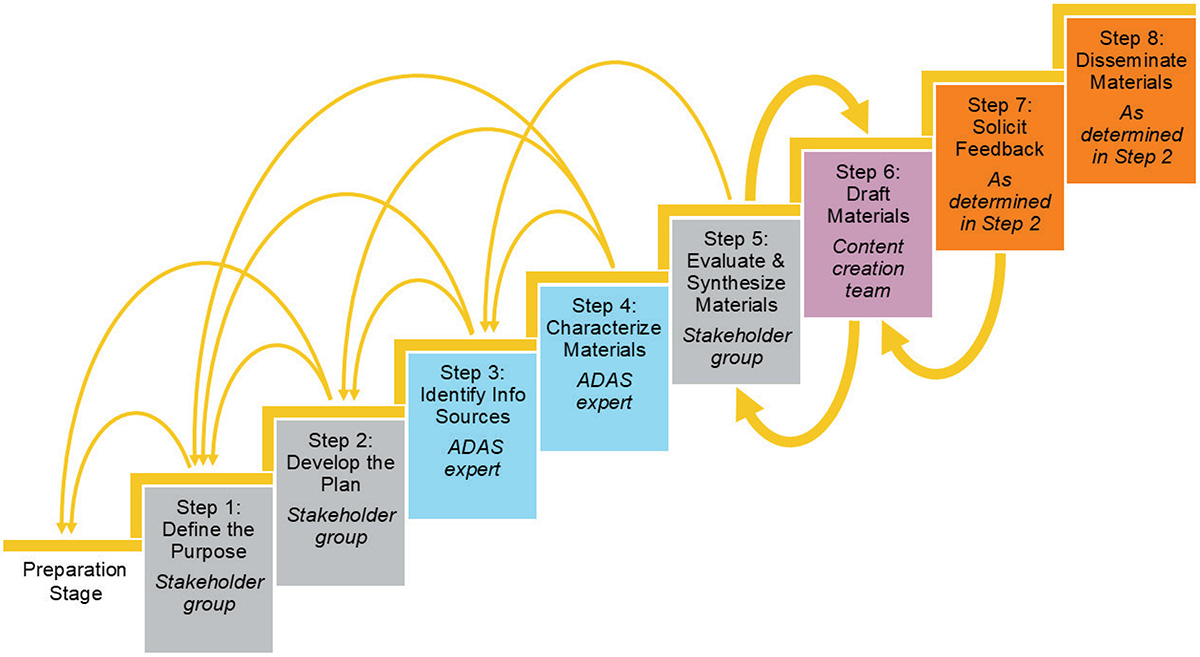
The process, which is shown in Figure 2, begins with the Preparation Stage (positioned in the lower left of the figure) and ends with Step 8: Disseminate Materials (positioned in the upper right). In the process, it is assumed that most organizations would use a team approach that includes a group of stakeholders, at least one of whom has ADAS expertise, and a content creation team that would produce the actual learning materials. Each step in the figure identifies the individuals most likely to perform the activities involved. However, the process is not intended to be prescriptive. Practitioners may add, remove, or execute steps in a different order or identify other individuals to perform activities. The process is intended to be iterative. Several rounds of iteration are expected to occur when practitioners are collaborating with the content creation team to synthesize, draft, and revise materials, indicated by the thick yellow arrows in Figure 2. In addition, at the end of each step, practitioners check back to verify that their decisions reflect the objectives, plan, and constraints that they previously identified, or they can choose to revisit and modify previous decisions. The narrow yellow arrows in the figure indicate this activity of iteratively checking back.
Preparation Stage
In this stage, practitioners gather information and “get their ducks in a row” to prepare for the process of providing ADAS education or training. Preparation includes the following:
- Clarifying why the organization wants to provide information about ADAS
- Identifying resources the organization will provide to support the effort
- Determining who should be involved in the effort
Being aware of the expectations, timeline, and resources from the beginning allows the practitioners to plan and execute the process more effectively. If practitioners are engaging in ADAS education or training because the task has been assigned to them by others in their organization, it is crucial to solicit information from those individuals about their motivations and expectations and the resources available.
Long Description.
A flowchart with 8 steps plus a Preparation stage on the left. Step 1 states define the purpose by the stakeholder group. Step 2 states develop the plan by the stakeholder group. Step 3 states identify information sources by the ADAS expert. Step 4 states characterize materials by the ADAS expert. Step 5 states evaluate and synthesize materials by the stakeholder group. Step 6 states draft materials by the content creation team. Step 7 states solicit feedback as determined in Step 2. Step 8 states disseminate materials as determined in Step 2. Many curved arrows connect the steps in sequence and loop back from later steps to earlier steps, showing repeated feedback among the steps.
Clarify the Organizationʼs Motivation and Aims
Understanding why the organization wants to provide ADAS education lays the foundation for the entire process. Clearly articulating the problem or knowledge gap that needs to be addressed is important because there are many different types of information and levels of detail that could be included in ADAS education and training. For the process to be successful, the practitioners need to understand the overall vision for this effort.
Identify where the idea for ADAS education and training originated. Perhaps someone in the organization attended a webinar or conference presentation that prompted them into action. Was there a recent crash or traffic stop that involved ADAS? How could education or training help prevent that situation from happening again? Maybe the organization is purchasing vehicles equipped with ADAS and wants to train their employees to use ADAS appropriately. Perhaps a leader at the organization has decided that educating their divisionʼs employees about ADAS would help them better perform their job duties.
Practitioners may also consider whether there are any messages the organization wants to avoid communicating to learners. For example, the organization may wish to encourage vehicle owners to find out which ADAS are on their vehicles, but it does not want to be perceived as promoting the use of driving support assistance features.
When identifying the knowledge gap, it might be appropriate to gather information from other sources, for example, conducting a survey or a focus group with the learners the organization wants to reach. In other cases, something more formal, like a needs analysis or engineering risk analysis, might be more appropriate.
Finally, practitioners should identify the criteria the organization will use to evaluate whether this ADAS education or training effort has been successful. Are there measurable outcomes the organization is expecting to see after the work has been implemented? Stating that the organization
wants to “increase safety” or “reduce crashes” does not give the practitioners a direction to go in. The outcomes must be specific and connected to the learning materials. For example:
- How many learners were able to interact with materials?
- Did their knowledge or awareness increase?
- Do the learners intend to change their behaviors?
- Are they planning to learn more information about the ADAS on their vehicles?
Identify the Resources Available
A key part of the preparation is identifying which resources the organization will provide to support the ADAS education or training effort, including finances to cover personnel, purchases for materials or equipment, and contracts for services with internal or external providers. Practitioners should also clarify how much calendar time is available for the effort.
Practitioners also need to understand the long-term expectations of the organization. What is the expected shelf life of the products from this effort? After the materials have been disseminated, will the organization continue to provide resources and personnel to maintain materials or interact with the learners? These constraints might make some types of outreach (e.g., classroom instruction) infeasible.
In addition, practitioners should determine whether specific people or departments must be involved in the effort, e.g., human resources, because training will be provided to employees, or risk management, because the organization needs to make sure they are protected against legal liability.
Form a Team of Stakeholders
In most cases, a single practitioner is not going to execute an ADAS education or training effort alone. It is important to identify a team of stakeholders with complementary skill sets, who can represent different perspectives to support the effort. There are a few key roles to consider, which are detailed below: ADAS expert, content creation, and learner audience. Except for the individual who will serve as the ADAS expert, the stakeholders do not need to have a requisite amount of ADAS knowledge or experience. The stakeholder group is a flexible entity; membership can be adjusted as needs for new perspectives are identified.
Practitioners should brainstorm which organizational interests could benefit from representation on the team. Examples of stakeholders are the following:
- Fleet manager
- Customer service
- Communications specialist
- Information technology specialist
- Compliance officer
- General counsel
- Safety manager
- Risk management
- Subject matter expert
- Human resources
- Learner (representative of target audience)
- Learning expert
- Training specialist
- Instructor
- External relations
- Vendors
Stakeholders can help identify and mitigate barriers, facilitate connections inside the organization, or help identify external partners or stakeholders when external perspectives or support might be helpful. Additionally, stakeholders might perform specific roles or tasks, for example, serving as a liaison to organizational leadership or performing project management. If an organization is aiming to develop curriculum, an education specialist is strongly recommended. A communications specialist from the organization may be able to provide insights on successes and failures from
previous campaigns or projects. They might also have contacts at other organizations who could provide information.
ADAS Expert
The research teamʼs review of the existing ADAS materials found during the first phase of the project identified many instances where materials contained potentially confusing or inaccurate information. The practitioner team would benefit from identifying someone with ADAS expertise who can evaluate the accuracy of materials. This is no small feat given the variation across versions and implementations of ADAS. The technology is constantly changing, and thus the expert must stay well versed in ADAS specifications. If an ADAS expert is not available, the stakeholder group may consider identifying one from another organization, for example, a transportation agency with a connected and automated vehicles (CAV) program, academic researchers, or industry consultants. If the organization chooses someone without existing expertise to fulfill this role, it may be best to select someone who has research or documentation experience, or perhaps the person with the most interest in the topic.
Content Creators
Many practitioners may not have the skill set to develop high-quality communications products. Organizations often have internal specialists or work with external partners to produce outreach or educational materials. When forming the stakeholder group, think about whether it makes sense for a content creator to be directly involved in the entire process as part of the stakeholder team. If not, think strategically about how someone from the stakeholder group can liaise with the content creators.
Audience of Learners
Practitioners should consider having representation from the audience of learners on the stakeholder team. This is especially important when ADAS education or training is required (e.g., employees who must complete training) or involves a large time commitment for the learner. When the target audience is external to the organization, they could be represented by members of the organization whose day-to-day role is not related to the ADAS education and effort. For example, someone who works in accounts receivable could represent the learner audience. Additional representatives might be called on later in the process to give feedback on learning materials (e.g., Step 7).
Stakeholder Kickoff
After the stakeholder team is formed, they can hold a kickoff meeting to initiate the ADAS education or training effort. The following items could be included on the agenda: (1) provide an overview of the organizationʼs motivations, aims, and requirements, (2) describe the resources and the timeline, (3) introduce the stakeholder team by detailing their role or responsibility on the team, (4) preview the process and discuss whether the steps should be adjusted to achieve the organizationʼs aims, (5) establish the stakeholdersʼ levels of awareness and understanding of ADAS, and (6) determine whether the stakeholders themselves need ADAS education or training to help them better participate in the process.
Step 1: Define the Purpose
In Step 1, practitioners define the purpose of the ADAS education or training effort by specifying the learning objectives the materials will support, identifying the target audience of learners, and identifying the ADAS that will be included in the materials. These three areas are highly
interrelated, and the order in which the practitioners consider them largely depends on their specific context. For example, in the case study described in Chapter 3, the organization set out to provide information about a specific ADAS. In some cases, an audience may be identified first (e.g., students in a driver education class). While working on Step 1, the practitionersʼ conversations may iterate among the audience, objectives, and ADAS.
Identify Objectives for Learners
The learning objectives need to align with the organizationʼs motivations and aims, but they are different. The learning objectives describe the change the practitioners intend for the audience to experience from interacting with the learning materials. Objectives for ADAS education will generally focus on the knowledge the audience will gain, e.g., “Learners will be able to describe the three main categories of ADAS and how the categories differ,” while the objectives for training typically identify the skills or competencies the learner will gain, e.g., “Learners will be able to demonstrate how to activate and deactivate lane keeping assistance.” In some situations, the learning materials may be intended to influence the audienceʼs attitudes or behaviors, e.g., “Learners will be less likely to disable lane departure warning.”
Practitioners should consider whether the objectives concern a specific ADAS technology (e.g., the LKA on a 2021 Toyota Corolla LE) or a generic technology (e.g., common information about LKA in most vehicles). The trade-off for generic objectives is loss of specificity. Objectives associated with a specific systemʼs ODD, procedures, or limitations cannot be achieved with generic materials that commonly present a range of possibilities across the different implementations.
In addition to identifying learning objectives associated with the organizationʼs aims, practitioners may also consider including objectives that are associated with information commonly included in learning materials across ADAS, content types, and information sources. These include concepts like:
- The driver is always responsible for the safe operation of the vehicle,
- The driver must always pay attention to the driving environment and be prepared to respond,
- ADAS are called by different names by different manufacturers, and
- Systems with the same name may operate differently.
Finally, practitioners may consider whether there are any objectives or messages they want to actively avoid communicating to the learners. For instance, when providing education about the function of LKA, practitioners intentionally avoid giving learners the incorrect impression that LKA can maintain lane position for extended periods.
Identify the Audience
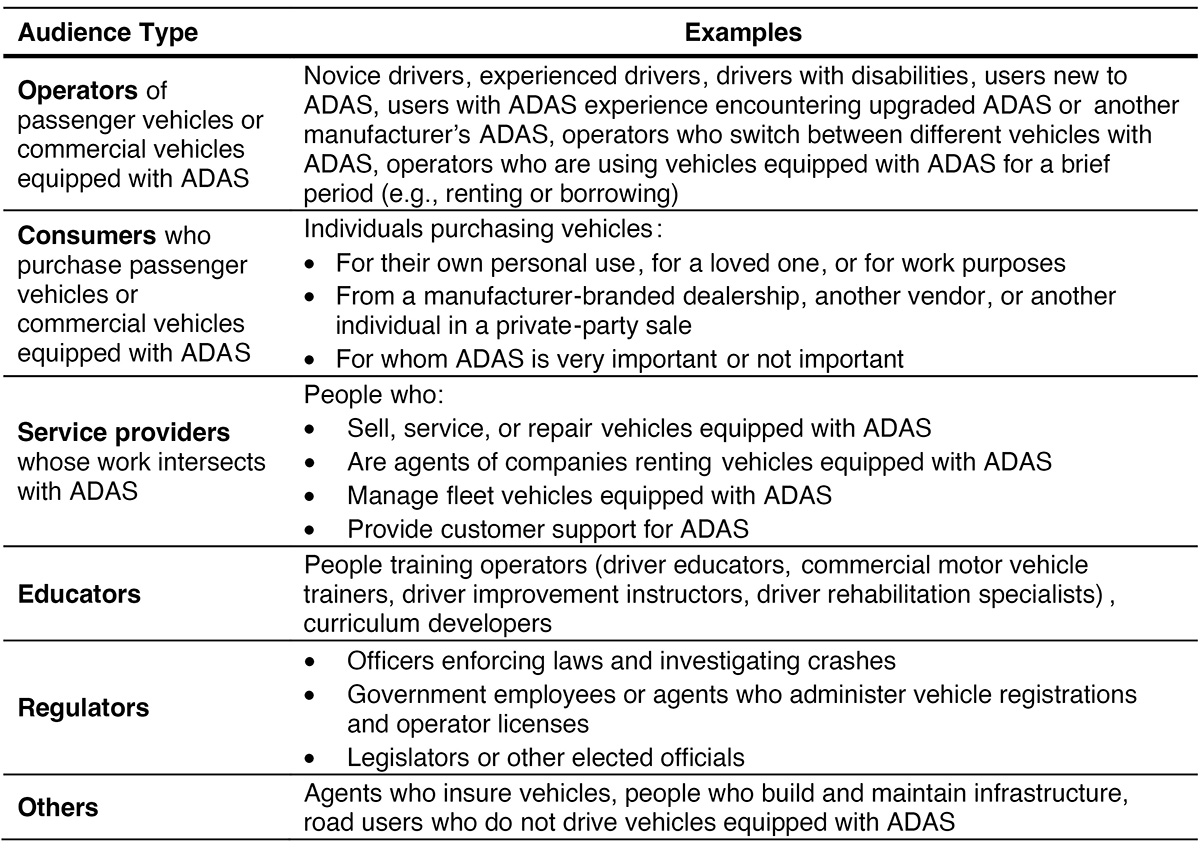
Many different populations could be an audience for ADAS education. Several categories are offered in Table 3. While drivers are an obvious audience, they are not a homogenous group. Vehicle operators vary by vehicle type (including passenger vehicles or commercial vehicles), driving experience, reason for driving, and experience with ADAS. Other potential audiences include consumers who are purchasing vehicles equipped with ADAS, service providers, educators, regulators, and more.
One dimension of defining an audience is specificity, or how narrowly or broadly the target audience is defined. Another dimension is how convenient it is to identify individuals who meet the desired audience criteria. In many cases it might be difficult to conveniently pinpoint members of the ideal audience, resulting in a trade-off between these two dimensions. For example, the ideal audience for an education effort might be people who are driving a new passenger vehicle that is equipped with an active driving assistance (ADA) feature. For the organization to directly identify
Long Description.
The table has 2 columns and 7 rows, including the column headers. The column headers in Row 1 are Audience Type and Examples. Row 2: Operators of passenger vehicles or commercial vehicles equipped with ADAS; Novice drivers, experienced drivers, drivers with disabilities, users new to ADAS, users with ADAS experience encountering upgraded ADAS or another manufacturerʼs ADAS, operators who switch between different vehicles with ADAS, operators who are using vehicles equipped with ADAS for a brief period such as renting or borrowing. Row 3: Consumers who purchase passenger vehicles or commercial vehicles equipped with ADAS; Individuals purchasing vehicles for their own personal use, for a loved one, or for work purposes; from a manufacturer-branded dealership, another vendor, or another individual in a private party sale; for whom ADAS is very important or not important. Row 4: Service providers whose work intersects with ADAS, People who sell, service, or repair vehicles equipped with ADAS; are agents of companies renting vehicles equipped with ADAS; manage fleet vehicles equipped with ADAS; provide customer support for ADAS. Row 5: Educators; People training operators such as driver educators, commercial motor vehicle trainers, driver improvement instructors, driver rehabilitation specialists, and curriculum developers. Row 6: Regulators; Officers enforcing laws and investigating crashes; Government employees or agents who administer vehicle registrations and operator licenses; Legislators or other elected officials. Row 7: Others; Agents who insure vehicles, people who build and maintain infrastructure, road users who do not drive vehicles equipped with ADAS.
individuals in this audience, it could obtain data for new vehicle registrations and cross-check those with information sources about which vehicle models and trim levels have ADA features. This method would identify the individuals who own the vehicles, which significantly overlaps with but is not exactly the same as the individuals who drive the vehicles.
Another consideration is the assumptions practitioners might be making (explicitly or implicitly) about the learners. In the earlier example, practitioners might instead propose letting drivers of new vehicles with ADA self-identify. That approach assumes that the drivers will know what ADA is and whether their vehicle is equipped with it.
Identify ADAS
Practitioners determine what types of ADAS will be featured in the materials and whether the learning objectives correspond to system-generic or system-specific information. For instance, if the learning objectives relate to learner awareness of driving control assistance features, the materials will likely include generic information about ACC and LCA. On the other hand, if the objective is to train a learner how to use ACC and LCA, procedural information and limitations from a specific vehicle would be needed.
When learning materials include driving control assistance features (i.e., ACC, LCA, and ADA), practitioners should take care not to portray these systems as safety systems. Most manufacturers describe these features as comfort or convenience systems, so learning materials should avoid associating these systems with learning objectives related to safety benefits of ADAS.
Finally, when learning materials include multiple ADAS, practitioners should be aware of the risk of learners confusing or conflating different systems. They may want to specify that the learning materials clearly differentiate the functions of the various systems.
Combined Audiences, Objectives, and ADAS
Some practitioners might be interested in identifying opportunities for providing education about ADAS to an audience that includes different types of operators, such as drivers of passenger vehicles and commercial or professional drivers. While these opportunities may exist, they are limited to providing education to achieve generic, high-level objectives, such as the following:
- Raising general awareness that ADAS exists and examples of types of ADAS present in both passenger vehicles and commercial motor vehicles
- Educating drivers that ADAS do not provide autonomous driving, and all drivers need to always pay attention
- Encouraging drivers to identify which technologies are on their vehicle and to learn how their ADAS work
However, many educational objectives would require targeting a specific audience of passenger vehicle drivers or commercial vehicle drivers, particularly education about how the technologies work and how the driver uses them. Sensor types, locations, and ranges and vehicle user interfaces are typically different on large commercial vehicles. For example, ACC in commercial vehicles generally allows longer following distances than ACC in passenger vehicles. The level of integration between ADAS features might be more transparent to the drivers of commercial vehicles than to drivers of most passenger vehicles. Objectives related to training drivers in the procedures and skills to use a vehicle-specific instance of ADAS restrict the target audience to drivers of that vehicle.
Checking Back
As practitioners complete this step, they verify that the identified objectives, target audience, and selected ADAS align with one another and with the organizationʼs motivations and aims. Do the stakeholders want or need the organization to review the purpose that has been defined? Are there early concerns about the ability to complete the effort using the identified resources?
Step 2: Develop the Plan
During this step, practitioners consider a range of factors to develop a plan for delivering ADAS education or training focused on the learning objectives to the target audience. In addition to deciding when and where the learning will occur, practitioners also consider how the learning materials can be selected or designed to promote learner engagement. While making these decisions, practitioners ensure that the approaches promote the organizationʼs motivations, are supported by the organizationʼs resources, and account for the organizationʼs internal processes and requirements.
When, Where, and How Learning Will Occur
Learners can interact with education or training materials in numerous ways. In this step, practitioners identify which methods of learning are suitable for the objectives and the audience. When the practitioners identified the target audience in Step 1, they might also have identified opportunities for the organization to connect or interact with that audience. In this step, practitioners complete a plan for when and where these touchpoints will occur. The decisions of when, where, and how the learners will access the learning materials are interrelated. Practitioners can begin the conversation in any area, address the areas in any order, and iterate among the areas as needed.
When Learning Will Occur
Practitioners should consider all the temporal aspects of the audienceʼs interaction with the learning materials. One aspect is how much time a typical learner is expected to spend interacting with the materials. This includes how much time is required to communicate information associated with the learning objectives and how much time most learners would be willing to dedicate to the learning activity. Consider whether the learner will be able to access all the content at one time or if it will be divided into different sessions or lessons. Would the learning experience be repeated at a regular interval (e.g., every year)? How long will the organizationʼs deployment of the learning opportunity last? What is the projected life cycle for this effort?
Where Learning Will Occur
Practitioners can brainstorm the available opportunities to interact with the identified audience of learners. Interactions can take place in person, online using a digital platform (e.g., a website or social media), through direct contact (e.g., a letter, email, or text sent directly to an individual), via traditional media (e.g., radio or TV), or through other means. Combinations of these are also possible. Identify the ways the organization already interacts with the potential audience members while conducting normal operations. For example, a state agency is in contact with citizens when they renew their driver licenses or motor vehicle registrations. Does the organization participate in community events like parades or fairs? Consider whether the touchpoint aligns with the temporal constraints mentioned earlier and the resources that would be required to facilitate each of the identified opportunities.
How Learning Will Occur
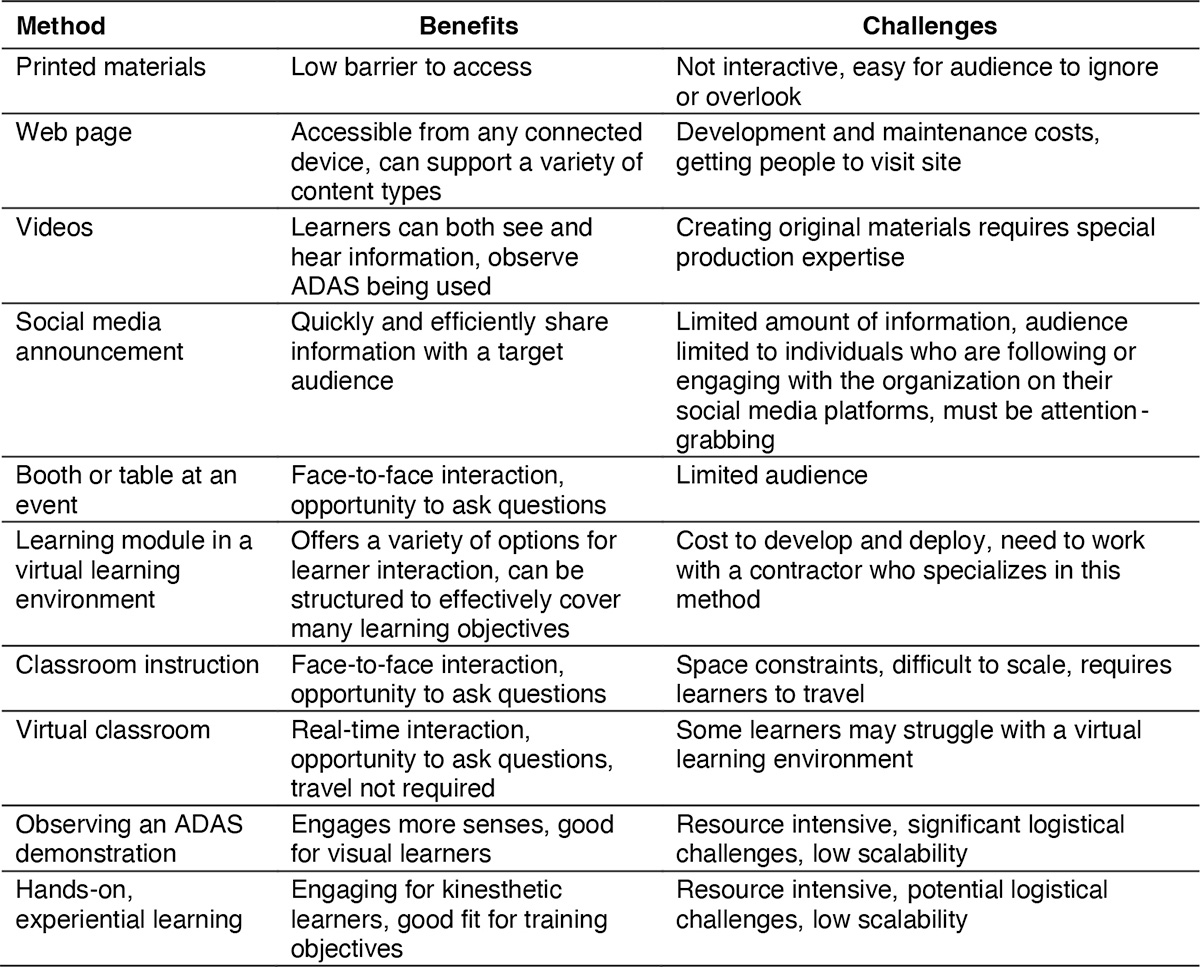
The method for learning needs to be compatible with the learning objectives, the audience, when and where the learning will happen, and the organizationʼs constraints. Table 4 lists some
Long Description.
The table has 3 columns and 11 rows. The column headers in Row 1 are Method, Benefits, Challenges. Row 2: Printed materials; Low barrier to access; Not interactive and easy for audience to ignore or overlook. Row 3: Web page; Accessible from any connected device and can support a variety of content types; Development and maintenance costs, getting people to visit site. Row 4: Videos; Learners can both see and hear information and observe ADAS being used; Creating original materials requires special production expertise. Row 5: Social media announcement; Quickly and efficiently share information with a target audience; Limited amount of information, audience limited to individuals who are following or engaging with the organization on their social media platforms, must be attention grabbing. Row 6: Booth or table at an event; Face to face interaction and opportunity to ask questions; Limited audience. Row 7: Learning module in a virtual learning environment; Offers a variety of options for learner interaction and can be structured to effectively cover many learning objectives; Cost to develop and deploy, need to work with a contractor who specializes in this method. Row 8: Classroom instruction; Face to face interaction and opportunity to ask questions; Space constraints, difficult to scale, requires learners to travel. Row 9: Virtual classroom; Real time interaction and opportunity to ask questions, travel not required; Some learners may struggle with a virtual learning environment. Row 10: Observing an ADAS demonstration; Engages more senses and good for visual learners; Resource intensive, significant logistical challenges, low scalability. Row 11: Hands on experiential learning; Engaging for kinesthetic learners and good fit for training objectives; Resource intensive, potential logistical challenges, low scalability.
methods an organization could use to share ADAS education or training with learners, along with a few of the many benefits and challenges.
Learner engagement is an important consideration. An effective learning experience needs to capture and maintain the learnerʼs attention. Passive learning, when the learner receives information through listening or reading, may not be very engaging or effective for many learners. Learning experiences that allow someone to engage in active learning through activities like quizzes, video vignettes, simulators, or games are more engaging. They also provide different types of learners, i.e., read/write, auditory, visual, and kinesthetic learners, options for interacting with the materials. Modalities that involve live interactions between an instructor and learners and among the learners, whether in a real or virtual environment, offer more engagement. When the learning objectives are related to training the learners to be proficient in certain skills or abilities, hands-on experiences are essential and might be accompanied by other learning activities, like reading or viewing instructional materials. Incentives or gamification are other strategies that can promote engagement. Providing learners with the opportunity to apply their new knowledge through a quiz or a problem-solving exercise can help to solidify their learning.
Practitioners should consider whether or how the learning experience may be modified for learners with different abilities (e.g., low vision or hearing loss). Consult with others in the organization or in other organizations to learn which adaptations are currently in place for these individuals.
Practitioners may also consider whether it is necessary or useful to track the progress of individual learners or to track learnersʼ engagement with materials (e.g., using website metrics or class registrations). The organization might have identified metrics like these as measurable outcomes for the ADAS education or training effort.
Another consideration is scalability. If the number of learners increases, can the learning effort be scaled accordingly? An approach that requires an instructor or specific equipment or requires learners to be in a specific location will be able to serve only a limited number of learners.
If the ADAS learning materials will be available to an audience without direct interaction with an instructor, such as to the general public, practitioners should consider in advance what might happen if the learners have questions. Some options are referring the learners to other resources, enabling comments on a web page, or setting up a contact form to field questions. These options should be implemented only if someone from the organization will be monitoring and responding to the communications.
Consideration of the Organizationʼs Requirements
When practitioners are formulating the plan for when, where, and how the learning will occur, they also need to consider how the plan relates to the remaining steps in the process, the overall timeline, and the constraints for the effort. This includes the personnel and other resources required to create the learning materials and to support the dissemination of the materials. Practitioners may need to gather additional information from the organization, the content creation team, or others to finalize the overall plan.
One component of this is identifying what type of content creation team is needed to create the learning materials. Does the organization have those resources internally? Do those individuals have availability? Will the organization need to contract with an external provider? The practitioners need to obtain an estimate of how much time is needed for material creation (i.e., Step 6). Additionally, they may want to clarify whether the content creation team has an existing process for soliciting the specifications for their projects.
Practitioners may consider options for obtaining feedback from representatives from the audience of learners before the learning materials are widely disseminated. This may occur
during Step 7 or potentially earlier. Options include inviting learners to join the stakeholder group, conducting focus groups to assess their needs, or planning a trial rollout to get learner feedback. Practitioners also should determine who will be responsible for obtaining the feedback and how much time they will need.
Does the organization have internal processes or required reviews (e.g., by leadership or risk management) that need to be incorporated into the project timeline? If so, time will need to be allowed for reviews and potential modifications.
Practitioners also need to think ahead about the time and costs associated with disseminating the learning materials. These might include identifying and training instructors, initiating support contracts for online learning modules, maintaining websites, fielding questions submitted by learners from an online web form, or coordinating the distribution of hard-copy materials. The plan to disseminate learning materials also needs to address how the learners, people within the organization, and others will be informed about the learning opportunity and how to access it.
Checking Back
As practitioners wrap up Step 2, they verify that the plan for the learning materials aligns with the identified audience and learning objectives and has stayed true to the organizationʼs motivations and aims. They also consider whether the stakeholder group would benefit by adding representation from any other areas. Finally, this may be an opportune time to brief the organizationʼs leadership on the plan and get their feedback.
Step 3: Identify Sources of ADAS Information
During this step, practitioners conduct a search to identify a set of ADAS information sources that support the purpose and plan they defined in Steps 1 and 2. The practitioners clarify what types of content are needed for the learning materials and create a plan for where and how to conduct the search, including which stakeholders will perform which tasks and how they will document their actions. The search can include web searches, ownerʼs manuals, and direct contacts. After the search is complete, practitioners select the identified sources that will be characterized in Step 4.
Establish Content Needs for the Learning Materials
Before performing a search, the practitioners consider what types of content are needed for the planned learning materials. These needs are informed by the learning objectives, the selected ADAS, and the plan for the learning materials.
Practitioners consider the learning objectives to identify what types of content are needed (i.e., purpose, function, ODD, procedures, limitations, and responsibility) for the selected ADAS. For example, if one of the objectives is for the learners to understand how a given ADAS works, the practitioners need to identify sources that describe the function of that ADAS. Some learning objectives might need to identify multiple types of content. For example, if the materials will educate the learners about when it is appropriate to use the selected ADAS, the practitioners will need to identify content related to the ODD and the limitations. If the learning objectives concern a vehicle-specific instance of ADAS, sources with content for that specific instance (e.g., materials provided by the manufacturer) should be prioritized over sources with generic information for the ADAS.
The content needs are also informed by the plan for the learning materials. If practitioners are looking for ADAS information sources that can be used in their current state, they will need to
consider the information source as a whole. How well does the resource in its entirety fit with the identified learning objectives, the target audience, and the selected ADAS? Alternatively, if the practitioners intend to synthesize information from various sources to create new learning materials, they can consider individual components from the various sources. These components can include media types (e.g., images, diagrams, or videos), activities that promote learner engagement, items to include in quizzes to test the learnerʼs knowledge, and frequently asked questions (FAQ).
Define the Search Plan
Practitioners discuss how to conduct the search, including what types of organizations to include, how many information sources need to be identified, search methods and assignments, and how search activities will be documented.
Organizations
The stakeholders discuss and identify the organizations to include in the search. These organizations might include governmental agencies, standards groups, manufacturers, and organizations for driving safety, education, research, and advocacy. Practitioners can consider how the various external organizationsʼ missions and audiences align with their organizationʼs aims, learning objectives, and target audience. For example, if the target audience is novice drivers, it may be useful to search for materials from organizations connected to driver education. If the education or training concerns ADAS on a specific vehicle, materials from the manufacturer will be essential. However, practitioners should be mindful when considering information sources that may have been created primarily for marketing. Practitioners can also discuss whether the group is willing to review international sources.
Number of Sources
Another consideration is how many sources are desired to characterize for each learning objective (Step 4). For practitioner teams who are looking for information sources to synthesize into new materials, the number of sources should be enough to allow a variety of options to review while also aligning to the scope and constraints of the project. If practitioners are looking to use existing materials, the number they decide to review will largely be determined by the resource constraints. If the practitioners conducting the search have low or moderate levels of ADAS expertise, it may be beneficial to review more sources to solidify their understanding of the selected ADAS.
Search Methods
Practitioners identify which methods will be used to perform the search and which stakeholder or stakeholders will conduct the search. In addition to web searches, methods could include reading ownerʼs manuals or directly contacting individuals or organizations (as described below). If general content is needed, it may be useful to start the search with the Resource Identification Tool (as described in the next section and in Appendix C). If content for a vehicle-specific instance of ADAS is needed, the search could include ownerʼs manuals, the vehicle manufacturerʼs web page or YouTube channel, or contact with a dealership.
Practitioners can consider whether the ADAS expert will conduct the search independently or if other stakeholders will be involved. In cases where time is limited or the practitioners want to conduct a more comprehensive search, it might make sense to strategically divide search assignments across different stakeholders according to their areas of expertise and professional contacts. Since different search engines will yield different results from the same prompt, it is recommended that the practitioners discuss which search engine or engines and search terms to use.
Documenting the Search
While performing the search, it is good practice to document how the search is done and what is found, including records for sources that do not have helpful information. Keeping good records can prevent duplication of effort. Important details to record include source name (i.e., name of the website, document, or individual), hyperlink or location, organization name, year the resource was created or last updated, how the resource was found (i.e., search terms entered, reference from another source, direct contact, etc.), the ADAS included in the resource, and notes about how the content in the source fits the content needs identified by the stakeholder team. The ADAS Information Source Tracker (Appendix B) is a spreadsheet template that practitioners can modify to fit their search tracking needs by adding columns to capture the types of needed content.
Search for Information Sources
Practitioners perform the search to identify information sources that contribute content to address the needs they have identified. This section describes how to use the Resource Identification Tool and provides strategies for performing online searches for ADAS information, and guidance for finding and reviewing videos and ownerʼs manuals and directly contacting individuals.
Using the Resource Identification Tool
In some cases, practitioners might decide to start the search using the Resource Identification Tool described in Appendix C. The tool is a filterable spreadsheet that summarizes the ADAS educational materials that the research team identified and reviewed while conducting a targeted organizational search in 2023 during Phase I of this project. The recorded characteristics include the organization, organization type, URL, audience type, ADAS type, type of content (i.e., purpose, function, ODD, limitations, procedures, and user responsibilities), and media options (i.e., image, animation, video). The resources in the tool present generic ADAS information. The tool does not include sources of information for vehicle- and manufacturer-specific ADAS.
Strategies for Online Searches
The names and terms used for ADAS collectively and for individual types of ADAS are not standardized and can vary widely. Conducting a simple search for “ADAS” or “Advanced Driver Assistance Systems” could miss sources that refer to these technologies with different terms, such as driver assist, advanced safety technology (or systems), driving aid, driving support, tech features for safer driving, driver safety, and vehicle safety features. Similarly, each ADAS included in this project was observed to have many different names, some of which are listed in Appendix A. When searching for information related to a specific ADAS, in addition to the common name, try to include some of the other terms that appear in the observed system names. For example, add “radar” to the search terms for “adaptive cruise control.” Search terms may have to be modified multiple times to achieve acceptable results. Documenting the terms that have been attempted is useful.
If practitioners want to search for ADAS-related content within a specific organization, they can add the name of the organization to their search terms. They can also visit the website for that organization and perform a search within the site. Exploring the organizationʼs website can also be useful because some organizations or agencies include ADAS-related content within materials associated with CAV.
If manufacturer-specific materials are desired, try using search terms like “safety,” “assist,” or “technology” because manufacturersʼ web pages may use unique names for their ADAS.
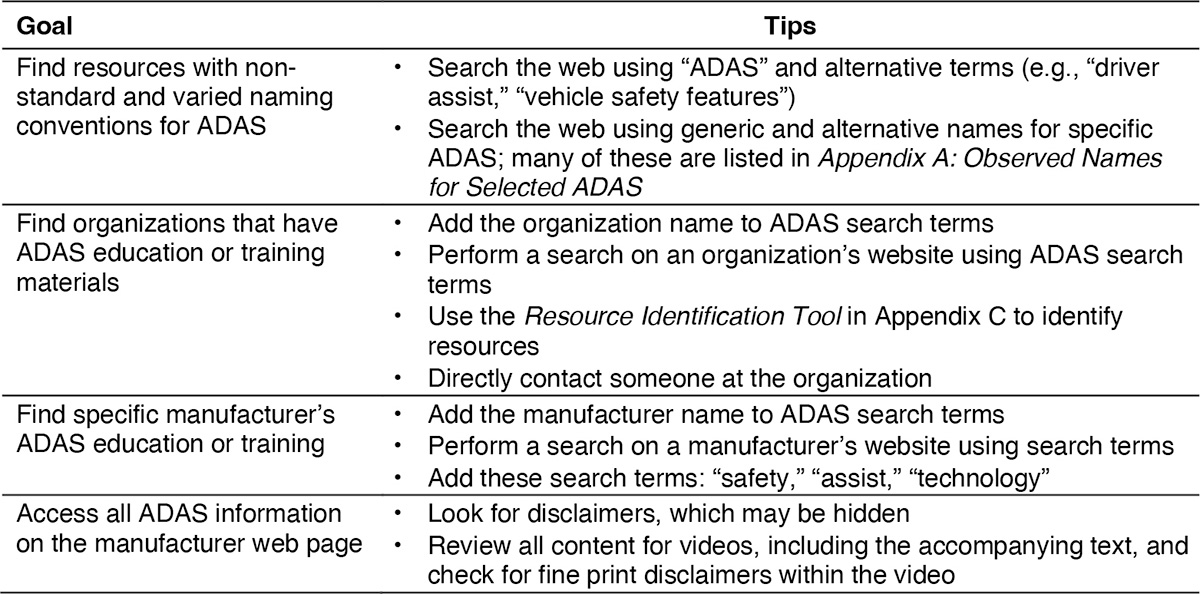
Manufacturers may also combine multiple features and describe them under umbrella terms. In addition, manufacturers may provide information for multiple versions of their ADAS packages, so be aware of which years, models, and systems are included in the package being reviewed. For some audiences (e.g., operators transitioning to newer models), being aware of how the technology has evolved over time may be beneficial to understanding. Manufacturersʼ web pages commonly include disclaimers in text and videos that may require additional clicks to display or be in small print. The disclaimers often emphasize driver responsibilities. Table 5 summarizes the online search task and provides tips on how to accomplish each task.
Searching for Videos
Searching for and identifying videos that meet the identified content needs requires some additional considerations, including the credentials of the person or organization who created the video, where the video was created, and when it was created. Another strategy would be to identify reputable organizations that have YouTube channels (i.e., search in YouTube using the name of the organization to find the channel) and then review the titles and descriptions of the videos available from that organization or search within their channel using ADAS-related search terms.
YouTube channels for a specific manufacturer or dealership can be beneficial for objectives that are for vehicle-specific instances of ADAS. These channels may include “how-to” videos about using specific ADAS or changing settings.
If conducting a direct search in YouTube, practitioners should be aware that video titles may be designed to get viewers to click on them rather than being an accurate representation of the content of the video. Search results are likely to include videos created in other countries with vehicle models and driving conventions that may not apply to the practitionersʼ jurisdiction. One advantage of YouTube is that it clearly indicates how long ago a video was uploaded.
Watching videos in their entirety can be time-consuming and may not be necessary to determine whether they contain content that is relevant to the learning objectives. To expedite the review of a video, practitioners can read the text description of the video, review a transcript of the videoʼs audio, examine video chapter titles (if the video has them), and view only portions of the video. In the search documentation, they should describe the potentially relevant content and note the timestamp in the video where it appears. Table 6 summarizes tips for finding and reviewing videos for source selection.
Long Description.
The table has 2 columns and 5 rows, including the column headers. The column headers in Row 1 are Goal and Tips. Row 2: Find resources with non standard and varied naming conventions for ADAS; Search the web using ADAS and alternative terms such as driver assist and vehicle safety features; Search the web using generic and alternative names for specific ADAS, many of which are listed in Appendix A Observed Names for Selected ADAS. Row 3: Find organizations that have ADAS education or training materials; Add the organization name to ADAS search terms; Perform a search on an organizationʼs website using ADAS search terms; Use the Resource Identification Tool in Appendix C to identify resources; Directly contact someone at the organization. Row 4: Find specific manufacturerʼs ADAS education or training; Add the manufacturer name to ADAS search terms; Perform a search on a manufacturerʼs website using search terms; Add search terms such as safety, assist, technology. Row 5: Access all ADAS information on the manufacturer web page; Look for disclaimers, which may be hidden; Review all content for videos, including the accompanying text, and check for fine print disclaimers within the video.
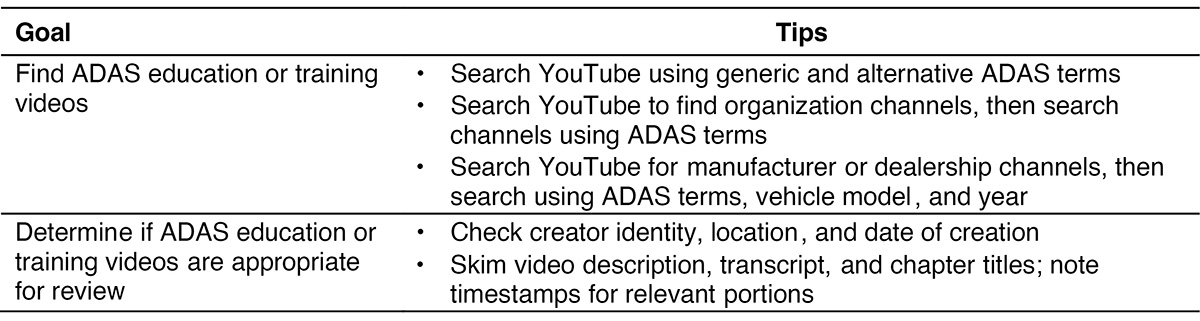
Long Description.
The table has 2 columns and 3 rows, including column headers. The column headers in Row 1 are Goal and Tips. Row 2: Find ADAS education or training videos; Search YouTube using generic and alternative ADAS terms; Search YouTube to find organization channels, then search channels using ADAS terms; Search YouTube for manufacturer or dealership channels, then search using ADAS terms, vehicle model, and year. Row 3: Determine if ADAS education or training videos are appropriate for review; Check creator identity, location, and date of creation; Skim video description, transcript, and chapter titles; Note timestamps for relevant portions.
Reviewing Vehicle Ownerʼs Manuals
Vehicle ownerʼs manuals can sometimes be found electronically on the web or by searching a website that offers vehicle manuals. Sometimes manuals can be obtained from the manufacturer only by providing a vehicle identification number (VIN). Identifying and understanding the ADAS-related content in an ownerʼs manual comes with its own challenges. Deciphering what keywords to look for in a manual can be tricky because manufacturersʼ names for ADAS features vary widely (as shown by the observed ADAS names provided in Appendix A). Searching for simple, single words like “assist,” “support,” “safety,” or “cruise” may be helpful. Where ADAS information is described in the ownerʼs manual also varies widely. The ADAS content may be in one section, spread across multiple sections, or presented in a separate ADAS manual. Manuals often describe all the systems available on any trim level in the model. If the system is not available on every trim level, the description may include a phrase like “if equipped,” and none of the manuals reviewed by the research team provided information about which trim levels included which feature or features as standard or optional equipment.
Manuals also vary widely in their formatting, presentation, and understandability. Important content may be highlighted in bold text, different colors, or in callouts with labels like “Warning,” “Note,” or “Information.” Manuals may include complex legal or technical terms, which can be difficult for some readers to understand. Table 7 provides tips for searching for information in vehicle ownerʼs manuals.
Contacting Organizations or Individuals
Another method for locating educational materials is to directly contact state or federal agencies, research entities, standards groups, safety advocacy groups, or similar organizations, and vehicle dealerships. For an initial contact by email, it may be useful for the practitioner to share
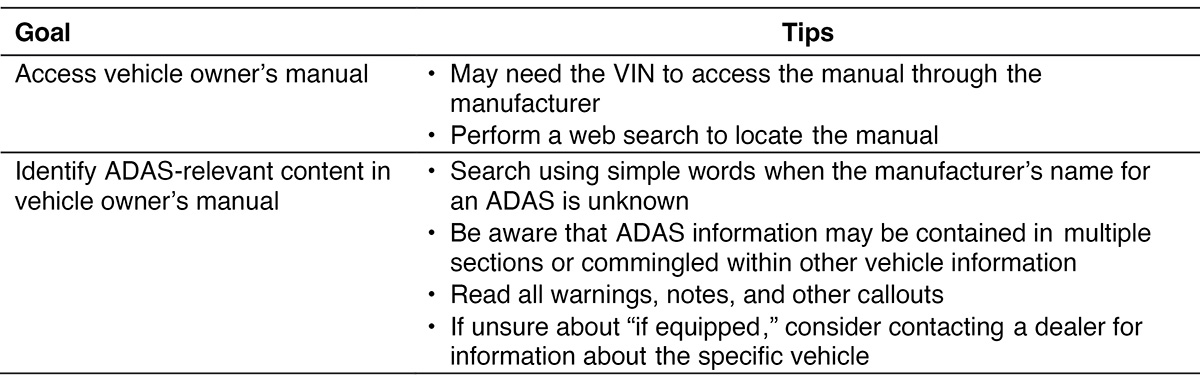
Long Description.
The table has 2 columns and 3 rows, including column headers. The column headers in row 1 are Goal and Tips. Row 2: Access vehicle ownerʼs manual; May need the VIN to access the manual through the manufacturer; Perform a web search to locate the manual. Row 3: Identify ADAS relevant content in vehicle ownerʼs manual; Search using simple words when the manufacturerʼs name for an ADAS is unknown; Be aware that ADAS information may be contained in multiple sections or commingled within other vehicle information; Read all warnings, notes, and other callouts; If unsure about if equipped, consider contacting a dealer for information about the specific vehicle.
who they are, what they are doing, and the request for assistance concisely in the first paragraph, and then follow up with additional details. The practitioner can also request a referral to the most appropriate individual in the organization. The Resource Identification Tool in Appendix C can help practitioners identify types of organizations to contact. Consider the opportunity to reach out to personal contacts of the stakeholder group or of others within the organization. These individuals may be able to help directly or provide a connection to someone else who is willing to help.
Vehicle dealerships may be able to assist practitioners by identifying which ADAS are on a vehicle, sharing educational materials, or providing demonstrations of how various ADAS work. As observed during the review phase of this project, different brands take different approaches to educating their sales staff and to teaching customers about ADAS. Some may offer hands-on demonstrations; others might refer customers to the manual, in-vehicle displays, or online information. Dealership staff may be restricted from sharing proprietary materials or ADAS information with the public rather than prospective customers.
Selection of Information Sources
After conducting the search, practitioners determine which information sources appear to be most promising for addressing the content needs that have been identified. In some cases, the ADAS expert might make this determination independently. However, if the search for information sources was distributed across stakeholders, they may need to meet and decide collectively which sources to prioritize.
Checking Back
If sufficient sources of information have not been identified for all the needed content, stakeholders may expand the search efforts or consider making modifications to the learning objectives or the methods for the learning materials.
Step 4: Characterize Materials
During Step 4, the designated practitioner (typically the individual serving as the ADAS expert) reviews the materials from the sources identified in Step 3 and extracts information related to each learning objective, makes general observations about the materials, identifies opportunities for confusion (i.e., information that is potentially inaccurate or unclear), and creates a summary about the content to facilitate the stakeholder discussion in Step 5. The reviewer organizes and documents this information to keep objectives and source materials in one place.
Review Process
This section describes a method practitioners can use to review the materials and identify content relevant to the objectives outlined in Step 1, the methods of learning identified in Step 2, and the content needs identified in Step 3. The process of characterizing the materials consists of multiple rounds of review across the information sources. This approach increases the reviewerʼs familiarity and understanding of the materials and helps the reviewer identify similarities and differences for content from the selected sources. The following method uses the Content Organization Tool (see Appendix D), which represents one approach for review and organization that practitioners can modify for their needs. Of course, practitioners can review materials in whichever ways work best for them.
First, the reviewer documents the objectives, material needs, source names, and hyperlinks, if applicable, within the Content Organization Tool. They then conduct an initial review of the individual sources using the following steps:
- Open each source and document the creation/update year in the appropriate column.
- Review the text content (or for a video source, review the transcript if available) in the source. Add a short description for any images, animations, and videos, and note general first impressions of the source. These initial observations may include likes and dislikes, usability, organization of content (heading or tab names), and so forth.
- If the source is posted online and has comments associated with it, consider skimming through them, as this might yield insights relevant to the target audience.
- Conduct this initial review for each source of information.
Next, the reviewer re-examines individual sources to identify text content that aligns with each learning objective using the following steps:
- Copy text content from the original source and paste it into the row of the “Text content” column associated with that source for the relevant objective. Some practitioners may prefer to copy all the text from a source into a document file to manipulate it (e.g., using highlighting, different font colors, bolding) and then copy the text content that is relevant for each objective into the organization tool.
- Document whether the media content in the source contributes information that is relevant to any of the objectives and note general observations.
- Identify materials containing opportunities for confusion (see the next section and Appendix E) and note those in the “Text content” column of the tool through font formatting (e.g., changing the font color to red).
- Complete this second review for each source of information.
During the third round of review, the reviewer verifies that the entered text aligns with each objective and identifies content that may be especially useful for addressing that objective. The reviewer also carefully examines the materials for any remaining opportunities for confusion and documents those in the appropriate column in the organizer.
Finally, the reviewer collectively reviews the sources for each objective and prepares a summary documenting the findings. This summary should include common themes, wording preferences, possible images or videos for the materials, and questions for the group. It serves as a guide for the discussion in Step 5. The reviewer might decide to share their summary and links to the sources with the stakeholder group and ask them to review those before the meeting.
Identifying Opportunities for Confusion
As summarized in Chapter 1 of this guide, the research team noted numerous potential inaccuracies when it reviewed ADAS educational materials. Most were related to the use of ambiguous or inconsistent language rather than information that was strictly inaccurate. Therefore, the researchers labeled these concerns as “opportunities for confusion” and organized them into four general categories. Not every opportunity for confusion fit neatly into a category, and some could be associated with more than one category. Each of the four categories is briefly explained below. The Aid for Identifying Opportunities for Confusion in Appendix E presents additional examples with explanations, along with a checklist for reviewing visual content.
During their review of materials from the information sources, practitioners should be thorough and document anything that raises a concern. Although the reviewer checks each source for opportunities for confusion, all the stakeholders should be on the lookout for them as the group discusses and determines the content of the learning materials during Step 5.
Ambiguous Content
Ambiguous content refers to language (in text or narration) that is vague or subjective (e.g., “safe,” “object,” “highway speeds”), explicitly states or implies an absolute (e.g., “will brake to avoid a collision”), includes jargon or is highly technical (e.g., “telltale”), or uses idioms (e.g., “guardian angel”). Content may also become ambiguous or unclear when multiple ADAS are presented together in materials (e.g., describing both FCW and AEB together as collision prevention) because it can be difficult to decipher which information is relevant for which ADAS.
Inaccurate Content
Inaccurate content may be the most difficult to identify because no standard information is available for each ADAS. The expert may need to have a high level of understanding for the ADAS to be able to identify potentially inaccurate content. Comparing and contrasting information from different sources during Step 4 may be one way to identify content that might not be accurate. Visual media can also contain inaccurate content (e.g., diagrams that illustrate sensor ranges that are much shorter or wider than the actual range covered). Although identifying ADAS inaccuracies can be difficult, identifying driving-related inaccuracies can be easier. For example, when viewing an image, verify that the lane markings are depicted accurately and that vehicles are traveling in the correct direction.
Inconsistent Content
Content that is inconsistent presents different messages within one source or across multiples sources for the same organization. Content of this type may be identified when a source uses different verbs, uses the same icon to illustrate multiple ADAS, or when text or narration do not align with the information shown in images or videos.
Lack of Context
Lack of context refers to situations where materials have content that is missing explanatory information, like materials that include images or animations without any captions or other text to explain them. Another example is materials containing statements that are not explained or supported, like stating that an ADAS may not always work without providing any context as to when or why it might not work.
Checking Back
After completing Step 4, practitioners should consider whether the materials that have been characterized are sufficient to address the content needs for the objectives and method or methods of learning. If not, practitioners might need to go back to Step 3 to identify additional sources, revisit Step 2 to adjust their plan for learning materials, or revise the learning objectives from Step 1.
Step 5: Evaluate and Synthesize Materials
The reviewer presents the summary from Step 4 and discusses the findings with the other stakeholders. The group discusses the content found for each objective and decides how to synthesize it for the learning materials. Then the stakeholders provide the specifications for the learning materials to the content creation team. If the stakeholder group does not include a member of the content creation team, one of the stakeholders should contact the content creation team before the meeting to discuss the specifications that the creation team will need to develop the materials.
Discussion of Reviewerʼs Summary
As a group, the stakeholders discuss the summary created by the practitioner who characterized the ADAS materials. The reviewer presents an overview of their work and their general observations of each source. The other stakeholders contribute their observations and ask the reviewer questions.
Evaluation of Text Content
The stakeholders review the text content identified by the reviewer for each learning objective. The reviewer highlights the findings, including the content that was consistent across the information sources. The group considers the following questions to evaluate whether the content is sufficient to address each learning objective and the plan for learning materials identified in earlier steps:
- Is the content aligned with this learning objective? For example, an objective related to what an ADAS does (i.e., its purpose) does not need procedural content that describes how a driver turns it on or off.
- Does the content have the appropriate level of detail to address the objective and meet the content needs for the learning method?
- Is the content appropriate for the target audience?
- Does the content include any opportunities for confusion and if so, how can they be remedied?
Together, the stakeholders select the text content to associate with each learning objective. If practitioners decide to use the exact language from a source, they must get permission to use the material and give proper attribution. After all the objectives have been addressed, practitioners are encouraged to conduct another review to ensure consistency of language and terms across objectives and to identify areas where the same content might be related to multiple objectives.
Evaluation of Media Content
Images, animations, or videos may also be discussed when the group evaluates the text content. However, the use of media should be decided after the text content has been selected. When evaluating whether to include media, the group can consider the same questions as when they evaluated the text content. In addition, they can consider the following:
- Would including visual media help promote learner understanding for this objective?
- Will the organization need to get permission from the copyright holder to use the media?
- Is modifying or recreating the media an option?
To improve clarity, animations and images should be paired with text or narration that provides context. One primary benefit of a video is that it may align with multiple objectives. Practitioners should keep in mind that materials from another country may show drivers on the opposite side of the roadway and that pavement markings and road signs may also differ.
Documenting Specifications for the Content Creation Team
The stakeholders and the content creation team work together to determine the specifications for the educational materials. A timeline for the initial and final drafts of each material, a point of contact for questions, and any additional guidelines, such as aligning materials with the organizationʼs branding and legal concerns, should also be included. Stakeholders should also advise the content creation team of any content that needs to be attributed to its source. When using media from an original source, make a plan with the content creation team to seek approval from the copyright owner to reuse the media. Consider making a secondary plan if reuse is not permitted.
If the team is using YouTube videos and the video creators have enabled sharing, the videos can be embedded in another site or a playlist.
Stakeholders provide the content creation team with a summary of the effortʼs aims, including a description of the target audience and the learning objectives. This can help the content creation team develop materials that are user-friendly, engaging, and relevant to the target audience. The practitioners should decide whether the learning objectives will be explicitly stated in the learning materials. When developing digital learning materials that will be available online, stakeholders should work with the content creation team to identify analytics to track visitor behavior and website performance. Finally, they should decide whether the content creation team will be involved in the advertising or promotion of the learning materials when they are disseminated.
If the content creation team will be creating images, the stakeholders should provide a detailed description of what is needed and with which objective or objectives it is associated. If available, provide the content creation team with some examples that are similar to the desired media. Practitioners may consider detailing the number of lanes on a road, lane marking types and colors, vehicle types and positions, scaling for objects in the image, and ADAS specifications (e.g., sensor range, speeds, icons). Stakeholders should also specify any additional text to accompany media content.
If the materials will include a link to another source, the specifications should detail what type of link (i.e., printed URL, hyperlink with alternate text, or QR code) is needed. Be aware that the process of creating new materials can be challenging and may require multiple design iterations to achieve the desired outcome.
Step 6: Draft Materials
During Step 6, the content creation team designs materials that meet the requirements identified in the previous steps. The drafting of materials should include several iterations of review by the ADAS expert and other stakeholders. Some teams may decide to obtain and incorporate feedback (Step 7) before materials are fully drafted.
The practitionersʼ organization may desire or be required to create materials that are accessible by learners of different abilities (e.g., individuals with low vision). Practitioners can seek sources of guidance or design tools for creating accessible materials (e.g., University of Pittsburgh, n.d.; University of Oxford, n.d.). The reading level of the text should be evaluated for understandability by the target audience. A general rule is to design material for the US median literacy rate, which is an 8th grade reading level.
Step 7: Solicit Feedback
Before disseminating the materials, practitioners may choose to solicit feedback from representatives of the target audience or others within and outside the organization so it can be integrated into the materials. Ideally, the stakeholders will have decided earlier in the effort whether to include this step and have a plan for how to do it.
Approaches for gathering feedback on the learning materials can include the following:
- Semi-structured interviews or focus groups – Meeting with members of the target audience to review the learning materials may offer insights about the content, layout, or understandability of the material.
- Surveys – A survey can be completed via pencil and paper or electronically using a QR code or hyperlink. A website, subscriber list, stakeholder group, or social media page may be an outlet for the survey.
- Pilot tests – Stakeholders can use pilot testing to evaluate the effects of the material on the intended objective. A survey can be hosted on a crowdsourcing platform such as Amazon Mechanical Turk, Prolific, or Qualtrics to gather suggestions, assess face validity, or test the effects of the materials on driversʼ understanding, perceptions, or attitudes about ADAS.
- Written feedback – Practitioners could share material within their networks to gather written feedback, markups, and suggested edits.
Time and resource constraints may affect practitionersʼ ability to gather and integrate feedback. They should ensure there is adequate time to gather, review, and integrate the feedback.
Step 8: Disseminate Materials
During this step, practitioners execute the dissemination plan that was developed over the course of the effort. This can include advising people within the organization about the effort, training staff who will support the effort, and promoting the learning opportunity to the target audience. Some organizations may decide to disseminate materials in phases to ensure the individuals and the systems supporting the dissemination are prepared and any unforeseen issues can be addressed early.
After deploying the learning materials, practitioners should monitor learnersʼ interactions with the materials and track engagement. This could entail the number of people or time spent accessing online material, the number of learners who participate in in-person or virtual classes, the number who share the learning opportunity on social media, and so forth. Practitioners may want to collect feedback or other information directly from the learners to evaluate the effortʼs outcomes, for example, by giving quizzes to measure learning or intention to take certain actions. If the learning materials allow students to ask questions, be sure personnel are monitoring those communication channels and responding in a timely manner. If offering incentives to learners, practitioners should ensure they are administered properly and promptly. Practitioners who are monitoring learner engagement should provide periodic updates to the stakeholder group and others in the organization.
If the learning opportunity is being promoted in a new way (e.g., a social media campaign) or to a new audience, practitioners should communicate this to everyone on the team so those who are monitoring or interacting with learners are prepared to field the surge in interactions that might result.
If the learning opportunity is limited by the number of instructors or locations, consider planning when additional instructors or sites will be added to the effort (e.g., when wait lists are at a certain percent relative to available slots).
Depending on the expected duration of the learning effort, materials may need to be reviewed and updated to account for advancements to technology, changes to standards, or other unanticipated events. Practitioners should plan for who will review the materials, how they will review them, and how often they will conduct reviews.


