Preparing the Transportation Workforce for Emerging Technologies: Developing a Guide (2026)
Chapter: Appendix A: Implementation Plan
Appendix A: Implementation Plan
Introduction
The National Cooperative Highway Research Program (NCHRP) 20-102 program was established in 2015 to explore the impacts of connected and automated vehicles (CAVs) on state and local transportation networks. The objectives of this program are centered around understanding the transformational changes CAVs and other transformative technologies will have on infrastructure owners and operators (IOOs), identifying critical issues, researching those issues to identify solutions, and conducting technology transfer to ensure the transportation industry remains up-to-date as the landscape of driving and infrastructure needs change.
Research Deliverables
In response to these transformations in technology, there is a need for evolutions in the transportation industry workforce to plan for, design, operate, and maintain transportation infrastructure. The purpose of the project, NCHRP 20-102(20), was to develop resources that provide strategies for transportation agencies to adapt their workforce in response to emerging technologies and trends. The project’s research deliverables provide insights into the current state of the workforce (as of 2024) and resources intended to support transportation agencies and education partners better navigate current and future transformations.
The project’s three primary deliverables are described below:
- NCHRP 102-20(20) A Guide to Preparing the Transportation Workforce for Emerging Technologies: The guide is a comprehensive and practical guide providing short-term and long-term strategies enabling transportation agencies to develop a workforce proficient in planning, designing, operating, and maintaining the next generation of transportation systems. The intended audience includes agency staff (all levels) and education partners (K-12, trade, community college, university, dedicated workforce programs) seeking strategies for preparing the workforce for emerging technologies.
- NCHRP 102-20(20) Preparing the Transportation Workforce for Emerging Technologies Final Report: The final report details the full research process including literature review, stakeholder outreach, workforce gap analysis, and the method for developing the guide. The intended audience includes peer researchers, agency staff, and education partners looking to build on the findings uncovered during this project.
- NCHRP 102-20(20) Preparing the Transportation Workforce for the Deployment of Emerging Technologies Final Presentation: The final presentation synthesizes the research process and guide into a clear and concise manner. The intended audience includes agency staff, education partners, and peer research partners interested in a high-level overview of the project and its outcomes.
Implementation Plan
To support the effective dissemination and sustained use of the NCHRP 20-102(20) project deliverables, this memorandum presents a set of implementation strategies organized by immediate, short-term, and long-term timelines. The strategies include a combination of targeted outreach, participation in industry events, and refined deliverable formats. Each strategy is tailored to meet stakeholders where they are—leveraging trusted platforms, familiar communication channels, and professional networks to maximize impact. These strategies are designed to promote awareness, encourage adoption, and increase long-term application of the project’s outcomes.
The following sections provide detailed descriptions of each proposed implementation strategy, including intended audiences, delivery methods, and opportunities for collaboration.
Proposed Strategies
A key element of successful implementation is the clear identification of roles and responsibilities for each activity. While it is assumed that NCHRP staff will lead or coordinate implementation efforts—potentially through a separately-funded implementation project—many strategies also rely on collaboration with transportation agencies, academic institutions, and professional organizations. As influential practitioners in the industry, the NCHRP 20-102(20) project panel is well positioned to support these implementation strategies.
The project team intentionally introduces a wide variety of options for NCHRP and Panel consideration with the understanding that not all implementation strategies need to be conducted to achieve successful advancement of the project’s findings. As a result, this memorandum presents a menu of implementation and dissemination strategies spanning a range of timeframes and formats, from immediate outreach efforts—like email blasts and social media engagement—to long-term initiatives—such as curriculum integration and periodic guide updates. Each implementation strategy is designed to be practical, scalable, and responsive to the evolving needs of the transportation workforce.
A summary of proposed strategies is provided in Table A-1, organized by recommended timeline following the project’s completion (immediate, short-term, long-term).
The following sections offer detailed descriptions of each strategy, including intended audiences, delivery methods, and opportunities for stakeholder involvement. The target audience in the strategy description can help to inform content, voice, and dissemination strategies. Relative investments associated with each implementation strategy are denoted by dollar sign icons $, $$, or $$$ to visually indicate the estimated amount of time, resources, and/or staff needed to execute the strategy.
Table A-1: Summary of Implementation Strategies
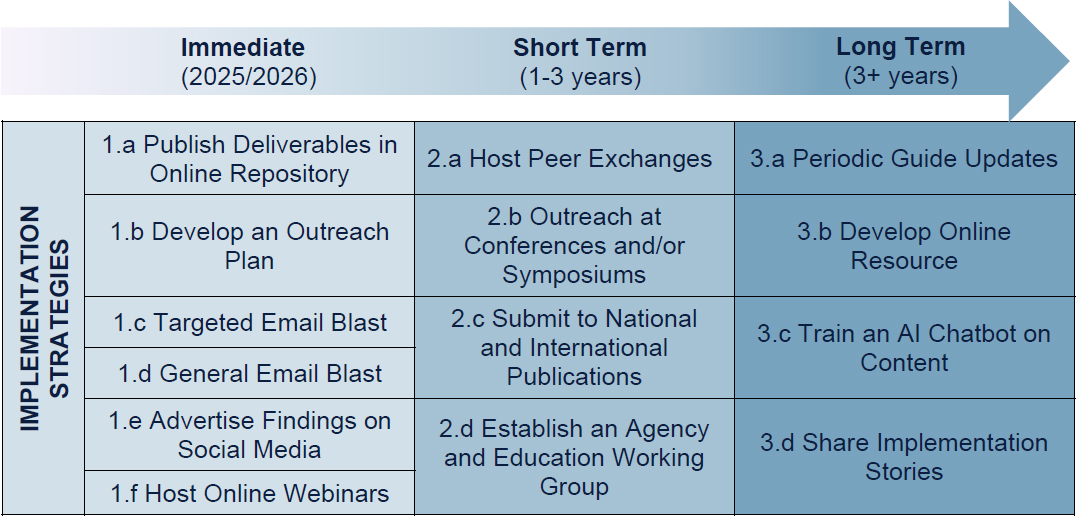
Clicking the strategies in the graphic below will “jump” readers to specific sections with greater detail.
Section 1: Immediate Term Strategies
1.a Publish Deliverables in Online Repository
| Audience: | Open to the public | Cost: $$$ |
To support broad dissemination and long-term accessibility of the research findings, all final deliverables, including the guide, should be hosted on a publicly accessible online repository that can be easily queried by commonly used search engines. This approach guarantees that stakeholders, practitioners, and researchers can easily access and reference the materials.
Making the panel-reviewed deliverables publicly available offers transparency and encourages continued engagement with the research. It also facilitates the integration of findings into future initiatives, conferences, webinars, and other outreach activities. Maintaining an open-access repository fosters ongoing dialogue, knowledge sharing, and iterative improvement in workforce development strategies within the evolving landscape of transportation technologies.
1.b Develop an Outreach Plan
| Audience: | NCHRP 20-102(20) Panel | Cost: $$$ |
Building upon the ‘menu’ of strategies contained in the NCHRP 20-102(20) implementation plan, the identified professionals from the NCHRP panel could collaboratively develop a formalized outreach plan, including the identification of specific roles, responsibilities, and timelines. This group would be responsible for advancing the remaining immediate-, short-, and long-term implementation strategies outlined in this implementation plan.
The outreach plan should include a proposed schedule, defined roles, and a clear strategy for disseminating targeted materials to key audiences; potentially leading to a Request for Proposals. Its primary goal is to support broader awareness and adoption of the workforce development guidance by tailoring content to specific stakeholder groups, including transportation agencies, educators, and prospective workforce entrants.
Key Elements of the Outreach Plan:
Audience Segmentation: Prioritize groups such as DOTs, MPOs, local agencies, universities, community colleges, and professional societies.
Channels: Use webinars, newsletters, TRB/NOCoE platforms, social media, and conference presentations.
Partnerships: Coordinate with organizations (e.g., AASHTO, ITE, WTS, COMTO, NOCoE) to co-host outreach and expand networks.
Materials: Use the guide resources (infographics, case example briefs, checklists).
SMART Targets: Define measurable goals (e.g., “10 agencies adopt three guide resources within 24 months”).
Feedback Loop: Collect lessons learned through surveys, polls, and peer exchanges.
Sustainability: Identify long-term champions (e.g., TRB committees, NOCoE, AASHTO).
A structured, proactive outreach plan will help advance research into practice, spark dialogue, and support workforce readiness in the face of emerging transportation technologies.
1.c Targeted Email Blast
| Audience: | Survey respondents, interviewees, stakeholder webinar attendees, and other interested parties | Cost: $$$ |
Reengaging stakeholders who contributed to the content developed throughout this research effort helps to show the value of the feedback they provided and increases their personal ownership in the finalized products, which increases the likelihood they will personally implement and share the findings.
Sharing the published materials via a personalized and targeted email blast thanking these stakeholders for their contributions to the project is an efficient and effective outreach method. The research team can provide a stakeholder contact list from those who indicated interest in remaining updated with project progress.
Intentional design effort should go into the delivered email and feature:
An engaging subject line
A concise summary of the key findings
Links to the online repository and final deliverables
Visual elements such as NCHRP branding, infographics, or screenshots
1.d General Email Blast
| Audience: | Professional organizations, TRB committees, and other national workforce organizations | Cost: $$$ |
An additional method of disseminating the results of this research includes sharing a general email blast to engage professionals in the transportation workforce. The email can be distributed to a curated list of individuals and organizations, including members of relevant TRB committees and transportation-focused professional associations. These recipients represent a cross-section of practitioners, researchers, and policymakers who are well-positioned to apply the findings in their respective domains.
The email distribution list can include individuals and organizations who expressed interest in staying informed, as well as relevant Transportation Research Board (TRB) committees and professional organizations. The research team has provided an initial list of organizations and industry contacts for consideration below:
AASHTO Research Council on emerging technology (subcommittee)
American Public Transportation Association (APTA)
Community Transportation Association of America
National Association of City Transportation Officials (NACTO)
Participants in Automated Road Transportation Symposium (ARTS) 2023
Partners for AV Education
Council of University Transportation Centers (CUTC)
Institute of Transportation Engineers (ITE)
Intelligent Transportation Society of America (ITS America)
Local Technical Assistance Programs (LTAP)
TRB Standing Technical Committee on Workforce and Information and Knowledge Strategies
Tribal Assistance Programs
USDOT ITS Professional Capacity Building (PCB) Program Education Institution partners and past survey respondents
Women’s Transportation Seminar (WTS)
Intentional design effort should go into the delivered email and feature:
An engaging subject line to capture attention
A concise summary of the research goals and key findings
Direct links to the online repository and final deliverables
Visual elements such as NCHRP branding, infographics, or screenshots to enhance appeal and encourage engagement
By leveraging this direct communication channel, the research findings are more likely to reach a broad yet relevant audience for implementation. The emails utilized for this outreach can be the basis of a new listserv to share any future communications.
1.e Advertise Findings on Social Media
| Audience: | General public | Cost: $$$ |
As a cost-effective and high-visibility strategy, sharing a concise summary or infographic on social media platforms can significantly broaden the reach of this research. This approach not only engages transportation professionals and stakeholders but also captures the attention of prospective workforce entrants, including students and early-career individuals.
By distilling key findings into visually engaging and easily shareable content, the research can spark interest, drive traffic to the full guide, and promote awareness of workforce development opportunities in the context of emerging transportation technologies. Strategic use of hashtags, partner organization tagging, and platform-specific formatting can further amplify visibility and engagement.
In addition, social media outreach provides an opportunity to invite feedback and experiences from agencies and practitioners, helping to capture lessons learned that can inform future updates to the guide.
1.f Host Online Webinars
| Audience: | Transportation professionals, workforce development practitioners, academic and training institutions, and professional committees and associations | Cost: $$$ |
Online webinars will extend the reach and practical application of the research findings and engage with existing or emerging communities of practice. These virtual events provide an interactive platform to present key insights, demonstrate tools and deliverables, and facilitate peer-to-peer learning.
It is recommended that a webinar be advertised on a variety of broad platforms such as e-communities and general outreach listservs (listed in the General Email Blast strategy). Recordings can be archived in the online repository to support on-demand access, while shorter clips repurposed as YouTube shorts or social media posts can help expand exposure and drive attendance.
Conducting webinars in collaboration with existing communities of practice, such as TRB subcommittees or workforce-focused working groups, will help sustain dialogue, gather feedback, and encourage the integration of research outcomes into ongoing professional development efforts.
Section 2: Short-Term Strategies
2.a Host Peer Exchanges
| Audience: | Agency leadership, department leads, human resources, and regional workforce development partners | Cost: $$$ |
Peer exchanges offer a hands-on opportunity for transportation industry professionals to collaborate with each other and learn from each other’s challenges and successes. Hosting peer exchanges focused on workforce development topics associated with emerging technologies would be a strategic way to share findings and recommendations from the NCHRP 20-102(20) project, as well as create a platform for individuals to translate insights into actionable strategies that align with agency goals and priorities. The peer exchanges could be designed around the recommendations introduced by the guide to identify the recommendations or resources with the greatest value for different user groups, and feedback could be gathered from the peer exchanges to inform further implementation strategies and additional research needs.
Similar to other strategies, diverse attendance at the peer exchanges—with representation from practitioners, human resources, educators, and technology specialists—would foster meaningful discussion. The peer exchanges could include facilitated discussions, scenario-based exercises, and guided walkthroughs of the recommendations provided in the guide. In preparation for these sessions, a moderator would be appointed to prepare content (including presentations), discussion questions, and facilitate the meeting. This approach fosters long-term integration of the research into agency planning cycles and supports the continued relevance and impact of the deliverables.
2.b Outreach at Conferences and/or Symposiums
| Audience: | Transportation professionals, DOTs, and academics | Cost: $$$ |
To further promote the research findings and encourage widespread adoption, it is recommended to submit proposals to present at relevant national and regional conferences and symposiums. These venues provide valuable opportunities for verbal dissemination of the research findings, allowing for direct engagement with practitioners, policymakers, educators, and researchers.
Presentations will enable the team to showcase key findings, demonstrate tools and visuals from the guide, and gather real-time feedback from diverse audiences. This format also supports interactive discussions, which can surface new implementation ideas and foster collaborative opportunities.
In addition to transportation-focused venues such as TRB and AASHTO, presenting at human resources and workforce development conferences—for example, the SHRM Annual Conference and Expo, the International Public Management Association for Human Resources (IPMA-HR) Conference, and the Academy of Human Resource Development (AHRD) Conference—would extend the reach of the guide to HR practitioners. These professionals play a critical role in job classification, position design, recruitment, and retention and may not typically attend transportation-specific events. Sharing findings in HR circles ensures the research reaches decision-makers who directly influence workforce structures and policies.
Conference participation, whether within transportation or HR communities, helps connect individuals and organizations invested in workforce development and emerging technologies. These connections can support future partnerships, pilot applications, and continued refinement of the guide and related resources.
2.c Submit to National and International Publications
| Audience: | Academics, professionals, and policy specialists | Cost: $$$ |
Disseminating the research findings through national and international peer-reviewed journals is a critical strategy for reaching diverse academic, professional, and policy-oriented audiences. Publishing in targeted journals can contribute to ongoing discourse in workforce development, transportation innovation, and emerging technologies.
To maximize impact, submissions will be tailored to the specific focus and readership of each journal. This includes aligning content with the journal’s thematic priorities—such as human resources, automation, workforce planning or digital transformation—and emphasizing findings most relevant to each audience.
The project team highlighted relevant topics and journals below that may maximize the impact of this research.
Suggested Journals and Target Topics
Transportation and Workforce Development
Institute of Transportation Engineers (ITE) Journal
Transportation Research Record (TRR)
Journal of Transportation Research Interdisciplinary Perspectives (TRIP)
Public Works Management and Policy
Technology and Innovation
IEEE Transactions on Intelligent Transportation Systems
Technological Forecasting and Social Change
Journal of Infrastructure Systems (ASCE)
Education and Training
Journal of Continuing Higher Education
International Journal of Training and Development
Education and Information Technologies
International and Policy-Oriented
Transport Policy
International Journal of Transport Development and Integration
World Transport Policy and Practice
Human Resources
Society for Human Resource Management (SHRM) HR Magazine
Journal of Human Resources
Public Personnel Management (SAGE)
International Journal of Human Resource Development and Management
Producing these journal articles may require conducting supplemental research to address gaps in literature and building on the findings produced by the project. Such efforts may be developed
into Research Needs Statements (RNS) for TRB committees to share topics of interest that may elicit use of the guides and tools.
2.d Establish an Agency and Education Working Group
| Audience: | Education partners, DOTs | Cost: $$$ |
For the sustained impact of the research findings, it is essential that a source of collaboration exist between DOTs, universities, community colleges, and professional organizations for workforce development planning. This can be established through a Working Group dedicated to advancing such topics. These partnerships can help translate the guide insights into formal education and training pathways that prepare the next generation of professionals.
A key step in this process is identifying the specific platform needed to expand connectivity between organizations’ workforce knowledge in emerging technology areas such as relevant TRB committees or the ITE Education Council. However, these groups have been traditionally siloed between researchers and practitioners, it is essential that the proposed working group engages both populations to encourage the collaboration and use of this guide. Aligning communities of transportation agencies or practitioners with higher education administrators reinforces the guide’s recommendations of collaborative workforce development strategies.
In addition to disseminating strategies developed under this guide, the working group should also create mechanisms to learn from new deployments and emerging practices. Documenting lessons learned, sharing successes and challenges, and integrating these insights into ongoing education and workforce planning will ensure the group remains adaptive and forward-looking.
Collaboration between DOTs and academic institutions can also support the development of new offerings, such as professional development certificates, continuing education modules, specialized graduate programs, or K-12 outreach programming. Incorporating the recommendations introduced by the guide into the design of these programs helps establish a clear pipeline from education to employment, grounded in the evolving needs and job opportunities of the transportation sector.
Section 3: Long-Term Strategies
3.a Periodic Guide Updates
| Audience: | Agency representatives and education partners | Cost: $$$ |
A designated oversight group, such as a standing committee within the TRB or NCHRP can monitor developments in emerging technologies, policy, and workforce trends to allow the guide to remain current and actionable. Proactive maintenance of the guide could occur on a scheduled basis or as needed in response to feedback gathered from other outreach strategies informing the applicability of the current guide.
The transportation workforce landscape is rapidly evolving due to advancements in automation, data analytics, electrification, and other emerging technologies. Periodic updates will allow the guide to reflect these changes, incorporate new case studies, and respond to feedback from practitioners. This living-document approach supports the guide and that it remains a relevant and trusted resource for workforce planning and development across the transportation sector.
3.b Translate Guide into an Online Resource
| Audience: | Transportation agencies, education administrators, and DOTs | Cost: $$$ |
Transforming the guide content into a digital and interactive resource, such as a TRB WebResource, would enhance the accessibility, usability, and long-term impact of the guide. This site could serve as a central hub for workforce development tools, templates, and resources related to emerging technologies in the transportation sector. This format may facilitate an efficient medium for publishing content updates and refinements as needs are recognized to keep the material aligned with current evolutions of technology and workforce development.
The vision for designing this interactive online resource includes clearly labeled, user-friendly webpages to support intuitive navigation. Proposed sections include:
Home: Overview of the research, key findings, and purpose of the guide.
Interactive Guide: A web-based version of the guide with expandable sections, embedded media, and keyword search functionality.
Tools and Templates: Downloadable and fillable resources such as workforce planning templates, skills gap analysis tools, and implementation checklists.
Case Studies: Real-world examples of workforce development strategies in action, with filters by agency type, technology, or region.
Training and Webinars: Archived and upcoming webinars, training modules, and links to external learning platforms.
Feedback and Updates: A form for users to submit feedback, suggest updates, or share how they’ve used the guide.
Open-Dialogue forum: A discussion board for users to communicate with one another on successes, challenges, or questions related to utilizing the results of this research.
3.c Train an AI Chatbot on Content
| Audience: | Transportation agencies, education administrators, and DOTs | Cost: $$$ |
Integrating an AI-powered chatbot assistant into the research’s dissemination strategy offers a dynamic and user-friendly way to extend the reach and utility of the guide. As transportation agencies and workforce professionals navigate complex and evolving challenges, the chatbot serves as an on-demand resource that enhances accessibility, engagement, and knowledge transfer.
Rather than being limited to the guide alone, the chatbot should be trained on the full context of the guide along with referenced resources and supporting materials. This broader foundation would allow users to receive conversational responses that highlight relevant recommendations, point to external resources, and link directly to related tools. By providing instant excerpts and tailored guidance, the chatbot could reduce barriers for new users, promote more efficient use of the materials, and help practitioners quickly locate the strategies most relevant to their real-time needs.
Additionally, AI platforms such as NotebookLM (or similar tools) could be used to generate podcast-style versions of the content. These audio summaries would offer another dissemination channel, making the guide’s insights accessible to a wider audience, particularly those who prefer on-the-go learning or alternative formats.
3.d Share Implementation Stories
| Audience: | Transportation agencies, education administrators, and DOTs | Cost: $$$ |
Documenting and sharing stories of guide recommendation implementations by public and private stakeholders is a powerful strategy for promoting best practices and encouraging broader adoption. These stories would offer real-world examples of how the guide’s strategies have been implemented, highlighting both the benefits and the challenges encountered along the way. For instance, showcasing a newly established professional development program or a workforce planning initiative inspired by the guide can provide actionable insights for other organizations to apply within their domains. These examples not only validate the guide’s relevance but also serve as a catalyst for similar efforts across the transportation sector.
To maximize their impact, case studies could be featured in updates to the guide, where they can be easily accessed, filtered by topic or organization type, and used as models for replication. Including quotes, metrics, and lessons learned will help make these stories relatable and informative for a wide range of users. Short YouTube “explainer” videos (1–2 minutes) can also be developed from these stories to capture highlights in a concise and engaging format, further extending reach to audiences who prefer quick, accessible content.
Continuous collection and publication of implementation stories, fosters a culture of continuous learning and supports the long-term integration of workforce development strategies across diverse contexts.
Measuring Implementation Progress
The purpose of disseminating and implementing the findings from NCHRP project 20-102(20) is to increase agency preparedness deploying, operating, and maintaining their transportation network. However, this impact is difficult to measure because every agency begins from a different starting point, and many factors influence an organization’s ability to make change. For these reasons, the research team recommends implementation progress be measured directly by the reach and impact of the recommended implementation strategies presented in this memorandum. Table A-2 through Table A-4 detail the metrics and measurement methods for the strategies discussed above.
Continuous Progress Monitoring
Table A-2: Continuous Strategies For Evaluating Implementation Progress
| Evaluation Area | Metric | Measurement Method |
|---|---|---|
| Resource Utilization | Number of downloads, interactions with resources (e.g., chatbot interactions) | Online Repository downloads of deliverables and usage logs |
| Online Repository Engagement | Page Views, time on page | Web analytic tools |
| Outreach Effectiveness | Number of email opens, social media reach, shares, and engagement | Email and platform analytics (LinkedIn, X, etc.) |
| User Feedback | Qualitative comments, satisfaction ratings | Embedded feedback forms, surveys, email comments/analytics |
Immediate or Short-Term Strategies
Table A-3: Immediate Or Short-Term Strategies For Evaluating Implementation Progress
| Evaluation Area | Metric | Measurement Method |
|---|---|---|
| Stakeholder Engagement | Webinar and workshop attendances | Registration or attendance data |
| Conference Dissemination | Number of presentations submitted/accepted, number of audience attendees | Submission records, conference feedback |
| Sharing Research | Number of journal papers submitted | Journal acceptances, paper citations, guide citations |
| Working Group Success | Number of attendees, Number of implementation actions in practice | Registration or attendance data, follow-up interviews, surveys, case study documentation |
Long-Term Strategies
Table A-4: Long-Term Strategies For Evaluating Implementation Progress
| Evaluation Area | Metric | Measurement Method |
|---|---|---|
| Guide Longevity | Frequency of updates, continued access/downloads | Repository analytics, update logs |
| Network Growth | New partnerships or collaborations formed | Peer exchange attendance, stakeholder mapping, engagement records |
| Curriculum Integration | Number of academic/training programs using the guide | Partnership tracking, curriculum reviews |
| Online Resource and Chatbot Engagement | Number of website users, interactions with chatbot, resources, or specific pages | Web analytics |


