Preparing the Transportation Workforce for Emerging Technologies: Developing a Guide (2026)
Chapter: 3 Foundational Research
Chapter 3: Foundational Research
The first step in the NCHRP 20-102(20) research approach was to conduct a comprehensive review of foundational research to ensure the work product from this project builds on existing work and addressed the highest priority challenges faced by transportation agencies. The following chapter discusses nine emerging topics and challenges that emerged from a literature review and two phases of stakeholder outreach.
Foundational Research Methods
The foundational research was comprised of findings and trends in literature, both past and present, and insights collected from stakeholders through surveys, interviews, and a webinar. The foundational research provided clarity on the workforce challenges associated with the adoption of emerging technologies in transportation that are currently unmet—or perceived to be unmet—by existing resources.
Literature Review
To understand the existing research and available resources, the project team conducted a literature review and summarized existing literature related to the workforce requirements and challenges in deploying, operating, and maintaining emerging transportation technologies. Much of the research incorporated was developed after 2011, with many relevant reports released in the past five years. The literature review considered emerging technologies, with many of the sources focused on transportation systems management and operations (TSMO), electric vehicles, and Transportation Management Center (TMC) operations. Each resource provided a different approach to the conversation, with some more focused at preparing the agency and organizational structure and culture for emerging trends, and others providing specific knowledge, skills, and abilities (KSA) needed within the workforce.
Stakeholder Outreach
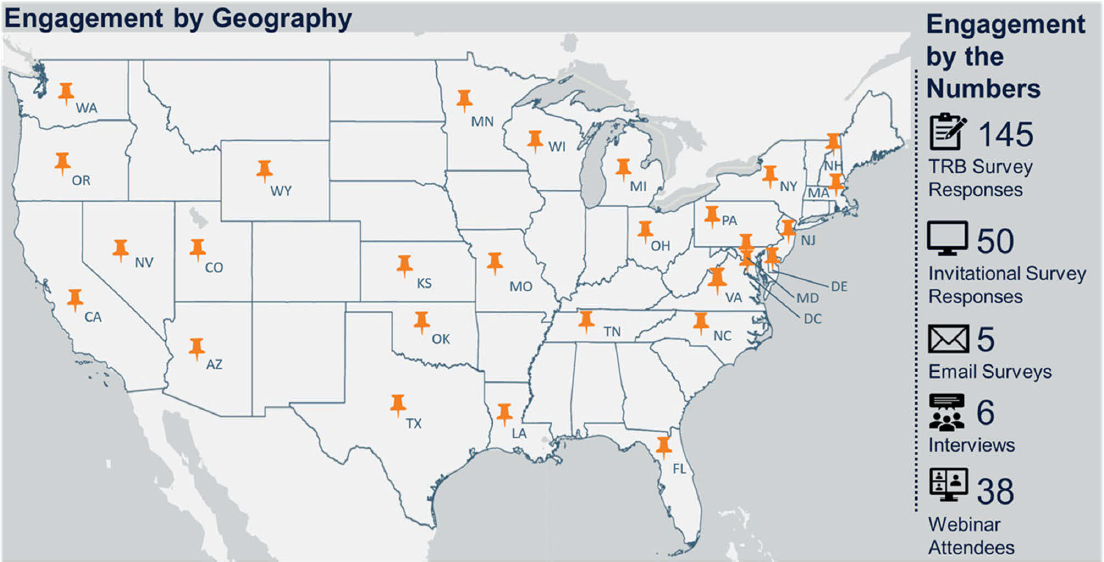
The project team conducted a two-phase outreach effort to better understand the current challenges and opportunities for agencies, academia, and other workforce preparedness organizations. For the first phase of outreach, the project team used a TRB survey, invitational survey, email surveys, and interviews to gather a diverse array of perspectives from state and regional agencies, contractors, industry partners, local workforce organizations, academics, and many others. Following the analysis of the literature review and findings from the first phase of outreach, the project team hosted an online interactive webinar to reengage stakeholders and validate the findings from the first phase of outreach and workforce gap analysis. Describes. Table 3 each of the outreach efforts and the respective engagement from stakeholders. Multiple outreach methods from a wide geographic area, as illustrated in Figure 7, helped the project team to identify opportunities and challenges stakeholders are experiencing presently, and understand the nuances of workforce planning for agencies.
Table 3: Stakeholder Outreach ‘By-the-Numbers’
 |
The project team promoted the TRB 2024 Annual Meeting Survey through business cards, TRB committee blasts, and attendance at TRB sessions, presentations, committee meetings, the career fair, and word of mouth. The survey was open from December 2023 through February 2024. The survey included 14 questions and took an average of 9 minutes to complete. |
 |
The project team promoted the Invitational Survey to a panel-reviewed stakeholder registry documented in the Stakeholder Outreach Plan. The survey opened in February 2024. The results discussed below capture survey responses through March 2024. The survey included 39 – 42 questions (depending on participant selections). The survey included all TRB survey questions. The invitational survey was designed to dive deeper into nuances of how emerging technology has influenced decision making, program development, and the workforce as a whole. |
 |
The project team conducted email outreach to contractors who support the installation and maintenance of emerging technologies. Questions and responses included topics such as hiring and retention, agency outsourcing, and emerging skills. |
 |
The project team reviewed responses to the surveys and the stakeholder outreach list to identify candidates for interview discussions to better understand the nuances and variations in perspectives across stakeholders and geographies. The project team reached out to 10 agencies/persons and scheduled eight 30min-1hr meetings. The project team tailored the questions based on the interviewee survey responses and agency role. Topics included organizational structure and policy adaptations, barriers and opportunities, and what resources would be most useful. |
 |
The project team hosted a Workforce Development Needs for Emerging Technology webinar to promote the project, share early findings, gather input on workforce development challenges and solutions inform, and collect insights from eventual end users of the guide. The webinar was distributed to those who provided emails or contact information in the surveys conducted, stakeholders identified by the NCHRP panel, and to academic partners on listservs. The webinar was hosted on Microsoft Teams on Wednesday, October 2nd, 2024, from 12PM to 1PM ET and had 38 attendees1. |
A recording of the webinar is available here: https://vimeo.com/1015795146?share=copy.
What We Heard: Emerging Topics and Challenges
The following sections are organized by topics starting with the technologies themselves and how agencies are adapting to new technologies, how academia and other programs can better support the evolving industry, and the availability of resources. The complete list of topics is below:
- Factors Influencing Deployment of Technology
- Need for New KSAs
- Perceptions of Agency Preparedness
- Challenges throughout the Project Lifecycle
- Fostering a Stronger Workforce Pipeline
- Academic and Trade Program
- Adapting Recruiting and Hiring Strategies
- Agency Near-Term Workforce Adaptation Actions
- Existing Workforce Development Resources
Experiences, examples, and perspectives collected through the project outreach are denoted as callouts to provide additional context and perspective. The inclusion of these callouts is not intended to be comprehensive of experiences shared in the outreach, rather provide context and framing for some of the findings discussed in the narrative. These callouts are indented and formatted in blue text. An example is shown below:
Example Title | Example details.
Factors Influencing Deployment of Technology
Factors such as regulation, funding, availability of data and other factors outside of the agency’s scope have direct influences on their ability to prepare the workforce.
Prior to discussing the impact technology is having on the transportation workforce, it is important to understand the influence of emerging technologies on transportation agencies. There are many factors outside of the technology itself that influence the momentum and pace of technological change within an organization. Through the surveys and interviews, stakeholders highlighted numerous factors, shown in Figure 8, that influence and often create challenges for deploying and managing emerging technologies.
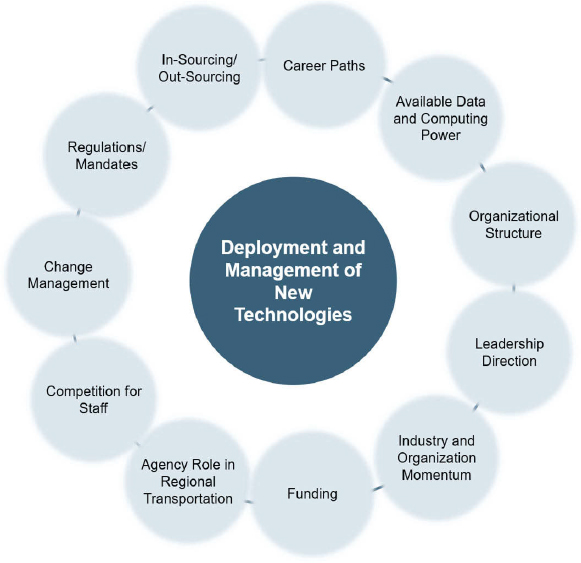
Respondents from public agencies noted funding and regulations/mandates are key factors in addressing workforce challenges. Funding availability and regulations can influence leadership direction on investments into specific applications of emerging technologies. In the absence of federal or state direction, leadership that encourages the adoption of emerging technologies can be a catalyst for shifts in culture and standard processes. A few respondents indicated that this type of leadership resulted in greater ease in requesting funding, adapting the organization, and multidisciplinary collaboration.
Regulation as a Catalyst to Prepare the Workforce | Regulation in California requires that by 2035 all new light-duty vehicles and most trucks must be electric vehicles. Thus, there is heightened attention towards the workforce needs required to support and maintain these vehicles and associated infrastructure. An MPO recognized the upcoming need to support and maintain electric vehicles and proactively reached out to local electricians to raise awareness for the need for certification to work on EV-related infrastructure and coordinated training opportunities with Electric Vehicle Infrastructure Training Program. Additionally, the MPO coordinated with community colleges and apprenticeship programs to identify opportunities to integrate the necessary skills into existing programs to better train the workforce to install and maintain EV infrastructure.
The challenges facing individual teams and staff within agencies vary slightly from the overall organization as they may face intra-organizational challenges or institutional barriers such as siloed departments within the organizational chart, lack of momentum to change existing processes, focus on professional engineer (PE) focused professional career path, varying levels of implementation of new technologies, and a lack of buy-in from leadership to integrate new technologies. The existing literature shown below provides discussion and strategies to adapt to and overcome some of these challenges:
- The Role of Transport Agencies in Shaping Disruptive Technologies and Service Models: Survey Report (15)
- Transportation Workforce Planning and Development Strategies, and Building a Sustainable Workforce in the Public Transportation Industry–A Systems Approach (16)
Several respondants discussed the influence of the technology, the broader transportation industry, and parallel industries in their organization’s workforce. Agencies and contractors alike reported challenges with recruiting and retaining staff due to non-competitive salaries and benefits, noting that candidates with highly specialized technical expertise have many options in seeking high-paying jobs across a wide range of technology fields and companies. This further emphasizes the key role of funding in addressing workforce challenges, which in many cases is also outside the control of the staff responsible for the implementation and mangement of new technologies and the workforce.
Need for New KSAs
Emerging technologies are transforming the knowledge, skills, and abilities (KSAs) needed within transportation workforce.
The technologies that are considered “new and emerging” vary between transportation agencies based on organizational responsibilities, priorities, and resources. Even within an individual organization, the perceived workforce challenges can differ among agency representatives based on their department, role, and personal experiences. For these reasons, the workforce challenges faced by agencies are not uniform.
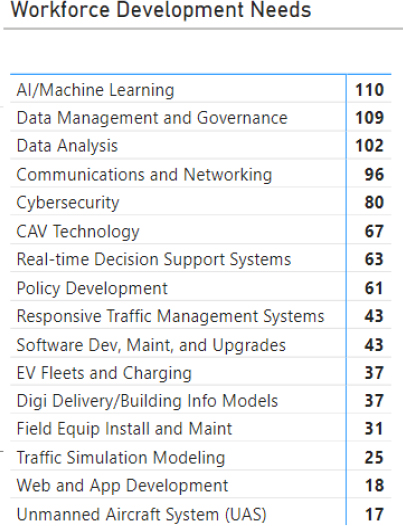
Much of the reviewed literature focuses on workforce development and preparedness for TSMO, TMCs, and EVs. Survey respondents from NCHRP 20-102(20) acknowledged these are key emerging technologies, respondents also ranked artificial intelligence/machine learning, data management and governance, data analysis, and communications and networking as the emerging technologies perceived to need the greatest workforce development as shown in Figure 9. In a different survey conducted through the AZTech partnership in 2022, responses from local agencies who operate arterial-based traffic management systems demonstrate a slightly different pattern. The survey ranks the following skillsets highly for the future of transportation management: signal operations for incidents, data analytics, communications, and CV technologies (17). The perception of which technologies have the potential to be most disruptive may vary, there is more alignment on the emerging skill gaps. Some of the needs that persisted through both surveys, such as data management and analytics, may indicate skills that are needed broadly across multiple technologies and phases of technology implementation. Additionally, the lag between literature and guidance and responses from agencies illustrates the challenge for agencies to keep pace with emerging technologies.
KSAs historically ‘new’ in the transportation industry are becoming more necessary for teams working within the transportation industry. The most common emerging skills and current skill gaps identified in both the literature and stakeholder outreach include electrical/electronic systems, data science and analysis, systems engineering, and cybersecurity. With the expansion of connected infrastructure and alternative fuel solutions, electronics and electrical skills are necessary for field teams and technicians to deploy and maintain new technologies and infrastructure. Data science and analysis skills are useful across multiple emerging technologies to integrate and leverage big data and new data types from the implemented technologies. Additionally, systems engineering and technology integration is important for agencies to realize the benefits of the technologies within teams and across departments.
In addition to technical KSAs, the literature and outreach responses emphasized non-technical KSAs that are necessary for the successful deployment, implementation, and maintenance of emerging technologies. Many emerging technologies require interdisciplinary awareness, skills, integration, and collaboration. The importance of these skills is increasing as technologies become more multi-faceted and require multiple departments to support the implementation and integration of new technologies. Other non-technical skill gaps include communication, ability to advocate for training or professional development, and the ability to understand the ‘why’, tradeoffs, and use cases for technologies.
The existing literature provides resources such as emerging, evolving, and transferable positions/roles, KSAs, and standardized occupational codes (SOCs). Resources also provide context for these KSAs through competency models and maturity models and associated KSAs, career pathways. Many of the sources provide strategies and action plans for agencies. Related existing literature are listed below:
- Agency Capability Building Web Portal–2024 (18)
- Ohio Auto and Advanced Mobility Workforce Training Guide–2023 (19)
- Attracting, Retaining, and Developing the Transportation Workforce – Design, Construction, and Maintenance–2022 (20)
- National Operations Center of Excellence (NOCoE) Virtual Peer Exchange on TMC Staffing–2022 (21–24)
- Attracting, Retaining, and Developing the Transportation Workforce: Transportation Planners–2021 (25)
- The Role of Transport Agencies in Shaping Disruptive Technologies and Service Models: Private Sector Roundtable–2021 (26)
- National Network for the Transportation Workforce, National Transportation Career Pathways Initiative, Final Project–2019 (27)
- Transportation Systems Management and Operations (TSMO) Workforce Guidebook–2019 (28)
- Federal Highway Administration (FHWA), Connecting TSMO and Human Resources Presentation–2018 (29)
- Leadership Guide for Strategic Information Management for State Departments of Transportation–2016 (30)
- Attracting, Recruiting, and Retaining Skilled Staff for Transportation System Operations and Management–2012 (31)
Perceptions of Agency Preparedness
Agencies are at different stages of adapting to new and emerging technologies.
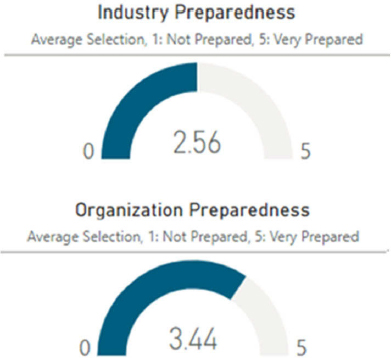
Shown in Figure 10, survey respondents perceive the transportation industry as a whole to be moderately prepared for emerging technologies, and their organizations are slightly more prepared for emerging technologies. Respondents often discussed the technologies that are more visible and closer to implementation within the industry (and the responder’s organization) and the associated workforce opportunities and challenges in their responses. The lesser-known technologies were rarely perceived to introduce significant workforce challenges because respondents didn’t have first-hand experience with the technologies, their organizations do not have the same momentum for implementation, limited funding has been dedicated to technology research/deployment, and thus there is a limited understanding of what workforce challenges will be faced when those technologies are deployed.
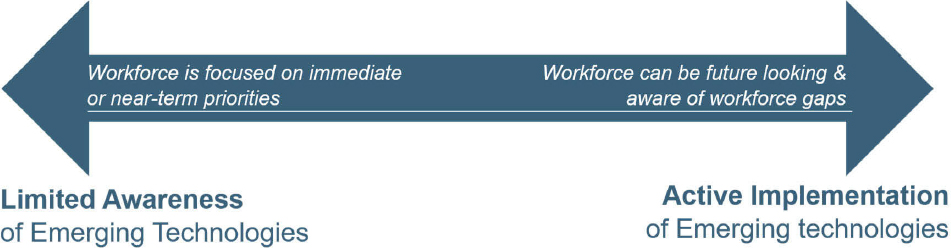
There is variation in the adoption of emerging technologies and the necessary workforce preparedness for those technologies. Therefore, there is also variation in the types of resources agencies are seeking to meet their unique needs. Figure 11 illustrates the spectrum of responses collected from stakeholder outreach, ranging from acknowledging the existence of a technology and actively working to integrate the technology into systems and
processes. The location along the spectrum directly impacts how proactively (or reactively) their workforce is preparing for new technologies. For example, after significant investment and experience with emerging technologies, organizations typically shift their focus to ensuring the value of those new technologies are being realized and communicated effectively to continue the advancement of those and other similar technologies.
As agencies undertake preparing the workforce, 26 respondents from public agencies rated the effectiveness of their organizational structure in promoting the advancement of emerging technology at a 4 out of 5, on average; meaning they generally feel that their organizational structures are conducive to the advancement of new technologies. Though some of the open-ended survey responses and interviewees discussed ongoing challenges with their organizational structures. An excerpt is below:
Opportunities for Non-PE Career Paths | Like many state DOTs, civil engineering PE licenses are required for many positions, which makes it challenging to retain talented non-engineering staff. They gave an example where a very good employee (not an engineer) recently left their agency and cited the lack of opportunity for advancement (i.e., they were as high as they could go in the organization without having a PE) as their reason for leaving.
Existing literature discusses strategies such as a ‘top-down’ approach or ‘one-person shows/single champions’ to create organizational change (32). Through the surveys and interviews, stakeholders indicated that the order matters when it comes to potential for workforce preparedness activities to leverage the full value from emerging technologies. Stakeholders provided the following examples of challenges that they perceive are preventing the industry from leveraging the full value of new technologies:
- Technology implementation occurs prior to the organization and its workforce preparing for deployment.
- Technologies are not properly integrated together.
- Staff is not identified to lead and manage the technology long-term.
- Training from the vendor is not integrated into contracts.
- Upper management may not be fully “bought-in” to the deployment.
Challenges throughout the Project Lifecycle
Agencies experience workforce challenges throughout the project lifecycle including programming and funding, systems integration, and maintenance and operations.
In the survey outreach, respondents were asked to identify lifecycle stages with the greatest workforce challenges. The options available in the survey included:
- Project-Level Planning
- Programming and Funding
- Design
- Construction
- Operations and Maintenance
- Systems Integration
The results illustrate that there was not one stage of the project lifecycle that was overwhelmingly identified as challenging. Overall, respondents identified the following three stages, programming/funding, systems integration, and maintenance and operations stages, as the stages with slightly greater workforce challenges.
Within the programing and planning stage, respondents noted the greatest challenges with an insufficient understanding of the technologies and/or their application to the transportation field. This makes it challenging to adequately plan and budget for specific technology needs, as well as plan for longer-term technology lifecycle management.
Need for Multidisciplinary Staff | The systems engineering and computer science students may learn some of those [emerging] skills, but [they] do not have the context from the transportation industry.
Respondents highlighted challenges with a lack of experience designing, reviewing designs, and integrating new technologies into their systems and operations within the implementation stage. This lack of awareness and inexperience often results in reduced effectiveness of new applications of technology.
Isolated Systems | At the state agency, we need people that understand how electronic systems communicate. This is because we have people that indicate they would like a new technology, but we don’t understand how these systems communicate and therefore we end up with many systems with nothing integrated.
Many responses have discussed challenges in realizing broad benefits of new technologies due to their organization’s inability to translate raw data into actionable and useful indicators, aligning with the greatest challenge identified in the leveraging and analyzing data stage. This presents mid-level managers or technology managers challenges in communicating the value (return-on-investment) or findings of the technologies to their leadership and the public.
Leveraging Data to Communicate its Value | As new technologies are introduced and considered, common questions regarding transportation investments have become increasingly challenging to answer. For example, questions such as, “what is the return on investment, what is the lifecycle, will maintenance costs be sustainable” are challenging to answer when many of these technologies have not yet been deployed broadly limiting the availability of historic data.
Within the operations and maintenance stage, the greatest workforce challenges are funding and staffing. Most transportation agencies have different staff dedicated to planning, design, construction, and operations/maintenance. Therefore, most often, when an application of technology reaches steady state operation, it would have traded hands (or departments) at least
once since its inception. There is not always clear communication between the early contributors and the long-term maintenance teams to convey the underlying purpose of implementing the new technology and more detailed “whys” behind design decisions. Similarly, a few organizations noted that it is more challenging to identify funding for maintaining new technologies than it is to implement them in the first place. Further, others indicated that full lifecycle analyses are not always conducted (or data is not available at the time) to clearly anticipate annual operations costs for new technology applications.
Installation and Construction Roles | We have actually encountered greater challenges in hiring competent, experienced workers for the less emerging-technology-based, but still skilled, installation and construction roles, such as equipment operators and experienced site foremen for construction of ITS and Signals.
Fostering a Stronger Workforce Pipeline
Agencies are undertaking actions to prepare their workforce and acknowledge continued investment and training in the workforce pipeline is necessary to fully prepare their workforce.
The perception of the preparedness of the workforce is that it is adapting and preparing but not prepared. Public agency staff are identifying ways to adapt to the new and emerging technologies most suitable for their agencies. Organizations have adapted in the near-term through improved training, organization, and institutional adjustments, and leveraging outsourcing. To better prepare their workforces stakeholders identified opportunities to improve the education pathway include increasing exposure for students to the wide breadth of opportunities in the transportation industry and building bridges between organizations (industry and education). Survey respondents identified civil engineering degrees as the best prepared major to support emerging technologies, though stakeholders and existing literature discusses opportunities to better prepare these students within the civil engineering field in addition to acknowledging that it is just one of many pathways into the transportation industry(20, 25).
Underscored in existing literature and stakeholder interviews is the importance of the partnership between human resources and project staff to develop positions descriptions and titles that attract staff with the necessary technical and non-technical competencies and refine career pathways for non-traditional roles (29). Additionally, partnerships between human resources and project staff can lead to skills-based recruiting and hiring strategies that may be more responsive to evolving skillsets. Many of the documents reviewed as a part of the literature review provided insights on how to continue to fill workforce gaps and better understand how to prepare the workforce for emerging technologies, though there is a lag for agencies implementing and realizing the benefits of these strategies.
To bridge the gap between education and the workforce, respondents suggest developing custom certification programs targeting skill development for new technologies. National organizations such as NOCoE, can play a key role in developing training and certification programs. Vendors identified that nationally accredited certifications, versus in-house training, are more useful to acquire contracts and level the playing field for the workforce.
Respondents also recommended increased exposure of students to the wide breadth of opportunities in the transportation industry earlier in their educations. Multiple literature sources discuss strategies to foster K-12 and trade exposure to the transportation industry (28, 33). Examples include investing in high school STEM programs, integrating apprenticeships into
college programs, and encouraging multidisciplinary education by pairing programs within universities or between education programs (university, community college, trade schools). Bringing students from different programs together can simulate the real-world environment and students can learn skills and approaches from other perspectives. This can offer a short-term and scalable solution in programs with limited flexibility on modifying curricula. Building upon the findings above, there is also a need to better understand skills beyond curricula that are necessary to provide employment-ready candidates.
High School Transportation Program | Transportation STEM Academies at High Schools cover the wide breath of transportation topics and skillsets. The school values multiple skillsets, from engineering to diesel mechanics. The organization also pays for certain accreditations, such as a pilot’s license if they are in the aviation program.
Multidisciplinary Education Programs | The advancement of emerging technologies has created unprecedented challenges that span across multiple agency departments and capabilities that require a knowledge base across multiple skills. These skill sets range from planning and systems engineering experience, then ultimately understanding of data analytics/or system services platforms to determine resource maintenance and operational needs. These skills in the past have been considered as siloed steps and generally considered independent focus areas in the educational environment.
Academic and Trade Program Opportunities
Some academic and trade programs have evolved to better prepare students for emerging technologies, though there is a broader need for programs as a whole to adapt to better provide the necessary technical and professional skills for the workforce.
Existing literature highlights the need and opportunity for transportation agencies to partner with academic and trade programs and proactively foster the workforce pipeline (34, 35). A few in-practice resources such as the DriveOhio Educator Toolkit and Michigan Works! Connected and Automated Vehicle Workforce Training Guide provide lists of the available training materials, programs, and/or certifications for those interested in the transportation industry (36, 37). Existing workforce development resources are further discussed in Existing Workforce Development Resources.
Literature about transforming transportation programs that are historically focused on civil engineering into multidisciplinary programs is limited, interviewees and survey responses identified numerous successful examples and challenges. Survey respondents representing educational institutions rank their programs as a 3.6 (out of 5=highly effective) in preparing students for careers in emerging technologies. Feedback suggested that academic institutions may be resistant to change due to the perception of what can/cannot be incorporated into courses to maintain ABET or other accreditation programs, justifying courses for a small student population, and showing the need or value of building specific skills that support emerging technologies.
Though, institutions are continuing to adapt degree or certification curriculums in response to emerging technologies within the transportation industry. University stakeholders shared a variety of strategies for integrating emerging technologies into curricula through survey responses and interviews:
- ✓ Developing new electives that build skills related to emerging technologies such as ITS.
- ✓ Updating existing courses and integrating technical and collaboration skills needed for new technologies.
- ✓ Inviting guest speakers from local agencies or LTAP programs or partnering with vendors or agencies for tours within new or existing courses.
- ✓ Modifying assignment questions to integrate emerging technologies and associated critical thinking skills.
- ✓ Modifying capstone projects to incorporate interdisciplinary problem statements and teams.
Strategies in existing literature and findings from stakeholder engagement emphasize the need for stronger bridges and partnerships with non-CE departments, community colleges, and trade schools to increase the pathways into the transportation industry and show the value in various teams with a breadth of skills (16, 32). This includes increasing the exposure and advertisement of opportunities within the transportation industry (33). Some education institutions have developed engineering and non-engineering pathways to reach transportation fields. Others have developed apprenticeship programs focusing on multidisciplinary problem solving or specific topics such as intelligent transportation systems (ITS).
Successful Apprenticeship Program | Professors created an apprenticeship program funded through the Department of Labor called “Transformative Technologies and Engineering”. The program brings together students from the university and local community college with an array of majors such as transportation, information technology (IT), and healthcare. The program includes guest speakers, networking with the industry that leads to internships. The partnership helps students to understand the need for a variety of perspectives and mindsets in multidisciplinary problem solving. There is momentum to build stronger pathways between universities, community colleges, and trade schools.
Respondents also identified the need to better share the breadth of opportunities within the transportation industry and within emerging technologies. Many of the respondents noted that students are often unaware of the opportunities within the transportation industry. By more prominently advertising the interdisciplinary nature of the transportation industry and the many transferable skills gained from other career paths, both industry and educational programs, can better integrate learners into the transportation workforce pipeline.
Adapting Recruiting and Hiring Strategies
Agencies need to continue adapting their recruiting and hiring strategies to reach a broader group of qualified candidates.
Recruiting, hiring, and retaining staff is often included in resources and research discussing the preparation and development of the transportation workforce. The following resources discuss strategies to adapt recruiting, hiring, and retention practices to better target candidates with the skills needed to support the deployment and maintenance of emerging technologies:
|
|
These resources suggest recruitment strategies such as:
- Identifying occupations with transferable skills and/or untapped talent.
- Sharing best practices for recruitment, retention from similar industries such as water, IT, accounting, and trucking.
- Updating job descriptions to more accurately market openings.
- Utilizing cross-training for internal staffing flexibility.
- Identifying the necessary ‘core’ skills and talent needed if outsourcing is leveraged.
- Providing advancement opportunities for existing staff (17).
While there are available resources and research for agencies to leverage to adapt their processes, agencies reported through the project’s outreach that they are still experiencing challenges identifying a strong candidate pool and incentivizing candidates to join their organizations. The current candidate pool is limited and there is a need to provide better exposure for the transportation field within universities and trade programs. On the other hand, a few agencies reported creative strategies for overcoming these challenges.
Connecting with Community Colleges | Through the ITS Joint Program Office (JPO) Connected Vehicle Deployment Program, the Tampa-Hillsborough Expressway Authority partnered with Hillsborough Community College to provide key services in their deployment, and as such, increased awareness of opportunities and trained the students on key emerging technology topics (41).
Agency Roundtable Discussion on Recruiting and Hiring | Through an AZTech partnership in Phoenix, Arizona, several local agencies who operate arterial based traffic management systems discussed the process of aligning “necessary” versus “desired” technical skills, and how those skills and certifications influence classifications and compensation levels. Agency representatives indicated (1) defining skill sets, (2) classifying staff, (3) aligning compensation, and (4) approval processes as relevant workforce challenges in their agencies (17).
While understanding the technology or obtaining a specific degree/certification is important, successful talent needs to understand the technologies within the context of transportation. Respondents who identified as human resources or administrative staff suggested that the next greatest challenges, after identifying a strong candidate pool, are navigating the unique and non-traditional career paths within an organization and writing accurate and multidisciplinary job requirements.
Multiple challenges were highlighted specifically for recruiting, hiring, and retaining technicians responsible for operating and maintaining emerging technologies. Private industry and agency staff identified a lack of trade/education opportunities and competition between agencies and private industry as challenges for sourcing and retaining staff. Private industry stakeholders acknowledged that trade schools exist and may provide the basics to support the operation and maintenance of emerging technologies, many of the skills are technology specific and learned on the job. To overcome this challenge, organizations have had success in developing in-house training or apprenticeship programs and looking to parallel industries to recruit talent.
Non-traditional parallel industries to leverage for recruitment for technician roles include:
- ✓ Electronics
- ✓ Veterans/Ex-military
- ✓ Telecommunications
- ✓ Security and alarm system installers
- ✓ Cable companies
Organizations have also identified candidates with technician-role skills listed below are transferable to the transportation industry:
- ✓ Low-voltage electrical
- ✓ Communications networking
- ✓ Data analytics
- ✓ Electronics
- ✓ Safety training
- ✓ Bucket truck operators
- ✓ Commercial driver’s license
Through outreach, agency representatives indicated that they are experiencing challenges recruiting and hiring staff responsible for planning, designing, and managing emerging technologies. There is resistance to shifting the paradigm from a civil engineering focused recruitment program to incorporate different degree programs such as database engineering, software engineering, and IT staff. Organizations who have updated their job titles, descriptions, and KSAs to better reflect the role are sometimes able to better capture candidates with the proper skills who may not be within the transportation industry. Requirements for a Civil Professional Engineering (PE) license, which may be common for professional roles at agencies, may eliminate candidates from comparable fields such as computer systems, data science, or electronics.
Agency Near-Term Workforce Adaptation Actions
The existing workforce is implementing strategies to adapt the ability of their workforce to respond to changes caused by emerging technologies.
Organizations and the existing workforce are adapting to new technologies by implementing strategies identified in the existing literature such as improved training, organizational and institutional adjustments, and leveraging outsourcing.
Through the project outreach, both private and public representatives outlined methods to upskill and reskill their workforces such as leveraging existing training programs with in-house or hired facilitators, external custom training programs, incentivizing continuing education, and created customized in-house training programs. Many contractors leverage in-house training programs to upskill their employees, whereas agencies rely on vendors or professional organizations to provide training to agency staff on new technologies.
Responses indicate that agency outsourcing is driven by funding and availability of staff with appropriate KSAs. Vendors can provide a significant benefit to agencies to bridge knowledge gaps and build competencies for agency staff. Respondents also identified challenges aligning project funding with staff/FTE planning. In some cases, a full FTE is not needed initially, and/or the project funding cycle is not aligned with staff forecasting and thus there is a bandwidth gap that could be filled with a consultant/contractor. There is a need to better understand and define the roles, responsibilities, and expectations from contractors and vendors in deploying new technologies. Looking forward, as automation, data processing, and AI capabilities continue to grow and evolve, some of the outsourced skills may be replaced with in-house technologies or existing staff (who may have additional bandwidth as technology may make their core tasks more efficient).
Planning for and Onboarding Staff | Organizations need people with these new skills but initially don’t have the needs of a full-time position. This means they need to have relevant KSAs to support other aspects of the agency’s responsibilities, take on menial work to fill their time (not desirable for employee), or be hired and have the company accept they will not be fully utilized for an unknown time period (not ideal for a business).
Many of the agency training programs are in early development and thus tracking or metrics are often not available. Some agencies have integrated training as part of staff annual review processes. Agencies have noted challenges, and lost momentum, for training if the in-house trainer leaves the organization, or if the technology is no longer considered ‘new’ (years after implementation).
Some organizations, with the support of their leadership, have restructured to incorporate new technologies while others are trying to prepare the workforce within the limitations of the existing organizational structure. There is a need for translators within organizations to understand highly technical information and communicate it to upper management. For example, mid-level managers can adopt a more interdisciplinary (‘flat’ organization) within their operations but also need to be able to operate within the more siloed (‘vertical’ organization) to advocate for the advancement of innovations. Some organizations have taken a more intentional approach to integrating the emerging technology workforce into the organization by creating a workforce component of their Strategic Plans.
Workforce Emphasis in Strategic Planning | The DOT’s Transportation Operations Strategic Plan (TOSP) has a workforce emphasis area demonstrating one positive step the agency is taking related to this topic. The strategic plan highlights initiatives over time to ensure the agency has the right number of resources and preferred skillsets to implement the plan. The workforce emphasis area is highlighting that they need well-rounded employees that are not only good at the technical aspects of their job, but also soft skills that include leadership, collaboration, and communication.
Existing Workforce Development Resources
Availability of existing workforce development resources vary by technology with the greatest availability for ITS, TMC, TSMO, and EV technologies.
At a national level, the USDOT has supported state and local agencies in building the technological capacity of the workforce through training programs and guidance on staffing positions/staffing levels for ITS operations and management.
- The ITS Professional Capacity Building (PCB) Program has developed and sponsored training across a range of technical topics and through various delivery types, including classroom-style training, web courses, hybrid courses, webinars, and peer exchanges (42).
- The National Highway Institute (NHI) sponsors several technology-focused courses on topics such as procuring technology, systems engineering, ITS and safety applications, and technologies for road weather management (43).
- The Transportation Management Center Pooled Fund Study (TMC PFS) completed foundational efforts focused on emerging technology system staffing and job descriptions, as well as human factors needs within the TMC environment. These topics continue to be a priority for the TMC PFS members as technology advances and the expectations for staff technical capabilities increase (44).
- The Consortium for ITS Education (CITE) continues to develop and provide new courses on emerging technology topics and has strived to keep its curricula updated to keep pace with agency technical needs (45).
- NCHRP 20-07/Task 408 conducted extensive research on emerging and future staffing needs as a result of a broad shift toward Transportation Systems Management and Operations (TSMO) by many agencies. TSMO encompasses several real-time operating functions and philosophies, and this research provided important perspective on future needs for staff with a stronger technical background in computer and systems engineering, data analysis, data and cybersecurity, and artificial intelligence, among others. Model job descriptions also were included as part of this research (46).
- The NCHRP effort provided an impetus for the National Operations Center of Excellence (NOCoE) to initiate a focused workforce development effort. There is an emerging body of work, guidance, and resources to support developing a highly skilled and trained pipeline of talent to be able to respond to evolving technologies and emerging capabilities. NOCoE’s workforce development focus area (https://transportationops.org/workforce) includes resources for addressing technical curricula needs and outreach at the full range of student levels, ranging from K-12 through universities. It also provides access to resources to support ongoing technical training, career paths for technical staff at transportation agencies, and strategies for how to recruit the right candidates for agency technical roles. NOCoE emphasizes the benefit of peer exchanges for transportation agencies to share lessons learned and successful practices that are supporting a better-prepared technical workforce (47).
The following list outlines the resources that respondents provided to the project team. While this list is not exhaustive, these specifics provide insight into the types of partners, guidance resources/documents, and certification programs respondents leverage for their workforces.
Partners that respondents look to for workforce development resources and support include:
- Local Technical Assistance Programs (LTAP)
- Local/Regional Working Groups to share resources
- Transportation professional organizations (e.g., AASHTO, APTA, COMTO, WTS)
- HR professional organizations field (e.g., the Society for Human Resource Management (SHRM)
- AI/Chat GPT
- State or Local Workforce Development or Career Exploration Programs
- FDOT Workforce Development
- Michigan Works!
- Minnesota and Ohio Office of Civil Rights
- Minnesota Governor’s Workforce Development Board: Career Pathways Partnership (CPP)
- Ohio TechCred
Guidance resources and documents that respondents refer to for workforce development guidance and support include:
- AZTech Coalition (17)
- Connected Vehicle Pooled Fund Study Guidance document (48)
- CAVe-in-a-box Website (49)
- Drive Ohio Toolkit (36)
- Computer Networking: A Top-Down Approach 8th and 9th Edition (50, 51)
- Transit Workforce Center – Resource Center (52)
- Federal Highway Administration (FHWA) Transportation Systems Management and Operations (TSMO) Website (53)
- Center for Creative Leadership: Leadership Development Program (LDP) (54)
- NOCoE Model TSMO Position Descriptions (55)
- NCHRP 20-07 (408) (46)
- National Highway Institute (NHI) (43)
- Department of Defense: Defense Acquisition University (training on Systems Engineering, SoS, MBSE) (56)
- Talent Technology Empathy Connected (TTEC) (57)
- Louisiana Transportation Research Center (58)
- EDC-5 Unmanned Aerial Systems (UAS) for Work Zones Peer Exchange in Columbus, Ohio (59)
Certificate programs that respondents leverage for workforce development include:
- National Institute of Standards and Technology (NIST) 4D/RCS
- International Municipal Signal Association (IMSA) Traffic Signal Technician Certification


