Preparing the Transportation Workforce for Emerging Technologies: Developing a Guide (2026)
Chapter: 6 Conclusions and Suggested Research
Chapter 6: Conclusions and Suggested Research
At the conclusion of the NCHRP 20-102(20) research effort, opportunities for implementation of the project’s outcomes and future research efforts building on these outcomes were explored. The following chapter outlines potential future initiatives to address the Guide’s outstanding resource needs, share and foster discussion around the guide, and evaluate the impact of the guide.
Implementation Plan
To support the effective dissemination and sustained use of the NCHRP 20-102(20) project deliverables, this memorandum presents a set of implementation strategies organized by immediate, short-term, and long-term timelines. The approach includes a mix of strategies, summarized in Table 15 that are tailored to meet stakeholders where they are through targeted outreach, participation in industry events, and refined deliverable formats. These strategies are designed to promote awareness, encourage adoption, and increase long-term application of the project’s outcomes.
Table 15: Summary of Implementation Strategies
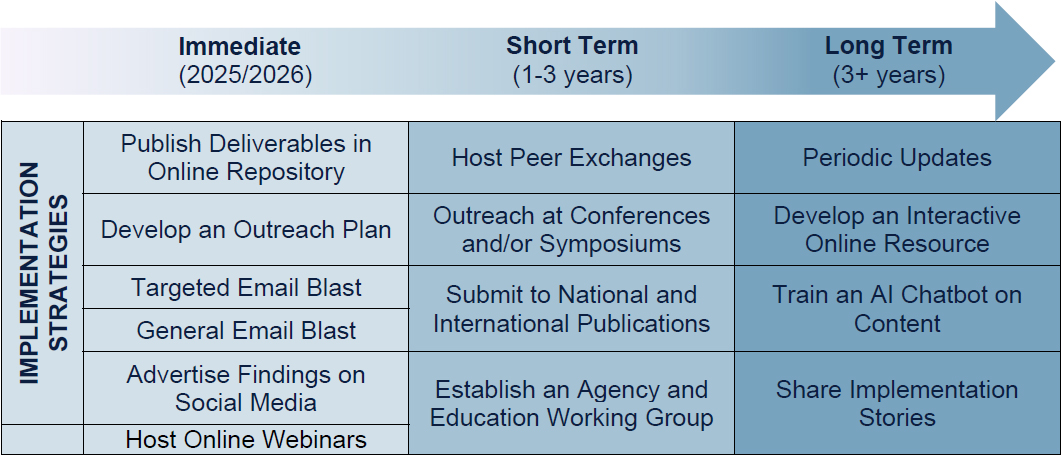
Greater detail for each of the recommended implementation strategies is included in Appendix A: Implementation Plan.
Outstanding Resource Needs
Chapter 5: Guide Overview and Resources detailed the main chapters of the guide, highlighting the root causes of workforce challenges and the corresponding resources designed to address them. However, based on the available research and resources currently available, the two root causes detailed in Table 16, would benefit from additional resources.
The first unexplored root cause relates to the lack of knowledge about emerging technologies and difficulties in calculating and communicating return on investment (ROI) analyses, which can hinder leadership support. Some resources exist on calculating ROI for specific technologies, though, there are limited resources and/or discussion on calculating ROI for the breadth of emerging technologies.
The second root cause included in Table 16 highlights challenges identified across stakeholders – the investment in workforce preparedness is significantly influenced by external mandates or policies. While mandates and policies may be set outside of the agency’s purview, they can directly impact how agencies allocate their funding and the types of workforce development available to employees. Additionally, stakeholders expressed a need for more information regarding funding sources that could be leveraged to fund workforce development activities.
Table 16: Gaps in Guide Resources by Root Cause
| Root Causes | Related Workforce Gaps |
|---|---|
| Lack of knowledge about emerging technologies and challenges in calculating/communicating return on investment (ROI) analyses on new technologies can result in a lack of support from leadership. |
|
| Local, state, and federal funding and mandates drive investment in adapting the curricula and training programs needed to prepare the workforce for emerging technologies. |
|

