Preparing the Transportation Workforce for Emerging Technologies: Developing a Guide (2026)
Chapter: Summary
Summary
The National Cooperative Highway Research Program (NCHRP) 20-102 program was established in 2015 to explore the impacts of connected and automated vehicles (CAVs) on state and local transportation networks. The objectives of this program are centered around understanding the transformational changes CAVs and other transformative technologies will have on infrastructure owners and operators (IOOs), identifying critical issues, researching those issues to identify solutions, and conducting technology transfer and information exchange to ensure the transportation industry remains updated as the landscape of driving and infrastructure needs change.
In response to these transformations in technology, the workforce is rapidly evolving to continue to maintain and operate transportation infrastructure. The purpose of NCHRP 20-102(20) is to develop a comprehensive, practical guide for transportation agency recruitment, hiring, development, and retention of a workforce proficient in planning, designing, operating, and maintaining the next generation of transportation systems. Findings and insights gathered from the literature review and stakeholder outreach (i.e., surveys, interviews, and webinar polling) informed the content and organization of the guide, published as NCHRP Research Report 1174: Preparing the Transportation Workforce for Emerging Technologies: A Guide. The guide is structured around three themes: institutional agility, staffing adaptability, and workforce pipeline. Each of these chapters provides short-term and long-term strategies for workforce development with varying levels of implementation effort.
Project Background
Technology is Changing the Transportation Landscape
Emerging and disruptive technologies have the potential to provide transformative benefits to the transportation system; however, they are accompanied by a long list of potential challenges for state, regional, and local transportation agencies. The evolution of technology has resulted in more complex software and systems for agencies to develop, implement, use, manage, and integrate. Field equipment is becoming more robust, communications can be accomplished in many areas through wireless and cellular capabilities, and machine learning and artificial intelligence are enabling automated strategy implementation whereas prior generations of systems required time and data-intensive analysis. While many of these capabilities allow agencies to respond faster to impacts on their roadways—in some instances, even allowing agencies to predict when impacts will require a change in strategy—transportation agencies need a workforce that can support these increasingly complex technologies. In addition to field and operations center technologies, there are needs for technical capabilities in data management, data sharing, analysis, cybersecurity, and CV/AVs.
Workforce Response to Emerging Technologies
This latest technological revolution is launching many new industries and is requiring many existing industries to adapt to a rapidly changing environment. The transportation industry is a prime example of this adaptation. State departments of transportation (DOTs) started as highway agencies, hiring primarily civil engineers to construct, operate, and maintain interstate highways. Local and regional transportation organizations largely focused on transit operation and multimodal infrastructure (bike and pedestrian), hiring urban planners and civil engineers. The challenges associated with embracing these emerging technologies have widespread impacts throughout transportation agencies emerging as critical elements in project design,
construction and deployment, system operation, and maintenance. However, today, as new technologies emerge on our streets and sidewalks, transportation agencies are recognizing the need for adaptations in the workforce to keep up with this technological transformation and take advantage of current and future advancements that have the potential to improve transportation safety, mobility, efficiency, and resiliency.
Research Approach
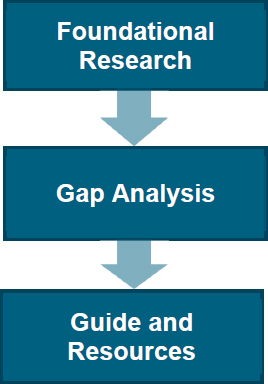
This project’s research approach, shown in Figure 1, was rooted in foundational research that involved a survey of published literature and stakeholder outreach in the form of a broadly disseminated survey, follow-up interviews, and a stakeholder webinar. Building on the foundational research, a workforce gap analysis was conducted to contextualize the foundational research and associate workforce gaps caused by the introduction of new technologies with their root causes. Next, resources and strategies for navigating these challenges were developed for inclusion in the workforce preparedness guide.
Foundational Research
The foundational research was comprised of findings derived from trends in literature and insights collected from stakeholders through surveys, interviews, and a stakeholder webinar. The foundational research provides clarity on the workforce challenges associated with the adoption of emerging technologies in the transportation industry and highlights which are currently unmet—or perceived to be unmet—by existing resources. The project team gathered a diverse array of perspectives from state and regional agencies, contractors, industry partners, local workforce organizations, academics, and many others.
The foundational research shed light on numerous topics that set the direction for the project. These challenges and opportunities span a variety of subjects including the technologies themselves, how agencies are adapting to new technologies, how academia and other programs can better support the evolving industry, and the availability of resources. Table 1 lists the topics and provides a brief description of the finding. More detail relating to each of these emerging themes can be found in Chapter 3: Foundational Research.
Table 1: Foundational Research Themes and Brief Descriptions
| Themes | Brief Description |
|---|---|
| Factors Influencing Deployment of Technology | Factors such as regulation, funding, availability of data and other factors outside of agency’s scope have direct influences on their ability to prepare the workforce. |
| Need for New KSAs | Emerging technologies are transforming the knowledge, skills, and abilities (KSAs) needed within the transportation workforce. |
| Perceptions of Agency Preparedness | Agencies are at different stages of adapting to new and emerging technologies. |
| Themes | Brief Description |
|---|---|
| Challenges throughout the Project Lifecycle | Agencies experience workforce challenges throughout the project lifecycle including programming and funding, systems integration, and maintenance and operations. |
| Fostering a Stronger Workforce Pipeline | Agencies are undertaking actions to prepare their workforce and acknowledge continued investment and training in the workforce pipeline is necessary to better prepare their workforces. |
| Academic and Trade Program Opportunities | Some academic and trade programs have evolved to better prepare students to work with emerging technologies; however, there remains a need for widespread curriculum adaptation to ensure students are receiving the necessary technical and professional skills to meet current industry needs. |
| Adapting Recruiting and Hiring Strategies | Agencies need to continue to adapt their recruiting and hiring strategies to better reach qualified candidates. |
| Agency Near-Term Workforce Adaptation Actions | Agencies are implementing targeted strategies to provide tools and resources for their existing workforce, enabling a better response to changes caused by emerging technologies. |
| Existing Workforce Development Resources | Availability of existing workforce development resources varies by technology with the greatest availability for intelligent transportation systems (ITS), traffic management centers (TMC), transportation systems management and operations (TSMO), and electric vehicle (EV) technologies. |
Workforce Gap Analysis
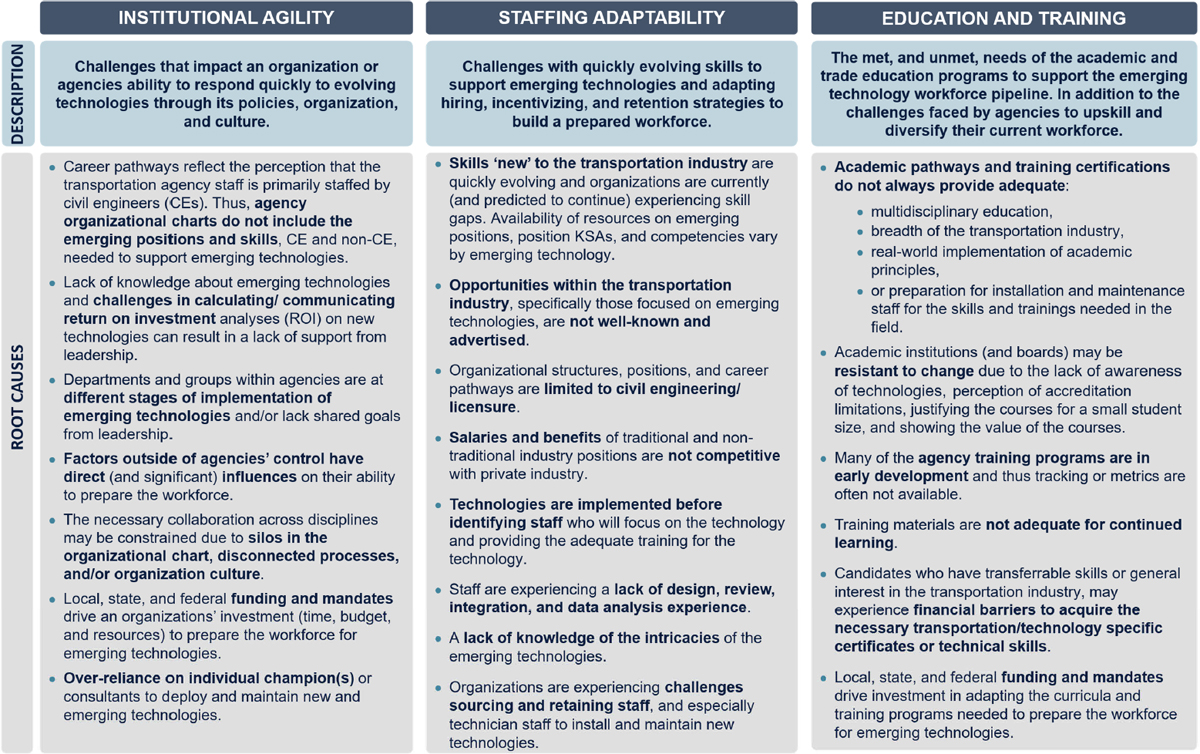
Once the project’s foundation was set through the literature review and stakeholder outreach, a workforce gap analysis was conducted to identify the persisting workforce needs for all levels of staff responsible for planning, implementing, maintaining, and operating emerging technologies. The findings from the workforce gap analysis are summarized in Figure 2. In reviewing “root causes” (defined as challenges or tensions experienced as organizations prepare for emerging technologies based on the literature review or stakeholder outreach) and “workforce gaps” (defined as the manifestation of the identified root causes), three overarching categories of challenges emerged: (1) institutional agility, (2) staffing adaptability, and (3) workforce pipeline. Chapter 4: Workforce Gap Analysis provides additional detail regarding the identified root causes, workforce gaps, and the available existing resources for agencies. The workforce gaps and resource gaps that emerged from this analysis informed the resources that may be most needed and/or useful to include in the guide.
Guide Overview and Resources
The guide developed through this project is a concise, graphically designed document with quick-reference material suited for a broad range of topics. The guide is structured around the three themes (institutional agility, staffing adaptability, and workforce pipeline) that emerged from the foundational research, with each chapter containing resources intended to help agencies and other stakeholders navigate the workforce and resource gaps identified through the workforce gap analysis. The developed resources are generally targeted towards all levels of agency staff, though one of the resources (WP-2) is specifically targeted towards education partners (e.g., university, trade, K-12 representatives). A brief description of the resources available in each chapter is provided below in Table 2. Chapter 5: Guide Overview and Resources includes greater detail on the guide format, content, and resources.
Table 2: Guide Resources and Descriptions
| ID | Resource Title | Resource Description  |
|---|---|---|
| Institutional Agility (IA) | ||
| IA-1 | Fostering Multidisciplinary Teams of the Future | Discussion of the value proposition for introducing multidisciplinary organizational teams into traditionally siloed organizational structures. Case studies of challenges and solutions are included. |
| IA-2 | Modernizing Organizational Structure and Culture | Implementation strategies for adapting organizational structures and fostering a culture that supports modern operational needs, implementable from local teams to agency wide. |
| IA-3 | Building a Business Case for New Positions | Framework and discussion guide for developing a business case to advocate for changes to existing positions, introduce new positions, and curate unique career paths. |
| IA-4 | Developing Compelling Benefits Packages | Worksheet to evaluate current or new positions and skills compensation packages relative to agency goals, agency compensation philosophy, and market value. |
| Staffing Adaptability (SA) | ||
| SA-1 | Emerging Positions and Skills | Tables of emerging positions in the transportation industry and knowledge, skills, and abilities by six key sectors. Additional details on the emerging positions are outlined in the guide’s Appendix. |
| SA-2 | Deciding to Upskill, Hire, or Outsource | Decision tool to help agencies decide whether to upskill current employees, hire new staff, or outsource tasks to address skill gaps effectively. |
| ID | Resource Title | Resource Description |
|---|---|---|
| SA-3 | Developing and Promoting New Career Paths | Strategies to create opportunities for staff’s growth personally, within their teams, and their agencies. |
| SA-4 | Leveraging Vendor Contracts for Internal Skill Building | Set of strategies to better leverage existing or future technology vendor contracts to build a resilient operation and maintenance team. |
| SA-5 | Identifying Transferrable Skills for Recruiting and Hiring | Framework for recruiting from traditional and nontraditional disciplines and table of transferable skills cross tabulated by adjacent fields. |
| SA-6 | Keeping Pace with Technology through Professional Organizations and Trainings | Tables of professional organizations and federal online training programs for current and prospective industry candidates. |
| Workforce Pipeline (WP) | ||
| WP-1 | Cultivating Agency Relationships with Education Partners | A maturity model for agencies to develop and strengthen relationships with educational institutions (e.g., K-12, university, college, trade) organized by current involvement between the agency and partner. |
| WP-2 | Modernizing Education Paths into the Transportation Industry | Case study discussions for education partners on adapting and building momentum within their programs to better meet the workforce needs. |
Conclusions and Suggested Research
This final report provides a comprehensive review of the research conducted throughout the NCHRP 20-102(20) project and documents many of the challenges and opportunities for resource development to advance the transportation workforce in the face of emerging technologies. The produced guide builds on these conclusions, responding to the need for resources that support short-term and long-term workforce advancement at transportation agencies. This final section of the report describes strategies for NCHRP to promote and advance the outcomes of this project, and highlights opportunities for further research that can be explored to continue to advance workforce development amidst technology transformations.


