Preparing the Transportation Workforce for Emerging Technologies: Developing a Guide (2026)
Chapter: 2 Research Approach
Chapter 2: Research Approach
Workforce Challenges Associated with Emerging Technology
The evolution of technology has resulted in more complex software and systems for agencies to develop, implement, use, manage, and integrate. Field equipment is becoming more robust, communications can be accomplished in many areas through wireless and cellular capabilities, and machine learning and artificial intelligence are enabling automated strategy implementation, whereas prior generations of systems required time and data-intensive analysis. While many of these capabilities allow agencies to respond faster to impacts on the roadways—in some instances even allowing agencies to predict when impacts will require a change in strategy—transportation agencies need a workforce that can support these increasingly complex technology environments. In addition to field and center technologies, there are needs for technical capabilities in data management and data sharing, analysis, cybersecurity, and CV/AVs.
Degree programs, such as civil engineering degrees, may not adequately prepare graduates for the emerging technology environment at transportation agencies. Most technical training is provided on-the-job or through focused topical training. Many roles and jobs within agency ITS or transportation management groups require a combination of knowledge within information technology, software development/management, system operations, data analysis, electrical engineering, telecommunications, networking/hardware, and other highly technical disciplines. For this reason, the industry focus has been on hiring a blended workforce and building a team of individuals with a variety of technical backgrounds to meet the deployment needs. The greatest challenge with this approach is agencies’ abilities to attract talented individuals with these alternative skillsets who are often unaware of the opportunities in the emerging transportation technologies space.
Research Need and Objectives
The NCHRP 20-102 program was established in 2015 to explore the impacts of CAVs on state and local transportation networks. The objectives of this program are centered around understanding the transformational changes CAVs will have on infrastructure owners and operators, identifying critical issues, researching those issues to identify solutions, and conducting technology transfer and information exchange to ensure the transportation industry remains updated as the landscape of driving and infrastructure needs rapidly change.
The outcome of NCHRP 20-102(20) is a comprehensive, practical guide for transportation agency modernization, recruitment, hiring, development, and retention of a workforce proficient in developing and deploying complex transportation technology and systems. The guide addresses short-term and long-term strategies for workforce development, including consideration of how and when to outsource in addition to or in place of building capacity internally. The guide builds upon and integrates findings from past studies to identify actionable strategies that enable transportation agencies to build and bolster their workforce by asking the right questions, hiring the right people with the right skill sets, and providing internal development opportunities to develop and retain talented staff.
The three primary project objectives are:
- Review and consolidate past research and survey transportation agencies to converge on the critical current and future transportation agency workforce needs.
- Develop decision support material to provide specific workforce development recommendations to agencies accounting for unique challenges, priorities, and requirements faced by different organizations.
- Produce a user-friendly guide that details strategies for recruiting, hiring, developing, and retaining staff with the necessary skill sets to deliver, operate, and maintain the current and future transportation system.
Research Approach
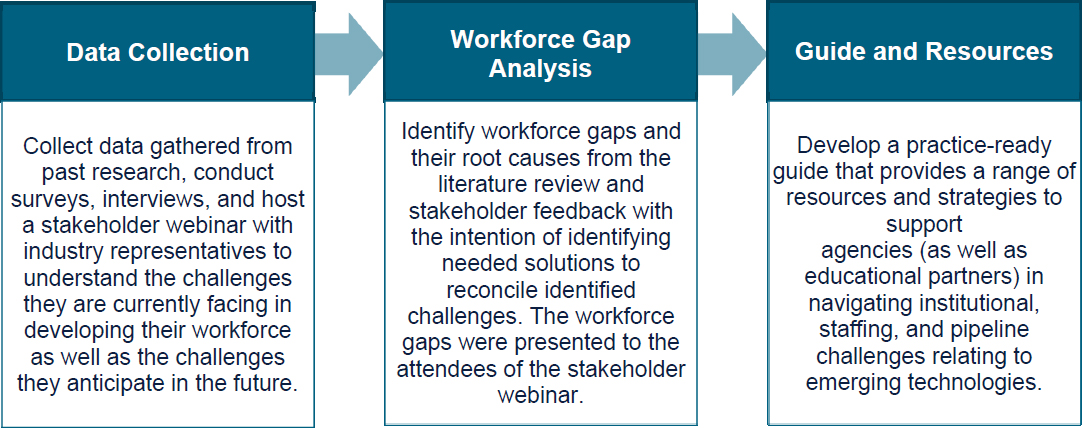
The research approach, shown in Figure 6, was used to develop NCHRP Research Report 1174: Preparing the Transportation Workforce for Emerging Technologies: A Guide. The approach was rooted in foundational research that involved a literature review and stakeholder outreach in the form of a broadly disseminated survey, follow-up interviews, and a stakeholder webinar. Building on the foundational research, a workforce gap analysis was conducted to contextualize the foundational research and associate gaps in the workforce caused by the introduction of new technologies with their root causes. Next, strategies for overcoming those root causes were developed for inclusion in the outline of content to be developed for the guide. The guide contains directly applicable and implementable resources for transportation agencies to leverage as they plan for the adoption, deployment, and maintenance of emerging technology.