Preparing the Transportation Workforce for Emerging Technologies: Developing a Guide (2026)
Chapter: 1 Background
Chapter 1: Background
As the transportation industry adapts to rapidly changing technologies, it is important to understand the evolution of these technologies and their impact on the industry. This chapter provides historical context and highlights eight prominent emerging technologies within the industry that are posing some of the greatest workforce challenges. Additionally, this chapter introduces the motivation, need, and research approach from NCHRP project 20-102(20) Preparing the Transportation Workforce for the Deployment of Emerging Technology.
Overview
An “industrial revolution” by definition refers to a societal shift that revolutionizes or significantly changes the way we live, how we work, and the tools we use. Many historians suggest our modern society has lived through four industrial revolutions:
1760s – The first industrial revolution embodies the economic transformation from agriculture to industry, where mechanical processes were developed to manufacture products. This revolution was driven by the discovery of coal, which led to the invention of the steam engine that transformed the way goods were made and transported.
1870s – The second industrial revolution was shaped by the discovery of electricity, gas, and oil, which led to the invention of the combustion engine (eventually the invention of the plane and car) and developments in communication (first the telegraph, then the telephone).
1970s –The third industrial revolution is earmarked by the discovery of computers, which introduced system automations and memory-programmable controls and enabled the creation of small automated systems that replaced small repetitive tasks.
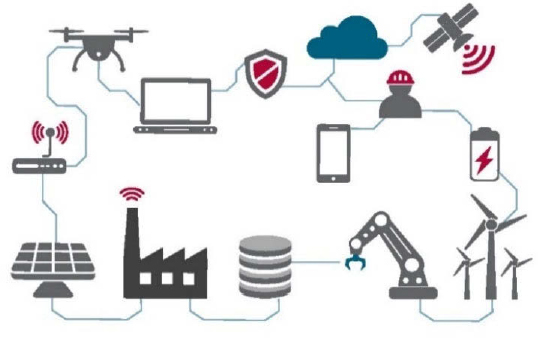
2010s – The fourth, and current, industrial revolution is defined by the proliferation of the internet-of-things (IoT) and smart automation. The rapid growth in technology and interconnectivity are leading to more than the efficiency improvements that started in the 1970s. Rather than isolated automated systems performing specific tasks, we now see complex cyber-physical systems, such as smart factories, smart homes, smart phones, automated driving systems, and vehicle to vehicle/device connectivity where all systems communicate, as shown in Figure 3, with one another to perform tasks autonomously and provide immediate feedback.
Historically, the priorities and workforce of transportation agencies have been shaped by the industrial opportunities and transportation challenges of the day. There is perhaps no better example than present-day as agencies adapt to the unprecedented connectivity among transportation systems and between systems and users. New technologies have opened
the door to new forms of transportation system development, operation, and maintenance, with the greatest differentiator being the merging of physical infrastructure with digital connectivity.
This latest technological revolution is launching many new industries and is requiring many existing industries to adapt to a rapidly changing environment. The transportation industry is a prime example of this adaptation. State DOTs started as highway agencies, hiring primarily civil engineers to construct, operate, and maintain interstate highways. Local and regional transportation organizations are primarily focused on transit operation and multimodal infrastructure (bike and pedestrian), hiring urban planners and civil engineers. However, as new technologies emerge on our streets and sidewalks, transportation agencies are recognizing the need for adaptations in the workforce to keep up with this technological transformation and take advantage of current and future advancements that have the potential to improve transportation safety, mobility, efficiency, and resiliency.
Through NCHRP 20-102(20) the project team developed a usable guide to support agencies in building and bolstering their workforce’s ability to design, deploy, operate, and maintain emerging transportation technologies.
Emerging Technologies in Transportation Industry
Emerging and disruptive technologies have the potential to provide transformative benefits to the transportation system but are accompanied by a long list of potential challenges for state, regional, and local transportation agencies. For the purpose of this project, emerging transportation technologies are defined as applications of technology in new and existing facets of the transportation network that are not currently widely capitalized on by agencies.
A few of the most prevalent emerging technologies include intelligent transportation systems (ITS); connected vehicles (CVs), infrastructure and devices; automated vehicles (AVs), electric vehicles (EVs), mobility on demand (MoD)/mobility as a service (MaaS), artificial intelligence/machine learning (AI/ML), data collection technologies, and big data and data management. The challenges associated with embracing these emerging technologies have widespread impacts throughout transportation agencies emerging as critical elements throughout all project lifecycle stages including project design, construction and deployment, system operation, and maintenance.
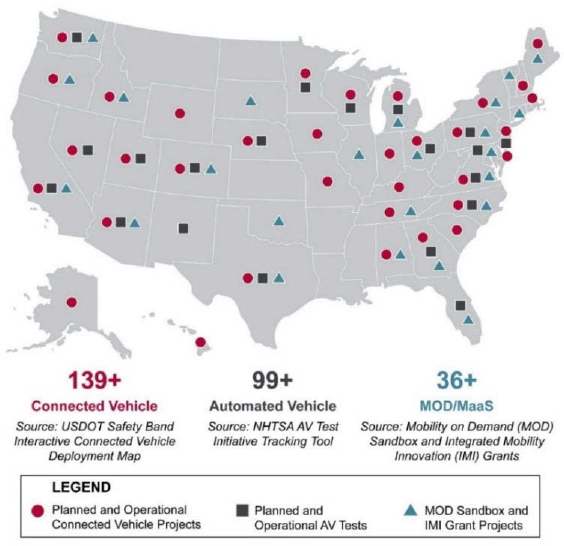
Several states are developing technology readiness plans that include road maps for potential introduction of novel technologies within their organization. Other agencies have engaged in early deployments, pilots, demonstrations, and tests of these emerging technologies. Figure 4 illustrates the vast deployment of emerging transportation technologies in the United States.
Intelligent Transportation Systems (ITS)
Transportation agencies rely on technology to support system operations, real-time communications, active monitoring, and management of transportation infrastructure, and to enable increasingly complex operating strategies to improve safety and mobility of corridors throughout the country. Early ITS deployments focused primarily on urban freeway corridor monitoring and management strategies; many agencies implemented first-generation camera and detector technologies, control strategies (such as ramp meters), fiber communications technologies such as copper and twisted wire pair, and overhead electronic message boards. These devices were monitored and controlled from operations centers with multiple servers, monitors, and consoles. In some areas, technology enabled more efficient operations such as plowing, winter road treatments, and monitoring for weather conditions that could impact road travel.
Data Collection Technologies
Data collection technologies like drones have profoundly impacted the transportation industry by offering new capabilities in monitoring, surveying, and infrastructure inspection. Drones equipped with high-resolution cameras and sensors can gather detailed data on road conditions, bridge stability, and traffic patterns more efficiently and cost-effectively than traditional methods (1). This information is crucial for maintenance planning, identifying potential hazards, and ensuring infrastructure safety.
In addition to drones, Internet of Things (IoT) devices embedded in vehicles and infrastructure collect real-time data on performance metrics, traffic flow, and environmental conditions. This continuous stream of information enables transportation agencies and operators to make data-driven decisions—for example, rerouting traffic to alleviate congestion based on actual traffic patterns rather than relying on predetermined schedules.
Advances in data analytics and AI allow for deeper insights and predictive capabilities. By analyzing historical and real-time data from various sources, such as drones, IoT devices, and traffic cameras, transportation stakeholders can anticipate challenges, optimize operations, and improve overall efficiency. These technologies not only enhance safety and reliability but also pave the way for smarter, more adaptive transportation systems capable of meeting future demands effectively.
Additionally, data and analytics can support reporting and planning. As more agencies and organizations move toward data-driven decision-making, high-quality and real-time data can be effective resources to enhance reporting capabilities, support decision-making for near-term planning and projects, and inform the development of long-range plans.
Big Data and Data Management
Big Data and advanced data management techniques are quickly infiltrating the transportation industry by offering unprecedented insights and capabilities. The sheer volume of data generated from sources such as GPS systems, sensors in vehicles, traffic cameras, and mobile devices provides a sizeable amount of data that can be leveraged to improve transportation networks. One significant impact is in traffic management, where real-time data analytics enable authorities to monitor traffic conditions dynamically, identify congestion hotspots, and adjust signals or reroute traffic to optimize flow (2). Utilizing these tools has reshaped the workforce by improving efficiency and personalizing user experience.
Analyzing historical data plays a crucial role in proactive maintenance for transportation infrastructure and vehicles. By examining previous data on maintenance timelines, usage patterns, and environmental factors, transportation companies can predict when components are likely to fail and schedule proactive repairs or replacements. This proactive approach minimizes downtime, reduces maintenance costs, and enhances overall liability.
On top of that, big data facilitates personalized services and operational efficiencies. For example, ride-sharing platforms utilize data analytics to match drivers and passengers efficiently, optimize routes, and predict demand. Airlines use data to optimize flight schedules, pricing strategies, and customer service (3). These services enable smarter decision-making, improving operational efficiency, and enhancing the overall quality of service.
Artificial Intelligence/Machine Learning
With increases in computing power, and more recently, with advances in distributed computing in the cloud, Artificial Intelligence (AI) and Machine Learning (ML) are being applied in more areas as a new way to solve problems. Whereas computers have been automating human tasks for decades—starting with simple adding machines—AI allows computers to take on more complex tasks that mimic human decision-making and judgement. With AI able to conduct more complex tasks such as data collection, processing, and analysis, agencies may reconsider how they outsource these tasks, or if these tasks are conducted in-house, identify opportunities for their existing staff to become more efficient, upskill, and/or work on more engaging and nuanced tasks. AI and ML have potential to revolutionize the transportation industry by enhancing efficiency, safety, and customer experience across various sectors.
In the field of Transportation Systems Management and Operations (TSMO), where practitioners are tasked with safely and efficiently moving people and goods in a highly complex and dynamic system, there is promise that AI can help with decision-making. Specifically, engineers and Transportation Management Center (TMC) operators need to make real-time decisions based on travel disruptions that are not based on simple rules or intuition, but that have been proven and vetted to be the best course of action based on the current situation.
Another application within the transportation industry is automated vehicles, where AI algorithms enable vehicles to perceive their surroundings, make decisions in real-time, and navigate without human intervention. This technology attempts to reduce accidents, optimize traffic flow, and potentially redefine urban planning by prioritizing safety and efficiency.
Additionally, AI has transformed logistics and supply chain management by optimizing route planning, predictive maintenance, and inventory management (4). Machine learning algorithms analyze large amounts of data to predict demand patterns, reduce idle times, and optimize delivery routes, thereby cutting costs and improving delivery times.
AI-powered systems have the potential to enhance public transportation by providing real-time updates on schedules, optimizing transit routes, and improving passenger access. Machine learning algorithms can analyze patterns and adjust services accordingly, ensuring more reliable and responsive public transportation systems.
Connected Vehicles, Infrastructure, and Devices
Connected vehicle (CV) technologies enable vehicles, infrastructure, and personal devices to communicate and share information via wireless communication technology. Connected vehicles are often communicating with other vehicles, infrastructure, and applications. Onboard units (OBUs) installed on vehicles continually broadcast information on the vehicle’s position,
direction, and speed in the form of a basic safety message (BSM) (5). Another component of the communication chain is roadside units (RSUs), which are installed along the roadway that can receive and broadcast messages (e.g., traveler information messages [TIMs]), helping to further improving safety and enhancing mobility. CVs communicate wirelessly with radios. Communication is enabled through the safety band—the radio spectrum reserved for transportation safety. Opportunities also exist to communicate with smartphones and other connected devices using cellular communications.
Connected Vehicle Terminology
- V2V (vehicle-to-vehicle) describes the technology for vehicles to communicate with each other.
- V2I (vehicle-to-infrastructure) describes the technology for vehicles to communicate with roadway infrastructure, such as traffic signals and tolling facilities.
- V2P (vehicle-to-pedestrian) describes the technology for vehicles to communicate with pedestrians.
- V2X (vehicle-to-everything) is the umbrella term indicating vehicle-to-anything connections.
Vehicle-to-Vehicle (V2V) applications are expected to provide significant safety benefits. These applications will be advanced by automotive original equipment manufacturers (OEM). Infrastructure owners and operators (IOOs) likely have a limited, if any, role in deploying V2V applications. Vehicle-to-infrastructure (V2I) applications offer the potential to provide mobility and safety benefits. These applications will be deployed in vehicles but enabled by messages provided by infrastructure.
The applications below provide a sample of CV applications transportation agencies are considering or beginning to deploy (6).
- Warnings about Upcoming Work Zones
- Advanced Traveler Information Systems
- Incident Scene Work Zone Alerts for Drivers and Workers
- Electronic Toll Collection
- Reduced Speed Zone Warning/Lane Closure
- Traveler Information-Smart Parking
- Curve Speed Warning
- Spot Weather Impact Warning
- Transit Signal Priority
- Pedestrian at Crosswalk Warning
- Emergency Vehicle Preemption
- Dynamic Ridesharing
- Incident Scene Prearrival Staging Guidance for Emergency Responders
- Road Weather Information for Maintenance and Fleet Management Systems
- Variable Speed Limits for Weather-Responsive Traffic Management
- Road Weather Warning
- In-Vehicle Signage
- Warnings about Work Zone Hazards in a Work Zone
- Red Light Violation Warnings
- Wrong Way Driver Warnings
- Queue Warning
- Speed Harmonization
- Road User Charging
- Vehicle Data for Traffic Operations
- Performance Monitoring/Planning
- Enhanced Maintenance Decision Support System
- Advanced Automatic Crash Notification Relay
- Road Weather Information and Routing Support for Emergency Responders
According to the USDOT’s Interactive Connected Vehicle Deployment Map there are 139 planned and operational CV deployments across 27 states (7). These deployments have been fostered by federal grants and initiatives including, but not limited to, the USDOT’s CV Pilot Deployment Program, SpaT Challenge, Saving Lives with Connectivity: Accelerating V2X Deployment, and Advanced Transportation and Congestion Management Technologies Deployment Program (ATCMTD) grants.
Automated Vehicles (AVs)
AVs are equipped with technologies that could replace human driver functions. These vehicles detect their surroundings using a variety of onboard sensors that may include radar, LiDAR, high-definition cameras, global positioning system data, and dead reckoning in tunnels and urban canyons. An advanced control system merges these information sources to interpret data to detect traffic signals, traffic control signs, obstacles, pedestrians, bicyclists, and pavement markings. Software on the vehicle processes the various inputs, interprets the information, and directs the vehicle (e.g., provides acceleration, braking, and steering inputs) along a path based on what it perceives (8).
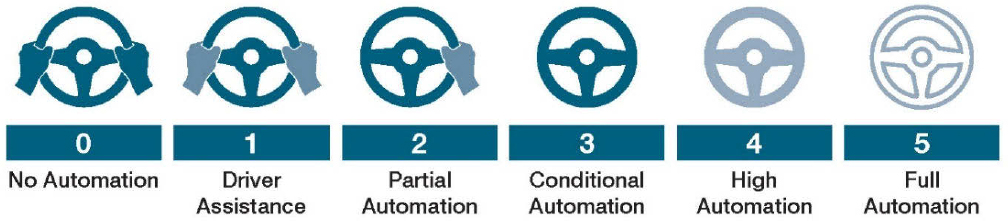
The Society of Automotive Engineers (SAE) International developed a classification system of six levels of automation, ranging from no automation to full automation shown in Figure 5 (9). These levels of automation as seen in the graphic above have been adopted by USDOT. While full automation (Level 5) may not be a reality, lesser levels of automation have already been deployed and are on our streets today.
While AVs can operate without connectivity, CAVs offer opportunities for vehicles to communicate with other vehicles, infrastructure (e.g., traffic signals), and traffic operation centers (TOCs). TOCs could, in turn, use the data to optimize overall system performance. CAVs also offer opportunities to improve interactions with work zones and vulnerable road users, such as bicyclists and pedestrians, to improve safety.
According to the National Highway Traffic Safety Administration’s (NHTSA) Test Tracking Tool, nearly 100 test initiatives have been reported across the United States. These tests include demonstrations and deployments of 40 automated shuttles, 42 cars, 8 delivery robots, and 6 heavy trucks (10). To support these initiatives, 30 states have enacted AV legislation, six states have executive orders, and five states have both.
Mobility on Demand (MoD) and Mobility as a Service (MaaS)
Although shared vehicles are not a technology themselves but rather a service enabled by other technologies, they may significantly impact mobility. A growing number of consumers are seeking convenient access for mobility to get from point A to point B while viewing vehicle ownership as a burden rather than a benefit. Shared mobility—the shared use of a vehicle, bicycle, or other travel modes—is an innovative transportation strategy that enables short-term access to transportation modes on an as-needed basis. Sharing can include sequential sharing (i.e., different users share the same transportation vehicle or equipment, one after the other) or concurrent sharing (i.e., sharing of the same transportation vehicle or equipment by multiple household users for the same trip) (11). Examples of shared mobility services include shuttles, taxis, public transit, pedicabs, paratransit, ridesharing, scooter sharing, shuttles, and transportation network companies (TNCs).
The convergence of on-demand shared travel, automation, and electric technology coupled with the commodification of transportation and multimodal integration (digital information and fare payment integration) could make the car more cost effective, efficient, and convenient. Digital information and fare integration coupled with the commodification of transportation services is contributing to new on-demand access models such as MoD and MaaS.
MoD is a new concept based on the principle that transportation is a commodity where modes have economic values that are distinguishable in terms of cost, journey time, wait time, number of connections, convenience, and other attributes (12). MoD enables consumers to access mobility, goods, and services on demand by dispatching or using shared mobility, delivery services, and public transportation solutions through an integrated and connected multimodal network.
MaaS primarily focuses on passenger mobility and subscription services breaking travel with suppliers, repackaging, and reselling it as a bundled package (13). Extending from the basics of car sharing and TNCs, new MaaS options include transit, scooters, and bicycles from single payment apps.
Many agencies are taking steps to advance MoD and MaaS across the country. Many of these deployments have been aided by federal grants including the MoD Sandbox (11 recipients), the recent Integrated Mobility Initiative grants (25 recipients) and Accelerating Innovative Mobility programs sponsored by Federal Transit Administration.
Electric Vehicles (EVs)
EVs derive all or part of their power from the electric grid and is stored in batteries within the vehicle. All electric vehicles (AEVs) consume no petroleum-based fuel and produce no tailpipe emissions. AEVs include battery electric vehicles and fuel cell electric vehicles. Plug-in hybrid electric vehicles use batteries to power an electric motor while relying on petroleum-based or alternative fuels to run the internal combustion engine. Most OEMs are now committed to transition from fossil fuels to a largely electric fleet throughout the next 10-15 years—expanding from luxury sports cars and hybrids to fully electric sedans, trucks, and even heavy-duty vehicles for freight. In the future, some experts believe that higher levels of AVs and automated fleets will be EVs (14).
Charging stations are needed to support EVs. The deployment of EV charging infrastructure is growing exponentially across the U.S. with a mixture of IOO-managed stations and privately-operated charging locations (Evgo, Electrify America, etc.). Opportunities exist for grid modernization that appreciates the duty cycles and use of vehicles as well as their potential to add energy back into the grid. More advanced concepts include overhead electrified cabling for hybrid trucks as well as on-road wireless (inductive) charging that uses an electromagnetic field to transfer electricity to an EV wirelessly. Finally, opportunities exist to leverage the right-of-way (ROW) to install clean, renewable energy sources such as solar and wind power. Opportunities exist for agencies to either leverage these clean energy sources or to or allow companies to use their ROW as a potential revenue source.


