Developing a Guide for Local Truck Parking Regulations (2026)
Chapter: Appendix B: Regulatory Survey

APPENDIX B
Regulatory Survey
NCHRP Survey of States and Local Comprehensive Planning
State mandates for comprehensive plans present a valuable opportunity to provide guidance for local governments grappling with truck parking issues. By incorporating directives within comprehensive plans, states can delineate guidelines for managing local land use and transportation concerns. Given that truck parking intersects with both land use zoning and transportation infrastructure, it is essential to address factors like site development and community impact within these plans and subsequent regulations. The framework established by state statutes dictates the extent to which local governments are required or recommended to address various issues around specific planning elements, such as land use and transportation. Not all states mandate the same level of analysis or guidelines in local plans. For instance, 31 states necessitate transportation or land use elements (often both) in the development and adoption of local comprehensive plans. Many other states offer guidance or recommendations on including these elements but do not enforce their incorporation. Nonetheless, comprehensive plans play a pivotal role in effectively implementing zoning regulations at the local level. Plans that acknowledge freight movement issues, including efficient truck parking provision, ensure a coordinated effort in addressing truck parking challenges within communitiesʼ subsequent policies and regulations. To facilitate appropriate decisionmaking approaches at the local level, it is beneficial to understand which states mandate regular updates to local comprehensive plans and require the inclusion of transportation and land use elements.
Table B.1, derived from the APAʼs 2022 Survey of State Planning Laws and further analysis of referenced state statutes, offers insight into the status of this practice (American Planning Association 2022).
NCHRP Truck Parking Regulations Best Practices Review
A nationwide review of truck parking regulations was conducted using sources available through APA, FHWA, state freight plans, and other literature research search engines. The search terms consisted of “tractor trailer parking area,” “truck parking,” “heavy vehicle parking,” and “truck tractor parking.” The following topics of interest were targeted:
- No truck parking on city streets (or limited).
- Regulations for trailer and semi-trailer parking only.
- Time restrictions for truck parking on city streets.
- Time restrictions for truck parking on city streets and no truck parking in residential areas.
- Weight regulations for truck parking.
- Dimensional standards for truck parking and loading.

Long Description.
The table has 3 columns and 52 rows. The column headers in Row 1 are: State; Mandate for Regular Update to Local Comprehensive Plans; Transportation or Land Use Element Requirement. Row 2: Alabama; NA; NA. Row 3: Alaska; Yes; No. Row 4: Arizona; Yes; Yes. Row 5: Arkansas; NA; NA. Row 6: California; Yes; Yes. Row 7: Colorado; Yes; Yes. Row 8: Connecticut; Yes; Yes. Row 9: Delaware; Yes; NA. Row 10: District of Columbia; NA; Yes. Row 11: Florida; Yes; Yes. Row 12: Georgia; Yes; Yes. Row 13: Hawaii; NA; Yes. Row 14: Idaho; NA; Yes. Row 15: Illinois; Yes; NA. Row 16: Indiana; NA; Yes. Row 17: Iowa; NA; NA. Row 18: Kansas; NA; Yes. Row 19: Kentucky; Yes; Yes. Row 20: Louisiana; NA; NA. Row 21: Maine; NA; Yes. Row 22: Maryland; Yes; Yes. Row 23: Massachusetts; NA; Yes. Row 24: Michigan; Yes; Yes. Row 25: Minnesota; Yes; Yes. Row 26: Mississippi; NA; Yes. Row 27: Missouri; NA; NA. Row 28: Montana; Yes, Yes. Row 29: Nebraska; NA; Yes. Row 30: Nevada; Yes; Yes. Row 31: New Hampshire; NA; Yes. Row 32: New Jersey; Yes; NA. Row 33: New Mexico; NA; NA. Row 34: New York; NA; NA. Row 35: North Carolina; Yes; Yes. Row 36: North Dakota; NA; NA. Row 37: Ohio; NA; NA. Row 38: Oklahoma; NA; NA. Row 39: Oregon; Yes; Yes. Row 40: Pennsylvania; NA; Yes. Row 41: Rhode Island; NA; Yes. Row 42: South Carolina; Yes; Yes. Row 43: South Dakota; NA; NA. Row 44: Tennessee; NA; NA. Row 45: Texas; NA; NA. Row 46: Utah; NA; Yes. Row 47: Vermont; Yes; Yes. Row 48: Virginia; Yes; Yes. Row 49: Washington; Yes; Yes. Row 50: West Virginia; Yes; Yes. Row 51: Wisconsin; NA; Yes. Row 52: Wyoming; NA; Yes. Note 1: NA = not applicable. Note 2: Not a complete survey. Many states require regular updates but do not provide the timeframe for acting on this requirement. Note 3: Hawaii provides for statewide planning mandates. Note 4: Oregon requires a periodic review to examine, as necessary, updates to comprehensive land use plans depending on size and context of the planning entity as defined in state statutes. Source: American Planning Association. 2022 Survey of State Planning Laws: Land Use, Hazard Mitigation, and Climate Action. Accessed at: h t t p s colon double slash storymaps dot arcgis dot com slash stories slash 142 e e c 1 a e 7 f e 42 b e 915 b 6 7 6 7 a c 811 e 40 and Various State Statutes as referenced above.
- No truck parking in residential areas (or exceptions): regulations prohibiting the standing or parking of trucks on streets in residential areas, except for commercial purposes of loading and unloading.
- No truck parking on city streets: prohibit all parking of all commercial and freight trucks on city streets without considering a minimum threshold weight of the vehicle.
- Regulations for trailer and semi-trailer parking only: prohibits the parking of trailers and semi-trailers on streets.
- Time restrictions for truck parking: hours restricted on municipal streets; time restrictions for parking trucks on streets in the nonresidential areas.
- Time restrictions for truck parking on all streets and no truck parking in residential areas:
- Weight regulations for truck parking: regulate the gross vehicle weight (GVW) of a truck or a truckʼs chassis manufacturer rating to limit truck parking on municipal streets.
- Heavyweight restrictions for truck parking in residential areas: 25,000 pounds (GVW) or more parking in residential areas.
- Lightweight restrictions for truck parking in residential areas: lightweight threshold of a truckʼs GVW ranging from 10,000 pounds to 14,500 pounds.
- Lightweight restrictions for truck parking on city streets.
- Other restrictions for lightweight truck parking in residential areas: restrict truck parking based on a truckʼs chassis manufacturer rating. In Arizona, Gilbert and Tolleson prohibit trucks with a chassis rating exceeding one ton (2,000 pounds) from parking on a street in a residential area, whereas Phoenix lowers the chassis threshold to 0.75 tons (1,500 pounds) for restricting truck parking on residential streets.
Other topics to note include the following:
- From the National Coalition on Truck Parking: State, Regional, and Local Government Coordination Working Group—November 30, 2017:
- Ensure local zoning for industrial uses and truck parking. We hear often about truck drivers needing to park after making a delivery, but they are not able to find parking.
- We could encourage communities to plan and stay ahead of potential truck parking problems by showing that planning for parking can make your facility more attractive to truck drivers.
- Through this working group, we could show companies the positive impacts that Elmira, New York, and Weed, California, have experienced by staying at the forefront of truck parking requirements. Another positive example is the program in Winterhaven, Florida, that requires high visibility of the drivers that park and exit their vehicles.
- Different categories of truck parking, such as curbside parking, staging, hours of service (HOS), and parking for trucks while their drivers are at home.
- Minimum land requirements for the development of private truck stops.
- Freight overlay zones that specify requirements for setbacks, parking, driveway spacing, and design criteria (truck turning radii).
- Zoning for truck stops.
- Freight parking and loading zones.
- Loading and parking restrictions.
- On-site or off-site staging requirements.
- APA Policy Guide on Freight (https://www.planning.org/policy/guides/adopted/freight/): traffic and parking regulations that accommodate local freight demand; municipalities should require loading zones to be incorporated in new developments and set standards for them as well as for loading docks as a part of certain land uses. Providing appropriate locations for truck lay-by parking to accommodate required driver rest periods should also be considered.
- Gaps and Barriers.
- E-charging for trucks—can non-e-trucks use the spaces?
- Dust ordinances in western states (Henderson, Nevada) as a potential barrier.
-
- Private companies.
- Prologis (trailer pull); what do you do if you sit and wait? (bob-tail section for short-term parking).
- Bob-tail parking.
- Need for better warehousing and distribution facility design. Large facilities can be built to include resting spaces and truckers lounges that allow drivers a place to shower and, in some cases, eat. Many current facilities that receive trucks do not allow drivers to park before or after making their delivery.
- Opportunities: What are dimensions for truck off-street parking?
- Very few zoning or traffic codes include parking provisions in terms of requiring developments to provide a specific number of truck parking spaces—part of the problem is lack of guidance on truck parking rates, especially if a new industrial facility is speculative (i.e., built on spec without knowledge of the future tenant or operations).
- The most frequent provision in either the zoning code or the traffic code is the strict prohibition of commercial motor vehicles or tractor trailer parking in residentially zoned districts. In some circumstances, exceptions may be permitted with special permission either from the police chief or zoning administrator. This prohibition, however, does not apply to temporarily stopped, standing, or parked trucks for the purpose of pickup or delivery (e.g., staging). However, the temporary stopping, standing, or parking of trucks shall not continue overnight.
- The FMCSA regulations define motor vehicles used in commerce to transport goods. The definitions are found in Sections 382.107 and 383.5. This definition applies to motor vehicles used in commerce to transport passengers or property with a GVW rating of 26,001 pounds or more, or a gross combination weight of 26,001 pounds or more, including a towed unit with a GVW rating of more than 10,001 pounds.
- If not properly planned, freight movements and related land uses also have the potential to produce negative environmental impacts, including noise and light pollution, unwanted odors, vibrations, safety concerns, and impacts to regional air and water quality.
- Staging: Establish staging areas for freight delivery. Many stores and other facilities receiving shipments do not have staging areas or freight loading docks. Trucks making deliveries must park along the curb or in a parking lot, which can impede traffic flow and cause congestion on the streets around the store. One solution calls for municipalities and other zoning authorities to require on-site and, preferably, off-street staging areas for facilities and businesses that regularly receive freight shipments. In some cases, there may not be sufficient space for on-site loading docks or parking areas. The establishment of common loading areas in multiple-tenant facilities and regulations to effectively manage curbside truck parking may be more suitable solutions.
- Establish space for freight. By requiring new developments to provide off-street truck-loading areas and reserving some on-street parking for commercial vehicles, Seattle is implementing a management policy that will offer commercial vehicles a place to park while loading and unloading. This limits illegal and unsafe parking that may have occurred otherwise.
- Provide space for trucks to park while awaiting loading or unloading. If a truck arrives prior to its scheduled delivery window, and it cannot pull up to the loading dock due to the presence of other trucks or because the facility staff are not ready to receive the truck, it will need a place to park and await service. A designated parking area should be provided on-site for this purpose.
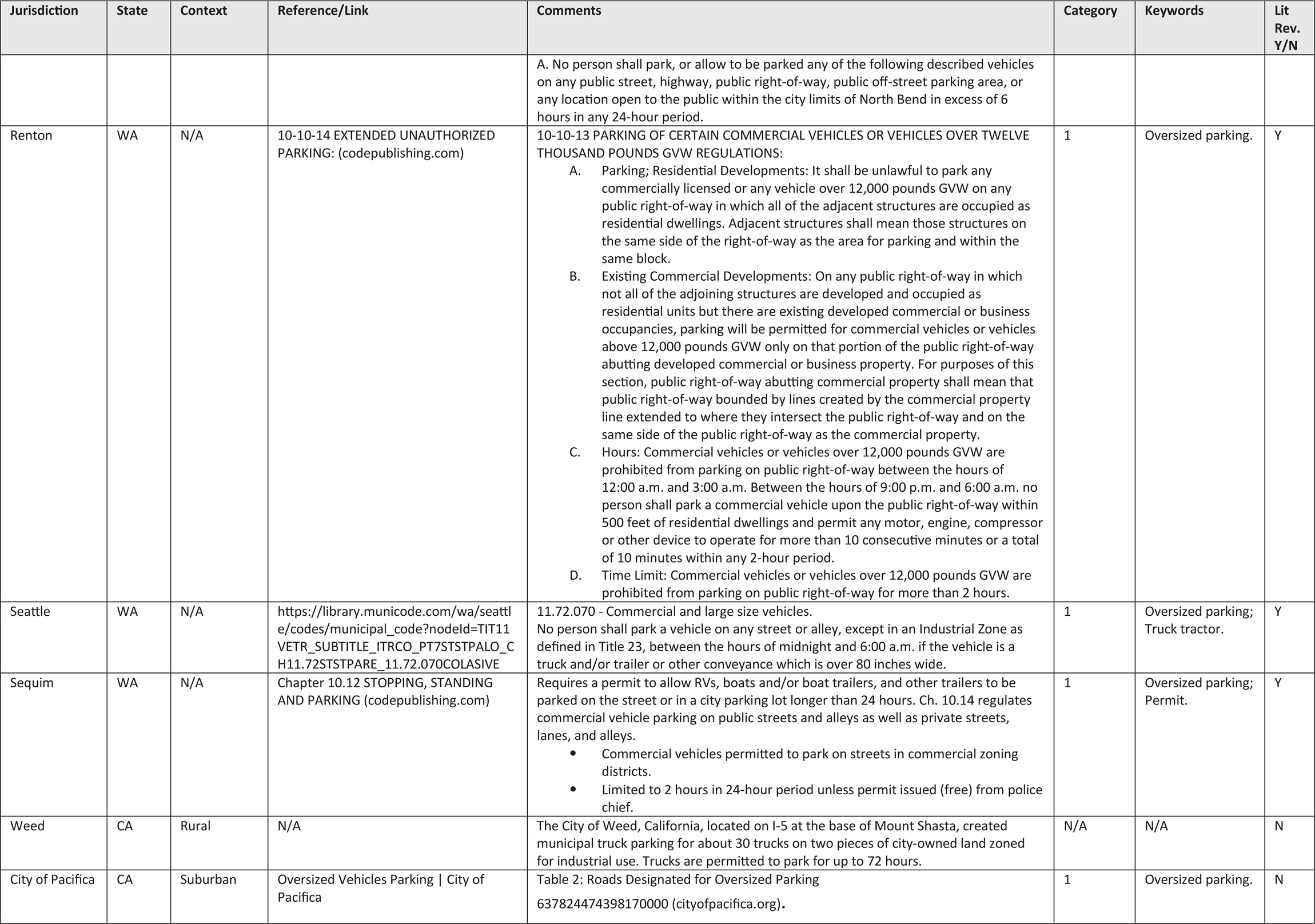
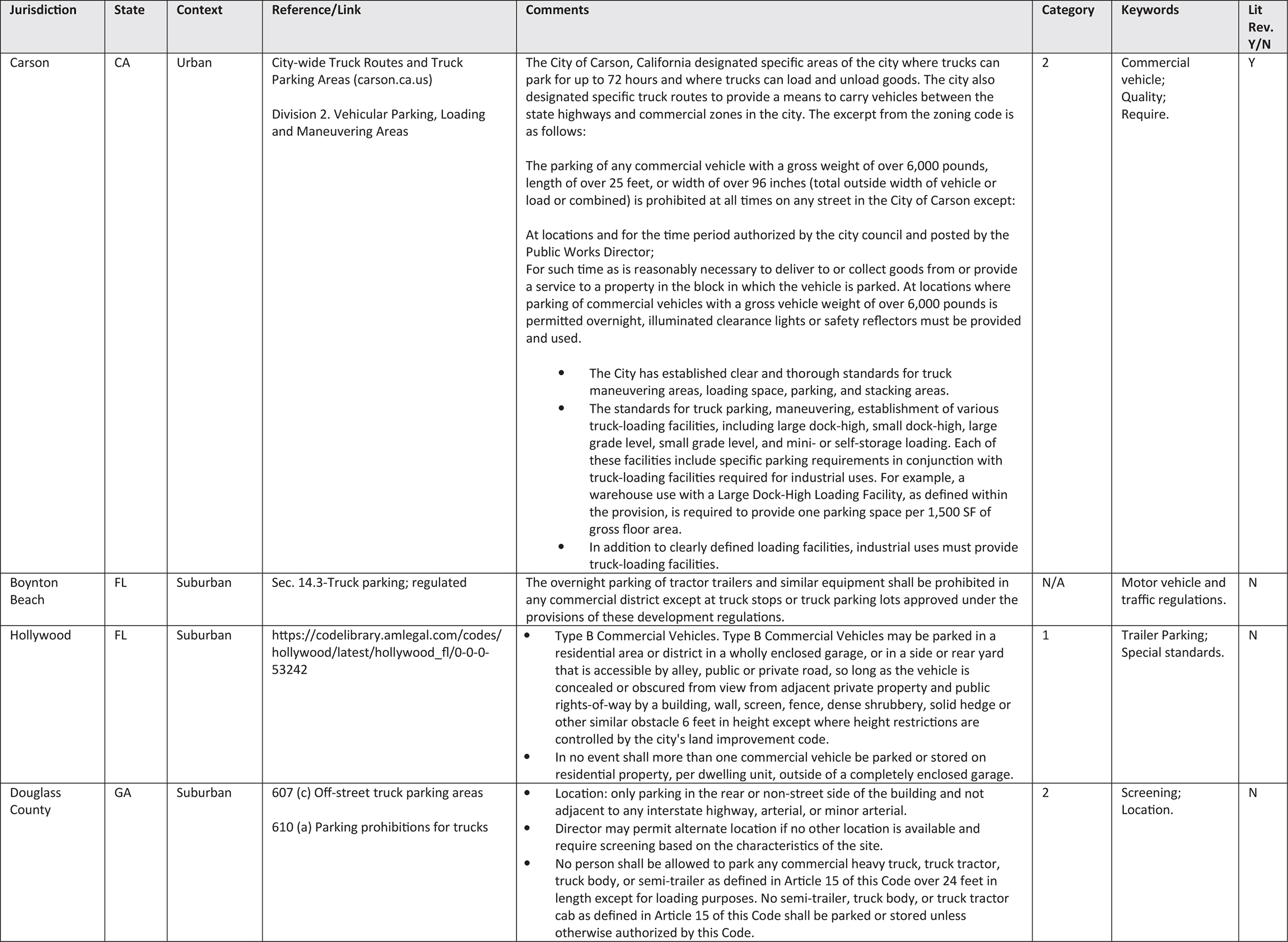
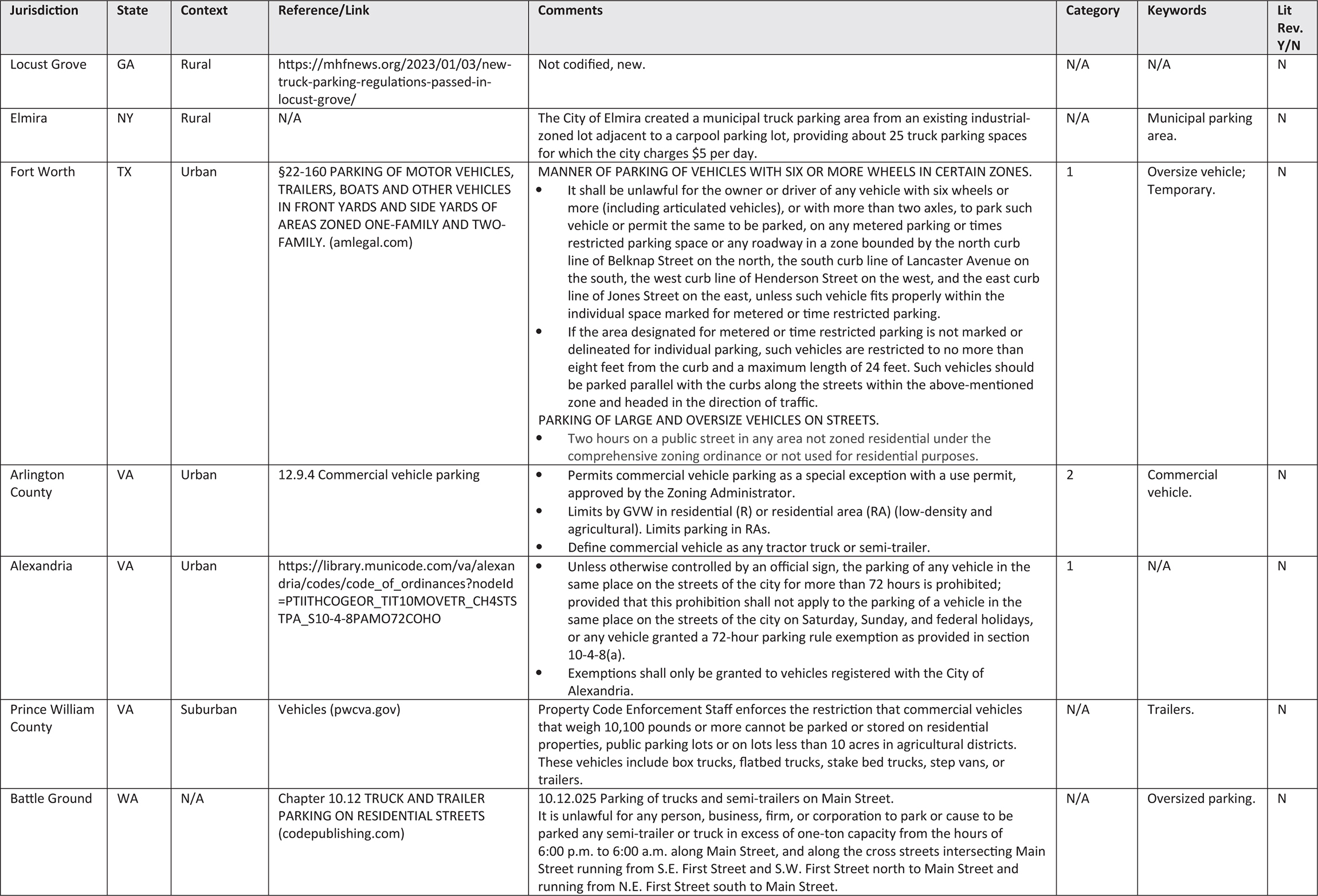
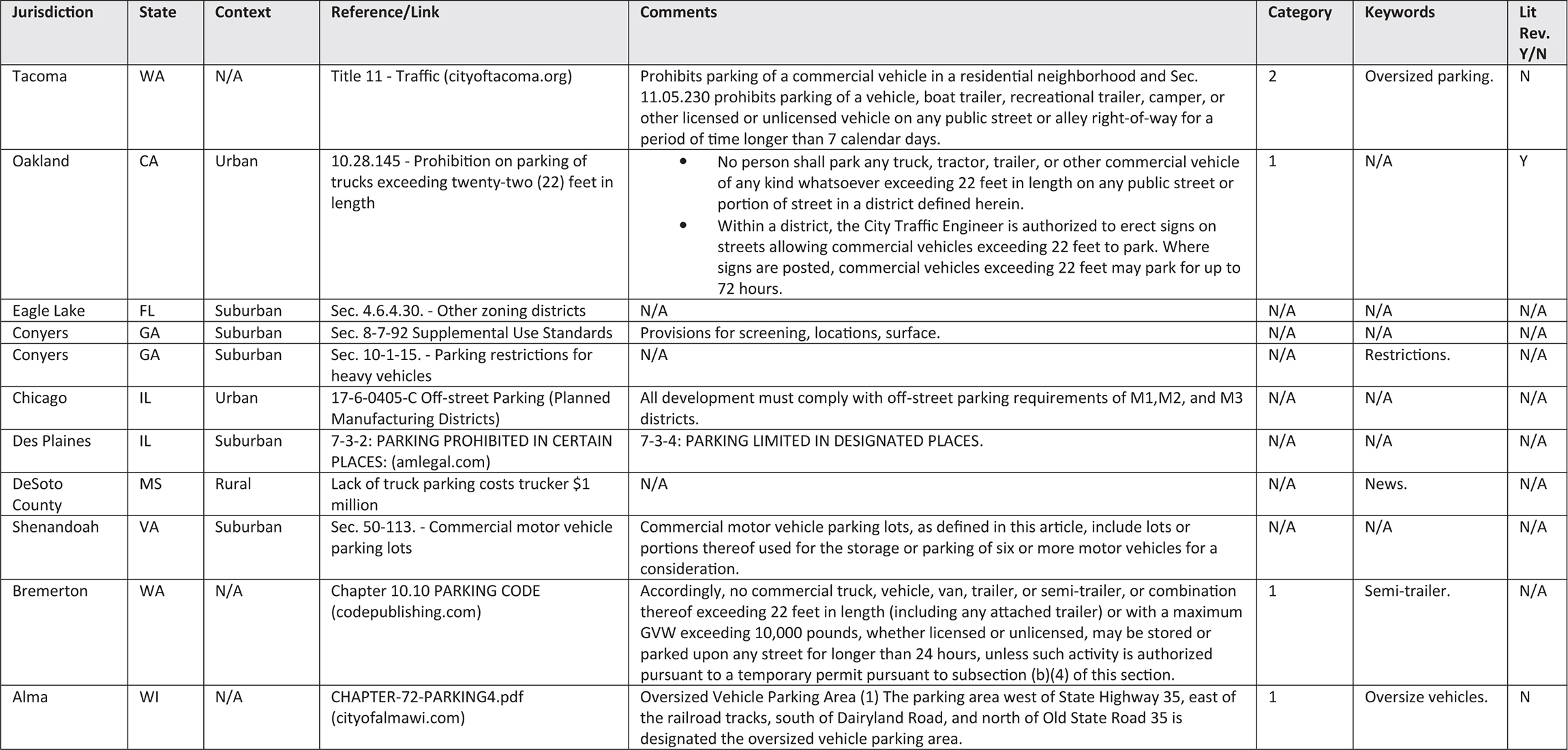
Table B.2 provides a summary of municipal codes that contained the terms “tractor trailer parking area,” “truck parking,” “heavy vehicle parking,” or “truck tractor parking.” The table contains a category column defined as: Category 1 = Traffic Code, and Category 2 = Zoning Code.
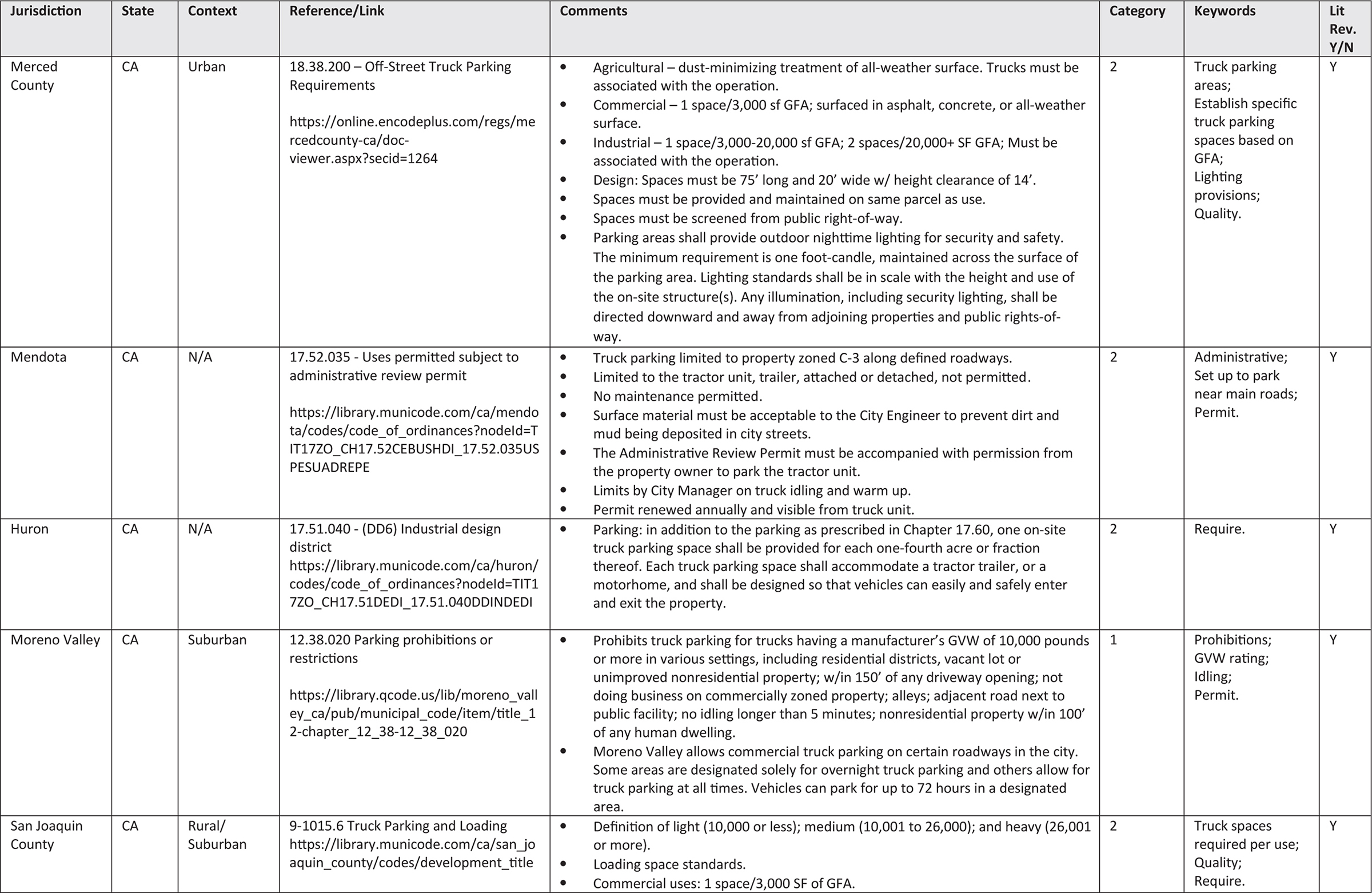
(continued on next page)
Long Description.
The table has 8 columns and 6 rows. The column headers in Row 1 are: Jurisdiction; State; Context; Reference or Link; Comments; Category; Keywords; Literature Review Yes or No. Row 2: Merced County; CA; Urban; 18.38.200, Off-Street Truck Parking Requirements; h t t p s colon double slash online dot encode plus dot com slash regs slash merced county hyphen c a slash doc hyphen viewer dot a s p x question mark s e c i d equals 1 2 6 4; Agricultural: dust-minimizing treatment of all-weather surface. Trucks must be associated with the operation. Commercial: 1 space per 3,000 square feet gross floor area; surface in asphalt, concrete, or all-weather surface). Industrial: 1 space per 3,000 to 20,000 square feet gross floor area; 2 spaces per 20,000 plus gross floor area. Must be associated with the operation. Design: spaces must be 75 feet long and 20 feet wide with a height clearance of 14 feet. Spaces must be provided and maintained on the same parcel as the use. Spaces must be screened from the public right-of-way. Parking areas must provide outdoor nighttime lighting for security and safety. The minimum requirement is one foot-candle maintained across the parking surface. Lighting standards must be in scale with on-site structure or structures. Any illumination, including security lighting shall be directed downward and away from adjoining properties and public rights-of-way; 2; Truck parking areas; Establish specific truck parking spaces based on gross floor area; Lighting provisions; QUALITY; Yes. Row 3: Mendota; CA; not applicable; 17.52.035: Uses permitted subject to administrative review permit; h t t p s colon double slash library dot municode dot com slash c a slash mendota slash codes slash code underscore of underscore ordinances question mark node i d equals T I T L E 1 7 Z O underscore C H 17 dot 5 2 D E B U S underscore 1 7 dot 5 2 dot 0 3 5 U S P E S U A D R E P E; Truck parking limited to property zoned C-3 along defined roadways. Limited to the tractor unit, trailer, attached or detached, not permitted. No maintenance permitted. Surface material must be acceptable to the City Engineer to prevent dirt and mud being deposited in city streets. The Administrative Review Permit must be accompanied with permission from the property owner to park the tractor unit. Limits by City Manager on truck idling and warm-up. Permit renewed annually and visible from truck unit; 2; Administrative; Set up to park near main roads; PERMIT; Yes. Row 4: Huron; CA; not applicable; 17.51.040, D D 6, Industrial Design District; h t t ps colon double slash library dot municode dot com slash ca slash huron slash codes slash code underscore of underscore ordinances question mark node i d equals T I T L E 1 7 Z O underscore C H 1 7 dot 5 1 dot 0 4 0 D D I N D E D I; Parking: In addition to parking required under Chapter 17.60, one on-site truck parking space is required for each one-fourth acre or fraction thereof. Each truck parking space shall accommodate a tractor trailer, or a motorhome, and shall be designed so that vehicles can easily and safely enter and exit the property; 2; REQUIRE; Yes. Row 5: Moreno Valley; CA; Suburban; 12 point 38 point 0 2 0, Parking prohibitions or restrictions; h t t p s colon double slash library dot q c o d e dot u s slash lib slash moreno underscore valley underscore c a slash pub slash municipal underscore code slash item slash title underscore 12 hyphen chapter underscore 12 dot 38 hyphen 12 underscore 38 underscore 0 2 0; Prohibits truck parking for trucks having a manufacturer’s gross vehicle weight of 10,000 pounds or more in various settings, including residential districts, vacant lot or unimproved nonresidential property; within 150 feet of any driveway opening; not doing business on commercially zoned property; alleys; adjacent road next to public facility; no idling longer than 5 minutes; nonresidential property within 100 feet of any human dwelling. Moreno Valley allows commercial truck parking on certain roadways in the city. Some areas are designated solely for overnight truck parking and others allow for truck parking at all times. Vehicles can park for up to 72 hours in a designated area.; 1; Prohibitions; gross vehicle weight rating; idling; PERMIT; Yes. Row 6: San Joaquin County; CA; Rural or Suburban; 9 hyphen 1 0 1 5 point 6 Truck Parking and Loading; h t t ps colon double slash library dot municode dot com slash c a slash san underscore joaquin underscore county slash codes slash development underscore title; Defines light trucks (10,000 pounds or less), medium trucks (10,001–26,000 pounds), and heavy trucks (26,001 pounds or more). Loading space standards. Commercial uses: 1 space per 3,000 square feet of gross floor area; 2; Truck spaces required per use; QUALITY, Require; Yes. (Table B.2 Continued.)

Long Description.
The table has 8 columns and 6 rows. The column headers in Row 1 are: Jurisdiction; State; Context; Reference or Link; Comments; Category; Keywords; Literature Review Yes or No Row 2: Blank; blank; blank; question mark node i d equals T I T 9 D E T I underscore D I V 10 D E R E underscore C H 9 hyphen 1 0 1 5 P A L O underscore 9 hyphen 1 0 1 5 dot 6 T R P A L O ; Industrial uses: 1 space per 3,000 to 20,000 square feet gross floor area; 2 spaces per 20,000 to 40,000 square feet gross floor area; for every 20,000 square feet over 40,000 add 1 space. Design standards: 25 feet in length, 15 feet width, 14 feet minimum height clearance; no parking permitted in driveways, parking aisles, or maneuvering areas; blank; blank, blank. Row 3: San Buenaventura; CA; Urban; Chapter 16 point 2 1 7, Oversized Vehicle and Trailer Parking, Code of Ordinances, San Buenaventura, CA, Municode Library h t t p s colon double slash library dot municode dot com slash c a slash san underscore buenaventura slash codes slash code underscore of underscore ordinances question mark node i d equals D I V 16 V E T R R E underscore C H 16 dot 2 1 7 O V V E T R P A; Oversized Vehicle Parking Permits. The purpose of authorizing the issuance of oversized vehicle accessible permits is to allow a person with a disability, whether or not such person has an accessible license plate, to park a designated oversized vehicle on a highway in the city. Persons holding a valid permit issued pursuant to this chapter may park an oversized vehicle in a street in a residential area. An oversized vehicle parking permit will be valid for a period not to exceed five consecutive calendar days; 1; Trailer Parking; PERMIT; Yes. Row 4: Rancho Cucamonga; CA; Urban; Chapter 17 point 64 Parking and Loading Standards h t t p s colon double slash library dot q code dot u s slash lib slash rancho underscore cucamonga underscore c a slash pub slash municipal underscore code slash item slash title underscore 17 hyphen article underscore 4 hyphen chapter underscore 17 underscore 64 underscore 100. Loading areas required. Entrance gate requirements specify minimum of 135 feet from the public right of way. Truck queuing must be grouped in designated areas with clear access to the loading docks. The approving authority may approve alternative queuing standards less than this standard as part of a master plan and accompanying parking management plan. Require that new commercial industrial developments where heavy-duty diesel trucks idle on-site shall install electric truck hookups in docks, bays, and parking areas. electric vehicle charging stations in industrial zones for electric powered trucks may be required as determined by the approving authority; 2; QUALITY; REQUIRE; Yes. Row 5: Rialto; CA; Urban; 18 point 112 point 0 2 50. Development standards (For indoor storage, including warehouses and fulfillment centers) h t t p s colon double slash library dot municode dot com slash c a slash rialto slash codes slash code underscore of underscore ordinances question mark node i d equals T I T 18 Z O underscore C H 18 dot 1 1 2 I N S T U S underscore 18 point 1 1 2 dot 0 5 0 D E ST; Parking and Access Standards. Truck parking areas or truck courts shall be paved with asphalt or concrete. Separate passenger vehicle parking spaces from truck parking. Only general guidance for including additional overflow areas shall be provided to accommodate all maneuvering, queuing, stacking, loading, unloading, and parking of vehicles on-site. On-site electric hookups shall be provided to eliminate idling of main and auxiliary engines during loading and unloading of cargo. Industrial Uses 18 point 34 point 0 5 0, Office, commercial and industrial parking requirements. One space of appropriate size shall be provided on-site for each vehicle used in conjunction with use and stored overnight on-site at any time; not applicable; not applicable; not applicable. Row 6: Los Angeles; CA; Urban; h t t p s colon double slash code library dot amlegal dot com slash codes slash los underscore angeles slash latest slash l a m c slash 0 hyphen 0 hyphen 0 hyphen 1 6 6 5 9 4; No person shall park or leave standing any commercial or construction vehicle upon any portion of a public street which passes beneath a railroad overpass, a freeway or any other viaduct or within 150 feet of either side thereof, the majority of the buildings upon property contiguous to said street are used for residential purposes. The Council may authorize, by resolution, the streets upon which the parking of oversized vehicles shall be restricted between 2:00 AM and 6:00 AM, except for those oversized vehicles displaying a valid permit issued pursuant to the provisions of Subsection c of this section. Upon Council action designating streets with oversized vehicle parking restrictions, the Department of Transportation shall cause appropriate signs to be erected in those streets, indicating the parking restriction prominently on the sign and stating that motor vehicles with valid permits shall be exempt from the restrictions; 1; Trailer Parking; PERMIT; Yes. (Table B.2 Continued.)
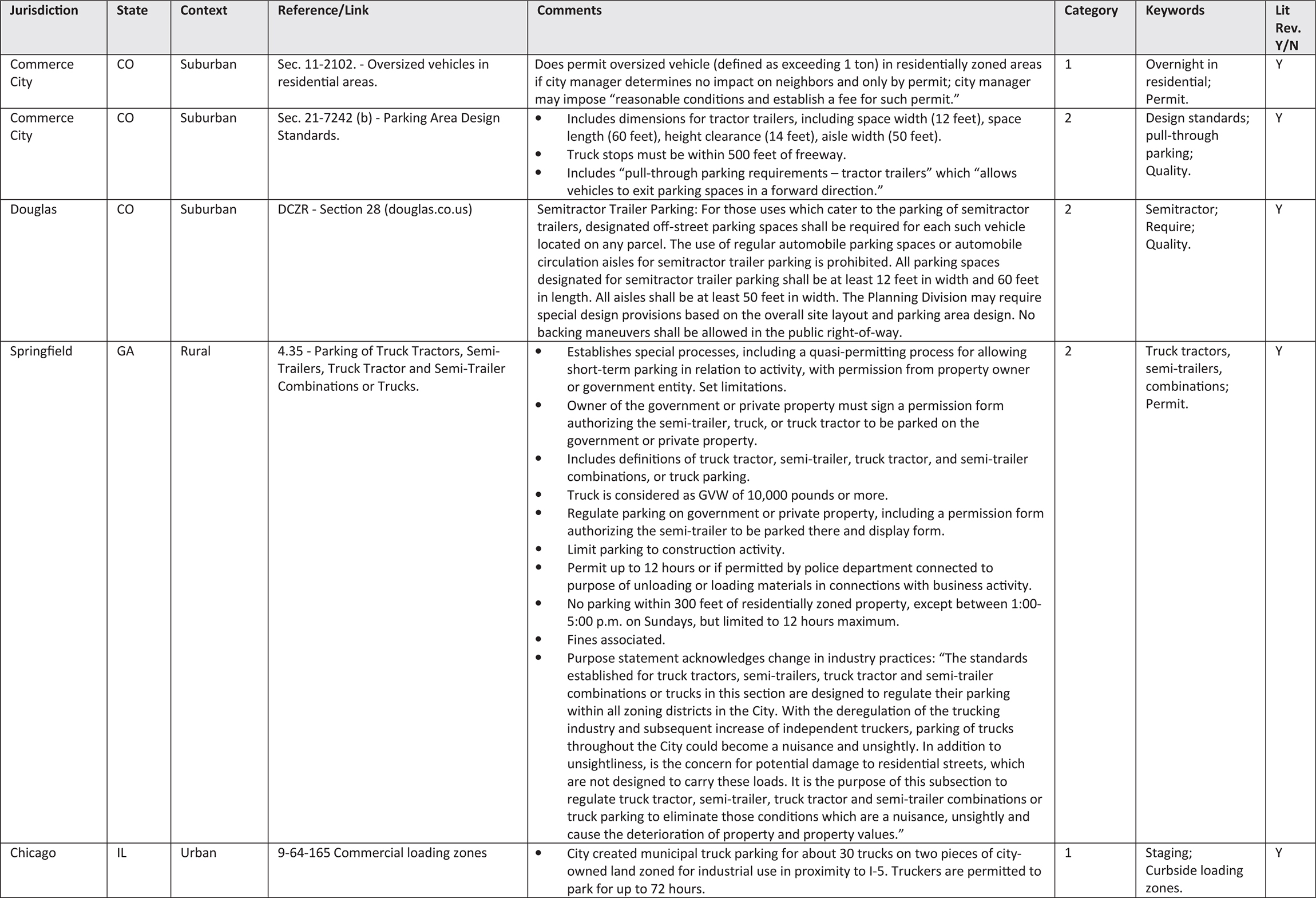
(continued on next page)
Long Description.
The table has 8 columns and 6 rows. Row 1: Jurisdiction; State; Context; Reference or Link; Comments; Category; Keywords; Literature Review, Yes or No Row 2: Commerce City; CO; Suburban; Section 11 21 0 2, Oversized vehicles in residential areas; Does permit oversized vehicle, defined as exceeding 1 ton, in residential zoned areas if city manager determines impacts on neighboring and city permit; city manager may impose reasonable conditions and establish a fee for such permit; 1; Overnight in residential PERMIT; Yes. Row 3: Commerce City; CO; Suburban; Section 21 724 b, Parking Area Design Standards; Includes dimensions for tractor trailers, including space width of 12 feet, space length of 60 feet, height clearance of 14 feet, aisle width of 50 feet. Truck stops must be within 500 feet of freeway; includes pull through parking requirements; tractor trailers which allows vehicles to exit parking spaces in a forward direction; 2; Design standards; pull-through parking; QUALITY; Yes. Row 4: Douglas; CO; Suburban; Douglas County Zoning Resolution, Section 28, douglas dot co dot u s; Semitractor Trailer Parking: For those uses which cater to the parking of semitractor trailers, designated off-street parking spaces shall be required for each such vehicle located on any parcel. The use of regular automobile parking spaces or automobile circulation aisles for semitractor trailer parking is prohibited. All parking spaces designated for semitractor trailer parking shall be at least 12 feet in width and 60 feet in length. All aisles shall be at least 50 feet in width. The Planning Division may require special design provisions based upon the overall site layout and parking area design. No backing maneuvers shall be allowed in the public right-of-way.; 2; Semitractor REQUIRE, QUALITY; Yes. Row 5: Springfield; GA; Rural; 4.35, Parking of Truck Tractors, Semi-Trailers, Truck Tractor and Semi-Trailer Combinations or Trucks; 2; Establishes special processes, including a quasi-permitting process for allowing short-term parking in relation to activity, with permission from property owner or government entity. Set limitations. Owner of the government or private property must sign a permission form authorizing the semi-trailer, truck, or truck tractor to be parked on the government or private property. Includes definitions of truck tractor, semi-trailer, truck tractor, and semi-trailer or truck parking. Truck is considered as gross vehicle weight of 10,000 pounds or more. Regulate parking on government or private property, including a permission form authorizing the semi-trailer to be parked there and display form. Limit parking to construction activity. Permit up to 12 hours or if permitted by police department connected to purpose of unloading or loading materials in connections with business activity. No parking within 300 feet of residentially zoned property, except between 1:00-5:00 p.m. on Sundays, but limited to 12 hours max. Fines associated. Purpose statement acknowledges change in industry practices: “The standards established for truck tractors, semi-trailers, truck tractor and semi-trailer combinations or trucks in this section are designed to regulate their parking within all zoning districts in the City. With the deregulation of the trucking industry and subsequent increase of independent truckers, parking of trucks throughout the City could become a nuisance and unsightly. In addition to unsightliness, is the concern for potential damage to residential streets, which are not designed to carry these loads. It is the purpose of this subsection to regulate truck tractor, semi-trailer, truck tractor and semi-trailer combinations or truck parking to eliminate those conditions which are a nuisance, unsightly and cause the deterioration of property and property values, 2; Truck tractors; semi-trailers; combinations; PERMIT; Yes. Row 6: Chicago; IL; Urban; 9 64 165 Commercial loading zones; City created municipal truck parking for about 30 trucks on two sides of city owned land zoned for industrial use in proximity to I 5. Trucks are permitted to park for up to 72 hours; 1; Staging; curbside loading zones; Yes. (Table B.2 Continued.)
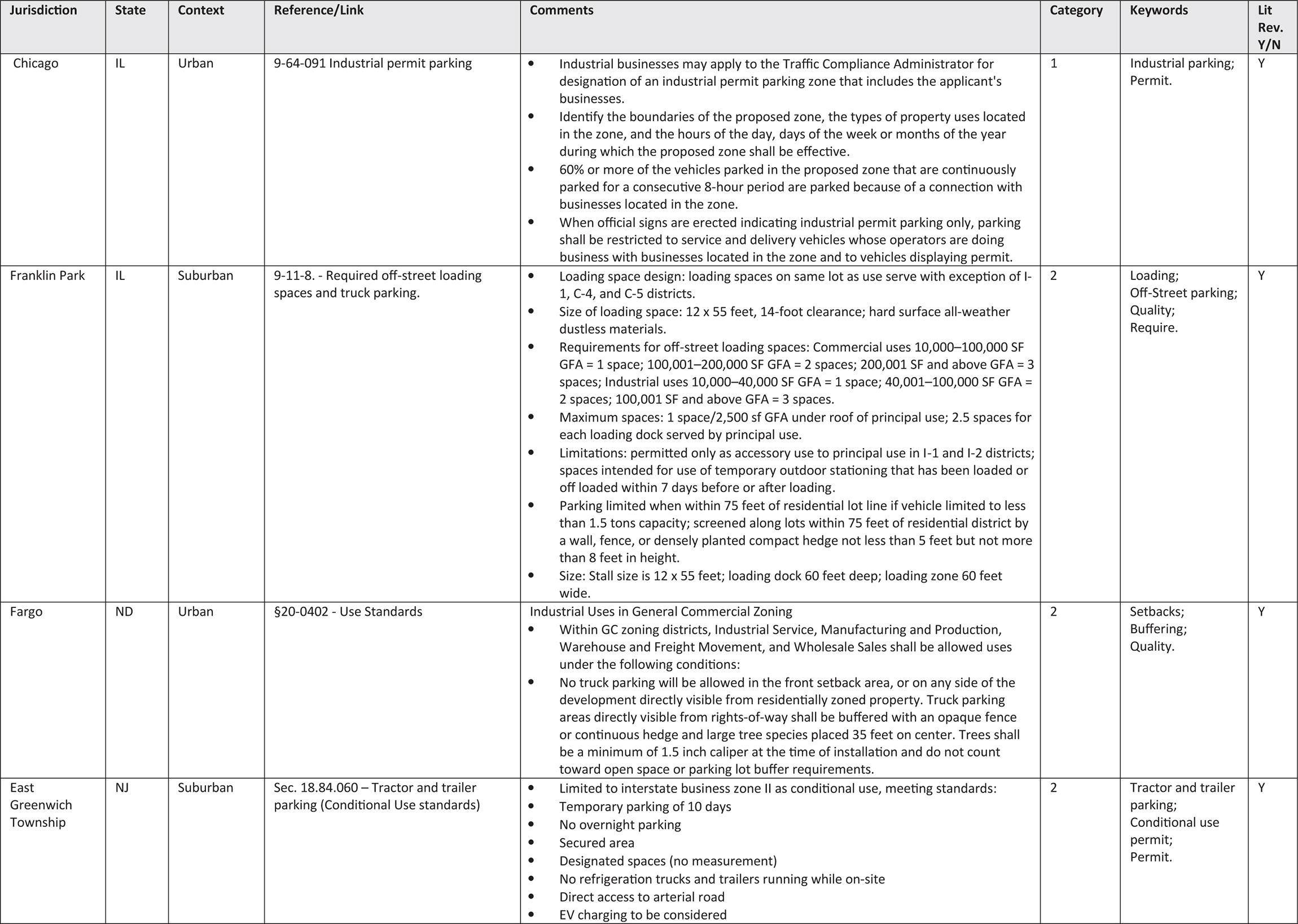
Long Description.
The table has 8 columns and 5 rows. Row 1: Jurisdiction; State; Context; Reference or Link; Comments; Category; Keywords; Literature Review, Yes or No Row 2: Chicago; IL; Urban; 9 64 0 9 1 Industrial permit parking; Industrial businesses may apply to the Traffic Compliance Administrator for designation of an industrial permit parking zone that includes the applicant's businesses. Identify the boundaries of the proposed zone, the types of property uses located in the zone, and the hours of the day, days of the week or months of the year during which the proposed zone shall be effective. 60 percent or more of the vehicles parked in the proposed zone that are continuously parked for a consecutive eight-hour period are parked in connection with businesses located in the zone. When official signs are erected indicating industrial permit parking only, parking shall be restricted to service and delivery vehicles whose operators are doing business with businesses located in the zone and to vehicles displaying permit; 1; Industrial parking; permit; PERMIT; Yes. Row 3: Franklin Park; IL; Suburban; 9 11.8, Required off-street loading spaces and truck parking; Loading space design: loading spaces on same lot as use serve with exception of I 1, C 4, and C 5 districts. Size of loading space: 12 x 55 feet, 14-foot clearance; hard surface all-weather dustless materials. Requirements for off-street loading spaces: Commercial uses 10,000 to 100,000 square feet gross floor area equals 1 space; 100,001 to 200,000 square feet gross floor area equals 2 spaces; 200,001 square feet and above gross floor area equals 3 spaces; Industrial uses 10,000 to 40,000 square feet gross floor area equals 1 space; 40,001 to 100,000 square feet gross floor area equals 2 spaces; 100,001 square feet and above gross floor area equals 3 spaces. Maximum spaces: 1 space per 2,500 square feet gross floor area under roof of principal use; 2.5 spaces for each loading dock served by principle use. Limitations: permitted only as accessory use to principal use in I 1 and I 2 districts; spaces intended for use of temporary outdoor stationing that has been loaded or off loaded within seven days before or after loading. Parking limited when within 75 feet of residential lot line if vehicle limited to less than 1.5 tons capacity; screened along lots within 75 feet of residential district by a wall, fence, or densely planted compact hedge not less than 5 feet but not more than 8 feet in height. Size: Stall size is 12 by 55 feet; loading dock 60 feet deep; loading zone 60 feet wide; 2; Loading Off-street parking; QUALITY; REQUIRE; Yes. Row 4: Fargo; ND; Urban; Section 20 0 4 0 2, Use Standards; Industrial uses in General Commercial Zoning. Within general commerical zoning districts, Industrial Service, Manufacturing and Production, Warehouse and Freight Movement, and Wholesale Sales shall be allowed uses under the following conditions: No truck parking will be allowed in the front setback area, or on any side of the development directly visible from residentially zoned property. Truck parking areas directly visible from rights-of-way shall be buffered with an opaque fence or continuous hedge and large tree species placed 35 feet on center. Trees shall be a minimum of 1.5 inch caliper at the time of installation and do not count toward open space or parking lot buffer requirements; 2; Setbacks; buffering; QUALITY; Yes. Row 5: East Greenwich Township; NJ; Suburban; Section 18 point 84 point 0 6 0, Tractor and trailer parking (Conditional Use standards); Limited to interstate business zone II as conditional use, meeting standards: Temporary parking of 10 days. No overnight parking. Secured area. Designated spaces (no measurement). No refrigeration trucks and trailers running while on-site. Direct access to arterial road. electric vehicle charging to be considered; 2; Tractor and trailer parking; conditional use; PERMIT; Yes. (Table B.2 Continued.)
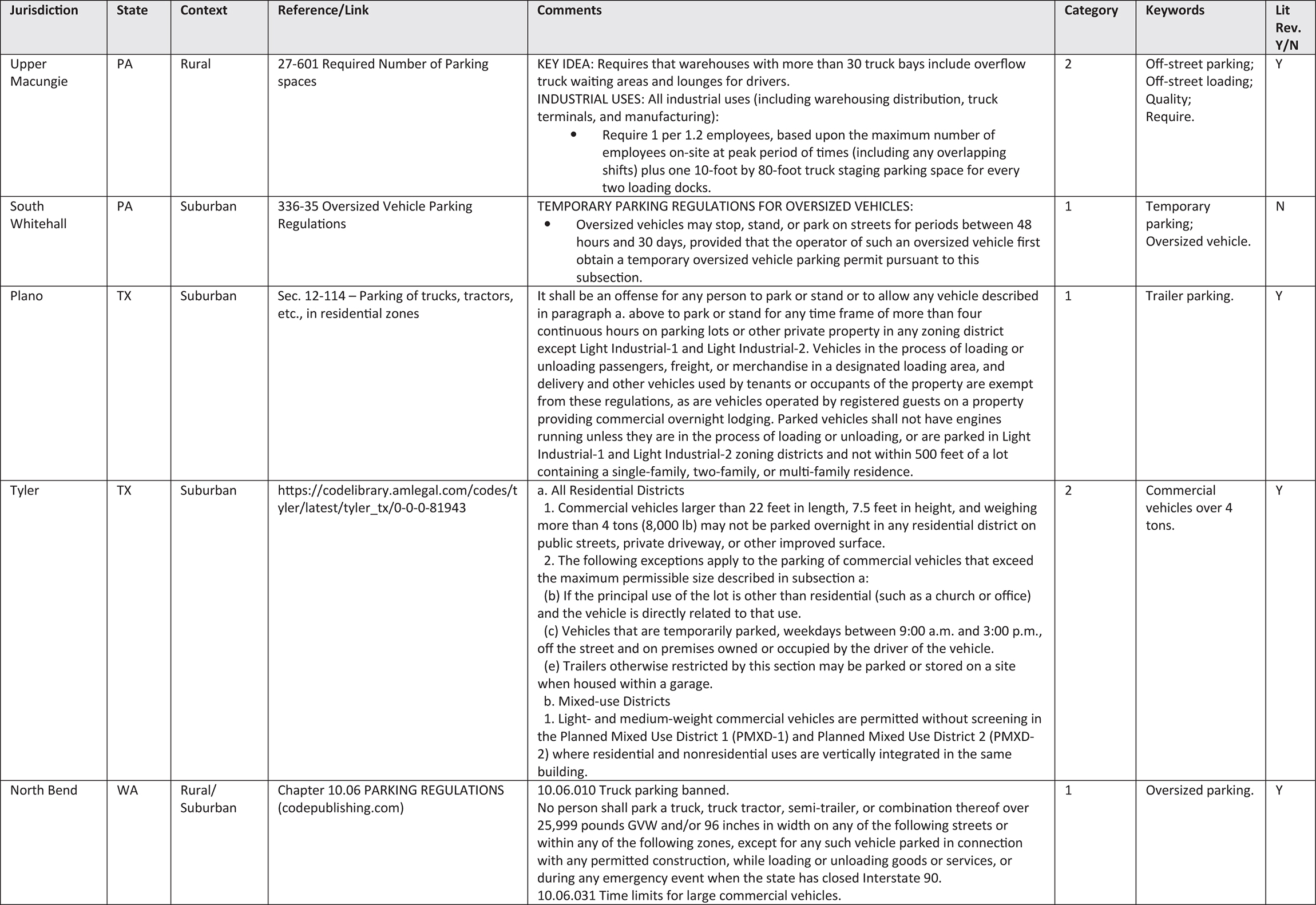
(continued on next page)
Long Description.
The table has 8 columns and 6 rows. Row 1: Jurisdiction; State; Context; Reference or Link; Comments; Category; Keywords; Literature Review, Yes or No. Row 2: Upper Macungie; PA; Rural; 27 601 Required Number of Parking Spaces; KEY IDEA: Requires that warehouses with more than 30 truck bays include overflow truck waiting areas for drivers. INDUSTRIAL USES: All industrial uses, including warehousing, distribution, truck terminals and manufacturing. Require 1 per 1.2 employees based upon the maximum number of employees on-site at peak period of times, including any overlapping shifts, plus one 10-foot by 80-foot truck staging parking space for every two loading docks; 2; Off-street parking; off-street loading; QUALITY; REQUIRE; Yes. Row 3: South Whitehall; PA; Suburban; 336 35 Oversized Vehicle Parking Regulations; TEMPORARY PARKING REGULATIONS FOR OVERSIZED VEHICLES: Oversized vehicles may stop, stand or park on streets for periods between 48 hours and 30 days, provided that the operator of such oversized vehicle first obtains a temporary oversized vehicle parking permit pursuant to this subsection; 1; Temporary Parking; Oversized vehicle; No. Row 4: Plano; TX; Suburban; Section 12 114, Parking of trucks, tractors, et cetera, in residential zones; It shall be an offense for any person to park or stand or to allow any vehicle described in paragraph a. above to park or stand for any time frame of more than four continuous hours on parking lots or other private property in any zoning district except Light Industrial 1 and Light Industrial 2. Vehicles in the process of loading or unloading passengers, freight or merchandise in a designated loading area, and delivery and other vehicles used by tenants or occupants of the property are exempt from these regulations, as are vehicles operated by registered guests on a property providing commercial overnight lodging. Parked vehicles shall not have engines running unless they are in the process of loading or unloading, or are parked in Light Industrial 1 and Light Industrial 2 zoning districts and not within 500 feet of a lot containing a single-family, two-family or multi-family residence; 1; Trailer Parking; Yes. Row 5: Tyler; TX; Suburban; h t t p s colon double slash code library dot amlegal dot com slash codes slash tyler slash latest slash tyler underscore t x slash 0 hyphen 0 hyphen o hyphen 8 1 9 4 3; a. All Residential District. 1. Commercial vehicles larger than 22 feet in length, 7.5 feet in height, and weighing more than 4 tons (8,000 pounds) may not be parked overnight in any residential district on public streets, private driveway, or other improved surface. 2. The following exceptions apply to the parking of commercial vehicles that exceed the maximum permissible size described in subsection a: (b) If the principal use of the lot is other than residential (such as a church or office) and the vehicle is directly related to that use. (c) Vehicles that are temporarily parked, weekdays between 9:00 a.m. and 3:00 p.m., off the street and on premises owned or occupied by the driver of the vehicle. (e) Trailers otherwise restricted by this section may be parked or stored on a site when housed within a garage. b. Mixed-use Districts. 1. Light- and medium-weight commercial vehicles are permitted without screening in the Planned Mixed Use District 1 (PMXD 1) and Planned Mixed Use District 2 (PMXD 2) where residential and nonresidential uses are vertically integrated in the same building.; 2; Commercial Vehicles over 4 tons 1; Yes. Row 6: North Bend; WA; Urban; Chapter 10 point 0 6 Parking Regulations, code publishing dot com; 10 point 0 6 point 0 1 0 Truck parking banned. No person shall park a truck, truck tractor, semi-trailer, or combination thereof over 25,999 pounds gross vehicle weight and/or 96 inches in width on any of the following streets or within any of the following zones, except for any such vehicle parked in connection with any permitted construction, while loading or unloading goods or services, or during any emergency event when the state has closed Interstate 90. 10 point 0 6 point 0 3 1 Time limits for large commercial vehicles. A. No person shall park, or allow to be parked any of the following described vehicles on any public street, highway, public right-of-way, public off-street parking area, or any location open to the public within the city limits of North Bend in excess of six hours in any 24-hour period.; 1; Oversized Parking; Yes. (Table B.2 Continued.)
Long Description.
The table has 8 columns and 6 rows. Row 1: Jurisdiction; State; Context; Reference or Link; Comments; Category; Keywords; Literature Review, Yes or No. Row 2: Renton; WA; Not applicable; 10 point 10 point 14 EXTENDED UNAUTHORIZED PARKING, codepublishing dot com; 10 point 10 point 13 PARKING OF CERTAIN COMMERCIAL VEHICLES OR VEHICLES OVER TWELVE THOUSAND POUNDS GVW REGULATIONS. A. Parking; Residential Developments: It shall be unlawful to park any commercially licensed or any vehicle over 12,000 pounds gross vehicle weight on any public right-of-way in which all of the adjacent structures are occupied as residential dwellings. Adjacent structures shall mean those structures on the same side of the right-of-way as the area for parking and within the same block. B. Existing Commercial Developments: On any public right-of-way in which not all of the adjoining structures are developed and occupied as residential units but there are existing developed commercial or business occupancies, parking will be permitted for commercial vehicles or vehicles above 12,000 pounds gross vehicle weight only on that portion of the public right-of-way abutting developed commercial or business property. For purposes of this Section, public right-of-way abutting commercial property shall mean that public right-of-way bounded by lines created by the commercial property line extended to where they intersect the public right-of-way and on the same side of the public right-of-way as the commercial property. C. Hours: Commercial vehicles or vehicles over 12,000 pounds gross vehicle weight are prohibited from parking on public right-of-way between the hours of 12:00 a.m. and 3:00 a.m. Between the hours of 9:00 p.m. and 6:00 a.m. no person shall park a commercial vehicle upon the public right-of-way within 500 feet of residential dwellings and permit any motor, engine, compressor or other device to operate for more than 10 consecutive minutes or a total of 10 minutes within any two hour period. D. Time Limit: Commercial vehicles or vehicles over 12,000 pounds gross vehicle weight are prohibited from parking on public right-of-way for more than two hours; 1; Oversized Parking; Yes. Row 3: Seattle; WA; Not applicable; h t t p s colon double slash library dot municode dot com slash w a slash seattle slash codes slash municipal underscore code node I d equals T I T 11 V E T R underscore SUBTITLE underscore I T R C O underscore P T 7 S T S T P A L O underscore C H 11 point 72 S T S T P A R E underscore 11 point 72 point 0 7 0 COLASIVE; 11 point 72 point 0 7 0, Commercial and large vehicles; No person shall park a vehicle on any street or alley, except Industrial Zone as defined in Title 23, between the hours of midnight and 6:00 a.m. if the vehicle is a truck and or trailer or other conveyance which is over 80 inches wide; 1; Oversized Parking Truck tractor; Yes. Row 4: Sequim; WA; Not applicable; Chapter 10 point 12 STOPPING, STANDING AND PARKING (codepublishing dot com); Requires a permit to allow RVs, boats and/or boat trailers and other trailers to be parked on the street or in a city parking lot longer than 24 hours. Ch. 10.14 regulates commercial vehicle parking on public streets and alleys as well as private streets, lanes, and alleys. Commercial vehicles permitted to park on streets in commercial zoning districts. Limited to two hours in 24-hour period unless permit issued (free) from police chief; 1; Oversized Parking PERMIT; Yes. Row 5: Weed; CA; Rural; Not applicable; The City of Weed, CA, located on I 5 at the base of Mount Shasta, created municipal truck parking for about 30 trucks on two pieces of city-owned land zoned for industrial use. Trucks are permitted to park for up to 72 hours; Not applicable; not applicable; No. Row 6: City of Pacifica; CA; Suburban; Oversized Vehicles Parking, City of Pacifica; Table 2: Roads Designated for Oversized Parking, 6 3 7 8 2 4 4 7 4 3 9 8 1 7 0 0 0 0. city of pacifica dot org; 1; Oversized Parking; No. (Table B.2 Continued.)
(continued on next page)
Long Description.
The table has 8 columns and 5 rows. Row 1: Jurisdiction; State; Context; Reference or Link; Comments; Category; Keywords; Literature Review, Yes or No. Row 2: Carson; CA; Urban; City-wide Truck Routes and Truck Parking Areas, carson dot c a dot u s, Division 2, Vehicular Parking, Loading and Maneuvering Areas; The City of Carson, California designated specific areas of the city where trucks can park for up to 72 hours and where trucks can load and unload goods. The city also designated specific truck routes to provide a means to carry vehicles between the state highways and commercial zones in the city. The excerpt from the zoning code is as follows: The parking of any commercial vehicle with a gross weight of over 6,000 pounds, length of over 25 feet, or width of over 96 inches (total outside width of vehicle or load or combined) is prohibited at all times on any street in the City of Carson except: At locations and for the time period authorized by the City Council and posted by the Public Works Director; For such time as is reasonably necessary to deliver to or collect goods from or provide a service to a property in the block in which the vehicle is parked. At locations where parking of commercial vehicles with a gross vehicle weight of over 6,000 pounds is permitted overnight, illuminated clearance lights or safety reflectors must be provided and utilized. The City has established clear and thorough standards for truck maneuvering areas, loading space, parking, and stacking areas. The standards for truck parking, maneuvering, Establishment of various truck loading facilities, including large dock-high, small dock-high, large grade level, small grade level, and mini- or self-storage loading. Each of these facilities include specific parking requirements in conjunction with truck loading facilities required for industrial uses. For example, a warehouse use with a Large Dock-High Loading Facility, as defined within the provision, is required to provide one parking space per 1,500 square feet of gross floor area. In addition to clearly defined loading facilities, industrial uses must provide truck loading facilities; 2; Commercial Vehicle QUALITY. Yes. Row 3: Boynton Beach; FL; Suburban; Section 14 point 3 Truck parking regulated; The overnight parking of tractor trailers and similar equipment shall be prohibited in any commercial district except at truck stops or truck parking lots approved under the provisions of these development regulations; Not applicable; Motor Vehicle and Traffic Regulations; No. Row 4: Hollywood; F L; Suburban; h t t p s colon double slash code library dot amlegal dot com slash codes slash hollywood slash latest f l slash 0 hyphen 0 hyphen 0 hyphen 5 3 2 4 2; Type B Commercial Vehicles. Type B Commercial Vehicles may be parked in a residential area or district in a wholly enclosed garage, or in a side or rear yard that is accessible by alley, public or private road, so long as the vehicle is concealed or obscured from view from adjacent private property and public rights-of-way by a building, wall, screen, fence, dense shrubbery, solid hedge or other similar obstacle 6 feet in height except where height restrictions are controlled by the city's land improvement code. In no event shall more than one commercial vehicle be parked or stored on residential property, per dwelling unit, outside of a completely enclosed garage; 1; Trailer Parking; special standards; No. Row 5: Douglas County; GA; Suburban; 607 (c) Off-street truck parking areas, 610 (a) Parking prohibitions for trucks; Location: only parking in the rear or non-street side of the building and not adjacent to any interstate highway, arterial, or minor arterial. Director may permit alternate location if no other location is available and require screening based on the characteristics of the site. No person shall be allowed to park any commercial heavy truck, truck tractor, truck body or semi‐trailer as defined in Article 15 of this Code over 24 feet in length except for loading purposes. No semi‐trailer, truck body or truck tractor cab as defined in Article 15 of this Code shall be parked or stored unless otherwise authorized by this Code; 2; Screening; location; No. (Table B.2 Continued.)
Long Description.
The table has 8 columns and 8 rows. Row 1: Jurisdiction; State; Context; Reference or Link; Comments; Category; Keywords; Literature Review, Yes or No. Row 2: Locust Grove; GA; Rural; h t t p s colon double slash m h f news dot org slash 2 0 2 3 slash 0 1 slash 0 3 slash new hyphen truck hyphen parking hyphen regulations hyphen passed hyphen in hyphen locust hyphen grove slash; Not codified, new; Not applicable; Not applicable; No. Row 3: Elmira; NY; Rural. NA; The City of Elmira created a municipal truck parking area from an existing industrial-zoned lot adjacent to a carpool parking lot, providing about 25 truck parking spaces for which the city charges 5 dollar per day; Not applicable; Municipal parking area; No. Row 4: Fort Worth; TX; Urban; Section 22 160 PARKING OF MOTOR VEHICLES, TRAILERS, BOATS AND OTHER VEHICLES IN FRONT YARDS AND SIDE YARDS OF AREAS ZONED ONE-FAMILY AND TWO-FAMILY. (amlegal dot com); MANNER OF PARKING OF VEHICLES WITH SIX OR MORE WHEELS IN CERTAIN ZONES. It shall be unlawful for the owner or driver of any vehicle with six wheels or more (including articulated vehicles), or with more than two axles, to park such vehicle or permit the same to be parked, on any metered parking or times restricted parking space or any roadway in a zone bounded by the north curb line of Belknap Street on the north, the south curb line of Lancaster Avenue on the south, the west curb line of Henderson Street on the west, and the east curb line of Jones Street on the east, unless such vehicle fits properly within the individual space marked for metered or time restricted parking. If the area designated for metered or time restricted parking is not marked or delineated for individual parking, such vehicles are restricted to no more than eight feet from the curb and a maximum length of 24 feet. Such vehicles should be parked parallel with the curbs along the streets within the above-mentioned zone and headed in the direction of traffic. PARKING OF LARGE AND OVERSIZE VEHICLES ON STREETS. Two hours on a public street in any area not zoned residential under the comprehensive zoning ordinance or not used for residential purposes; 1; Oversize Vehicle Temporary; No. Row 5: Arlington County. VA; Urban; 12 point 9 point 4 Commercial vehicle parking; Permits commercial vehicle parking as a special exception with a use permit, approved by the Zoning Administrator. Limits by gross vehicle weight in Residential or Residental Areas (low-density and agricultural). Limits parking in residential areas. Define commercial vehicle as Any tractor truck or semi-trailer; 2; Commercial vehicle; No. Row 6: Alexandria; VA; Urban; h t t p s colon double slash library dot municode dot com slash v a slash alexandria slash codes slash code underscore of underscore ordinances question mark node I d equals P T I I T H C O G E O R underscore T I T 10 M O V E T R underscore C H 4 S T S T P A underscore S10 hyphen 4 hyphen 8 P A M O72 C O H O; Unless otherwise controlled by an official sign, the parking of any vehicle in the same place on the streets of the city for more than 72 hours is prohibited; provided that this prohibition shall not apply to the parking of a vehicle in the same place on the streets of the city on Saturday, Sunday and federal holidays, or any vehicle granted a 72-hour parking rule exemption as provided in section 10 4 8 (a). Exemptions shall only be granted to vehicles registered with the City of Alexandria.; 1; Not applicable; No. Row 7: Prince William County; VA; Suburban; Vehicles (p w c v a dot gov); Property Code Enforcement Staff enforces the restriction that commercial vehicles that weigh 10,100 pounds or more cannot be parked or stored on residential properties, public parking lots or on lots less than 10 acres in agricultural districts. These vehicles include box trucks, flatbed trucks, stake bed trucks, step vans or trailers; Not applicable; Trailers; No. Row 8: Battle Ground; WA; Not applicable; Chapter 10 point 12 TRUCK AND TRAILER PARKING ON RESIDENTIAL STREETS (codepublishing dot com); 10 point 12 point 0 2 5 Parking of trucks and semi-trailers on Main Street. It is unlawful for any person, business, firm or corporation to park or cause to be parked any semi-trailer or truck in excess of one-ton capacity from the hours of 6:00 p.m. to 6:00 a.m. along Main Street, and along the cross streets intersecting Main Street running from SE First Street and SW First Street north to Main Street and running from NE First Street south to Main Street; NA; Oversized Parking; No. (Table B.2 Continued.)
Notes:
N/A = not available.
GVW = gross vehicle weight.
SF = square foot.
GFA = gross floor area.
GC = general commercial.
Long Description.
The table has 8 columns and 12 rows. Row 1: Jurisdiction; State; Context; Reference or Link; Comments; Category; Keywords; Literature Review, Yes or No. Row 2: Tacoma; WA; Not applicable; Title 11, Traffic (city of tacoma dot org); Prohibits parking of a commercial vehicle in a residential neighborhood and Section 11 point 0 5 point 230 prohibits parking of a vehicle, boat trailer, recreational trailer, camper, or licensed or unlicensed vehicle on any public street or alley right-of-way for a period of time longer than seven calendar days; 2; Oversized Parking; No. Row 3: Oakland; CA; Urban; 10 point 28 point 145, Prohibition on parking of trucks exceeding twenty-two feet in length; No person shall park any truck, tractor, trailer, or other commercial vehicle of any kind whatsoever exceeding 22 feet in length on any public street or portion of street in a district defined herein. Within a district, the City Traffic Engineer is authorized to erect signs on streets allowing commercial vehicles exceeding 22 feet to park. Where signs are posted, commercial vehicles exceeding 22 feet may park for up to 72 hours; 1; Not applicable; Yes. Row 4: Eagle Lake; FL; Suburban; Section 4 point 6 point 4 point 30, Other zoning districts; NA; NA; NA; No. Row 5: Conyers; GA; Suburban; Section 8 7 92 Supplemental Use Standards; Provisions for screening, locations, surface; NA; NA; NA. Row 6: Conyers; GA; Suburban; Section 10 1 15, Parking restrictions for heavy vehicles; Not applicable; Not applicable; Restrictions; Not applicable. Row 7: Chicago; IL; Urban; 17 6 0 4 0 5 Off-street Parking (Planned Manufacturing Districts); All development must comply with off-street parking requirements of M 1, M 2, and M 3 districts; Not applicable; Not applicable; Not applicable. Row 8: Des Plaines; IL; Suburban; 7 3 2 Parking Prohibited in Certain Places (amlegal dot com); 7 3 4 Parking Limited in Designated Places; Not applicable; Not applicable; Not applicable. Row 9: DeSoto County; MS; Rural; Lack of truck parking costs trucker 1 million dollars; Not applicable; Not applicable; News; Not applicable. Row 10: Shenandoah County; VA; Suburban; Section 50 113, Commercial motor vehicle parking lots; Commercial motor vehicle parking lots, as defined in this article, include lots or portions thereof used for the storage or parking of six or more motor vehicles for a consideration; Not applicable; Not applicable; Not applicable. Row 11: Bremerton; WA; Not applicable; Chapter 10 point 10 Parking Code (codepublishing dot com); Accordingly, no commercial truck, vehicle, van, trailer, or semi-trailer, or combination thereof exceeding 22 feet in length, including any attached trailer, or with a maximum GVW exceeding 10,000 pounds, whether licensed or unlicensed, may be stored or parked upon any street for longer than 24 hours, unless such activity is authorized pursuant to a temporary permit pursuant to subsection (b)(4) of this section; 1; Semi-trailer; Not applicable. Row 12: Alma; WI; Not applicable; Chapter 72 Parking 4 dot p d f (city of alma w i dot com); Oversized Vehicle Parking Area (1). The parking area west of State Highway 35, east of the railroad tracks, south of Dairyland Road and north of Old State Road 35 is designated the oversized vehicle parking area; 1; Oversize Vehicles; No. (Table B.2 Completed.)
Summary of Municipal Code Review Findings
Local governments regulate development through zoning and subdivision regulations and in nearly all cases these ordinances include general development standards (e.g., for landscaping or parking). Many zoning ordinances also contain use-specific development standards (e.g., for manufacturing operations or car dealerships or drive-through windows). These standards could be amended by the jurisdiction to better accommodate truck parking. For example, the parking requirements could require one truck parking space per 20,000 square feet (sf) of gross floor area and could require that it be accessible after hours, maybe just outside of the security gate. Many local ordinances already require a loading zone or loading space in many circumstances, but they are not typically required to be accessible after hours. Likewise, a commercial subdivision could require common truck parking spaces that are shared among the subdivisionʼs property owners. This issue would need to be addressed by each local government, and it will be important to understand where the spaces are needed so those communities can be targeted.
Local zoning and truck parking regulations are important factors that influence the availability of truck parking spaces in a community. A literature review of local zoning and truck parking regulations must consider the various factors that affect truck parking, including land use, zoning laws, and the needs of truck drivers.
One study found that land use is a critical factor in determining the availability of truck parking spaces (Kawamura and Menninger 2018). Areas with large amounts of industrial and commercial land use are more likely to have a higher demand for truck parking, and thus require more truck parking spaces. This can lead to conflicts with other land uses, such as residential areas, which can result in zoning regulations that limit the number of truck parking spaces in certain areas.
Another study found that zoning laws play a significant role in determining the availability of truck parking spaces (FHWA 2012). Zoning regulations can limit the number of truck parking spaces in certain areas or require that truck parking facilities be located a certain distance from sensitive areas such as residential neighborhoods or schools. Zoning regulations can also specify the size and design of truck parking facilities and require certain features such as security measures and restrooms.
A third study found that the needs of truck drivers must be considered when developing local zoning and truck parking regulations (Boris and Brewster 2018). Truck drivers require safe and secure parking, facilities such as restrooms and food, and locations that are a reasonable distance from their destination. Regulations that fail to consider the needs of truck drivers can result in inadequate truck parking spaces, which can lead to safety hazards and inconvenience for truck drivers.
In conclusion, to ensure the safety and well-being of truck drivers and the general public, local zoning and truck parking regulations must be designed to address the needs of truck drivers while also addressing the concerns of communities.
Initial List of Sources Investigated
Sources used in the main research are contained in the References and Other Resources section. The initial list of sources investigated are in Table B.3.
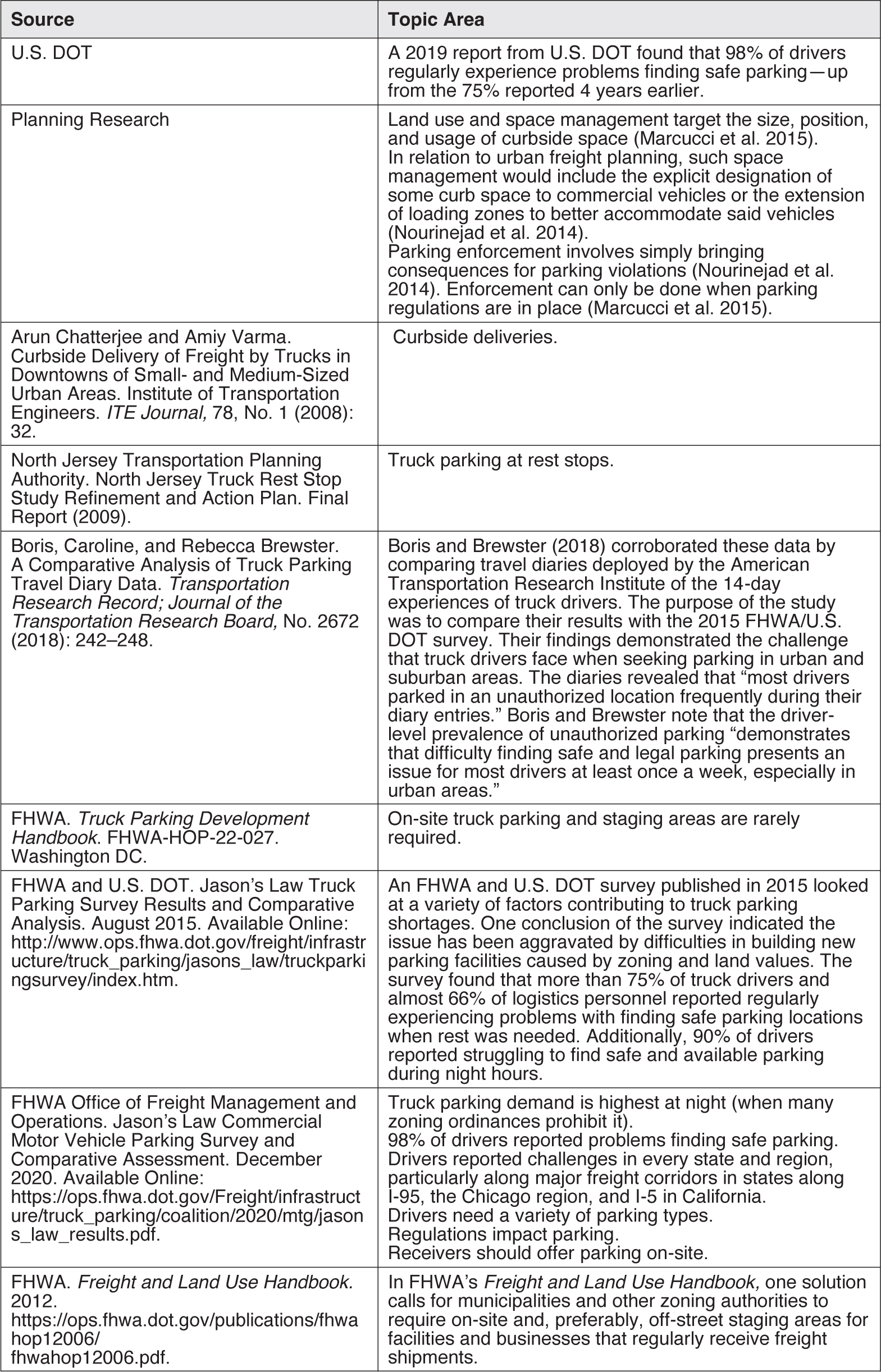
(continued on next page)
Long Description.
The table has 2 columns and 10 rows. Row 1: Source; Topic Area. Row 2: US DOT; A 2019 report from US DOT found that 98 percent of drivers regularly experience problems finding safe parking, up from the 75 percent reported four years earlier. Row 3: Planning Research; Land use and space management target the size, position, and usage of curbside space (Marcucci et al. 2015). In relation to urban freight planning, such space management would include the explicit designation of some curb space to commercial vehicles or the extension of loading zones to better accommodate said vehicles (Nourinejad et al. 2014). Parking enforcement involves simply bringing consequences for parking violations (Nourinejad et al. 2014). Enforcement can only be done when parking regulations are in place (Marcucci et al. 2015). Row 4: Arun Chatterjee PHD, PE, and PHD Amiy Varma; Curbside delivery of freight by trucks in downtowns of small and medium-sized urban areas. Institute of Transportation Engineers, ITE Journal 78, no. 1 (2008): 32, Curbside deliveries. Row 5: North Jersey Transportation Planning Authority. North Jersey Truck Rest Stop Study Refinement and Action Plan. Final Report (2009); Truck parking at rest stops. Row 6: Boris, Caroline and Rebecca Brewster; A comparative analysis of truck parking travel diary data. Transportation Research Record, Journal of the Transportation Research Board, No. 2672 (2018): p. p. 242 to 248. Boris and Brewster (2018) corroborated these data by comparing travel diaries deployed by the American Transportation Research Institute of the 14-day experiences of truck drivers. The purpose of the study was to compare their results to the 2015 FHWA or US DOT survey. Their findings demonstrated the challenge that truck drivers face when seeking parking in urban and suburban areas. The diaries revealed that most drivers parked in an unauthorized location frequently during their diary entries. Boris and Brewster note that the driver-level prevalence of unauthorized parking demonstrates that difficulty finding safe and legal parking presents an issue for most drivers at least once a week, especially in urban areas. Row 7: FHWA, Truck Parking Development Handbook, FHWA H O P 22 0 2 7; Washington DC: Federal Highway Administration: On-site truck parking and staging areas are rarely required. Row 8: Federal Highway Administration and US DOT. Jason’s Law Truck Parking Survey Results and Comparative Analysis. August 2015. Available Online: h t t p colon double slash w w w dot o p s dot f h w a dot d o t dot gov slash freight slash infrastructure slash truck underscore parking slash jasons underscore law slash truckparking survey slash index dot h t m; An FHWA and US DOT survey published in 2015 looked at a variety of factors contributing to truck parking shortages. One conclusion of the survey indicated the issue has been aggravated by difficulties in building new parking facilities caused by zoning and land values. The survey found that more than 75 percent of truck drivers and almost 66 percent of logistics personnel reported regularly experiencing problems with finding safe parking locations when rest was needed. Additionally, 90 percent of drivers reported struggling to find safe and available parking during night hours. Row 9: FHWA Office of Freight Management and Operations, Jason’s Law, Commercial Motor Vehicle Assessment, December 2020; Available Online: h t t p s colon double slash o p s dot f h w a dot d o t dot gov slash Freight slash infrastructure slash truck underscore parking slash working groups slash 2020 slash m t g slash m t g 1 2 0 1 2 0 2 0 underscore jasons underscore law dot h t m. Truck parking demand is highest at night, when many zoning ordinances prohibit it. 98 pecent of drivers reported problems finding safe parking. Drivers reported challenges in every state and region, particularly along major freight corridors in states along I 95, the Chicago region, and I 5 in California. Drivers need a variety of parking types. Regulations impact parking. Receivers should offer parking on-site. Row 10: FHWA, Freight and Land Use Handbook, 2012; h t t p s colon double slash o p s dot f h w a dot d o t dot gov slash publications slash f h w a hop 1 2 0 0 6 dot p d f. In FHWA’s Freight and Land Use Handbook, one solution calls for municipalities and other zoning authorities to require on-site and preferably off-street staging areas for facilities and businesses that regularly receive freight shipments. (Table B.3 continued.)
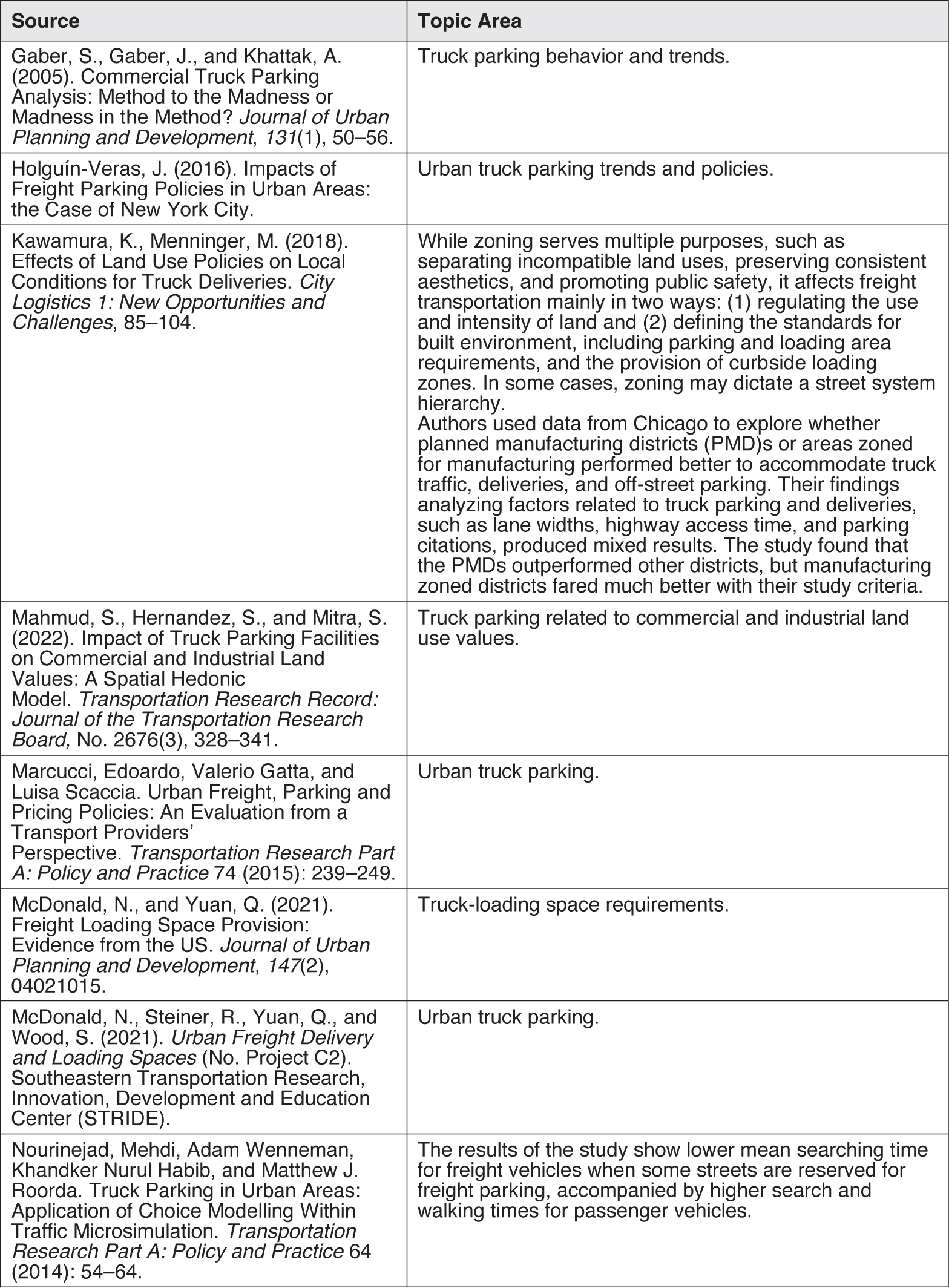
Long Description.
The table has 2 columns and 9 rows. Row 1: Source; Topic Area. Row 2: Gaber, S., Gabel, J., and Khattak, A. (2005). Commercial truck parking analysis: Method to the Madness or Madness in the Method? Journal of Urban Planning and Development, 131 (1), 50 to 56; Truck parking behavior and trends. Row 3: Holguin-Veras, J. (2016). Impacts of freight parking policies in urban areas: The case of New York City. Urban truck parking trends and policies. Row 4: Kawamura, K., and Menninger, M. (2018). Effects of Land Use Policies on Local Conditions for Truck Deliveries. City Logistics 1: New Opportunities and Challenges, 85 to 104. While zoning serves multiple purposes such as separating incompatible land uses, preserving consistent aesthetics, and promoting public safety, it affects freight transportation mainly in two ways: (1) regulating the use and intensity of land and (2) defining the standards for built environment including parking and loading area requirements, and the provision of curbside loading zones. In some cases, zoning may dictate a street system hierarchy. Authors used data from Chicago to explore whether PMDs or areas zoned for manufacturing performed better to accommodate truck traffic, deliveries, and off-street parking. Their findings analyzing factors related to truck parking and deliveries, such as laned widths, highway access time, and parking citations, produced mixed results. The study found that the P M Ds outperformed other districts, but manufacturing zoned districts fared much better with their study criteria. Row 5: Mahmud, S., Hernandez, S., and Mitra, S. (2022). Impact of Truck Parking Facilities on Commercial and Industrial Land Values: A Spatial Hedonic Model. Transportation Research Record, Journal of the Transportation Research Board, No. 2676, p. p. 328 to 341; Truck parking related to commercial and industrial land use values. Row 6: Marcucci, Edoardo, Valerio Gatta, and Luisa Scaccia. Urban freight, parking and pricing policies: An evaluation from a transport providers’ perspective. Transportation Research Part A: Policy and Practice 74 (2015): 239 to 249; Urban truck parking. Row 7: MacDonald, N., and Yuan, Q. (2021). Freight loading space provision: Evidence from the US. Journal of Urban Planning and Development, 147 (2), 0 4 0 2 1 0 1 5.; Truck loading space requirements. Row 8: McDonald, N., Steiner, R., Yuan, Q., and Wood, S. (2021). Urban Freight Delivery and Loading Spaces (No. Project C 2). Southeastern Transportation Research, Innovation, Development and Education Center (STRIDE); Urban truck parking. Row 9: Nourinejad, Mehdi, Adam Wenneman, Khandker Nurul Habib, and Matthew J. Roorda. Truck parking in urban areas: Application of choice modelling within traffic microsimulation. Transportation Research Part A: Policy and Practice 64 (2014): 54 to 64; The results of the study show lower mean searching time for freight vehicles when some streets are reserved for freight parking, accompanied by higher search and walking times for passenger vehicles. (Table B.3 continued.)
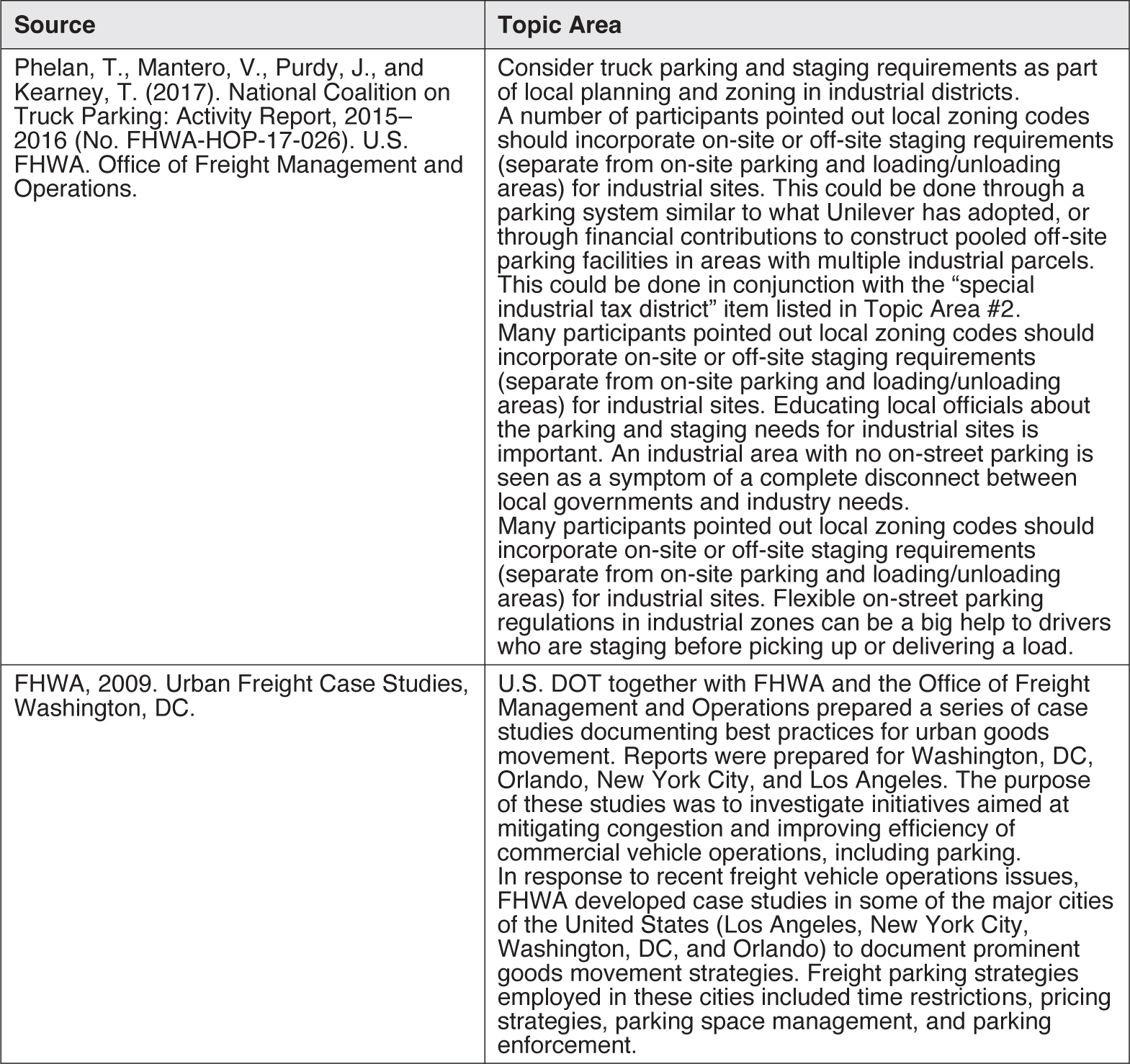
Long Description.
The table has 2 columns and 3 rows. Row 1: Source; Topic Area Row 2: Phelan, T., Mantero, V., Purdy, J., and Kearney, T. (2017). National Coalition on Truck Parking: Activity Report, 2015 to 2016 (No. FHWA H O P 17 0 2 6). United States. Federal Highway Administration. Office of Freight Management and Operations; Consider truck parking and staging requirements as part of local planning and zoning in industrial districts. A number of participants pointed out local zoning codes should incorporate on-site or off-site staging requirements (separate from on-site parking and loading/unloading areas) for industrial sites. This could be done through a parking system similar to what Unilever has adopted, or through financial contributions to construct pooled off-site parking facilities in areas with multiple industrial parcels. This could be done in conjunction with the special industrial tax district item listed in Topic Area number 2. Many participants pointed out local zoning codes should incorporate on-site or off-site staging requirements (separate from on-site parking and loading/unloading areas) for industrial sites. Educating local officials about the parking and staging needs for industrial sites is important. An industrial area with no on-street parking is seen as a symptom of a complete disconnect between local governments and industry needs. Many participants pointed out local zoning codes should incorporate on-site or off-site staging requirements (separate from on-site parking and loading/unloading areas) for industrial sites. Flexible on-street parking regulations in industrial zones can be a big help to drivers who are staging before picking up or delivering a load. Row 3: Federal Highway Administration, 2009. Urban Freight Case Studies. Federal Highway Administration, Washington, DC. US DOT together with FHWA and the Office of Freight Management and Operations prepared a series of case studies documenting best practices for urban goods movement. Reports were prepared for Washington, DC, Orlando, New York City, and Los Angeles. The purpose of these studies was to investigate initiatives aimed at mitigating congestion and improving efficiency of commercial vehicle operations, including parking. In response to recent freight vehicle operations issues, FHWA developed case studies in some of the major cities of the United States (Los Angeles, New York City, Washington, DC, and Orlando) to document prominent goods movement strategies. Freight parking strategies employed in these cities included time restrictions, pricing strategies, parking space management, and parking enforcement. (Table B.3 completed.)
This page intentionally left blank.


